Key Takeaways
- A backlink worth studying meets three conditions simultaneously: editorial intent, topical adjacency, and contextual placement inside substantive prose rather than footers, sidebars, or undisclosed paid blocks 1, 2.
- Federal agency, faculty resource, trade press, local news, and credentialed association links pass the editorial test because supply-side policy or fact-checking enforces the standard before publication 6, 8.
- Compliance now sits inside link quality: undisclosed sponsored mentions, footer reciprocal swaps, syndicated press release links, and generic resource widgets fail editorial or FTC checks regardless of domain authority 2, 3.
- Multi-location teams should weight outreach toward account-level archetypes that lift the parent domain first, then pursue location-specific links only where local search visibility is the actual bottleneck 10.
The three conditions that separate a real backlink example from a vanity link
Domain rating alone has never been a reliable proxy for link quality, and audits across mature SEO programs keep confirming the same pattern: most underperforming link profiles are stuffed with high-DR placements that fail one or more editorial tests. A backlinks example worth studying meets three observable conditions at once.
The first is editorial intent. The linking site chose to reference the source on its own, without compensation, exchange, or solicitation that would create a material connection under FTC guidance 1. Federal agencies make this concrete: EPA staff are required to develop a written rationale for every external link before it goes live, which is why outbound links from .gov properties are scarce and disproportionately weighted by readers and crawlers alike 6.
The second is topical adjacency. The linking page and the target page share a clear subject relationship a reader could describe in one sentence. Washington State University's faculty linking policy formalizes this point, instructing that external links from university pages "must relate directly to a faculty member's work" 8. When that adjacency is absent, the link reads as decorative regardless of the source's authority.
The third is contextual placement. The link sits inside substantive prose where it supports a specific claim, not in a footer, sidebar widget, sponsored block, or undisclosed paid mention 2. Strip any one of these three conditions and a backlink stops functioning as third-party validation, which is the only thing a backlink was ever supposed to be.
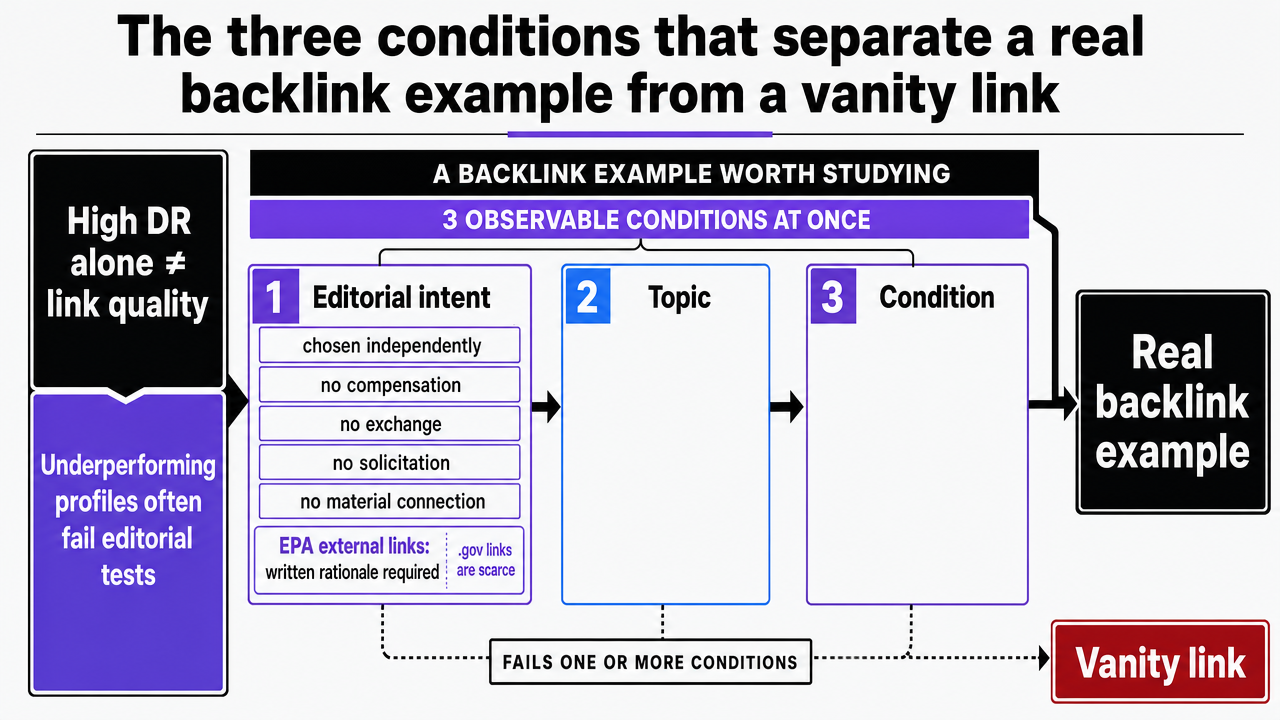 Visualize the three editorial conditions framework introduced in this section as a clear reference diagram
Five backlink archetypes worth studying
The cited research mention from a federal agency
Federal agency links are scarce by design, which is exactly what makes them valuable. The EPA's external linking procedure requires staff to be aware of every outbound link, develop a written rationale for including it, and link to the most appropriate internal page on the external site rather than the homepage 6. That rationale must survive editorial review before publication. The supply of .gov outbound links is therefore constrained at the policy layer, not the technology layer, and no amount of outreach pressure changes that.
A strong example looks like this: a state health department page on opioid prescribing guidance cites a clinical study and links to the specific protocol document on a hospital system's site, not the hospital's homepage. The link sits inside a paragraph that names the source, summarizes the finding, and tells the reader why it matters. Editorial intent is documented in the agency's own procedure. Topical adjacency is explicit. Placement is deep-link, which signals the linker actually read the target rather than dropping a courtesy reference.
Digital.gov reinforces the editorial caution behind these placements by requiring agencies to clearly state that external content is not endorsed by the federal government 7. That disclaimer is sometimes read as a weakness. It is not. The disclaimer exists because the link itself carries enough implied weight that the agency has to actively disown the endorsement reading. Marketers chasing this archetype should pursue substantive primary research, public data sets, or protocols that an agency would have a documented reason to cite.
The faculty resource page link from a university department
Faculty resource pages are the most underrated archetype on the supply side because the editorial bar is set by the institution, not the SEO market. Washington State University's faculty linking guidelines instruct that outbound links from official university pages should be minimal and that all linked content must relate directly to a faculty member's work for the university 8. The same guidelines require disclaimers for personal external sites and a documented professional connection for everything else.
The practical implication is straightforward. A faculty member running a graduate seminar on health systems operations may link to a white paper, dataset, or methodology page that supports a syllabus reading. The link's value is not the .edu suffix. It is the fact that a domain expert publicly attached a course or research program to that resource. Crawlers read that as topical authority. Human readers read it as professional endorsement.
A good example would be a nursing informatics department resource page that links to a published staffing-ratio analysis on a provider organization's research blog, with the link sitting alongside three or four peer-reviewed citations. The wrong example is a faculty bio page with a footer link to an unrelated commercial tool. The latter happens, but it usually disappears at the next site audit because it fails the institution's own policy test.
Link prospecting for this archetype is research-led, not outreach-led. Teams should map syllabi, research center publications, and departmental resource hubs to topics where their own assets are genuinely citable.
The trade press feature with a named source attribution
Trade press links carry weight because the publication's editorial reputation is on the line every time a source is named. A good example is a feature in a healthcare operations trade publication that quotes a named executive or clinician, attributes the insight to a specific organization, and links to the underlying report, case study, or methodology page that supports the quote.
Three elements distinguish the strong examples from the placeholder ones:
- The link points to the specific asset the quote references, not the corporate homepage.
- The anchor text describes the resource rather than the brand.
- The surrounding paragraph attributes the claim to a real person, which the publication's fact-checker had to verify before publication.
That verification step is the editorial filter. Trade editors do not link to sources they cannot stand behind, because their byline carries the cost of a bad citation. When a trade outlet links to a provider's clinical outcomes data, the link is functioning as a footnote in a piece of journalism, which is how search engines were originally designed to interpret citations.
The practical implication for growth teams is that this archetype is earned through subject-matter access, not media lists. Publishing original data, making clinicians available for interviews, and producing the kind of methodology pages a journalist can actually cite generates trade press links as a byproduct. Pitching links directly almost never works, because the editor has no reason to attach their masthead to a source they did not select.
The local news mention tied to a real event or expert quote
Local news links are often dismissed as low-authority compared to national publications, which understates what they actually do. A regional outlet covering a hospital expansion, a community health screening, or a clinician's expert commentary on a public health story produces a link that meets all three editorial conditions: the journalist chose the source, the story is topically aligned, and the link sits in reported prose.
The strongest examples tie to something verifiable in the physical world. A grand opening, a research grant award, a partnership with a school district, or a quoted expert response to a local outbreak. The link points to a page that documents the event or credentials the source, not a generic services page. That specificity is what makes the link defensible during an audit.
For multi-location operators, this archetype scales unevenly. A single regional outlet may cover one location's news and not another's, which produces a fragmented link profile across the portfolio. The fix is not chasing equivalent local coverage for every site. It is recognizing that local news links primarily reinforce local search signals for the specific location named in the story, while the underlying domain authority benefit accrues to the parent. Teams should pursue these links for their geographic precision, not as a substitute for editorial coverage at a higher tier.
The association directory or industry body citation
Association directory listings are the archetype most often confused with low-value link building, because the broader directory category is full of pay-to-play schemes. The distinction comes down to whether the association applies real membership criteria and whether the listing sits inside editorial context rather than a paid tier.
A legitimate example is a specialty medical association's member directory that lists accredited practices with verified credentials, or an industry body's published list of organizations participating in a research consortium. The link is editorial because membership was earned against a standard the association enforces. It is topically adjacent because the directory exists to serve practitioners and patients searching within that specialty.
The wrong version of this archetype is a generic business directory that accepts any submission for a fee, or a sponsored association page where the listing is functionally an ad. The FTC's endorsement framework applies: if the association is compensated for the placement and the relationship is not disclosed, the link carries compliance exposure rather than trust signal 1. Growth teams should map which associations actually credential their members and prioritize those, ignoring directories that monetize listings without any qualification gate.
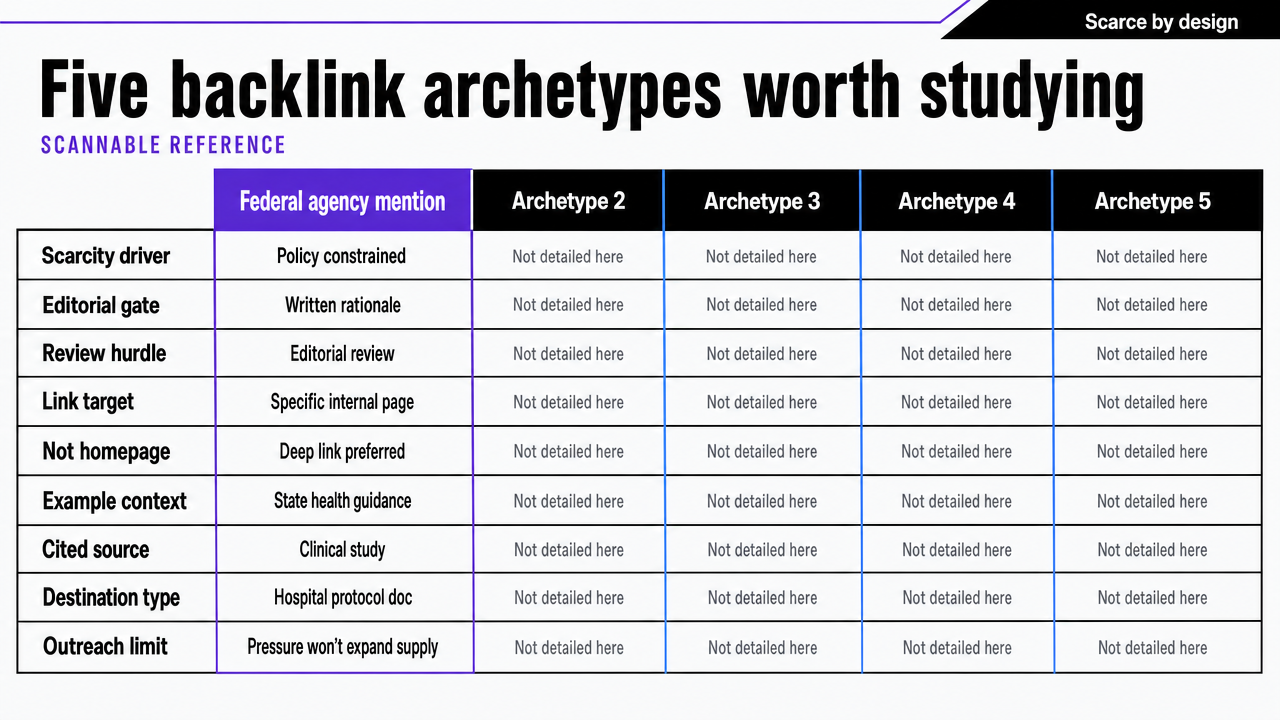 Comparison table of the five backlink archetypes the section profiles, giving readers a scannable reference
Links that look authoritative and fail the test
The harder audit work is not identifying obviously spammy links. It is recognizing the placements that score well on superficial metrics and fail one of the three editorial conditions on closer inspection. Four patterns show up repeatedly in mature portfolios.
The undisclosed sponsored review is the highest-exposure case. A respected industry blog publishes a glowing write-up of a provider's new service line, links to the booking page with branded anchor text, and never indicates that the placement was paid or that products were gifted. The FTC's position is unambiguous: material connections between advertisers and endorsers must be disclosed, and disclosures should be hard to miss and placed with the endorsement message itself rather than buried in a separate page or comment thread 2, 3. A disclosed sponsored mention is a legitimate marketing asset. The same placement without disclosure is a compliance liability that auditors and regulators can find as easily as competitors can.
The footer reciprocal swap is the classic vanity link. Two sites agree to link to each other from sitewide footers, often through a partner widget. The link appears on thousands of pages, which inflates raw backlink counts, but it fails editorial intent (the placement was negotiated, not chosen), topical adjacency (footer links rarely match the page subject), and placement context (footers are not substantive prose). Search engines have devalued this pattern for over a decade.
The syndicated press release link looks like coverage and behaves like a template. A single release distributes the same boilerplate and the same link across dozens of low-edited republishing sites. None of the linking pages applied editorial judgment to the placement, which is why the link reads as bulk distribution rather than third-party validation.
The sidebar widget or resource-list inclusion on an otherwise high-authority site is the most deceptive case. The domain looks strong. The link sits in a generic "Resources" module that the site owner monetizes or populates indiscriminately. There is no surrounding prose, no editorial selection visible to the reader, and often no meaningful relationship between the widget topic and the linked page. A backlink that a reader would not have clicked because it was not part of the article they were reading is not functioning as a citation, regardless of where it lives.
Test Real Backlink Campaigns With Full Access
Validate your backlink strategy by launching and measuring live content during your trial period.
A diagnostic rubric for evaluating any backlink in under a minute
Auditing a backlink profile at the scale of a real growth program means scoring hundreds of placements without reading every linking page in full. The rubric below collapses the prior archetype analysis into four binary checks: editorial intent, topical adjacency, placement context, and FTC exposure. Any link that fails two or more is a candidate for disavow review. Any link that passes all four belongs in the reference set used to brief outreach teams and benchmark new opportunities.
The scoring distribution across common archetypes is uneven in ways that surprise teams running their first structured audit. A federal agency citation typically scores clean across all four conditions because the linking agency had to document its rationale before publication 6. A faculty resource page scores clean when the institution's policy ties the link to a faculty member's actual work 8. A trade press feature with a named source attribution and a deep link to the cited asset scores clean, as does a local news mention tied to a verifiable event. An association directory scores clean only when membership reflects a credentialing standard rather than a paid tier.
The failure cases score the way the editorial conditions predict. An undisclosed sponsored post fails FTC exposure outright and usually fails editorial intent, because the placement was purchased rather than chosen 1, 2. A footer reciprocal swap fails editorial intent, topical adjacency, and placement context simultaneously, which is why it represents almost no signal even at high domain authority.
The operational use of this rubric is portfolio triage. Score every link in the existing profile against the four checks, sort by failure count, and the disavow shortlist writes itself. Use the clean-scoring examples as the template for outreach briefs, because they describe what the linking site's editorial logic already accepts rather than what the receiving team wishes were true.
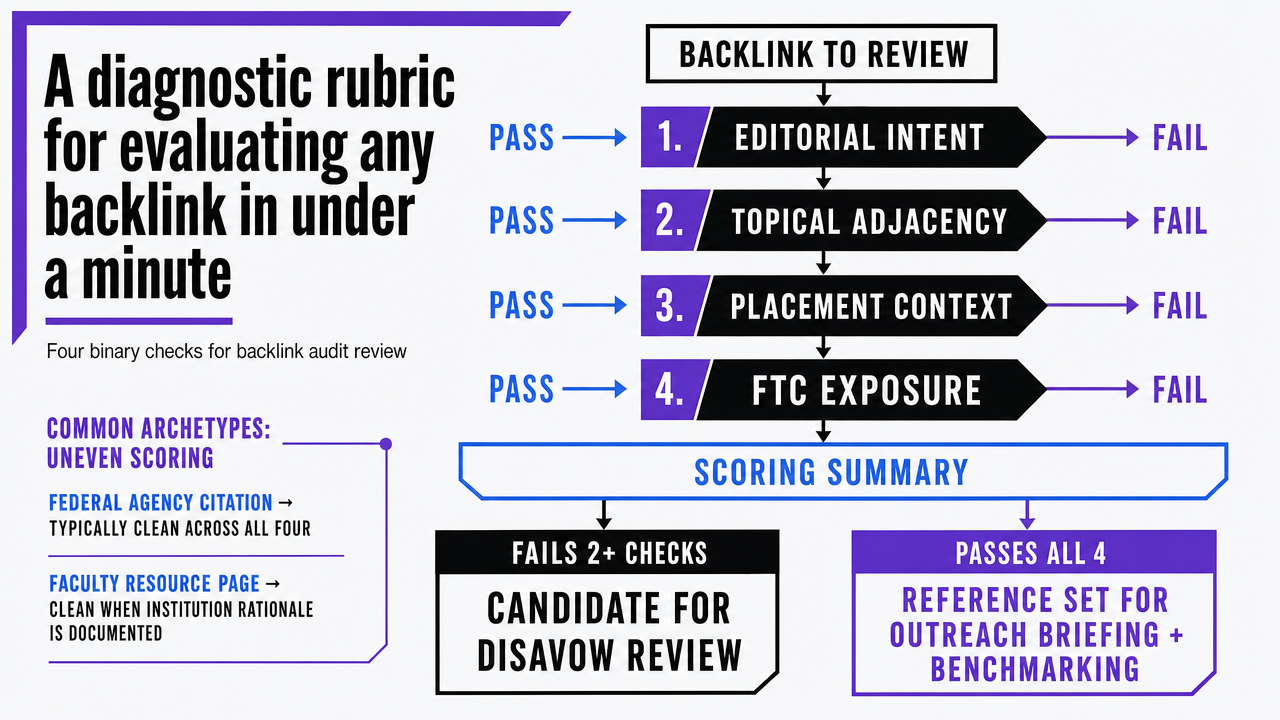 Operationalize the four-check diagnostic rubric described in this section as a decision flow
Compliance is now part of link quality
Five years ago, an SEO audit and a regulatory audit ran on separate tracks. That separation no longer holds. The FTC's endorsement framework treats a link inside a sponsored mention the same way it treats the endorsement language around it: if the placement was compensated or the reviewer received free products, services, or other consideration, the material connection must be disclosed in a way that is hard to miss 1, 2. The disclosure has to sit with the endorsement itself, not on a separate policy page, a comment thread, or a hover tooltip 2.
What changed operationally is the surface area. Influencer placements, creator partnerships, affiliate reviews, gifted-product write-ups, and PR-arranged contributor pieces all generate backlinks that look editorial to a crawler and look like endorsements to a regulator. The 2009 guides established the baseline that material connections between advertisers and endorsers must be disclosed 3. The FTC's ongoing FAQ resource has extended that baseline into the specifics of compensated reviewers, gifted products, and platform-native disclosure tools 4. None of this prohibits paid placements. It conditions them on disclosure that a reader can actually see.
The practical implication for backlink audits is that every link tied to a commercial relationship needs a documented disclosure check alongside the editorial-quality check. A disclosed sponsored link is a legitimate asset that simply does not pass PageRank under standard rel attributes. An undisclosed one is a compliance finding that sits in the same database competitors and regulators can scrape. Link quality and link legality now share the same shortlist.
See Real-World Backlink Examples That Outperform Industry Benchmarks
Request data-backed backlink samples from enterprise campaigns, including domain authority metrics and proven impact on search performance, designed for agencies managing multi-site or high-volume client portfolios.
If you manage backlinks across multiple locations or service lines
A note on audience scope: this section is written for growth teams whose single SEO program covers many sites, locations, or service lines under one parent brand. The evaluation logic from the prior sections still applies, but attribution and prioritization shift in ways that naive per-location link counts obscure.
The central question is whether a given backlink benefits the parent domain, a specific location page, or only a service-line subfolder. A federal agency citation pointing to a clinical protocol document on the parent domain distributes trust across the entire site architecture, because the linked asset sits in shared editorial territory 6. A local news mention naming one clinic and linking to that location's page reinforces local search signals for that specific geography and does relatively little for the other thirty locations in the portfolio. Both links can be high quality. They are not interchangeable inputs.
The table below frames the trade-off in terms of attribution scope rather than dollar cost, since link prices vary too widely to benchmark from supplied research.
| Link archetype | Attribution scope | Portfolio behavior ||---|---|---|| Federal agency citation to parent research asset | Account-level | One link benefits every location and service line || Trade press feature with deep link to methodology page | Account-level | Reinforces topical authority across the domain || Faculty resource page linking to a parent-domain dataset | Account-level | Compounds with each additional academic citation 8|| Local news mention of one location | Location-specific | Lifts local pack signals for that geography only || Association directory listing per location | Location-specific | Useful if the association credentials each site individually |
The operational implication is that growth teams running multi-location programs should weight outreach budget toward account-level archetypes first, then pursue location-specific links where local search visibility is the bottleneck rather than domain authority. Stanford's credibility guidelines reinforce the reader-side logic: third-party validation builds trust most efficiently when the cited source is visibly authoritative across the whole organization, not just one branch of it 10. Fragmented per-location link building produces a profile that looks busy in a reporting dashboard and underperforms in aggregate ranking lift.
Why third-party validation still matters beyond the algorithm
Search engines were built to imitate how readers assess credibility, not the other way around. Stanford's Web Credibility Project framed this years before backlink economics became an industry: sites earn trust when visitors can verify claims through independent sources, which usually means showing third-party references the reader recognizes 10. A backlink from a federal agency, a university department, or a named industry publication functions as that verification layer for a human reader scanning a page for signs that the organization is real, accountable, and cited by people who would know.
This matters more in healthcare and complex B2B categories than in commodity verticals. Patients researching a procedure, hospital systems evaluating a vendor, and SaaS buyers running diligence all look for external corroboration before they convert. A page that names credentialed sources and is itself cited by credentialed sources reduces the verification work a reader has to do. Crawlers reward the same pattern because they were designed to. Backlink quality and reader trust are not two separate KPIs. They are one signal measured twice.
Frequently Asked Questions
References
- 1.Advertisement Endorsements | Federal Trade Commission.
- 2.Disclosures 101 for Social Media Influencers.
- 3.FTC Publishes Final Guides Governing Endorsements, Testimonials.
- 4.FTC's Endorsement Guides: What People Are Asking.
- 5.Tapping Into SEO: How Government Websites Can Improve Content Findability.
- Procedure: External Site Links | Web Guide - US EPA. https://19january2021snapshot.epa.gov/web-policies-and-procedures/procedure-external-site-links.html
- 7.Required web content and links.
- 8.Guidelines for Faculty for Linking to Personal/Outside Web Content from University Websites.
- 9.Leading Digital Transformation in Health Care.
- 10.Stanford Guidelines for Web Credibility.