
Key Takeaways
- Prospecting databases like Ahrefs and Semrush form the input layer, surfacing qualified referring domains through gap analysis but leaving placement context and anchor decisions to humans downstream.
- Outreach automation tools like Pitchbox handle sequences and reply tracking, but anchor governance must be closed manually through a tracked ledger covering branded, naked URL, partial, and exact match distribution.
- Digital PR engines such as Muck Rack and Featured capture earned placements inside editorial content, scoring high on placement context while accepting low yield and journalist-chosen branded anchors.
- Link-worthy content systems like Clearscope and SurferSEO determine whether acquired links convert into ranking gains, since thin destination pages absorb referring-domain growth without producing position movement.
- AI-coordinated platforms like Vectoron sit above the four utility categories, encoding strategist judgment across prospecting, outreach, content, and anchor governance through one account-level plan rather than four dashboards.
Why "Backlinks Generator" Is the Wrong Frame for Replacing an Agency
The query "backlinks generator" implies a button: press it, links appear, rankings move. That product does not exist in any form that survives Google's link spam policies, and the tools sold under that label tend to push automated directory submissions, comment injection, or private blog network placements that put YMYL sites at outsized risk. For a SaaS growth lead or multi-location healthcare operator already paying a retainer, the more useful question is which category of tooling actually performs the work an agency performs.
The peer-reviewed literature frames inbound links as one of four determinant components of an SEO strategy, alongside niche differentiation, content quality, and technical factors 1. A single generator addresses none of those four in isolation. Agencies, when they earn their fee, coordinate prospecting, outreach, placement context, anchor distribution, and reporting — five operational functions, not one mechanical output.
Replacing that coordination requires a stack. The five categories evaluated in this piece map to the actual jobs an agency performs: a prospecting database to surface qualified referring domains, an outreach automation layer to manage sequences and anchor governance, a digital PR engine to capture earned placements through journalist requests, a content system to make destination pages worth linking to, and a coordinating layer — increasingly AI-driven — that runs the playbook continuously.
The scoring rubric introduced in the next section measures each option against what an agency retainer actually buys: prospect quality, placement context, anchor governance, reporting depth, and cost efficiency. "Generator" is the wrong noun. "Stack" is the right one.
What an Agency Actually Delivers: A Five-Criteria Operator Rubric
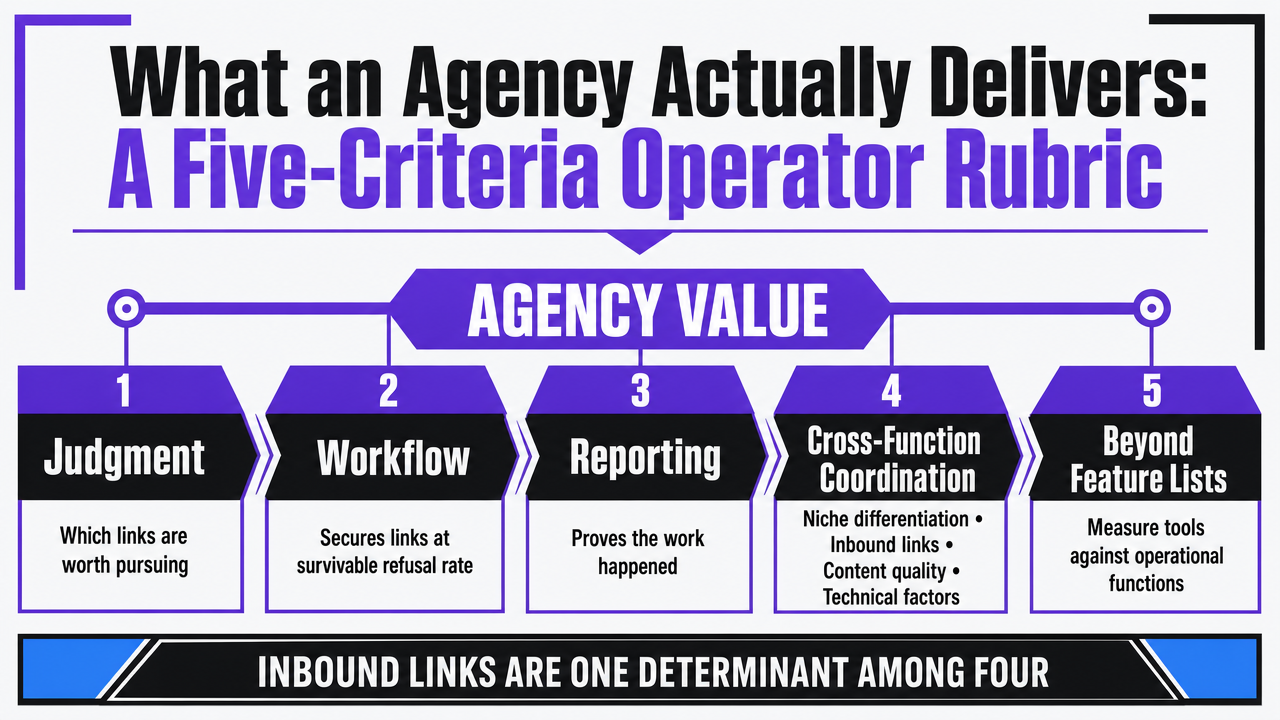
A link-building retainer is not paying for links. It is paying for the judgment that decides which links are worth pursuing, the workflow that secures them at a survivable refusal rate, and the reporting that proves the work happened. Any tool stack that aims to replace that retainer must be measured against those operational functions, not against a feature list.
The peer-reviewed SEO literature reinforces why a single mechanical output cannot stand in for that judgment. The review by Asaad et al. identifies four major components of an SEO strategy — niche differentiation, inbound links, content quality, and technical factors — and treats inbound links as one determinant among four rather than a freestanding lever 1. An agency's value lives in the coordination across those four, not in the link count alone.
The five-criteria rubric used through the rest of this article scores each tool category against what that coordination actually requires:
- Prospect quality. Whether the tool surfaces referring domains with topical relevance and defensible authority, not just high DR scores attached to thin sites.
- Placement context. Whether links land inside genuinely relevant editorial content, or get buried in resource pages, footers, and link roundups that pass minimal equity.
- Anchor governance. Whether the workflow tracks anchor distribution across campaigns to avoid over-optimization patterns that trigger algorithmic suppression.
- Reporting depth. Whether placements, lost links, and referring-domain growth are tracked at the account level with enough granularity to defend the spend.
- Cost efficiency. Whether the per-placement cost, including internal hours, compares favorably to the agency baseline being replaced.
Tools that score on one or two criteria are utilities. Tools that score on four or five are functioning as part of the replacement stack. The next section evaluates each category against the rubric in that order.
 Visualize the five-criteria operator rubric introduced in this section so readers can reference the scoring dimensions used throughout the rest of the article
Test Autonomous Backlink Generation on Live Campaigns
Validate link-building impact by publishing real content and analyzing measurable SEO gains within your own environment.
The Five Categories That Replace Agency Output
Prospecting Databases: Ahrefs, Semrush, and the Referring-Domain Layer
Every link campaign starts with a list. Whether that list is 200 referring domains or 2,000, its quality determines the ceiling on everything downstream — outreach reply rates, placement context, the eventual anchor profile. Prospecting databases like Ahrefs and Semrush are the layer where that list gets built, and they are the closest analog to what a junior agency strategist does in their first two weeks on an account.
The peer-reviewed evidence for treating referring-domain quality as the foundational input is concrete. The Moodle/Central Asia SEO study found that backlinks, Alexa Rank, and PageRank had a direct and significant relationship with visibility metrics in the educational-platform context it examined 8. The scope is narrow — one vertical, one region — but the directional finding survives translation: when authority signals correlate with visibility, the database that surfaces those authoritative referring domains becomes the highest-leverage seat in the stack.
Against the operator rubric, prospecting databases score strongly on prospect quality and reporting depth. Ahrefs' Link Intersect and Semrush's Backlink Gap surface domains linking to two or three competitors but not to the target — the closest thing to a qualified prospecting list a tool can produce without human judgment. Both export referring-domain growth and lost-link tracking at the account level, which covers the reporting criterion that agencies usually bury in PDF decks.
Placement context and anchor governance score lower. A database surfaces candidates; it does not control where the link lands inside the article or how the anchor reads. Treat this category as the input layer, not the output layer. Without it, the rest of the stack has nothing qualified to act on.
Outreach Automation: Pitchbox and the Anchor Governance Problem
Outreach automation is where most in-house stacks break. Pitchbox, BuzzStream, and Respona handle sequence delivery, reply detection, and CRM-style tracking, but the operational hard part is not sending the emails. It is governing the anchor text across hundreds of placements so the resulting profile does not trip algorithmic suppression.
A reasonable outreach workflow paralleling academic search rigor would specify the prospecting criteria, the personalization variables, the anchor distribution targets, and the disqualification rules before a single email goes out — the same way a systematic review predefines its search strategy to be specific, unbiased, and reproducible 2. Most agencies skip that documentation step and rely on the strategist's memory. Most in-house teams replacing an agency skip it too, then wonder why their anchor profile drifts toward exact-match within a quarter.
Pitchbox scores well on workflow depth: sequences, opportunity scoring, integration with Ahrefs and Moz for live authority metrics, and reporting that surfaces placement velocity at the account level. Its weakness against the rubric is anchor governance. The tool tracks what was sent, not what the publisher ultimately published or how the anchor reads in context. That gap has to be closed manually with a tracked anchor ledger — a spreadsheet, ideally, with target distribution percentages for branded, naked URL, partial match, and exact match anchors.
For a SaaS growth team, a Pitchbox seat plus a dedicated outreach specialist running 40–60 hours per month is roughly the minimum viable replacement for the outreach function of a mid-tier agency. The anchor ledger is non-negotiable. Without it, the stack delivers volume without governance, which is the failure mode that gets healthcare and YMYL sites penalized fastest.
Digital PR Engines: Muck Rack, Featured, and HARO-Style Request Flow
Digital PR is the category where earned placements live — the links that come from being quoted in an article rather than asking to be linked from one. Muck Rack provides journalist databases and pitch tracking. Featured (the renamed Terkel) and Qwoted run the structured request flow that replaced HARO after its 2024 shutdown. Connectively, the HARO successor briefly run by Cision, has effectively ceded that lane.
The placement context here is structurally different from cold outreach. When a journalist at a trade publication includes a source quote, the link sits inside editorial content the publisher already planned to write, which scores high on placement context and on the kind of topical relevance that academic SEO literature treats as a quality signal alongside the link itself 3. The cost per placement is internal time spent writing pitches, not a fee paid to a publisher.
The weakness is yield. A reasonable Featured workflow at 10–15 pitches per week converts to one or two published placements per month for most operators, with topical relevance varying widely. Muck Rack adds proactive pitching to specific reporters, which improves the relevance variable but raises the hours required. Anchor governance is essentially zero — the journalist chooses the anchor, which is almost always branded or naked URL. That is a feature for profile diversification, not a bug.
For SaaS operators, this category replaces the digital PR retainer line item, typically the most expensive single deliverable on an agency contract. It does not replace the broader link-acquisition function. Treat it as the placement-context anchor of the stack, paired with the prospecting and outreach layers above it.
Link-Worthy Content Systems: Clearscope, SurferSEO, and the Destination Quality Layer
A link is only as useful as the page it points to. The diabetic retinopathy SEO study found that search visibility in that medical context was tied to readability and website design quality, not just inbound link counts 5. The implication for any link-replacement stack is direct: the destination page has to earn the ranking lift the link is trying to produce, or the campaign converts referring domains into nothing.
Clearscope and SurferSEO sit in the content-optimization layer of the stack. Both grade draft content against the top-ranking pages for a target query, surfacing entity coverage, heading structure, and readability gaps. MarketMuse extends the same logic to topical authority modeling across a site. Frase compresses the brief-and-draft workflow into a single interface. The job-to-be-done is not writing the content — it is making sure the destination has enough on-page signal that an acquired link has something to lift.
Against the rubric, this category scores on a criterion the others cannot touch: it determines whether the rest of the stack produces ranking outcomes or just referring-domain growth. A site with thin destination pages can accumulate links for two quarters and watch nothing happen in Search Console. A site with well-structured, comprehensive destination content converts the same link volume into measurable position gains.
For most operators, the content-system seat costs less than a single mid-tier agency placement and runs continuously. The hard part is the editorial workflow around it — subject-matter input, fact-checking, internal linking — which is where the next category, AI coordination, starts to matter. Without destination quality, the link stack is acquiring assets that point at pages incapable of using them.
AI-Coordinated Strategy Platforms: Where Vectoron Fits
The four categories above are utilities. Each one performs a discrete job, and each one requires a human strategist to coordinate the outputs into something resembling an agency's continuous workflow. The coordination layer is the operational gap a single-tool subscription cannot close, and it is the category where AI-driven platforms have started to compete directly with the agency model rather than supplementing it.
The job-to-be-done at this layer is the strategist's playbook: read the current backlink profile, identify referring-domain gaps against competitors, prioritize prospecting lists by topical authority overlap, govern anchor distribution across active campaigns, brief content destinations against acquired link intent, and report placement velocity at the account level. That sequence is what a senior agency strategist runs every week. Tools like Vectoron, which assigns specialist AI strategists to content, SEO, and backlink functions and coordinates them through a single account-level plan, sit in that coordination role rather than in any individual category above.
Against the rubric, coordinated platforms score by stitching the criteria together rather than maxing any single one. Prospect quality depends on the underlying database integrations. Placement context depends on whether the outreach layer hands off to a content layer that can build a worthy destination. Anchor governance becomes enforceable when one system tracks the entire campaign rather than three separate dashboards.
The honest tradeoff: coordinated platforms are newer than Ahrefs or Pitchbox, and the strategist judgment they encode varies by vendor. Operators evaluating this category should ask which functions are actually executed inside the platform versus surfaced as recommendations, and how anchor and placement decisions get reviewed before they go live.
Stack Economics: Agency Retainer vs. In-House Tooling vs. AI Coordination
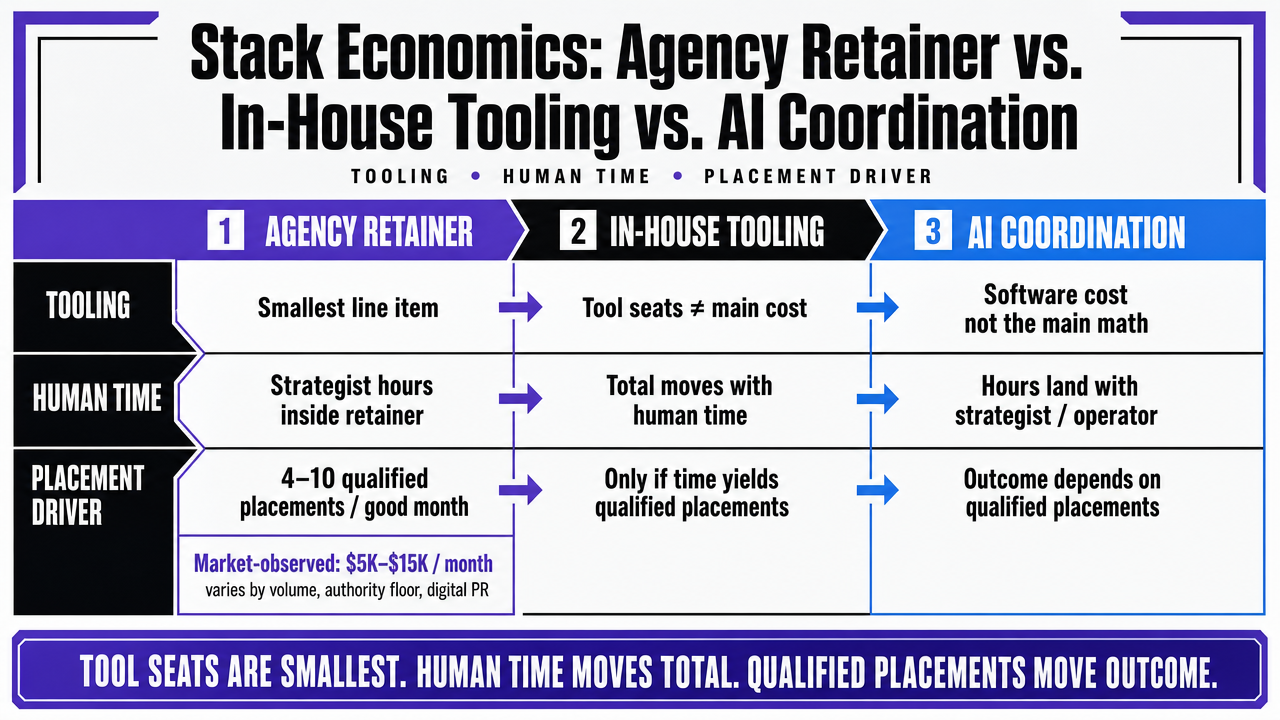
The math behind replacing a link-building retainer is less about software cost and more about where strategist hours land. Tool seats are the smallest line item in any honest comparison. The variable that moves the total is human time — and the variable that moves the outcome is whether that time produces placements an agency would call qualified.
Market-observed retainers for link-building agencies serving SaaS and multi-location healthcare operators typically range from $5,000 to $15,000 per month, depending on placement volume, target authority floor, and whether digital PR is included. That range is observed across vendor proposals, not drawn from a sourced study, and it varies widely by vertical. What it buys, on a good month, is roughly 4–10 placements on referring domains the agency considers worth the spend, plus the strategist coordination that academic SEO literature treats as part of a broader structured investment in domain authority and link acquisition 3.
The in-house alternative is a variable equation, not a fixed number. The components:
| Model | Tooling | Human Time | Placement Driver |
|---|---|---|---|
| Agency retainer | Bundled | ~2–4 internal review hours/mo | Agency strategist judgment |
| In-house stack | X prospecting seats + Y outreach seats + content optimization seat | H strategist hours + outreach specialist hours + Z freelance PR placements/mo | Internal playbook discipline |
| AI-coordinated platform | Single account-level subscription | Approval and editorial review hours | Encoded strategist logic + human approval |
Plugging real numbers in matters more than the table itself. A two-seat prospecting and outreach stack with one part-time specialist running 60 hours a month, plus three to four freelance-pitched PR placements, lands well under the low end of the agency range on tooling but consumes meaningful internal management. The coordinated platform line collapses the management overhead at the cost of ceding some judgment to the system. None of these lines is universally cheaper. The right answer depends on how many strategist hours the growth team already has to give.
 Translate the comparison table in this section into a scannable visual so operators can compare the three models on tooling, human time, and placement driver at a glance
See How Top Teams Automate Backlink Acquisition—No Manual Outreach Needed
Request a walkthrough of enterprise-grade AI backlink generators replacing traditional agency link-building—benchmark real performance, cost, and workflow advantages for multi-site or high-growth brands.
Healthcare and YMYL: When the Rubric Tightens
The rubric described above applies to any growth team replacing a link-building retainer. For multi-location healthcare operators, dental groups, derm chains, and other YMYL footprints, three of the five criteria stop being adjustable dials and start being pass/fail gates. The category the agency was hired to deliver — qualified, contextually relevant placements on authoritative domains — is the only category that survives Google's quality assessment for medical content. Volume tactics that survive in adjacent verticals do not survive here.
The medical-marketing review of digital tactics for private practice found that in the study it cited, backlinks were the highest-correlated factor for first-page results in the medical context examined 10. The scope is narrow — private practice digital marketing, not multi-location enterprise — but the directional finding sharpens the rubric: in medical search, the link signal carries more weight, which means the quality threshold for each acquired link carries more weight too. A link from a regional health system's resource page outperforms ten links from generic business directories, and the gap widens in YMYL classification.
The academic literature on healthcare digital marketing also frames link acquisition as a byproduct of reputation, content usefulness, and trust signals rather than as an outreach output 6. That framing changes which tools in the stack get prioritized. Digital PR engines and link-worthy content systems move up the priority list. Aggressive cold-outreach automation moves down, because the placements it produces — guest posts on low-authority blogs, link inserts on tangentially related sites — fail the topical relevance bar that medical search applies more strictly than commercial search.
The compliance posture matters too. NIST's healthcare cybersecurity guidance reinforces the regulatory environment medical operators work inside 7, which spills over into vendor selection: outreach tools that scrape patient-facing sites, AI systems that ingest PHI-adjacent content, and any tactic that violates link spam policies carry reputational risk that an agency would absorb but an in-house team owns directly. For multi-location healthcare operators, the rubric tightens to three non-negotiables: every referring domain must clear a topical-authority bar, every placement must sit inside genuinely medical or adjacent editorial context, and every anchor must skew toward branded or naked URL to avoid the over-optimization patterns that medical search penalizes faster than other verticals.
Choosing the Combination: Two Operator Scenarios
SaaS Growth Team Replacing a $10K Retainer
A $10K agency line typically funds prospecting, outreach, and a thin layer of digital PR. A SaaS team replacing it can run the same workload on a prospecting database seat, a Pitchbox-class outreach seat, and a content-optimization seat, paired with one outreach specialist at 50–70 hours per month and a part-time strategist owning the anchor ledger. That structure preserves the four SEO determinants — niche differentiation, inbound links, content quality, and technical factors — that the peer-reviewed literature identifies as co-equal inputs 1.
The unlock is not cost. Tooling lands well under the retainer; specialist hours absorb the rest. The unlock is governance: anchor distribution, placement context, and lost-link tracking move in-house, which means the growth lead sees the work weekly instead of in a monthly deck.
If You Manage Multiple Locations or Practices
Scope changes when the account covers eight dermatology clinics or twenty dental offices instead of one product site. Per-location agency billing compounds fast, and most retainers were not designed to coordinate link acquisition across a shared brand with location-specific service pages. The job becomes routing authority signals to the right destination — a city page, a service-line hub, a provider bio — without diluting the anchor profile across the footprint.
The medical-marketing review found that in the study it cited, backlinks were the highest-correlated factor for first-page results in that medical context 10. For multi-location operators, that finding sharpens the prioritization: a coordinated platform that runs one account-level plan across all locations beats stacking individual tools, because the anchor ledger and topical-authority overlap have to be governed once, not per site.
Frequently Asked Questions
References
- 1.Search engine optimisation (SEO) strategy as determinants to increase web visibility.
- 2.Systematic Reviews: 4. Search Terms & Strategies.
- 3.The Significant Role of SEO in Effective Web Marketing.
- 4.Visibility of Moodle applications in Central Asia: analysis of SEO.
- 5.Search engine optimization and its association with readability and website design in diabetic retinopathy websites.
- 6.Digital Marketing for Private Practice: How to Attract New Patients.
- 7.NIST Updates Guidance for Health Care Cybersecurity.
- 8.Visibility of Moodle applications in Central Asia: analysis of SEO - PMC.
- 9.Search engine optimization and its association with readability and website design in diabetic retinopathy websites - PMC.
- 10.Digital Marketing for Private Practice: How to Attract New Patients.