Key Takeaways
- The referring page, not the domain or the tool that surfaced it, is the correct unit of analysis when evaluating a backlink prospect 9.
- Authority transmits through a five-axis rubric: editorial intent, topical fit, link-graph position, engaged referral traffic, and institutional credibility—each inspected at the page level.
- High Domain Rating does not rescue off-topic roundups, stale resource pages, or syndicated press wires, because spam controls and quality signals discount those patterns aggressively 11.
- Strategists should build shorter, defensible prospect lists scored page by page, and decide deliberately when one editorial relationship serves many location pages versus when local links are required 6.
The term 'backlinks website' is misread—here's what operators actually mean
Search the phrase "backlinks website" and the results split into two unrelated piles: vendors selling link inventory, and tools that audit existing link profiles. Neither matches the question growth leaders actually ask when they type it into a search bar.
The real question is more specific. Which referring pages are worth a link from, and how can a strategist tell before spending outreach hours or budget on the prospect? The unit of analysis is not a tool, a marketplace, or a domain rating dashboard. It is the page that will eventually contain the link 9.
That reframe matters because the evaluation criteria shift entirely. A vendor question gets answered with pricing and turnaround. A referring-page question gets answered with editorial intent, topical fit, link-graph position, engagement, and credibility—signals rooted in how link-based ranking models actually weigh authority 3. Growth leaders running internal programs or managing agencies already know the tool landscape. What separates the teams getting compounding returns from the teams burning cycles is a disciplined view of which referring pages deserve a slot on the prospect list, and which look promising on a metrics screen but will not move the work forward.
Working definition: the referring page is the unit of analysis
A backlink is an incoming link to a target page from an external page elsewhere on the web 9. That definition sounds simple, but it locates the evaluation problem precisely: the object under inspection is the external page, not the domain it lives on, not the tool that surfaced it, and not the anchor text wrapped around the link.
Domain-level thinking obscures more than it reveals. A respected publication can run a thin syndicated post that no editor touched, and a niche industry blog can publish a tightly researched piece read by exactly the audience a growth team wants to reach. The page carries the signal. The domain carries an average.
Framing the referring page as the unit of analysis changes what a strategist actually examines. Instead of accepting a domain rating at face value, the work becomes inspecting one page at a time for editorial intent, surrounding topical context, outbound link patterns, and whether the page itself has earned attention. That page-level discipline is what separates prospect lists that compound into ranking gains from prospect lists that produce links nobody reads.
Why authority is a property of the linking page, not the link count
The mathematical foundation of link-based ranking made this point decades ago, and operators still fight it. PageRank assigns a real number to each page on the web based on link structure, and that number depends on more than how many backlinks point at the page 1. It weighs the rankings of the pages that contain those backlinks 3. A link from a page with high computed authority transmits more signal than a link from a page with low computed authority, and the difference is not linear. It compounds.
The practical implication is straightforward. One link from a referring page that itself sits in a dense neighborhood of trusted, topically aligned sources can outweigh dozens of links from pages that nobody else cites. Survey work on link analysis describes the same dynamic: links from authoritative pages significantly influence the perceived importance of target pages in graph-based models 11. Counts flatten that distinction. Weighted authority preserves it.
There is a second layer that growth leaders cannot skip. Link-based models alone are vulnerable to manipulation, which is why search systems layer spam controls and additional quality signals on top of raw link structure 11. That is why a 50-link push from a private blog network, a paid directory, or a syndicated press release blast often produces nothing measurable. The model is not counting links naively. It is asking whether the pages doing the linking look like pages a human editor curated.
This is the spine of every evaluation criterion that follows. When a strategist inspects a prospect page, the question is not "does this page exist and contain a link slot." The question is whether the page itself carries authority worth transmitting, whether the surrounding link graph treats it as a node worth pointing at, and whether the editorial pattern would survive the spam-detection layer sitting on top of the math. Volume targets that ignore those questions buy motion, not ranking.
Test AI-driven link acquisition on real campaigns
Evaluate real backlink placements and content production in your live SaaS or healthcare domains risk-free for 7 days.
The 5-axis rubric for scoring a referring page
Editorial intent: did a human decide this link belonged here
Editorial intent is the first filter because it is the cheapest to inspect and the hardest to fake at scale. A strategist reads the paragraph around the link and asks one question: did a working editor or writer choose to include this reference because it served the reader, or did the link appear through a template, a syndication feed, a paid placement disclosure, or a footer widget?
The inspection takes minutes. Editorial links sit inside running prose, point to a specific claim or example, and use anchor text that a writer would naturally pick. Non-editorial links cluster in resource boxes, author bios that repeat across hundreds of posts, sponsored sections labeled as such, or comment fields. Pages that surface links through automated content syndication often carry boilerplate that reads identically across dozens of domains.
This axis matters because search systems layer spam controls on top of raw link counts precisely to penalize patterns that look unedited 11. A link a human placed for a human reader survives that filter. A link inserted by a template does not, regardless of how strong the hosting domain looks on a metrics screen.
Topical fit: does the surrounding page reinforce the same subject
Topical fit measures whether the referring page discusses subject matter adjacent to or overlapping with the target page. A link from a cardiology continuing-education article to a cardiology service page carries more signal than a link from a generic small-business blog, even if the small-business blog reports a higher domain rating.
The inspection method is structural. Strategists scan the page's headline, subheads, internal links, and outbound links. A topically aligned page tends to cite other sources in the same subject cluster. A misaligned page sits in a different neighborhood of the web entirely, and its outbound link patterns reveal that disconnect.
This axis ties directly to how link-based models interpret authority. Links from pages embedded in topically dense networks transmit more weight than links from isolated or off-topic pages, because the surrounding link graph reinforces the subject signal 11. Operators chasing volume routinely accept links from off-topic resource pages and roundups. Those links pass the count test and fail the topical-fit test.
Link-graph position: where the page sits in the network
Link-graph position asks a structural question. Is the referring page itself cited by other pages in the same subject area, and do those citing pages also carry authority? The math behind link-based ranking treats this recursively. PageRank weighs the rankings of the pages that contain a backlink, not just the count of backlinks pointing at the target 3. The same logic applies one layer up: a referring page earns its own authority from the pages linking to it, and that inherited authority is what gets transmitted forward.
The practical inspection is straightforward. Strategists check whether the referring page is referenced by other respected sources in the same field, whether it shows up in curated resource lists maintained by editors rather than scrapers, and whether its own backlink profile reads like a page editors found useful. A high-quality website tends to carry a clear internal link structure and a meaningful set of backlinks from quality sources, and that pattern is visible on inspection 6.
Pages that sit at dead ends of the link graph, with no incoming references from peers, transmit weak signal regardless of their host domain's overall metrics.
Engaged referral traffic: whether the link actually sends humans
A backlink that no human ever clicks is a crawler signal at best. A backlink that sends sessions, scroll depth, and return visits is a ranking signal and a revenue signal at once. The rubric's fourth axis evaluates whether the referring page actually delivers measurable human traffic, because pages that draw real readers transmit stronger evidence of relevance than pages that exist mainly for search crawlers.
Web analytics platforms measure user interactions across large samples of websites, and the engagement metrics they surface—sessions, time on page, scroll depth, return visits—are how strategists confirm that a referring page sends readers rather than bots 8. The inspection method depends on access. When a publisher shares referral data through a partnership, the question answers itself. When access is limited, strategists infer engagement from public signals: comment activity, social shares on the specific article, recency of publication, and whether the page appears in author and topic indexes that drive return readership.
A backlink from a page nobody reads still gets crawled. It rarely moves rankings the way a link from a well-read page does.
Institutional credibility: who stands behind the page
Institutional credibility is the final axis, and it matters disproportionately in regulated verticals. The question is who stands behind the referring page: a named editorial team at a recognized publication, a nonprofit organization, a university department, a government agency, or an anonymous content site with no accountable byline.
Research on credible sources of health information ranks nonprofit and government organizations among the most credible categories, ahead of commercial and social channels 10. For healthcare growth teams, that hierarchy translates directly into prospect-list priorities. A link from a state health department resource page or a patient-advocacy nonprofit transmits trust signals that a commercial directory cannot match, and search systems have spent years tuning quality signals to reward exactly that pattern.
The inspection method is direct. Strategists check the masthead, the about page, the funding disclosures, and whether named editors or clinical reviewers appear on the page. They look for ownership transparency, contact information, and editorial policies. Pages that obscure who is behind them rarely survive deeper credibility review, regardless of their surface-level authority metrics. The five axes do not weight equally across verticals, but in healthcare prospecting, credibility often decides which links earn outreach budget and which do not.
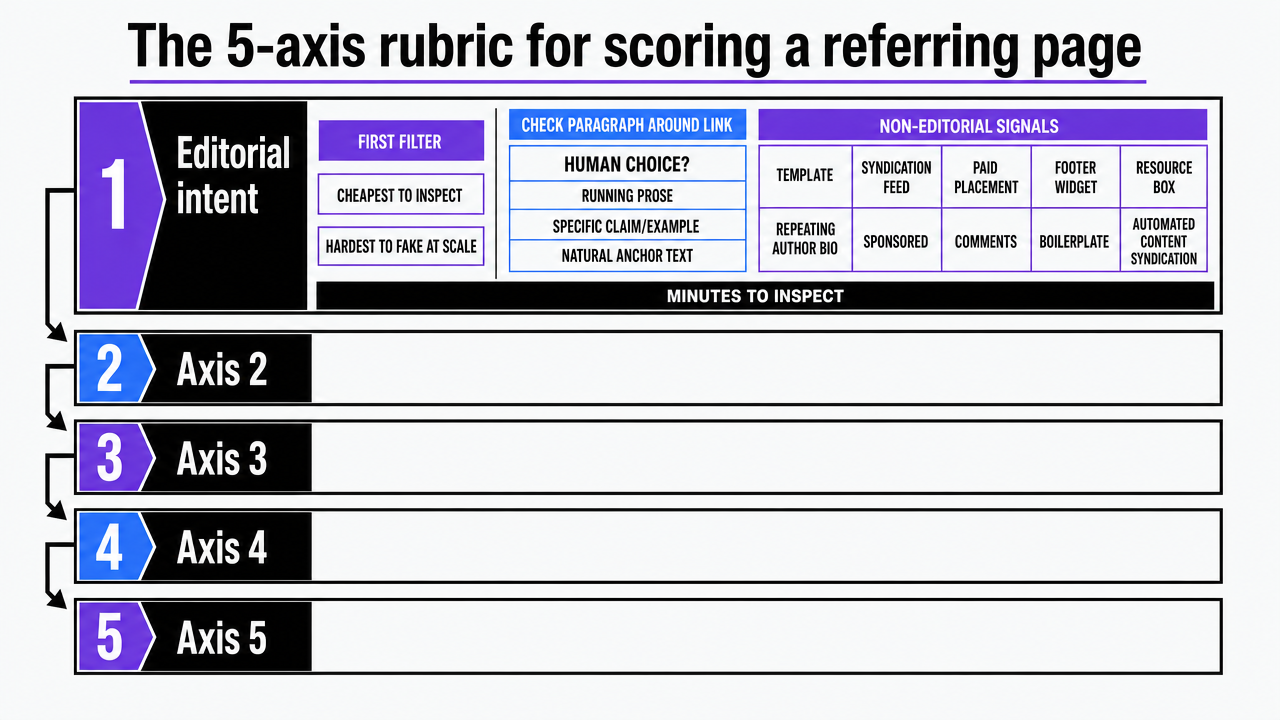 Visualize the five evaluation axes the section defines, giving readers a scannable framework that mirrors the subsection structure
How to inspect a prospect page in under ten minutes
The rubric collapses into a repeatable inspection sequence. A strategist who runs it the same way every time can clear a prospect list of fifty pages in an afternoon and emerge with a defensible keep-or-cut decision on each.
- Start with the page itself, not the domain. Read the paragraph containing the link slot, or the section where a link would belong if the outreach succeeded. Editorial intent reveals itself in the first read: does the prose cite sources because the writer needed evidence, or do links cluster in resource boxes and sponsored disclosures 11?
- Next, scan the headline, subheads, and outbound links for topical fit. A page that links to peers in the same subject cluster sits in a dense neighborhood. A page that links across unrelated verticals does not.
- Check the link-graph position by searching for the page itself. Pages cited by other respected sources in the field carry inherited authority worth transmitting; pages with no incoming references from peers transmit weak signal regardless of the host domain's metrics 6.
- Look for engagement evidence. Comment activity, social shares tied to the specific URL, publication recency, and appearance in author or topic indexes all suggest the page draws return readers rather than crawler traffic alone 8.
- Close with credibility. Masthead, named editors, funding disclosures, and accountable ownership decide whether the page survives deeper review. Pages that obscure who stands behind them get cut.
The failure mode: high-DR links from off-topic, low-engagement pages
The most expensive mistake in link building is buying authority that does not transmit. A page on a Domain Rating 85 publication that covers personal finance and happens to mention a cardiology clinic in a roundup of "healthcare brands to watch" carries less ranking weight than a DR 35 page on a regional medical society site that discusses the same clinical procedure in detail. The math behind link-based ranking explains why. Authority is inherited from the surrounding link graph, and pages embedded in topically dense neighborhoods transmit stronger signal than pages floating in unrelated subject clusters 11.
Three patterns produce this failure mode repeatedly:
- Off-topic roundups on high-DR domains where editors syndicate vendor lists with minimal review.
- Resource pages on aging university or nonprofit subdomains where nobody has touched the outbound link block in years.
- Press-release-style coverage on news aggregators that republish wire content across hundreds of domains, creating a wide footprint of identical links that spam controls discount aggressively.
Each of these passes a domain-metrics screen. None of them passes the five-axis rubric. The links get crawled. They rarely move the rankings the prospect list was built to move.
See How Leading Agencies Identify and Secure High-Value Backlink Opportunities
Request a walkthrough of data-driven backlink acquisition workflows designed for enterprise-scale link building, including competitive gap analysis and automated quality assurance based on real SEO performance metrics.
Readability and clarity on the referring page change the signal strength
The condition of the referring page itself shapes how much weight a link transmits. A peer-reviewed study of diabetic retinopathy educational websites found that better readability correlated with improved SEO performance and earlier placement in search results 5. The mechanism cuts both directions. Pages that are easier to read tend to rank better on their own, which means they sit higher in the link graph and pass stronger inherited authority. They also tend to draw the kind of return readership that confirms editorial value.
For healthcare prospecting, the practical implication is direct. A referring page packed with jargon, broken syntax, or auto-generated boilerplate is rarely a page that clinicians, patients, or editors cite voluntarily. Strategists inspecting a prospect should read a few paragraphs the way a target reader would. If the prose is muddy, the page is unlikely to be the kind of source that other quality pages reference, and the link will sit in a weaker neighborhood of the graph regardless of the host domain's surface metrics.
Clarity is not a soft criterion. It is a proxy for whether a human editor cared enough to make the page useful, and that editorial care is exactly what link-based models, layered with quality signals, are tuned to reward.
If you manage multiple locations: portfolio-level link economics
When one editorial relationship should support many location pages
This section shifts scope. The reader is no longer a single-site growth lead but an operator managing a portfolio of locations or service lines under one brand, where link acquisition decisions compound across dozens of pages.
A single editorial relationship should support many location pages when the referring page discusses the brand, the service category, or the clinical specialty rather than a specific geographic market. A feature in a national trade publication about a multi-state operator's care model, a clinical society resource page about the specialty, or a nonprofit guide that references the brand as a category example all qualify. The link points to the corporate or service-category page, and internal link structure redistributes authority to the relevant location pages from there 6.
Location-specific links remain necessary when the referring page is geographically anchored: a regional newspaper, a state health department resource, a county nonprofit, or a local university extension page. The signal in those cases is the geographic context itself, and routing it through the brand page dilutes the relevance that made the link valuable. Strategists decide on a page-by-page basis, not by blanket policy.
Per-location vs. account-level link acquisition: variables that matter
The economics of portfolio link acquisition come down to whether outreach happens once or repeats per location. Per-location programs build separate prospect lists, run separate outreach sequences, and negotiate separate placements for each market. Account-level programs build one prospect list at the brand and category level, run unified outreach, and use internal link structure to redistribute authority across the location footprint 6.
The variables that decide which model fits a given portfolio are operational, not theoretical. The table below names them without fabricated dollar figures, because the relevant comparison is effort and link velocity, not invoice math.
| Variable | Per-location acquisition | Account-level acquisition |
|---|---|---|
| Prospect list size | Multiplies by location count | Single list at brand/category level |
| Outreach hours per quarter | Scales linearly with locations | Roughly fixed regardless of footprint |
| Editorial relationships maintained | One set per market | One set centrally |
| Link velocity per location | Lower; effort fragments | Higher when internal structure redistributes authority |
| Geographic signal strength | Strong on local pages | Weaker unless paired with local links |
| Best fit | Markets where local credibility decides ranking | Specialty and category pages serving multiple markets |
Most portfolios run both tracks. The discipline is knowing which referring pages belong on which list before outreach begins, and refusing to spend local outreach hours chasing links that the brand page could earn once and distribute many times.
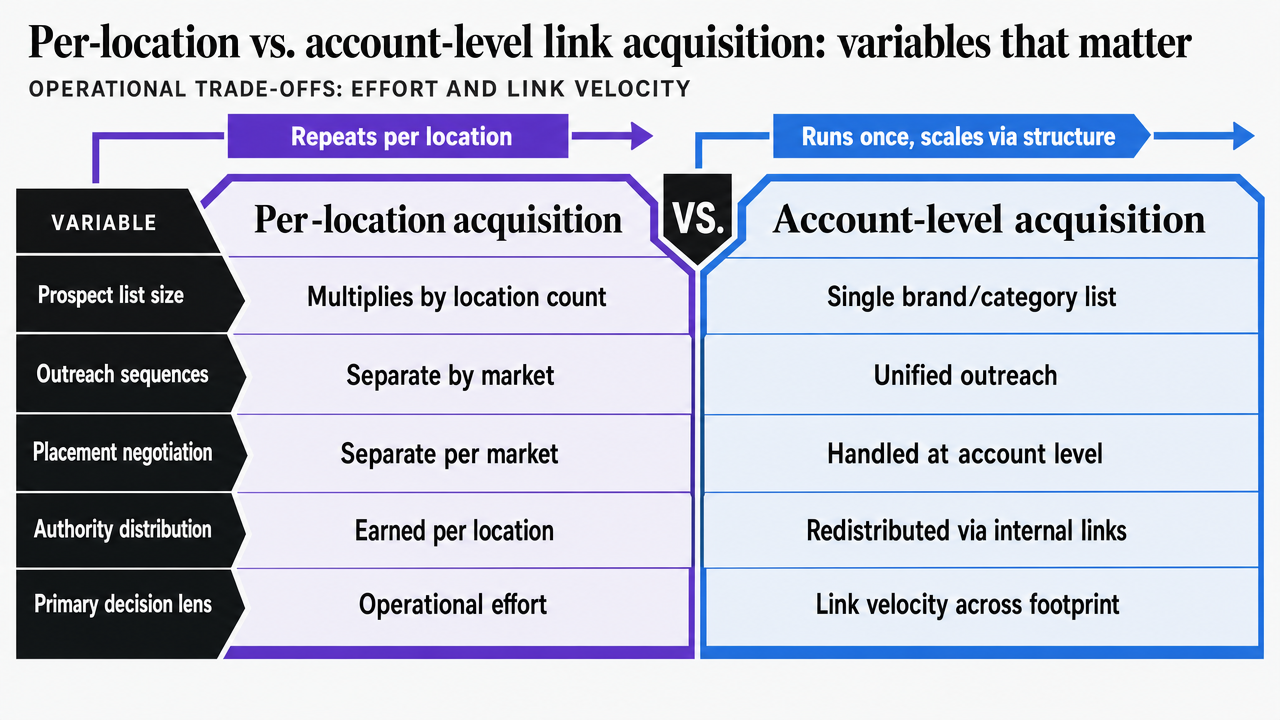 Render the comparison table from the section as a clean side-by-side visual so portfolio operators can scan the operational trade-offs
Building a defensible prospect list from the rubric
A defensible prospect list is one a strategist can hand to a skeptical reviewer and explain page by page. Each entry carries a short note on why it cleared the five axes, and each rejection carries an equally short note on why it did not. That documentation is what turns link acquisition from a volume exercise into an evaluable program.
The build sequence is mechanical. Strategists start with seed pages already linking to topically aligned competitors or peers, because those pages have demonstrated editorial willingness to cite sources in the subject area. They score each candidate against editorial intent, topical fit, link-graph position, engaged referral traffic, and institutional credibility. Pages that clear all five stay. Pages that fail any one get cut, regardless of how strong the host domain looks on a metrics screen.
The output is shorter than most operators expect. A scrubbed list of forty pages tends to outperform an unfiltered list of four hundred, because outreach hours concentrate on prospects that will actually transmit signal once the link lands 7. The discipline compounds across quarters, and the list itself becomes an asset—reviewed, retired, and replenished as the link graph shifts.
Frequently Asked Questions
References
- 1.Link Analysis.
- 2.Deeper Inside PageRank.
- 3.Tackling PageRank with R.
- 4.PageRank Beyond the Web.
- 5.Search engine optimization and its association with readability and search visibility of diabetic retinopathy educational websites.
- 6.The Quality of Infectious Disease Hospital Websites in Poland.
- 7.Visibility of Moodle applications in Central Asia: analysis of SEO.
- 8.Measuring user interactions with websites: A comparison of two web analytics platforms.
- 9.Analyzing repositories of OER using web analytics and accessibility metrics.
- 10.Identifying Credible Sources of Health Information in Social Media.
- 11.The structure and evolution of the web: A survey of link analysis.