
Key Takeaways
- Profound delivers portfolio-wide AI visibility tracking across ChatGPT, Gemini, Perplexity, and Google's AI modes, making it fit for agencies that need monthly citation-share trends rather than production output.
- Peec AI focuses on citation and prompt research, mapping which prompts trigger AI responses and where competitors win, which suits onboarding phases and quarterly gap analyses.
- Otterly.AI offers prompt-level monitoring across ChatGPT, Perplexity, and Gemini with per-brand pricing that works for mid-sized agencies, though Google AI Overview coverage is thinner.
- AthenaHQ adds sentiment scoring on brand mentions inside generative answers, which matters for regulated verticals where a citation can be neutral, favorable, or damaging 10.
- Semrush AI Toolkit consolidates AEO features inside an existing SEO suite, trading prompt-sampling depth for a single contract and reporting surface 8.
- Ahrefs Brand Radar correlates AI answer citations with organic performance for agencies already committed to Ahrefs, but loses its leverage when bought as a standalone AEO layer.
- Scrunch AI pairs citation research with content recommendations, shortening the handoff between the analyst spotting a gap and the writer fixing the page.
- Writesonic AEO audits schema coverage against Schema.org types and generates JSON-LD plus answer-formatted copy, targeting the structured data layer that affects citation odds 5.
- Vectoron routes citation gaps, schema misses, and entity issues into a strategist workflow with an approval queue, closing the loop between insight and shipped fix for portfolio agencies.
The four archetypes of AEO tooling agencies now evaluate
Search leads evaluating an AEO checking tool are not shopping in a single category. The market has split into four functional archetypes, and confusing them is how agencies end up paying for a dashboard that produces no client outcome.
The first archetype is the AI visibility tracker. These platforms sample prompts across ChatGPT, Gemini, Perplexity, and Google's AI modes, then score how often a brand appears in generated answers relative to competitors 7. The job-to-be-done is portfolio monitoring: knowing, per client, whether citation share is trending up, flat, or gone.
The second is citation and prompt research. These tools work backward from the answer engines themselves, surfacing which prompts trigger AI Overviews or LLM responses in a given vertical, which sources get cited, and where competitor gaps exist. This is discovery work, closer to keyword research than to rank tracking.
The third is the integrated SEO suite with an AEO module. Enterprise SEO platforms have added AI visibility layers on top of existing rank tracking, technical audit, and content optimization workflows 8. The pitch is consolidation—one contract, one seat model, one reporting surface across traditional and AI search.
The fourth is the execution platform. These systems treat AEO signals as inputs to production: a citation gap triggers a schema update, an entity consolidation task, or a content rewrite that routes through an approval queue before publishing. The category reflects agency practice patterns documented in 2025—prompt taxonomies, schema ubiquity, entity consolidation, and hourly monitoring loops wired to Slack alerts 6.
A useful buying test: name which archetype a shortlisted tool sits in before comparing features. Two products in different archetypes cannot be scored on the same rubric, and agencies that force that comparison usually pick the prettier interface over the one that changes client rankings.
Why AEO monitoring changes agency P&L math
The financial case for an AEO checking tool rests on a single question: what happens to a client's organic click volume when an AI Overview appears above the ten blue links? The current answer breaks the old rank-tracking model.
Across a sample of queries analyzed by DigitalApplied, AI Overviews now appear in roughly 13% of searches, and position-1 organic CTR falls by 18% when the brand is not cited inside the Overview. When the brand is cited, position-1 CTR rises by 35% 3. That 53-point swing between cited and uncited is the number that reframes AEO spend from a nice-to-have monitoring layer into a direct revenue variable.
For a retainer built on organic pipeline, the math is straightforward. A client sitting at position 1 for a commercial term inside the 13% of AI-Overview-triggered queries has two possible outcomes on the same ranking: a citation win that grows clicks, or an uncited loss that quietly bleeds a fifth of the traffic the report still shows as "position 1." Neither outcome is visible in a standard rank tracker, because rank did not change—citation status did.
Agency leads defending tool spend to a CFO can anchor on this delta rather than on general AI hype. The line to run: monitoring citation status on the subset of client queries that trigger Overviews is the difference between charging for a ranking that still converts and charging for a ranking that has been silently downgraded. That framing turns AEO tooling into a retention control, not a research expense.
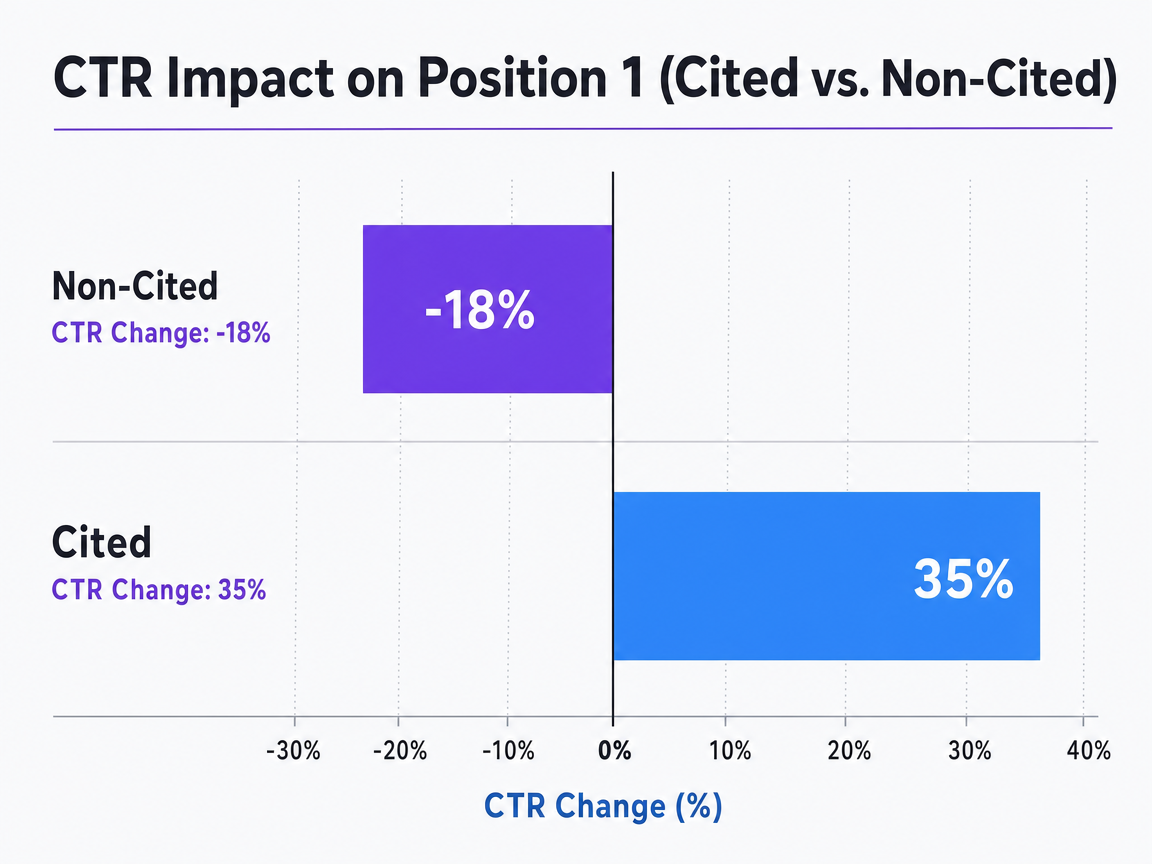 CTR Impact on Position 1 (Cited vs. Non-Cited)
Compares the impact on click-through rate for a page in organic position 1. If not cited, CTR drops 18%. If cited within the AI Overview, clicks increase by 35%.
Test AEO strategies with live, real-world data
Evaluate AEO tool accuracy by running and publishing genuine agency content during your free trial period.
Buyer criteria search leads should apply to every shortlist
A defensible AEO shortlist is built on five criteria, and each one maps to a decision a search lead has to defend in a QBR.
- Prompt and query coverage. The tool has to sample the prompts that actually trigger AI Overviews and LLM responses in the client's vertical, not a generic keyword universe. Generative results appear inconsistently and personalize by user, so credible coverage requires automated sampling plus periodic human validation 4. Ask vendors how many prompts per client per day are sampled, and how the prompt set is refreshed.
- Citation and sentiment tracking across engines. Monitoring has to cover ChatGPT, Gemini, Perplexity, and Google's AI modes at minimum, with citation share and sentiment scored per brand and per competitor 7. A tool that only reads Google AI Overviews will miss half the client conversations already happening in ChatGPT.
- Structured data audit depth. Schema ubiquity is one of the five practice patterns leading AEO agencies have institutionalized 6, and the underlying vocabulary comes from Schema.org's FAQ, HowTo, Product, and Organization types 5. A shortlisted tool should surface which schema is missing on which URL, not just flag "schema opportunity."
- Portfolio economics. Per-brand or per-domain seat pricing has to hold up at 25 and 60 clients without a custom quote. If the vendor's pricing page stops at 10 brands, the tool is not built for agency delivery.
- Production integration. Alerts have to reach Slack, Jira, or the agency's content workflow. Monitoring without a handoff to production is a report, not a control.
Nine AEO checking tools evaluated by agency job-to-be-done
Profound — portfolio-wide AI visibility tracking
Profound sits squarely in the AI visibility tracker archetype. The platform samples prompts across ChatGPT, Gemini, Perplexity, and Google's AI modes, then scores brand appearance rates against a defined competitor set 7. For agency operators, the value is portfolio breadth: a single dashboard rolls up citation share, sentiment, and share-of-voice across every client brand, refreshed on a cadence tight enough to catch week-over-week drift.
The strongest fit is agencies where the retainer includes AI visibility reporting as a distinct line item and the deliverable is a monthly trend view rather than task-level production. Search leads managing 30 or more brands can defend the seat cost by reallocating hours previously spent on manual prompt spot-checks.
Profound is the wrong choice when the agency needs the tool to also generate the schema fix, content rewrite, or entity update that closes a citation gap. It reports; it does not produce. Teams pairing Profound with an execution layer will get value; teams expecting monitoring to double as production will not.
Peec AI — citation share and competitor gap discovery
Peec AI leans into the citation and prompt research archetype. Its core work is discovery: mapping which prompts trigger AI responses in a given vertical, which sources those responses cite, and where a client sits against named competitors in citation share. That output feeds directly into the prompt taxonomy work that leading AEO agencies have institutionalized as a formal service line 6.
Peec AI performs best for agencies onboarding new clients or entering new verticals, where the first job is building the prompt universe worth monitoring. It also earns its seat during quarterly gap analyses, when the search lead needs to show a client exactly which competitor domains are winning cited placements and on which prompt clusters.
The tool is a poor fit when the mandate is continuous, hourly citation monitoring at scale. Discovery-oriented platforms typically sample less frequently than dedicated trackers, and agencies that need Slack alerts on citation drops within the same business hour should pair Peec AI with a monitoring layer.
Otterly.AI — prompt monitoring across ChatGPT, Perplexity, and Gemini
Otterly.AI is a focused AI visibility tracker with an emphasis on prompt-level monitoring across ChatGPT, Perplexity, and Gemini. The platform lets search leads define custom prompts per client and tracks whether the brand appears, at what position, and with what cited URL over time. Because generative results appear inconsistently and personalize by user, credible tracking depends on a mix of automated sampling and human validation 4—a workflow Otterly.AI operationalizes rather than leaving to the agency.
For mid-sized agencies (15 to 40 clients), Otterly.AI's per-brand pricing tends to be more manageable than enterprise-tier tools, and its prompt-level granularity makes it useful for verticals where a small set of high-intent queries drives most pipeline.
The wrong-choice signal is scope. Otterly.AI does not cover Google AI Overview tracking with the same depth as its LLM coverage, so agencies whose client traffic is heavily exposed to Google's AI mode should treat it as a partial solution rather than a full portfolio replacement.
AthenaHQ — enterprise AI visibility with sentiment scoring
AthenaHQ targets the enterprise end of the AI visibility tracker archetype. Beyond citation counts, the platform scores sentiment on brand mentions inside generative answers, which matters for verticals where a citation can be neutral, favorable, or actively damaging—healthcare, financial services, and legal, in particular. The feature aligns with the shift toward Generative Engine Optimization, where brand success is measured by being cited well, not just being cited 10.
AthenaHQ suits agencies with enterprise or regulated clients that require reputation-grade reporting alongside visibility metrics. Sentiment breakdowns give account leads material for QBRs that a raw citation-share number does not.
Smaller agencies should read the pricing carefully. AthenaHQ's enterprise positioning means seat and query costs scale for organizations that expect white-glove onboarding and API access, not for a 15-client shop that needs a lightweight tracker. The tool also does not produce schema, content, or technical fixes—sentiment signals still have to route into a separate production workflow before they change client outcomes.
Semrush AI Toolkit — integrated SEO suite with AEO module
Semrush's AI Toolkit is the clearest example of the integrated SEO suite archetype. AEO features—AI Overview tracking, prompt research, and citation monitoring—sit alongside the rank tracking, technical audit, and content optimization workflows agencies already run. MarTech's survey of enterprise SEO platforms notes this consolidation pattern: complex organizations rely on integrated platforms to scale SEO operations without adding equivalent headcount 8.
The operational win is a single contract, a single reporting surface, and a shared keyword universe between traditional and AI search. Search leads who have already standardized their agency on Semrush get AEO coverage without adding a second vendor login, seat model, or data reconciliation step.
Semrush AI Toolkit is the wrong choice for agencies that need best-in-class prompt sampling depth or LLM coverage beyond Google. Integrated suites tend to trail specialist trackers on how many prompts per client are sampled per day and on how quickly new AI surfaces are added. Depth of coverage is the trade for breadth of platform.
Ahrefs Brand Radar — AEO layered onto an existing SEO stack
Ahrefs Brand Radar extends the integrated-suite logic to agencies already committed to Ahrefs for backlink, keyword, and rank data. Brand Radar tracks brand mentions across AI answer surfaces and correlates them with existing organic performance data, which lets search leads model whether a citation win translates into measurable click volume or stalls at the impression layer.
The practical value shows up in reporting. Agency account leads can present AI visibility inside the same dashboard clients already read for organic performance, which shortens the education curve on why AEO spend belongs in the retainer. It also holds up under Forrester's observation that leading SEO platforms increasingly use AI to prioritize opportunities and automate routine tasks 13.
Brand Radar is the wrong pick for agencies that do not already run on Ahrefs. The tool's leverage comes from integration with the surrounding data set; buying it as a standalone AEO layer strips out the reason to choose it over a dedicated tracker with deeper prompt coverage.
Scrunch AI — citation research plus content recommendation
Scrunch AI sits between the citation research and execution archetypes. The platform surfaces which prompts trigger AI responses in a vertical, which URLs get cited, and then generates content recommendations aimed at closing the gap—section additions, FAQ structures, and answer-format rewrites tuned to how LLMs summarize sources.
For agency content teams, the value is a shorter path from insight to brief. A citation gap surfaces in the tool alongside a specific recommendation for the editor to act on, which cuts the handoff cycle between the SEO analyst who spots the gap and the writer who has to fix the page. That maps to the conversation design sprints leading AEO agencies have adopted as a practice pattern 6.
Scrunch AI is the wrong choice when the agency's content production is fully outsourced or when brief templates are locked. Recommendations are only as useful as the production system's ability to absorb them. Agencies with rigid editorial workflows will read Scrunch's output as noise rather than input.
Writesonic AEO — schema and answer-format execution
Writesonic's AEO features target the structured data and answer-format layer. The platform audits schema coverage against the FAQ, HowTo, Product, and Organization types documented by Schema.org 5, then generates JSON-LD and answer-optimized copy blocks intended to increase the chance of citation inside AI answers.
The timing case for schema-and-format tools is quantitative. Across a synthesis of independent studies, queries with AI summaries drove CTR reductions of 34 to 46 percent, and zero-click search rates rose from 56 percent in May 2024 to 69 percent in May 2025 12—the scope is publisher-cohort traffic, not universal search, but the direction is unambiguous. Structured data and answer-format work are among the direct levers agencies have to reverse that trend.
Writesonic AEO is the wrong fit when the client site already has mature schema governance and a dedicated technical SEO owner. In those cases, the audit output duplicates internal tooling. It also does not replace citation monitoring; agencies still need a tracker to measure whether the schema work moved the citation needle.
Vectoron — execution loop from citation gap to published fix
Vectoron represents the execution platform archetype. Rather than treating AEO signals as a reporting output, the platform routes citation gaps, schema misses, and entity inconsistencies into a specialist strategist workflow that produces the fix—content update, JSON-LD implementation, or entity consolidation task—and holds it in an approval queue until a human on the agency team signs off before publishing.
The fit is agencies whose primary operational bottleneck is the handoff between insight and production, not the insight itself. Search leads managing 25 or more brands who already have monitoring coverage often find that the delay between spotting a gap and shipping a fix is where retainer margin erodes. Closing that loop is the job Vectoron is built for, and it maps to the hourly monitoring loops and entity consolidation practices leading AEO agencies have documented as core service patterns 6.
Vectoron is the wrong pick when the agency wants a pure reporting layer with no production integration or when clients require production work to remain fully manual. The platform's leverage comes from execution; teams uninterested in that layer are paying for capability they will not use.
Evaluate Enterprise-Ready AEO Checking Workflows for Agency-Scale Delivery
Connect with a solutions expert to benchmark your current AEO audit process, explore automation strategies, and assess fit for multi-client, multi-channel agency environments.
Portfolio AEO tooling cost math for 25 and 60 client footprints
For agency leads managing 25 or more client brands, AEO tool spend has to survive a per-client math test before it reaches the retainer P&L. The four archetypes price on different units, and the unit choice—not the sticker price—determines whether a tool is affordable at scale.
The table below uses labeled variables where the vendor has not published portfolio pricing. Search leads should populate each variable during procurement and multiply against their actual footprint before signing.
| Archetype | Pricing unit | 25-client math | 60-client math ||---|---|---|---|| AI visibility tracker | Per brand tracked, monthly ($V) | 25 × $V | 60 × $V || Citation/prompt research | Per prompt or query volume ($P per 1,000 prompts) | (prompts/client × 25) × $P | (prompts/client × 60) × $P || Integrated SEO suite AEO add-on | Per domain, monthly ($D) | 25 × $D | 60 × $D || Execution platform | Per workflow or approved task ($W) | (tasks/client × 25) × $W | (tasks/client × 60) × $W |
Two cost dynamics deserve attention. Per-brand seat models scale linearly and are easiest to forecast, but they charge the same for a client with 40 monitored prompts and a client with 400. Per-prompt models flex with actual coverage, which suits agencies whose clients have uneven query universes but exposes the retainer to overage risk if prompt taxonomies grow between QBRs.
The execution platform unit is the one most often mispriced during procurement. Tasks per client scale with citation-gap volume, not with brand count, and citation gaps tend to concentrate in the 13% of queries where AI Overviews appear 3. Search leads sizing an execution seat should model tasks against the subset of client queries that trigger Overviews, not against the full keyword list, or the per-workflow spend will look inflated relative to the ranking surface it actually influences.
How to run a 30-day AEO tool trial without stalling delivery
A 30-day AEO trial fails when it runs parallel to normal delivery instead of inside it. The fix is to scope the trial as a live production test on three or four representative client accounts, not a sandbox demo.
- Week one. Load prompt sets for the trial cohort using the client's actual commercial queries, not a vendor-supplied starter list. Generative results personalize by user and trigger inconsistently, so credible sampling requires both automated pulls and human validation on a defined cadence 4. Baseline citation share, sentiment, and AI Overview presence per prompt.
- Weeks two and three. Route every citation gap the tool surfaces into the existing content or technical queue with a labeled ticket. Track two numbers: time from alert to shipped fix, and citation status on the affected prompt at day 30.
- Week four. Score the tool on delta, not dashboard quality. If closed-loop tickets moved citation status on at least a third of flagged prompts, the trial paid for itself. If the output sat in a report tab, the archetype was wrong for the agency's delivery model, and the shortlist restarts one tier over.
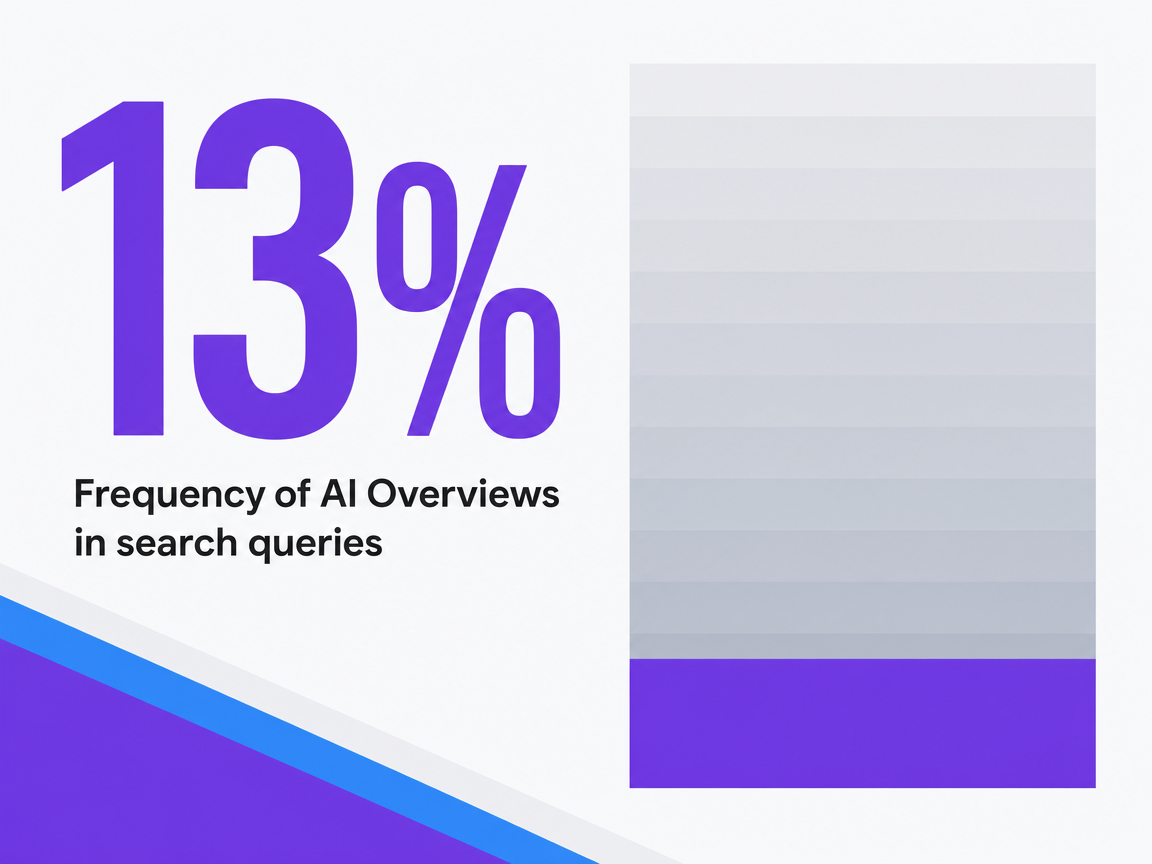 Frequency of AI Overviews in search queries
Frequency of AI Overviews in search queries
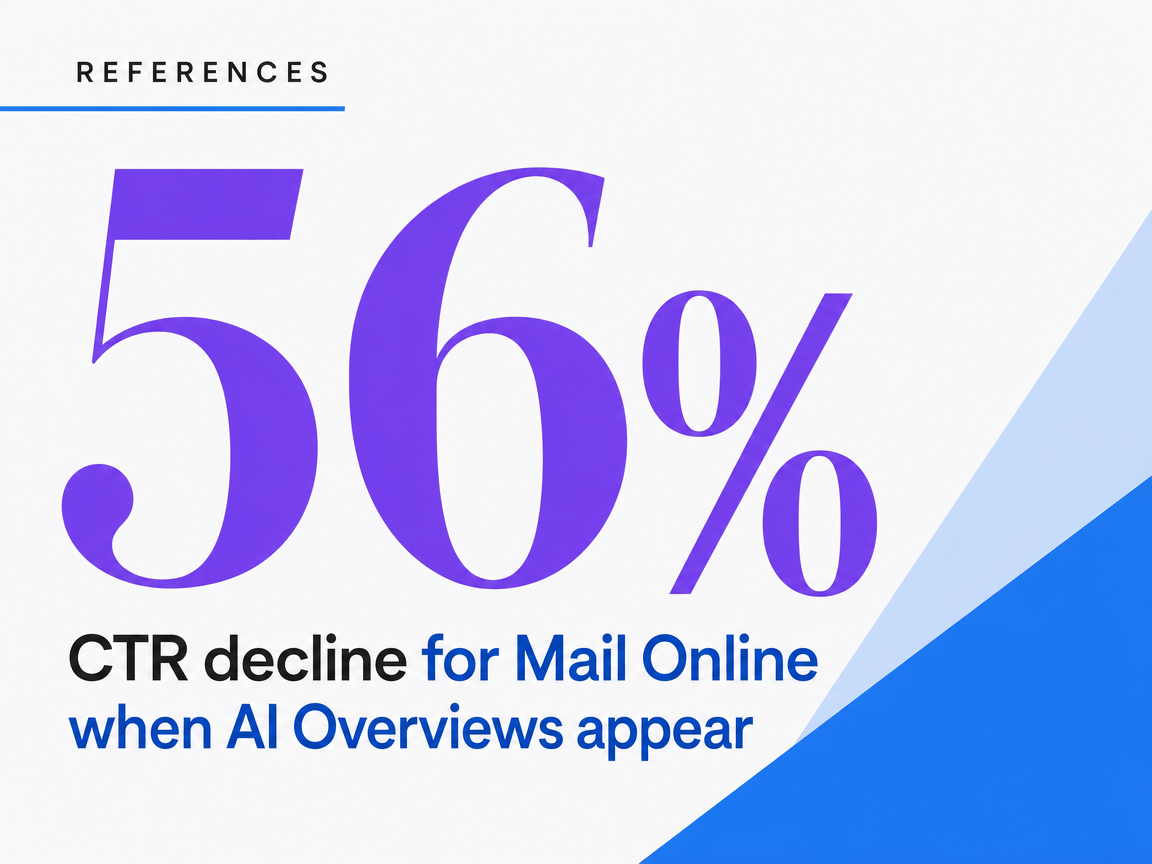 CTR decline for Mail Online when AI Overviews appear
CTR decline for Mail Online when AI Overviews appear
Frequently Asked Questions
References
- 1.How Google's AI Overviews is affecting paid search.
- 2.How Do AI Overviews Affect SEO? (And How to Counter Them).
- 3.AI Overviews in 13% of Queries: SEO Traffic Impact.
- 4.How to Track Google's Generative Search Experience (GSE).
- 5.Getting Started with Schema.org Using Microdata, RDFa, and JSON-LD.
- 6.Top 10 Agencies Leading Answer Engine Optimization (AEO) in 2025.
- 7.11 Best Answer Engine Optimization (AEO) Tools for AI Search.
- 8.Enterprise SEO Platforms: A Marketer's Guide.
- 9.Google SGE: Study Reveals Potential Disruption For Brands & SEO.
- 10.An Exploratory Study on the Impact of Generative AI (Search Generative Experience) on Traditional SEO Strategies.
- 11.SEO Experts: Prepare For Search Generative Experience With These Tips.
- 12.Google AI Overviews Impact On Publishers & How To Adapt.
- 13.The Forrester Wave: SEO Platforms.
- 14.Unveiling SGE-Intelligence—A Scholarly Study of AI-Driven Content Optimization in the Search Generative Experience.