
Key Takeaways
- Profound delivers the strongest multi-engine monitoring with white-label dashboards, but execution still routes back to the agency, so analyst hours accumulate against every flagged gap at scale.
- AthenaHQ leads on citation attribution and competitor share-of-voice depth, making monthly reports defensible — though its per-client add-on pricing compounds sharply past the 40th account.
- Peec AI's prompt-level sentiment tracking matters most in high-stakes verticals where tone inside AI answers shifts client perception, but every diagnosed gap converts to CMS work outside the platform.
- Vectoron spans monitoring, diagnostics, and execution through a Command Center approval step, so adding clients scales closer to seat economics than to headcount economics.
- Otterly.AI fits agencies running 10 to 25 clients that need multi-engine visibility without diagnostics depth, but reporting thins visibly once the book crosses roughly 30 accounts.
- Scrunch AI handles brand mention tracking with reporting hooks into existing BI, working best as a supplementary monitoring source rather than a primary AEO platform for larger books.
- Semrush AI Toolkit extends an already-licensed SEO suite into AEO without a new contract, though multi-engine depth, sentiment granularity, and competitor attribution lag specialist platforms 8.
Why agency AEO tool selection is now an operating-model decision
AI-generated summaries are becoming the first impression most prospects have of an agency's clients, which shifts what a Head of SEO is actually buying when evaluating AEO software 1. The purchase is no longer a monitoring dashboard bolted onto an existing stack. It is a decision about how delivery capacity gets allocated across a book of 25, 50, or 75 clients.
McKinsey has already reframed this as an enterprise capability question rather than a plugin selection, arguing that generative engine optimization belongs alongside content, SEO, and measurement as a core function 7. That framing matters at the agency level for a simple reason: any tool that only reports visibility inside AI answers, without executing the schema, content, and structured-data changes those answers require, pushes the labor back onto the agency's specialists. Multiply that gap by a full client roster and the tool choice quietly determines headcount.
Benchmark data shows brands running AI-informed SEO workflows have posted double-digit gains in organic impressions and click-through rates against peers still on legacy tactics 2. Capturing those gains at scale, across every client, is the operating problem this ranking is built to solve.
The three functional layers most rankings blur together
Most AEO listicles score platforms on a flat feature grid, which hides the fact that the tools are actually solving three different problems. Separating them changes which platform an agency should buy — and how many.
The first layer is monitoring: tracking whether a client's brand appears inside AI-generated answers, how often, and against which competitors. Share-of-voice inside synthesized responses is the headline metric here. The second layer is diagnostics: explaining why a citation was earned or skipped — which URLs were pulled, which prompts triggered a competitor mention, which topical gaps caused a miss. The third layer is execution: actually shipping the schema updates, content rewrites, FAQ blocks, and republishing that close those gaps.
Most platforms live cleanly in one layer. As one comparative review of the category notes, AEO tools "monitor LLM responses, score your share of voice against competitors, and flag content that AI engines are extracting or skipping" — but stop before the fix ships 9. That gap is why agencies end up running a monitoring vendor, a diagnostics vendor, and a content operations system in parallel, then absorbing the execution hours themselves.
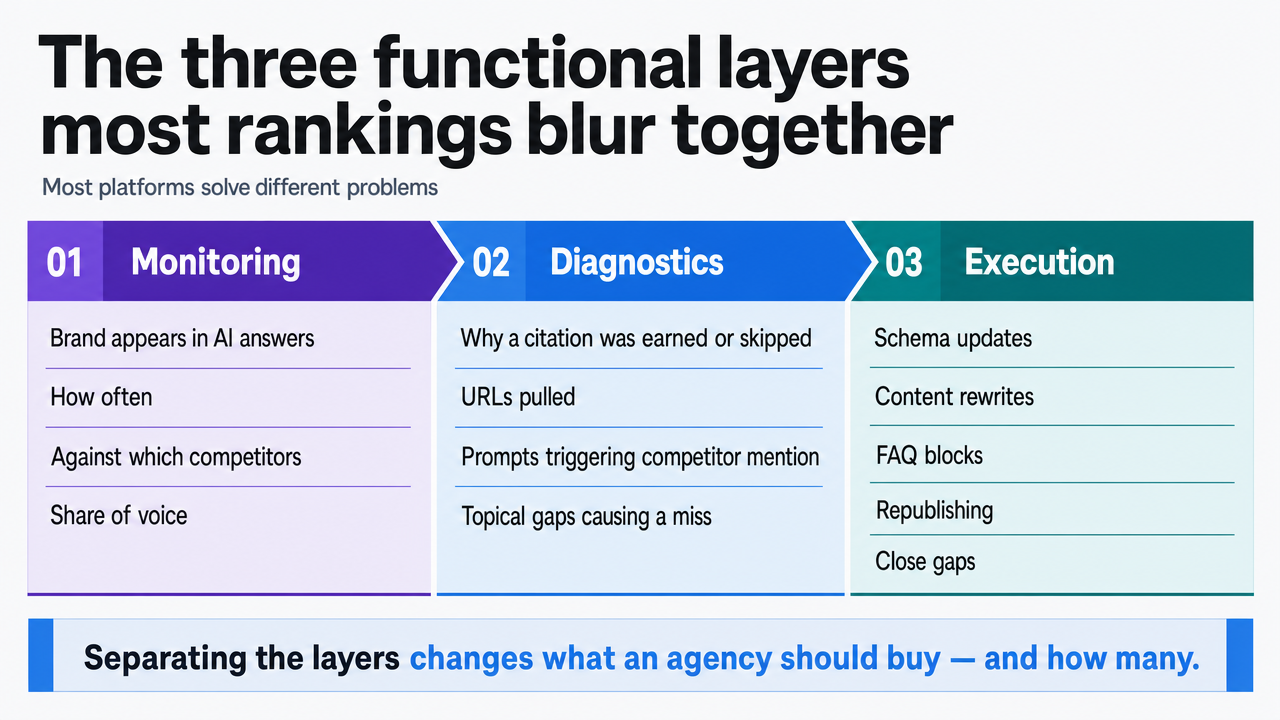 Visualize the three functional layers (monitoring, diagnostics, execution) that the section explicitly defines, helping readers internalize the framework used throughout the ranking
The four-axis rubric used to score each tool
Any ranking that scores AEO platforms on feature counts flatters the vendors and misleads the buyer. The four axes below were chosen because each one directly changes how many hours per client per month an agency has to absorb — and how defensible the resulting deliverable looks to the client.
McKinsey's GEO framing is useful here: the recommendation is to reallocate content investment toward AI-optimized assets across owned, third-party, and community surfaces, which means the tool has to hold up across engines, attribute results specifically enough to act on, ship the fix, and do all of that at a marginal cost per client that survives portfolio math 7.
Multi-engine coverage across Google AI Overviews, ChatGPT, Perplexity, Gemini, and Claude
Coverage is the entry ticket. A platform that only reads Google AI Overviews leaves ChatGPT, Perplexity, Gemini, and Claude uninstrumented, which now includes newer surfaces like Copilot, Grok, DeepSeek, and Meta AI reachable via enterprise add-ons 8. Score higher when native tracking spans all five primary engines without a paid tier upgrade, and when prompt volumes per client are high enough to catch long-tail queries, not just the head terms a client already knows about.
Citation attribution depth
Knowing a client was cited is not the same as knowing which URL, which passage, and which prompt triggered it. Attribution depth is what turns a monitoring dashboard into a diagnostic tool. The strongest platforms surface the specific pages AI engines extract or skip, alongside share-of-voice against named competitors 9. Score down any tool that reports a citation count without the extractable source, because that gap is where agency analyst hours quietly disappear each month.
Execution-to-approval workflow depth
This axis separates dashboards from delivery systems. A tool scores high if it can ship the schema update, the FAQ rewrite, or the entity-clarifying content edit through a governed approval step — not just email the agency a to-do list. Most category reviews describe AEO software as monitoring plus recommended actions, with execution living outside the platform 9. That handoff is where per-client hours accumulate and where a Head of SEO loses the ability to productize the deliverable.
Per-client marginal cost at agency scale
The last axis is the one most rankings ignore: what does adding the 26th, 40th, or 75th client actually cost? Two variables matter — the platform's per-client add-on fee and the residual analyst hours the tool cannot eliminate. A monitoring-only tool at a low sticker price often carries the highest true cost because every flagged gap pushes execution back onto salaried specialists. Score the marginal cost across both lines, not the seat license in isolation.
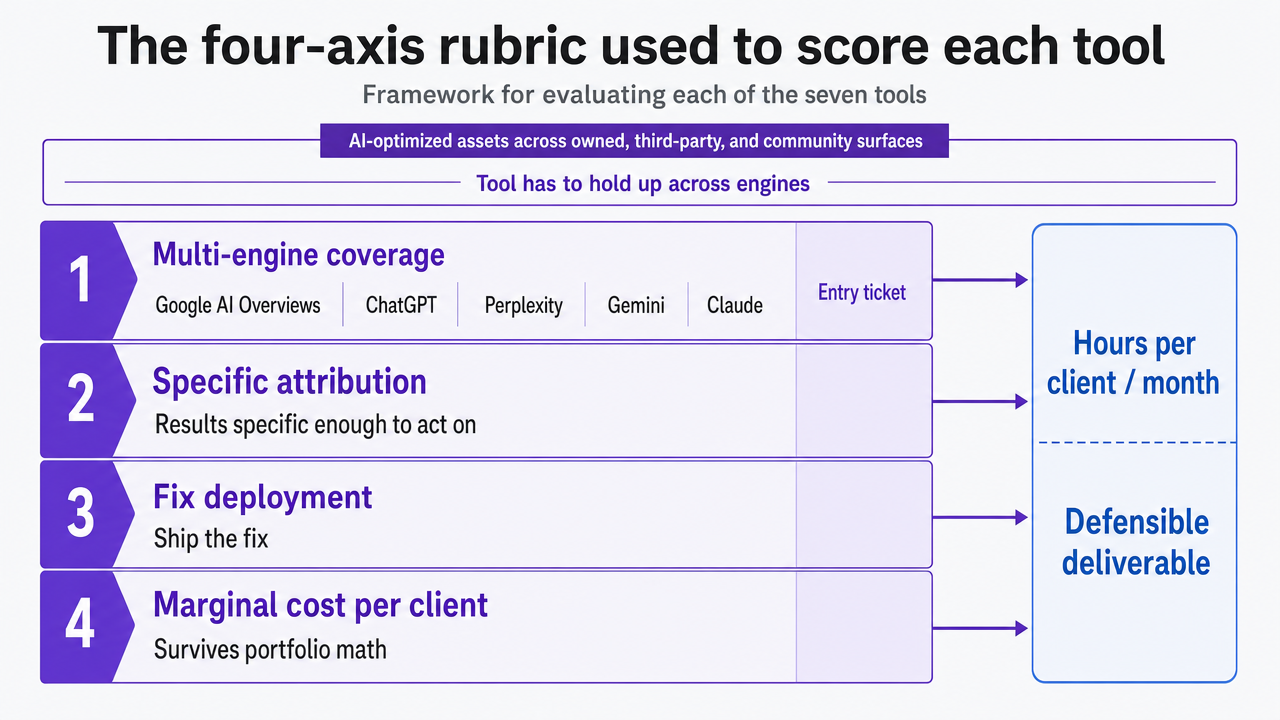 Illustrate the four scoring axes described in the section as a framework diagram, reinforcing the evaluation rubric applied to each of the seven tools
Test AI-powered AEO workflows on live campaigns
Validate measurable AEO improvements across real client projects with full platform access for seven days.
The ranked seven
The seven platforms below are scored against the same four-axis rubric: multi-engine coverage, citation attribution depth, execution-to-approval workflow, and per-client marginal cost at agency scale. Capability descriptions draw on comparative category reviews that enumerate what each tool tracks, how citations surface, and where execution stops 8, 9, 10. Order reflects fit for a Head of SEO running a book of 25 or more clients, not raw feature count.
1. Profound — deep multi-engine monitoring with agency dashboards
Profound scores highest on the monitoring axis. Category reviews position it among the platforms that track brand presence across Google AI Overviews, ChatGPT, Perplexity, Gemini, and Claude, with enterprise tiers extending into Copilot, Grok, DeepSeek, and Meta AI 8. Multi-client dashboards and white-label reporting are native, which matters for a Head of SEO who exports client-facing PDFs on a monthly cadence.
Attribution depth is strong. The platform surfaces which URLs each engine extracted, which prompts triggered a citation, and share-of-voice against named competitors 9. That level of specificity turns a monitoring output into an analyst's remediation list.
Execution is where Profound plateaus. Recommendations ship as action items the agency then routes through its own content, dev, and QA teams. At 30 clients, the residual hours accumulate against whatever pod is responsible for schema and content updates. The per-client marginal cost looks favorable on the seat license and less favorable once analyst hours to close flagged gaps are counted.
2. AthenaHQ — citation attribution and competitor share-of-voice at portfolio depth
AthenaHQ leads the diagnostics layer. The platform is built around identifying which specific pages AI engines extract, which passages get pulled, and how a client's share-of-voice stacks against a defined competitor set across multiple answer surfaces 9. For an agency proving AEO impact to clients who previously graded on keyword rankings, that attribution granularity is what makes a monthly report defensible.
Engine coverage spans the primary five, with tracked prompt volumes deep enough to surface long-tail queries beyond a client's known head terms 8. Portfolio views let a lead strategist scan all clients before drilling into any one.
Execution capability is limited to recommended actions. Content rewrites, schema deployments, and republishing happen in whatever CMS and workflow the agency already runs. Per-client marginal cost is competitive at low seat counts but scales through a per-client add-on model that a Head of SEO should model against the full 25- to 75-client book before signing.
3. Peec AI — sentiment tracking and prompt-level diagnostics
Peec AI differentiates on sentiment and prompt-level diagnostics. Category reviews highlight it among platforms that score not just whether a client is cited, but how the surrounding language positions the brand across AI-generated responses 8. For high-stakes verticals — legal, behavioral health, senior living — sentiment drift inside a synthesized answer can matter as much as citation count.
Coverage spans the major answer engines, with prompt-level views showing which queries produced favorable, neutral, or negative framing. Competitor comparisons are prompt-specific rather than aggregated, which lets an analyst pinpoint the exact question where a client is losing share-of-voice.
The tool sits firmly in the monitoring-plus-diagnostics layer. Executing the fix — rewriting the extractable passage, tightening entity signals, updating the FAQ block — happens outside the platform 9. At agency scale, that means a dedicated analyst pod owns the loop between Peec AI's diagnostic output and the CMS work that responds to it. Sentiment specificity is the reason to buy it; execution overhead is what to budget for.
4. Vectoron — monitoring plus in-platform execution against the same rubric
Vectoron scores differently because it operates across all three functional layers. Specialist AI strategists cover content, SEO, backlinks, PPC, social, and call intelligence, with a Command Center that routes every recommendation through a human approval step before execution ships. That places it in the monitoring-plus-execution category most category reviews flag as underserved 9.
On the coverage axis, the platform ingests visibility signals across the primary answer engines alongside traditional SEO data, then attributes citations to specific URLs and prompts. On the execution axis, approved schema updates, FAQ rewrites, and entity-clarifying content changes ship from the same workflow that flagged them — no handoff to a separate content operations vendor.
Per-client marginal cost is where the rubric shifts. Because execution hours don't accumulate against a salaried specialist pod for every flagged gap, adding the 40th or 60th client scales closer to platform seat economics than to headcount economics. For a Head of SEO whose margin pressure comes from analyst hours consumed between monitoring output and shipped fix, that is the axis that matters.
5. Otterly.AI — lightweight multi-client monitoring for smaller books
Otterly.AI fits agencies running smaller books — roughly 10 to 25 clients — that need multi-engine visibility tracking without a full diagnostics or execution layer. Category reviews position it as an accessible monitoring option covering the major AI answer surfaces with straightforward share-of-voice reporting 8.
Attribution is present but shallower than what AthenaHQ or Peec AI surface. Citations register, competitor comparisons render, but prompt-level and passage-level extraction depth is thinner. That trade sits behind a lower price point and a simpler onboarding curve.
Execution is out of scope. The tool reports, and the agency does the work. Where Otterly.AI holds up is as the monitoring layer inside a two- or three-tool stack for an agency that isn't ready to consolidate. Past roughly 30 clients, the reporting depth and per-client add-on economics push most Heads of SEO to reassess against a diagnostics-capable option.
6. Scrunch AI — brand mention tracking with reporting hooks
Scrunch AI concentrates on brand mention tracking inside AI-generated responses, with reporting hooks that plug into existing agency BI or client dashboards 8. The value is narrower than the platforms above: mention counts, sentiment flags, and citation frequency across the primary answer engines.
Attribution is present at the mention level. Which URL was pulled, which passage was extracted, and which prompt triggered the response are less consistently surfaced than in diagnostics-first tools 9. For agencies whose client reports lead with mention volume and sentiment as top-line KPIs, that scope may be sufficient.
Execution is not part of the platform. Every flagged gap converts to an internal ticket. Scrunch AI works as a supplementary monitoring source alongside a deeper diagnostics tool, not as the primary AEO platform for a large agency book.
7. Semrush AI Toolkit — generalist SEO suite with an AEO add-on
Semrush AI Toolkit is the generalist option — an AEO module inside a broader SEO suite most agencies already license. That existing footprint is the argument for it. A Head of SEO who already runs Semrush for keyword research, backlink audits, and site health can extend into AEO tracking without adding a new vendor contract or seat structure.
The trade is depth. Category reviews consistently note that depth of multi-engine AEO measurement in generalist suites lags dedicated AEO platforms 8. Coverage across the five primary answer engines is present, but prompt-level attribution, sentiment granularity, and share-of-voice against named competitors run thinner than specialist tools.
Execution stays outside the AEO module. Recommendations flow into the same task queues Semrush surfaces for traditional SEO, which the agency's content and dev teams process. At agency scale, the toolkit is defensible as a floor — a way to instrument every client with baseline AEO monitoring — while a specialist platform handles the top-priority accounts.
The consolidation math: stacked point tools vs. a unified platform across 25 clients
The four-axis rubric collapses into one economic question at agency scale: what does the AEO layer actually cost per client per month? The variables below are the ones a Head of SEO can fill in from their own ops sheet. The labor-hours side is the one most rankings omit and it dominates the total. Category reviews describe AEO tools as platforms that "monitor LLM responses, score your share of voice against competitors, and flag content that AI engines are extracting or skipping" — flagging without shipping, which is where the residual hours come from 9.
| Cost line | Three-tool stack (monitor + diagnose + execute) | Unified monitor-plus-execute platform ||---|---|---|| Per-seat license | $M/mo × N analyst seats × 3 vendors | $U/mo × N analyst seats × 1 vendor || Per-client add-on | $C₁ + $C₂ + $C₃ × 25 clients | $C × 25 clients || Execution hours per client | ~H hrs/mo × $R blended rate × 25 | ~H/3 hrs/mo × $R blended rate × 25 || Vendor coordination overhead | 3 contracts, 3 SSOs, 3 QBRs | 1 contract, 1 SSO, 1 QBR |
Run the math with any realistic H — four, six, eight hours per client per month for schema, FAQ, and entity-clarifying edits flagged but not shipped — and the execution row swamps the license rows well before the 25th client. That is the number worth defending in the next planning cycle.
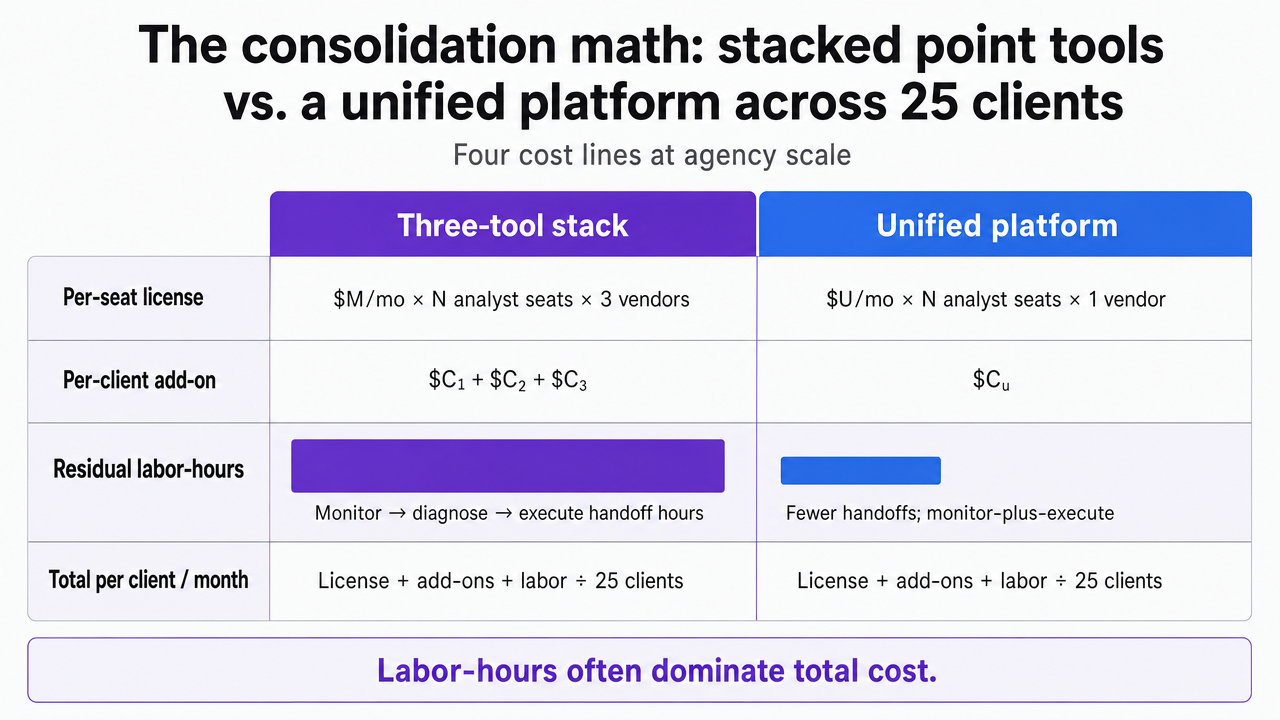 Visualize the four cost lines comparing a three-tool stack against a unified platform, matching the table already in the section prose
Technical criteria the tool must actually enforce
Two technical failure modes cause most AEO deliverables to underperform, and both are enforceable at the platform level rather than left to analyst discipline. The first is FAQ schema drift, where JSON-LD and visible page content fall out of sync. The second is structured data decay, where markup that validated at launch quietly breaks during CMS updates, template changes, or content refreshes. A Head of SEO scoring platforms against the four-axis rubric should treat both as gating criteria, not nice-to-haves. Google's own guidance for structured data is unambiguous that the markup must accurately represent what appears on the page for it to be eligible for rich or AI-adjacent presentations 5. When the platform can't enforce that alignment automatically, the enforcement burden lands on the agency's QA pod — which is another line item hidden inside per-client marginal cost.
FAQPage schema that matches visible content
FAQPage markup earns citations when the question-and-answer content is present in the visible DOM, not injected only into JSON-LD. Google's original announcement is explicit that FAQPage structured data makes eligible content "eligible to display these questions and answers… directly on Google Search and the Assistant" 4, and its ongoing documentation reinforces that the markup must reflect on-page Q&A 11. Practitioner guidance is blunter: FAQs written only in JSON-LD and not displayed on the screen are invalid, and both Google and AI answer engines penalize the pattern 3. An AEO tool worth buying flags schema-only FAQs during audit and blocks them from shipping.
Structured data validation as a recurring check, not a one-time audit
Structured data validation cannot be a launch-week checklist item. Every CMS deployment, template refactor, or plugin update can silently break markup that previously validated, and the citation impact shows up weeks later as declining share-of-voice inside AI answers. Google's structured data documentation treats accurate, current markup as the baseline for rich result and advanced search eligibility 5. The platform criterion is simple: recurring automated validation across every client URL with schema present, alerts routed to the responsible pod, and versioned diffs when markup changes. Anything less converts schema hygiene back into scheduled analyst hours per client per month.
See How Leading Agencies Streamline AEO Workflow With AI-Driven Precision
Request a walkthrough of coordinated, approval-first AEO execution—built for agencies seeking measurable ranking gains without increasing headcount or sacrificing strategy oversight.
Where each tool breaks at 30+ clients
Every platform in the ranking holds up cleanly at 10 clients. The failure modes only surface once the roster crosses roughly 30 accounts, and they're specific enough to predict before the contract renewal.
Profound holds coverage across all five primary answer engines natively, but the enterprise tier gating for Copilot, Grok, DeepSeek, and Meta AI adds a step-function cost when a client in a competitive vertical demands visibility past the core five 8. AthenaHQ's attribution depth remains strong at scale, but the per-client add-on model compounds — the 40th client costs the same as the 4th, with no volume relief on the diagnostics tier. Peec AI's prompt-level sentiment views become an operational liability past 30 clients because the analyst hours required to translate sentiment drift into content edits scale linearly against a monitoring output that flags without shipping 9. Otterly.AI hits its ceiling earliest; reporting depth thins visibly past 25 clients, and the tool starts functioning as a floor rather than a primary source. Scrunch AI's mention-level attribution leaves gaps in URL and passage extraction that a portfolio-scale analyst pod can't reconcile against client reports leading with citation quality. Semrush AI Toolkit holds up on breadth but loses defensibility in client QBRs when compared line-by-line to specialist output on the top 20% of accounts driving 80% of margin.
Vectoron's failure mode is different in kind: the constraint is approval throughput, not analyst hours. Past 60 clients, the Command Center review queue becomes the pacing item, which is a workflow problem a Head of SEO can staff against rather than a per-client hour tax.
If you manage multiple locations or franchise clients
For agencies delivering AEO across multi-location clients — DSOs with 40 practices, home services franchisors with regional operators, senior living portfolios spanning state lines — the rubric shifts on two axes. Coverage volume becomes a per-location problem, not a per-client one. A 30-client book that includes three multi-location accounts can carry 400 or more tracked location entities, each with distinct citation surfaces inside AI answer engines that synthesize location-specific responses 10.
The second shift is structured data enforcement. Location-level schema — services, hours, service areas, per-location FAQs — has to validate continuously across every child page, not just the parent brand site. Google's structured data guidance treats accuracy at the page level as the eligibility baseline 5, which means a franchise client with 80 locations needs 80 independent audit trails. Score any shortlisted platform on whether location entities roll up into a single portfolio view while retaining page-level attribution and validation. Anything that flattens locations into a single brand signal will underreport visibility and undercount the execution hours the agency is already absorbing.
How to pilot a shortlist without disrupting current delivery
A pilot that touches every client in the book is not a pilot — it is a migration wearing a smaller name. The workable approach is narrower: two platforms, three client cohorts, one 60-day window, and a decision criterion set before onboarding starts.
Select the cohorts against the rubric that already applies to the full roster. One cohort should be three or four brand-first clients where citation attribution matters most. A second should be a multi-location or franchise client where per-page schema validation is the harder test 5. A third should be a competitive vertical where sentiment drift inside AI answers changes what the client sees in monthly QBRs 6.
Run each shortlisted platform against both a monitoring-only baseline and an execution-through-approval scenario. Score against the four axes on week 60, not week 14. The pilot has succeeded when residual analyst hours per client have moved measurably — not when the dashboard looks good in a demo.
Frequently Asked Questions
References
- 1.THE IMPACT OF AI ON SEARCH ENGINE OPTIMIZATION.
- 2.AI SEO Benchmark Report: Key Stats & Insights.
- 3.How to Correctly Write FAQPage Structured Data (Increasing AI ....
- 4.New in structured data: FAQ and How-to.
- 5.Introduction to structured data.
- 6.Search in the Age of AI.
- 7.New front door to the internet: Winning in the age of AI search.
- 8.Best AEO Tools in 2026: 11 Answer Engine Optimization ....
- 9.Best Answer Engine Optimization Tools: 9 AEO Platforms ....
- 10.10 Best Answer Engine Optimization Tools in 2026 (AEO).
- 11.FAQPage structured data.