
Key Takeaways
- Traditional rank trackers miss AI-era brand exposure because pages can hold top positions yet lose clicks when AI Overviews answer above the fold 9.
- Agencies must monitor a six-surface answer environment spanning ChatGPT, Google AI Overviews, AI Mode, Perplexity, Gemini, and Copilot, since 65% of sessions now surface an AI reference 10.
- A defensible platform choice rests on four axes—measurement methodology, diagnostic depth, portfolio workflow, and attribution—each backed by concrete vetting questions a CMO can challenge.
- Methodology matters because UI scraping, API collection, and synthetic prompt libraries produce different signals; vendors should name their approach and disclose which engines are native versus inferred 6.
- Diagnostic tools explain why brands are included or excluded but carry model-drift risk, so dashboards should visibly separate observation from inference to survive client scrutiny.
- Portfolio-ready platforms need multi-tenant workspaces, white-label reporting, per-client prompt libraries, and seat models that scale—capabilities positioned by SE Ranking's Visible and OtterlyAI 2, 3.
- Attribution capability separates renewable services from vanity dashboards; look for prompt-level timestamps, warehouse exports, and citation URLs that can be matched to CRM and referral data 5.
- Named platforms cluster by strength—Scrunch AI and Profound lead on diagnostics, SE Ranking and OtterlyAI on portfolio workflow—so a two-tool stack usually defends margin better than a single-vendor compromise 1, 3.
Why Rank Tracking Stopped Measuring Brand Presence
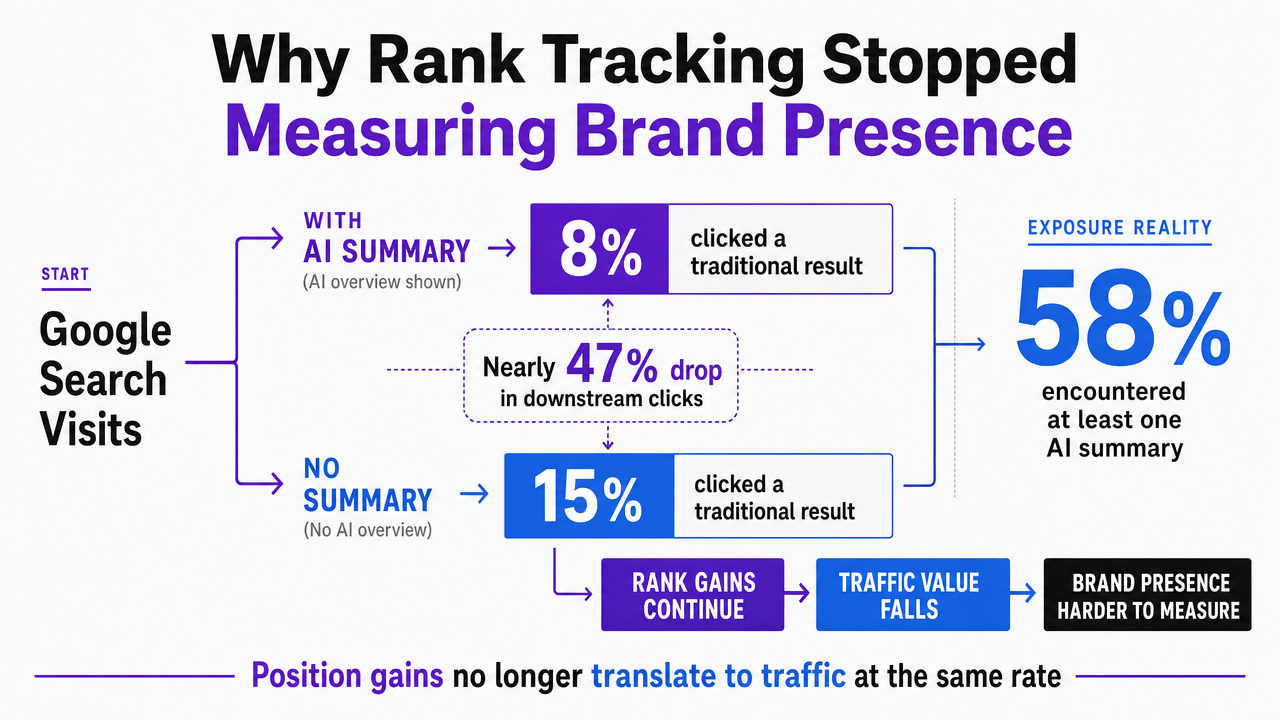
The tools most agencies still use to prove SEO value were built for a click economy that is quietly shrinking. Pew Research Center's analysis of March 2025 Google search behavior found that users clicked a traditional search result on just 8% of visits when an AI-generated summary appeared, compared with 15% of visits when no summary was present—a nearly 47% drop in downstream clicks attributable to the AI answer box itself 9. The same study found that 58% of surveyed users encountered at least one Google search producing an AI summary during the observation window 9. Rank tracking dashboards continue to report position gains on those same queries. The gains no longer translate to traffic at the rate they once did.
That gap is the diagnostic problem an agency Head of SEO now has to solve for every client. A page can hold position three, get cited inside an AI Overview, and still lose the visit—because the answer was rendered above the fold and the user never scrolled. Traditional rank trackers cannot see the citation, the mention position inside the generated answer, or the competitor brands that were named alongside the client. They were designed to measure a link's rank on a page of ten blue links, not a brand's presence inside a synthesized paragraph.
AI brand visibility platforms exist to close that measurement gap. Credible ones run real prompts across major LLMs, record whether the client brand is mentioned, cited, or excluded, and compare exposure against competitors across the same prompt set 6. That is the baseline. The harder question—which tool an agency should standardize on across a client portfolio—starts with how each platform actually generates its numbers.
The Surface Area an Agency Now Has to Monitor
Pew's follow-up survey work put a number on how large the AI-answer surface has become. In observed sessions, 65% of respondents ran a search that produced an AI reference somewhere on the results page, and 54% landed on a shopping page containing an AI reference 10. That is not a niche behavior confined to power users or a single vertical. It is the default context in which a client's brand is now being described, compared, and recommended.
Each of those surfaces renders differently:
- Google AI Overviews and AI Mode synthesize a paragraph and cite a small set of sources.
- ChatGPT and Gemini answer conversationally, often naming two or three brands inside the response body.
- Perplexity threads citations through the answer at the sentence level.
- Copilot mixes web results with generated summaries.
- Shopping-context AI references introduce a separate layer where product mentions and comparison language appear before the user reaches a category page.
An agency measuring only Google organic positions is watching one channel of a five- or six-channel broadcast. A credible AI visibility platform has to run defined prompt sets across ChatGPT, Google AI Overviews, AI Mode, Perplexity, Gemini, and Copilot, then record where the client brand appears, where competitors appear instead, and where the brand is excluded entirely 1, 7. Anything narrower misses the majority of the surface a client's buyers now touch before making contact.
A Four-Axis Selection Framework
The Framework at a Glance
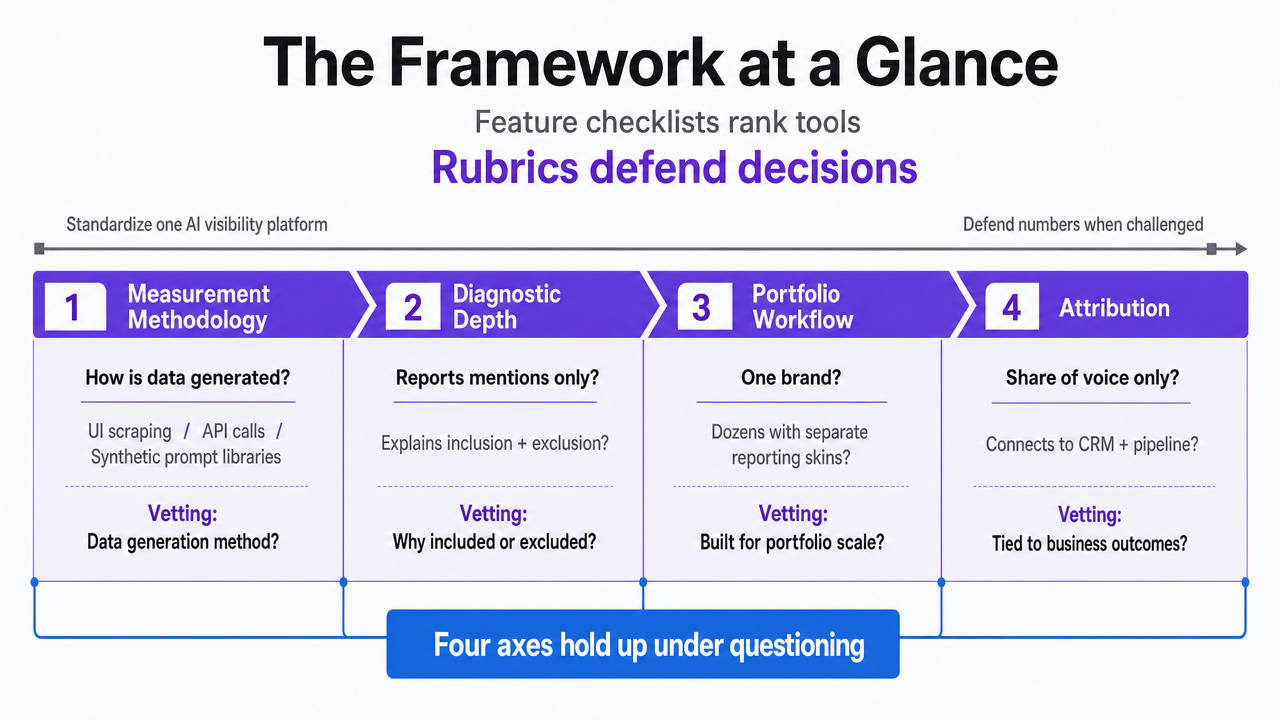
Feature checklists rank tools. Rubrics defend decisions. An agency Head of SEO standardizing on a single AI visibility platform across a client portfolio needs the second, because every recurring service line eventually gets challenged by a client CMO who wants to know why the numbers on the dashboard should be trusted.
Four axes hold up under that questioning:
Measurement Methodology : Asks how the platform generates its data—UI scraping of real answers, API calls, or synthetic prompt libraries.
Diagnostic Depth : Asks whether the tool only reports mentions or also explains inclusion and exclusion.
Portfolio Workflow : Asks whether the platform was built for one brand or for dozens under separate reporting skins.
Attribution : Asks whether visibility data connects to CRM and pipeline signals or stops at share of voice.
Underneath each axis sits a concrete vetting question set drawn from the credibility criteria that credible AI visibility platforms are now expected to meet: running real prompts across major LLMs, tracking whether the brand is mentioned, cited, or excluded, measuring visibility across a defined prompt set, comparing presence to competitors, showing prompt-level results, and trending visibility over time 6. A platform that clears all six on paper can still fail on any one axis in practice. The next four sections work through each in order.
Axis One: Measurement Methodology
Two platforms can watch the same brand across the same engines during the same week and report visibility scores that differ by a factor of three. The gap almost always traces back to methodology. How does the platform actually ask the question, and what does it capture from the answer?
Three methods dominate the category, and each carries a different reliability profile:
- UI scraping runs prompts through the live web interface of ChatGPT, Perplexity, Google AI Mode, and Gemini, then parses the rendered response the way a user would see it. This produces the closest analog to real user experience but is the most fragile—interface changes, rate limits, and personalization can distort results.
- API-based collection pulls answers through official model endpoints, which is stable and cheap to scale but misses the retrieval-augmented layer that shapes what a logged-in user actually sees inside a consumer product.
- Synthetic prompt libraries generate large volumes of variant queries to sample how a brand surfaces across an intent space, which is powerful for coverage but drifts from real search demand unless the library is anchored to observed query data.
None of the three is inherently correct. What matters for an agency is that the vendor can name their approach on a discovery call and explain what it does and does not capture. Ask specifically: does the platform run real prompts across major LLMs, and can it show prompt-level results with mention, citation, and exclusion states recorded for each 6? Ask which engines are covered natively versus inferred, because platform coverage across ChatGPT, Google AI Overviews, AI Mode, Perplexity, Gemini, and Copilot varies significantly by vendor 1, 3. A tool that scrapes ChatGPT but pulls Gemini through API is comparing two different signals and calling it one score. That is the kind of methodological asymmetry a client CMO will spot the first time two vendors' reports land on the same desk.
Axis Two: Diagnostic Depth vs Monitoring Discipline
A monitoring tool tells an agency that a client's mention rate on category prompts fell from 34% to 22% over eight weeks. A diagnostic tool tells the agency why—which prompts lost the mention, which competitors filled the space, which citation patterns disappeared, and which content or entity signals correlate with the change. Both are useful. They are not interchangeable.
The distinction matters because diagnostic platforms carry model-drift risk that monitoring platforms do not. Diagnostic tools infer or reverse-engineer the reasons AI systems include or exclude a brand 6. Those inferences depend on model behavior that changes when the underlying LLM updates, and updates are not scheduled around agency reporting cycles. A recommendation that produced a lift in October can produce nothing in January because the model weighting shifted. Monitoring-only tools sidestep that risk by never claiming causality—they report what happened, not why.
Neither approach is safer by default. A monitoring-only stack leaves the agency doing the diagnostic work manually, which does not scale past a handful of accounts. A diagnostic-heavy stack accelerates recommendations but obligates the agency to communicate uncertainty honestly to clients, especially in high-stakes verticals where a wrong optimization thesis wastes a quarter of content spend.
The practical vetting question is whether the platform separates observation from inference in its UI and its exports. A dashboard that labels a mention rate change as fact and a recommended fix as hypothesis—ideally with the confidence interval or supporting evidence attached—can be defended to a client. A dashboard that renders both in the same font weight cannot. For agencies productizing AI visibility as a recurring service, that presentation-layer discipline is what makes the diagnostic output survive contact with a skeptical CMO.
Axis Three: Portfolio Workflow for Multi-Client Operations
The features that matter for a single in-house brand—slick dashboards, deep sentiment analysis on one prompt library, weekly emails—matter less when 40 client brands need parallel measurement, each with its own competitor set, prompt library, industry vertical, and reporting cadence. Agency workflow is a first-class evaluation dimension, not a bonus feature.
Four questions separate portfolio-ready platforms from in-house tools dressed for agencies:
- Does the platform support a genuinely multi-tenant architecture, with client workspaces isolated from one another and role-based access that allows analysts to work across accounts without exposing data between them?
- Does it offer white-label reporting—not just a logo swap, but full domain masking, custom color schemes, and branded PDF exports that can be resold under the agency's name 2?
- Does it support scheduled prompt libraries per client, so the query set stays anchored to that brand's category and competitors rather than a generic industry template 2?
- Does the seat model scale, or does per-user pricing punish agencies for adding analysts to shared accounts?
Platforms explicitly built for agency workflows tend to advertise these capabilities—SE Ranking's Visible product and OtterlyAI, for example, are positioned around multi-client dashboards and white-label output 2, 3. Enterprise-oriented tools like Profound and Scrunch AI carry deeper diagnostic capability but may require workarounds to run at portfolio scale 1, 3. Neither is disqualified by that positioning. The point is to know which side of the tradeoff the platform sits on before signing an annual contract, because retrofitting agency workflow onto a single-tenant tool is where operational margin quietly disappears.
Axis Four: Attribution to Pipeline and Lead Quality
Share of voice on a ChatGPT prompt set is a metric. It is not, on its own, an argument for renewal. The platforms that will hold up over a full contract cycle are the ones that map visibility data into presence, positioning, and perception categories and then correlate those signals with qualified traffic, CRM records, and pipeline outcomes 5.
Attribution capability sits on a spectrum:
- At the low end, a platform tracks mentions and citations and exports them as CSV—useful raw material, but the agency has to build the connection to client CRM data manually.
- In the middle, the tool ingests referral data from AI engines and tags sessions arriving from Perplexity or Copilot citations, letting the agency see which mentions actually delivered visits.
- At the high end, the platform integrates directly with HubSpot, Salesforce, or a call intelligence layer so that a citation on a specific prompt can be tied to a qualified opportunity downstream 5.
Most tools are not at the high end yet, and vendors know it. The vetting question is not whether full attribution exists today. It is whether the platform's roadmap and data model can support it. Does the tool timestamp mentions at prompt-level granularity? Can it export to a warehouse where the agency's own attribution model lives? Does it capture citation URLs that can be matched against server-side referral logs? An affirmative on those three keeps the door open to pipeline attribution even if the native integration is not ready.
Test AI-driven brand visibility at full scale
Experience measurable brand consistency and workflow efficiency with unrestricted publishing during your seven-day trial.
Vetting Named Platforms Against the Framework
Applying the four axes to specific platforms turns the framework from theory into a discovery-call script. The point is not to declare a winner. It is to show where each tool sits on each axis so an agency can match platform strengths to the client mix it actually manages.
- Scrunch AI and Profound are frequently positioned as diagnostic-heavy platforms with deep engine coverage and enterprise reporting, which pairs well with agencies serving large B2B accounts where the client CMO wants to know why the brand lost share on a specific prompt cluster 1, 3. Portfolio workflow tends to be the weaker axis—both were architected around depth per brand rather than breadth across brands.
- SE Ranking's Visible product and OtterlyAI tilt the other direction. Both are explicitly positioned around multi-client dashboards, white-label reporting, and lower-friction onboarding for mid-market agency portfolios 2, 3. Diagnostic depth is lighter, so an agency using either as its primary platform typically pairs it with manual competitive teardowns for higher-value accounts.
- Peec AI sits closer to the monitoring end of the spectrum with competitive share-of-voice reporting as its center of gravity 3.
- Ahrefs Brand Radar and Brand24 extend visibility tracking from adjacent categories—SEO tooling and social listening respectively—so their strength on the methodology axis depends heavily on how each vendor bridges its legacy data stack to real LLM prompt runs 1.
- Writesonic's visibility features illustrate the all-in-one tradeoff: convenience of a single vendor, less rigor than specialist tools built purely for AI visibility measurement 3.
The operational takeaway is that no single platform clears all four axes at the same depth. An agency running 40 mixed accounts will usually land on one portfolio-first platform for baseline reporting and a specialist diagnostic tool for the three or four accounts where the fee justifies the second seat. That two-tool posture is easier to defend on a renewal call than a single-vendor compromise, because each tool is doing what it was actually built for.
If You Manage Multiple Client Brands: Portfolio Economics
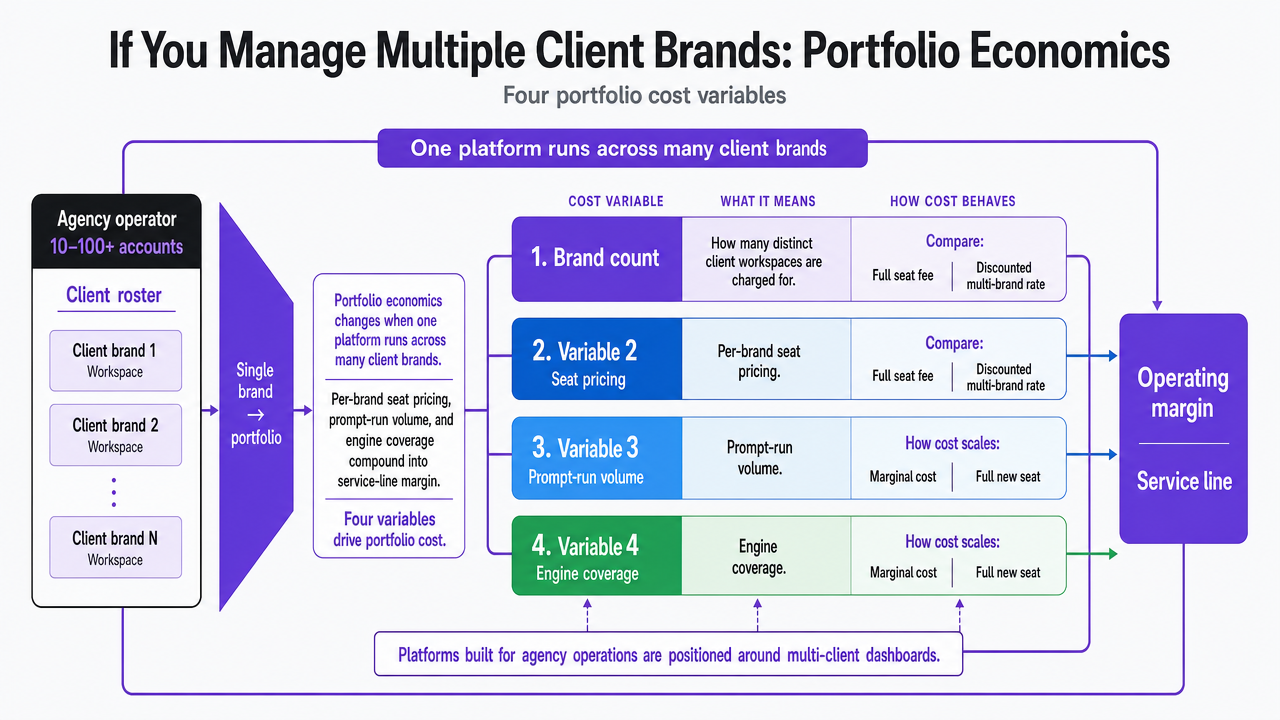
The math changes once the same platform has to run across a client roster rather than a single brand. This section is written for the agency operator managing 10 to 100+ client accounts—the point at which per-brand seat pricing, prompt-run volume, and engine coverage stop being line items and start compounding into the operating margin of an entire service line.
Four variables drive portfolio cost, and each vendor exposes them differently in their pricing model:
- The first is brand count—how many distinct client workspaces the platform charges for, and whether each carries a full seat fee or a discounted multi-brand rate. Platforms explicitly built for agency operations, such as SE Ranking's Visible product and OtterlyAI, are positioned around multi-client dashboards where adding a brand is closer to a marginal cost than a full new subscription 2, 3. Enterprise-diagnostic tools like Profound and Scrunch AI more often meter by brand at higher tiers, which is defensible on depth but expensive at portfolio scale 1, 3.
- The second variable is prompt library size per brand. A category with 40 buyer-intent prompts costs less to monitor than one with 400. Vendors that meter by prompt-run volume rather than by seat push the cost curve toward larger, more strategic clients and away from long-tail accounts where the fee structure inverts on the agency.
- The third is engine coverage. Running the same prompt set across ChatGPT, Google AI Overviews, AI Mode, Perplexity, Gemini, and Copilot multiplies query volume by six 1, 7. Some vendors bundle engines into flat tiers; others charge per additional engine. The latter model punishes agencies that need full-surface coverage to defend visibility scores to a CMO.
- The fourth is reporting cadence. Weekly refreshes on 40 brands across six engines and 100 prompts each is a different cost profile than monthly refreshes on the same footprint.
| Variable | Portfolio-friendly signal | Cost-escalation signal |
|---|---|---|
| Brand count | Multi-brand workspace pricing, white-label included 2 | Per-brand seat fees at enterprise-tier rates 1 |
| Prompt library per brand | Flat prompt allowance across all client workspaces | Metered per-prompt-run billing |
| Engine coverage | Bundled tier covering all six major engines 1, 7 | Per-engine surcharges above a base of two or three |
| Reporting cadence | Configurable refresh intervals per client | Fixed high-frequency polling billed to the agency |
The operational takeaway is that portfolio economics rarely favor a single platform across the entire client mix. A tiered stack—portfolio-first tool for baseline reporting on the long tail, specialist diagnostic tool for the top-fee accounts where the second seat pays for itself—tends to protect margin better than forcing every client into the same license.
See How Leading Agencies Automate Brand Consistency with AI
Request a personalized walkthrough of AI-driven brand visibility tools proven to synchronize messaging, voice, and market positioning across high-volume, multi-channel campaigns—without expanding your headcount.
Governing Data Provenance in Client Deliverables
Every AI visibility report an agency sends to a client is a synthesis of prompts, model outputs, scraping logs, and inferred recommendations. When the client CMO asks where the mention rate number came from, the answer needs to be documented, not remembered. That is the operational reason to treat data provenance as a deliverable requirement rather than a back-office concern.
The NIST AI Risk Management Framework Playbook translates provenance into a set of questions any mature AI workflow should be able to answer: what are the sources and origins of the data, what transformations and augmentations were applied, what labels and dependencies attach to each record, and what constraints or metadata travel with the output 8. Applied to AI visibility work, that means an agency should be able to name the prompt set that produced a score, the engines it ran against, the collection method used, the date of the run, and any filtering or normalization applied before the number reached the client dashboard.
Platforms that expose prompt-level results, timestamped collection logs, and exportable citation URLs make that documentation routine. Platforms that only surface aggregated scores force the agency to build the audit trail manually—which usually means it does not get built until a client challenges a number and the account team is scrambling to reconstruct a quarter of methodology on a Friday afternoon.
From Measurement to a Brand Intelligence Layer
Measurement is the first half of the problem. Once an agency knows which prompts surface the client brand, which competitors keep appearing in the same answers, and which citations the model actually rewards, the harder question is what to do with that intelligence at portfolio scale. Reading the signal is not the same as acting on it across 40 accounts without adding headcount.
The category is already pointing in that direction. AEO-oriented platforms are being built to map visibility data into presence, positioning, and perception categories and connect those signals to CRM and pipeline outcomes rather than stopping at a share-of-voice chart 5. The martech-stack view treats AI visibility tracking as adjacent to SEO, brand, and demand generation tooling, which means the outputs need to feed downstream execution rather than sit in a standalone dashboard 7.
The practical extension is a brand intelligence layer that holds each client's voice, positioning, competitor set, product context, and prompt library as durable memory—then routes visibility findings into content, PPC, and outreach work with human approval at each step. Platforms like Vectoron are built around that loop. For an agency Head of SEO, the selection question shifts from which tool reports the cleanest number to which measurement stack feeds the execution system that actually moves it.
Frequently Asked Questions
References
- 1.Choosing an AI Brand Visibility Monitoring Tool in 2026.
- 2.7 Best AI Brand Visibility Tracking Tools (2026).
- 3.Best AI Visibility Tools for Brand Mention Tracking (2026).
- 4.The 8 best AI visibility tools in 2026.
- 5.The best AEO tools that actually improve lead quality.
- 6.The 10 Best Tools for Tracking AI Visibility.
- 7.Best AI Brand Visibility Tracking Tools in 2026.
- 8.AI RMF Playbook - NIST AI Resource Center.
- 9.Do people click on links in Google AI summaries?.
- 10.Pew Research Center report on AI summaries and search behavior.