
Key Takeaways
- Otterly.AI delivers the broadest multi-engine citation coverage across ChatGPT, Perplexity, Gemini, AI Overviews, AI Mode, and Copilot, making it useful for consistent reporting across many client accounts 6.
- Profound is the enterprise-weight monitor, backed by a $96 million round and offering prompt-level analysis and narrative depth for regulated brands where wording matters as much as citation counts 2, 14.
- Peec AI focuses on hallucination detection and competitive accuracy across LLMs, giving agencies in legal, healthcare, and financial services a fact-correction queue rather than a share-of-voice slide 12.
- Scrunch AI pairs competitor visibility gaps with content, prompt, and off-site recommendations, pushing closer to an execution brief than a dashboard export for internal content teams 11, 14.
- Semrush AI Toolkit consolidates AI visibility onto the largest existing SEO data foundation, resolving workflow fragmentation for agencies already running Semrush across their client book 10, 11.
- Similarweb reads AI citation share against organic and paid traffic in one interface, giving strategists a revenue-attribution story that pure citation monitors cannot support 10.
- Ahrefs Brand Radar layers AI citation and mention data onto the Ahrefs stack, and its 75,000-brand analysis identifies YouTube title and transcript mentions as the strongest AI Overview correlator 3, 10.
- ZipTie and Vectoron occupy the execution-linked quadrant, routing visibility reads into ranked work queues, which matters under citation decay curves where refresh windows close within days 1, 4.
The Split in the 2026 GEO Tools Market
The AI visibility tracking category matured fast, and by 2026 it split into two clearly different products dressed in similar dashboards. Analyst coverage of the generative engine optimization landscape frames the divide directly: passive monitoring platforms that count citations across ChatGPT, Perplexity, Gemini, Google AI Overviews, and Copilot on one side, and agentic execution platforms that turn those readings into ranked work on the other 1. The distinction matters because agencies do not buy dashboards for their own sake. They buy them to fill a client reporting slot, expose an opportunity, or trigger production work across a portfolio.
Capital has followed the same split. Specialized GEO tools attracted meaningful funding rounds through 2025 and 2026, including a $96 million round for Profound, as brands treat AI citation share as infrastructure rather than a curiosity metric 2. That investment is uneven across the category. Monitoring tools raised on breadth of coverage; execution-adjacent platforms raised on the promise of closing the loop between measurement and content, off-site signal, and technical fixes.
For an agency head of SEO running fifteen to a hundred and fifty accounts, the practical question is not which tool has the prettiest citation graph. It is whether a given platform adds a tab to an already crowded stack or absorbs some of the prioritization work an in-house strategist would otherwise do. The eight tools that follow are evaluated on exactly that axis.
How to Evaluate AI Visibility Tools as an Agency Buyer
The Monitoring-vs-Execution Axis
Feature checklists collapse under portfolio load. An agency running forty accounts does not need a tool that can display citation share across five LLMs; it needs a tool whose output changes what the content team does on Monday morning. That is the axis worth scoring on.
Analyst coverage of the 2026 GEO landscape frames the same divide, contrasting passive monitoring dashboards with agentic execution platforms that translate visibility data into work 1. Four operational roles fall out cleanly:
- Multi-engine monitors — count citations broadly across ChatGPT, Perplexity, Gemini, Google AI Overviews, and Copilot.
- Competitor and hallucination trackers — focus on side-by-side share and accuracy.
- Integrated SEO+GEO suites — layer AI visibility onto keyword and backlink data agencies already pay for.
- Execution-linked platforms — rank and route the resulting work into content, off-site, and technical queues.
Every tool covered in the next section is scored on that grid. A monitor that produces beautiful weekly PDFs but no prioritized action list belongs in one quadrant. A platform that reads a client's citation gaps and generates the content brief belongs in another. Both can be correct purchases; they solve different problems.
What the Tools Should Actually Measure
Citation counts are the easy number. They are also the least useful one in isolation, because they do not tell an agency why a client is invisible or what a strategist should do about it. A defensible AI visibility tool exposes the signals that predict citation, not just the citations themselves.
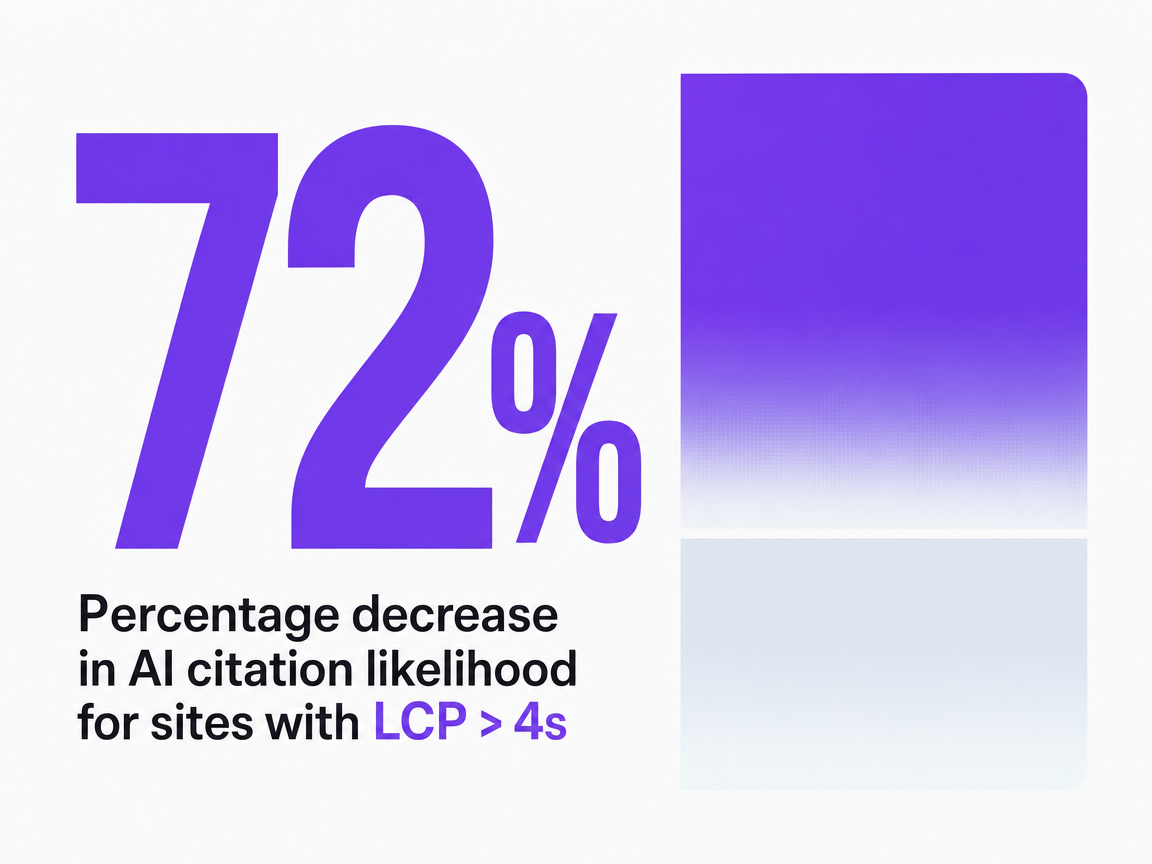
Site performance is one of those signals, and it is measurable today. A 2026 technical guide analyzing brand visibility factors in AI search reports that sites with Largest Contentful Paint over 4 seconds are 72% less likely to be cited in AI answers 7. This correlation, while not a universal law, is directionally consistent with how LLM crawlers and retrieval systems weight source quality. For an agency, it means a visibility dashboard that ignores Core Web Vitals is missing a lever the SEO team already knows how to pull.
The same logic applies to off-site signal tracking. An Ahrefs analysis of 75,000 brands found that mentions in YouTube video titles and transcripts were the single strongest correlating factor with AI Overview visibility 3. Tools that surface off-site mention gaps, structured data errors, and page-speed regressions alongside citation share give strategists something to act on. Tools that show citation share alone give them a slide for the next client call.
Why Citation Decay Changes the Reporting Cadence
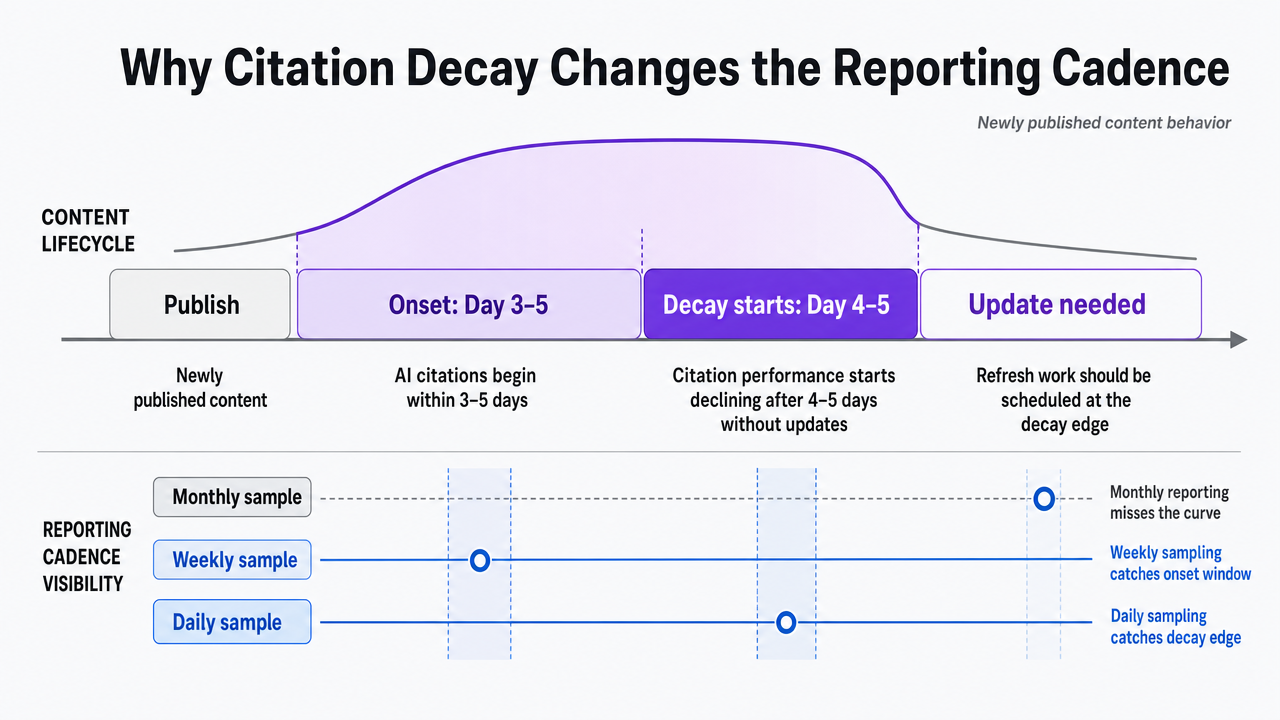
AI citations behave nothing like traditional rankings. Analysis of the GenOptima AI Brand Visibility Report notes that newly published content can begin generating AI citations within three to five days, but citation performance typically starts declining after four to five days without updates 4. That describes newly published content behavior specifically, not every URL on a domain, but it is enough to break the monthly reporting model most agencies still run on.
A dashboard sampled every thirty days cannot see this curve. It sees a snapshot before onset, or a snapshot after decay has already erased the gain, and the client hears that citation share moved without any explanation of why. Weekly sampling catches the onset window. Daily sampling catches the decay edge, which is where refresh work needs to be scheduled.
The operational consequence is direct. If citation performance decays inside a week without refresh, the tool has to hand the content team a ranked refresh list on the same cadence. Otherwise the agency is measuring a signal it cannot act on fast enough to matter.
 Percentage decrease in AI citation likelihood for sites with LCP > 4s
Percentage decrease in AI citation likelihood for sites with LCP > 4s
Test AI brand visibility tracking on live campaigns
See how automated visibility insights impact real client performance with unrestricted platform access for seven days.
The Eight Tools, Grouped by Operational Role
Multi-Engine Monitors: Otterly.AI
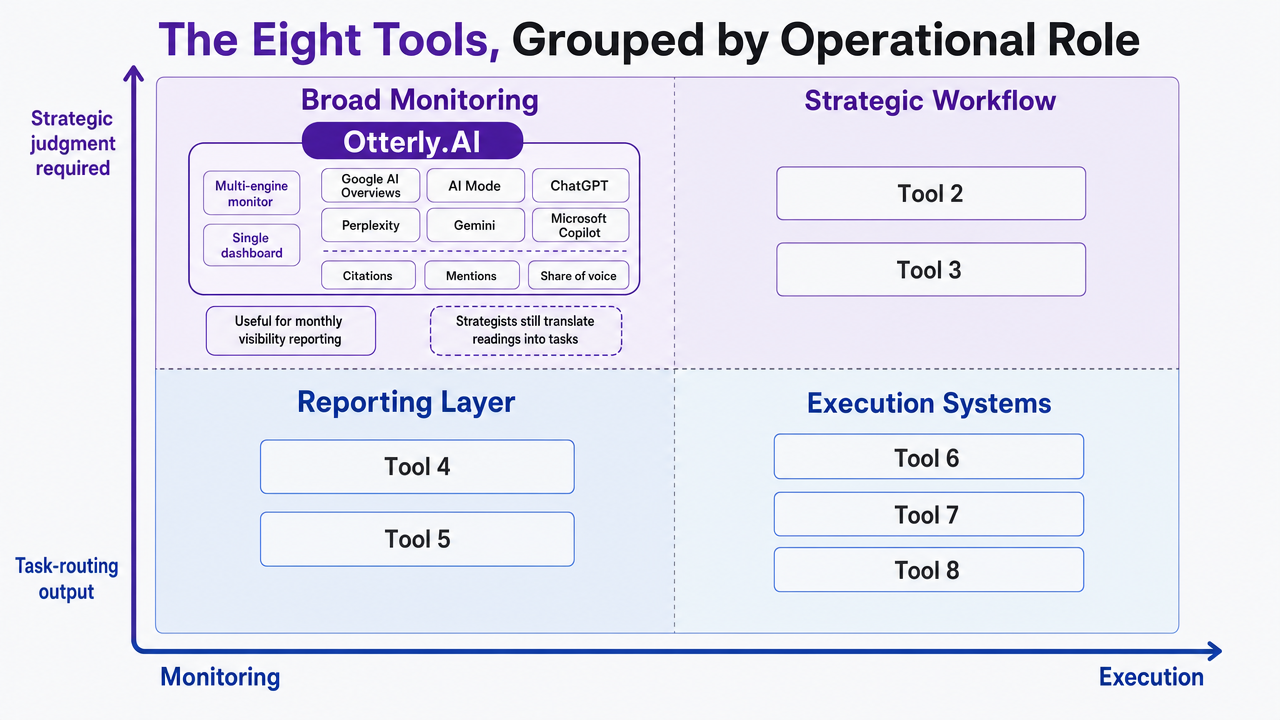
Otterly.AI earns its slot on breadth. Trade coverage of the 2026 category places it at the top of the multi-engine monitor group, tracking Google AI Overviews, AI Mode, ChatGPT, Perplexity, Gemini, and Microsoft Copilot inside a single dashboard 6. For an agency SEO lead who needs one screen that answers the client question of "where are we showing up across AI," that coverage is the point.
The operational judgment is narrower than the marketing suggests. Otterly.AI reports on citations, mentions, and share of voice per engine, which is enough to fill a monthly client slide but not enough to route work. There is no native content brief output, no off-site signal queue, no technical audit layer. Strategists still translate the readings into tasks.
For agencies with a functioning content ops team and a reporting cadence to defend, that trade is acceptable. The tool sits alongside Ahrefs or Semrush rather than replacing anything, and its value scales with the number of client accounts that need consistent multi-engine coverage without a custom prompt panel per brand 10. It is a monitor, priced and scoped as one.
Multi-Engine Monitors: Profound
Profound is the enterprise-weight entry in the monitor category. A 2026 synthesis report on the AI search market notes the platform closed a funding round above $96 million, and analyst coverage places it among the largest all-in-one platforms an agency can deploy for AI visibility tracking 2, 10. The capital has bought engineering headroom that shows up in prompt-level monitoring, custom answer engines, and enterprise reporting features that mid-market monitors do not offer.
The tool tracks visibility across the major LLM surfaces and layers in narrative analysis, which matters for agencies handling regulated brands where the wording of an AI answer carries as much weight as the citation itself 14. Built In's category coverage identifies Profound as one of the reference platforms brands and their agencies use when the question is not just "are we cited" but "what is being said" 14.
For an agency running a large enterprise book, Profound's ceiling is higher than the mid-market monitors and its floor, in terms of setup effort and cost, is higher too. It is a platform choice, not a line item. Small books do not need it; enterprise books cannot easily justify a lighter tool once client questions move past raw citation counts.
Competitor and Hallucination Trackers: Peec AI
Peec AI is built for the question monitors avoid: is the AI answer about a client actually accurate, and how does that answer compare to a named competitor. A 2026 competitive analysis of the category identifies Peec AI's core strength as detecting hallucinations and incorrect information across LLM outputs, with a stated fit for B2B SaaS, agencies, and accuracy-critical brands 12.
That focus reshapes the reporting output. Instead of a citation count trending up or down, an agency strategist sees which LLM is telling which client story wrong, and where a competitor is capturing the frame. The tool's multi-platform citation analysis has been cited in broader industry synthesis work as one of the datasets shaping how agencies audit AI visibility today 3.
For agencies serving legal, healthcare, financial services, or any vertical where a fabricated capability claim creates liability, this is the more defensible instrument. It replaces nothing in an existing SEO stack. It sits next to the monitors and produces a different work queue, one aimed at fact correction and competitive positioning rather than share-of-voice reporting.
Competitor and Hallucination Trackers: Scrunch AI
Scrunch AI sits in the same evaluative quadrant as Peec AI but leans harder toward actionable GEO output. A 2026 review of AI visibility tools describes Scrunch's strength as producing actionable generative engine optimization insights, not just citation reports 11. Built In's coverage places Scrunch alongside Profound and Peec AI as one of the reference platforms in the AI search optimization service category 14.
Where Scrunch differs is the translation step. The tool surfaces competitor visibility gaps and pairs them with specific content, prompt, and off-site recommendations, which is closer to an execution brief than a dashboard export. For an agency head of SEO evaluating whether a tool changes what the content team does next week, Scrunch is one of the few in the tracker category that credibly attempts that handoff.
The tool does not fully close the loop into production. It does not write the refresh, brief the writer, or push the update. It hands a prioritized list to whoever does. For agencies with internal content operations, that is often the correct division of labor.
Integrated SEO+GEO Suites: Semrush AI Toolkit
Semrush's AI Toolkit is the most defensible choice for agencies already running the platform's traditional SEO stack. A 2026 review describes it as offering the largest data foundation in the category, layering AI visibility tracking onto the existing keyword, backlink, and site audit surfaces agencies already pay for 11. Zapier's 2026 category guide reaches the same conclusion, positioning Semrush as the tool for existing Semrush users rather than a standalone AI visibility purchase 10.
The operational judgment is straightforward. If a client book already runs on Semrush dashboards, adding the AI Toolkit consolidates reporting and eliminates a second login, a second data export, and a second white-label configuration. Wix Studio's category catalog also names the Semrush AI Toolkit as a primary option for bridging traditional analytics with AI search visibility 13.
The limits mirror the other suites. Coverage of AI engines is narrower than the specialist monitors, and the citation depth trails purpose-built trackers on hallucination detection and prompt-level analysis. For agencies whose reporting pain is workflow fragmentation rather than analytical depth, that trade is worth taking. For agencies whose clients ask specifically about ChatGPT answer accuracy, it is not.
Integrated SEO+GEO Suites: Similarweb AI Visibility
Similarweb's AI visibility module leans on the company's traffic and market intelligence foundation. Zapier's 2026 category guide identifies Similarweb as the tool for side-by-side SEO and GEO tracking, where AI citation share is read against organic and paid traffic patterns in the same interface 10.
For an agency reporting to clients who care about revenue attribution rather than citation counts alone, that pairing is useful. Strategists can show a decline in organic click-through against a rise in AI Overview presence for the same query set, which is a harder story to tell inside a monitor that only sees the AI side.
The tool is less useful for agencies whose primary need is deep prompt-level analysis or hallucination detection. Similarweb's strength is comparative context, not narrative accuracy. It sits inside an existing SEO+market intelligence stack cleanly, and it replaces the need for a separate traffic-benchmarking tool for many mid-market accounts. On the monitoring-to-execution axis, it stays firmly on the measurement side.
Integrated SEO+GEO Suites: Ahrefs Brand Radar
Ahrefs Brand Radar is the AI visibility layer for agencies already committed to the Ahrefs backlink and content research stack. Zapier's 2026 guide positions it as the option for benchmarking brand performance, aligned with Ahrefs' historical strength in comparative index data 10. The value is proximity: agencies pulling backlink gaps and content audits from Ahrefs get AI citation and mention data on the same platform.
Ahrefs also runs some of the most-cited underlying research in the category. A widely referenced analysis of 75,000 brands found that mentions in YouTube video titles and transcripts were the single strongest correlating factor with AI Overview visibility 3. That finding shapes how Brand Radar's mention tracking is used in practice. Agencies that treat off-site video presence as a signal, not just a channel, get more from the tool than agencies still reporting on written mentions alone.
The trade against specialist monitors is the same as with Semrush. Engine coverage and prompt-level depth are narrower. The gain is stack cohesion, which for agencies managing forty or more accounts often outweighs the analytical ceiling of any individual specialist tool.
Execution-Linked Platforms: ZipTie and Vectoron
The execution-linked quadrant is the smallest and the most operationally distinct. Analyst coverage of the 2026 GEO market frames this group as the shift from passive monitoring dashboards to agentic execution platforms that translate visibility data into ranked work 1. Two tools in this list sit here.
ZipTie is the lighter-weight entry. Zapier's 2026 guide includes it among the recognized AI visibility platforms and positions it toward agencies and teams that want citation tracking paired with actionable recommendations rather than reporting alone 10. It is not a full production system; it is a monitor with sharper handoff into what to do next.
Vectoron represents the fuller execution model. The platform pairs AI visibility signals with content, off-site, and technical work queues managed through an approval workflow, so citation gaps identified in monitoring surface as ranked briefs for the content team rather than as separate PDF exports. For agencies running fifteen to a hundred and fifty accounts under citation-decay conditions where newly published content can begin generating AI citations within three to five days but decline after four to five days without updates 4, the compression from reading to routed work is the operational point. Both tools sit on the execution side of the axis. Neither replaces the specialist monitors for pure breadth; both change what happens after the reading.
Comparison Table: Coverage, Pricing, and Agency Use Case
The table below summarizes how each tool sits on the monitoring-to-execution axis and where it fits inside an agency stack. Pricing is marked "not disclosed" where the sourced material does not state a specific figure at the entry tier.
| Tool | Operational Role | AI Engines Tracked | Primary Agency Use Case |
|---|---|---|---|
| Otterly.AI | Multi-engine monitor | Google AI Overviews, AI Mode, ChatGPT, Perplexity, Gemini, Copilot 6 | Broad citation reporting across many client accounts 6, 10 |
| Profound | Enterprise monitor | Major LLM surfaces with prompt-level analysis 14 | Enterprise books needing narrative and prompt depth 2, 14 |
| Peec AI | Competitor and hallucination tracker | Multi-LLM citation and accuracy analysis 12 | Accuracy audits in regulated verticals 3, 12 |
| Scrunch AI | Competitor tracker with GEO actions | Multiple LLMs with actionable GEO output 11 | Prioritized recommendation lists for content teams 11, 14 |
| Semrush AI Toolkit | Integrated SEO+GEO suite | Layered onto Semrush data foundation 11, 13 | Consolidated reporting for existing Semrush books 10, 11 |
| Similarweb | Integrated SEO+GEO suite | Side-by-side SEO and GEO tracking 10 | Traffic-attribution context for AI citation shifts 10 |
| Ahrefs Brand Radar | Integrated SEO+GEO suite | AI citation and mention data inside Ahrefs 10 | Off-site mention and benchmark work 3, 10 |
| ZipTie / Vectoron | Execution-linked platform | Multi-engine reads routed into work queues 1, 10 | Portfolio operators compressing reading into ranked action 1, 4 |
Pricing not disclosed at entry tier across the cited sources; agencies should confirm current rates directly with each vendor.
The right column is the one that matters. Coverage differences narrow every quarter; the use-case column is where an agency stack decision actually gets made.
See How Top Agencies Track Brand Visibility Using AI—Without Scaling Headcount
Request a walkthrough of unified brand visibility tracking and approval workflows that streamline reporting, performance monitoring, and multi-client management for agencies operating at scale.
If You Manage 15+ Client Accounts: Consolidation Math
Scope shifts here from single-brand evaluation to portfolio operators running fifteen or more accounts. At that scale, the tool stack becomes a line item that multiplies against every client, and the question stops being which platform reads AI citations most cleanly. It becomes how many platforms a strategist can defensibly maintain per book.
The variables are straightforward. Total tool cost per month scales as licenses × number of clients tracked × reporting frequency, with a step change when a tool moves from account-level to workspace-level billing. Trade coverage of the 2026 category confirms that entry pricing and seat structures vary widely across Otterly.AI, Profound, Peec AI, and the integrated suites, which is why consolidation math rarely resolves on price alone 6, 10. A cheaper monitor that requires a second execution tool to route work often costs more in strategist hours than a single execution-linked platform.
The consolidation call comes down to whether adding a specialist monitor pays back in client retention or upsell. If it does not, the integrated suite already in the stack usually wins on operator hours saved per account.
Fitting AI Visibility Data Into an Existing SEO Stack
AI visibility data is only useful if it lands in a workflow that already exists. For agencies running Ahrefs or Semrush across a client book, the integration question is where the citation feed enters the audit-to-production loop, not whether to open a new tab for it. Trade coverage of the 2026 category consistently frames these tools as bridges between traditional analytics and AI search visibility rather than replacements for the underlying stack 13.
Three integration points hold up in practice:
- The monthly content audit, where AI citation share per priority query joins organic ranking and click-through data to reshape refresh priority.
- The off-site work queue, where mention gaps in AI answers pair with backlink gaps from the existing SEO tool, and Ahrefs' 75,000-brand analysis showing YouTube mentions as the strongest correlating factor with AI Overview visibility becomes an assignable off-site task, not a slide 3.
- The technical audit, where Core Web Vitals and structured data findings from the current stack get re-weighted against AI citation likelihood.
The stack question resolves cleanly. Specialist monitors add a data feed. Integrated suites consolidate reporting. Execution-linked platforms compress the reading-to-work handoff that eats the most strategist hours across a portfolio.
Frequently Asked Questions
References
- 1.Generative Engine Optimization Tools 2026: AI Search Visibility Landscape.
- 2.AI Search & GEO Report 2026: New Front Door of the Internet.
- 3.AI Search Visibility in 2026: What the Data Says, What’s Working, and Where Most Brands Are Still Lost.
- 4.The 30% Problem: Why Most Brands Are Invisible to AI Search in 2026 and What the Data Says You Should Do About It.
- 5.The Role of Artificial Intelligence in Personalizing Social Media Marketing.
- 6.10 Best AI Visibility Tools in 2026 for Tracking Brand Presence Across AI Search Platforms.
- 7.What Influences Brand Visibility in AI Search? A Practical Guide for 2026.
- 8.Top 10 Social Listening Tools for Brand Monitoring Success.
- 9.Forrester Wave Report Names Top Four Social Listening Tools.
- 10.The 8 best AI visibility tools in 2026.
- 11.The Best AI Visibility Tracking Tools (My Honest Reviews).
- 12.Peec AI - Competitive....
- 13.14 best tools to track brand visibility in AI search.
- 14.Agencies That Help Brands Appear in AI Search Results.