
Key Takeaways
- AccuRanker anchors SERP accuracy with pixel-level position detection and two-hour refresh cycles, turning rank data into a control input rather than a lagging postmortem report 14.
- Semrush and Ahrefs win on enterprise breadth, keyword databases, and API depth, though their AI visibility modules and daily refresh cadence trail specialist tools.
- STAT and Nightwatch fit portfolio delivery where six-figure keyword counts, local segmentation, white-label reporting, and per-client workspace math drive the buying decision over AI coverage.
- SE Ranking bridges both tracks in one workspace across GPT, Gemini, Copilot, and Google AI Overviews, trading prompt library depth for consolidated reporting 15.
- Rankscale and dedicated LLM tools treat AI visibility as the primary discipline, investing in prompt libraries, cross-model coverage, citation attribution, and transparent sampling methodology 16.
- Vectoron routes SERP and AI visibility signals into an approval-first execution loop, converting rank movement into ranked recommendations rather than dashboard telemetry that never triggers action.
Rank tracking split into two disciplines this year
Rank tracking in 2025 no longer describes a single workflow. Agency SEO leads now manage two parallel measurement disciplines: classic SERP position tracking against Google and Bing, and AI answer visibility tracking across Google AI Overviews, ChatGPT, Perplexity, Claude, Gemini, and Copilot. A recent guide to the category reports that 40% of new rank trackers now ship with AI search monitoring built in, tracking brand mentions across LLM outputs alongside traditional keyword positions 14. That share signals a category split, not a feature bolt-on.
The two disciplines use different units of measurement. SERP tracking counts keyword-to-URL positions, SERP feature ownership, and share of voice. AI visibility tracking measures whether a brand appears inside a generated answer at all, using prompts as the unit of observation rather than keywords 16. For delivery teams evaluating tools this year, the practical question is which vendors cover both tracks credibly, and where a paired stack outperforms any single dashboard.
The CTR economics forcing a rethink of tracking spend
Buying criteria for rank tracking software used to center on keyword volume and update frequency. Both still matter, but neither addresses the revenue math that now drives procurement conversations.
When an AI Overview appears on a Google results page, average organic click-through rate falls by 8.9%, and paid performance takes a heavier hit: Google Ads CTR on the same query set drops from 21.27% to 9.87% 1. Those figures come from the same analysis covering the December 2024 state of AI Overviews, and they cut in one direction for uncited pages. The countervailing number sits in the same dataset. Pages cited as sources inside an AI Overview see click-through rates as much as 80% higher than non-cited pages on those queries 1. Inclusion is now the differentiator between a query that pays and a query that leaks traffic to the summary.
For an agency SEO lead defending a tracking budget, that changes the argument. A rank tracker that reports position 3 on a keyword without flagging whether an AI Overview sits above the organic block is measuring a version of the SERP that no longer describes the click economy. The evaluator needs tools that tag AI Overview presence per query, record citation status for the tracked domain, and report both alongside classic position data. Anything less produces reports that look healthy while pipeline softens. That is the shift buyers are pricing when they compare vendors this year, and it explains why traditional position-only trackers have started to look underpowered against hybrid platforms.
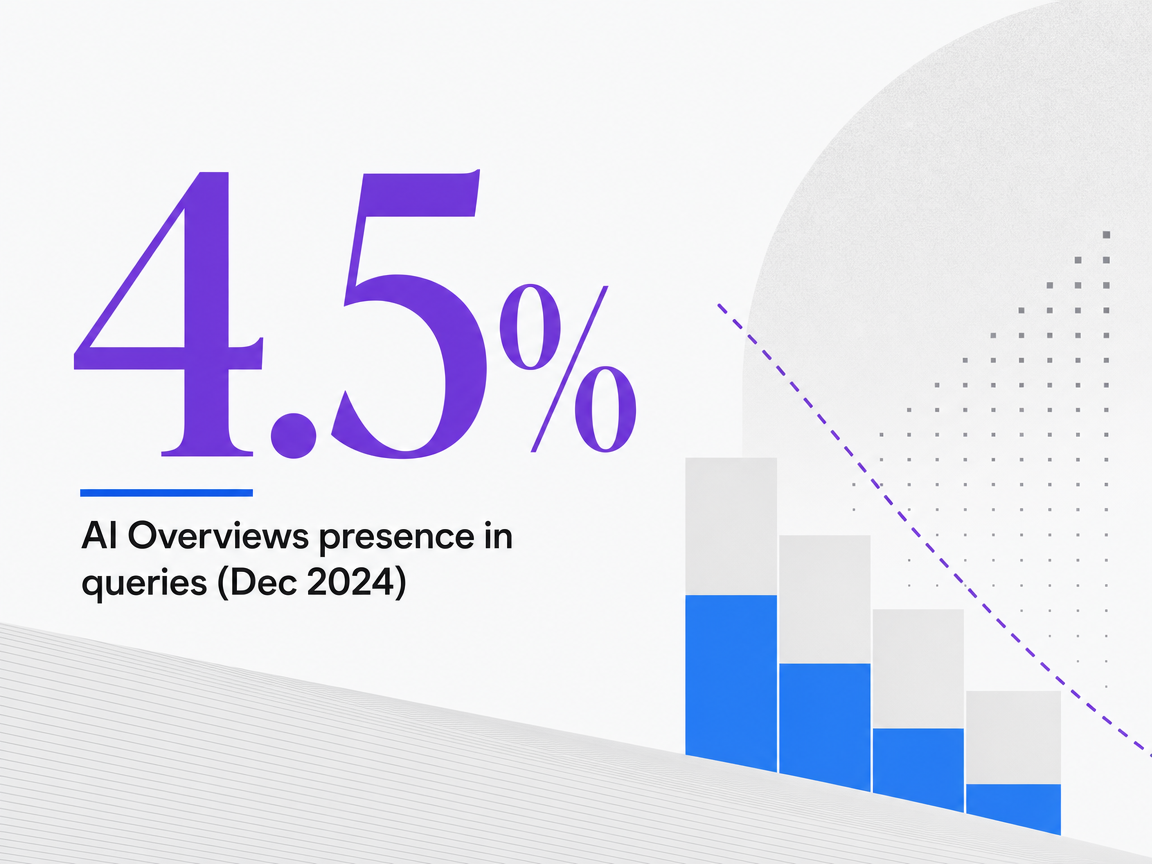 AI Overviews presence in queries (Dec 2024)
AI Overviews presence in queries (Dec 2024)
What AI rank tracking actually measures
AI rank tracking swaps the keyword-to-URL relationship for a prompt-to-mention relationship. The unit of observation is a prompt fired at a large language model, and the measurement is whether the target brand appears inside the generated answer, in what context, and with what citation 16. Position is replaced by inclusion. Volume is replaced by prompt coverage. The reporting question shifts from "where does this page rank" to "how often does this brand surface when a buyer asks the model."
The methodology matters because it drives the data quality. Tools in this category use structured prompt libraries and natural language processing to detect brand presence inside model-generated content, then log citation status, sentiment, and competitive share of mention across runs 15. Some scrape rendered outputs from consumer interfaces, others query APIs, and a third group generates synthetic prompt sets calibrated to a client's category. Each approach produces different numbers for the same brand, which is why agency SEO leads should treat AI visibility metrics as directional until a single methodology is standardized across the client portfolio. Comparability inside one tool beats accuracy claims across tools.
A two-track evaluation framework for agency stacks
Track one: SERP position tracking criteria
SERP tracking still owns the position-to-revenue link on classic blue-link queries, and the buying criteria have tightened. Delivery leads evaluating this track should score vendors on five properties:
- data source accuracy and refresh cadence
- SERP feature detection (including AI Overview presence flags)
- local and mobile coverage across the client roster
- share-of-voice math against a defined competitor set
- API depth for pushing data into reporting warehouses
Accuracy and cadence sit at the top because everything downstream inherits their error rate. One 2026 category guide identifies AccuRanker as the accuracy benchmark, citing pixel-level position tracking and refreshes every two hours 14. That refresh window matters when a client's core commercial keywords shift during a launch or a competitor's price change. Slower daily-only trackers show the same event a day late, which turns the report into a postmortem rather than a control input.
Track two: AI answer visibility criteria
The AI visibility track uses a different scorecard. Evaluators should weigh:
- prompt library depth
- LLM breadth (ChatGPT, Claude, Perplexity, Gemini, Copilot, and Google AI Overviews at minimum)
- citation attribution accuracy
- sentiment and context capture around brand mentions
- how the tool handles run-to-run variance in model outputs
Methodology transparency is the underrated criterion. Tools scrape rendered LLM interfaces, hit APIs directly, or generate synthetic prompt sets, and each approach yields different numbers for the same brand on the same day 16. Delivery leads should ask vendors to document the exact prompt construction, sample size per run, and how they normalize across model updates. A tool that reports a brand appearing in 34% of category prompts without disclosing the prompt count or sampling window is selling a number, not a measurement. Comparability inside a single methodology across weeks matters more than headline accuracy claims.
The attribution problem that separates contenders from also-rans
Every rank drop in 2025 has at least three plausible causes:
- a core algorithm update
- an AI Overview appearing above the organic block
- a genuine position loss driven by competitor movement or on-page decay
Tools that conflate these three produce reports that describe symptoms without diagnosing causes. Search Engine Journal's chronology confirms both signals now run in parallel, with the August 2024 core update demoting low-value content while Gemini-powered AI summaries reshaped result pages in the same window 5.
The contenders in this category timestamp core updates against the tracked keyword set, flag AI Overview presence per query and per run, and let the analyst pivot between those layers in a single view. Also-rans report a position number and leave the diagnosis to a spreadsheet. For an agency defending client retention through a volatile quarter, the difference is whether the QBR opens with "here is what changed and why" or with "we are still investigating."
Test AI Rank Tracking Across Real Campaigns
Monitor and optimize actual keyword rankings for clients during your trial—see live results before making decisions.
The evaluation matrix: eight tools scored against agency criteria
Eight platforms cover most of the shortlists agency SEO leads are weighing in 2025: Semrush, Ahrefs, AccuRanker, SE Ranking, Nightwatch, STAT, Rankscale, and Vectoron. The matrix below scores each against the criteria that decide whether a tool survives a client portfolio: SERP coverage across Google, Bing, and local packs; AI Overview presence detection; LLM coverage spanning ChatGPT, Perplexity, Claude, Gemini, and Copilot; update cadence; multi-client segmentation; API depth; and price tier. The scoring reflects capabilities documented in the category, where 40% of new rank trackers now ship with AI search monitoring built in 14.
No single tool scores at the top of every column. Semrush and Ahrefs lead on breadth and API depth but treat AI visibility as a newer module. AccuRanker anchors SERP accuracy with two-hour refresh cycles 14. SE Ranking and Rankscale sit closer to the AI visibility track. STAT and Nightwatch handle enterprise keyword volume. Vectoron routes rank signals into an approval-first execution loop rather than a standalone dashboard. The matrix reads as a coverage map, not a leaderboard, and that is the point: the paired-stack thesis makes the shortlist a combination question, not a single-vendor choice.
SERP trackers worth shortlisting in 2025
AccuRanker: pixel-level position data with two-hour refresh
AccuRanker earns its shortlist slot on refresh cadence and measurement fidelity. Category reviewers identify it as the accuracy benchmark for classic SERP tracking, citing pixel-level position detection and updates every two hours across the tracked keyword set 14. For agency delivery teams monitoring commercial keywords through product launches, promotional windows, or competitor pricing shifts, that cadence turns rank data into a control input rather than a lagging report. The tool also flags SERP feature ownership per query, which matters when an AI Overview or a featured snippet displaces the organic block. Where AccuRanker underperforms is native LLM visibility; it stays disciplined about SERP mechanics and expects the paired stack to cover prompt-level tracking elsewhere.
Semrush and Ahrefs: enterprise breadth with hybrid AI modules
Semrush and Ahrefs dominate agency shortlists on breadth: large keyword databases, backlink graphs, site audits, competitor intelligence, and API access wide enough to feed reporting warehouses across a client portfolio. Both have added AI visibility modules in response to the category shift, consistent with the reported 40% of new rank trackers now shipping AI search monitoring alongside classic position tracking 14. Neither treats prompt-level tracking as the anchor discipline, which is the trade-off. Evaluators pick these platforms when consolidation matters more than best-in-class AI coverage, when analysts already know the interface, and when the client mix rewards backlink and content data feeding the same dashboard as rank. Refresh cadence on rank data typically runs daily rather than hourly, so pair either with a faster SERP monitor for volatility-sensitive accounts.
STAT and Nightwatch: high-volume tracking for portfolio delivery
STAT and Nightwatch handle the keyword volumes agencies actually run across a portfolio, where six-figure tracked term counts are routine. STAT indexes daily SERPs at scale with granular local and mobile segmentation, share-of-voice math against custom competitor sets, and API access built for warehouse ingestion. Nightwatch sits closer to the agency mid-market with strong multi-client segmentation, white-label reporting, and per-project keyword allocation that keeps client accounting clean. Both integrate SERP feature detection, though AI Overview flagging and LLM prompt tracking remain lighter than what dedicated AI visibility platforms provide. Delivery leads shortlist these tools when reporting depth and portfolio segmentation drive the buying decision, and route AI answer measurement to a second vendor on the paired stack.
AI visibility platforms that hold up across LLMs
SE Ranking: hybrid tool bridging keyword and prompt tracking
SE Ranking sits in the useful middle of the market: a classic SERP tracker that has grafted on AI visibility measurement across GPT, Gemini, Copilot, and Google AI Overviews in a single workspace 15. For agency SEO leads who want one login covering both tracks, that consolidation reduces vendor sprawl and keeps client reporting cohesive. The trade-off is depth. Prompt libraries and citation attribution stay lighter than what specialist AI visibility platforms produce, and methodology transparency around sampling and run frequency lags dedicated tools 16. Delivery leads should shortlist SE Ranking when portfolio scale is moderate, when clients want one dashboard rather than two, and when directional AI visibility numbers are enough to guide content priorities rather than settle attribution disputes.
Rankscale and dedicated LLM visibility tools
Rankscale sits in the specialist tier that treats AI visibility as the primary discipline rather than a bolt-on module. The category, as defined in recent reviews, measures brand inclusion in AI-generated answers using prompts as the core unit of observation instead of keyword-to-URL positions 16. Dedicated tools invest in prompt library construction, cross-LLM coverage spanning ChatGPT, Claude, Perplexity, Gemini, and Copilot, citation attribution, and sentiment capture around each brand mention. Rankscale and its peers publish sampling methodologies more openly than hybrid platforms, which matters when the analyst has to defend a visibility number in a client QBR. Agency SEO leads pair these tools with a SERP tracker when clients compete in categories where LLM-mediated discovery already drives measurable pipeline, and when directional data from a hybrid platform is not enough.
Vectoron: rank data feeding approval-first execution
Vectoron enters the shortlist from a different angle. It is not a standalone rank tracker; it is an execution platform where SERP position data and AI visibility signals feed into a coordinated content and SEO workflow governed by human approval. Rank movement in Vectoron becomes an input into ranked recommendations that specialist strategists surface for review, rather than a chart that ends at the dashboard edge. For agency SEO leads scaling delivery across a client portfolio without adding analysts, that wiring matters more than a marginal accuracy gain on a single keyword. The platform assumes teams still use a best-in-class SERP monitor for pixel-level position data and a dedicated AI visibility tool for prompt-level tracking, then routes the signal into the loop that ships work. Rank data that never triggers action is expensive telemetry.
Segmenting by query intent to avoid misleading signals
Aggregate ranking averages hide the damage AI experiences do to specific query types. A Search Generative Experience test spanning 90,000 queries recorded traffic changes ranging from -64% to +219% across the sample, with 60% of queries producing no AI snapshot at all 2. That variance is the story. A tracker reporting a stable average position across a client's keyword set can mask a 60% collapse on informational terms while commercial and navigational queries hold steady, or vice versa.
The intent breakdown sharpens the point. Top-ranking informational pages have seen click-through declines of 58-61% when an AI Overview sits above them, based on Ahrefs and Seer Interactive data compiled in category analysis 3. Commercial and local queries move differently, and navigational terms often barely register the shift. A rank tracker that cannot segment reporting by query intent forces the analyst to reconstruct the diagnosis in a spreadsheet every week.
Agency SEO leads should require intent tagging at the keyword level, filtered views by intent inside dashboards, and delta reporting that surfaces which intent bucket is losing traffic even when average position looks flat. Tools that treat all queries as interchangeable will produce QBRs that describe a healthy portfolio one month before a client escalates a pipeline problem.
See How Leading Agencies Are Scaling SEO Without Expanding Headcount
Request a walkthrough of unified AI rank tracking and workflow automation designed to help agency teams monitor, report, and act on rankings across all clients—backed by live data and approval-first execution.
If the agency manages multiple client portfolios
Scope shifts here from single-account evaluation to portfolio delivery, where an agency SEO lead is running the same tool across dozens of clients with different verticals, competitor sets, and reporting cadences. At that scale, the buying criteria that mattered for a single-brand shortlist become secondary to segmentation depth, permission architecture, and how cleanly the tool isolates one client's data from the next.
Four capabilities separate portfolio-grade platforms from single-brand tools:
- Workspace segmentation with per-client keyword allocations that map to billing, so an account manager can prove utilization against contract scope.
- White-label reporting with client-specific branding, scheduled delivery, and role-based access for both internal analysts and external stakeholders.
- API depth that supports pushing rank and AI visibility data into a central warehouse, where a single BI layer serves every client dashboard rather than forcing analysts to rebuild reports per account.
- Share-of-voice math against distinct competitor sets per client, since a national law firm and a regional dental group cannot share a benchmark.
STAT and Nightwatch built explicitly for this profile, and AccuRanker's API supports warehouse ingestion at the volumes portfolio delivery requires 14. The trap to avoid is picking a tool that scores well on a single-brand demo but collapses under 40 client workspaces and mixed reporting SLAs.
Wiring rank data into reporting and execution workflows
Rank data that ends at a dashboard costs money and changes nothing. The gap between measurement and action is where most agency stacks lose value, and it widens as the paired-stack thesis adds a second data stream from AI visibility tools alongside classic SERP feeds.
Three wiring decisions determine whether rank signals drive execution:
- API depth on both tracks: SERP position data, AI Overview presence flags, and prompt-level citation status should push into the same warehouse on the same cadence, or the analyst spends the week reconciling exports instead of diagnosing movement.
- Trigger logic that promotes specific rank events into work queues: a page falling out of an AI Overview citation set, a commercial keyword losing three positions across a two-hour refresh, or a competitor gaining share of voice on a tracked cluster 14.
- Human approval at the point where a triggered signal becomes a content brief, a technical ticket, or a bid adjustment, so nothing ships without sign-off.
Agency SEO leads scaling delivery across a client portfolio should treat rank tracking spend as one input into that loop, not the endpoint. The tools that survive procurement in 2025 are the ones whose data leaves the dashboard cleanly.
A defensible shortlist for 2025 procurement
The paired-stack thesis produces a specific procurement pattern for agency SEO leads heading into 2025 budget cycles. On the SERP track, AccuRanker anchors accuracy with two-hour refresh cycles 14, with Semrush or Ahrefs layered in for backlink graphs and competitive intelligence, and STAT or Nightwatch reserved for portfolios where six-figure keyword counts and white-label reporting drive the decision. On the AI visibility track, SE Ranking covers hybrid clients wanting one dashboard across GPT, Gemini, Copilot, and Google AI Overviews 15, while Rankscale and dedicated LLM tools serve categories where prompt-level measurement already ties to pipeline. Vectoron sits alongside both, routing the combined signal into an approval-first execution loop where recommendations reach analysts with the reasoning attached rather than dying at the dashboard. The defensible answer for leadership is not one vendor. It is a stack that covers position, presence, and action.
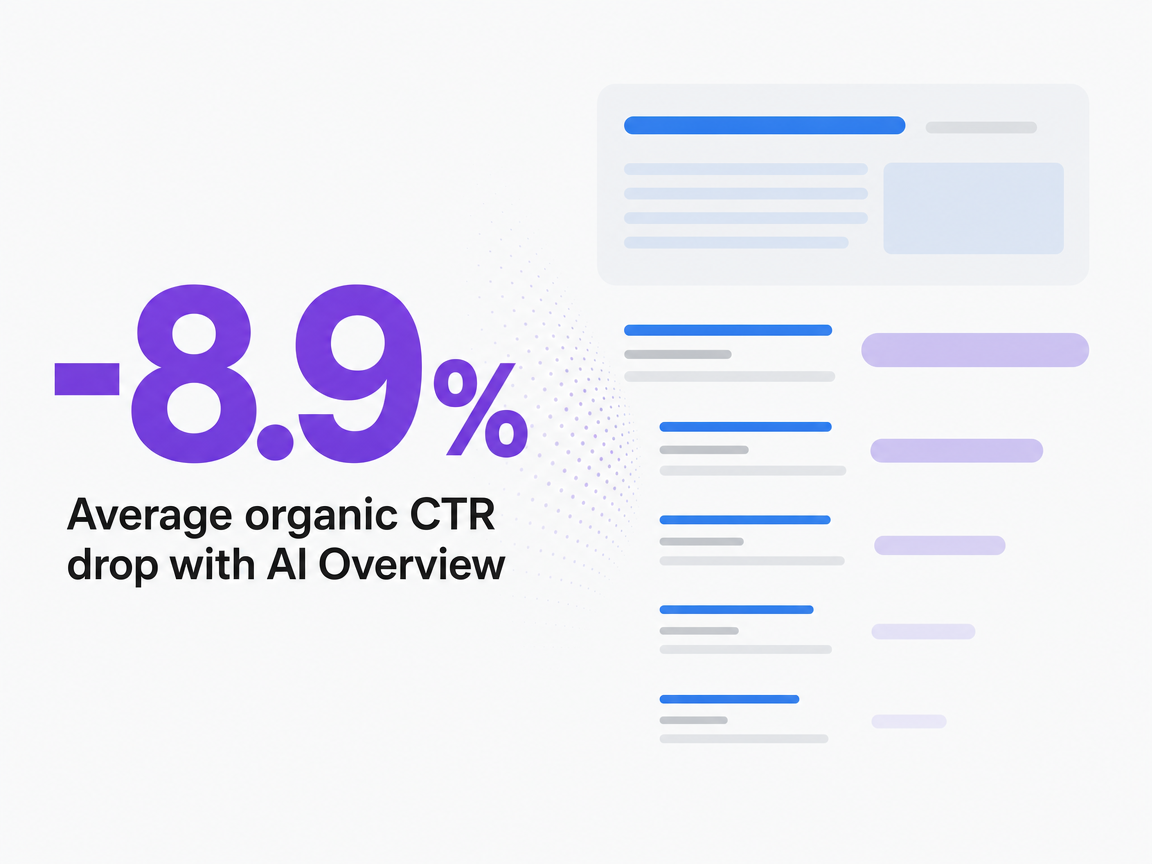 Average organic CTR drop with AI Overview
Average organic CTR drop with AI Overview
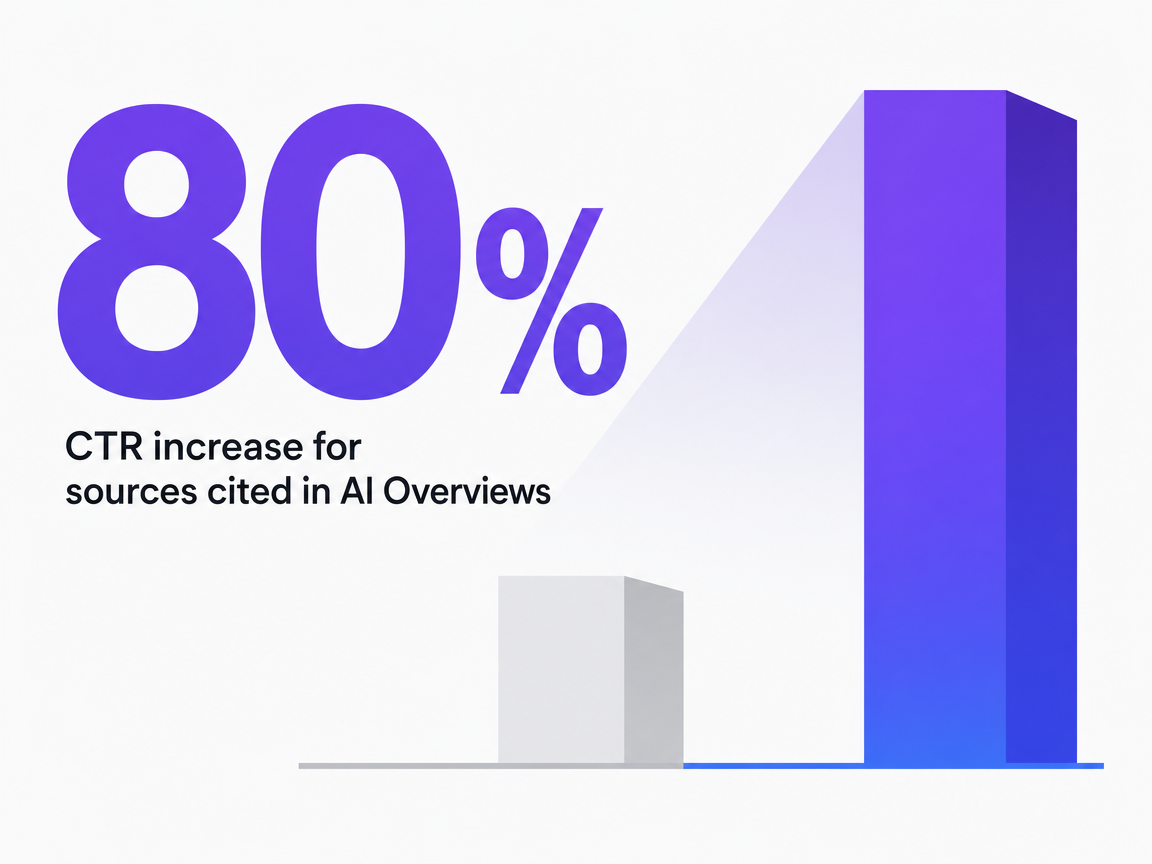 CTR increase for sources cited in AI Overviews
CTR increase for sources cited in AI Overviews
Frequently Asked Questions
References
- 1.Google AI Overviews: What's Changing for SEO & SEA in 2025.
- 2.Google's AI Search Generative Experience: The Impact on SEO.
- 3.The Strategic Shift.
- 4.Generative AI in Search: Let Google do the searching for you.
- 5.Google Algorithm Updates & Changes: A Complete History.
- 6.SEO Optimization Software Market Size & Share Report.
- 7.SEO Software Market Size Worth USD 265.91 Bn by 2034.
- 8.SEO Software Market Size to Hit USD 311.02 Billion by 2035.
- 9.SEO Software Market Size, Share, Growth, Analysis.
- 10.SEO Software Market Statistics, Key Players | Forecast.
- 11.AI-powered SEO Software Market Size | CAGR of 23.4%.
- 12.SEO Software Market Report | Global Forecast From 2025 To 2033.
- 13.Search Engine Optimization Advertising Software Market.
- 14.Best Rank Tracking Software for 2025: Complete Guide.
- 15.Top 10 AI Rank Tracking Tools for 2026: Measuring Visibility ....
- 16.The Best AI Visibility Tools in 2026 (Tested & Compared).