
Key Takeaways
- BrightEdge with AI Catalyst suits enterprise pods already standardized on the suite, extending existing rank data to AI Overviews and generative citations without new taxonomy 4.
- seoClarity fits agencies serving regulated verticals, pairing mature enterprise SEO reporting with citation-source depth needed for legal, healthcare, and financial services compliance review 4.
- Semrush AI Toolkit exposes the forum, review, and Wikipedia citations AI models favor, giving agencies a diagnostic map for entity authority and remediation work 3.
- Profound and Peec AI lead the AI-native monitoring category, delivering prompt-level share-of-voice benchmarking against named competitors across all major engines with per-engine breakdowns 6.
- Vectoron unifies AI visibility with approval-routed content, SEO, and backlink execution, addressing delivery capacity for agencies scaling client rosters without adding a specialist per account.
Why AI Visibility Became a Separate Agency Service Line in 2026
The demand-supply gap in AI search optimization is now large enough to justify its own retainer line. McKinsey's analysis of the AI search shift estimates that generative interfaces could influence up to $750 billion in revenue by 2028, yet only 16% of brands systematically track AI search performance today 11. This gap represents a significant opportunity for agencies: enterprise buyers recognize that AI answers are reshaping discovery, but most lack the internal capabilities to measure or optimize for it.
Client inquiries are driven by referral data. Analysis of 1.96 million LLM-driven sessions between November 2024 and November 2025 found that ChatGPT alone accounts for 84.2% of AI referral traffic to websites, with other platforms like Copilot, Claude, and Perplexity showing rapid year-over-year expansion 1. Agencies managing enterprise SEO stacks are increasingly asked about citation share, share of voice within AI answers, and the impact of Google AI Overviews on branded organic clicks. These questions extend beyond traditional rank-tracking dashboards.
This mismatch has led to the emergence of a distinct tool category. Vendors are now addressing three problems that traditional SEO platforms were not designed to solve:
- monitoring brand presence in generative answers,
- attributing pipeline to AI referrals, and
- reporting on citation patterns across engines that do not publish keyword-level data 2.
For agency Heads of SEO, the key strategic decision is no longer whether to offer AI visibility as a service, but which tool can manage the workload without requiring additional specialist headcount per client.
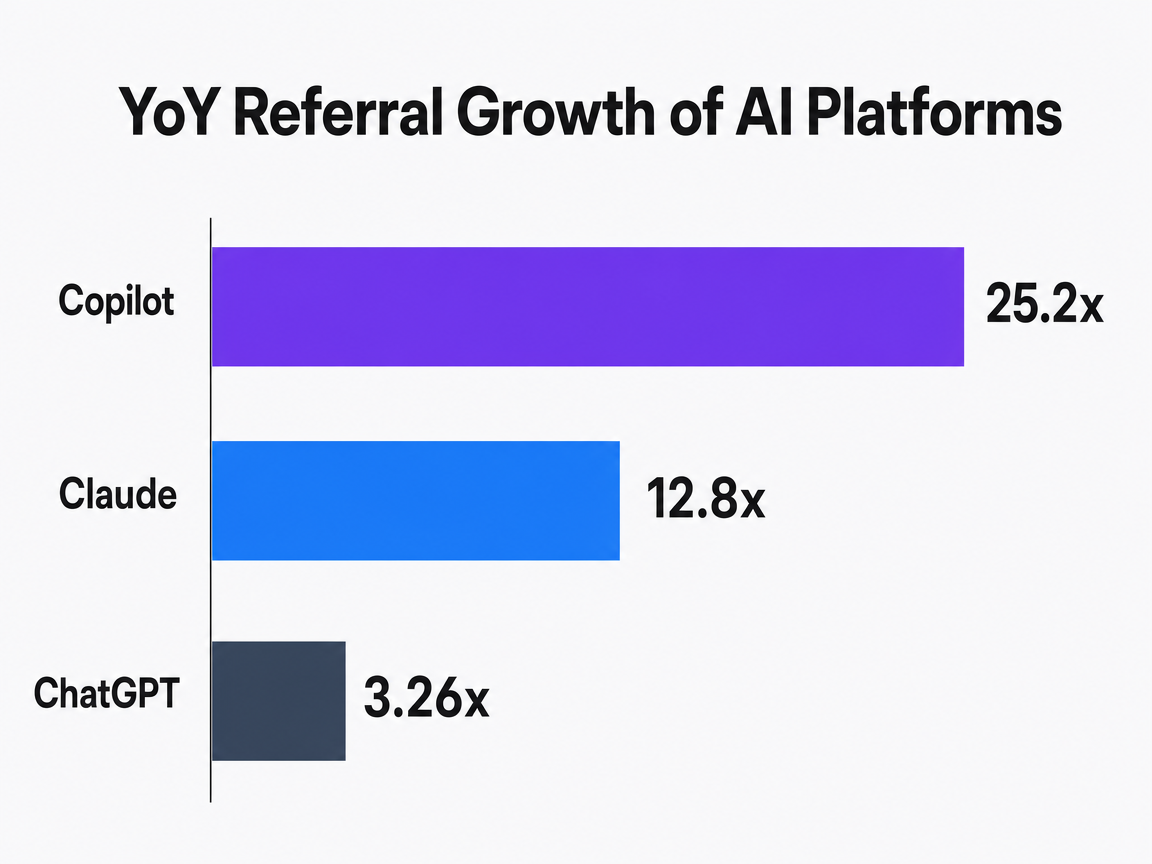 YoY Referral Growth of AI Platforms
Comparison of year-over-year referral traffic growth across major AI platforms: Copilot, Claude, and ChatGPT.
The Three Criteria That Actually Separate Agency-Grade Tools
Engine Coverage: Which LLMs a Tool Must Monitor to Be Worth a Seat
Coverage breadth is a primary differentiator. While a tool tracking only ChatGPT might seem sufficient given its 84.2% share of AI referrals, growth trends indicate otherwise. The same analysis of 1.96 million LLM sessions showed Copilot referrals expanding 25.2x year-over-year and Claude 12.8x, compared to ChatGPT's 3.26x 1. Copilot's growth is particularly relevant for agencies serving B2B clients, as it integrates with Microsoft 365 workflows where buying committees operate.
Practically, any tool under consideration must report on ChatGPT, Gemini, Copilot, Claude, and Perplexity as separate data streams, plus Google AI Overviews as a distinct surface within traditional SERPs. Aggregated "AI visibility" scores that combine engines into a single metric can obscure the specific signals agencies need, as prompt behavior, citation patterns, and referral quality vary by engine.
Agencies working with regulated verticals should also verify that the tool captures Perplexity citation URLs and Copilot enterprise-mode responses. Both engines frequently cite third-party publishers, and clients in sectors like legal, healthcare, and financial services require visibility into which external domains are being surfaced for their brand queries.
Attribution Depth: From Citation Counts to Revenue Ties
Citation counts are merely a vanity metric unless they can be linked to pipeline. The second criterion is whether a tool can translate "the client was mentioned in 34% of prompts in this cluster" into "AI referrals contributed X sessions, Y assisted conversions, and Z closed revenue." Enterprise SEO guidance now emphasizes attribution as the factor that distinguishes AI visibility experiments from budget-justifiable programs, with B2B AI SEO campaigns reporting average ROI above 6,800% when visibility signals are connected to revenue data 2.
Three layers of attribution are crucial for agencies:
- Prompt-level share of voice against a defined competitor set, updated frequently to reflect model changes.
- Citation-source tracking that identifies the third-party domains, forums, and review sites AI answers draw from when a client is mentioned or omitted.
- Referral attribution that connects AI-sourced sessions to CRM events via UTM handling, server-side tagging, or direct data warehouse integrations.
Tools that only provide the first layer generate reports, not renewal justifications. The gap between basic citation reporting and revenue attribution is where many agencies lose enterprise clients after the initial quarters of an AI visibility retainer.
Delivery Workflow: Multi-Client Governance, White-Label, and API Access
The third criterion is the tool's ability to operate at agency scale without requiring a specialist for each account. This includes multi-client seat structures with role-based permissions, white-label reporting that meets client standards, and API access clean enough for integration into existing BI stacks. Testing across current tools reveals significant variation in workflow compatibility, with some highly-rated monitoring platforms still lacking multi-tenant governance features 6.
Four workflow signals distinguish agency-grade platforms from single-brand tools:
- Bulk prompt management across accounts, allowing a strategist to update tracked queries for multiple clients in one session;
- Dashboard-level white-labeling with client logos, not just downloadable PDF templates;
- API endpoints for citation and share-of-voice data, enabling agencies to consolidate reporting within a data warehouse instead of managing multiple vendor logins; and
- Approval routing for any content or remediation recommendations, ensuring human sign-off before anything reaches a client's site.
Agencies evaluating tools should conduct a live test: onboard three client brands, invite two seat types, and export a monthly report. If any of these steps necessitates a support ticket, the tool will likely not scale beyond a dozen accounts.
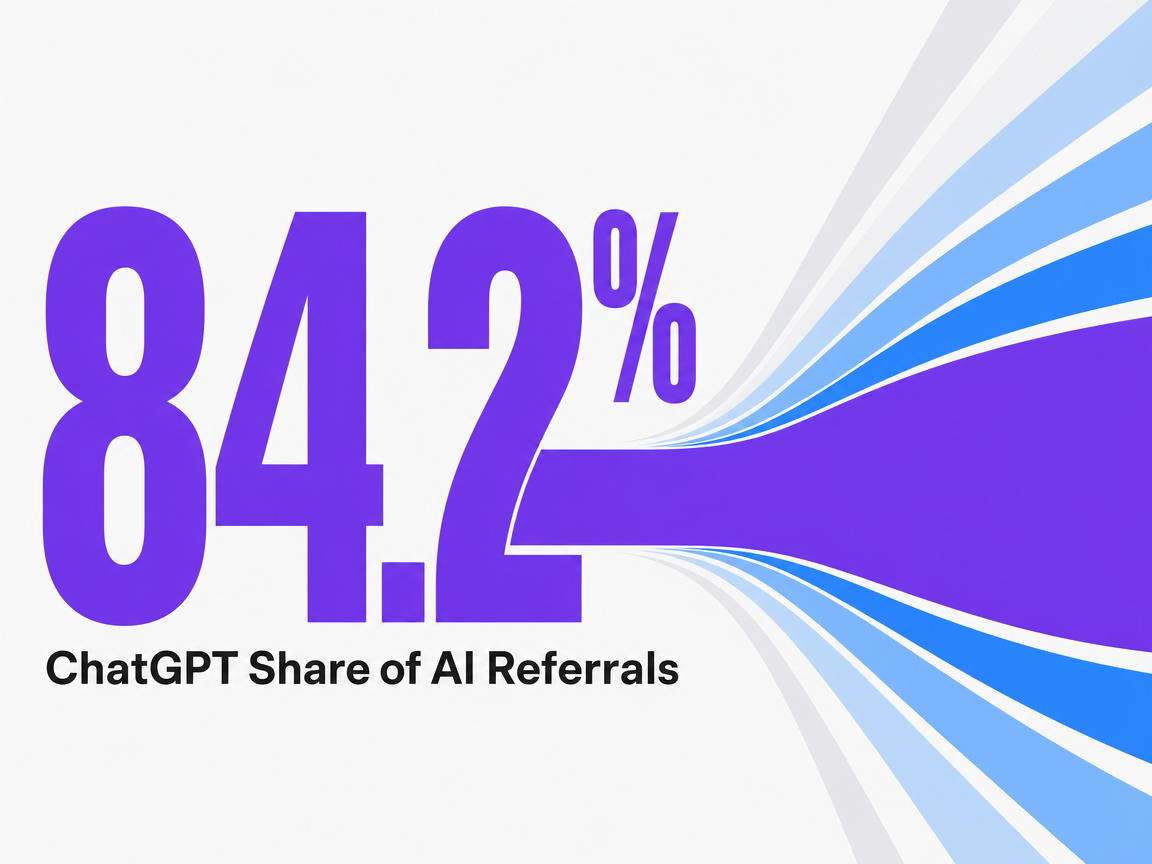
ChatGPT Share of AI Referrals
The Five-Tool Shortlist: How Each Category Fits an Agency Stack
Five tools meet the criteria for coverage, attribution, and workflow, each representing a distinct category rather than a direct feature clone. This shortlist includes two enterprise SEO suites with added AI visibility layers, one hybrid platform offering community citation depth, one AI-native monitoring category designed for share-of-voice benchmarking, and one unified approval workflow platform focused on multi-client delivery 4, 5, 6.
The comparison matrix following this section maps all five against engine coverage, attribution depth, agency workflow fit, and pricing tier. Where vendors do not publish per-seat pricing, entries indicate "tiered / contact sales." Agencies should use this matrix for initial triage: eliminate tools based on coverage gaps first, then attribution, then workflow. Individual profiles follow, each evaluated against the same three criteria to ensure comparable trade-offs across categories.
BrightEdge with AI Catalyst: The Enterprise SEO Suite Adding AI Layers
BrightEdge, particularly with its AI Catalyst module, is frequently cited in enterprise landscape reviews for AI visibility tracking, alongside seoClarity 4. For agencies already using BrightEdge for rank-tracking and content recommendations, AI Catalyst extends the existing dataset to include AI Overview appearances and generative citations, without requiring the delivery team to learn a new system. This continuity is a significant advantage for agencies with standardized reporting workflows on BrightEdge for enterprise retainers.
Engine coverage prioritizes Google AI Overviews, with expanded monitoring across ChatGPT, Perplexity, and Copilot integrated through Catalyst 4. Agencies serving clients whose AI referral concentration aligns with ChatGPT's market dominance will find the coverage sufficient. However, prompt-level share-of-voice reporting has historically been less granular than that offered by AI-native monitoring platforms. Clients in regulated verticals requiring visible citation-source URLs from Perplexity and Copilot enterprise responses should validate this depth during a pilot.
BrightEdge's strength in attribution lies in its established integrations with GA4, Adobe Analytics, and enterprise data warehouses. Citation and AI Overview appearance data can be combined with session and conversion streams within existing, trusted reporting layers, accelerating the path from visibility signals to revenue-attributed reporting. Workflow fit is best for agencies with dedicated enterprise pods, as multi-client governance assumes the seat volume and contract scale typical of Fortune 1000 relationships, rather than lean mid-market agency structures. Pricing follows an enterprise model, tiered and contract-based, without published per-seat rates. Agencies with fewer than ten enterprise accounts often find the license economics less justifiable than pairing an AI-native tool with their existing SEO suite 6.
Test AI-driven search visibility at full scale
Experience real-time impact on client rankings and workflow efficiency before making a commitment.
seoClarity: Enterprise Reporting Depth for Agencies Serving Regulated Verticals
seoClarity is a strong contender for agencies whose client base includes legal, healthcare, financial services, and other regulated verticals where reporting rigor is paramount 4. Its AI visibility layer is built upon a mature enterprise SEO dataset, which is crucial when clients expect AI Overview appearances and generative citations to be reported alongside their long-standing keyword universe. The continuity of taxonomy is an often-underestimated benefit, as legal marketing directors prefer not to introduce a new glossary of metrics mid-contract.
Engine coverage spans Google AI Overviews, ChatGPT, Perplexity, and Copilot, with citation-source URLs provided at a depth necessary for compliance review in regulated verticals 4. Agencies serving healthcare and financial services should specifically validate during a pilot whether the tool captures third-party publisher and community-forum citations that AI models often use when generating branded answers. Semrush's research indicates that AI models frequently favor community-verified and neutral sources over traditional authority signals, highlighting the need for clients to see forum and review-site mentions that traditional rank trackers typically overlook 3.
Attribution depth is seoClarity's strongest feature. Its data-warehouse integrations and custom-dimension support enable agencies to link citation and share-of-voice data with CRM-stage revenue, aligning with enterprise client expectations for reporting 2. Workflow fit is geared towards agencies with a defined enterprise pod: multi-client seats, role-based permissions, and API access are available, assuming a contract scale rather than a small roster of mid-market accounts. Pricing follows an enterprise model, tiered and quoted per engagement. Agencies with fewer than eight regulated-vertical retainers may find the license economics less favorable than a leaner AI-native tool combined with an existing SEO stack 6.
Semrush AI Toolkit: Community Citation Tracking and Entity Authority
The Semrush AI Toolkit is valuable because its own research demonstrates that AI models often prioritize community-verified and neutral sources over the backlink-weighted authority signals that traditional SEO platforms are built upon 3. This insight influences the tool's design. Beyond monitoring branded prompts across ChatGPT, Perplexity, Gemini, and Google AI Overviews, the toolkit identifies which forum threads, review sites, Wikipedia entries, and third-party publishers AI answers draw from when a client is cited or omitted. For agencies whose traditional SEO dashboards show positive trends while AI citations remain flat, this visibility layer provides crucial diagnostic information.
Engine coverage is broad but emphasizes the citation-source view rather than deep prompt-level share-of-voice benchmarking. Agencies managing structured competitor sets with a fixed prompt library may want to supplement the toolkit with an AI-native monitoring platform. Semrush excels in entity authority workflow: it helps identify the community properties, structured schema, and neutral reference pages necessary for a client's brand to be consistently cited in generative answers 3.
Attribution depth is mid-tier. The toolkit connects visibility data to the broader Semrush traffic and position dataset, which is suitable for mid-market retainers but does not extend to the CRM-joined revenue reporting expected by enterprise clients. Workflow fit is ideal for agencies already standardized on Semrush for multi-client SEO delivery: existing project structures, seat management, and API access are maintained, meaning adding AI visibility does not introduce a new vendor login per account. Pricing follows Semrush's published tiered model with add-on access to the AI Toolkit. Agencies serving legal, healthcare, and financial services clients should consider this tool when the strategic priority is addressing citation-source gaps rather than benchmarking prompt-level share of voice against a specific competitor list.
Profound and Peec AI: AI-Native Monitoring Built for Share-of-Voice Benchmarking
Profound and Peec AI represent the AI-native monitoring category: platforms designed specifically to benchmark prompt-level share of voice against a defined competitor set across ChatGPT, Gemini, Copilot, Claude, and Perplexity 6. Unlike tools with a legacy in keyword-rank tracking, their interfaces reflect this focus. The primary unit of analysis is the prompt cluster, not the keyword, and the main output is a share-of-voice percentage against three to ten named competitors, rather than a position number.
Engine coverage is a strong point for both tools. Prompt libraries can be structured by client, geography, and buying stage, with refresh frequencies tight enough to detect model updates that alter citation patterns within a week. Agencies with clients in categories where Copilot referrals are growing 25.2x year-over-year benefit from a per-engine breakdown rather than a blended score. This granularity is essential for strategists when a client questions why AI-sourced sessions doubled but pipeline remained flat 1.
Attribution depth is mid-tier and transparent about its capabilities. Both platforms export citation and share-of-voice data via APIs, leaving the CRM integration to the agency's data warehouse. This is an advantage for agencies with a data engineer but a challenge for those without. Workflow fit is where category leaders distinguish themselves: multi-client seat structures, bulk prompt management, and white-label reporting are standard among AI-native vendors, though depth can vary. Pricing typically follows tiered/contact-sales models scaled by tracked prompt volume rather than client count. Agencies benchmarking three to ten enterprise brands against named competitors should prioritize this category; those needing a single vendor for traditional SEO reporting should pair it with an existing suite rather than replacing one.
Compare Leading AI Search Visibility Tools—See Which Platform Delivers Documented Efficiency Gains
Get data-backed insights into AI platforms designed for agencies managing multi-site or enterprise SEO, including workflow benchmarks, integration strategies, and platform-specific ROI metrics.
Vectoron: Unified Approval Workflow for Multi-Client Delivery
Vectoron represents a distinct category: a unified approval workflow platform that integrates AI visibility as one signal within a broader multi-channel execution loop, rather than as a standalone monitoring product. For agency Heads of SEO facing delivery bottlenecks in coordinating content, SEO, backlinks, and reporting for a growing client roster, the platform's value proposition is that share-of-voice data is most effective when it directly triggers approved production work without requiring a specialist per account.
Engine coverage includes ChatGPT, Gemini, Copilot, Claude, Perplexity, and Google AI Overviews, with citation and share-of-voice data feeding into a recommendation queue that also prioritizes content, on-page, and backlink tasks. This structure directly addresses the finding that AI models often favor community-verified and neutral sources over traditional authority signals: remediation recommendations can encompass new entity content, schema updates, and third-party citation building, extending beyond a mere monitoring dashboard 3. Every recommendation undergoes a Command Center approval step before execution, ensuring human oversight for all actions affecting a client's site.
Attribution depth connects visibility signals to live business data, including qualified calls and pipeline events, which is critical for high-stakes verticals where trust signals influence conversion as much as reach 15. Workflow fit is the category's strongest attribute: multi-client seats, role-based permissions, and unified approval routing are core to the platform's design. Pricing follows a published subscription tier after a two-week trial. Agencies whose primary constraint is delivery capacity across an expanding client base, rather than deep prompt-level benchmarking against a fixed competitor set, should evaluate this category alongside AI-native monitoring platforms, rather than as a direct replacement.
Matching Tools to Agency Use Cases: White-Label, Benchmarking, and Remediation
White-Label Reporting for Retainer Clients
Retainer clients expect consistent monthly reports, now expanded to include AI Overview appearances, citation share, and prompt-level presence data. Enterprise SEO suites excel here for agencies already using BrightEdge or seoClarity dashboards under a client's brand: the AI layer integrates with existing white-label configurations, maintaining consistent taxonomy across reporting periods 4. AI-native monitoring platforms address this need through dashboard-level branding, which is crucial when clients log in mid-month to check share of voice. Agencies should avoid tools where white-labeling requires a support ticket per client. Bulk logo, domain, and permission configuration via an admin console is the operational standard for scaling beyond a dozen retainers without increasing coordinator hours.
Share-of-Voice Benchmarking Against Named Competitors
Benchmarking is where AI-native monitoring platforms differentiate themselves from enterprise suites. Agencies managing structured competitor sets across three to ten brands require prompt-level share-of-voice data updated frequently enough to capture model changes that reshape citation patterns within a week 6. Given Copilot's 25.2x year-over-year growth, per-engine breakdowns are essential for B2B benchmarking, as Copilot citation patterns often differ from ChatGPT results for the same prompt cluster 1. While enterprise suites report on this, they often blend engines into a composite score. Agencies pitching a share-of-voice retainer to a CMO who specifies competitors should first consider Profound or Peec AI, then decide whether to combine this benchmark data with an existing enterprise SEO suite for traditional rank reporting.
Content Remediation Workflows That Move Citations
Monitoring identifies gaps; remediation closes them. This use case combines citation-source depth with approval-routed production. Semrush's AI Toolkit reveals which forum threads, review sites, and Wikipedia entries AI answers draw from, providing agencies with a diagnostic map before recommending entity content, schema updates, or third-party citation building 3. Unified approval workflow platforms extend this by routing recommendations through a Command Center, where a strategist approves each action before execution, ensuring human judgment for every asset reaching a client's site. Agencies whose primary bottleneck is producing and implementing remediation work, rather than just identifying the gap, should evaluate remediation-capable platforms against pure monitoring tools. A dashboard that flags a citation deficit without a clear production path will incur additional specialist hours per client for the agency.
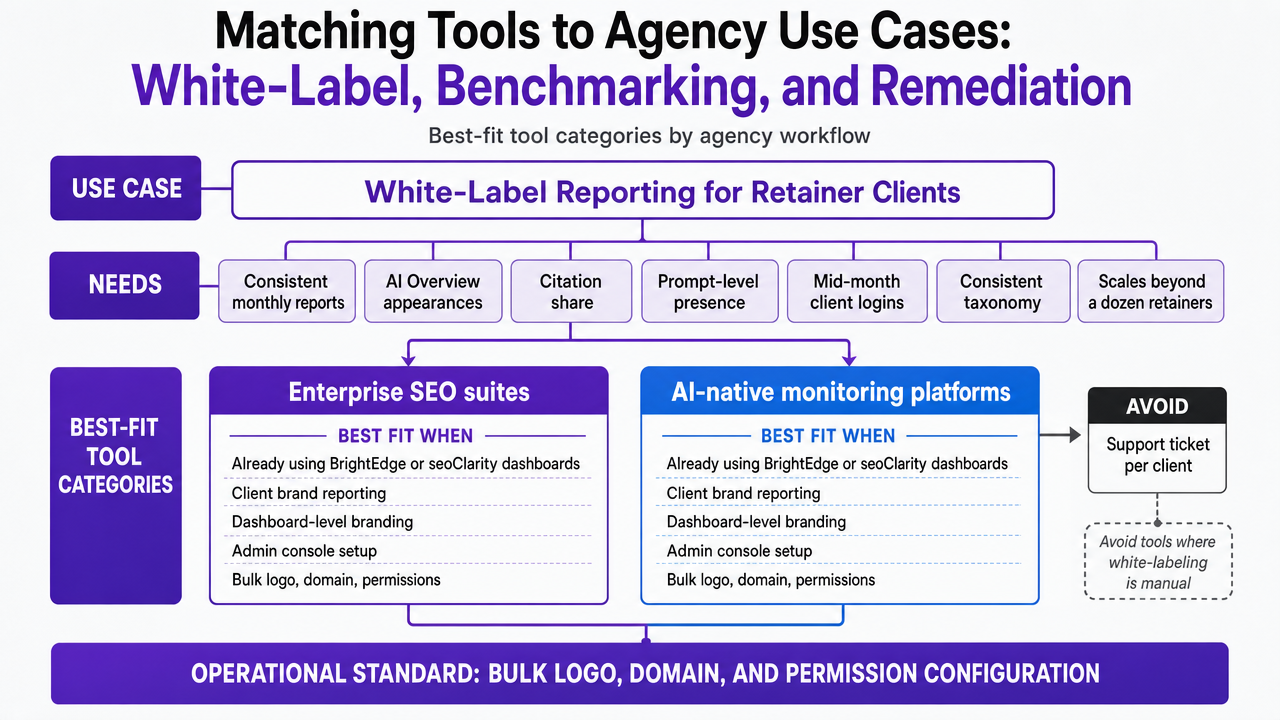 Comparison infographic mapping the three agency use cases from this section's subsections to their best-fit tool categories, reinforcing the decision framework
If an Agency Manages More Than 25 Client Brands: Consolidation Math
This section addresses agencies managing a portfolio of 25 or more client brands, where tool sprawl becomes a margin issue rather than a mere preference. Below this threshold, managing two or three specialized platforms is feasible. Above it, accumulating per-seat licenses, duplicating prompt libraries, and reconciling exports across vendors begin to consume strategist hours that automation was intended to free up.
The consolidation calculation depends on three agency-specific variables:
- total tracked prompts across the portfolio,
- the number of engines each client contract requires, and
- the monthly hours strategists spend reconciling reports from separate monitoring, SEO, and production tools.
Zapier's testing indicates significant variance in workflow depth across current vendors, meaning license cost alone underestimates the true operating expense when coordinator time is factored in 6. Agencies often find that a two-tool stack (AI-native monitoring plus an enterprise SEO suite) offers deeper benchmarking but requires a dedicated analyst to merge outputs, whereas a unified approval workflow platform may trade some prompt-level depth for a single reporting interface.
Portfolios heavily weighted towards regulated verticals, where trust signals are as critical as reach for conversion, tend to consolidate earlier. This is because duplicate compliance reviews across separate tools significantly compound delays 15. Conversely, portfolios focused on enterprise benchmarking retainers may maintain a federated tool approach for longer.
Frequently Asked Questions
References
- 1.2025 State of AI Discovery Report: What 1.96 Million LLM Sessions Reveal.
- 2.Enterprise SEO: The Complete Strategy Guide for 2026.
- 3.How AI Search Really Works: Findings from Our AI Visibility Study.
- 4.Best Enterprise AI SEO Platforms for 2026.
- 5.Best AI Search Visibility Tools for Businesses in 2026.
- 6.The 8 best AI visibility tools in 2026.
- 7.AI Marketing Analytics: The Ultimate Guide to Data-Driven Insights.
- 8.AI Marketing Analytics: Features, Benefits, Use Cases, & Top Tools.
- 9.25 AI marketing tools you need to get ahead in 2026.
- 10.AI-Powered Marketing Optimization: Step-by-Step Guide.
- 11.Winning in the age of AI search.
- 12.Americans and AI 2026: Chatbots, Smart Devices and Views on Impact.
- 13.What Web Browsing Data Tells Us About How AI Appears Online.
- 14.Americans have mixed feelings about AI summaries in search results.
- 15.Trust, attitudes and use of artificial intelligence: A global study 2025.