
Key Takeaways
- Surfer SEO compresses brief creation into minutes and raises output quality for junior writers, though senior strategists see thinner gains and should stay focused on positioning and edits 11.
- Jasper's Brand Voice features let agencies reuse tone and terminology across dozens of clients, but template-driven volume risks triggering Google's scaled content abuse enforcement without human research 2.
- Frase compresses SERP research into editable outlines, though strategists must brief writers on what the top ten miss to avoid producing pages that mirror existing rankings 6.
- Screaming Frog with AI-assisted extractions turns forensic crawls into pattern-level analysis, answering whether service pages actually cover searcher questions on complex, multi-brand sites 6.
- Semrush Copilot delivers a ranked morning triage queue across every client property, but strategists must reorder alerts against revenue before anything reaches a client report 12.
- Profound tracks brand citations and share of voice inside ChatGPT and Perplexity, closing the reporting gap between classic rankings and the discovery surfaces buyers now use 17.
- AlsoAsked and Otterly cover Google's answer surfaces by mapping the PAA question graph and monitoring which queries trigger AI Overviews and which sources get cited 1.
- Vectoron orchestrates content, SEO, PPC, backlinks, social, and call intelligence through a single human approval gate, keeping automation on the safe side of Google's spam policy 4.
- The stacked toolchain versus consolidated workflow comparison shows point tools multiply logins and reporting reconciliation, while a single approval loop absorbs coordination into one queue with uniform gate coverage.
The four jobs AI SEO tools actually do for an agency book
Adoption is a settled question. Forrester's 2026 study of US marketing agencies found that roughly nine in ten already use generative AI and about half deploy agentic AI for marketing execution, with SEO, content, and media strategy among the most cited use cases 9. The tension has moved downstream: which tools do which jobs, and how many can a delivery org actually run without recreating the coordination overhead that AI was supposed to remove.
Across a 15-to-100-client book, AI SEO software now splits into four distinct jobs. The first is content production at scale, where brief generation, optimization, and drafting compress the hours a strategist spends per asset. The second is technical and on-page automation, where crawlers and AI-assisted audit tools clear backlogs that used to sit in a queue for weeks. The third is AI answer visibility, tracking citations and presence inside ChatGPT, Perplexity, and Google's AI Overviews, since organic clicks are no longer the whole scoreboard. The fourth is workflow orchestration, the layer that routes AI output through human approval before anything ships to a client site.
No single platform wins all four. The scaling risk is not picking the wrong content tool; it is stacking six disconnected ones. Forrester's own read is that genAI still functions as a cost center rather than a revenue driver inside most agencies, largely because productivity gains get absorbed by tool sprawl and coordination tax 8. The shortlist that follows maps one anchor pick per job, then closes with a rubric for pruning what the stack does not need.
Job one: content production that survives Google's helpful-content bar
Content production is where most agencies first felt AI leverage, and where the policy risk shows up fastest. Google's guidance is unchanged on the standard: originality, substantial completeness, and evidence of expertise decide whether a page earns visibility, regardless of how it was drafted 6. The March 2024 spam update sharpened the enforcement side, treating automation as spam when its primary purpose is manipulating Search rankings 4. That leaves a workable middle for AI-assisted drafting when human strategists own research, framing, and edits, and a narrow one for anything resembling scaled content abuse 3.
The three picks below cover different sub-jobs inside content production: brief-driven optimization, branded template reuse across a client roster, and SERP-anchored research. None of them replace an editor. Each of them, deployed correctly, compresses the hours a strategist spends before a draft is ready for review.
Surfer SEO for brief-driven optimization at strategist scale
Surfer's core value for an agency is compression. A SERP-driven brief with entities, subheading structure, and target coverage lands in a writer's hands in minutes rather than the two-to-three hours a strategist used to spend building the same document by hand. Across a 40-client book with weekly publishing cadences, that compression is where the delivery math starts to work.
The productivity ceiling is skill-dependent. The NBER study of a generative AI assistant deployed in customer support found output rose 14% on average and 34% for novice and low-skilled workers, with minimal gains for experienced staff 11. The study measured resolved issues per hour, not published articles, and the workflow was different from content optimization. The pattern still translates: brief-driven tools raise the floor for junior writers who otherwise burn hours pattern-matching SERPs, while senior strategists see thinner marginal gains because the analytical work was already fast for them.
That spread has a practical consequence for staffing. Surfer earns its seat when it lets a mid-level writer produce a draft that clears editorial review on the first pass, not when a director uses it to check their own instincts. Assign it to production. Keep senior time on positioning, internal linking strategy, and the edits that decide whether a page reads as original work under Google's helpful-content standard 6.
Jasper for branded content templates across a client roster
Jasper earns its place in an agency stack for a specific reason: brand voice reuse across dozens of clients without a template graveyard in a shared drive. Its Brand Voice and Style Guide features let a strategist codify tone, banned phrases, and structural conventions per client, then apply them to every downstream draft the platform touches. For an agency running 40 clients across law firms, home services, and behavioral health, that per-client memory is the difference between AI drafts that need a full rewrite and drafts that land in editorial review with the correct cadence and terminology.
The caveat is what Jasper cannot do. Template-driven output at volume is exactly the pattern Google flagged when it sharpened scaled content abuse enforcement, which treats mass-produced pages without added value as spam regardless of whether a human or a model wrote them 2. Jasper is safe when a strategist uses it to draft against a real brief with real research, and risky when it becomes a page factory pointed at a keyword list. Assign it to writers producing branded thought leadership, service-page rewrites, and newsletter cadence work. Keep it away from programmatic location pages unless a human is validating every output against original research on that market.
Frase for SERP-anchored research and outline generation
Frase sits earlier in the workflow than Surfer or Jasper. Its job is to compress the research phase: pulling the top-ranking pages for a query, extracting their headings and questions, and stacking that context into an outline a strategist can edit rather than build from scratch. For an agency running weekly editorial calendars across dozens of clients, that shift moves the strategist's time from tab-hopping to judgment work, which is where the actual quality signal lives.
The caution is inherited from the same category risk that governs every SERP-anchored tool. Outlines assembled from what already ranks tend to converge on what already exists, and Google's helpful-content framework rewards original information and substantial completeness over pages that mirror the current top ten 6. Frase earns its seat when a strategist uses it to map the competitive floor, then briefs the writer on what the SERP is missing. Treat the outline as a starting reference, not the finished argument. That is where research compression turns into ranked pages instead of another indistinguishable draft.
Job two: technical and on-page automation that clears the audit backlog
Technical debt is the quiet killer of an agency book. Every client site accumulates broken internal links, orphaned pages, thin category templates, and schema that stopped validating six months ago. On a small book, a strategist works through it manually. Across 40 or 80 clients, the backlog compounds until audits get scheduled quarterly and half the findings expire before anyone acts on them.
AI-assisted crawlers and cross-client health platforms attack that backlog directly. The point is not that they run audits faster, which they do. The point is that they turn a periodic deliverable into a continuous signal, which is what Google's own guidance rewards: crawlability, unique valuable content, and technical fundamentals remain the base layer for both classic Search and AI features 1. The two picks below cover the two ends of the technical stack: forensic crawl analysis on a single site, and triage across the entire client roster.
Screaming Frog with AI-assisted crawl analysis
Screaming Frog has been the strategist's forensic tool for years, and its recent AI integrations extend rather than replace what it already did well. The crawler still surfaces the same layer of technical evidence:
- status codes
- redirect chains
- canonical conflicts
- hreflang mismatches
- indexability signals
- schema errors
What changed is the analysis layer. Custom JavaScript and LLM-connected extractions now let a strategist run natural-language checks against every URL in a crawl, from flagging pages missing author bylines to summarizing the primary entity of each page against the target query.
That capability matters most on complex sites where the audit finding is not a broken link but a pattern. A 12,000-URL law firm site with practice-area templates spanning three merged brands does not need another status-code export. It needs a strategist to answer whether the service pages actually cover the questions searchers ask, which is exactly what Google's helpful-content framework measures against 6. AI-assisted crawl extractions compress that answer from a two-week manual review into a single crawl pass.
Assign Screaming Frog to the senior technical strategist on the team, not to production. The tool rewards operator judgment about which custom checks to run and how to interpret the output. On a client book, run it against the top three revenue sites monthly and against the rest quarterly, with AI extractions scoped to whatever question the last core update raised.
Semrush Copilot for cross-client site health triage
Screaming Frog answers deep questions about one site. Semrush Copilot answers shallow questions about all of them. That is the split an agency needs. Copilot sits on top of the standard Semrush project stack and surfaces prioritized alerts across every client property connected to the account:
- new indexation drops
- ranking losses on money keywords
- backlink toxicity spikes
- Site Audit issues that crossed a severity threshold since the last check
For a director triaging 60 client dashboards on a Monday morning, the value is not the underlying data, which was already there. The value is the ranked queue.
The caution is the same one that governs any AI recommendation layer: prioritization is only as good as the rules behind it, and Copilot will happily promote a fix that moves a Site Audit score without moving revenue. McKinsey's global read on enterprise AI is relevant here, finding that adoption is nearly universal but most organizations have not embedded the tools deeply enough to see material impact 12. The lesson translates directly. Copilot earns its seat when a strategist reviews the queue and reorders it against client revenue and contract commitments before anything reaches a client-facing report.
Use it as the morning triage layer that decides where senior time goes that week. Do not let it write the client update. That step still belongs to the human who knows which fixes the client actually pays for.
Experience AI SEO Execution at Full Scale
Test drive AI-driven workflows and publish live content for clients with measurable SEO impact during your trial.
Screaming Frog with AI-assisted crawl analysis
Screaming Frog has been the strategist's forensic tool for years, and its recent AI integrations extend rather than replace what it already did well. The crawler still surfaces the same layer of technical evidence: status codes, redirect chains, canonical conflicts, hreflang mismatches, indexability signals, and schema errors. What changed is the analysis layer. Custom JavaScript and LLM-connected extractions now let a strategist run natural-language checks against every URL in a crawl, from flagging pages missing author bylines to summarizing the primary entity of each page against the target query.
That capability matters most on complex sites where the audit finding is not a broken link but a pattern. A 12,000-URL law firm site with practice-area templates spanning three merged brands does not need another status-code export. It needs a strategist to answer whether the service pages actually cover the questions searchers ask, which is exactly what Google's helpful-content framework measures against 6. AI-assisted crawl extractions compress that answer from a two-week manual review into a single crawl pass.
Assign Screaming Frog to the senior technical strategist on the team, not to production. The tool rewards operator judgment about which custom checks to run and how to interpret the output. On a client book, run it against the top three revenue sites monthly and against the rest quarterly, with AI extractions scoped to whatever question the last core update raised.
Semrush Copilot for cross-client site health triage
Screaming Frog answers deep questions about one site. Semrush Copilot answers shallow questions about all of them. That is the split an agency needs. Copilot sits on top of the standard Semrush project stack and surfaces prioritized alerts across every client property connected to the account: new indexation drops, ranking losses on money keywords, backlink toxicity spikes, and Site Audit issues that crossed a severity threshold since the last check. For a director triaging 60 client dashboards on a Monday morning, the value is not the underlying data, which was already there. The value is the ranked queue.
The caution is the same one that governs any AI recommendation layer: prioritization is only as good as the rules behind it, and Copilot will happily promote a fix that moves a Site Audit score without moving revenue. McKinsey's global read on enterprise AI is relevant here, finding that adoption is nearly universal but most organizations have not embedded the tools deeply enough to see material impact 12. The lesson translates directly. Copilot earns its seat when a strategist reviews the queue and reorders it against client revenue and contract commitments before anything reaches a client-facing report.
Use it as the morning triage layer that decides where senior time goes that week. Do not let it write the client update. That step still belongs to the human who knows which fixes the client actually pays for.
Job three: AI answer visibility, because clicks are no longer the scoreboard
The measurement problem is now bigger than the ranking problem. Bain's read on zero-click behavior finds that roughly 80% of consumers rely on zero-click results in at least 40% of searches, organic traffic is down an estimated 15% to 25%, and click-through rates have fallen by as much as 30% in some B2B categories including B2B software 13. The sample is consumer search behavior and marketer-reported traffic declines, not a controlled study of every vertical, but the direction is consistent across the dataset and confirmed in the B2B snap chart 15.
That shift changes what an agency owes a client each month. Rankings and sessions still matter, but they no longer capture whether the brand is present when a prospect asks ChatGPT for a shortlist or reads an AI Overview instead of clicking through. Forrester frames the same problem from the discovery side, noting that content and site structure now have to earn visibility across ChatGPT and Perplexity in addition to classic Search 17. The two picks below handle the two halves of that measurement job: citation tracking inside LLM answers, and monitoring the answer surfaces Google itself now renders above the blue links.
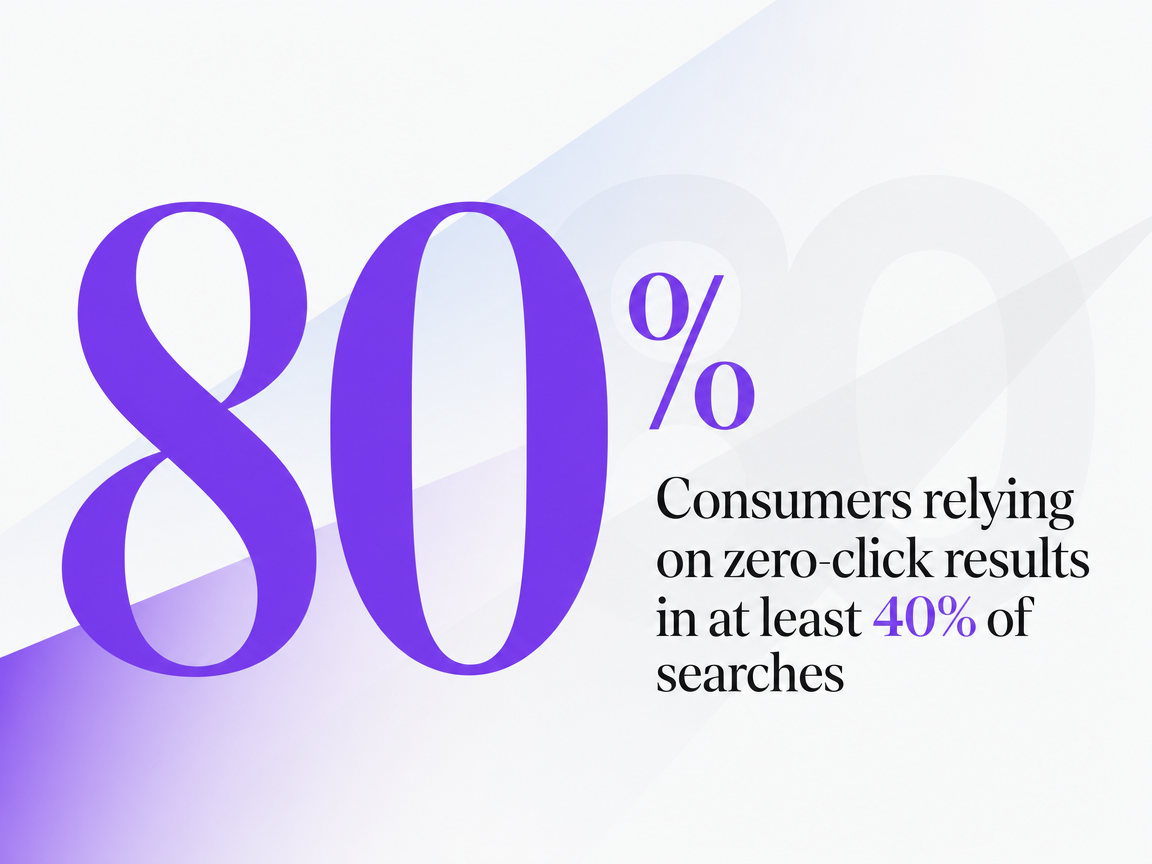 Consumers relying on zero-click results in at least 40% of searches
Consumers relying on zero-click results in at least 40% of searches
Profound for citation tracking inside ChatGPT and Perplexity
Profound answers a question that classic rank trackers cannot: when a prospect asks ChatGPT or Perplexity for the best personal injury firm in Denver or the top DSO acquirer in the Southeast, does the client's brand appear in the answer, and which sources did the model cite to build it. The platform runs prompt panels across the major LLM surfaces, logs which domains get cited for which queries, and tracks share of voice against named competitors over time. For an agency director building a Monday client report, that data closes the gap between traditional rankings and the discovery surfaces buyers now use to shortlist vendors 14.
The measurement case is the one Forrester makes directly: content and site structure now have to earn visibility across ChatGPT and Perplexity in addition to classic Search, and agencies without a monitoring layer are flying blind on half the funnel 17. Profound earns its seat when a strategist uses citation data to inform which pages get rewritten, which entities need reinforcement, and which competitors are pulling ahead in specific prompt clusters. Assign it to the analyst who owns reporting, not to production. The output is a decision input for the content roadmap, not a deliverable in itself.
AlsoAsked and Otterly for AI Overviews and answer-surface monitoring
Profound tracks what LLMs say in conversation. AlsoAsked and Otterly cover what Google itself renders above the blue links. The split matters because AI Overviews and People Also Ask boxes now decide whether a client's page gets read at all, and the answer surface changes weekly as Google adjusts which queries trigger which formats.
AlsoAsked maps the question graph around a target query, pulling the branching PAA data that reveals which sub-questions Google associates with a topic. That data feeds outline decisions directly: a service page that answers the surfaced questions in-line has a defensible shot at Overview inclusion, which Google's own guidance frames as a byproduct of clear, crawlable, uniquely valuable content rather than a separate optimization track 1. Otterly runs the monitoring side, checking whether specific queries trigger an AI Overview, which sources Google cited, and how that mix shifts over time.
Assign both to the analyst layer, not production. The output belongs in the monthly client report as a companion to rank data, showing where the brand is present in AI answers and where competitors have taken the citation slot 17.
Explore AI SEO Platforms That Deliver Scalable, Data-Backed Results Across Multiple Clients
Connect with a specialist to see how unified AI-driven workflows can reduce manual oversight, accelerate SEO execution, and improve measurable outcomes for agency and enterprise teams managing high-volume client portfolios.
Job four: workflow orchestration and the tool sprawl tax
The first three jobs each earn their seat on the merits. The problem shows up when they run in parallel. A content stack that combines Surfer, Jasper, and Frase already spans three logins, three billing lines, and three sets of outputs that a strategist has to reconcile before a draft reaches a client. Add Screaming Frog and Semrush Copilot for technical work, Profound for LLM citation tracking, and AlsoAsked and Otterly for answer-surface monitoring, and the delivery org is now running eight tools that do not talk to each other. Someone has to move outputs between them, and that someone is usually the strategist the tools were supposed to free up.
Forrester's read on the 2025 agency picture is direct on this point: genAI functions as a cost center rather than a revenue driver in most agencies, largely because productivity gains get absorbed by the coordination work the tools themselves create 8. McKinsey's global survey draws the same line from a different angle, finding that adoption is nearly universal but most organizations have not embedded AI deeply enough into workflow to see enterprise-level impact 12. Point tools raise the ceiling on individual tasks. They do not, on their own, raise the ceiling on delivery throughput. The orchestration layer is what closes that gap.
Vectoron for approval-gated multi-client execution
Vectoron sits at a different layer than the content, technical, and visibility tools above it. Its job is orchestration: connecting the strategy signals coming out of live business data, ranking the work that matters most across a client roster, routing every recommendation through human approval, and executing the approved steps across content, SEO, PPC, backlinks, social, and call intelligence in one governed loop. For an agency director managing 40 or 60 clients, the platform replaces the coordination work that currently lives in project management tools, briefing documents, status meetings, and the handoffs between them.
The approval gate is the design choice that matters most for policy risk. Google's guidance on AI-generated content is explicit that automation is acceptable when it does not manipulate rankings or produce low-value pages, and it is spam when its primary purpose is scaled ranking manipulation 2. A workflow that ships AI output without human sign-off invites exactly the pattern the March 2024 update sharpened enforcement against 4. A workflow that routes every recommendation through a strategist before publication keeps the automation on the safe side of the line, because a human is deciding whether each asset meets the helpful-content bar 6.
The orchestration case also matters for provenance. NIST-linked public guidance recommends clear labels, disclaimers, watermarking, and metadata embedding for AI-generated content, which matters for regulated verticals where disclosure is either required or advisable 16. Assign Vectoron to the delivery layer that currently absorbs the most coordination tax: the director triaging the Monday queue, the strategist writing briefs, and the account lead consolidating updates across channels.
Stacked toolchain vs consolidated approval workflow
The economics of orchestration are variable-driven, not list-price-driven. The relevant comparison is not per-seat pricing across eight vendors, which shifts too often to model reliably. It is the coordination time a delivery org spends moving outputs between tools that do not share a workflow, measured against the same work handled inside a single approval loop.
The table below uses reader-supplied variables rather than invented dollar figures. A director working with a 40-client book, four strategists, and a typical stack of one content optimizer, one AI drafting tool, one research tool, one crawler, one cross-client health platform, one LLM citation tracker, and two answer-surface monitors carries the coordination load across all eight surfaces.
| Coordination dimension | Stacked toolchain | Consolidated approval workflow |
|---|---|---|
| Logins per strategist | 8+ vendor accounts | 1 workflow surface |
| Weekly hours per client on tool coordination | Variable per strategist; compounds with roster size | Absorbed into the approval queue |
| Approval gate coverage | Per-tool, inconsistent | Uniform across channels |
| Reporting assembly | Manual export and reconciliation | Continuous within the workflow |
The NBER productivity study is the honest ceiling for what consolidation can reclaim on the coordination side. Access to a generative AI assistant raised issues resolved per hour by 14% on average across the customer support agents studied, with 34% gains for novice workers and minimal impact for experienced staff 11. The study measured a different job, and the number does not translate directly to SEO delivery hours. It sets the shape of the expectation: material lift concentrated on junior and mid-level work, thinner marginal gains for senior strategists.
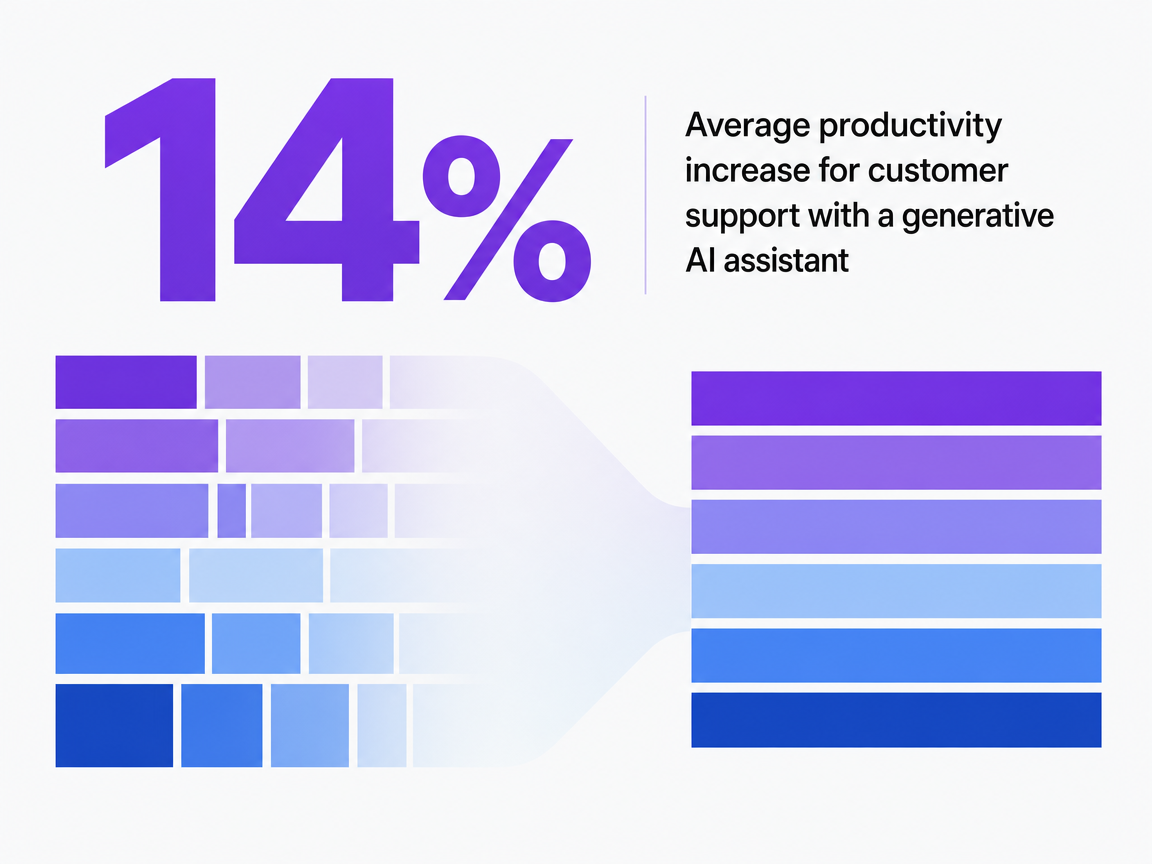 Average productivity increase for customer support with a generative AI assistant
Average productivity increase for customer support with a generative AI assistant
Vectoron for approval-gated multi-client execution
Vectoron sits at a different layer than the content, technical, and visibility tools above it. Its job is orchestration: connecting the strategy signals coming out of live business data, ranking the work that matters most across a client roster, routing every recommendation through human approval, and executing the approved steps across content, SEO, PPC, backlinks, social, and call intelligence in one governed loop. For an agency director managing 40 or 60 clients, the platform replaces the coordination work that currently lives in project management tools, briefing documents, status meetings, and the handoffs between them.
The approval gate is the design choice that matters most for policy risk. Google's guidance on AI-generated content is explicit that automation is acceptable when it does not manipulate rankings or produce low-value pages, and it is spam when its primary purpose is scaled ranking manipulation 2. A workflow that ships AI output without human sign-off invites exactly the pattern the March 2024 update sharpened enforcement against 4. A workflow that routes every recommendation through a strategist before publication keeps the automation on the safe side of the line, because a human is deciding whether each asset meets the helpful-content bar 6.
The orchestration case also matters for provenance. NIST-linked public guidance recommends clear labels, disclaimers, watermarking, and metadata embedding for AI-generated content, which matters for regulated verticals where disclosure is either required or advisable 16. Assign Vectoron to the delivery layer that currently absorbs the most coordination tax: the director triaging the Monday queue, the strategist writing briefs, and the account lead consolidating updates across channels.
Stacked toolchain vs consolidated approval workflow
The economics of orchestration are variable-driven, not list-price-driven. The relevant comparison is not per-seat pricing across eight vendors, which shifts too often to model reliably. It is the coordination time a delivery org spends moving outputs between tools that do not share a workflow, measured against the same work handled inside a single approval loop.
The table below uses reader-supplied variables rather than invented dollar figures. A director working with a 40-client book, four strategists, and a typical stack of one content optimizer, one AI drafting tool, one research tool, one crawler, one cross-client health platform, one LLM citation tracker, and two answer-surface monitors carries the coordination load across all eight surfaces.
| Coordination dimension | Stacked toolchain | Consolidated approval workflow |
|---|---|---|
| Logins per strategist | 8+ vendor accounts | 1 workflow surface |
| Weekly hours per client on tool coordination | Variable per strategist; compounds with roster size | Absorbed into the approval queue |
| Approval gate coverage | Per-tool, inconsistent | Uniform across channels |
| Reporting assembly | Manual export and reconciliation | Continuous within the workflow |
The NBER productivity study is the honest ceiling for what consolidation can reclaim on the coordination side. Access to a generative AI assistant raised issues resolved per hour by 14% on average across the customer support agents studied, with 34% gains for novice workers and minimal impact for experienced staff 11. The study measured a different job, and the number does not translate directly to SEO delivery hours. It sets the shape of the expectation: material lift concentrated on junior and mid-level work, thinner marginal gains for senior strategists.
Google policy risk as an evaluation criterion, not a footnote
Most tool comparisons treat Google's stance on AI content as a disclaimer at the end. That inverts the priority for anyone running delivery across a client book, where a single policy hit can wipe out a quarter of retained revenue. Policy exposure belongs in the shortlist criteria, next to output quality and integration coverage.
The standard itself is not ambiguous. Google's position is that AI-generated content is not prohibited when it meets Search Essentials, and it is spam when its primary purpose is scaled ranking manipulation 5. The March 2024 update sharpened enforcement against three patterns that AI tools make cheap to produce at volume:
- expired domain abuse
- scaled content abuse
- site reputation abuse 4
Current spam policy explicitly covers attempts to manipulate generative AI responses in Search as well 3. The helpful-content framework sits above all of it, rewarding originality, substantial completeness, and evidence of expertise regardless of how the draft was produced 6.
That gives a director three concrete filters to apply before a tool enters the stack:
- Does the platform default to human approval before publication, or does it ship AI output on a schedule. Auto-publishing at scale is the pattern the March 2024 update was written for.
- Does the platform support programmatic page generation without a corresponding research input, which is the fastest route to scaled content abuse findings 2.
- Does the platform surface provenance controls, including labeling and metadata for AI-assisted assets, which matters for regulated verticals where disclosure is either expected or required 16.
Any tool that fails two of the three earns closer scrutiny before it touches a client site.
A decision rubric for shortlisting across the four jobs
The shortlist above spans eight tools across four jobs, and no delivery org needs all of them at once. The pruning question is which anchor picks earn a seat against three criteria that map to how an agency actually scales: headcount avoided, hours reclaimed per client per month, and approval-gate coverage across the assets that ship.
Headcount avoided is the cleanest test. A tool earns its seat when it lets the existing team hold the current client-to-strategist ratio at the next tier of book growth, or when it lets a mid-level writer produce work that used to require a senior editor's rewrite. That gain concentrates where the NBER study found it: junior and mid-level production, not senior strategy 11. Surfer, Jasper, and Frase clear this bar for writers. Screaming Frog and Semrush Copilot clear it for technical and triage work. Profound, AlsoAsked, and Otterly clear it for the analyst layer.
Hours reclaimed per client per month is the harder test, because it measures coordination time rather than task speed. A content tool that saves a strategist three hours on a brief but adds two hours of moving outputs between systems has reclaimed one hour, not three. Directors should measure the delta at the client level, not the tool level, and prune whichever platform contributes the least net reclaimed time per month across the book.
Approval-gate coverage is the criterion most tool comparisons skip. Google's position is that AI content is acceptable when it meets Search Essentials and is spam when automation ships low-value pages at scale 2. A stack where each tool has its own publishing path multiplies the surfaces where an unreviewed asset can reach a client site. A stack where a single approval workflow governs every AI-assisted output across content, technical fixes, and reporting narrows that risk to one gate. That is the argument for anchoring the stack in an orchestration layer such as Vectoron and treating the point tools as inputs to it, not as parallel publishers running alongside it.
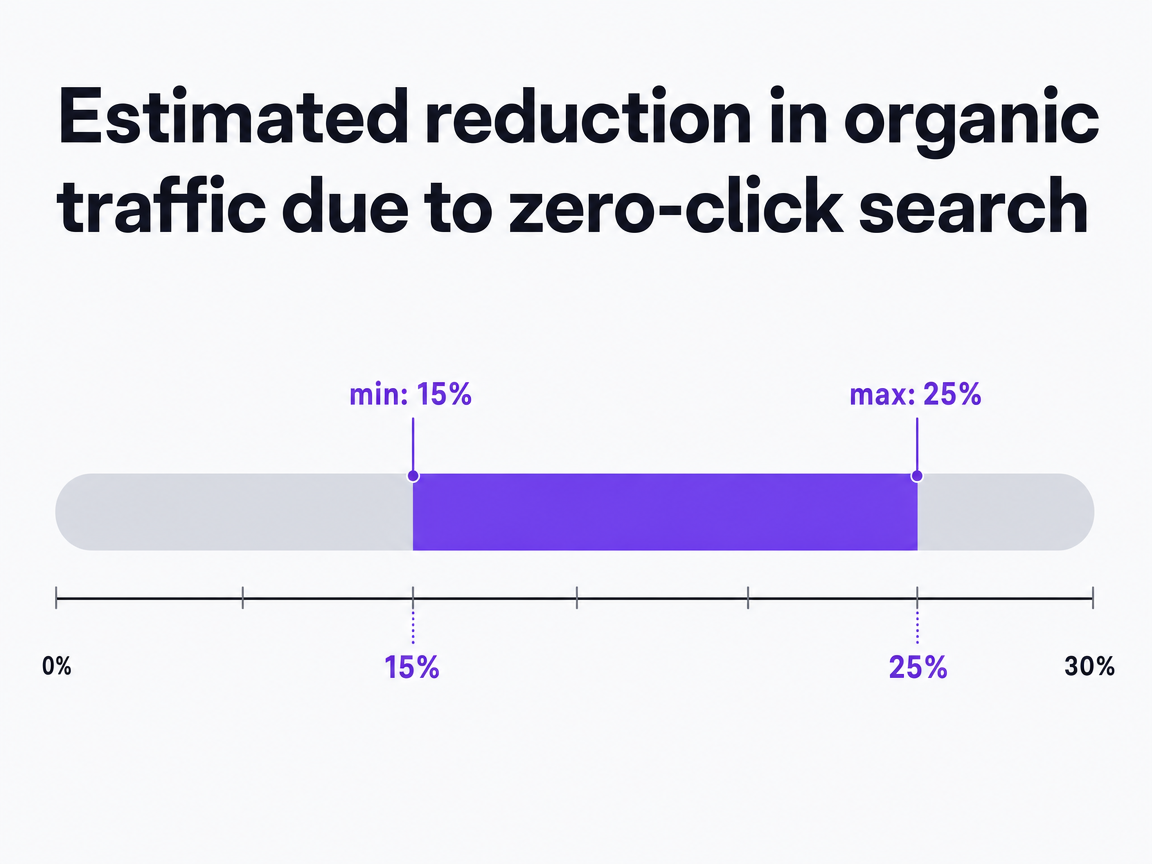 Estimated reduction in organic traffic due to zero-click search
Bain's estimate of the impact of zero-click search on organic traffic, suggesting a significant decline.
Frequently Asked Questions
References
- 1.Google's Guide to Optimizing for Generative AI Features on Google Search.
- 2.Google Search's Guidance on Generative AI Content on Your Website.
- 3.Spam Policies for Google Web Search.
- 4.Our March 2024 core update.
- 5.Google Search's guidance about AI-generated content.
- 6.Creating Helpful, Reliable, People-First Content.
- 7.Search Quality Rater Guidelines: An Overview - Google.
- 8.The State Of Generative AI Inside US Marketing Agencies, 2025.
- 9.The State Of AI Inside US Marketing Agencies, 2026.
- 10.Forrester: Nine In 10 US Marketing Agencies Use AI To Cut Costs And Improve Productivity.
- 11.Generative AI at Work.
- 12.The state of AI in 2025: Agents, innovation, and transformation.
- 13.Goodbye Clicks, Hello AI: Zero-Click Search Redefines Marketing.
- 14.Marketing's New Middleman: AI Agents.
- 15.Losing Control: How Zero-Click Search Affects B2B Marketers.
- 16.GENERATIVE AI STRATEGIES AND.
- 17.GenAI Reshapes Shopping And Revives SEO.