
Key Takeaways
- Semrush AI Visibility Toolkit reconciles prompt sampling across four major engines with existing SEO data, making it a strong fit for agencies scaling mid-market clients without adding a second reporting stack.
- Ahrefs Brand Radar anchors AI citation tracking to ranking data, which matters because 76% of AI Overview citations come from pages already ranking in Google's top 10 11.
- Peec AI leads on prompt sampling depth and sentiment granularity across ChatGPT, Perplexity, and Google AI Overviews, making it the pick when narrative sentiment is the reporting KPI.
- BrightEdge with OmniSEO fits enterprise accounts by combining broad engine coverage with zero-click analysis that addresses reconciliation gaps between Search Console AI Overview logging and third-party samples 1, 8.
- Vectoron connects AI visibility signals to an approval-first execution workflow, closing the loop on the 40% source-side visibility lift that dashboard-only tools leave unclaimed 6.
Why AI visibility measurement broke the old SEO reporting stack
Traditional rank tracking assumes a stable SERP: query in, position out, report on Monday. That assumption no longer holds when a client's brand narrative is being assembled on the fly by ChatGPT, Perplexity, Gemini, and Google's AI Overviews, each pulling a different citation set on a different day. A 2026 preprint that measured citation stability across major AI search platforms found that the source sets underlying answers overlapped by only 34%–42% on consecutive days, and recommended rolling two-to-four-week aggregation windows before any score is treated as a KPI 4. A single-day dashboard reading, in other words, is closer to a weather sample than a ranking.
The reporting stack breaks in a second place too. Google's own documentation now confirms that AI Overviews are logged inside Search Console Performance reports and that no additional technical requirements exist beyond standard indexing and snippet eligibility 1, 8. That sounds reassuring until an agency tries to isolate AI-driven impressions from classic blue-link impressions inside the same report, or to reconcile Search Console counts with what a third-party AI tracker sampled from ChatGPT the same week. The two data models do not line up.
The consequence for delivery teams is concrete. Any AI visibility analysis tool that returns one score, one screenshot, one day, is producing a number that will not survive the next QBR. The rest of this piece scores five contenders against the measurement realities that actually govern AI answer surfaces.
The four measurement axes agencies should score every tool against
Prompt sampling depth and coverage per client
Prompt sampling is the raw material of AI visibility measurement, and shallow sampling produces reports that look decisive but describe almost nothing. A tool that runs 50 prompts against ChatGPT once a week for a client with a full product catalog is capturing a sliver of the intent surface, not the surface itself. Agency leads should ask vendors two mechanical questions: how many distinct prompts per client per month, and how many runs per prompt across which engines.
Coverage matters as much as volume. A recent measurement framework analyzed 602 prompts across ChatGPT, Google AI Overview/Gemini, and Perplexity and still had to separate breadth from depth to see which engine actually influenced answers 5. Tools that sample one engine deeply and treat the others as afterthoughts will misreport share of voice for any client whose customers move between assistants.
Rolling aggregation windows versus single-day scores
The single most consequential finding for agency reporting sits inside a 2026 preprint that tracked citation stability across major AI search platforms: the source sets underlying answers overlapped by only 34%–42% on consecutive days, and the authors explicitly recommended rolling aggregation over two to four weeks before any score is treated as a KPI 4. A comparison chart of Day-1 versus Day-2 source overlap makes the operational point immediately: any tool that produces a single-day visibility score is producing a number that would move materially if the same prompts were run tomorrow.
For agencies, this reframes tool selection. The right question is not "does the platform show a visibility percentage" but "what window does that percentage represent, and can the window be adjusted per client cadence." A tool that defaults to seven-day rolling aggregation with an option to widen to 28 days is defensible in a QBR. A tool that reports yesterday's snapshot is not, regardless of how clean the interface looks.
Delivery teams should also confirm whether the tool exposes variance alongside the mean. Uncertainty estimates, which the same 2026 paper argued should accompany AI visibility reporting 4, separate professional measurement from marketing theater.
Separating citation from mention from absorbed influence
Three different phenomena hide inside the phrase "AI visibility." A brand can be mentioned in an answer without being cited, cited without being absorbed into the model's phrasing, and absorbed into the phrasing without appearing as a linked source. A 2026 GEO measurement paper proposed a two-stage framework that formalizes the distinction: citation selection, which controls whether a page enters the candidate set, and citation absorption, which controls how much that page shapes the generated answer 5. The same paper documented that ChatGPT tends to cite fewer sources but with higher average influence per fetched page, a pattern that a mention-count dashboard will completely miss.
Agency-grade tools should surface all three signals as separate columns. A share-of-voice score that collapses mentions, citations, and absorbed influence into one number tells a client their visibility is up when their actual answer footprint may be flat or down. Ask vendors to demonstrate how a cited-but-not-influential source appears in their reporting.
Source-side signal capture and third-party citation tracking
Owned content is only one half of the AI visibility equation. A 2026 study of 167,551 URL-grounded citations across 128 brands found that source-side strategy, meaning deliberate work on the third-party pages that AI engines fetch and cite, raises visibility by roughly 40% 6. Tools that only track a client's own domain, or that treat earned media as a footnote, leave that lift invisible on the dashboard and unclaimed in the account.
The practical requirement is straightforward. An AI visibility platform should identify which third-party domains are cited when a client's brand or category comes up, rank them by citation frequency and influence, and let the agency operationalize outreach against that list. Delivery teams evaluating vendors should ask for a sample third-party citation report on a live category before signing anything.
How brand tier changes which tool an agency actually needs
The same measurement rubric produces very different tool requirements depending on where a client sits in the brand hierarchy. A 2026 arXiv study of 100K+ prompt responses across 100+ brands recorded first-run AI visibility of 73% for global household names, 44% for established mid-market brands, and 11% for niche and small brands 3. That spread is the single most useful segmentation cut an agency lead can apply when scoping a GEO service line.
Global-brand accounts are the easy case. Their names surface on the first prompt run most of the time, so the tool's job is comparative: track share of voice against a stable competitor set, monitor sentiment drift, and flag citation format changes. Mid-market clients need more mechanical work. A 44% first-run hit rate means more than half of relevant prompts return an answer that omits the brand entirely, so prompt sampling depth and rolling windows matter far more than dashboard polish.
Niche and small-brand clients invert the economics. At 11% first-run visibility 3, a tool that samples 50 prompts a week will produce a handful of positive hits and a lot of noise. Those accounts need aggressive prompt volume, source-side citation tracking, and a platform that treats absence-of-mention as a first-class signal rather than a blank cell. Agencies that apply the same tool configuration across all three tiers will overspend on enterprise clients and underserve the smaller book where the visibility gap is widest.
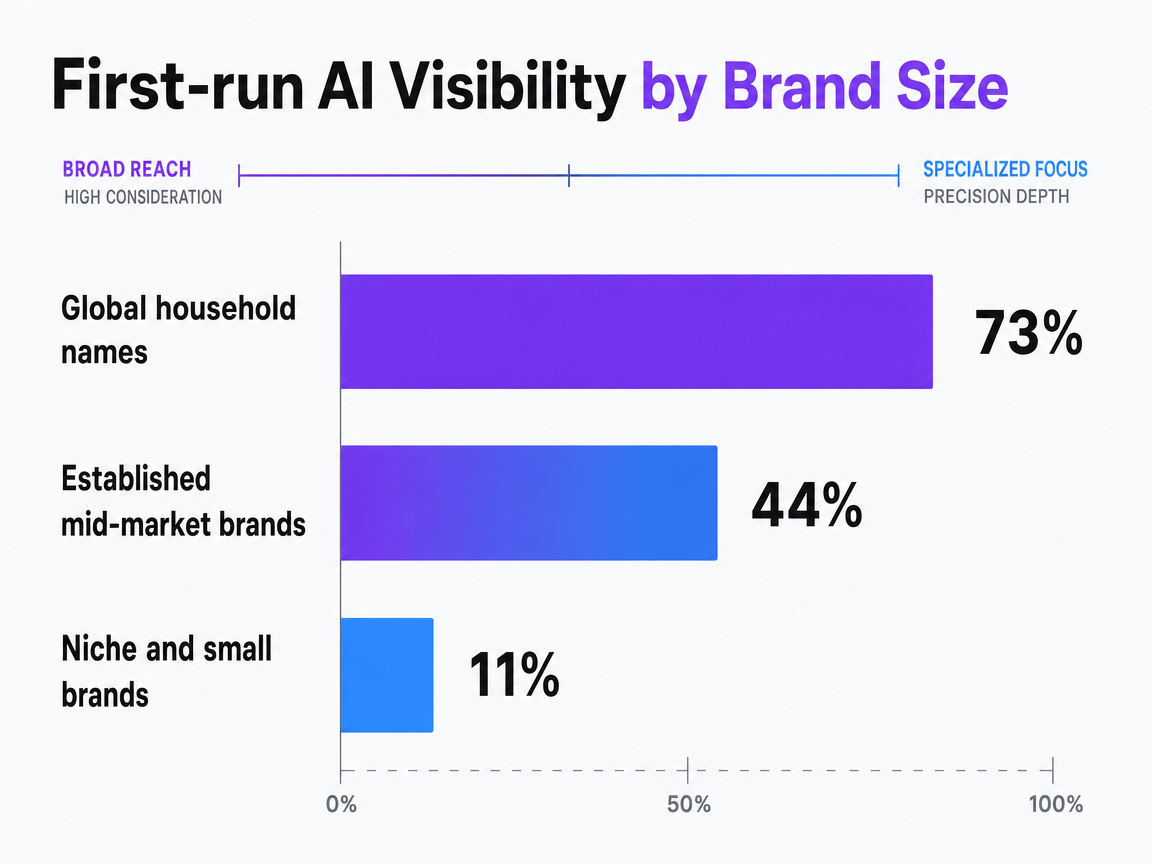 First-run AI Visibility by Brand Size
A 2026 study of over 100,000 prompt responses found that AI visibility on the first run varies significantly by brand size and recognition.
Test AI-driven visibility analysis on live campaigns
Evaluate real-time SEO impact and workflow efficiency using your own client data during the trial period.
Five tools evaluated against the measurement rubric
Semrush AI Visibility Toolkit: SEO-native aggregation with prompt-level tracking
Semrush extended its SEO suite into AI answer surfaces with a toolkit that samples prompts across ChatGPT, Perplexity, Gemini, and Google's AI Overviews, then reconciles those samples against the same domain, backlink, and keyword data the platform already collects 14. For agencies that have standardized reporting on Semrush across a client book, the pull is obvious: one login, one client list, one export layer.
What it actually measures against the four axes: prompt sampling is configurable per client but capped by plan tier, engine coverage spans the four major surfaces, mention and citation columns are separated in the interface, and rolling windows are exposed at the report level. The weakness sits in source-side signal capture. Third-party citation lists surface as domains and URLs, but the platform does not natively rank those sources by absorbed influence in the sense the two-stage GEO framework describes 5, so an analyst still has to interpret whether a cited page moved the answer.
Best fit is agencies with heavy Semrush footprints running mid-market clients where prompt volume needs to scale without adding a second reporting stack.
Ahrefs Brand Radar: ranking-anchored AI citation coverage
Ahrefs approaches AI visibility from the citation-graph side rather than the prompt-sampling side. Brand Radar layers AI Overview citation tracking on top of the same backlink and top-10 ranking data the platform is known for, which matters because Ahrefs' own analysis found that 76% of citations in Google AI Overviews come from pages already ranking in Google's top 10 11. A tool that already knows which client pages rank in the top 10 has a structural advantage in explaining why a citation appeared or disappeared.
Against the rubric, Ahrefs scores strongest on source-side signal capture and citation attribution, moderate on prompt sampling depth relative to dedicated GEO platforms, and weaker on engine breadth outside the Google AI Overviews and Perplexity axis 15. Rolling windows are supported at the report level, and mentions are separated from linked citations in the interface.
The practical read for delivery teams: Brand Radar is the strongest option when the client's AI visibility question is downstream of a traditional ranking question. It is less useful for a niche brand that is not ranking in the top 10 anywhere yet.
Peec AI: dedicated multi-engine mention and sentiment sampling
Peec AI belongs to the dedicated GEO platform category rather than an SEO suite with an AI add-on. It tracks brand mentions, positions, and sentiment across ChatGPT, Perplexity, and Google AI Overviews as its primary product surface rather than a secondary module 14. For agencies onboarding clients who care about assistant-side narrative more than blue-link rankings, that focus shows up in the depth of the prompt library and the granularity of the sentiment column.
Scoring against the rubric produces a specific profile. Prompt sampling depth is the platform's strength, with configurable prompt sets per client and multi-run sampling by default. Engine coverage is solid across the three named assistants but thinner on Gemini-specific surfaces. Rolling windows are exposed. The gap sits in absorbed influence: the platform reports mentions and sentiment cleanly but does not yet separate citation selection from citation absorption in the way the 2026 measurement framework recommends 5.
Peec is the right pick when narrative sentiment and mention frequency are the reporting KPIs. It is a weaker single tool when the client also needs traditional ranking context in the same view.
BrightEdge with OmniSEO: enterprise AI visibility and zero-click analysis
BrightEdge sits at the enterprise end of the market, and its OmniSEO layer tracks visibility across multiple AI-generated traffic sources alongside zero-click analysis and AI-driven SEO recommendations 15. For agencies running enterprise accounts with in-house SEO teams on the client side, that positioning is the differentiator: the reporting is built for stakeholders who already speak the language of share of voice, competitor gap, and zero-click loss.
Against the four axes, BrightEdge scores highest on engine breadth and enterprise reporting integration, and its zero-click analysis directly addresses the reconciliation gap between Search Console AI Overview logging 1, 8and third-party AI samples. Prompt sampling volume scales with plan tier, and rolling windows are configurable. Source-side citation tracking is present but oriented toward competitive share of voice rather than the third-party outreach workflow that source-side lift research points to 6.
The operational takeaway: BrightEdge is defensible for agencies with a small number of large accounts where the reporting audience already includes VPs of Marketing and Heads of Digital. It is oversized for a book weighted toward mid-market or niche brands.
Vectoron: approval-first execution platform with a Brand Intelligence layer
Vectoron is not a dedicated AI visibility tracker. It is an AI-powered marketing execution platform with specialist AI strategists managing content, SEO, PPC, backlinks, social, and call intelligence in a unified approval workflow, and its Brand Intelligence layer extracts and maintains voice, visual identity, positioning, competitors, products, and market context from client websites so that every downstream execution stays consistent. For agency leads evaluating this piece against the other four, the category distinction matters: Vectoron reads AI visibility signals and then routes recommended work to a human approver before anything ships.
Against the rubric, the platform is strongest on source-side signal capture and citation-to-execution linkage. When third-party citation patterns surface a domain worth pursuing, the same workflow drafts the outreach, the content brief, and the on-site update, then holds them for sign-off. That closes the loop that the 40% source-side visibility lift finding points to 6rather than leaving the insight in a dashboard. Prompt sampling and multi-engine coverage sit alongside the execution layer rather than as the product itself.
Best fit is agencies that need GEO measurement and execution in one governed loop across many client accounts.
Portfolio economics: cost, coverage, and cadence at agency scale
Scope shift: the calculus that governs a single-brand deployment breaks when the same platform has to serve 20 to 200 client accounts under one agency roof. The unit of analysis stops being cost per seat and becomes cost per tracked client per month, with prompt volume, engine coverage, and reporting cadence as the variables the agency lead actually controls.
Three ratios drive the math. Prompt volume per client per month sets the statistical floor for whether a visibility score means anything, especially for niche accounts where first-run visibility sits near 11% and a small sample produces mostly zeros 3. Rolling window length sets the reporting floor: anything shorter than the 14-to-28-day range the 2026 citation stability study recommends will surface noise as signal 4. Engine coverage sets the credibility floor with clients whose customers move between ChatGPT, Perplexity, Gemini, and Google AI Overviews on the same day.
| Variable | Entry tier | Mid tier | Enterprise tier |
|---|---|---|---|
| Prompt volume per client / month | ~200–500 | ~1,000–3,000 | 5,000+ |
| Rolling window default | 7 days | 14 days | 28 days, configurable |
| Engines covered | 1–2 assistants | 3 assistants + AI Overviews | All major surfaces + zero-click |
| Reporting integration | CSV export | API + GSC reconciliation 8 | White-label + workflow API |
The operational takeaway for delivery leads: model cost per tracked client against the analyst hours a defensible rolling window saves per QBR, not against the sticker price of the tool. A platform that halves report-prep time across 50 accounts pays back faster than one that shaves 20% off the license line.
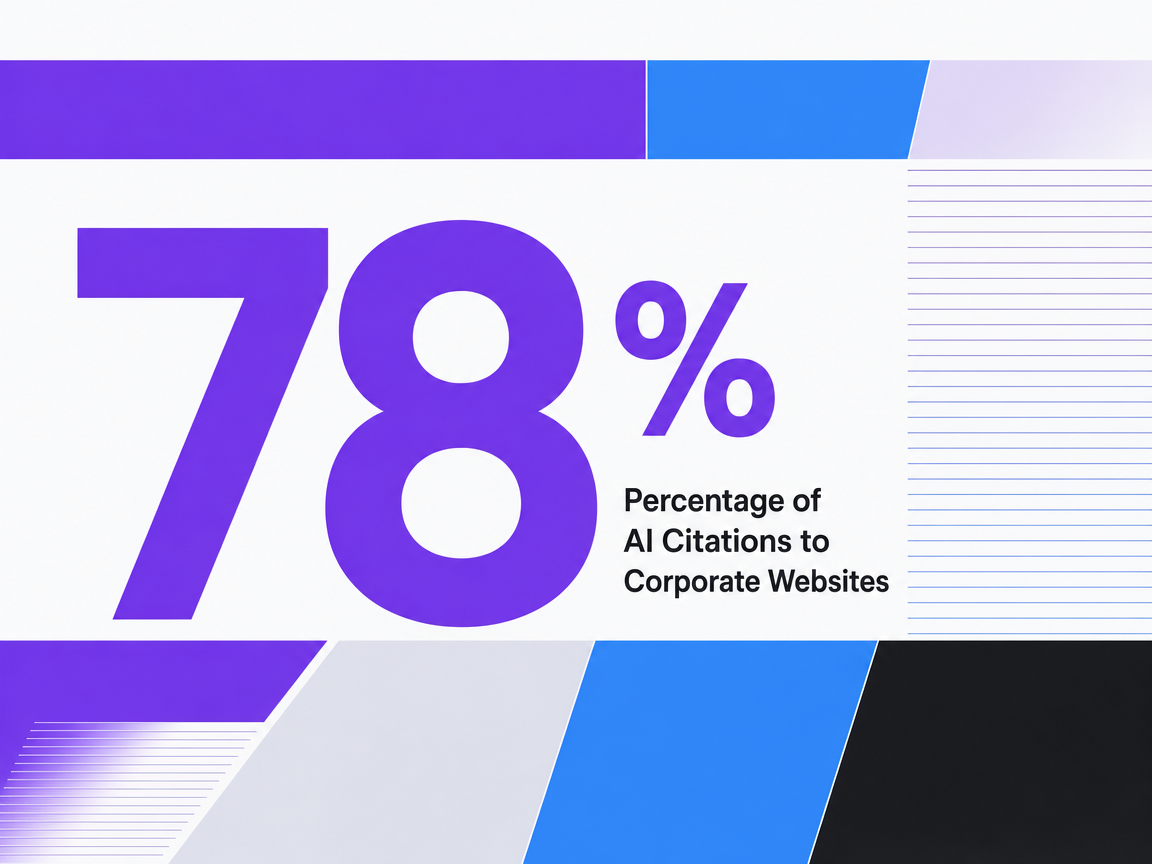 Percentage of AI Citations to Corporate Websites
Percentage of AI Citations to Corporate Websites
See How Top Agencies Use AI for Scalable Visibility Analysis
Request a live walkthrough of advanced AI-powered visibility analysis workflows proven to accelerate reporting and oversight across complex, multi-client portfolios.
What Google and Bing guidance actually says about measurable AI surfaces
Platform-side documentation from Google and Bing is more useful for tool selection than most agency roundups admit, because it defines what a visibility platform can realistically reconcile against first-party data. Google's official guidance states there are "no additional technical requirements" for appearing as a supporting link in AI Overviews or AI Mode beyond standard indexing and snippet eligibility, and confirms that AI feature impressions are logged inside Search Console Performance reports 1, 8. That single fact sets the floor for any tool claiming AI Overview coverage: if the platform cannot cross-check its sampled citations against Search Console impressions, the numbers float free of any first-party ground truth.
Bing's guidance points in a complementary direction. Its Webmaster team argues that combining sitemaps with real-time submission through IndexNow gives content the best chance to be "discovered, crawled, and indexed efficiently" in AI-powered search, with accurate lastmod values and daily sitemap reprocessing as the mechanical requirements 2. Bing has also formally added GEO language to its official guidelines and expanded its AI abuse definitions, signaling that answer-engine optimization is being folded into standard search operations rather than treated as a fringe discipline 12.
The practical filter for agency leads: any AI visibility platform on the shortlist should reconcile with Google Search Console, respect Bing's IndexNow submission model for freshness, and separate indexing hygiene from answer inclusion in its reporting.
A defensible reporting cadence that survives client QBRs
QBR failure modes are predictable. A visibility score jumps 12 points one month and drops 9 the next, the client asks what changed, and the analyst cannot explain the movement because the underlying prompt set was resampled against an unstable citation ecosystem. The fix is procedural, not technical: agencies need a reporting cadence that matches the measurement reality of AI answer surfaces rather than the calendar convenience of monthly decks.
A defensible cadence has three layers. Weekly internal pulls run on a 7-day rolling window to catch directional shifts and flag anomalies for the delivery team, not the client. Monthly client reports aggregate on a 28-day rolling window, which sits comfortably above the two-to-four-week threshold the 2026 citation stability study recommended for KPI-grade measurement 4. Quarterly business reviews compare 90-day aggregates against the prior quarter, with variance bands rather than point estimates.
Two disciplines separate credible reporting from theater. First, every score ships with the prompt count and engine mix that produced it, so the client understands the sample. Second, mentions, citations, and absorbed influence report as three columns, never one blended index 5. Analysts who hold that line stop defending yesterday's snapshot and start explaining trajectory.
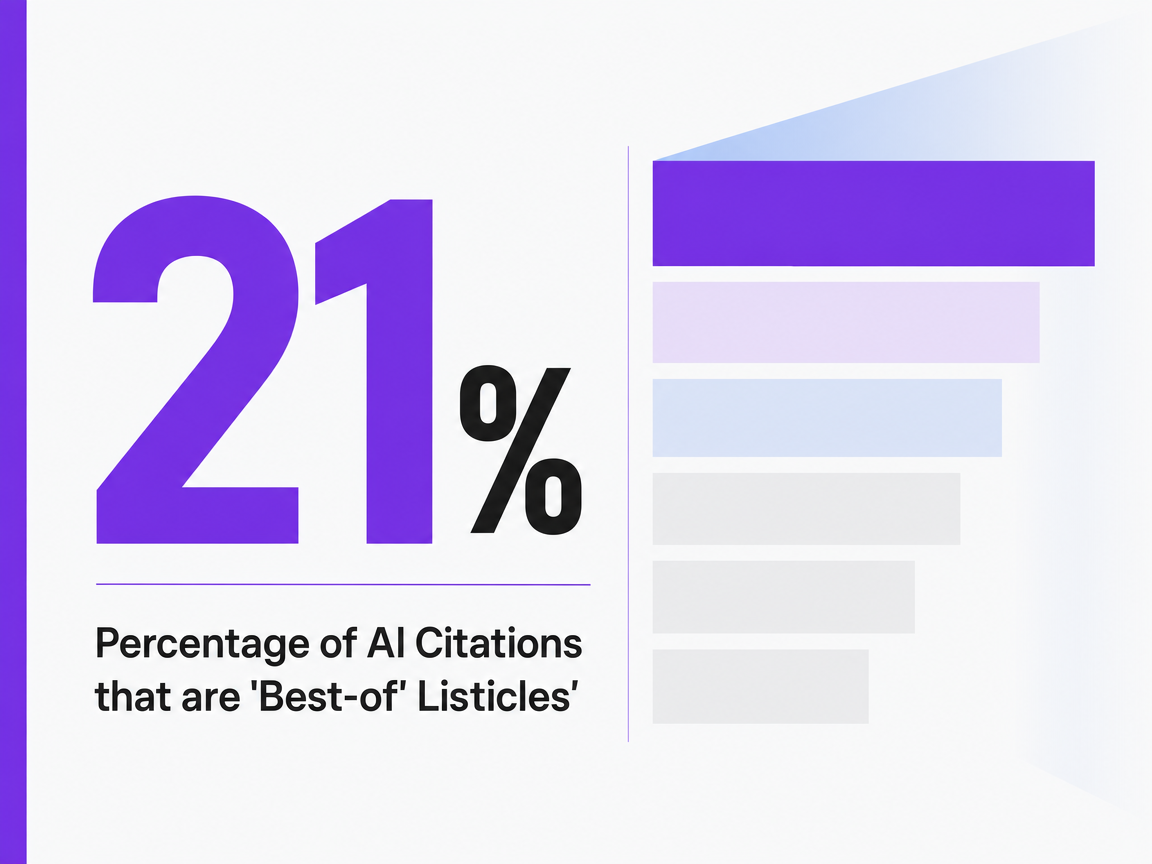 Percentage of AI Citations that are 'Best-of' Listicles
Percentage of AI Citations that are 'Best-of' Listicles
Frequently Asked Questions
References
- 1.AI Features and Your Website | Google Search Central.
- 2.Keeping Content Discoverable with Sitemaps in AI Powered Search.
- 3.Generative Engine Optimization at Scale: Measuring Brand Visibility Across AI Search Engines.
- 4.Don't Measure Once: Measuring Visibility in AI Search (GEO).
- 5.A Measurement Framework for Generative Engine Optimization.
- 6.How Large Language Models Source Brand Reputation.
- 7.Optimizing Visibility in Generative Engines: A Critical Survey of Generative Engine Optimization (2023-2026).
- 8.Latest Google Search Documentation Updates | Google Search Central | What's new | Google for Developers.
- 9.Google's new guide for AI search: what SEO really needs now.
- 10.Decoding Google's Official AI Optimization Guide — What Changed?.
- 11.Answer Engine Optimization: How To Get Your Content Into AI Responses.
- 12.Bing Adds GEO To Official Guidelines, Expands AI Abuse Definitions.
- 13.How schema markup fits into AI search — without the hype.
- 14.I tested 5 of the best SEO AI tools for visibility in 2026.
- 15.Your Vetted List of Best AI Visibility Tools to Try for 2026.