
Key Takeaways
- Semrush anchors the research stage with unmatched keyword, SERP, and backlink data, but its coverage ends at brief handoff, leaving production and publishing coordination manual.
- Ahrefs leads on backlink intelligence and SERP archive depth for portfolio audits, though its rank tracking still assumes traditional ten-blue-link SERPs and skips citation influence 4.
- Screaming Frog and Sitebulb automate technical crawl detection across Forrester's AEO indexability checklist 3, but remediation still depends on developer tickets and CMS work.
- Clearscope and MarketMuse standardize brief quality across distributed writers, yet a scored brief still needs manual assignment, editing, schema, and CMS handoffs to close the loop.
- AlliAI and SearchAtlas extend automation into bulk on-page and schema edits, but without approval-first governance they amplify errors as fast as wins in regulated verticals 1.
- Vectoron covers all six delivery-loop stages with approval as the default state, closing the handoffs point tools leave open rather than replacing research and crawl infrastructure.
Why the automated SEO category split in two
Automation ceased to be a unique selling proposition in agency SEO around late 2025. Forrester's 2026 agency survey revealed that 91% of US ad agencies are either utilizing or exploring generative AI, with larger agencies showing more advanced adoption 11. When most competitors employ some form of AI-assisted keyword research, brief generation, or on-page optimization, the tool itself no longer provides a competitive advantage. The key differentiator becomes what the tool automates.
This distinction has divided the category into two tiers. The first tier, point automation, involves software that accelerates a single, discrete task within the delivery loop, such as rank tracking, site audits, content briefs, or schema generators. While these tools are valuable, they do not reduce the coordination burden between tasks. For instance, a brief still requires manual assignment, drafting, review, publishing, and measurement, with each handoff remaining a manual process.
The second tier, orchestration, encompasses platforms that automate the entire workflow between tasks. In this model, research informs briefs, briefs drive production, production leads to publishing, publishing feeds measurement, and measurement guides the next iteration—all within a governed system with built-in approval checkpoints.
For agencies managing 10 accounts, the choice between these tiers might be a preference. However, for those managing 50 accounts, it directly impacts the profit and loss statement.
The delivery-loop scoring rubric
Evaluating agency delivery tools based on feature checklists is an outdated approach. The true measure of a tool's value lies in how much work transitions from human effort to automated systems, and which handoffs still necessitate manual reassignment, re-briefing, or re-explanation. The following rubric assesses tools based on three criteria: the number of delivery loop stages they cover, their support for the AEO structure (which Forrester now considers essential), and the robustness of their approval governance for high-stakes client work.
Six stages: research, brief, produce, publish, measure, iterate
Every client account follows a consistent six-stage monthly cycle:
- The research phase identifies opportunities, such as keyword gaps, SERP shifts, competitor movements, or technical regressions.
- The brief stage translates these opportunities into assignments with clear intent, structure, and internal linking targets.
- Production transforms the brief into a draft.
- Publishing involves pushing the content through a CMS, complete with schema, metadata, and internal links.
- Measurement connects the published asset to rank, traffic, citations, and pipeline performance.
- Finally, iteration uses these insights to inform the next round of research.
Point tools automate only one of these stages. For example, Semrush automates research, Clearscope automates brief scoring, and AlliAI automates on-page publishing edits. While valuable in isolation, these tools do not seamlessly transfer information between stages without human intervention. This means manually copying keyword lists into brief templates, pasting drafts into WordPress, or exporting rank reports into client decks. This manual handoff work is where significant margin is lost at a portfolio scale.
AEO readiness as a 2026 filter
Forrester's 2026 guidance outlines a specific technical foundation required for AI answer engines to reliably ingest content. This includes sitemaps, internal linking depth, schema markup, pre-rendering for JavaScript-heavy pages, freshness signals, and authoritative answer-mapping that connects questions to canonical site responses 3. Any tool considered for agency delivery in 2026 should be evaluated against this checklist, rather than solely on the volume of keyword suggestions it generates.
A practical filter involves six key questions:
- Does the tool generate or validate schema markup at scale?
- Does it map internal links by topical cluster?
- Does it identify stale content based on publish date and SERP volatility?
- Does it pre-render or integrate with a CMS that does?
- Does it structure answers to specific questions, rather than just optimizing for keyword density?
- Does it track citation appearance within AI answer surfaces, beyond traditional SERP position?
Tools that score low on this checklist are considered legacy options, as their focus on traditional rank tracking will become less relevant as visibility shifts to AI answer surfaces.
Approval governance as a delivery constraint
In highly regulated industries such as law, healthcare, behavioral health, and financial services, where an inaccurate claim can lead to regulatory action, automation without an approval layer introduces significant liability for agencies. NIST's AI Risk Management Framework emphasizes trustworthy AI as a governed lifecycle, requiring documented controls at each stage: design, development, use, and evaluation 1. This framework directly applies to SEO delivery, where every published asset carries reputational and regulatory risk. Consequently, every automated step needs a checkpoint where a human strategist provides sign-off before execution.
The scoring question is binary: Does the tool enforce approval as the default state, ensuring nothing publishes without sign-off, every recommendation includes its reasoning, and every automated action is logged? Or is approval an optional workflow that teams must configure themselves? Point tools typically fail this filter, whereas orchestration platforms are designed with this governance in mind.
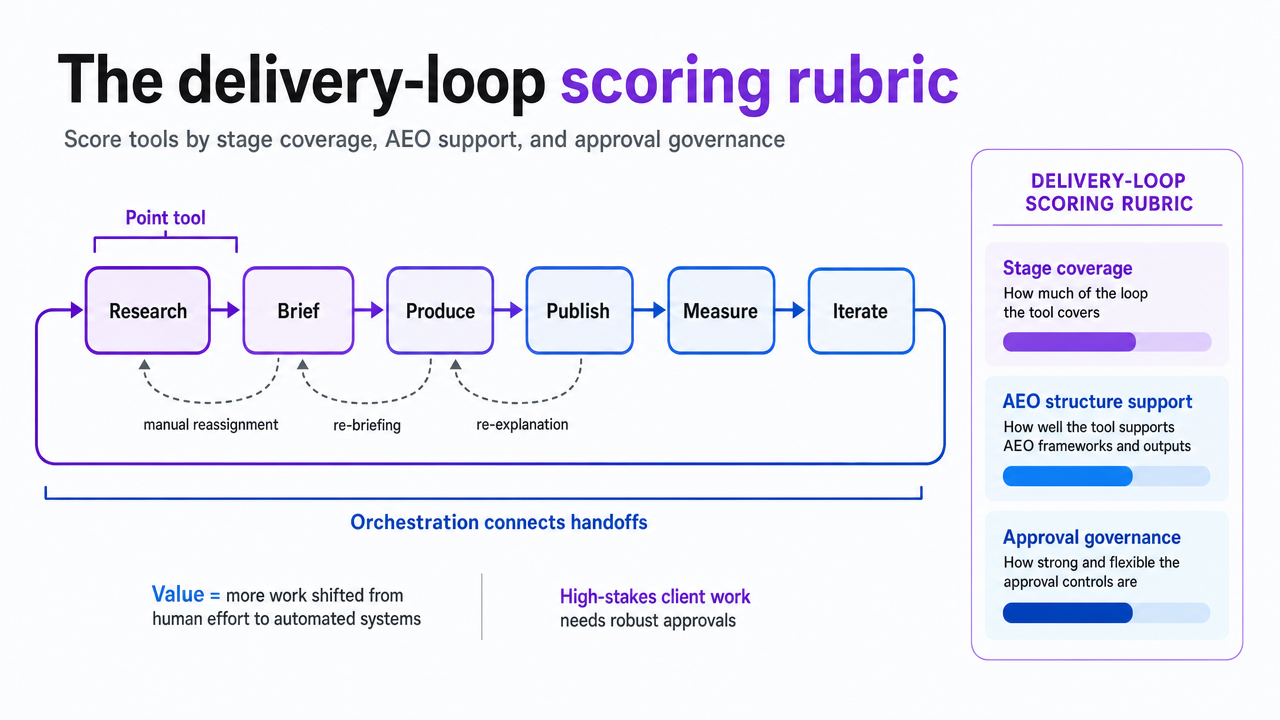 Visualize the six-stage delivery loop cited in the section, showing how point tools cover single stages while orchestration connects handoffs
The six tools, scored against the delivery loop
Each tool below is evaluated based on its coverage of the six-stage delivery loop, AEO readiness, and approval governance. A consistent pattern emerges: category leaders excel in one or two stages, leaving the remaining tasks to manual human coordination. This isn't a flaw but rather a characteristic of their category. The following outlines each tool's strengths and where coordination inefficiencies may arise.
Semrush: research-side dominance, thin on production
Semrush offers comprehensive coverage of the research stage, surpassing other tools in the category. Its capabilities include keyword gap analysis, SERP feature tracking, competitor content audits, backlink discovery, and position tracking, all within a unified dataset. For a delivery director overseeing 40 accounts, the Position Tracking API and Site Audit alerts provide a rapid method to identify clients requiring immediate attention.
However, its delivery-loop coverage concludes at the brief handoff. While Semrush generates content templates and topical research, the output still requires manual export, formatting, assignment to a writer, and transfer to a CMS. AEO readiness is partial; schema audits are available within Site Audit, but tracking citations within AI answer surfaces remains an unaddressed gap for most rank-focused platforms 4. Furthermore, approval workflows are not a native feature.
Verdict: Semrush is essential research infrastructure for agencies of all sizes. However, it should not be expected to reduce coordination time between research and publishing. It is best utilized as an intelligence layer feeding an orchestration platform, rather than serving as the platform itself.
Ahrefs: backlink and SERP intelligence for portfolio audits
Ahrefs excels in link intelligence and SERP archive depth. For agencies conducting technical audits across multiple clients, Site Explorer and Batch Analysis enable a single analyst to assess backlink profiles for dozens of accounts efficiently. Its Content Explorer index is more extensive than many competitors for competitive content research, and the Rank Tracker's SERP feature breakdown is valuable for identifying client pages losing visibility to AI Overviews or featured snippets.
Ahrefs' delivery-loop coverage is narrower than Semrush's, primarily focusing on research with limited briefing support and no production layer. Its AEO readiness score is low because its rank tracking still assumes the traditional ten-blue-links SERP, and it does not address Forrester's 2026 shift towards citation influence 4. There is no integrated approval workflow.
Verdict: Ahrefs is the strongest choice for agencies focused on backlink analysis and technical audits. It should be paired with a briefing tool and an orchestration layer, as it does not reduce the manual handoff work between insights and published solutions.
Screaming Frog + Sitebulb: technical crawl automation at portfolio scale
Screaming Frog and Sitebulb, while specializing in technical SEO crawling, are crucial for agencies due to the non-negotiable importance of technical AEO readiness. Screaming Frog's scheduled crawls, integrated with Search Console and Analytics APIs, can run across an entire client portfolio overnight. Sitebulb enhances this by providing prioritized issue reporting and a more polished audit deliverable for client presentations.
Both tools automate detection but not remediation. They identify issues such as broken schema, missing hreflang, weak internal linking, or pre-rendering failures, all directly relevant to Forrester's AEO indexability checklist 3. However, converting these findings into deployed fixes still requires developer tickets, CMS changes, or manual template edits. Neither tool addresses content production or approval governance.
Verdict: These tools are mandatory infrastructure for any agency providing technical SEO services. They automate the audit process but not the repair. The handoff from crawl report to implemented fix is precisely where an orchestration layer demonstrates its value.
Clearscope and MarketMuse: brief generation without orchestration
Clearscope and MarketMuse both automate the brief stage by scoring content against ranking competitors. Clearscope's grading is more straightforward and faster for writers, while MarketMuse's topic modeling offers deeper insights for content strategists developing cluster architecture. Both integrate with Google Docs and common CMS platforms.
Their limitations become apparent after brief generation. A scored brief still requires manual assignment to a writer, drafting, review against the score, editing for brand voice, adding schema and internal links, and pushing through the CMS. Each of these handoffs involves manual communication via Slack or project management tickets. Neither tool addresses Forrester's AEO guidance regarding content structured to answer specific questions with authoritative, indexable responses, rather than just optimizing for term coverage 3. Approval workflows are not part of their product offerings.
Verdict: These are strong choices for content-heavy agencies needing consistent brief quality across a pool of freelance writers. However, a scored brief should not be mistaken for a closed loop. The coordination burden between brief and publish is where these tools reach their limit, and orchestration becomes necessary.
AlliAI and SearchAtlas: on-page automation with variable QA
AlliAI and SearchAtlas extend automation into the on-page and technical execution stages. AlliAI focuses on bulk on-page edits—such as title tags, meta descriptions, schema, and internal links—deployed across an entire site via script or CMS integration, without requiring individual page edits. SearchAtlas offers a broader suite of tools, including on-page recommendations, content generation, and technical audits, under a single subscription.
While their coverage appears extensive, the critical issue lies in quality control. Bulk automated edits at a portfolio scale can amplify both successes and errors. A misconfigured rule that rewrites 400 title tags for a legal client could lead to a client retention crisis, not a productivity gain. Neither tool incorporates the approval-first governance that NIST's AI RMF frames as a lifecycle control 1; approval exists but is not the default state.
Verdict: These tools are beneficial for mid-market agencies with robust internal QA processes. However, they pose a risk in high-stakes verticals without a strict approval gate between recommendation and deployment.
Vectoron: orchestration and approval-workflow coverage
Vectoron is an orchestration platform, not a direct replacement for existing research and crawl infrastructure. It coordinates specialist AI strategists across content, SEO, PPC, backlinks, social, and call intelligence within a unified Command Center. Every recommendation includes its rationale, and every automated action requires human sign-off before execution.
Vectoron's delivery-loop coverage spans all six stages: research signals inform ranked recommendations, approved briefs move into production, published assets are tracked against pipeline, and iteration cycles drive subsequent research. Its AEO readiness is integrated into both content and technical layers, featuring schema generation, internal linking by topical cluster, freshness monitoring, and answer-mapping aligned with Forrester's indexability checklist 3. Approval governance is the default state, not a configurable option, which is crucial in regulated industries where automation without checkpoints creates agency liability 1.
Verdict: Ideal for agencies managing 20 or more accounts where coordination overhead is impacting margins. It complements tools like Ahrefs or Screaming Frog by closing the handoffs they leave open, rather than replacing them.
Test Automated SEO Workflows in Real Time
Experience live SEO automation and publish actual client content before you decide.
Coordination overhead is where agency margin actually breaks
At a portfolio scale, the primary bottleneck is rarely the analytical work itself. Instead, it's the transitions between analytical steps: writing a ticket, reassigning a brief, re-scoping a draft after client feedback, or rebuilding a report because rank data resides in one platform and pipeline data in another. Each of these transitions represents specialist hours that are not billable to the client.
McKinsey's 2026 analysis of enterprise marketing organizations adopting always-on AI orchestration quantifies this exposure. In traditional operating models, marketers spend 60% to 70% of their time on execution tasks. However, in organizations that have restructured around integrated AI orchestration—connecting research, production, deployment, and measurement within a single system—this figure drops to as low as 10% to 15% 6. While this data pertains to enterprise marketing organizations, not 12-person agencies, the significant delta indicates a clear direction, aligning with what delivery directors observe in their timesheets.
Point tools reduce the analytical time within a specific stage, whereas orchestration platforms minimize the coordination time between stages. For agencies managing 50 accounts, the latter is where significant improvements to the P&L are realized.
If you manage 50+ accounts: a coordination-cost consolidation table
For agencies managing 50 or more accounts, the specialist hours not directly billable to clients become a critical factor determining gross margin. The table below outlines the six delivery activities and distinguishes between what a point tool covers and what an orchestration layer handles. Per-account hour benchmarks vary widely across verticals and content depth, so these columns are left as agency-supplied variables. Delivery leads should input their own timesheet data for accurate assessment.
| Delivery activity | Typical specialist hours per account per month | Point-tool coverage | Orchestration coverage | Residual human hours ||---|---|---|---|---|| Keyword and SERP research | agency-supplied variable | High (Semrush, Ahrefs) | High, feeds next stage automatically | Strategic review only || Brief creation and assignment | agency-supplied variable | Partial (Clearscope, MarketMuse) | High, brief inherits research state | Editorial sign-off || Content production | agency-supplied variable | Low | High, draft inherits brief state | Voice and accuracy edit || On-page and schema deployment | agency-supplied variable | Partial (AlliAI) | High, deploys post-approval | Approval gate || Measurement and reporting | agency-supplied variable | Partial, siloed by tool | High, unified across stages | Client narrative || Iteration planning | agency-supplied variable | Low, requires manual synthesis | High, measurement feeds next research cycle | Prioritization call |
The interpretive value of this table aligns with McKinsey's finding that enterprise marketing organizations transitioning to always-on operating models reduce execution time from 60–70% to 10–15% 6. While agencies are not enterprise marketing departments, this delta indicates the potential for efficiency gains. The table clarifies that residual human hours should be dedicated to strategic review, editorial judgment, approval, and client narrative. All other coordination tasks should be handled by the system.
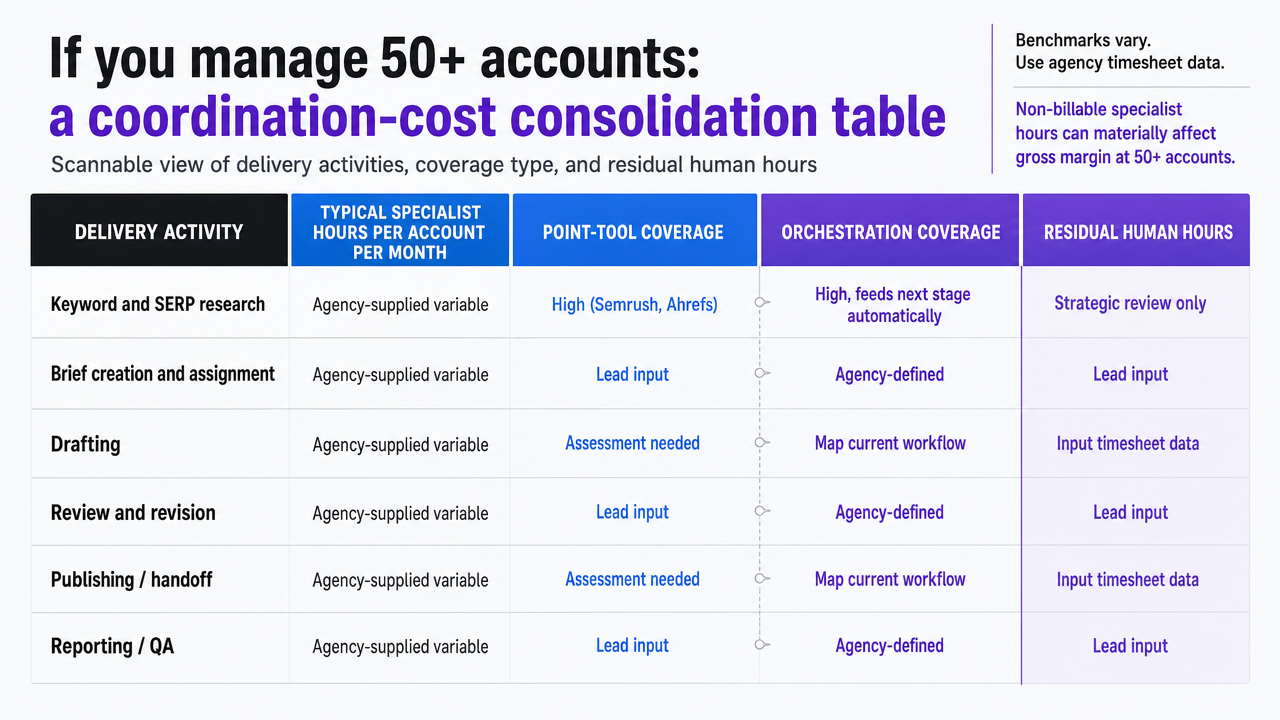 Render the article's comparison table as a scannable visual mapping delivery activities to point-tool versus orchestration coverage and residual human hours
Where AEO changes the tool selection math
The landscape of measurement is evolving. Forrester's 2026 accountability analysis posits that AI search will transform B2B marketing measurement, shifting visibility away from traditional SERP rank and click-through rates towards citation influence within generative answer surfaces 4. Consequently, a rank tracker that only monitors positions one through ten will be observing a diminishing window of visibility.
This shift necessitates a revised buyer's checklist, elevating three capabilities from "nice-to-have" to baseline requirements:
- First, schema and structured data generation at a portfolio scale are crucial because AI answer engines rely on typed markup to select citation sources.
- Second, answer-mapping—pairing specific questions with canonical responses on the site—is essential, as Forrester's AEO guidance emphasizes indexable, question-shaped content as the new foundation 3.
- Third, citation tracking within AI answer surfaces becomes vital, as the objective is no longer solely a blue link.
AEO also expands the scope of coordination. Forrester describes it as a discipline demanding broader collaboration than traditional SEO, encompassing content, web development, PR, and brand 2. A single-stage automation tool cannot manage this extensive coordination load. Therefore, tool selection increasingly favors platforms capable of maintaining workflow cohesion as the visibility surface continues to change.
See How Leading Agencies Automate SEO Delivery Without Adding Headcount
Request a personalized walkthrough of unified, approval-first workflows that reduce manual SEO tasks and accelerate campaign execution across multiple client accounts.
Governance, hallucination risk, and the approval layer
Deloitte's 2025 enterprise survey confirms a trend many delivery leads already perceive: as generative AI moves from experimentation to production, organizations successfully scaling it are those establishing explicit governance around bias, hallucination, and compliance controls 10. For agencies serving regulated sectors like law, healthcare, behavioral health, or financial services, such governance is not optional; it determines whether automation yields a win or a client retention crisis.
The practical control lies in where approval is positioned within the workflow. NIST's AI Risk Management Framework emphasizes that trustworthiness should be integrated into the design, development, use, and evaluation of AI systems, rather than being an afterthought 1. In the context of SEO delivery, this means every automated recommendation must include its reasoning, every deployment must log its trigger, and every publishing action must pass through a human sign-off before affecting a client's property. Tools that offer approval as a configurable option, rather than a default state, transfer the risk back to the agency. At a portfolio scale, a single hallucinated statistic on a regulated client's site can incur costs far exceeding a year's worth of tool savings.
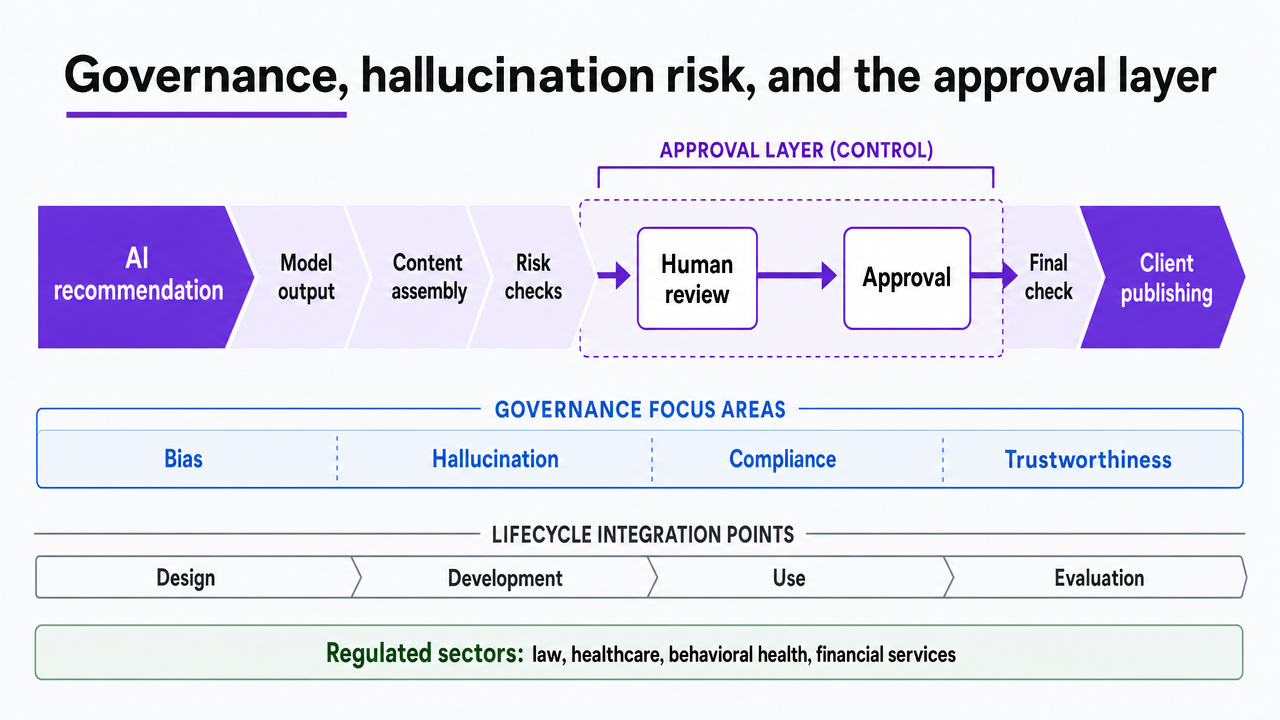 Illustrate the approval-first governance flow described in the section, showing where human sign-off gates sit between AI recommendation and client publishing
Verdicts by agency scale
The optimal tool shortlist varies significantly with account volume. What functions effectively for eight clients under one strategist becomes unmanageable for forty clients managed by three pod leads. Tools that prove cost-effective at scale may appear excessive for a boutique roster. The following verdicts categorize the six tools based on their suitability for different agency sizes.
Solo strategist and boutique (under 10 accounts)
At this scale, a single individual can still manage coordination overhead. The recommended stack includes Semrush or Ahrefs for research and rank intelligence, Screaming Frog for scheduled crawls, and Clearscope for consistent brief quality across freelance writers. Orchestration platforms are premature, as handoffs are short enough to be managed effectively with a well-maintained project board. Prioritize point tools that enhance judgment and defer workflow automation until roster growth necessitates it.
Mid-market delivery (10-30 accounts)
This is the range where coordination inefficiencies begin to impact utilization reports. Essential research and audit infrastructure, such as Ahrefs or Semrush combined with Screaming Frog or Sitebulb, remains critical. Briefing tools like Clearscope or MarketMuse become valuable if the writer pool is distributed. AlliAI or SearchAtlas are viable for on-page deployment, but only with a stringent internal QA layer preceding bulk edits. Orchestration is worth piloting on the largest three or four accounts before broader implementation.
Scaled delivery (50+ accounts)
Beyond fifty accounts, relying solely on point tools often leads to compressed gross margins. While research and crawl infrastructure—Ahrefs, Semrush, and Screaming Frog—remain indispensable, the layer above them must evolve. Vectoron, or a comparable orchestration platform, bridges the gaps left by these tools. It ensures research informs ranked recommendations, briefs inherit that state, approved work deploys with logged sign-off, and measurement drives the next cycle. In regulated verticals, approval-first governance is the crucial factor distinguishing a successful scaling strategy from a client retention issue 1.
Frequently Asked Questions
References
- 1.AI Risk Management Framework | NIST.
- 2.Seven Roles, One Goal: How To Organize For Answer Engine Optimization.
- 3.The Marketer's Guide To Answer Engine Optimization.
- 4.AI Search Will Forever Change The Rules Of B2B Marketing Accountability.
- 5.The economic potential of generative AI: The next productivity frontier.
- 6.From campaigns to continuous growth: AI capabilities shaping the future of marketing.
- 7.How generative AI can boost consumer marketing.
- 8.Marketing and sales soar with generative AI.
- 9.An unconstrained future: How generative AI could reshape B2B sales.
- 10.State of Generative AI in the Enterprise.
- 11.The State Of AI Inside US Marketing Agencies, 2026.
- 12.Win Visibility In AI Search With Answer Engine Optimization.