
Key Takeaways
- Enterprise crawlers like Lumar, seoClarity, BrightEdge, Botify, and Screaming Frog absorb scale on million-page sites where integrated suites time out, though native reporting rarely ships client-ready 2.
- Integrated suites such as Semrush, Ahrefs, Moz, and Majestic standardize the six-step audit workflow across a portfolio, making deliverables interchangeable between junior and senior analysts 1, 3.
- Specialist depth tools earn their spot only when the extra fidelity changes a client recommendation, and should be reviewed against that outcome quarterly rather than renewed on autopilot.
- AI execution layers sit downstream of research tools and convert competitive findings into shipped briefs, on-page edits, and outreach, ideally through approval-first workflows that preserve strategic oversight 7.
Competitor Research as Production Infrastructure
Agency SEO leaders are no longer buying competitor research tools to make analysts smarter. They are buying them to remove analyst hours from recurring monitoring so those hours can move to interpretation, prioritization, and client-facing strategy. The distinction matters because it changes what qualifies as a good tool. A platform that produces a beautiful gap report but requires four hours of analyst prep per client per month is worse than a duller platform that runs the same report unattended across thirty clients.
The spending signal backs this reframe. The enterprise SEO platform market is projected to grow from roughly $5 billion in 2025 to $15 billion by 2033, a 15% compound annual growth rate driven by demand for integrated suites that bundle keyword research, technical audits, rank tracking, and reporting under a single workflow 4. Agencies are the accelerant. They are the buyers most exposed to the cost of tool sprawl and the ones with the clearest incentive to centralize competitive intelligence across a client book rather than assemble it per engagement.
What follows is not a ranked list. It is a working shortlist organized by delivery model: enterprise crawlers, integrated suites, specialist depth tools, and AI execution layers. Each archetype solves a different bottleneck. Enterprise crawlers absorb scale. Integrated suites standardize analyst workflows. Specialist tools handle the non-obvious work that broad suites miss. Execution layers turn findings into shipped changes without another handoff. The right combination depends on where an agency sits on the automation curve, not on which vendor won last quarter's G2 grid.
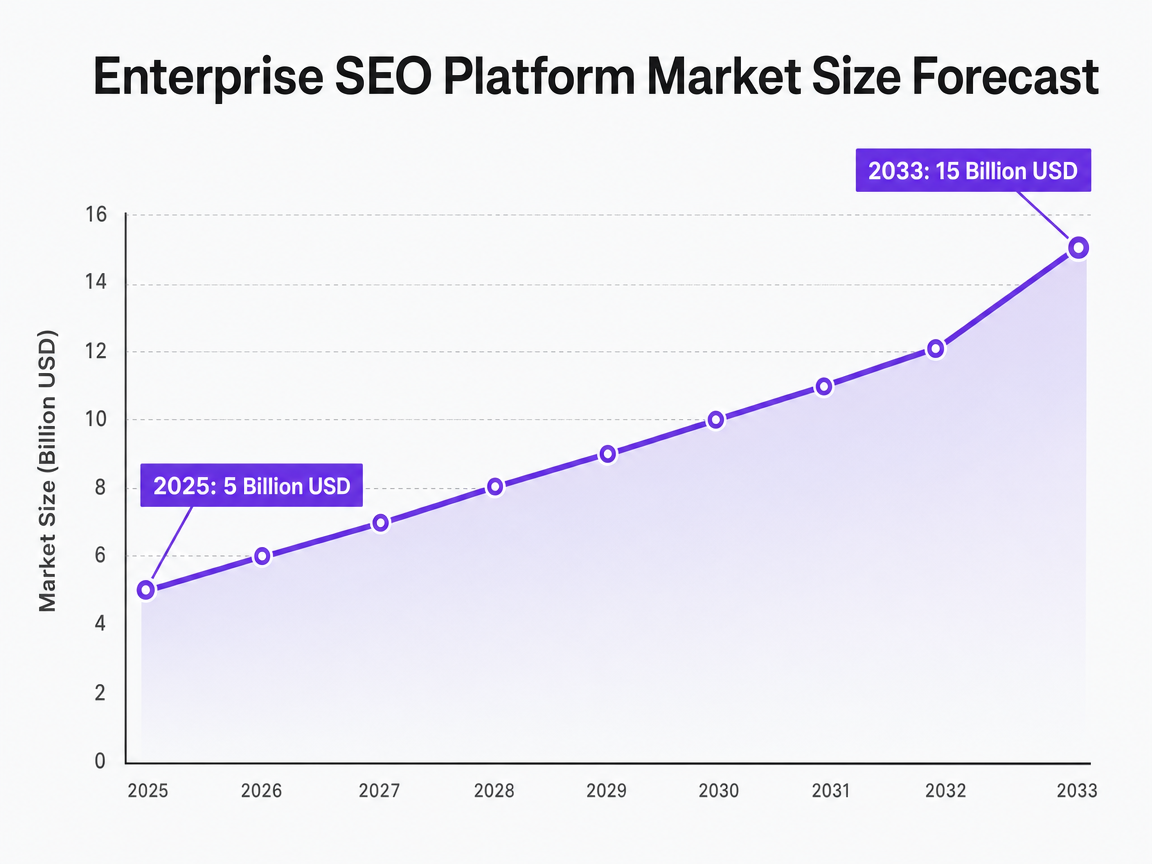 Enterprise SEO Platform Market Size Forecast
The market is projected to grow from $5 billion in 2025 to $15 billion by 2033, as companies increase investment in integrated SEO platforms.
What Qualifies a Tool for the Agency Shortlist
A platform earns a spot on the shortlist by covering the full competitive audit workflow without analyst babysitting. That workflow is well documented:
- competitor identification,
- keyword difficulty scoring,
- gap discovery,
- on-page and content analysis,
- backlink profile inspection, and
- site structure review 1.
Any tool that handles four of those six as one-click reports and the other two through structured exports belongs in the evaluation. Anything that requires an analyst to stitch outputs together across tabs does not.
Three additional filters apply at agency scale:
- First, multi-client workspace support with per-domain tracking, shared taxonomies, and role-based access. Solo-seat tools that force analysts to swap logins per client fail on economics alone.
- Second, an API or scheduled export path robust enough to feed a reporting layer, because dashboards built on screenshots do not survive a portfolio of thirty accounts.
- Third, change monitoring that runs on its own cadence, flagging backlink deltas, ranking movements, and content publishing events without a human triggering the crawl 2.
What does not belong on the list: tools sold on a single differentiator, tools priced per query in ways that punish routine monitoring, and tools whose enterprise tier locks the API behind a sales call. Agencies buying competitor research infrastructure need predictable unit economics per client, not a demo cycle every time a new account onboards.
Four Archetypes That Actually Map to Delivery Models
Enterprise Crawlers Built for Scale
Enterprise crawlers exist because integrated suites hit a ceiling somewhere around a few hundred thousand URLs. When an agency inherits a client with a million-page catalog, a multi-region publisher, or a marketplace with dynamic faceted navigation, the question stops being which platform surfaces the prettiest keyword gaps. The question becomes which platform can crawl the site and its top three competitors on a schedule without timing out or blowing the crawl budget.
The canonical roster here is narrow. Lumar, seoClarity, BrightEdge, Botify, and Screaming Frog show up repeatedly in enterprise-tier competitor analysis workflows, each engineered to crawl sites with millions of pages, automate performance tracking, and manage large-scale campaigns across regions and product lines 2. Semrush and Ahrefs enterprise tiers extend into this territory as well, though their strength remains keyword and backlink intelligence rather than log-file-grade site auditing.
The operational value is not the crawler itself. It is the ability to diff a competitor's site week over week and surface what changed: new template deployments, indexation shifts, internal link restructures, and content velocity by section. That data feeds the analyst brief for the next client call without an analyst opening a spreadsheet.
Two tradeoffs matter at agency scale. First, seat and domain economics get punishing fast when a portfolio adds smaller clients whose competitive footprint does not justify enterprise-tier tracking. Second, the reporting layer is rarely client-ready out of the box, so agencies usually pipe crawler outputs into a downstream dashboard rather than sharing the native UI. Agencies with fewer than roughly a dozen large-site clients typically get better unit economics running Screaming Frog at scale on their own infrastructure and reserving the hosted enterprise crawlers for the accounts that actually need distributed crawls and historical archives.
Integrated Suites That Standardize Analyst Workflows
Integrated suites are the workhorse tier. They are what analysts open first every morning and what most agencies default to when onboarding a new client, because they collapse the six-step competitive audit workflow, competitor identification, keyword difficulty, gap discovery, on-page analysis, backlink profile inspection, and site structure review, into a single interface 1. Semrush, Ahrefs, Moz, and Majestic dominate this category, with BrightEdge and seoClarity crossing over from the enterprise tier for agencies that want a unified suite across all client sizes 3.
The strategic value here is standardization. When every analyst on a fifteen-person team pulls competitor data from the same platform using the same taxonomy, deliverables become interchangeable across accounts. Junior analysts can run the recurring monitoring on twenty clients without a senior strategist rechecking each report. That is where analyst utilization actually moves.
The failure mode is depth. Integrated suites are broad by design, which means their backlink index will lag a specialist, their SERP feature tracking will lag a rank-monitoring purist, and their content analysis will miss the semantic nuance that a dedicated content optimization tool catches. Agencies that treat the suite as the only source of truth end up with reports that look right and miss the competitive move that mattered.
The right posture is to run one integrated suite as the standardized reporting spine and keep a small budget for specialist tools that fill known gaps. Agencies running two overlapping suites, usually Semrush and Ahrefs in parallel, should audit whether the redundancy pays for itself in cross-verification or whether it is just historical inertia from a merger or a team preference that never got reconciled.
Specialist Depth Tools for the Non-Obvious Work
Specialist tools exist for the work that integrated suites do at 70% fidelity. Backlink intelligence is the clearest example. Majestic maintains its own link index alongside the more familiar ones and is cited among the major enterprise SEO platform players specifically for that depth 3. Screaming Frog, though technically a crawler, functions as a specialist tool in most agency stacks because analysts run it on demand for the audits that hosted crawlers over- or under-scope 2.
Beyond backlinks, the specialist category covers:
- rank tracking with SERP feature granularity,
- content optimization scoring against real ranking pages,
- log-file analysis for crawl budget diagnosis, and
- SERP volatility monitoring.
Each of these can be handled inside an integrated suite. None of them is handled as well.
The agency question is not whether the specialist depth is real. It is whether the depth changes the recommendation. If a backlink audit from a dedicated index surfaces toxic domains that Ahrefs missed but the client's disavow file already covers them, the specialist tool paid for a report the strategist could not act on. If the same audit surfaces a link-building pattern a competitor is running that changes the outreach plan for the next quarter, the tool paid for itself in a single engagement.
Specialist tools belong in the stack when a specific client outcome depends on data the suite cannot produce. They should be reviewed against that outcome quarterly, not renewed on autopilot.
AI Execution Layers That Close the Loop
The fourth archetype is the newest and the one most often miscategorized. AI execution layers do not compete with Semrush or Ahrefs on data breadth. They sit on top of that data, or ingest it directly, and turn competitive findings into shipped work: briefs written against gap keywords, on-page changes staged for approval, backlink outreach sequenced, internal link updates pushed to the CMS. The research tool tells the analyst what a competitor is doing. The execution layer produces the response.
The adoption context matters for how seriously to take this category. Survey data compiled by MarTech reports that 94% of organizations now use AI to prepare or execute marketing, 91% of agencies use AI technologies in some form, and 63% of agencies describe their use as extensive 7. Those figures are agency self-report rather than audited usage, so the 63% extensive-use figure should be read as a directional signal about intent, not a measured operational baseline. The signal is still clear enough to act on: AI is now inside the agency workflow, and the question is which functions it owns.
Execution layers vary widely. Some are single-function content generators loosely bolted onto keyword data. Others coordinate specialist agents across content, SEO on-page, backlinks, and reporting through an approval workflow, which is the design Vectoron's platform takes. The differentiator that matters for an agency evaluation is whether the tool requires a human approval step before publishing or executing, because approval-first automation is what preserves the strategic oversight that clients pay for.
Execution layers do not replace competitor research tools. They shorten the distance between the finding and the change that closes the gap, which is where agency margin actually lives.
Test AI-driven competitor insights on live campaigns
Validate your agency’s SEO strategy with actionable research and publish results during your free trial period.
Shortlist Comparison at a Glance
The four archetypes map to different bottlenecks, and the shortlist below reflects that. Named tools are drawn from the enterprise and integrated-suite rosters cited in the reference set 2, 3. Execution layers are described categorically because the reference map does not underwrite a full vendor slate in that tier; Vectoron is included as one example of the approval-first design pattern.
| Archetype | Representative Tools | Primary Use Case | Multi-Client Workspaces | Notable Limitation |
|---|---|---|---|---|
| Enterprise Crawler | Lumar, seoClarity, BrightEdge, Botify, Screaming Frog 2 | Scheduled crawls of million-page sites and their top competitors | Strong at enterprise tier; seat and domain pricing scales fast | Native reporting rarely client-ready without a downstream layer |
| Integrated Suite | Semrush, Ahrefs, Moz, Majestic 3 | Standardized six-step competitive audit across a portfolio 1 | Yes, with per-project taxonomies and shared access | Depth ceiling on backlinks, SERP features, and content scoring |
| Specialist Depth Tool | Majestic (links), Screaming Frog (crawl) 2, 3 | Audits where suite fidelity changes the recommendation | Limited; typically seat- or license-bound | Payoff depends on whether findings alter client actions |
| AI Execution Layer | Approval-first coordination platforms, including Vectoron | Turning competitive findings into shipped briefs, on-page edits, and outreach | Yes, when built for portfolio workflows | Depends on upstream research feeds; not a data source itself |
Read the table as a coverage map, not a ranking. Most agencies run one item from rows one or two as the spine, add one specialist where a client outcome demands it, and evaluate the execution layer against analyst hours reclaimed per client per month.
Stack Rationalization as a Margin Lever
The margin math on competitor research is not a tool problem. It is a utilization problem. Enterprise companies run an average of 91 marketing technology tools while only 58% are actively used, which means roughly 38 tools per enterprise stack sit idle or underused at any given time 9. Agencies that resell or mirror that pattern across a client book compound the waste, because every unused seat is billed monthly regardless of whether an analyst opened the platform.
The trend line is directional but not linear. Martech stack capability utilization sat at 58% in 2020, fell to 33% in 2023 as tool sprawl outpaced training and integration, and recovered to 49% in 2025 as consolidation and AI-enabled interfaces made more of each platform reachable 5. The 2023 low is the interesting number for agency heads. It marks the point where buying more tools stopped producing more insight, and it explains why the current wave of platform selection is defensive rather than expansionist.
Rationalizing the competitor research slice of the stack is where the reclaimable margin actually sits. Most agencies carry two integrated suites, one enterprise crawler license they use on three accounts, two or three specialist tools with expired justifications, and a handful of single-seat rank trackers analysts brought over from previous jobs. Consolidating that footprint to one suite plus one crawler plus one specialist, with the execution layer sitting downstream, typically eliminates four to six overlapping subscriptions without losing coverage.
The following consolidation map uses the sourced utilization benchmarks as anchor data. Hours reclaimed are expressed as variables because analyst time savings depend on portfolio size and reporting cadence, not on vendor marketing.
| Tool Category | Typical Agency Subscription Count | Consolidation Target | Analyst Hours Reclaimed per Client per Month |
|---|---|---|---|
| Integrated Suites | 2 (Semrush + Ahrefs in parallel) | 1 primary, 1 read-only for cross-check | 2 to 4 hours (recurring gap and rank reports) |
| Enterprise Crawler | 1 hosted + ad hoc Screaming Frog | 1 hosted for large sites only, Frog everywhere else | 1 to 3 hours (scheduled diffs replace manual crawls) |
| Specialist Depth Tools | 2 to 4 (backlinks, rank, content, SERP volatility) | 1 tied to a specific client outcome, reviewed quarterly | 0.5 to 1.5 hours (per client where the tool is applied) |
| Execution Layer | 0 to 2 fragmented content or outreach tools | 1 approval-first coordination platform | 3 to 6 hours (brief production, on-page staging, outreach) |
The lever is not the subscription savings. It is the analyst hours that move from data assembly to interpretation once the consolidation is done. That is the line item that shows up in gross margin.
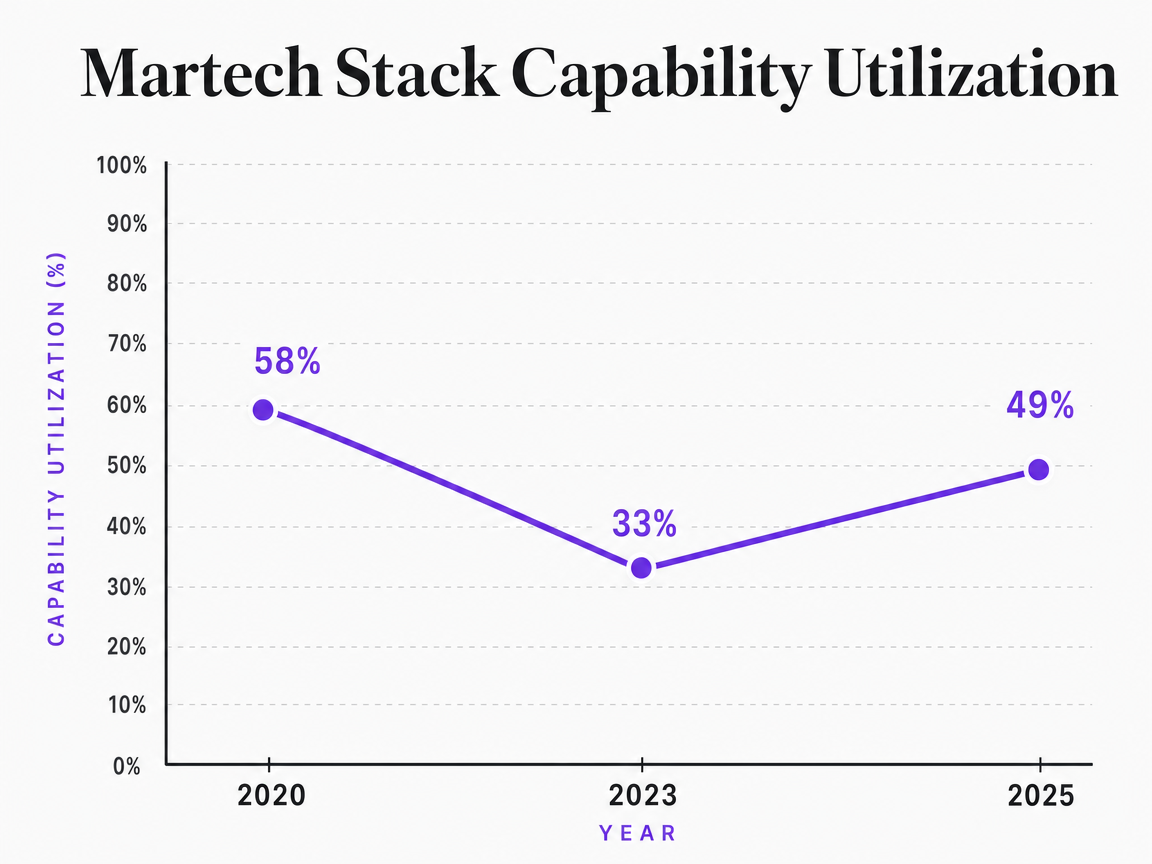 Martech Stack Capability Utilization
Shows the percentage of martech stack capabilities used by marketers over time, indicating underutilization but recent improvement.
Buy the Platform or Build on the API
The 2025 State of Your Stack survey found that marketers are using more tools than ever, and a growing share of those tools are homegrown, built faster because AI has collapsed the cost of writing internal software 8. Agencies are a visible slice of that trend. Analysts who used to export Ahrefs CSVs into spreadsheets are now writing lightweight monitoring layers on top of the Ahrefs and Semrush APIs, piping the outputs into a shared warehouse, and rendering client-ready dashboards without touching the vendor UI.
The build case is real when three conditions hold:
- The portfolio is large enough that per-seat vendor pricing exceeds engineering cost.
- The competitive metrics the agency reports on are stable enough to codify.
- There is at least one engineer who owns the pipeline as a product, not a side project.
Under those conditions, a custom layer turns three vendors into one warehouse and reclaims the analyst hours spent reconciling exports.
The buy case wins everywhere else. Homegrown pipelines carry maintenance debt that compounds every time a vendor changes an API contract, a client asks for a metric the pipeline does not compute, or the engineer who built it leaves. Agencies that go this route without a named owner end up with a fragile dashboard, a stale index, and an analyst quietly running the old export process in parallel.
The decision is not build versus buy on principle. It is whether the agency wants to operate a data engineering function alongside its SEO delivery function. Most should not.
See How Agencies Systematize Competitor Insights Across Every Client
Connect with our team to explore how unified competitor research workflows streamline data collection, reporting, and execution for multi-site SEO programs—enabling you to scale insights without increasing analyst headcount.
If You Manage a Multi-Client Portfolio
Scope note: this section addresses agencies operating ten or more concurrent SEO engagements, where per-client tool decisions compound into portfolio-level economics. Single-client boutiques and in-house teams face different constraints.
Portfolio management changes the shortlist criteria in one specific way. The question stops being which tool produces the best output for a client and becomes which tool produces acceptable output across the widest client range with the least analyst supervision. A platform that shines on ecommerce accounts but stumbles on local service businesses forces the agency to run parallel stacks, which erodes the standardization that made the suite worth buying 3.
Three portfolio-specific moves matter more than tool selection itself:
- Segment the client book by competitive complexity, not revenue, and match archetypes to segments: enterprise crawlers for the top decile with million-page sites, the integrated suite as the default for the middle, and lightweight ad hoc audits for accounts where competitor research is a quarterly check rather than a monthly deliverable.
- Standardize the six-step audit workflow, competitor identification through site structure review, so every analyst delivers comparable outputs regardless of which platform ran the query 1.
- Run a portfolio-level change monitoring layer that flags competitor moves across all accounts nightly, so analyst attention gets pulled toward the accounts where something actually shifted 2.
The reclaimable analyst hours live in that third move. Portfolio-wide change monitoring is what turns competitor research from a scheduled report into an alerting system.
How to Sequence the Consolidation Over One Quarter
Rationalizing a competitor research stack in one move breaks reporting and spooks analysts. Sequenced over a quarter, it moves without disruption.
- Weeks 1 to 3: audit and freeze. Pull every active competitor research subscription, map each to the six-step audit workflow, competitor identification through site structure review 1, and flag which platform actually produced last quarter's client deliverables. Freeze new tool purchases and cancel auto-renewals expiring in the window. Most agencies find two or three tools no analyst has opened in ninety days.
- Weeks 4 to 7: designate the spine. Pick one integrated suite as the standardized reporting layer and migrate every analyst's recurring gap, rank, and backlink reports onto it. Keep the second suite in read-only mode for cross-verification on the top decile of accounts. Retire specialist tools that do not tie to a named client outcome reviewed inside this quarter.
- Weeks 8 to 10: install the change monitoring layer. Configure portfolio-wide alerts on backlink deltas, ranking shifts, and content publishing events so analyst attention gets pulled to accounts where something moved 2. This is where the reclaimed hours become visible.
- Weeks 11 to 13: evaluate the execution layer. Run one AI execution platform against two or three accounts with clean competitive briefs and measure hours from finding to shipped change. Renew or replace based on that number, not the demo.
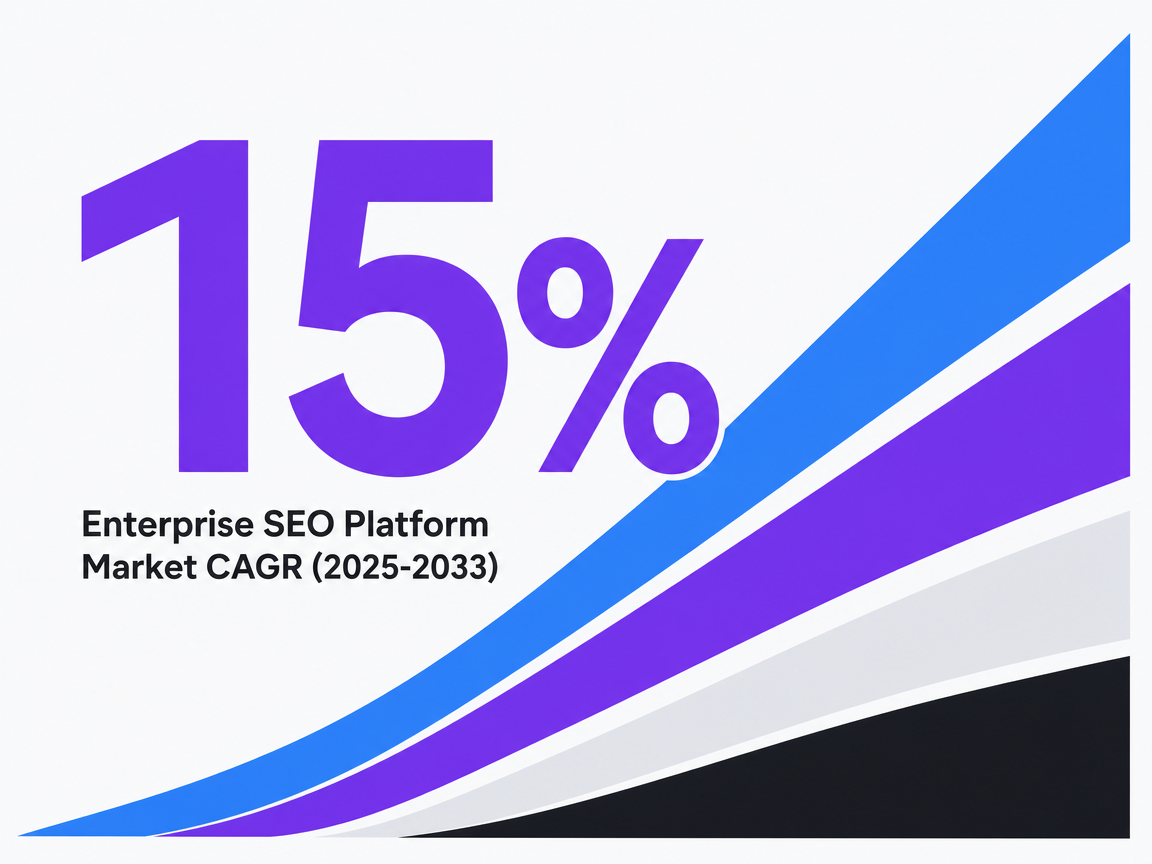 Enterprise SEO Platform Market CAGR (2025-2033)
Enterprise SEO Platform Market CAGR (2025-2033)
Frequently Asked Questions
References
- 1.SEO Competitive Analysis: The Definitive Guide.
- 2.Enterprise SEO Competitor Analysis: A Quick Start Guide.
- 3.Enterprise Seo Platforms Market Share, Size, Trends | 2035.
- 4.Enterprise SEO Platforms Analysis 2025 and Forecasts 2033.
- 5.32 Martech Statistics and Data Points for 2026.
- 6.Peak Martech: 15505 Tools, Almost Zero Growth.
- 7.AI and marketing: What the stats show.
- 8.State of the Stack 2025: Homegrown martech surges as AI ....
- 9.46 Marketing Technology (MarTech) Statistics for 2026.
- 10.Marketing Technology Statistics: 30 Key MarTech Trends ....