
Key Takeaways
- The real constraint at scale is execution throughput per approved decision, not keyword database size, so evaluate enterprise SEO software as an operating-model choice rather than a feature comparison.
- The category resists clean shortlists because no vendor covers crawling, content, logs, accessibility, and attribution at equal depth, making integration cost and executive-ready measurement the deciding factors 10, 5.
- Judge data breadth by which of six signal streams the platform ingests natively, since blind spots in rendered crawls, logs, or Core Web Vitals force the team to build a second dashboard 3.
- Workflow governance turns findings into standards through written rules, continuous monitoring, and routed remediation, a pattern visible in Connecticut, New Jersey, and GSA deployments 2, 9, 3.
- Measure execution throughput by cycle time from surfaced recommendation to shipped change and by the ratio of recommendations acted on, because backlog growth is not scale 6.
- Revenue attribution decides executive reviews, so the platform must tie organic sessions to CRM stages and hold up under algorithm volatility without a BI engineer assembling the join 5, 8.
- The stack-versus-suite decision shifts coordination cost between the team and the platform; VPs hitting the headcount ceiling should weight cycle time and governance above category depth 6.
- AI-coordinated execution changes the buy when approval-first workflows route ranked recommendations to named owners, execute approved changes, and feed outcomes back into attribution inside one interface 4.
The headcount ceiling is now the SEO software problem
Every Marketing VP running organic at scale eventually hits the same wall: the content calendar keeps expanding, the technical backlog keeps growing, and finance keeps declining requests for two more SEOs and a full-stack developer. The bottleneck is no longer strategy or budget. It is throughput per approved decision.
That shift changes what enterprise SEO software has to do. A tool that surfaces 4,000 crawl issues without a workflow to triage, assign, and ship fixes across product, engineering, and content teams is not a platform. It is a report generator. Forrester frames the underlying issue directly: SEO has a marketing problem, meaning it has repeatedly failed to prove revenue contribution to executives who control budget 5. Ranking dashboards do not close that gap.
The operator question is narrower than most vendor demos suggest. It is not which platform has the largest keyword database. It is which system can move a ranked recommendation from signal to shipped change without adding a person for every hundred URLs. The rest of this article treats enterprise SEO software selection as an operating-model decision, evaluated against four criteria a VP can defend to a CFO: data breadth, workflow governance, execution throughput, and revenue attribution.
Why the enterprise SEO category resists a clean shortlist
The fragmented landscape a VP is actually shopping in
Forrester describes the SEO platform landscape as a
"cheese board of point solutions"
10. That phrase captures the practical shopping problem: there is no single vendor that convincingly owns technical crawling, content optimization, rank tracking, log-file analysis, accessibility auditing, and revenue attribution at enterprise depth. Each category has specialists, and each specialist has gaps in the adjacent category.
A VP evaluating this market is not choosing between three comparable suites. They are choosing between a suite that covers four of six functions credibly and a stack of point tools that covers all six but requires internal glue. Forrester's own platform analysis identifies core capability categories a full platform should span, from crawling and content workflow to analytics integration and governance 6. Few products hit every category with equal weight.
That fragmentation has second-order effects. Each additional tool adds a contract, a login, a data schema, and a person who becomes the de facto owner of that tool. Enterprise site audits, competitor benchmarking, and content structuring are foundational tasks 1, but at scale the question is not whether a tool can perform them. It is whether the outputs of one tool can trigger action inside another without a human copying a CSV. Shortlists that ignore integration cost tend to fail in year two, when the team realizes half the platform's value sits in exports no one reads.
The measurement gap behind executive skepticism
The harder problem sits one level above tooling. Forrester's analysts argue that SEO has a marketing problem: the discipline has repeatedly failed to translate its activity into language a CFO or CRO treats as revenue proof 5. That gap explains why enterprise SEO software purchases stall in procurement even when the technical case is clear. Executives are not skeptical of crawlers. They are skeptical of dashboards that report keyword movement without connecting to pipeline.
Algorithm volatility deepens the problem. Peer-reviewed work on SEO and brand positioning finds that marketers face continuous evolution of positioning strategy driven by algorithm changes that affect reach and engagement 8. A platform that reports rankings on a two-week lag cannot survive that volatility, and a platform that reports rankings without tying them to sessions, conversions, and revenue cannot survive an executive review.
This reframes the shortlist question. A Marketing VP is not evaluating enterprise SEO software against feature parity. They are evaluating whether the platform produces evidence the finance office will accept: attribution that links organic sessions to pipeline stages, cohort views that survive algorithm shifts, and reporting cadences that match the board calendar. Any tool that cannot answer those three questions in its own interface, without a data engineer building the join, is a point solution wearing enterprise pricing.
Evaluate enterprise SEO performance at full scale
Test real workflows and see measurable SEO impact before making any commitment.
Four operator criteria for evaluating enterprise SEO software
Data breadth: what the platform can actually see
Data breadth is the first filter because every downstream decision inherits the platform's blind spots. A crawler that indexes 100,000 URLs but cannot parse rendered JavaScript will miss the actual DOM users and search engines see. A rank tracker that pulls desktop SERPs weekly will lag algorithm shifts that affect reach and engagement in real time, a volatility peer-reviewed work on SEO strategy identifies as a persistent challenge for maintaining visibility 8.
The operator question is what signal categories the platform captures natively versus what it expects the team to import. At enterprise scale, a defensible platform reads six streams:
- crawl and render data
- log files
- on-page content signals
- backlink graphs
- SERP feature presence
- analytics or CRM data tied to conversions
Foundational SEO work depends on audits, competitive benchmarking, and content structuring at a smaller scale 1, but at enterprise depth those tasks fail if the platform cannot ingest server logs to see how Googlebot actually spends crawl budget across a large URL set.
Government deployments illustrate the breadth requirement in a different frame. The GSA integrates Lighthouse to assess performance, SEO, accessibility, and mobile optimization in one pass across its web portfolio 3. That combination matters because a platform that reports rankings but ignores Core Web Vitals or accessibility flags leaves the team building a second dashboard elsewhere. When evaluating vendors, a VP should ask which signals arrive in the platform without a middleware layer, and which require a data engineer to reconcile.
Workflow governance: how decisions become standards
Governance is where most enterprise SEO software quietly fails. A platform can surface every technical issue on a 50,000-URL site and still produce no change if there is no mechanism to codify a standard, assign an owner, and enforce the rule the next time a page is published. Governance is not a permissions setting. It is the combination of written standards, centralized monitoring, and remediation workflow that converts individual findings into repeatable behavior across teams.
Public-sector deployments make the pattern concrete. Connecticut's enterprise content standards codify plain language and SEO expectations across a statewide digital platform, giving every content contributor the same rulebook rather than leaving interpretation to individual authors 2. New Jersey uses Siteimprove as a shared optimization layer to monitor performance, accessibility, and content quality across state agencies from a single pane 9. The GSA runs Lighthouse audits that fold SEO, accessibility, and performance into one assessment, so a page cannot pass one criterion while quietly failing another 3. Three different governance models, one shared logic: written standard, centralized monitoring, integrated remediation.
Accessibility deserves a specific note here because it is often treated as a separate compliance track. DOJ guidance for state and local sites recommends checking the HTML of new and modified pages for accessible elements as an ongoing process rather than a one-time audit 4. That workflow discipline overlaps directly with SEO governance, which is why Forrester's platform framework treats governance and workflow as core capability categories rather than optional add-ons 6.
When evaluating vendors, a VP should ask three governance questions:
- Can the platform store and enforce site-specific rules, not just industry defaults?
- Can it monitor compliance against those rules continuously, not on demand?
- Can it route remediation tasks to the right owner without a project manager copying findings into a separate ticketing tool?
Execution throughput per approved decision
Execution throughput is the criterion most vendor demos avoid, because it exposes the gap between insight and shipped work. A platform that generates 300 optimization recommendations per month is not producing throughput. It is producing backlog. The metric that matters is how many approved recommendations move from surfaced signal to published change per unit of team capacity.
The reason this criterion is now decisive is the headcount ceiling. Enterprise SEO work spans on-page edits, technical fixes, internal linking changes, redirect logic, schema updates, and content refreshes. Each category historically required a specialist and a handoff. UW's higher-education guidance describes the underlying content-performance loop clearly: study high-traffic pages, replicate their format, rework underperformers based on actual traffic data 7. That loop is straightforward on a 200-page site. On a 20,000-page site, it collapses under coordination cost unless the platform can produce the recommendation, route it for approval, and execute the approved change without a person rebuilding the brief in another tool.
Forrester's platform analysis positions this coordination problem as one of the reasons a dedicated platform beats a fragmented tool stack: platforms exist to reduce the manual glue between insight and action across marketing, product, and engineering 6. When evaluating vendors, a VP should measure throughput two ways. First, cycle time from recommendation surfaced to change deployed on a representative task, such as a title tag rewrite or an internal linking pass across 500 URLs. Second, the ratio of recommendations acted on to recommendations surfaced over a 90-day window. A platform that surfaces ten times more than the team ships is not scaling execution. It is scaling guilt.
Revenue attribution: closing the loop to pipeline
The fourth criterion is the one that decides whether the platform survives an executive review. Forrester's analysts state the problem plainly: SEO has a marketing problem because it has struggled to translate activity into revenue language executives accept 5. A platform that cannot connect organic sessions to pipeline stages leaves the Marketing VP defending line items without a P&L narrative.
Attribution at enterprise depth requires three connections the platform either supports natively or forces the team to build:
- Organic sessions tied to identified accounts or leads through the CRM, not just aggregate traffic counts.
- Keyword and page-level performance mapped to conversion events that finance recognizes, such as qualified opportunities or booked revenue.
- Cohort views that hold up when algorithm shifts change traffic composition, since peer-reviewed work confirms algorithm volatility directly affects reach and engagement over time 8.
Most platforms handle the first connection through an analytics integration and stop there. The gap sits in the second and third, where attribution models must survive contact with a CFO. A ranking dashboard is not an attribution model. A traffic report is not a pipeline report. When evaluating vendors, a VP should ask whether the platform produces board-ready views inside its own interface or whether every executive conversation requires a data analyst to assemble the join in a BI tool. If the answer is the second, the platform is a reporting layer, not an enterprise system, and the measurement gap Forrester identifies will follow the team into the next budget cycle.
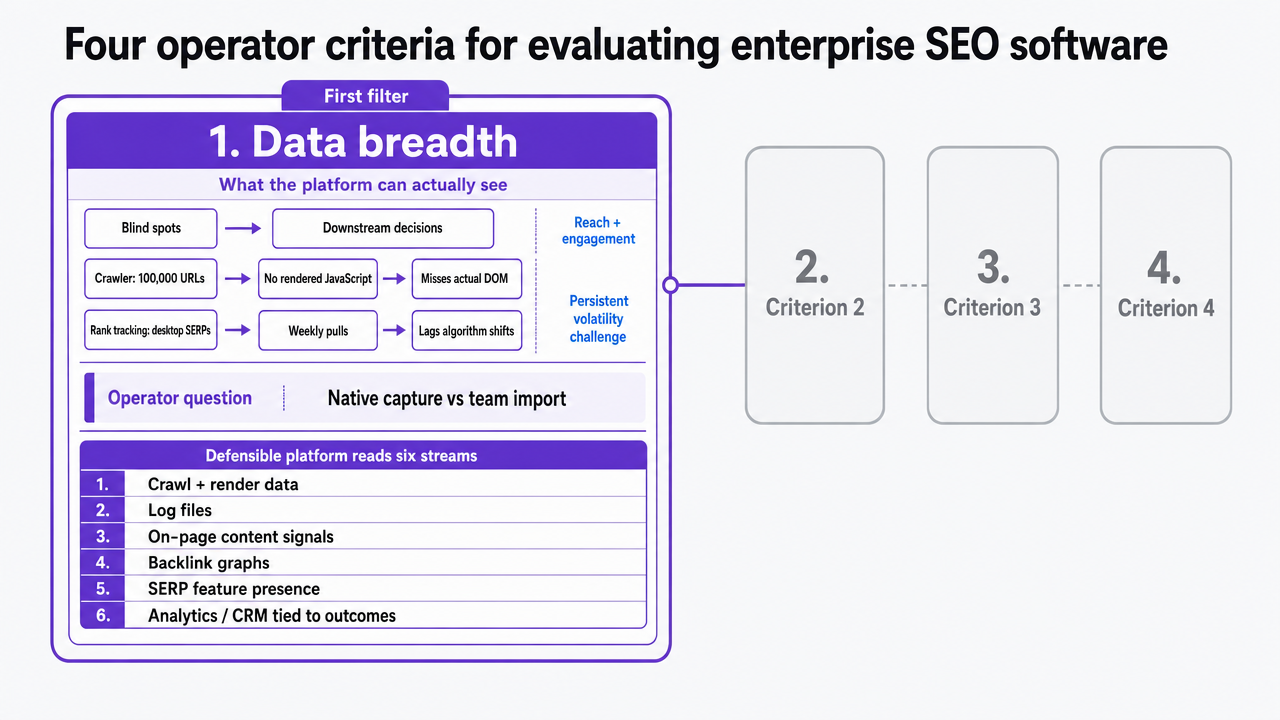 Visualize the four-criteria evaluation framework introduced in this section as a cohesive decision model the reader can scan before diving into subsections
Stack or suite: the operating model decision
What each model costs you in coordination
The stack-versus-suite question is not a preference. It is an operating-model choice that determines where coordination work lives in the organization. Forrester's characterization of the SEO platform landscape as a "cheese board of point solutions" 10is not just market commentary. It describes the two paths a Marketing VP is actually choosing between: assemble a stack that covers every function with specialist depth, or adopt a unified platform that covers most functions with integrated workflow.
Each path shifts cost to a different place. The stack model pushes coordination cost onto the internal team, which becomes responsible for reconciling data schemas, maintaining API connections, and translating findings between tools. The suite model pushes capability cost onto the platform, which will inevitably be weaker in one or two categories than a best-of-breed specialist. Neither model is universally correct, but the trade-offs are quantifiable if the VP measures them against the four operator criteria rather than feature lists.
The table below frames the comparison using variables the reader supplies from their own environment, not invented pricing. A VP running a 500-URL site with three tools and one integration engineer will land in a different place than one running a 50,000-URL portfolio with eight tools and no dedicated integration capacity.
| Criterion | Point-solution stack | Unified platform ||---|---|---|| Data breadth | Deepest per category; requires N integrations to unify | Broad by default; category depth varies by vendor || Workflow governance | Rules live in each tool; enforcement requires a project layer | Rules centralized; enforcement native to the platform || Execution throughput | Cycle time = sum of handoffs across tools + approval | Cycle time = single approval loop inside one interface || Revenue attribution | Requires BI layer or data engineer to assemble joins | Native attribution views if the platform supports CRM ingestion || Hidden cost driver | Integration hours, seat sprawl, tool-owner overhead | Category gaps requiring supplemental point tools |
Forrester's platform analysis argues that the coordination reduction is the reason a dedicated platform exists at enterprise scale 6. The stack model wins on category depth. The suite model wins on cycle time. A VP hitting the headcount ceiling should weight cycle time and governance more heavily than depth in any single category.
If you manage multiple brands, regions, or regulated sites
Scope note: this section addresses VPs whose organic footprint spans multiple brands, regional sites, franchise or location pages, or regulated properties where content standards vary by jurisdiction. The calculus differs from a single-domain operator.
Multi-property environments break the stack model faster than single-site environments. Every additional property multiplies the reconciliation work across tools, because each brand or region typically has its own analytics view, its own content standard, and its own remediation owner. New Jersey's approach illustrates the alternative pattern: a single optimization layer applied across state agencies produces one monitoring surface for performance, accessibility, and content quality, regardless of which agency owns the underlying site 9. Connecticut codifies content standards centrally so that every contributor across the statewide platform works from the same rulebook 2.
Both examples reveal the operator principle. Multi-property scale rewards centralized standards with local execution, not local standards with centralized reporting. A stack that produces ten separate dashboards forces the VP to become the integration layer.
Regulated properties add a second constraint. DOJ guidance treats accessibility as an ongoing check on every new and modified page 4, which means the platform must monitor continuously rather than audit periodically. A suite that folds accessibility into its standard crawl removes an entire parallel workflow. A stack that keeps accessibility in a separate tool guarantees the compliance team and the SEO team will disagree about priorities at least once per quarter.
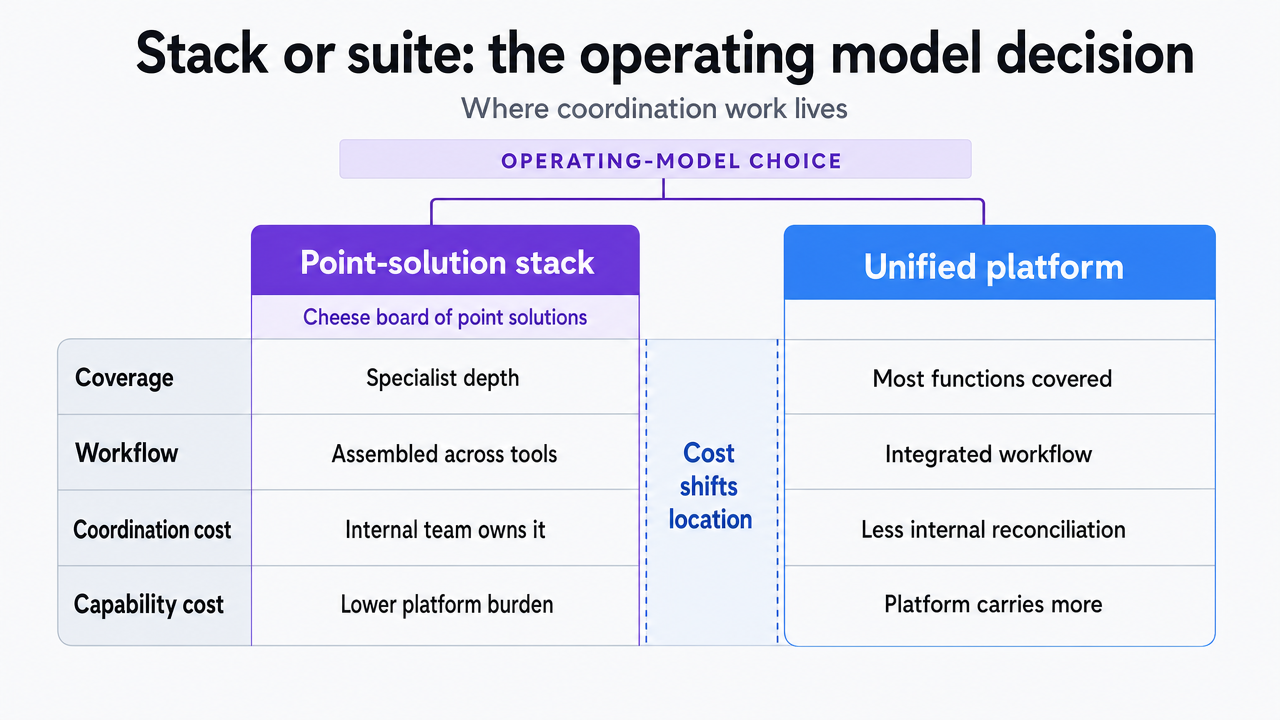 Render the comparison table from this section as a scannable visual so readers can weigh the trade-offs between point-solution stacks and unified platforms across the four operator criteria
See How Top Enterprise Brands Streamline SEO Execution at Scale
Request a walkthrough of unified SEO automation and approval workflows proven to reduce manual effort while controlling quality across multi-site, multi-channel portfolios.
Where AI-coordinated execution changes the buy
The four operator criteria expose a gap that traditional enterprise SEO software was not built to close. Data breadth is a data engineering problem. Governance is a workflow problem. Attribution is an integration problem. Each has vendor solutions. Execution throughput is the outlier, because it is a coordination problem that no crawler or rank tracker was designed to solve. That is where AI-coordinated execution changes the buy.
The shift is not that AI writes title tags faster. It is that a governed loop can now sit between signal and shipped change, replacing the project manager who used to translate a crawl finding into a Jira ticket, a content brief, and a QA checklist. Forrester's argument for dedicated platforms rests on this coordination reduction: the value of a platform is the manual glue it removes between marketing, product, and engineering 6. AI-coordinated execution extends that logic by handling the ranking of priorities and the production of the approved change, while the human retains the approval decision.
Approval-first is the operative constraint. A platform that executes without a review gate will not survive a regulated environment, and DOJ guidance on continuous accessibility checks makes clear that automated action without human oversight is a compliance risk rather than a throughput win 4. The buying question becomes narrower: does the platform surface a ranked recommendation with its reasoning, hold the change until a named owner approves, execute the approved work, and feed the outcome back into the next ranking cycle? If yes, the team scales output without scaling headcount. If no, the platform is a faster report generator.
A Marketing VP evaluating this category should test three things in a demo:
- Whether the AI recommendation carries the strategic reasoning behind it, not just the suggested edit.
- Whether approval routes to the correct owner by task type, since a schema change and a content refresh belong to different reviewers.
- Whether execution updates the attribution model automatically, so the revenue-proof requirement Forrester identifies 5 is satisfied inside the same interface rather than in a downstream BI join.
Platforms that hit all three collapse the headcount ceiling that started this analysis.
A short evaluation script for vendor conversations
Most enterprise SEO software demos default to feature tours. A Marketing VP running against the four operator criteria needs the opposite: a short set of questions that force the vendor to demonstrate cycle time, governance, and attribution rather than describe them. The following script is designed for a single 60-minute session with a live sandbox, not a slide deck.
Start with data breadth. Ask the vendor to ingest a sample of server logs from a 10,000-URL section of the site and show which URLs Googlebot actually crawled last week. A platform that cannot do this inside its own interface is a rank tracker with extra tabs. Follow with a rendered-crawl request on a JavaScript-heavy template to confirm the crawler sees what users see.
Move to governance. Ask the vendor to codify a site-specific rule, such as a title tag pattern for a product category, and demonstrate how the platform monitors compliance across new pages published in the next 24 hours. Connecticut's centralized content standards work because the rulebook is enforced continuously, not audited quarterly 2. The demo should show the same discipline.
Test execution throughput next. Pick one representative task, a title tag rewrite across 500 URLs or an internal linking pass, and ask the vendor to walk the cycle from recommendation to approved change inside the platform. Count the handoffs. Anything above two is a coordination tax.
Close on attribution. Ask to see organic sessions tied to a named CRM opportunity stage in the platform's own interface, not in an exported dashboard. If the answer requires a data analyst, the measurement gap Forrester identifies will follow the purchase into the next budget cycle 5.
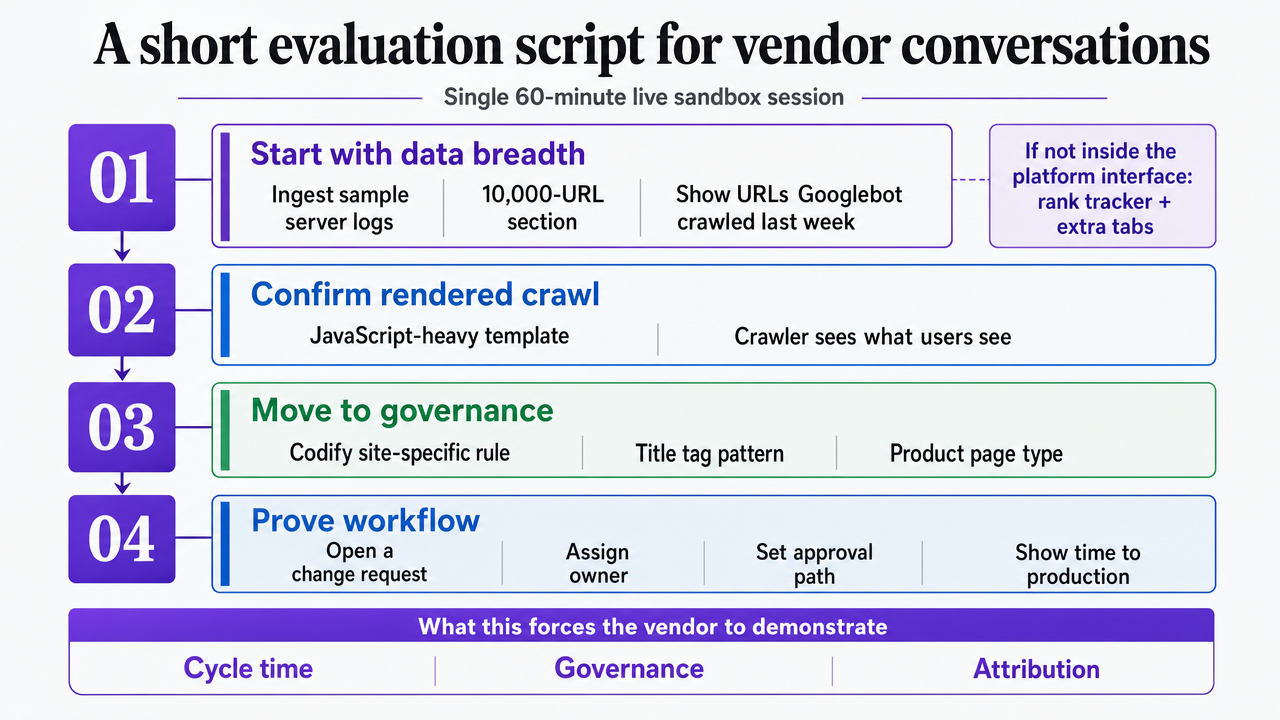 Convert the four-step vendor evaluation script into a sequential process infographic that a VP can bring into a demo session
Frequently Asked Questions
References
- 1.Six Ways to Improve Your Site's Ranking (SEO).
- 2.Content - CT.gov enterprise content standards.
- 3.Enhancing the customer-centricity of GSA websites.
- 4.Accessibility of State and Local Government Websites to People with Disabilities.
- 5.SEO Must Solve Its Marketing Problem.
- 6.Every Company Needs An SEO Platform.
- 7.7 Tactics for Creating a Winning SEO Strategy for Higher Education.
- 8.Search engine optimisation (SEO) strategy as determinants to online brand positioning marketing strategy.
- 9.New Jersey Web Presence Hub - Siteimprove Metrics.
- 10.The SEO Platform Landscape Is A Cheese Board Of Point Solutions - Forrester.