
Key Takeaways
- AccuRanker suits volatility-heavy portfolios needing fast refreshes across multiple locations or device splits, though it lacks integrated content audits or backlink monitoring for broader SEO work.
- Nightwatch specializes in grid-level local tracking, showing ZIP-by-ZIP position differences that directly inform content assignments and citation strategies for multi-location service brands 7.
- Semrush earns its place through platform breadth, consolidating rank tracking with audits, backlinks, and competitor research so mixed-service agencies avoid tool sprawl 14.
- Ahrefs fits content-led SEO teams by combining deep SERP history with keyword and backlink research already used in daily workflows 7.
- SE Ranking stands out for white-label reporting at scale, automating branded client dashboards and reclaiming analyst hours otherwise lost to manual rebuilds 7.
- SERPWatcher from Mangools works as a lightweight daily monitor for lean teams or smaller retainers where a full Semrush or AccuRanker seat is overkill 7.
- AWR delivers enterprise depth with AI-modeled CTR and search volume, quantifying the traffic value of position changes as zero-click and AI blocks reshape SERPs 12.
Why daily rank tracking became a delivery problem, not a reporting problem
For agency Heads of SEO, daily keyword position data is now an input to the work itself, not just a reporting metric. When a client's key keyword drops significantly overnight, the window to diagnose and fix the issue is hours, not weeks. Weekly refreshes fail to capture this urgency.
This shift is driven by two factors. First, algorithmic volatility, where indexes now compare Google Search Console positions daily across thousands of keywords, flagging significant movements near the top of page one 9. Second, competitive pressure, as dedicated rank trackers provide precise daily position data that Search Console only estimates, allowing agencies to detect movement before it impacts traffic 10.
The challenge for agencies is not whether to track daily, but which tool, combined with first-party data, can generate actionable signals across a client portfolio without increasing headcount.
The GSC-plus-one stack: what agency Heads of SEO actually run
Search Console as the first-party position of record
Search Console remains essential because it's the only free source providing Google's own click, impression, CTR, and position data for queries a site ranks for 2. Its first-party status ensures its place in every agency's stack, and senior practitioners often consult it first when client traffic changes 14.
However, GSC's "average position" is a blended figure, representing the arithmetic mean of observed ranks across various devices, geographies, and personalization states 2. A position of 4.8 doesn't mean a searcher sees that exact rank; it's an aggregate. This makes GSC useful for understanding query trends but less effective for diagnosing specific SERP changes on a given day 1.
Why a specialized daily tracker sits next to it
A dedicated rank tracker complements Search Console by answering a different question: the exact position of a URL for a specific query, in a particular location, on a given device, today. These trackers provide precise daily position data, catching significant shifts before they manifest as traffic drops in GSC 10. Waiting for GSC to reflect a two-position slide on a commercial keyword can mean losing a week of sessions.
Daily snapshots from specialized trackers also offer a controlled view of SERP features like local packs, sitelinks, and video carousels. These features can impact visibility without changing ranked position, and advanced trackers now catalog them alongside position data 11. This granularity transforms rank data into a critical input for triage.
The common agency approach is not an either/or choice. GSC handles query discovery and long-term position trends, while a specialist tracker manages daily fluctuations, SERP feature coverage, and location-specific details for critical keywords.
How the seven trackers were scored
Each tool in this shortlist was evaluated based on four criteria reflecting actual agency use, not just marketing features:
- Daily refresh reliability: consistent daily position updates for all tracked keywords, even in large sets 8.
- Local and multi-location support: the ability to handle grid-level tracking across many client locations with both aggregate and drill-down views 13.
- SERP feature and AI overview coverage: cataloging local packs, sitelinks, video results, and newer AI-generated blocks 11.
- Reporting and white-label depth: seamless integration with client-facing dashboards without manual rebuilding 12.
Pricing was a secondary consideration, as public rates vary and agency contracts often differ. The evaluation highlights each tool's core strengths rather than grading it against irrelevant use cases.
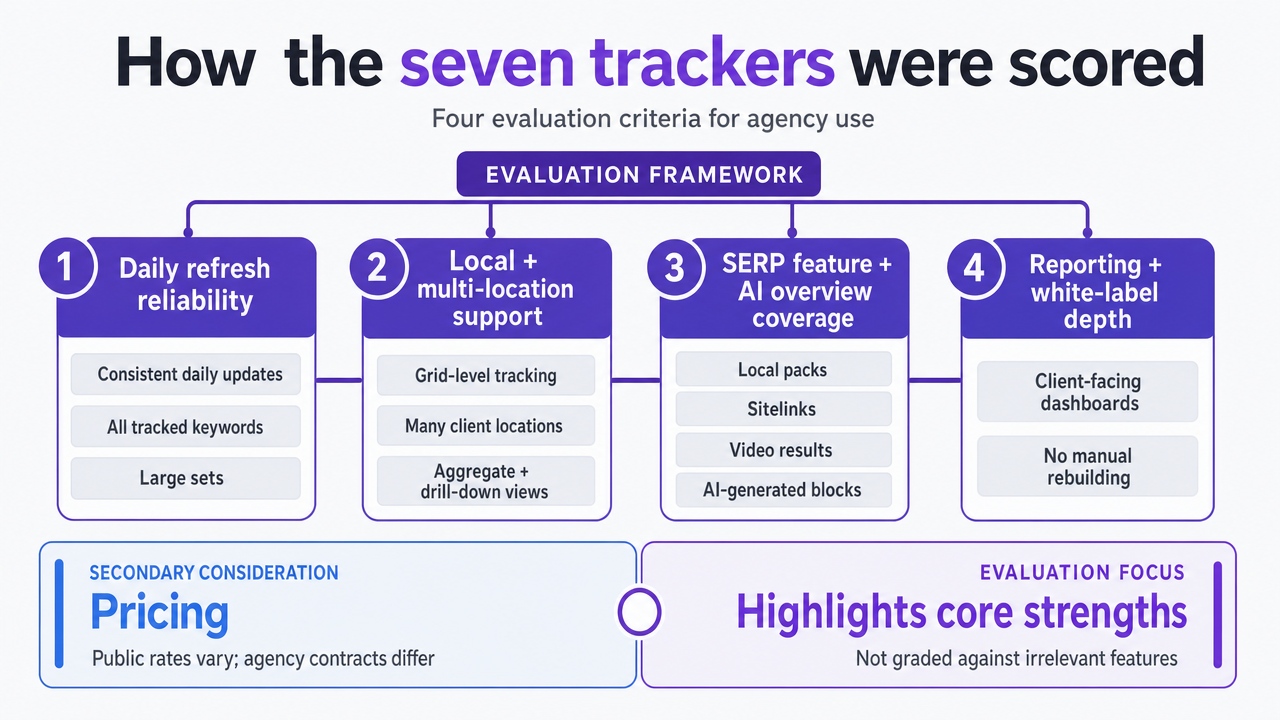 Visualize the four evaluation criteria used to score each rank tracker, giving readers a clear framework before diving into individual tool reviews
Test Daily Rank Tracking With Real Campaigns
Experience daily keyword tracking on live projects before making a commitment.
The seven trackers, evaluated for agency delivery
AccuRanker: fast refreshes for volatility-heavy portfolios
AccuRanker is known for its speed and accuracy, often compared to AWR for fast updates and deep analytics in data-heavy or enterprise SEO programs 3, 12. Its rapid refresh capability is crucial for portfolios experiencing frequent algorithmic turbulence, enabling quicker responses.
For agency Heads of SEO, AccuRanker is ideal for concentrated keyword sets tracked across multiple locations or device splits, where daily position changes demand immediate action. It's less suitable for teams that only use rank tracking for monthly exports. Its value is realized when daily deltas are actively monitored and routed into content or technical work.
However, AccuRanker is not an all-in-one solution. Agencies needing integrated content audits or backlink monitoring will require additional platforms. It serves as a specialized tool rather than a comprehensive suite.
Nightwatch: local grid tracking without a separate tool
Nightwatch is a top choice for local keyword tracking, particularly for agencies managing multi-location service brands 7. A single client can generate numerous tracked keyword-location pairs, making its specialization valuable.
Its grid-level tracking provides detailed position data across geographic areas for the same query, showing, for example, a client ranking second in one ZIP code and eighth in another. This resolution directly informs content assignments and local citation strategies.
Nightwatch focuses on rank tracking and doesn't aim to be a full SEO platform. Agencies requiring integrated backlink or content audit workflows will need to pair it with another tool. For portfolios dominated by local businesses like dentists or law firms, this specialized pairing is more cost-effective than adapting a generalist tracker.
Semrush: all-in-one platform for mixed-service agencies
Semrush is frequently included in agency rank tracker shortlists, not necessarily for having the most advanced rank tracking module, but because it's part of a comprehensive platform that also covers content audits, backlink monitoring, competitor research, and reporting 7, 14. Agencies often use Search Console daily and then rely on an all-in-one platform like Semrush for broader SEO needs 14.
For a Head of SEO managing diverse client portfolios—some needing technical audits, others content velocity, and all requiring position reporting—consolidation reduces tool sprawl. This means one login, one export layer, and a familiar interface for the account team.
Semrush's rank tracking is competent, offering daily refreshes on higher tiers, broad SERP feature coverage, and reporting exports compatible with most client templates. However, teams prioritizing rapid volatility response over workflow consolidation might still prefer a specialized tracker.
Ahrefs: content-led SEO teams with deep SERP history
Ahrefs is valued in agency stacks for its SERP history and content intelligence, rather than just standalone rank tracking 7. For content-focused SEO teams, its tracker integrates seamlessly into daily workflows that already involve Ahrefs for keyword research and backlink analysis.
The rank tracking module supports daily updates on higher plans, catalogs SERP features, and provides extensive historical position data. This historical depth is a key advantage, allowing agencies to analyze ranking changes alongside SERP feature shifts over long periods, offering deeper diagnostics than short-term charts.
Agencies focused on local grid work or rapid volatility response may find Ahrefs' daily refresh depth less comprehensive than AccuRanker or Nightwatch. It's best suited for content-first SEO practices that use one platform for the entire research-to-tracking cycle.
SE Ranking: white-label reporting at scale
SE Ranking is a popular choice for SEO agencies, particularly for its white-label reporting capabilities 7. For agency Heads of SEO who need to deliver branded monthly or weekly ranking reports for numerous clients, its export layer and dashboard templating automate a significant recurring task.
Its rank tracking offers daily updates and standard SERP feature coverage, similar to other all-in-one platforms. What distinguishes it is its agency-centric reporting layer, designed for branding, permissioning, and scheduling client dashboards without constant manual rebuilding.
This tool is less ideal for agencies whose primary challenge is algorithmic response speed. If the bottleneck is reacting quickly to ranking changes, SE Ranking addresses a different part of the workflow. However, if reporting consumes substantial analyst time, it provides a direct solution.
SERPWatcher (Mangools): lightweight daily monitor for lean teams
SERPWatcher, part of the Mangools suite, functions as a SERP monitor rather than a full-platform tracker 7. It efficiently handles daily position checks for a defined keyword set with a clean interface and low cost, without attempting to replace a broader SEO platform.
For lean agency teams or sub-brands managing smaller retainer accounts, it covers essential needs: daily position deltas, basic SERP feature flagging, and shareable dashboards with minimal configuration. Its keyword limits and reporting depth are lower than enterprise-level tools.
In a mature agency stack, SERPWatcher often plays a complementary role. It's suitable for accounts where a full Semrush or AccuRanker seat is excessive, and where GSC combined with a lightweight daily monitor meets visibility requirements without unnecessary tooling overhead.
AWR (Advanced Web Ranking): enterprise depth and AI-modeled CTR
AWR, like AccuRanker, is positioned in the enterprise bracket, offering fast updates and deep analytics for large-scale or data-intensive SEO programs 12. Its data engineering is built to handle the demands of national brands, multi-country tracking, or extensive keyword sets.
A recent advancement in enterprise rank trackers, including AWR, is AI-based CTR and search volume modeling 12. This is crucial because zero-click SERPs and AI-generated result blocks have altered the traditional relationship between position and traffic. A tool that models expected clicks per position based on SERP layout provides a quantifiable value for ranking changes, which is valuable when clients inquire about the impact of a position gain.
AWR requires more configuration than the specialized trackers mentioned earlier. Agencies without a dedicated data lead or analyst might not fully utilize its capabilities.
Refresh cadence, SERP features, and the AI overview gap
The actual refresh cadence often differs from vendor marketing. A 2026 Zapier survey of twelve rank trackers revealed that some tools default to daily updates, others to weekly, and free tiers frequently offer weekly refreshes with limited on-demand daily checks 8. For agencies, this distinction is critical when pricing portfolios, as a "daily" tool might only provide daily positions on higher, more expensive tiers.
SERP feature coverage is another area where cadence alone doesn't tell the full story. Features like local packs, sitelinks, and video carousels can significantly impact a listing's visibility without changing its ranked position. Current tools now catalog these features alongside position data for each tracked keyword 11. If a ranking holds steady at position three but an AI overview and three video results appear above it, the listing is losing clicks. The delivery team needs this feature history to explain the situation to the client before traffic data confirms it.
The emergence of AI overviews presents a new challenge. Practitioner reviews in 2026 indicate that AI search visibility tracking is an evolving category, with dedicated tools often appearing alongside, rather than within, traditional rank trackers 7. For agencies whose clients operate in verticals where AI-generated result blocks are prominent, addressing this gap will be a key focus for future visibility work.
If you manage multiple locations: portfolio economics of daily tracking
For agency Heads of SEO managing multi-location service brands, the unit of tracking shifts from a keyword to a keyword-location pair. A single client with 40 locations and 25 core commercial queries per location generates 1,000 tracked pairs. Across ten such clients, this totals 10,000 daily refreshing pairs. This volume drives vendor investment in aggregation and drill-down features, contributing to the projected growth of the global keyword rank tracking software market from $0.3B in 2024 to $0.75B by 2033 3.
Portfolio economics are determined by the cost per tracked pair per day, not just seat price. Consider the following archetypes:
| Tool archetype | Unit of cost | Best-fit portfolio shape |
|---|---|---|
| Specialist daily tracker (e.g., AccuRanker archetype) | Per keyword, flat across locations if geo-modifiers are treated as separate queries | Concentrated keyword sets, high volatility response need |
| All-in-one platform (e.g., Semrush archetype) | Per project or per keyword allotment tied to plan tier | Mixed-service portfolios where rank sits alongside audits and backlinks |
| Local grid tracker (e.g., Nightwatch archetype) | Per keyword-location pair, with grid density as a cost multiplier | Dense multi-location clients where ZIP-level resolution drives the deliverable |
The archetype with the lowest per-pair cost often wins the initial contract. However, this calculation often overlooks the reporting layer. Multi-location work benefits from tools that provide both location-level and aggregate views on customizable dashboards, offering actionable insights rather than raw data dumps 13. A tool that is cheaper per pair but requires an analyst to manually rebuild aggregate reports each month negates any initial cost savings.
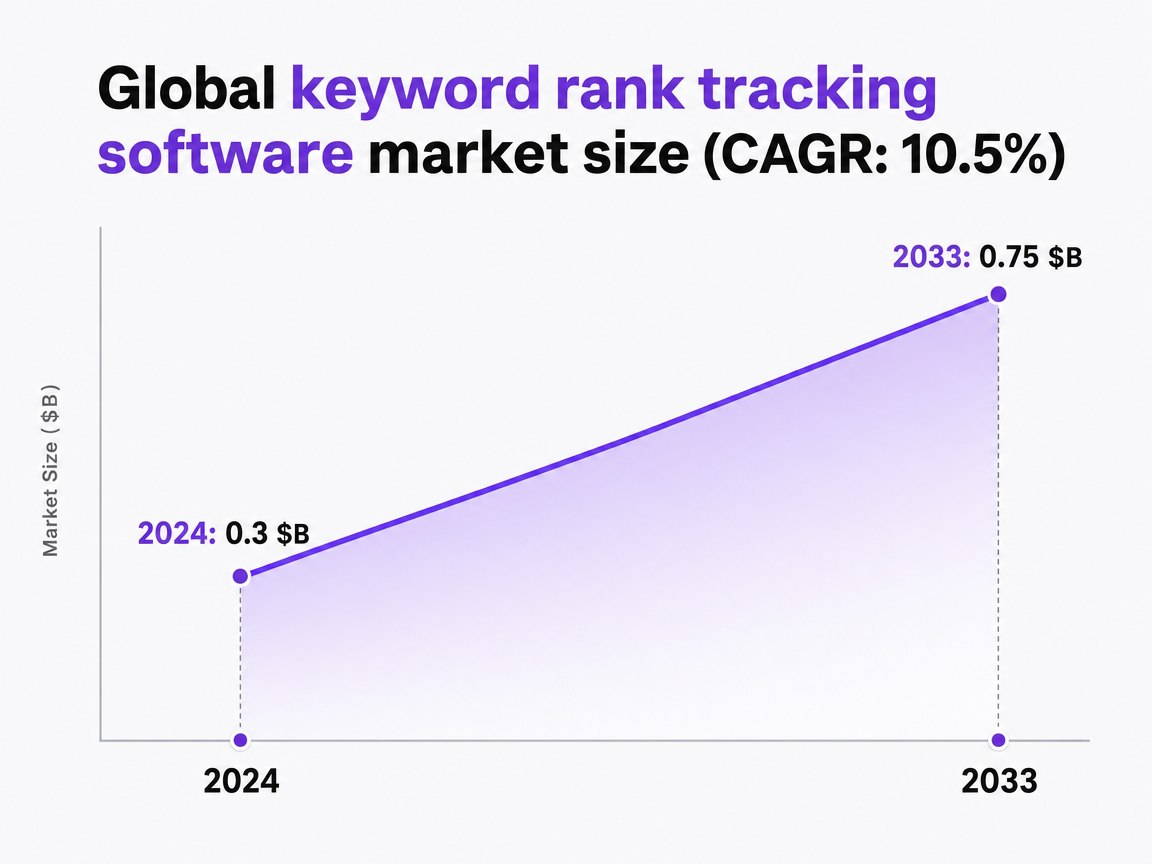 Global keyword rank tracking software market size (CAGR: 10.5%)
Source: Verified Market Reports - Keyword Rank Tracking Software Market Size, SWOT, Market Trends & Forecast 2033
See How Leading Agencies Monitor Keyword Performance at Scale—Without Manual Oversight
Connect with our team to explore data-driven workflows for real-time rank tracking, automated reporting, and cross-client SEO visibility—enabling your agency to scale monitoring across hundreds of sites with measurable efficiency.
A recommendation matrix by agency profile
No single tracker is universally superior. The optimal solution involves pairing GSC as the primary record with a specialist tracker chosen for the portfolio's dominant use case, complemented by a reporting layer that minimizes analyst time.
| Portfolio profile | Primary tracker | Why it fits |
|---|---|---|
| Local multi-location (dental, home services, senior living) | Nightwatch, paired with GSC | Grid-level resolution translates ZIP-by-ZIP deltas into actionable content and citation assignments 7 |
| Enterprise or national brand with six-figure keyword sets | AWR or AccuRanker, paired with GSC | Fast refreshes and AI-modeled CTR provide a quantifiable value for position changes 12 |
| Content-led SEO practice | Ahrefs, paired with GSC | SERP history and topical research are integrated into the team's existing daily workflow 7 |
| Mixed-service agency (audits, backlinks, rank, reporting) | Semrush or SE Ranking, paired with GSC | Consolidation reduces tool sprawl; SE Ranking is preferred when white-label reporting efficiency is critical 7, 14 |
| Lean team or smaller retainer accounts | SERPWatcher, paired with GSC | Provides daily deltas without complex configuration for accounts where a full platform is excessive 7 |
Agencies managing mixed portfolios often use two trackers, as the cost of a second tool is less than the analyst hours wasted using an unsuitable single tool.
From ranking signal to shipped work
A daily rank tracker is only valuable if a two-position slide on a commercial query triggers immediate action, not just another dashboard view. While most agency stacks identify the signal—GSC confirms site queries 2, a specialist tracker flags deltas 10, and volatility indexes indicate algorithmic or competitive movement 9—the workflow often breaks down. A Slack message leads to a strategist briefing a writer, who queues a technical review, awaiting client sign-off. This delay allows the window for effective intervention to close.
The key differentiator for agencies scaling delivery versus headcount lies in the process between detecting a delta and deploying a fix. An approval-first execution model routes each ranking signal through a ranked recommendation, a drafted response, and a single client sign-off before implementation. The tracker identifies the client's current position, and the execution layer converts this insight into a briefed, drafted, and approved revision without requiring additional hires. Vectoron is designed around this loop, transforming ranking signals from mere reports into actionable work.
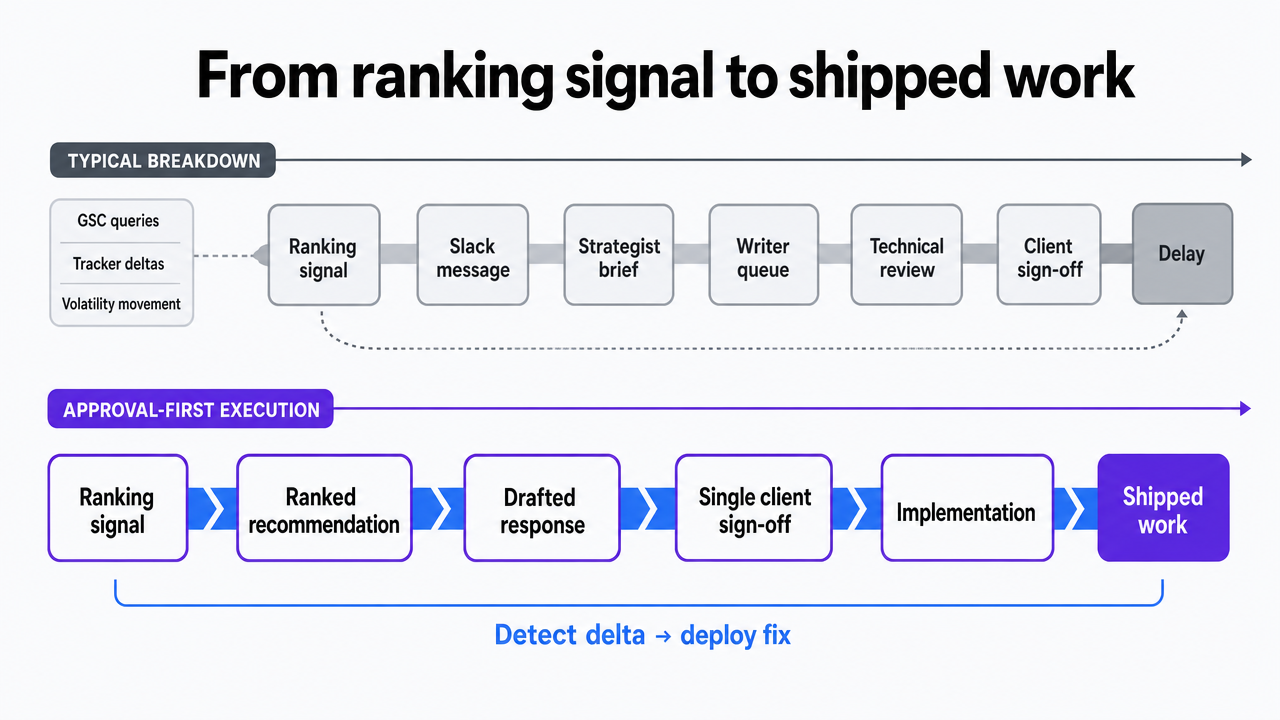 Illustrate the approval-first execution workflow that converts a ranking signal into deployed work, matching the section's described process
Frequently Asked Questions
References
- 1.How to check keyword ranking in Google Search Console.
- 2.Google Search Console Keyword Ranking: How to Find, Filter, and Act on Your Ranking Data.
- 3.Keyword Rank Tracking Software Market Size, SWOT, Market Trends & Forecast 2033.
- 4.How to Use Google Search Console for Keyword Research.
- 5.Best Keyword Rank Tracker Software (2026).
- 6.Top 10 Best Keyword Rank Software of 2026.
- 7.14 best rank tracker software I'm using for SEO in 2026.
- 8.The 12 best rank tracker tools - Zapier.
- 9.SERP Volatility Index — Daily Google Ranking Turbulence Tracker.
- 10.20 Best SEO Monitoring Tools You Need for Your Agency ....
- 11.15 Best Rank Tracking Tools for Local SEO and AI SERPs.
- 12.Rank Tracker For Agencies....
- 13.Best Multi-Location SEO Software 2026 | Oonot.
- 14.16 Secret SEO Tools Top Agencies Use to Rank Fast.