
Key Takeaways
- The Hoth delivers managed outreach in productized DA tiers but relies on a recurring publisher network, limiting unique referring-domain growth and leaving approval as a post-delivery audit.
- FATJOE prioritizes white-label volume, yet its shared publisher pool causes overlap across reseller portfolios and pushes anchor and context decisions past the pre-publish stage.
- Page One Power sources fresh prospects per campaign, trading monthly throughput for higher referring-domain diversity and earlier anchor and target-URL sign-off before outreach begins.
- Searcharoo exposes traffic and referring-domain filters at order stage, but its paid-guest-post weighting and publisher-discretion rel tagging leave a compliance gap for agency QA.
- Adsy offers broad marketplace inventory at publisher-set prices, though it enforces no rel tagging or draft review, transferring nearly all compliance risk to the buying agency.
- Collaborator adds editorial filters and a content-draft approval step, making it the marketplace option with the strongest pre-publish control for topically relevant placements.
- Respona is outreach software the agency staffs itself, offering the highest quality ceiling and full anchor control but demanding internal headcount for prospecting, negotiation, and QA.
- Vectoron routes each placement through two approval gates and enforces rel tagging at the workflow layer, scaling referring-domain diversity without proportional prospector hiring.
Why referring-domain diversity became the agency KPI in 2026
A July 2026 correlation study across roughly 85,000 pages placed the Spearman coefficient between referring-domain count and ranking position at 0.74, the strongest single-factor signal the researchers measured across positions 1 through 30. The same dataset found that top-1 pages carry an average of 4.2x more referring domains than pages sitting in positions 2 through 10 13. Backlinko's earlier analysis of 11.8 million Google results reported a 3.8x backlink multiple at position 1 versus positions 2 through 10, using a different sample, different metric, and a five-year gap 12. These independent studies highlight that the gap at the top of the page is a gap in linking domain breadth, not merely raw link count.
For agency heads managing link building for multiple clients, this reframes the delivery target. Volume goals stated in "links per month" underweight the variable that actually correlates with rank movement. The critical metric is unique referring domains added per client per quarter, weighted by editorial relevance. Platform selection should prioritize vendors that expand the referring-domain footprint without compromising quality control. Each operating model reviewed below is evaluated against this criterion.
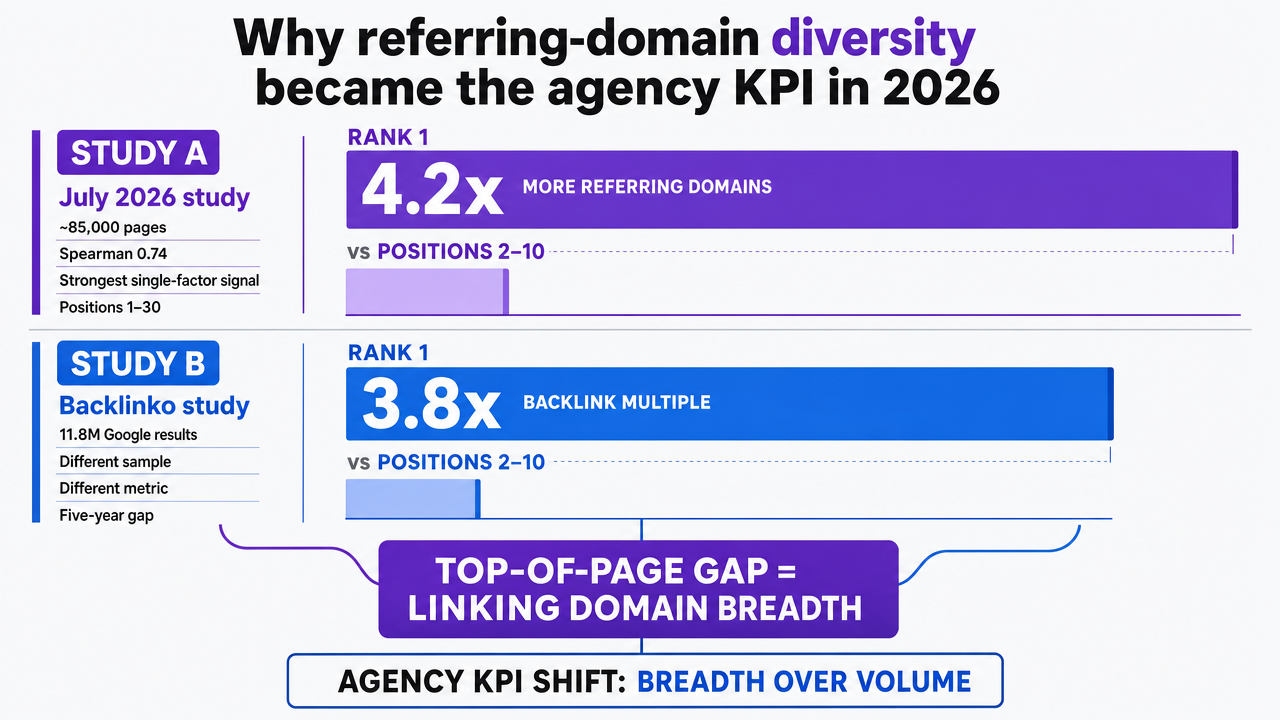 Visualize the referring-domain multiple at rank 1 versus positions 2-10 from two independent correlation studies cited in the section
Three operating models the eight platforms fall into
Vendors in the link building space generally fall into three operating models:
- Managed outreach services employ human prospectors and account managers to negotiate placements.
- Self-serve marketplaces provide access to publisher inventory for direct transactions, typically at a fixed rate.
- AI-coordinated workflow platforms automate prospecting, outreach drafting, and negotiation tracking, routing placements through an agency-controlled approval gate.
These models differ significantly in their risk exposure and where the approval process occurs. Managed outreach centralizes approval within the vendor, with agencies reviewing delivery reports post-publication. Marketplaces shift approval entirely to the buyer, who sees the placement only after committing budget. AI-coordinated workflows integrate approval earlier, both before outreach and again before publication. This proactive approval aligns with Google's spam guidance, which defines link spam as "the practice of creating links to or from a site primarily for the purpose of manipulating search rankings" 1. Google's 2017 guidance on large-scale article campaigns warns that distributing keyword-rich links across many articles for ranking manipulation, rather than audience value, constitutes a link scheme 4. A model allowing human review of intent, anchor, and context for each placement makes compliance auditable, unlike bulk placements shipped without pre-publish review.
The division of labor also varies by model. Managed outreach offloads prospecting and negotiation but leaves QA and reporting to the agency. Marketplaces primarily offer inventory access. AI-coordinated workflows reassign prospecting and drafting to software, retaining strategic judgment, anchor mix, and final sign-off with the agency's SEO lead. The eight platforms below are grouped and scored within this framework.
The four operator axes each platform is graded on
The following reviews grade platforms based on four key axes, each addressing a critical decision an agency lead must defend in a client audit:
- Referring-domain diversity, measured as unique new root domains produced per client per month, rather than just link count. Moz's research indicates that the Domain Authority (DA) and Page Authority (PA) of linking pages are stronger predictors of rank position than total link count 16.
- Editorial versus paid placement mix. Sponsored placements require correct rel tagging under Google's link spam guidance, and platforms that fail to enforce this shift risk to the agency.
- Approval workflow: whether a human reviews the prospect, anchor text, and draft before outreach, and if a second checkpoint exists before publication.
- Client-reporting artifacts, specifically whether the platform provides referring-domain deltas, anchor distribution, and crawlable-link verification that meet Google's technical guidance on
<a href>elements and descriptive anchors 2.
Each platform receives a grade on all four axes.
Test AI-driven link building execution at scale
Experience hands-on, automated link building across multiple client campaigns with real content published during your trial.
The compliance boundary every platform has to work inside
Google's spam policy defines link spam as "the practice of creating links to or from a site primarily for the purpose of manipulating search rankings." The July 2026 refresh explicitly identifies excessive link exchanges, automated link creation, partner pages for cross-linking, and sitewide template placements as violations 1. Policy enforcement focuses on intent and scale. A platform facilitating a single, editorially relevant guest post on a topically aligned publication operates within guidelines. However, the same tactic applied across hundreds of low-relevance sites with keyword-rich anchors crosses the line, echoing the pattern flagged in the 2017 guidance on large-scale article campaigns 4.
Paid and sponsored placements have specific tagging obligations. Google's 2021 link spam update reiterated that sponsored or affiliate links require rel="sponsored" or rel="nofollow", aiming to be "even more effective at identifying and nullifying link spam more broadly" 3. Platforms that broker paid placements without enforcing correct rel values transfer manual-action risk directly to the agency. Any vendor evaluated below either enforces rel tagging at the placement layer or is marked down for pushing this liability downstream.
The eight platforms, scored against agency delivery reality
The Hoth: managed outreach with productized tiers
The Hoth offers managed outreach in fixed tiers based on a minimum DA threshold per placement. Referring-domain diversity depends on the tier purchased, and account managers typically draw from a recurring publisher network. This approach limits the unique-domain footprint an agency can build over time.
The editorial mix often includes paid placements presented as guest contributions, requiring agencies to verify correct rel tagging under Google's link spam guidance 3. The approval workflow is post-hoc; agencies review a delivered URL rather than a prospect or draft. Reporting includes a spreadsheet with DA, referring page, and anchor, but lacks crawlable-link verification against Google's <a href> specification 2. Grade profile: moderate on volume, weak on approval control, weak on domain diversity at scale.
FATJOE: high-volume managed outreach for white-label resellers
FATJOE specializes in white-label resale, which influences its delivery model. Its strength is volume, enabling agencies to secure many placements per client per month from a standing publisher pool. However, this shared pool becomes a constraint, as referring-domain diversity can degrade when multiple resellers draw from the same inventory, leading to publisher overlap across client portfolios.
The editorial mix heavily features niche edits and guest posts on sites primarily existing for paid inbound links. This pattern aligns with what Google's 2017 guidance flagged as scheme-adjacent when the primary intent is ranking manipulation 4. Approval involves agencies reviewing delivered URLs, with limited pre-publish input on anchor or context. Reporting is templated and white-labelable, suitable for resale but lacking compliance distinction.
Page One Power: managed outreach with editorial vetting
Page One Power employs a managed model centered on campaign-specific prospecting, rather than a recurring inventory. Prospectors source new sites for each client, yielding higher referring-domain diversity per quarter compared to tiered resale services, albeit with lower monthly throughput. This aligns with Moz's findings that DA and PA of linking pages predict rank more strongly than raw link count 16.
The editorial mix favors unpaid resource and niche edits, with paid placements being a smaller component and rel tagging enforced when applicable. The approval workflow includes anchor and target-URL sign-off before outreach, engaging the agency earlier than Hoth or FATJOE. Reporting includes referring-domain deltas and anchor distribution, though crawlable-link verification against Google's technical guidance remains an agency responsibility 2. Grade profile: stronger on quality, weaker on throughput per FTE managing the vendor.
Searcharoo: mid-market managed outreach with transparent metrics
Searcharoo emphasizes metric transparency, exposing traffic thresholds, referring-domain counts of linking sites, and country-level filters at the order stage. Referring-domain diversity is moderate, constrained by a smaller publisher network than FATJOE but broader than Hoth's.
The editorial mix is heavily weighted towards paid guest posts, with rel tagging often left to publisher discretion. This creates a compliance gap for the agency to address during QA. The approval workflow is order-based, meaning agencies select targets against filters but do not review anchor placement in context before publication. Reporting artifacts are a strong point, offering live-link status and traffic snapshots upon delivery. Grade profile: strong on visibility of purchased assets, weaker on pre-publish control and the editorial-versus-paid distinction Google's spam guidance considers material.
Adsy: self-serve marketplace with publisher-side pricing
Adsy operates as a marketplace where publishers set placement prices and buyers transact directly. While theoretically offering unlimited referring-domain diversity, the practical limit is an agency's capacity to vet publishers before purchase, shifting all quality control onto the buyer.
The editorial mix is almost entirely paid, making correct rel tagging a policy requirement under Google's 2021 link spam update 3. Adsy does not enforce this tagging at the platform level, exposing agencies to compliance risks if manual checks are skipped. The approval workflow allows agencies to select publishers, but no draft review occurs pre-publication. Reporting is per-transaction, requiring external tools for portfolio-level referring-domain deltas. Grade profile: high inventory access, high risk transfer, minimal workflow structure.
Collaborator: marketplace with editorial filters and reporting
Collaborator is a more structured marketplace. Publisher listings include organic traffic estimates, referring-domain counts, topical tags, and language filters, enabling agencies to prioritize editorially relevant properties over pure link inventory.
While transactions are paid, the filtering options facilitate selecting publishers with genuine audience traction, which serves as an operational proxy for the authority axis Moz found to predict rank better than link count 16. The approval workflow includes a content draft step, allowing agencies to upload or approve articles before publication—a pre-publish checkpoint that Adsy lacks. Reporting includes campaign-level referring-domain summaries. Grade profile: the strongest marketplace option for pre-publish control, but still less coordinated than a workflow platform for portfolio-level orchestration across many clients.
Respona: outreach software agencies operate themselves
Respona is an outreach software, not a link vendor, meaning agencies staff and manage it themselves. This alters the economics across all axes. Referring-domain diversity is limited only by the agency's prospecting capacity and email deliverability, with quality fully under agency control. The trade-off is that prospecting, personalization, negotiation, and QA all remain internal payroll responsibilities.
The editorial mix reflects the agency's outreach strategy, typically favoring genuine resource links, HARO-style contributions, and unpaid guest posts, all of which align with Google's spam policy regarding intent and scale 1. The approval workflow is entirely agency-defined; the software identifies prospects and tracks conversations but does not dictate placement quality. Reporting is campaign-level, with integrations into tools like Ahrefs or Semrush. Grade profile: highest quality ceiling, highest headcount requirement, lowest capacity-per-new-client at a fixed team size.
Vectoron: AI-coordinated workflow with an approval-first Command Center
Vectoron exemplifies the AI-coordinated workflow model. A backlinks strategist within a unified Command Center identifies ranked prospects, drafts personalized outreach, tracks negotiations, and routes each placement through two approval gates: one before outreach and another before publication. Referring-domain diversity scales with software, not prospector headcount. Portfolio-level deduplication prevents publisher overlap across client campaigns, addressing a common issue in resale-heavy managed services.
Editorial mix compliance is enforced at the workflow layer; paid placements require correct rel tagging before publication is authorized, closing the compliance gap seen in Adsy and Searcharoo 3. Approval rests with the agency's SEO lead, not the vendor, aligning with Google's spam guidance on intent 1. Reporting provides referring-domain deltas, anchor distribution, and crawlable-link verification against Google's <a href> specification 2. Grade profile: strong across all four axes, with scalable capacity without proportional hiring.
Delivery economics: which platform replaces which internal role
The economics of link building are reshaped by Moz's finding that DA and PA of linking pages correlate more strongly with ranking position than total link count 16. This shifts the productivity metric: a prospector securing 20 low-authority guest posts per month is less effective than one landing eight editorially placed links on topically aligned sites. Any economic comparison that measures cost per link without weighting for authority will undervalue high-quality options and overstate the throughput of resale-heavy managed services.
The table below illustrates how each operating model impacts internal roles, allowing agency leads to identify where headcount is saved or reallocated.
| Delivery function | In-house team | Managed outreach service | AI-coordinated platform |
|---|---|---|---|
| Prospecting | Hours per FTE per week on list building | Absorbed by vendor, capped by vendor inventory | Software surfaces ranked prospects; agency reviews shortlist |
| Outreach and negotiation | Emails per FTE per day, reply-rate dependent | Absorbed by vendor account manager | Drafts generated per prospect; agency approves before send |
| Placement QA | Hours per client per month on anchor and context review | Stays with agency as post-delivery audit | Pre-publish approval gate on anchor, context, and rel tagging |
| Client reporting | Hours per client per month assembling referring-domain deltas | Templated report, agency reformats for client | Referring-domain deltas and crawlable-link verification generated at run |
| Compliance review | Manual per-placement check against spam policy | Vendor-dependent, liability often shifts to agency | Enforced at workflow layer before publish |
| Capacity to add one client | Requires FTE headcount increase past a fixed portfolio size | Requires larger retainer, same vendor bottleneck | Marginal, bounded by approval-review time not headcount |
Managed services offload prospecting and outreach but retain QA, reporting, and compliance responsibilities for the agency. AI-coordinated workflows automate mechanical tasks and centralize judgment at a single approval point, which is crucial for controlling quality dispersion.
See How Top Agencies Automate Link Building at Scale—Without Adding Headcount
Connect with a solutions expert to benchmark your current link acquisition process and explore workflow-driven automation for multi-client SEO delivery.
The commercial case that has to survive the client QBR
Ranking movement must translate into commercial outcomes for clients. Research shows that moving a search result from position 1 to position 2 can reduce click-through rates by one-third to two-thirds, depending on query type 7. This "CTR cliff" is what every referring-domain gain ultimately aims to mitigate. An agency focusing solely on link volume may struggle in a QBR when asked about the commercial impact of placements. An agency framing link building in terms of rank-position economics can maintain focus on outcomes relevant to the CFO.
The interaction with paid search further strengthens this case. Google's research on organic ranking and ad incrementality indicates that, on average, 50% of ad clicks are incremental when the advertiser also holds the top organic result for the query 8. This means a link program elevating a client from position 3 to position 1 not only boosts organic traffic but also improves the incrementality of paid spend for the same query. The commercial argument for referring-domain diversity is a combined-channel one, supported by primary research rather than vendor benchmarks.
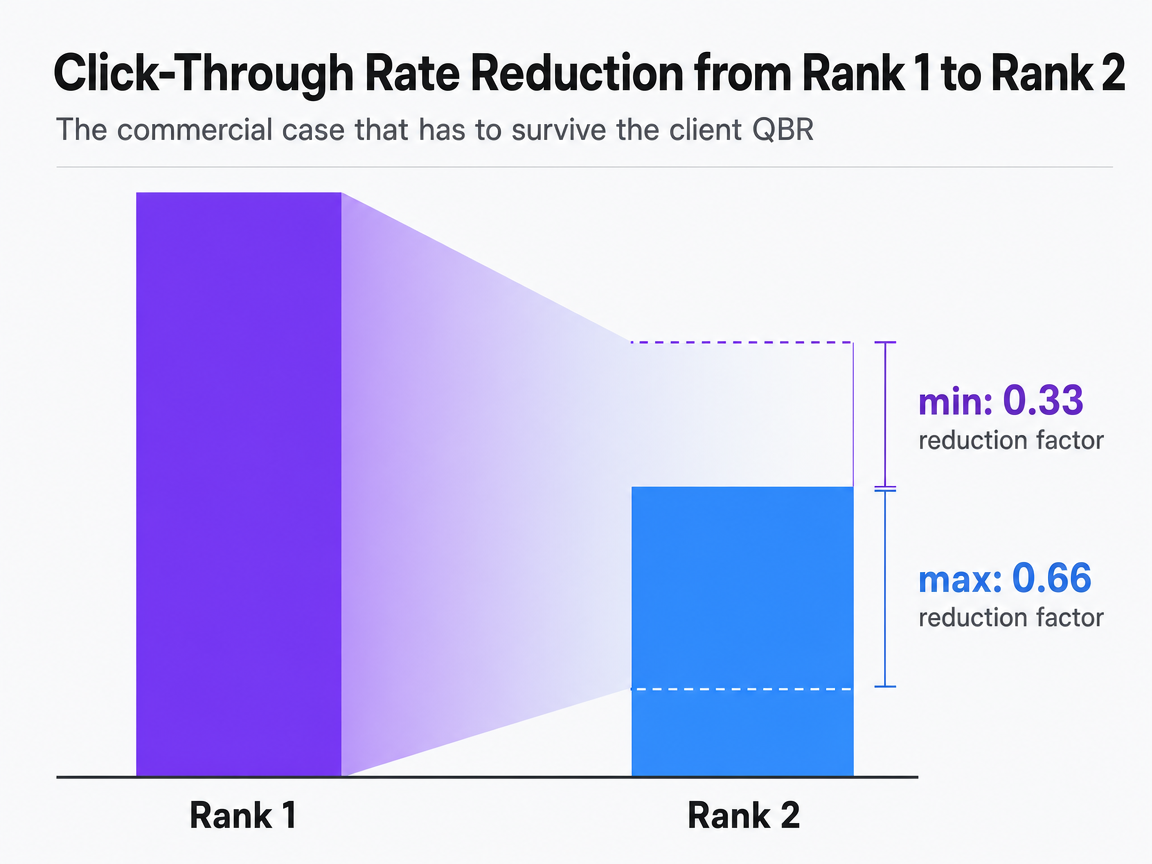 Click-Through Rate Reduction from Rank 1 to Rank 2
Moving a search result from rank 1 to rank 2 reduces the probability of a user clicking on it by a factor of one-third to two-thirds. This can be visualized as a range or a funnel showing the drop-off.
Where links alone stop moving the needle
Two 2021 Moz findings define the limits of a link-only strategy. First, brand-related signals, including branded search volume, have increased in ranking weight relative to raw link metrics 15. This implies that a link program without parallel brand and content investment will eventually face diminishing returns. Second, despite this, the correlation between linking root domains and rank position remains around 0.30 across a 15,000-keyword sample, and top results for competitive queries rarely appear without external links 17. Links are nearly mandatory but no longer sufficient.
For agencies, this means platform selection cannot be isolated from the client's content depth and branded demand. A referring-domain program on a thin site with low branded search volume will yield slower and smaller rank movement than the same program on a site with active PR, product coverage, and category authority. Vendor scoring should consider link building as one input into a multi-signal outcome, not the sole determinant.
A selection framework for the next four quarters
A client-audit-proof shortlist addresses four key questions. First, what is the referring-domain deficit per client compared to top-ranking competitors for target queries, measured in unique root domains? This sets the quarterly delivery target. Second, which operating model closes this gap without transferring rel-tagging liability or pre-publish review to the agency?
- Managed outreach suits agencies with stable portfolios and existing QA.
- Marketplaces are for tactical gap-filling by in-house leads who vet each publisher.
- AI-coordinated workflows are ideal for agencies scaling client count faster than they can hire prospectors.
Third, does the reporting output provide referring-domain deltas, anchor distribution, and crawlable-link verification that clients can inspect without agency reformatting? Fourth, where is the approval gate relative to publication? Platforms that concentrate approval after a link is live transfer unmanageable risk to the agency. Vectoron's approval-first Command Center is available for $599/month after a two-week trial for teams evaluating the AI-coordinated model against these criteria.
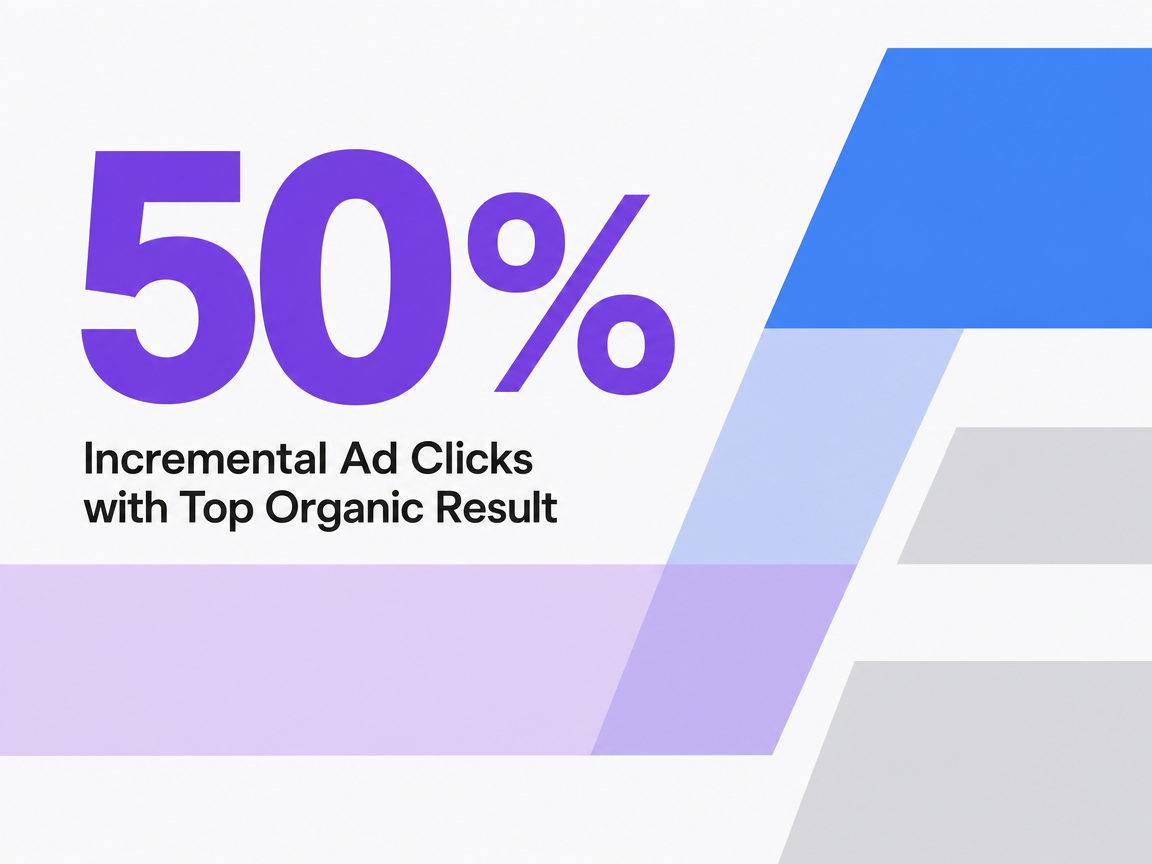 Incremental Ad Clicks with Top Organic Result
Incremental Ad Clicks with Top Organic Result
Frequently Asked Questions
References
- 1.Spam Policies for Google Web Search.
- 2.SEO Link Best Practices for Google.
- 3.A reminder on qualifying links and our link spam update.
- 4.A reminder about links in large-scale article campaigns.
- 5.Quality links to your site.
- 6.Is Google Getting Worse? A Longitudinal Investigation of Search Quality.
- 7.How Does Ranking Affect User Choice in Online Search?.
- 8.Impact Of Ranking Of Organic Search Results On The Incrementality Of Search Ads.
- 9.Chapter 14 Link Analysis and Web Search.
- 10.Introduction to Information Retrieval.
- 11.Links Are Still Fundamental to Organic Search Rankings – Here's Proof.
- 12.We Analyzed 11.8 Million Google Search Results. Here's What We Learned About SEO.
- 13.Backlink Statistics 2026: 85,000-Page Correlation Study.
- 14.Link Building Statistics 2026 | 80+ Backlink Data & Benchmarks.
- 15.Links and Brand as Ranking Factors: 2021 Correlation Study.
- 16.The Correlation Between Authoritative Links and Ranking [SEO Study].
- 17.Can You Rank in Google Without Links? New Data Says Slim Chance.