
Key Takeaways
- Profound offers the broadest engine coverage, tracking over ten AI systems including Meta AI, Grok, and DeepSeek, making it essential for enterprise portfolios needing wide surface visibility 4.
- Peec AI delivers real-time citation alerts and prompt-level tracking, giving strategists managing large client books push notifications instead of manual dashboard polling 6, 9.
- AthenaHQ combines GEO monitoring with optimization recommendations in one interface, shortening the time between a visibility drop and strategist action 7, 8.
- Otterly.AI sits in the SMB tier, offering an affordable entry point for boutique agencies whose 10-20 client mix cannot support enterprise platform costs 7, 9.
- Semrush AI Toolkit provides transparent $99-per-domain pricing across ChatGPT, Perplexity, Gemini, and Claude, but scales linearly and compresses margins on large client books 5.
- Ahrefs Brand Radar bolts AI visibility onto existing Ahrefs contracts across five major engines, offering low procurement friction but narrower coverage than dedicated trackers 5, 4.
- SE Ranking AI Visibility targets mid-market agencies with bundled AEO reporting inside a rank tracker, covering the four baseline engines without a separate procurement cycle 9, 2.
- Writesonic handles structural optimization by adapting page content for generative retrieval, with controlled benchmarks showing visibility gains up to 40% on specific query sets 12, 16.
- Vectoron fills the governance layer by routing AI-generated content through approval-first workflows, aligning with NIST AI RMF guidance and mitigating adversarial risk 11, 13.
Why LLM SEO Is a Stack Decision, Not a Tool Decision
A recent critical survey of 45 generative engine optimization studies concluded that no reviewed technique demonstrates a stable, longitudinal, cross-platform causal effect on organic discoverability or downstream behavior 15. This finding, drawn from academic and industry work published between 2023 and 2026, applies to isolated tactics, not disciplined measurement programs. It's crucial because most vendor pitches promise the opposite.
Agency heads triaging LLM SEO platforms are not choosing a single winner; they are choosing a stack. Peer-reviewed evaluation of large language models in SEO audits reports that LLM-based tools cannot yet run real-time, end-to-end audits and are better positioned as optimization aids than as replacements for crawlers and analytics 1. This gap necessitates coverage across four functions: cross-engine visibility tracking, structural and entity optimization, editorial production, and governance.
The nine tools profiled below map to these functions. Consider them as slots in a portfolio, not as competitors for a single line item. Agencies scaling AI visibility work without adding strategist headcount are those treating tool selection as a delivery-architecture decision.
How to Evaluate LLM SEO Tools at Agency Scale
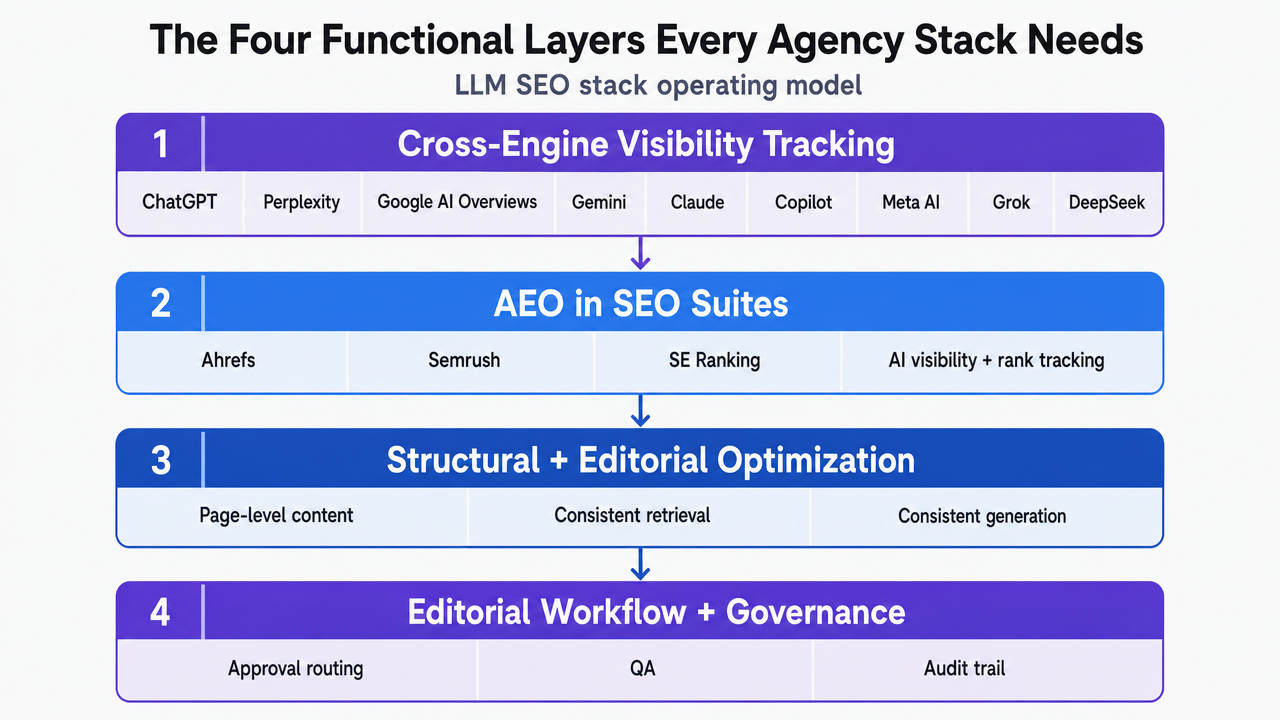
The Four Functional Layers Every Agency Stack Needs
A workable LLM SEO stack resolves into four distinct layers, and much agency confusion stems from conflating them.
- The first layer is cross-engine visibility tracking: standalone platforms that monitor brand and page appearances across ChatGPT, Perplexity, Google AI Overviews, Gemini, Claude, and increasingly Copilot, Meta AI, Grok, and DeepSeek 4.
- The second layer involves AEO modules integrated into classic SEO suites, where platforms like Ahrefs, Semrush, and SE Ranking have added AI visibility reporting alongside existing rank tracking 5, 9.
- The third layer handles structural and editorial optimization, adapting page-level content to ensure more consistent retrieval and generation 16.
- The fourth layer covers editorial workflow and governance: the approval routing, QA, and audit trail necessary to transform tool output into deliverable client work.
Skipping any layer creates predictable failure modes. Tracking without structural output leads to dashboards no one acts on. Structural work without governance results in inconsistent client quality. Governance without tracking produces polished work that cannot be proven to move a metric.
The Measurement Trap: Citation Breadth vs. Citation Depth
Two tools can report the same share-of-voice number but mean entirely different things. A measurement framework paper on generative engine optimization documents a sharp divergence between citation breadth and citation depth across platforms: some engines cite many sources shallowly, while others weight a smaller set of sources heavily in the final answer 17. Selection is not the same as influence.
For agency heads, this means a vendor showing a client cited in 40 prompts on Perplexity is not equivalent to a competitor cited in 12 prompts on ChatGPT if ChatGPT anchors long-form answers on those 12 sources. Tools that only count mentions inflate breadth metrics without measuring whether the citation actually shaped the answer.
When evaluating a platform, agencies should ask two questions: does it separate citation selection from citation influence, and does it track retrieval-stage inclusion distinct from generation-stage attribution 16? Tools that collapse these into one number will mislead client reporting.
An Evaluation Rubric for Multi-Client Delivery
Feature checklists often overlook the constraints that actually hinder agency delivery. A rubric suitable for a 40-to-100 client book prioritizes five criteria.
Engine coverage : A minimum of five engines (ChatGPT, Perplexity, Google AI Overviews, Gemini, Claude) is essential, matching current enterprise B2B AEO benchmarks 2. Anything less necessitates a second tracker.
Seat and domain economics : Per-domain pricing can quickly escalate across a client book, and pricing varies from published rates to enterprise-only quotes 5. Model these costs before committing.
API and export access : Without these, strategists manually rebuild dashboards for each client, negating the utilization gains the tool was intended to provide.
Measurement model transparency : Does the platform disclose how it samples prompts, rotates paraphrases, and differentiates selection from influence 17?
Approval-workflow fit : Outputs must integrate into existing review processes, not create parallel ones. Tools that only produce PDFs push governance work back onto strategists, undermining the scaling premise.
Cross-Engine Visibility Trackers
Profound: Broadest Engine Coverage for Enterprise Books
Profound offers the widest engine coverage. Independent listings indicate it tracks over ten AI systems, including ChatGPT, Perplexity, Google AI Overviews, Gemini, Copilot, Claude, Meta AI, Grok, and DeepSeek 4. For agencies managing enterprise clients who may be audited across any of these surfaces, this breadth eliminates coverage gaps that would otherwise require a second tracker.
The tradeoff is its enterprise-focused pricing. Profound is positioned for enterprise buyers, and public rate cards are not disclosed in the reviewed sources 7. Agencies should model it as a fixed platform cost absorbed across a portfolio, rather than a per-domain line item that scales linearly with the client roster.
Profound distinguishes itself by covering surfaces that competitors often miss, particularly Meta AI, Grok, and DeepSeek 4. Agencies serving clients whose buyers use non-Western or non-Google surfaces will find this coverage indispensable.
Peec AI: Citation Alerts and Prompt-Level Tracking
Peec AI specializes in rapid signal delivery. It provides real-time visibility alerts and citation tracking across AI answer engines, flagging when a brand appears, drops, or is displaced in generated responses 6. This alerting mechanism is crucial at agency scale: strategists managing 40 or more clients cannot manually poll dashboards daily, making push notifications on citation changes their primary interface.
Prompt-level tracking is another key differentiator. Instead of a single share-of-voice score, Peec AI surfaces which specific prompts triggered a citation and which did not 9. This granularity directly informs content briefs, allowing strategists to see the exact question format a page needs to address.
Agencies often pair Peec AI with a broader coverage tool, using it for daily monitoring while the wider platform handles quarterly benchmarking.
AthenaHQ: Monitoring Paired With Optimization Recommendations
AthenaHQ positions itself as a combined GEO monitoring and optimization platform, integrating the tracking and recommendation layers within a single interface 7. For agencies aiming to shorten the time between a visibility drop and strategist action, this consolidation reduces context switching.
Its recommendation engine sets AthenaHQ apart from pure trackers. Beyond reporting brand citation status, it suggests content adjustments linked to observed citation patterns 8. Whether these recommendations consistently lead to durable visibility gains is a separate question, as broader literature cautions against assuming universal effectiveness across all engines 15.
Within an agency workflow, AthenaHQ functions best as a strategist's daily working surface, with recommendations routed through an existing editorial approval process rather than being executed directly from the tool.
Otterly.AI: Affordable Entry Point for Smaller Client Books
Otterly.AI's primary appeal is its affordability. Independent reviews consistently place it in the SMB and lower mid-market tier of GEO tools, making it a practical entry point for agencies whose client mix cannot support enterprise platform costs 7. For a boutique agency managing 10 to 20 clients, seat economics are often more critical than the broadest possible engine coverage.
Functionally, Otterly.AI tracks brand and page presence across major AI answer engines, reporting on share of voice and prompt-level appearances 9. While it doesn't aim for the surface breadth of enterprise-tier platforms, its coverage aligns with where demand primarily exists for agencies whose clients rank on ChatGPT, Perplexity, and AI Overviews.
Test LLM-driven SEO workflows on live projects
Experience full-scale, real-time SEO analysis and content deployment without commitment during your free trial.
AEO Modules Inside Classic SEO Suites
Semrush AI Toolkit: Per-Domain Pricing and Multi-Engine Prompt Ranks
Semrush's AI Toolkit exemplifies a classic SEO suite integrating AEO reporting into an existing rank-tracking foundation. It covers brand mentions, sentiment, and prompt rankings across ChatGPT, Perplexity, Gemini, and Claude. It is priced at $99 per month per domain 5. This pricing is unusually transparent for the category, making it easy to model but potentially expensive to scale.
The per-domain structure is a significant constraint for agency heads. A 40-client book, at published rates, would incur $3,960 per month for this tool alone; a 100-client book would approach $9,900. Agencies treating AI visibility as a universal deliverable will experience margin compression. However, agencies that scope AEO tracking as a paid add-on, applied only to clients whose buyer journeys involve the covered engines 2, can maintain workable economics.
The toolkit's advantage is its integration. Prompt-rank data appears alongside existing keyword and backlink dashboards, allowing strategists already familiar with Semrush to avoid a second login and reporting template.
Ahrefs Brand Radar: AI Visibility Bolted Onto an Existing Ahrefs Contract
Ahrefs launched Brand Radar in March 2025 to track visibility across ChatGPT, Google AI Overviews, Gemini, Perplexity, and Copilot 5. For agencies already standardized on Ahrefs for backlink and keyword analysis, the appeal lies in procurement inertia: one contract, one seat pool, one billing relationship.
Engine coverage is moderate. Brand Radar covers the surfaces most enterprise buyers use but does not extend to Claude, Meta AI, Grok, or DeepSeek, which Profound covers 4. Agencies with clients whose audiences lean towards Claude or non-Western engines will require a second tracker.
Practically, Brand Radar is the low-friction option when Ahrefs is already the system of record. It is not the choice when a client's AEO scope demands the widest possible engine list. While strategist time saved on tool sprawl is real, measurement gaps introduced by narrower coverage are also a significant consideration.
SE Ranking AI Visibility: Mid-Market AEO Inside a Rank Tracker
SE Ranking's AI Visibility module targets the mid-market, a segment not fully addressed by either enterprise trackers or SMB-tier tools 4. Integrated within SE Ranking's existing rank-tracking product, agencies using SE Ranking for keyword monitoring gain AEO reporting without a separate procurement cycle 9.
Coverage includes ChatGPT, Perplexity, Gemini, and AI Overviews, aligning with the four engines now considered baseline for most enterprise AEO benchmarks 2. Prompt-level tracking and share-of-voice metrics are included, though the module does not attempt the surface breadth of dedicated platforms.
For agencies with a client mix heavier on regional service businesses than enterprise B2B, SE Ranking's combined pricing often undercuts stacking a standalone AEO tracker on top of a separate rank tracker. However, it does not close the gap in measurement transparency regarding citation selection versus influence 17, which strategists must address in client reporting.
Stack Economics: What Per-Domain Pricing Does to a Client Book
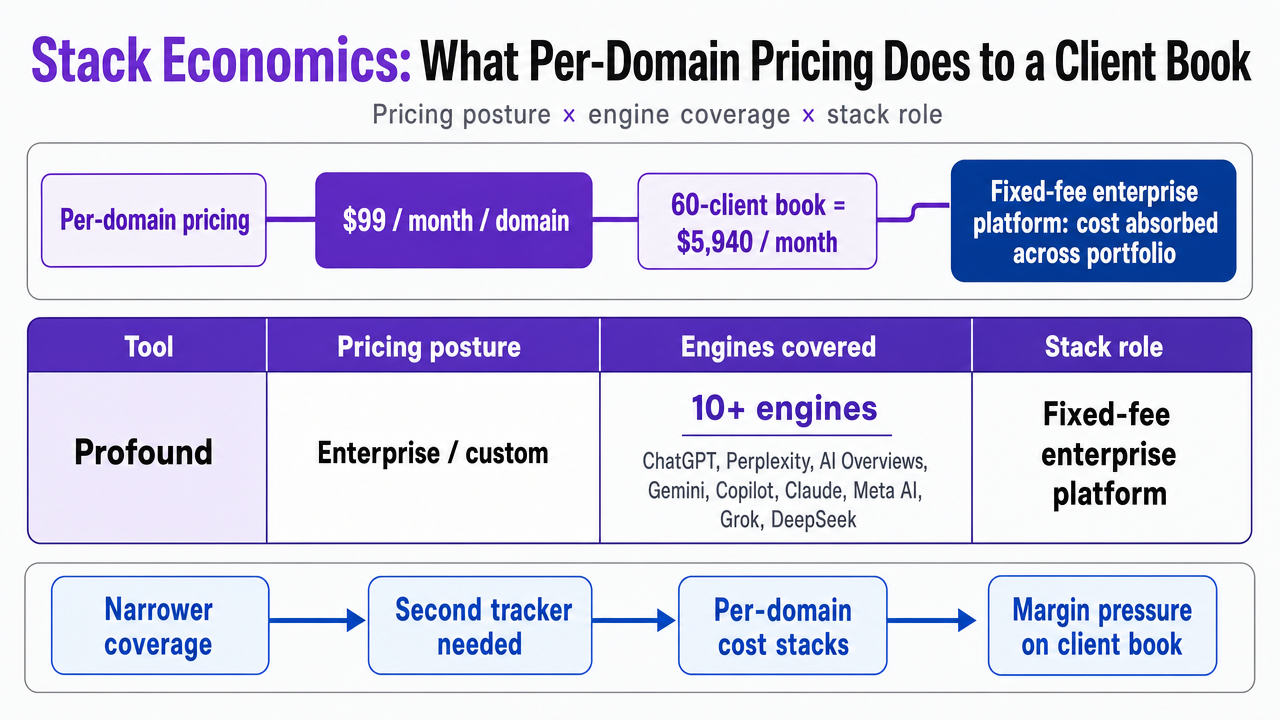
Per-domain pricing is the factor that often determines whether an AI visibility program is margin-positive. Semrush's AI Toolkit, for example, is priced at $99 per month per domain 5. While transparent, this scales linearly with the client roster. A 60-client book would incur $5,940 per month for this single tool; the same book on a fixed-fee enterprise platform would absorb the cost across the entire portfolio instead of stacking it per account.
The economics also depend on the number of engines each tool covers, as narrower coverage necessitates a second tracker, effectively doubling the per-domain cost.
| Tool | Pricing posture | Engines covered | Stack role ||---|---|---|---|| Profound | Enterprise / custom 7| 10+ including ChatGPT, Perplexity, AI Overviews, Gemini, Copilot, Claude, Meta AI, Grok, DeepSeek 4| Cross-engine tracker || Semrush AI Toolkit | $99/mo per domain 5| ChatGPT, Perplexity, Gemini, Claude 5| AEO module in SEO suite || Ahrefs Brand Radar | Bundled with Ahrefs contract 5| ChatGPT, AI Overviews, Gemini, Perplexity, Copilot 5| AEO module in SEO suite || SE Ranking AI Visibility | Bundled with SE Ranking 9| ChatGPT, Perplexity, Gemini, AI Overviews 4| Mid-market AEO module || Otterly.AI | SMB tier 7| Major AI answer engines 9| Entry-tier tracker |
Operationally, agencies scoping AEO as a universal deliverable across every client will experience margin compression fastest with per-domain SKUs. Agencies that scope it as a paid add-on, priced through to clients whose buyers actually use the covered engines 2, will find the math more manageable.
Structural and Editorial Optimization Layer
Writesonic: Content Adaptation for Generative Engines
Tracking identifies where a client is invisible; Writesonic addresses how to fix it. This platform occupies the structural-optimization slot in the stack, adapting page-level content to ensure more consistent retrieval and generation 6. This includes rewriting for answer-shaped queries, expanding entity coverage, and restructuring passages so search-augmented LLMs can extract them cleanly 16.
Foundational GEO research sets expectations for this category. Structured optimization has shown visibility gains of up to 40% in generative responses and 37% on Perplexity in controlled benchmarks 12. These figures were measured on specific query sets, not durable organic traffic in live conditions, and broader survey literature cautions against generalizing them across all engines 15.
Within an agency, Writesonic's output should be integrated into a brief-and-edit loop, not a direct publishing workflow. Strategists should route generated revisions through the same editorial review process used for human-written work, preserving citation gains without inheriting the adversarial risks associated with unsupervised rewrites 13.
Vectoron: Editorial Workflow and Human-Approval Governance
The workflow layer is where many agency LLM SEO programs encounter challenges. Tracking platforms identify visibility gaps, and structural tools produce recommended rewrites. However, neither can be delivered to a client without a review, approval, and publishing sequence that scales beyond a strategist's manual queue. Vectoron fills this gap by routing AI-generated content and recommendations through an approval-first workflow before anything reaches a client site.
This governance posture is critical because underlying research explicitly highlights the risks. LLM outputs cannot be treated as end-to-end audits or autonomous publishing 1, and adversarial optimization pressure on LLM-based search systems creates real content-integrity exposure that agencies must guard against 13. The NIST AI RMF Playbook outlines the operational response: define data-quality standards, testing and validation steps, and monitoring frequency before deploying LLM outputs at scale 11. An approval workflow is the mechanism that translates these requirements into a repeatable delivery process.
Within a stack, Vectoron pairs with a tracker on one side and a structural tool on the other, ensuring strategist judgment remains in the loop without becoming a throughput bottleneck.
See How Leading Agencies Orchestrate LLM-Powered SEO Analysis at Scale
Connect with our team to benchmark your agency’s SEO operations and discover workflow automation options using advanced LLM analysis tools for higher throughput and measurable efficiency gains.
If You Manage a Multi-Location Portfolio
This section is specifically for agency heads whose delivery model focuses on multi-location operators—such as DSO groups with 40+ practices, home-services franchises with regional footprints, senior-living portfolios with location-level pages, and legal networks with per-office landing sites. While the stack decisions discussed previously still apply, the per-location economics significantly influence tool ranking.
Multi-location books amplify per-domain pricing in a way single-brand agencies do not experience. For example, a dental group with 60 practice pages tracked at $99 per month on the Semrush AI Toolkit would incur $5,940 per month for just one client 5. This cost is before considering the parent brand domain, recruiting site, or specialty subsites. Fixed-fee enterprise trackers absorb location count into a single contract, which is why Profound's coverage model is more advantageous for portfolio operators than for single-brand entities 4.
The measurement priority also shifts. Cross-engine research indicates a systematic bias toward earned media over brand-owned and social content in AI search 14. This is particularly relevant for multi-location clients whose individual location pages rarely earn independent citations. Trackers that can identify which specific locations are cited, and which are absorbed into a parent-brand mention, become the crucial reporting layer. Both Otterly.AI and Peec AI expose prompt-level appearances, which is where location-level attribution truly resides 9.
Governance, QA, and Adversarial Risk
Governance is the layer that ensures an LLM SEO program is defensible under client scrutiny. Two research findings highlight the exposure. First, LLM-based tools cannot audit sites end-to-end; therefore, any output from a tracker or optimizer serves as an input to strategist judgment, not a replacement for it 1. Second, LLM-based search systems are susceptible to adversarial content manipulation, meaning automated rewrites deployed without review can degrade both client integrity and the citation signals the tool was intended to improve 13.
The NIST AI RMF Playbook provides the operational framework, calling for documented standards on data quality, testing and validation, and the frequency of monitoring, auditing, and review 11. In agency practice, this translates to: every tool-generated recommendation landing in a queue with a named reviewer, a pass/fail rubric tied to client brand voice, and a monitoring cadence that catches drift between publish date and citation impact.
Three controls bear most of the weight:
- Named human approval before publishing,
- A change log linking each edit to the prompt or signal that triggered it, and
- Periodic paraphrase testing to confirm citations are holding across engines, not just on the prompts the tool happened to sample.
Building the 3-4 Tool Stack That Fits Your Delivery Model
The nine tools profiled above condense into a smaller working set once an agency defines its delivery model. Three configurations cover most client books.
- Enterprise-heavy portfolios typically anchor on Profound for its engine breadth 4, pair it with Semrush AI Toolkit or Ahrefs Brand Radar if those suites are already part of the client contract 5, and add Writesonic at the structural layer. A critical component is an approval-first workflow tool like Vectoron, routing every rewrite through named review 11.
- Mid-market and regional books usually operate leaner: SE Ranking AI Visibility serves as both tracker and AEO module 9, Peec AI provides daily alerting 6, and the same governance layer is applied on top.
- Boutique agencies managing under 20 clients often start with Otterly.AI for coverage and cost-effectiveness 7, then integrate structural and workflow tools only when a client explicitly scopes AEO.
Three tools are usually sufficient. A fourth becomes necessary when a portfolio spans both enterprise buyers on Claude or Meta AI and regional clients whose visibility primarily resides on AI Overviews. The stack decision is not about which single platform wins, but which combination effectively closes the loop from citation signal to shipped edit without increasing strategist headcount.
Frequently Asked Questions
References
- 1.Large Language Models as a Tool in SEO Audits.
- 2.Multi-Engine AEO Performance Benchmarks 2024.
- 3.Answer Engine Optimization Benchmarks | AEO/GEO Guide for AI Search.
- 4.Top 10 Tools for Answer Engine Optimization (AEO) in 2026.
- 5.GitHub - amplifying-ai/awesome-generative-engine-optimization.
- 6.The 9 Best Generative Engine Optimization (GEO) Tools for AI Search.
- 7.11 Best Generative Engine Optimization Tools for 2025.
- 8.Best AEO Tools 2026: Top Answer Engine Optimization Platforms.
- 9.Best LLM SEO Analysis Tools in 2026: The 7 Platforms That Matter.
- 10.The Generative AI Marketing Revolution.
- 11.AI RMF Playbook - NIST AI Resource Center.
- 12.GEO: Generative Engine Optimization.
- 13.Adversarial Search Engine Optimization for Large Language Models.
- 14.Generative Engine Optimization: How to Dominate AI Search.
- 15.A Critical Survey of Generative Engine Optimization (2023-2026).
- 16.Analyzing Search-Augmented Large Language Models.
- 17.A Measurement Framework for Generative Engine Optimization.