
Key Takeaways
- Profound delivers defensible AI-search citation share reporting across ChatGPT, Perplexity, Google AI Overviews, and Gemini, but leaves draft evaluation and rewrite decisions to the SEO team.
- Athena HQ runs drafts through a reference LLM configured as a judge, returning line-level scores and per-vertical rubrics that help editors justify rewrites to client stakeholders.
- Peec AI narrows visibility tracking to prompt-level citation evidence, returning the cited paragraph, linked URL, and passage position when clients ask why a competitor keeps surfacing.
- Otterly.AI monitors brand, URL, and executive mentions with sentiment across generative surfaces, making it useful for reputation-sensitive verticals rather than owned-content evaluation.
- Writer treats governance as a first-class object, combining evaluation with routed review, model version logging, and retained prompts — the audit trail regulated verticals require.
- Vectoron consolidates evaluation, visibility, governance, and publishing under a single approval log at $599 per month post-trial, targeting agencies replacing five-tool stacks with one workspace.
The Category Has Shifted From Detection to Evaluation
The question agency leads are actually asking when they type "best LLM SEO checking tool" into a browser is not "which tool spots AI writing?" It is "which tool tells us whether this content will get cited inside an AI Overview, ranked under E-E-A-T scrutiny, and defended in front of a client?" Those are two different jobs, and the tooling market has spent 2024 and 2025 quietly reorganizing around the second one.
Pew's July 2025 behavioral study measured what changed. When Google shows an AI summary above the traditional results, clicks to the classic ten blue links collapse from 15% to 8%, and only 1% of visits with an AI summary produce a click on any cited source 11. That is not a rank-tracking problem. It is an evaluation problem: the content either earns its way into the summary as a cited source, or it effectively disappears from the query.
Detection-first tools were built for a plagiarism-era question that no longer matches the operator's daily brief. Evaluation-first tools score content the way an LLM scores content — for evidence density, source traceability, citation-worthiness, and topical authority — and pair that with visibility monitoring inside AI Overviews, Perplexity, ChatGPT search, and other answer engines.
The shortlist that follows applies a single rubric to that operator brief. It scores tools on how they judge content, not on how they guess at its authorship.
Why Detector-First Tools Fail the Agency Brief
Detector-first tools promise a binary verdict: human or machine. Agency workflows need something else entirely — a defensible read on whether a page will earn a citation, hold up under E-E-A-T review, and survive a client's legal team. The detector category cannot deliver that, and the underlying research explains why.
A 2024 comparison of ten free AI-detection tools found sensitivity ranging from 0% to 100% when identifying fully AI-generated text, with predictive value described as highly variable across the sample 2. A separate 2025 study evaluating detectors against academic writing concluded that none achieved 100% reliability, and false positives posed real risk to writers whose work was flagged incorrectly 1. When researchers added human raters to the same experimental design, scoring accuracy landed at 19%, a result the authors called indistinguishable from chance 3. Institutional guidance has followed the evidence: recent summaries note real-world success rates well below vendor claims and warn against using detectors as evidence in misconduct cases 4.
For an SEO director signing off on content across a book of clients, those numbers translate into three operational problems:
- False positives create defensible-content disputes with writers and clients.
- False negatives give a green light to work that still needs strengthening on evidence, sourcing, and topical depth.
- Neither outcome answers the question that matters — whether the page contains the signals an LLM actually weighs when it decides what to cite in an AI Overview.
Detection is a compliance-adjacent parlor trick. Evaluation is the job. The tools worth licensing in 2026 score content against the qualitative criteria search systems already use, and they leave authorship guessing to the vendors still selling last year's problem.
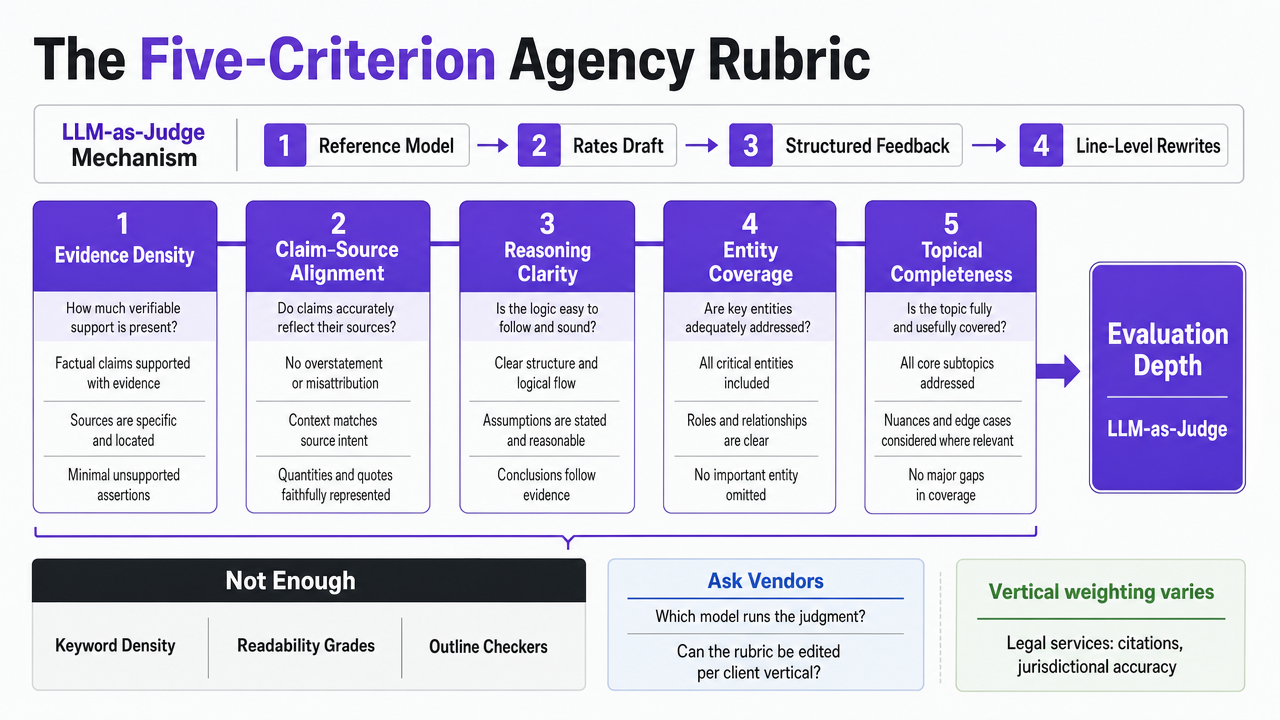
The Five-Criterion Agency Rubric
Evaluation Depth: LLM-as-Judge, Not Keyword Density
Evaluation depth measures whether a tool scores content the way a large language model actually scores content when deciding what to cite. That means graded reads on evidence density, claim-source alignment, reasoning clarity, entity coverage, and topical completeness — the qualitative signals an LLM weighs when it selects a passage for an AI Overview.
Keyword density scores, readability grades, and outline checkers do not clear this bar. An LLM-as-judge feature, by contrast, prompts a reference model to rate a draft against a rubric and return structured feedback with specific line-level rewrites. Agency directors should ask vendors two questions: which model runs the judgment, and can the rubric be edited per client vertical? A legal-services rubric weights citations and jurisdictional accuracy differently than a home-services rubric weights local proof and pricing transparency.
AI-Search Visibility Tracking Across AI Overviews and Answer Engines
Visibility tracking should answer a narrower question than "where does the client rank?" It should answer: for a defined prompt set, which sources does each answer engine cite, in what position, and with what surrounding context? A tool that reports impression counts inside AI Overviews without capturing the cited sentence and the linked domain is measuring the wrong thing.
Context matters because trust is thin. Pew found that only 6% of Americans who have seen AI summaries trust them a lot, while 46% report little or no trust in them 12. That gap means users who do click through are skimming for corroboration — the cited source, the numbers, the named author. Tools that log citation context, not just brand mentions, give agency leads the raw material to argue for content changes that earn the next citation.
Governance and Approval Workflow
Governance is the criterion most listicles skip and most agency P&Ls end up paying for. A tool that generates or scores content without a routed approval step forces SEO directors to bolt on their own review layer in Notion, Asana, or email — which is where quality slippage and client-facing errors originate.
The NIST AI Risk Management Framework, extended by the July 2024 Generative AI Profile, catalogs 12 risk categories and roughly 200 recommended actions for organizations deploying generative AI 5, 6. Agencies do not need to implement all 200, but the mapping question is worth answering per tool: does the platform log who approved which output, retain the prompt and model version, and let a reviewer reject a draft with structured feedback before publication? Tools that treat approval as a first-class object earn the governance point.
Portfolio Scale and Multi-Client Reporting
A tool that evaluates one URL at a time is a writer's tool. A tool that evaluates a portfolio is an agency's tool. The scale criterion tests whether the platform supports client workspaces with separate rubrics, permission tiers for account managers versus client stakeholders, bulk URL ingestion, and reporting that rolls up citation share and evaluation scores across a book of business.
Directors managing 15 or more client sites should ask for a live demo of the multi-client dashboard populated with sample data. Vendors that can only show a single-project view are pricing single-project tools and quietly expecting agencies to buy a seat per client. That math breaks fast at 25 clients.
Evidence Handling and Source Traceability
Evidence handling is the closing criterion because it determines whether a tool's outputs survive client review and legal scrutiny. The platform should attach source URLs or document references to every factual claim it scores or generates, flag unsupported statements, and let reviewers replace a citation without rewriting the surrounding paragraph.
This is also the criterion where forward-looking policy pressure lands first. Public comments on the NIST GenAI Profile draft argued for stronger data provenance standards and the ability for users to interrogate AI-generated content 7. Tools that already expose source chains — which passages informed which claim, which model version produced which draft — position agencies ahead of the provenance requirements likely to arrive in enterprise procurement templates through 2026.
Test AI-driven SEO checks on live projects
Experience real-time LLM SEO validation and publish agency-ready content before committing long-term.
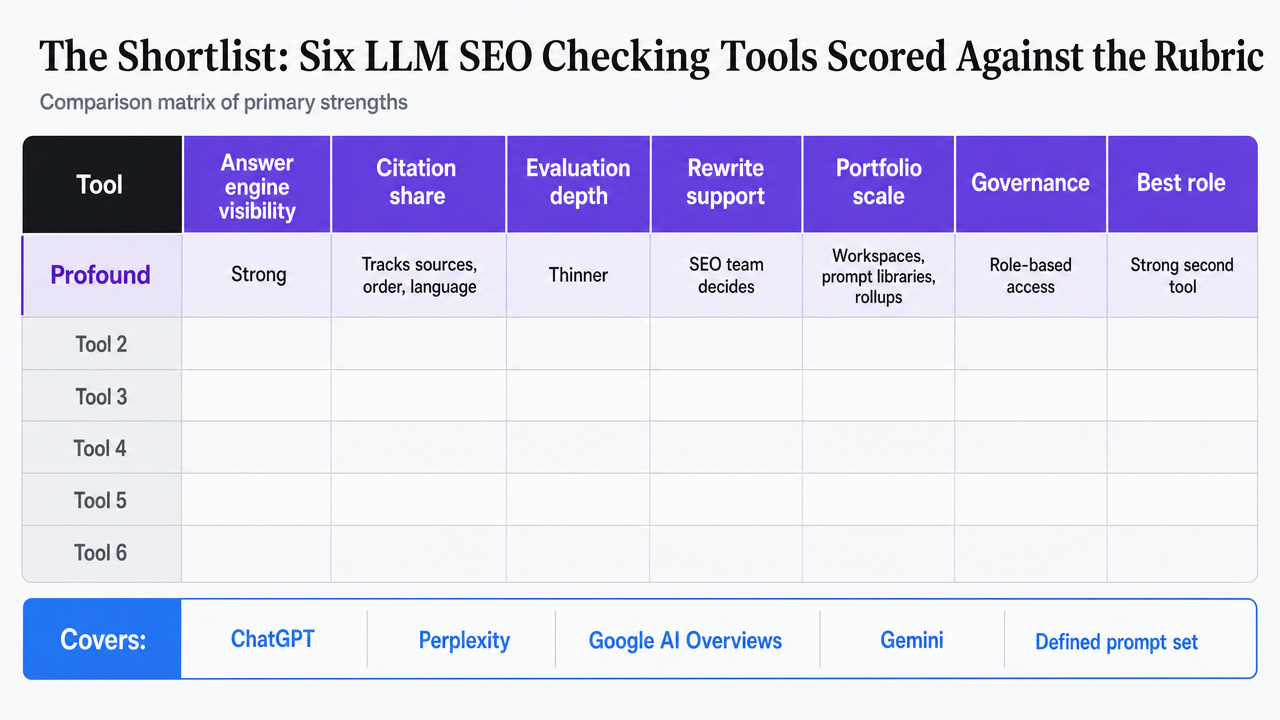
The Shortlist: Six LLM SEO Checking Tools Scored Against the Rubric
Profound: Answer Engine Visibility Monitoring
Profound evaluates the visibility side of the rubric — where client content surfaces across ChatGPT, Perplexity, Google AI Overviews, and Gemini for a defined prompt set. The platform's core output is a citation share report: for a tracked topic, which sources each answer engine references, in what order, and with what surrounding language.
Evaluation depth is thinner. Profound does not run an LLM-as-judge pass on draft content; it measures what already ranks and cites, then leaves the rewrite decision to the SEO team. That split makes it a strong second tool rather than a standalone solution. Portfolio scale is credible — client workspaces, prompt libraries, and rollup reporting exist — and governance is handled through role-based access rather than a routed approval workflow.
Fit: agency leads who already have an editorial evaluation process and need a defensible way to report AI-search visibility to clients quarter over quarter.
Athena HQ: LLM-as-Judge Content Scoring
Athena HQ sits on the opposite side of the rubric from Profound. Its evaluation engine runs draft URLs through a reference LLM configured as a judge, returning line-level scores on evidence density, claim-source alignment, entity coverage, and answer-readiness. Reviewers see structured feedback rather than a single quality number, which matters when a senior editor has to justify a rewrite request to a client-side stakeholder.
Rubrics can be edited per vertical — a legal-services scoring template weights citations and jurisdictional accuracy; a home-services template weights local proof and service-area specificity. Visibility tracking is present but narrower than Profound's, covering AI Overviews and one or two answer engines rather than the full set.
Governance handles model version logging and prompt retention, though the approval step lives outside the tool in whatever project system the agency already uses. Fit: content-led SEO teams that need defensible evaluation scoring on every draft before it ships.
Peec AI: Prompt-Level Citation Tracking
Peec AI narrows the visibility question to its most useful unit: the prompt. Instead of measuring brand mentions in aggregate, the platform ingests a curated list of buyer-intent prompts per client and tracks which sources each answer engine cites at the passage level, including the sentence the citation supports.
That granularity solves a reporting problem most visibility tools skip. When a client asks why a competitor keeps appearing in Perplexity for a specific query, Peec AI returns the cited paragraph, the linked URL, and the passage's position in the generated answer. Evaluation depth is limited to visibility signals — the tool does not score draft content — and governance is minimal, with export-based handoffs rather than in-app approval.
Portfolio scale works for agencies running structured prompt libraries per client. Fit: SEO directors whose reporting cadence requires prompt-level evidence, not just directional trend lines, and who have a separate content evaluation layer already in place.
Otterly.AI: AI Search Rank and Brand Mention Auditing
Otterly.AI focuses on brand and URL tracking across generative search surfaces, with a lighter editorial layer. The platform monitors when a client's domain, product name, or key executives are mentioned inside AI Overviews, ChatGPT responses, and Perplexity answers for a tracked prompt set, and logs sentiment along with position.
The mention-tracking angle matters for verticals where reputation shapes conversion — legal, behavioral health, senior living — because it surfaces off-site content the client cannot directly edit but can respond to. Evaluation depth on owned content is limited; the tool is not built to score drafts against an LLM-as-judge rubric.
Governance and approval workflow are not the platform's focus. Portfolio scale supports multi-brand tracking, though the reporting is oriented more toward PR and marketing dashboards than to editorial teams. Fit: agencies with reputation-sensitive verticals that need a dedicated brand-mention feed alongside a separate content evaluation tool.
Writer: Governed Content Evaluation With Approval Gates
Writer earns its position on this list because it treats governance as a first-class object rather than a settings tab. The platform combines content evaluation — style, factuality, terminology adherence, claim substantiation — with routed review, model version logging, and retained prompts, giving compliance teams a defensible record of who approved which output and under what rubric.
For agencies serving regulated verticals, that audit trail is the difference between a tool that survives a client's legal review and a tool that gets quietly pulled from the stack. Evaluation depth is strong on brand voice and claim accuracy, though visibility tracking across answer engines is not the product's focus and typically requires pairing with Profound or Peec AI.
Portfolio scale supports enterprise workspaces with granular permissions. Fit: agency directors serving law firms, healthcare systems, or DSOs where content approval evidence has to hold up under a compliance officer's review, not just a marketing manager's.
Vectoron: Approval-Workflow-Native Evaluation and Publishing
Vectoron closes the shortlist as the option built around the approval workflow itself rather than bolted onto it. Specialist strategists for content, SEO, backlinks, and social feed ranked recommendations into a Command Center, where every draft, brief, or optimization change routes to a human reviewer before execution. The evaluation layer scores content on evidence density and topical completeness; the governance layer logs the reasoning, the model version, and the approver.
Visibility tracking and answer-engine citation monitoring sit inside the same workspace as the editing and publishing tools, which removes the export-import friction agencies otherwise absorb across three or four vendors. Portfolio scale is the design center — client workspaces, per-vertical rubrics, and rollup reporting are native rather than add-ons. Pricing is disclosed at $599 per month post-trial.
Fit: agency leads who want the evaluation, visibility, governance, and publishing layers governed by a single approval log rather than stitched together across a five-tool stack.
Governance Sidebar: What NIST and the FTC Actually Require
Two frameworks set the compliance floor for any agency deploying LLM SEO tooling in 2026, and both are already in force. Neither is optional for firms serving regulated verticals, and neither is satisfied by a vendor's marketing claim of "enterprise-grade" anything.
The NIST AI Risk Management Framework, extended by the July 2024 Generative AI Profile, is the voluntary but rapidly-becoming-standard baseline for U.S. organizations deploying generative AI. The profile catalogs 12 risk categories and roughly 200 recommended actions covering accuracy, oversight, provenance, and accountability 5, 6. The companion Playbook translates those actions into implementation outcomes agencies can map to their own review checkpoints 13. The operational read for SEO directors: every tool in the stack should log which model produced which output, who approved it, and against what rubric. That log is what a client's compliance officer will ask for.
The FTC's final rule on consumer reviews and testimonials, effective October 21, 2024, closes the other side of the exposure. The rule prohibits selling or purchasing fake reviews, incentivizing sentiment-conditioned reviews, and suppressing negative ones, and it explicitly names AI-generated fake reviews as a covered deceptive practice 8, 10. Agencies managing local SEO, review response, or UGC at scale carry direct liability under the rule's Q&A guidance 9. A separate operational caution worth noting once: institutional guidance advises against treating AI-detection scores as evidence in any dispute, because real-world detector accuracy falls well below vendor claims 4. Tools that route review responses or generate testimonial-adjacent content without an approval log are the ones to remove from the stack first.
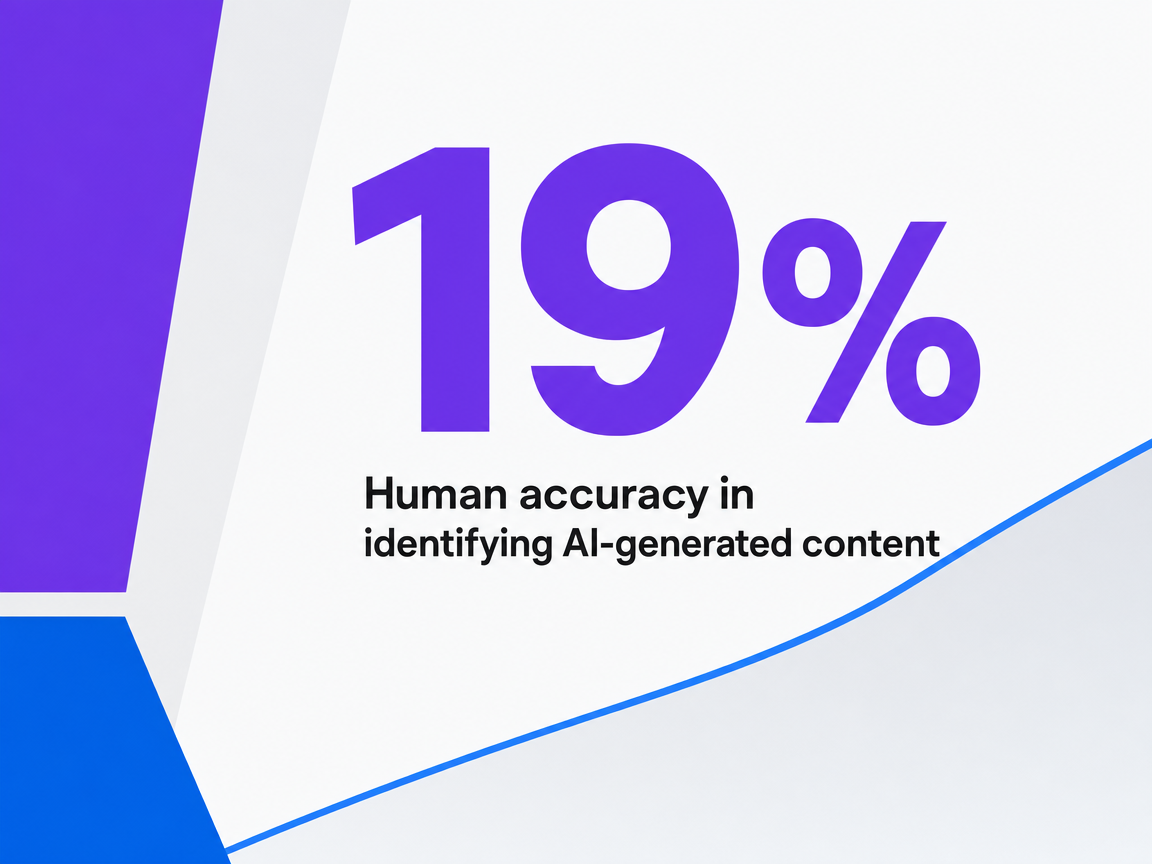 Human accuracy in identifying AI-generated content
Human accuracy in identifying AI-generated content
See How Leading Agencies Use AI to Audit LLM-Generated SEO Content at Scale
Connect with our team to benchmark your current LLM SEO workflows against 2026’s top-performing agency models—discover automation strategies that streamline multi-client quality checks without adding headcount.
For Agency Leads Managing Multi-Location Portfolios: A Staffing-Model Worksheet
Audience switch: this section is written for agency leads and in-house directors managing a book of 25 client sites or 25 locations under a single brand, where the marginal cost of adding one more property has to be defended against a P&L that does not scale linearly with headcount.
The worksheet below compares three staffing models against the same 25-property book. Only one hard number appears — the disclosed $599 per month post-trial price for the approval-workflow platform referenced later. Every other cell is a variable the reader fills in from internal loaded-cost data, because inventing benchmarks here would produce the wrong answer for most agencies.
| Input | Traditional SEO specialist model | Hybrid: specialists + LLM SEO evaluation tools | Approval-workflow AI platform |
|---|---|---|---|
| Clients or locations per senior specialist | [agency variable: C₁] | [agency variable: C₂, typically higher than C₁] | [agency variable: C₃] |
| Loaded FTE cost per specialist (monthly) | [agency variable: F] | [agency variable: F] | [agency variable: F, reduced review hours] |
| Tool license per client/location | $0 baseline | [vendor variable: T] | $599/mo platform license |
| Review and QA hours per property per month | [agency variable: H₁] | [agency variable: H₂, reduced by evaluation scoring] | [agency variable: H₃, routed approvals] |
| Monthly cost per property | (F ÷ C₁) + (H₁ × review rate) | (F ÷ C₂) + T + (H₂ × review rate) | $599 + (H₃ × review rate) |
Two operational points shape how directors read this table. First, the hybrid and platform rows only pay back if evaluation output is trusted at the reviewer level, which is why the earlier rubric weights LLM-as-judge depth and evidence handling ahead of visibility tracking. Second, the platform row consolidates tool spend that otherwise gets scattered across separate line items for evaluation, visibility, and publishing, and it collapses coordination hours that rarely show up in a vendor comparison but always show up in an operations budget.
Where LLM SEO Tooling Is Heading in 2026
Three trajectories are already visible in vendor roadmaps and policy drafts, and each one reshapes what agency leads should ask for in their next license renewal.
- Provenance moves from nice-to-have to procurement requirement. Public comments on the NIST GenAI Profile draft pushed for stronger data provenance standards and mechanisms that let users interrogate AI-generated content — which passages informed which claim, which model version produced which draft 7. Enterprise procurement templates will follow. Tools that already expose source chains at the passage level clear that bar without a rebuild.
- Evaluation converges with publishing. The stack of separate vendors for scoring, visibility tracking, and CMS handoff is being compressed into single-workspace platforms where the approval log is the connective tissue. Agencies running five-tool stacks in 2025 will consolidate to two or three by late 2026 for reasons that show up in reconciliation, not features.
- Rubrics get vertical-specific. Generic quality scores lose credibility with clients in legal, healthcare, and DSO verticals; scoring templates tuned to jurisdictional accuracy, clinical citation standards, or service-area proof become table stakes rather than premium add-ons.
Frequently Asked Questions
References
- 1.Can we trust academic AI detective? Accuracy and limitations of AI-output detectors.
- 2.How Sensitive Are the Free AI-detector Tools in Detecting AI-generated Text?.
- 3.Ability of AI detection tools and humans to accurately identify AI-generated content.
- 4.AI Detection Tools – Considerations and Limitations.
- 5.AI Risk Management Framework | NIST.
- 6.Department of Commerce Announces New Guidance Tools 270 Days Following ....
- 7.NIST Generative AI RMF Draft.
- 8.Use of Consumer Reviews and Testimonials: Final Rule.
- 9.The Consumer Reviews and Testimonials Rule: Questions and Answers.
- 10.Federal Trade Commission Announces Final Rule Banning ....
- 11.Do people click on links in Google AI summaries?.
- 12.How Americans feel about AI summaries in search results.
- 13.AI RMF Playbook.