
Key Takeaways
- Profound delivers defensible citation tracking across ChatGPT, Perplexity, Gemini, AI Overviews, and Copilot, with a category-taxonomy sampling method that keeps visibility scores stable across reporting cycles.
- Otterly.AI offers prompt-level visibility across ChatGPT, Perplexity, and Gemini at agency-friendly pricing, trading deeper AI Overview and Copilot coverage for faster setup and lower per-domain cost.
- Peec AI centers on share-of-voice against named competitors across the major LLM surfaces, mapping directly to the competitive benchmarking conversations that drive retainer renewals.
- AthenaHQ adds sentiment analysis and source-quality grading on top of citation counts, which matters most in legal, healthcare, and financial services where a negative-context mention is a client crisis.
- Semrush AI Toolkit folds AI Overview tracking and brand-mention monitoring into an existing Semrush workflow, closing the urgent measurement gap for mid-market accounts without a stack migration.
- Ahrefs Brand Radar ties AI Overview mentions to the keyword and backlink universe agencies already monitor in Ahrefs, making earned placements that feed AI answers easier to identify.
- Vectoron sits underneath the tracking layer as an execution platform, routing visibility signals from other tools into briefs, content updates, and approvals so analyst capacity stops bottlenecking delivery.
Ranking reports stopped telling the whole story
For agency Heads of SEO, the monthly client report is starting to look like a relic. Position three for a money keyword still gets a green arrow in the deck, but the click-through curve underneath it has been quietly flattening. The reason sits above the organic results: a generative answer that resolves the query before the user ever scrolls.
Pew Research found that 65% of U.S. adults say they at least sometimes come across AI summaries in search results, and 45% see them extremely often or often 1. This indicates a significant shift in how the median searcher now experiences Google. The retention problem follows directly from this behavioral change. When a client asks why traffic is soft despite holding rankings, an answer built on position tracking cannot explain the gap. The query was satisfied inside the AI surface, the brand was either cited or not, and the agency had no instrument pointed at that layer. Renewals get harder to defend when the report misses the place where attention actually went.
The seven tools below are evaluated against that reality.
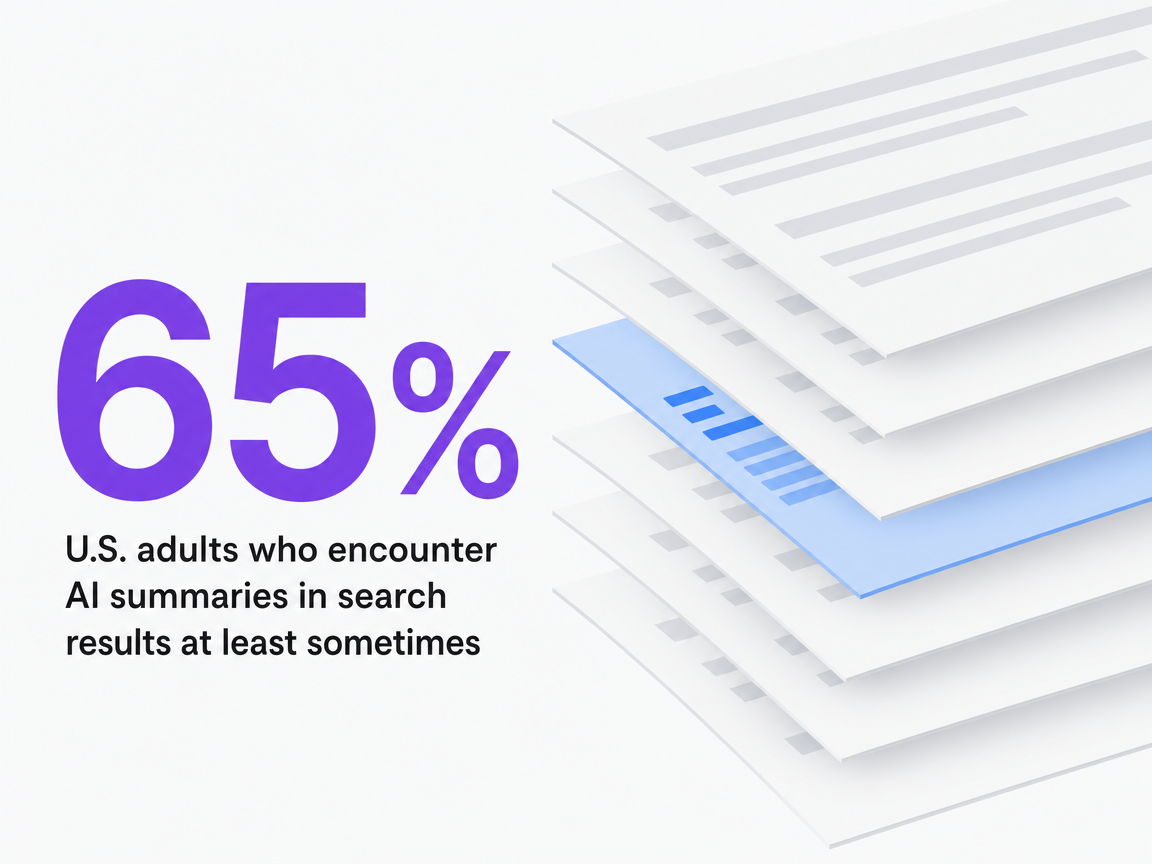 U.S. adults who encounter AI summaries in search results at least sometimes
U.S. adults who encounter AI summaries in search results at least sometimes
How this shortlist was built
The LLM SEO tracking category is loud, young, and largely self-marketed. Most comparison pieces ranking for this query were written by the vendors themselves or by affiliates collecting referral fees. That is worth naming before any tool gets a paragraph.
Seven products earned a spot here because they meet three baseline conditions:
- they track citation or visibility data across at least two major LLM surfaces,
- they publish a methodology that an agency analyst can interrogate, and
- they are operationally usable across a client portfolio rather than a single domain.
Tools that only monitor one surface, that rely entirely on user-submitted prompts with no sampling logic, or that have no path from visibility data to a client-ready report were excluded.
Each tool is then scored against five operator criteria detailed in the next section. The scoring is qualitative and based on stated product capabilities, public documentation, and the realities of running a 15-to-80-account book where reporting cadence, not feature breadth, decides whether a retainer renews. Pricing claims are kept to publicly stated figures; where pricing is gated, the analysis uses per-domain or per-seat as a variable rather than guessing.
The five criteria that separate operator-grade tools from vendor demos
Citation and visibility coverage across LLM surfaces
Coverage is the first filter because a tool that only watches one surface leaves the rest of the answer layer dark. McKinsey notes that only 16% of brands systematically track AI search performance, even as AI summaries already appear in roughly half of Google searches 2. An operator-grade tool monitors citation share and brand mentions across at least ChatGPT, Perplexity, Gemini, and Google AI Overviews, with Copilot increasingly expected. Equally important is sampling logic: how prompts are generated, refreshed, and rotated. Tools that depend entirely on user-submitted prompts produce visibility scores that drift the moment the analyst stops feeding them.
Attribution from AI citation to downstream conversion
Visibility without attribution is a vanity layer. The Columbia framework on generative AI ROI argues that traditional measurement tools are often ill-suited to capture AI's indirect value, which is exactly the gap LLM SEO tracking inherits 11. A defensible tool ties citation events to referral sessions, form fills, or revenue through GA4, CRM connectors, or server-side identifiers — not just to a brand-mention count. Where direct click attribution fails because the AI surface resolved the query, the tool should at minimum model assisted lift through pre- and post-citation cohorts. Anything less leaves the agency arguing renewal on impressions alone.
Multi-client workflow and analyst leverage
A tool that takes an analyst 45 minutes per client per week to pull, clean, and format does not scale to a 60-account book. Operator-grade products expose role-based access, client workspaces, white-label reporting, and bulk prompt management so a single strategist can run visibility tracking across 20 or more domains without copying spreadsheets between tabs. The honest test: how many clients can one analyst maintain on weekly cadence without missing a delivery? Tools built around a single power user, however clever the dashboard, hit a ceiling fast inside an agency P&L.
Integration depth with GSC, GA4, and rank tools
AI visibility data is most defensible when it sits next to the metrics clients already trust. A tool that pipes citation share into the same view as GSC impressions, GA4 sessions, and existing rank data lets the agency tell one continuous story rather than three disconnected ones. API access, scheduled exports to BI tools like Looker Studio, and write-back into existing reporting templates separate products built for analyst leverage from those built for screenshot decks.
Reporting defensibility and methodology transparency
The reliability gap between LLM platforms is real — a 2025 peer-reviewed comparison found measurable quality differences across generative systems, with traditional search still ranking as the most reliable source in the categories tested 8. That variance means a citation in one model is not equivalent to a citation in another, and a defensible tool publishes its sampling method, model versions queried, refresh cadence, and how it handles answer drift. When a client's CMO asks how the number was produced, the agency needs a documented methodology, not a black-box score. Vendors that refuse this detail fail the criterion.
Test LLM SEO tracking on live campaigns
Measure and validate SEO ROI on actual client content before committing to a full platform rollout.
Why category-level tracking matters more than brand tracking alone
Brand-name monitoring is the easy starting point and the wrong stopping point. A Medill Spiegel Research Center test of 160 queries across four industries found that 43% triggered AI Overviews, with informational and commercial-intent queries behaving differently inside the answer surface 9. The sample is small and industry-bound, but the pattern is directional: roughly four in ten category queries now resolve, at least partially, inside an AI answer before the user reaches a result.
That changes what an agency needs to instrument. Tracking only "law firm of [client name]" or "[client brand] reviews" captures the queries already won. The queries that decide pipeline — "best estate planning attorney near me," "do I need a personal injury lawyer," "how much does Invisalign cost" — are non-branded, category-level, and disproportionately likely to surface an AI answer. If the agency cannot show citation share on those prompts, the client never sees where new demand is actually being arbitrated.
Operator takeaway: build the prompt set around the client's category demand, not just its brand stem, and weight reporting toward the non-branded segment.
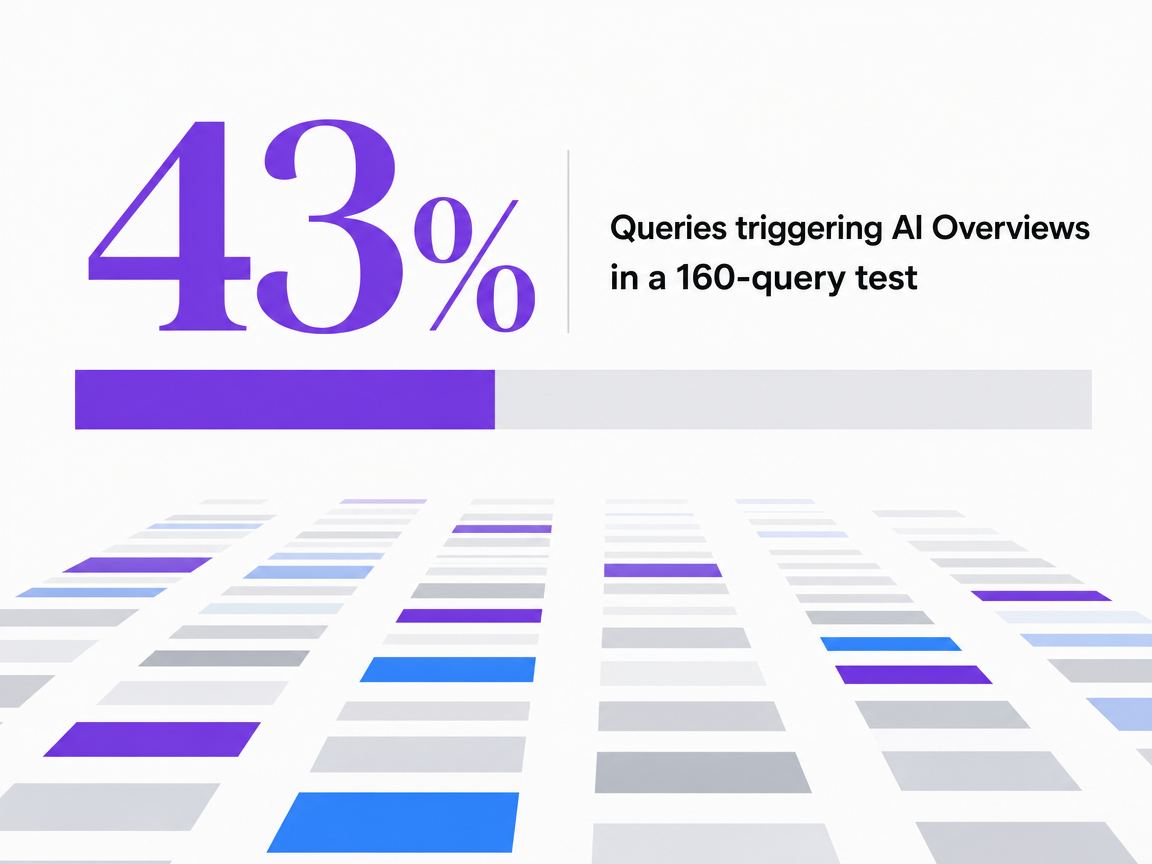 Queries triggering AI Overviews in a 160-query test
Queries triggering AI Overviews in a 160-query test
The seven tools worth evaluating
Profound — enterprise-grade citation tracking across major LLMs
Profound is built for brands and agencies that need defensible coverage across ChatGPT, Perplexity, Gemini, Google AI Overviews, and Copilot inside a single workspace. Its sampling approach generates synthetic prompts from a brand's category taxonomy rather than relying on whatever an analyst types in that week, which is the main reason its visibility scores hold up over reporting cycles.
Citation share, share of voice against named competitors, and source-quality breakdowns are exposed at the prompt level, and the platform pushes data to BI tools through an API. Conversion attribution is the weak spot: Profound surfaces visibility and referral sessions cleanly, but tying a citation event to a downstream CRM record still requires the agency to wire GA4 and a server-side identifier on its own.
For agency Heads of SEO running enterprise or upper-mid-market clients who expect a published methodology and surface-by-surface coverage, Profound is the strongest pure-tracking option in the category.
Otterly.AI — prompt-level visibility for ChatGPT, Perplexity, and Gemini
Otterly.AI takes a narrower path: track defined prompts across ChatGPT, Perplexity, and Gemini, monitor link mentions and brand mentions, and alert when citation share moves. The product is priced and structured for agencies running a defined book of clients rather than a single enterprise brand, with workspaces and shareable reports built in.
The trade-off is scope. Google AI Overviews coverage has historically lagged the three core LLM surfaces, and Copilot is not a first-class citizen. Prompt seeding is more manual than Profound's category-graph approach, which means the analyst owns the prompt set's quality. That is fine for accounts where the strategist already has a tight non-branded keyword list, less fine where category research is part of the engagement.
Otterly fits agencies that want clean prompt-level visibility data for mid-market clients without enterprise pricing, and that are willing to accept partial AI Overview coverage in exchange for faster setup and lower per-domain cost.
Peec AI — share-of-voice tracking with competitor benchmarking
Peec AI leads with competitor benchmarking. The interface centers on share-of-voice across a defined competitor set inside ChatGPT, Perplexity, Gemini, and AI Overviews, with model-by-model breakdowns and citation-source views. For agencies whose retainer conversations revolve around "how are we doing against [named competitor]," that framing maps directly to the deck the Head of SEO already builds.
Sampling runs on a scheduled cadence the agency controls, and the platform exposes which sources the LLMs cite most often on a given prompt — useful for prioritizing digital PR and link targets that actually feed the answer layer rather than just the index.
Attribution depth is light. Peec connects citation movement to traffic through GA4 integration, but assisted-conversion modeling for clickless sessions is not a core feature. Use Peec where the client cares most about competitive positioning inside AI answers and where conversion attribution is handled in a separate BI layer.
AthenaHQ — sentiment and source-quality layer on top of citation data
AthenaHQ differentiates on what comes after the citation count. The platform layers sentiment analysis on the answer text itself and grades the quality of cited sources, which matters because a peer-reviewed comparison in 2025 found that answer reliability varies materially across generative systems, with traditional search still ranking as the most reliable source in the categories tested 8. A brand cited in a hallucinated paragraph is not equivalent to a brand cited in a sourced one, and AthenaHQ is one of the few tools that treats that distinction as a first-order metric.
Surface coverage spans ChatGPT, Perplexity, Gemini, and AI Overviews. The multi-client workflow is less mature than Profound or Peec, with workspace management still evolving, so analyst leverage at the 60-plus account level requires workarounds.
Best fit: regulated verticals — legal, healthcare, financial services — where a misattributed or negative-context citation is a client crisis and source-quality grading is worth the workflow friction.
Semrush AI Toolkit — AI visibility bolted onto an existing agency stack
For agencies already standardized on Semrush across the book, the AI Toolkit is the lowest-friction entry point. It adds AI Overview tracking, brand-mention monitoring across major LLMs, and prompt-level visibility into the same workspace that already holds keyword tracking, site audits, and competitive research. No new vendor contract, no new login for the analyst, no new export format for the client deck.
The depth trade-off is real. The Toolkit's LLM sampling and methodology transparency are thinner than what Profound or AthenaHQ publish, and the sentiment and source-quality layers are basic by comparison. It is best understood as AI visibility data integrated into an existing rank-tracking workflow rather than a purpose-built measurement system.
For agencies whose reporting muscle memory and client templates are built on Semrush, and whose clients are mid-market rather than enterprise, the AI Toolkit closes the most urgent measurement gap without forcing a stack migration. Specialist tools still beat it on depth.
Ahrefs Brand Radar — AI Overview tracking inside familiar workflows
Ahrefs Brand Radar takes the same logic from a different starting point. It tracks brand mentions across AI Overviews and ties them back to the keyword universe the agency already monitors in Ahrefs, with prompt-level visibility for ChatGPT and Perplexity expanding over time. Mention tracking is paired with the same backlink and content data the strategist uses for traditional SEO, which makes it straightforward to identify which earned placements are actually feeding AI answers.
The honest limit: Gemini and Copilot coverage are weaker, and the AI-specific feature set is newer than the rest of the Ahrefs suite, so methodology disclosure is still maturing.
Ahrefs-anchored agencies get a defensible AI Overview signal without leaving the workflow that drives their existing deliverables. For clients where AI Overviews are the dominant AI surface — most local and category-search-driven verticals — that coverage is often enough to anchor the retainer narrative.
Vectoron — closing the loop from tracking to execution
The six tools above measure. Measurement is necessary, but a Head of SEO running 40 accounts still has to convert each tracking insight into briefs, content updates, PR pitches, schema changes, and approval cycles — work that consumes the hours saved by better dashboards. Vectoron is positioned as the execution layer underneath that workflow rather than a competing tracking product.
The platform's specialist strategists for content, SEO, backlinks, PPC, social, and call intelligence read live data — including AI-surface visibility signals from connected tracking sources — rank what should change next, and route every recommended action through a Command Center for human approval before execution. Visibility data from Profound, Otterly, Peec, or the Semrush and Ahrefs stacks becomes the input that drives the next published asset, not just the next slide.
For agencies whose constraint is analyst and producer capacity rather than measurement coverage, Vectoron is the layer that turns LLM SEO tracking into delivered work without adding headcount.
Mapping tools to client tiers across a portfolio
Audience scope shift: this section is for the Head of SEO running a 25-plus account book where tool selection is a portfolio decision, not a single-client one. The question is not which product is best in isolation. It is which combination keeps reporting cadence intact across tiers.
McKinsey reports that only 16% of brands systematically track AI search performance, even though AI summaries already appear in roughly half of Google searches today 2. Inside an agency, that gap shows up as analyst hours. The table below models a 25-client book under three approaches, using hours per reporting cycle and clients-per-analyst capacity as the comparable variables.
| Approach | Hours per client per cycle | Clients per analyst | Per-domain tool cost |
|---|---|---|---|
| Manual analyst pulls across LLM surfaces | 3.5–5.0 | 8–10 | None |
| Point tracking tool layered on existing stack | 1.0–1.5 | 20–25 | Per-domain variable |
| Unified execution plus tracking | 0.5–0.75 | 30–40 | Per-domain variable |
The mapping that follows from that math:
- Enterprise and regulated accounts go to Profound or AthenaHQ where methodology and source-quality grading carry the room.
- Mid-market accounts on a Semrush or Ahrefs foundation stay inside that stack.
- Competitor-driven retainers route to Peec.
- Execution capacity, not dashboard count, becomes the binding constraint above 25 accounts.
See How Leading Agencies Quantify LLM SEO Impact Across Clients
Request a demo of unified LLM-powered SEO tracking and reporting designed for multi-site oversight, automated attribution, and transparent ROI benchmarking at scale.
If you manage multiple client portfolios: the consolidation question
Scope shift: this section is written for the Head of SEO whose agency runs two or more distinct portfolios — a legal book, a behavioral health book, a home services book — each with its own reporting template, competitive set, and decision-maker on the client side. The buying question changes at that scale.
Three tracking contracts across three portfolios produces three methodologies, three exports, three login layers, and three invoices. Each portfolio lead defends a different number with a different definition of citation share. The Columbia framework on generative AI ROI flags exactly this problem: traditional measurement tools are often ill-suited to capture AI's indirect value, and inconsistency across measurement layers compounds the gap 11. A CMO comparing the legal report to the dental report cannot tell whether visibility moved or the instrument did.
Consolidation gets harder to avoid above roughly 40 accounts. The operational call is whether to standardize one specialist tracking tool across every portfolio and absorb the coverage compromises, or accept multiple tools and invest in a unified execution layer that normalizes their outputs into one reporting frame.
What none of these tools can do yet
Honest framing matters here because the category is being sold as further along than it is. Three gaps show up in every product evaluated above, and a Head of SEO should price them into the retainer narrative rather than wait for a vendor to close them.
Clickless attribution remains unsolved. Pew's browsing-data analysis found that roughly six-in-ten respondents visited a search page with an AI-generated summary in a single month 12, yet none of the seven tools can deterministically tie an answer-surface impression to a downstream conversion when no click occurs. Modeled lift is the workaround, not a measurement.
Sentiment inside the answer text is shallow. Most tools count citations; few read the paragraph around the citation well enough to flag a negative-context mention before a client does. Source-quality grading is similarly early. Finally, prompt-set drift is real — what the LLM surfaces this week is not what it surfaced last month, and no product fully solves refresh logic without analyst input.
Translating AI visibility into a defensible ROI narrative
Citation share is a metric, not a story. The Head of SEO who walks into a renewal meeting with a screenshot of "share of voice up 18 points in Perplexity" still has to answer the question every CMO eventually asks: what did that buy us. Forrester's Total Economic Impact study modeled a 611% ROI on an SEO program by connecting incremental organic traffic to revenue through a composite organization framework 10. The composite caveat matters, but the structure transfers cleanly to LLM SEO: visibility leads to assisted sessions, sessions lead to modeled leads, leads lead to closed revenue at the client's known rates.
The defensible narrative has three layers stacked in that order:
- Citation share movement on non-branded category prompts, the upstream signal.
- Assisted-session lift measured against a pre-citation baseline cohort, the behavioral bridge that handles clickless visits.
- Pipeline contribution priced at the client's actual lead-to-close economics, the financial layer the CFO will accept.
Skip any layer and the report reverts to vanity.
Build the template once per vertical, populate it from the tracking stack, and the agency stops selling reports and starts selling outcomes.
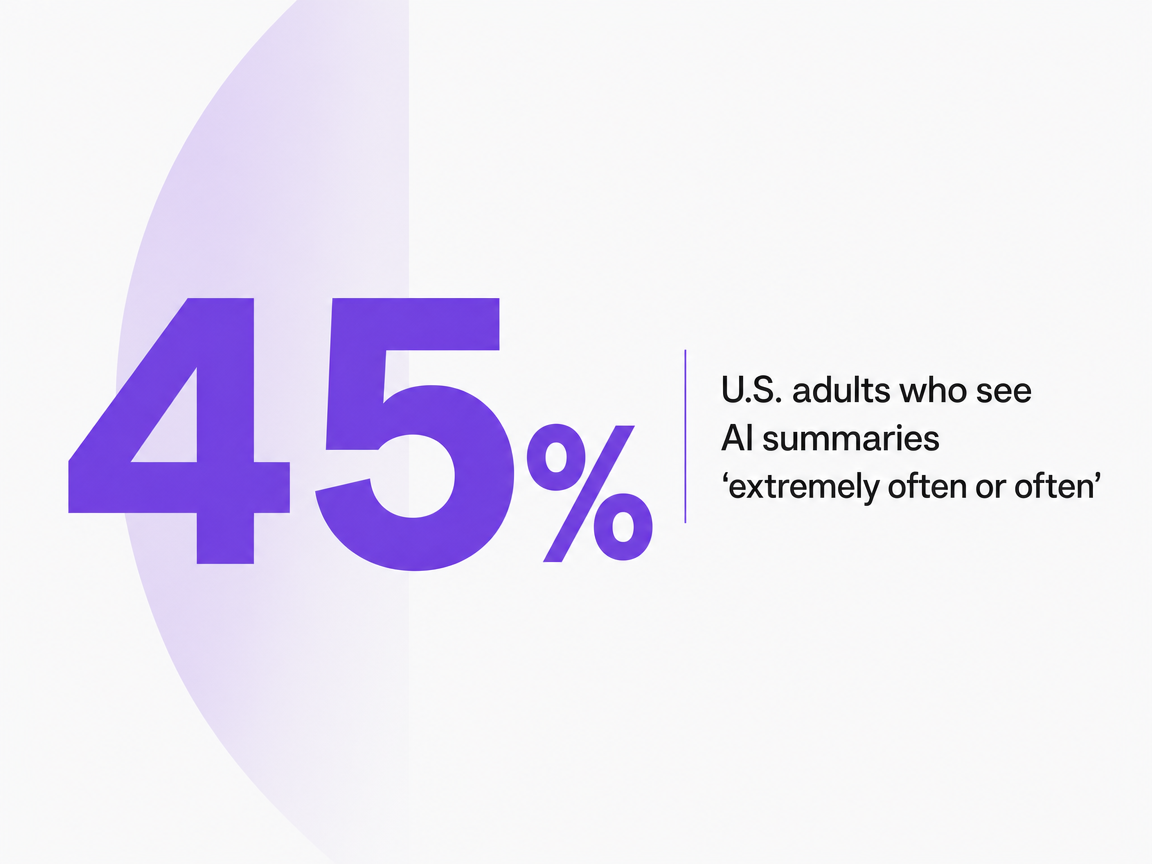 U.S. adults who see AI summaries 'extremely often or often'
U.S. adults who see AI summaries 'extremely often or often'
Frequently Asked Questions
References
- 1.Americans have mixed feelings about AI summaries in search results.
- 2.Winning in the age of AI search.
- 3.Seizing the agentic AI advantage.
- 4.Gen AI's ROI.
- 5.The state of AI in early 2024: Gen AI adoption spikes and the technology’s early impact.
- 6.The State of AI: Global Survey 2025.
- 7.The Fed - Monitoring AI Adoption in the US Economy.
- 8.The Reliability Gap: How Traditional Search Engines Outperform ....
- 9.Google AI Overviews Decoded - Medill Spiegel Research Center.
- 10.You Can Quantify The ROI Of SEO.
- 11.Challenges in calculating the ROI to Generative AI for financial institutions.
- 12.What Web Browsing Data Tells Us About How AI Appears Online.