
Key Takeaways
- Profound delivers enterprise citation intelligence, quantifying Citation Authority and Share of Model so agencies can justify content spend against entrenched competitors on curated query sets 1.
- AIclicks tracks brand mentions across 10+ AI systems with daily refresh, exceeding the five-platform baseline and catching citation loss earlier than weekly incumbent cadences 3, 5.
- Nightwatch combines SERP rank tracking with LLM monitoring in one interface, preserving reporting continuity when clients need SERP and AI answer performance analyzed together 3.
- SE Ranking extends a mature SEO suite with an AI answer layer, minimizing retraining for existing customers but trailing dedicated GEO tools on Citation Authority depth 1.
- Ahrefs pairs Brand Radar with its link intelligence heritage, connecting citation gaps to link gaps for accounts where authority and backlink strategy drive the narrative 1.
- Semrush concentrates on AI Overviews inside a familiar workflow, fitting Google-heavy clients but lacking the cross-platform citation depth of specialist trackers 1, 5.
- SimilarWeb supplies competitive Share of Model at market scale, giving Heads of SEO the board-level comparative framing that raw mention counts cannot deliver 1.
- The execution-layer archetype converts citation gaps into approved content, entity, and link actions through a single approval queue, addressing the throughput bottleneck across portfolio books 4.
The Measurement Bifurcation Reshaping Agency Tool Stacks
The LLM visibility category has split into two distinct camps, influencing how agency Heads of SEO build their tool stacks. One camp focuses on dedicated Generative Engine Optimization (GEO) trackers designed to quantify citation share, brand mentions, and positioning across various AI platforms like ChatGPT, Gemini, Claude, Perplexity, and Google AI Overviews5. The other camp consists of incumbent SEO suites that have integrated AI answer layers into their existing rank-tracking workflows, extending familiar dashboards to generative surfaces1.
This distinction is crucial for procurement. Dedicated GEO platforms emphasize metrics such as Citation Authority and Share of Model1, while incumbent tools maintain a focus on keyword and backlink metrics. Neither approach fully bridges the gap between measurement and remediation, which often consumes significant agency resources.
The eight tools profiled below are categorized by archetype, allowing a Head of SEO to align capabilities with client needs rather than following a simple ranking.
Five Dimensions That Actually Separate the Category
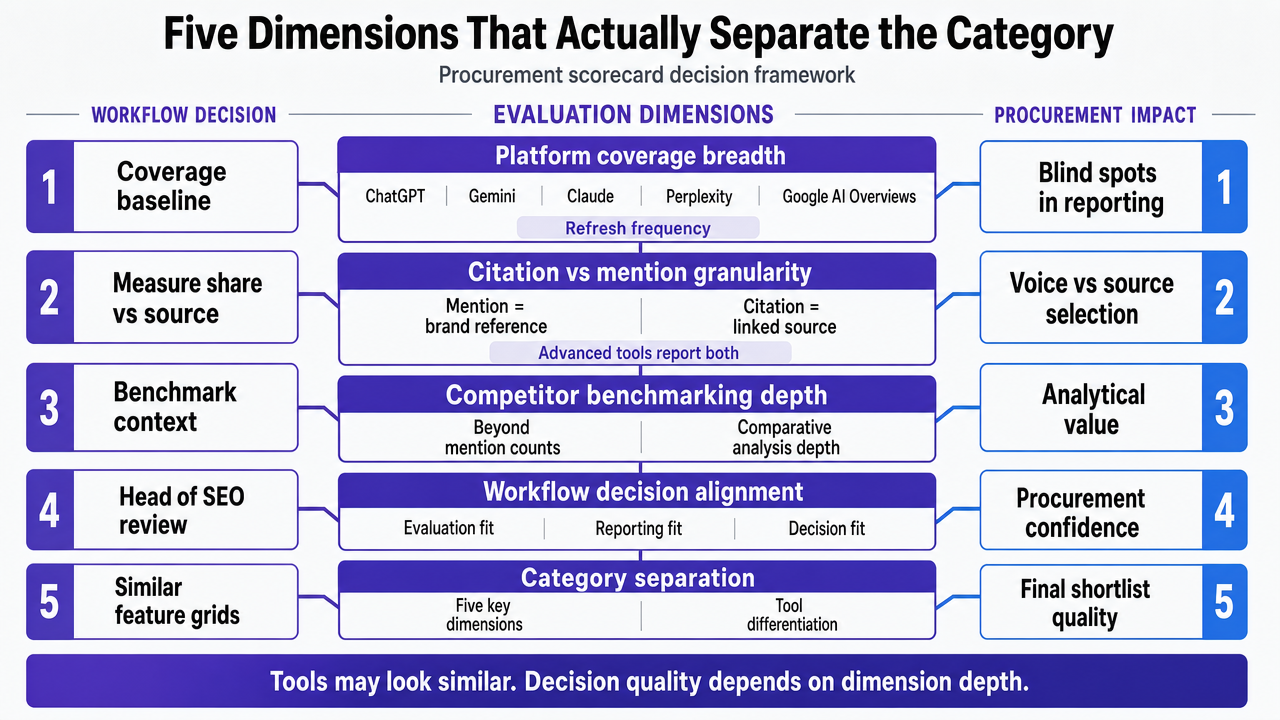
Vendor feature grids often appear similar. However, five key dimensions differentiate tools and influence procurement decisions, each corresponding to a workflow decision for a Head of SEO:
Platform coverage breadth : This refers to the number of AI systems a tool queries and its refresh frequency. A robust baseline includes ChatGPT, Gemini, Claude, Perplexity, and Google AI Overviews5. Inadequate coverage can lead to blind spots in client reporting.
Citation-versus-mention granularity : A mention is any reference to a brand within an AI answer, while a citation is a linked source attributed by the model. This distinction is critical: mentions track share of voice, whereas citations indicate source selection. Advanced tools report both2.
Competitor benchmarking depth : Beyond simple mention counts, the analytical value lies in Citation Authority and Share of Model—how often a brand is chosen as a source compared to competitors for the same queries1. Without this comparative view, citation data can be a vanity metric.
Bot log visibility and prompt ideation : Analyzing bot interactions and automating prompt generation are now standard features in mature platforms4. Tools lacking these capabilities are considered outdated.
Execution-layer integration : This dimension assesses whether a tool merely provides a dashboard or actively connects measurement insights to content, entity, and link building actions. This is where the archetypes diverge most significantly.
Eight Tools, Grouped by Archetype
Profound: Enterprise Citation Intelligence
Profound targets the enterprise segment of the dedicated GEO market, focusing on which sources AI models prefer for specific query sets, rather than just brand appearance1. Its analytics emphasize Citation Authority and Share of Model, providing comparative metrics on how often a brand is cited versus its competitors for identical prompts1.
This tool is ideal for Heads of SEO managing enterprise or mid-market accounts with strong competition. Profound offers the diagnostic data needed to justify content investments, illustrating not just a lack of mentions but how often competitors are cited for key prompts. This reframes budget discussions.
However, Profound's scope is specialized. It is priced for in-depth analysis on curated query sets, not for broad coverage across numerous SMB clients. Agencies often use it in conjunction with a broader tracking tool.
AIclicks: Dedicated GEO Tracker With Daily Refresh
AIclicks is a purpose-built Generative Engine Optimization platform that tracks brand mentions across over 10 AI systems with daily data refreshes3. This exceeds the standard five-platform baseline (ChatGPT, Gemini, Claude, Perplexity, and Google AI Overviews5), which is crucial for clients whose buyer journeys involve platforms like Copilot, Meta AI, or region-specific systems.
Its daily refresh rate is a key differentiator. AI answers can change rapidly, and a weekly cadence might delay detection of citation loss. Daily granularity provides early warnings for proactive content adjustments.
AIclicks suits agencies managing mid-market SaaS, e-commerce, or multi-region programs where comprehensive coverage and frequent updates are vital for reporting credibility. It is less suitable for accounts focused on only two AI surfaces with established weekly reporting cycles.
Nightwatch: Hybrid SERP and LLM Tracking
Nightwatch offers a hybrid approach, integrating traditional SEO rank tracking with AI and LLM tracking within a single interface3. This design acknowledges that most agency Heads of SEO still report weekly on keyword rankings and traffic, and a separate dashboard for AI visibility can complicate client reviews.
The hybrid model is particularly valuable when SERP performance and AI answer performance need to be analyzed together. For instance, if a client loses commercial query positions but gains citation share in AI Overviews, the strategy can shift to substitution analysis rather than panic.
However, its analytical depth may be limited compared to dedicated GEO tools, which often provide richer citation granularity and competitor share-of-model views. Nightwatch is suitable for agencies prioritizing a single contract, login, and reporting continuity over specialized depth.
SE Ranking: Incumbent Suite With AI Answer Layer
SE Ranking is recognized as a leading platform for quantifying AI-era visibility, alongside Ahrefs, Profound, SimilarWeb, and Semrush1. It exemplifies the incumbent strategy: extending a mature SEO suite to include AI answer tracking, allowing existing customers to avoid new procurement or team retraining.
For agencies already using SE Ranking, the AI answer layer streamlines operations, maintaining existing reports and client logins. The learning curve is minimal, involving new columns rather than a new tool.
The analytical capabilities of incumbents typically lag dedicated GEO platforms. Metrics like Citation Authority and Share of Model1 originated with specialists, and incumbent implementations tend to be less comprehensive. Agencies with significant competitor benchmarking needs for enterprise accounts often use SE Ranking as a baseline and supplement it with a dedicated tracker.
Ahrefs: Brand Radar and Citation Authority Signals
Ahrefs is also part of the leading evaluation cohort for AI-era visibility1. Its expansion into LLM measurement leverages its historical strengths in link intelligence and content gap analysis, directly supporting the concept of Citation Authority—how reliably a brand is chosen as a source in AI answers1.
This tool is particularly effective for accounts where link acquisition and content authority are central to the strategy. If an agency already uses Ahrefs for backlink profiling and topical authority mapping, the AI answer layer connects citation gaps to link gaps within a single workflow, accelerating insights into actionable briefs.
The limitation is similar to other incumbents: coverage across the full five-platform standard5 and daily refresh rates may not match purpose-built GEO tools. This is acceptable for agencies whose reporting focuses on link and authority narratives but not for those prioritizing citation share reporting.
Semrush: AI Overviews Coverage Inside a Familiar Workflow
Semrush, another platform in the leading evaluation group1, has focused heavily on AI Overviews, where traditional SERP and AI answer measurement converge. Google AI Overviews is a critical surface for visibility tracking alongside conversational LLMs5, and Semrush's positioning in this area is noteworthy.
It is well-suited for agencies with clients heavily reliant on Google traffic, whose teams already use Semrush for keyword research, position tracking, and site audits. Integrating AI Overviews visibility into the same interface prevents fragmentation caused by using multiple tools.
However, Semrush does not offer the deep, cross-platform citation intelligence across ChatGPT, Gemini, Claude, and Perplexity that a dedicated tracker provides. Agencies with B2B clients, where Perplexity and Claude are significant for discovery, often pair Semrush with a specialist tool.
SimilarWeb: Competitive Share-of-Model Intelligence
SimilarWeb, also part of the five-platform evaluation cohort for AI-era visibility1, offers a distinct focus on competitive intelligence at scale. Building on its expertise in traffic and market intelligence, it extends naturally into share-of-model views across competitor groups and industries.
For Heads of SEO developing business cases in competitive sectors like legal, financial services, or healthcare, SimilarWeb provides the comparative framework needed to influence clients. Its Share of Model metrics, expressed as percentages across defined competitor sets, offer clear, board-level insights that simple mention counts do not.
Its limitation lies in workflow granularity. SimilarWeb is optimized for market-level analysis, not for the tactical loop of detecting citation gaps and implementing content or entity remediation. Agencies typically use it as a strategic layer for quarterly narratives and competitive briefings, while a dedicated tracker or incumbent suite handles weekly reporting.
The Execution-Layer Archetype: Turning Visibility Signals Into Approved Actions
While the previous seven tools focus on measurement, the execution-layer archetype addresses a different challenge: how to convert a visible citation gap into published content, updated entity data, and acquired links across a client portfolio without increasing analyst headcount.
This archetype combines LLM visibility monitoring with a specialist-strategist workflow, involving separate operational units for content, on-page SEO, entity data, and link acquisition, all managed through a single approval queue. Each recommendation includes its underlying rationale, and nothing is published without approval from a Head of SEO or account lead. Prompt ideation and bot interaction analysis, now standard features in mature platforms4, serve as inputs to this queue rather than just dashboard data.
This approach is ideal for portfolio agencies where the bottleneck has shifted from measurement to action. For a client book of 40 accounts, running a baseline audit across three or more AI platforms, the execution layer ensures that citation reporting translates into tangible output rather than becoming a monthly time sink.
Test LLM visibility insights in real workflows
Assess LLM-driven content visibility and publish live client outputs during your trial—no delays, no sandbox limitations.
Archetype Comparison: What Each Tool Actually Measures
The five evaluation dimensions from the procurement scorecard provide a clear comparison when the eight archetypes are viewed side-by-side. The baseline for dedicated GEO platforms is the five-platform standard (ChatGPT, Gemini, Claude, Perplexity, and Google AI Overviews5). AIclicks surpasses this by tracking brand mentions across over 10 AI systems with daily refreshes3. Incumbent suites generally lag in both coverage breadth and refresh frequency, as illustrated in the table below.
| Archetype | Platform Coverage | Citation Granularity | Competitor Benchmarking | Execution Integration |
|---|---|---|---|---|
| Profound (enterprise citation intelligence) | Five-platform standard5 | Citation, mention, positioning2 | Citation Authority, Share of Model1 | Dashboard only |
| AIclicks (dedicated GEO tracker) | 10+ AI systems, daily refresh3 | Mention and citation2 | Cohort share tracking4 | Dashboard only |
| Nightwatch (hybrid SERP + LLM) | Five-platform standard plus SERP3 | Mention-weighted2 | Moderate depth | Dashboard only |
| SE Ranking (incumbent add-on) | Partial of five-platform standard1 | Mention-first2 | Suite-native competitor views1 | Dashboard only |
| Ahrefs (incumbent add-on) | Partial of five-platform standard1 | Citation-weighted2 | Citation Authority signals1 | Dashboard only |
| Semrush (incumbent add-on) | Emphasis on AI Overviews5 | Mention and citation2 | Suite-native competitor views1 | Dashboard only |
| SimilarWeb (market intelligence) | Cross-platform market view1 | Positioning-weighted5 | Share of Model at cohort scale1 | Dashboard only |
| Execution-layer archetype | Consumes tracker feeds4 | Tracker-dependent | Tracker-dependent | Approval-queued content, entity, link actions |
The table reveals a consistent pattern: seven of the eight archetypes are limited to dashboard reporting. While coverage breadth, citation granularity, and competitor benchmarking are measurement variables, execution integration is the factor that distinguishes a reporting tool from a throughput system. This column highlights that most tools do not offer integrated execution capabilities.
The Measurement-to-Remediation Gap
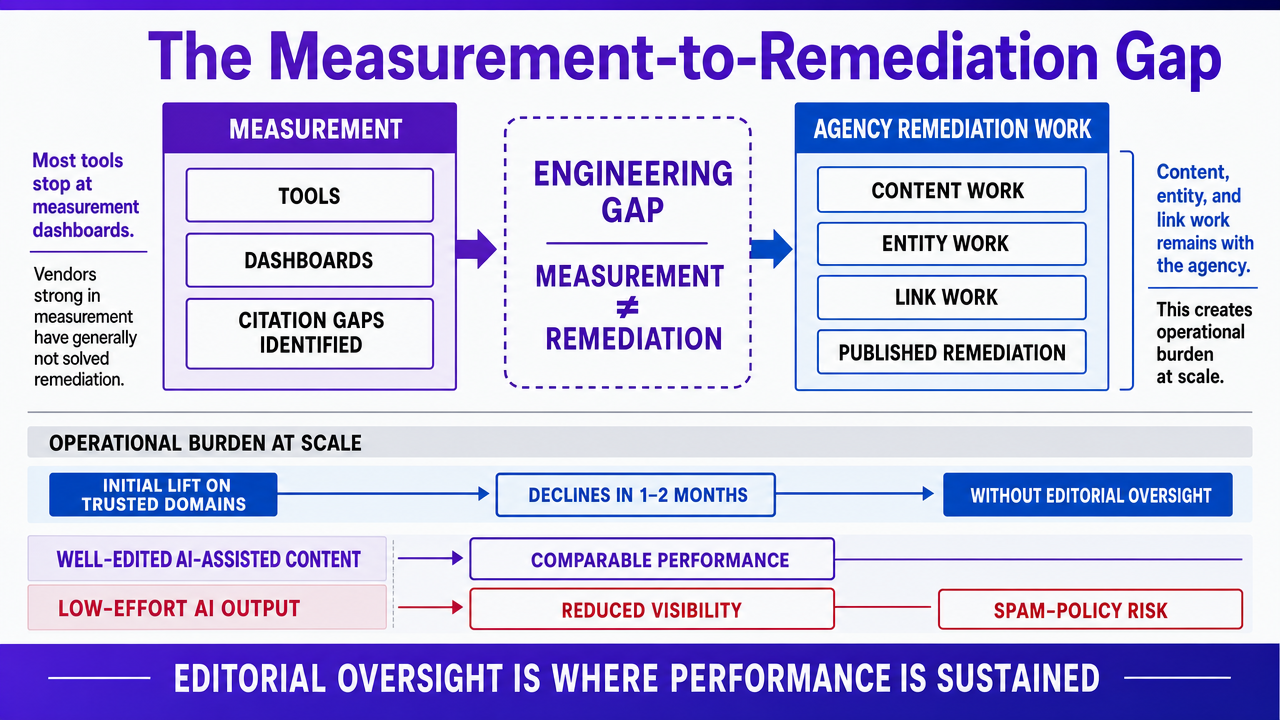
The pattern observed in the archetype comparison table is not accidental. Most tools conclude at the dashboard because measurement and remediation are distinct engineering challenges. Vendors excelling in measurement have, with few exceptions, not yet solved the remediation problem. This means citation gaps are identified, but the subsequent content, entity, and link work remains with the agency.
This gap creates an operational burden at scale. While AI-drafted content can initially perform well on trusted domains, its effectiveness often diminishes within one to two months without human editorial oversight7. Studies confirm that well-edited AI-assisted content performs comparably to human-written work, whereas low-effort AI output correlates with reduced visibility and increased risk under spam policies10. Both findings underscore the importance of remediation quality, not just volume, in gaining and maintaining citation share.
A dashboard that flags 200 citation gaps across 40 clients generates a queue, not throughput. The speed at which this queue is cleared depends on the operational layer between measurement and publication, including brief generation, editorial review, entity updates, link acquisition, and the approval processes that prevent low-quality output from being deployed.
A Baseline Audit Protocol Before Any Purchase
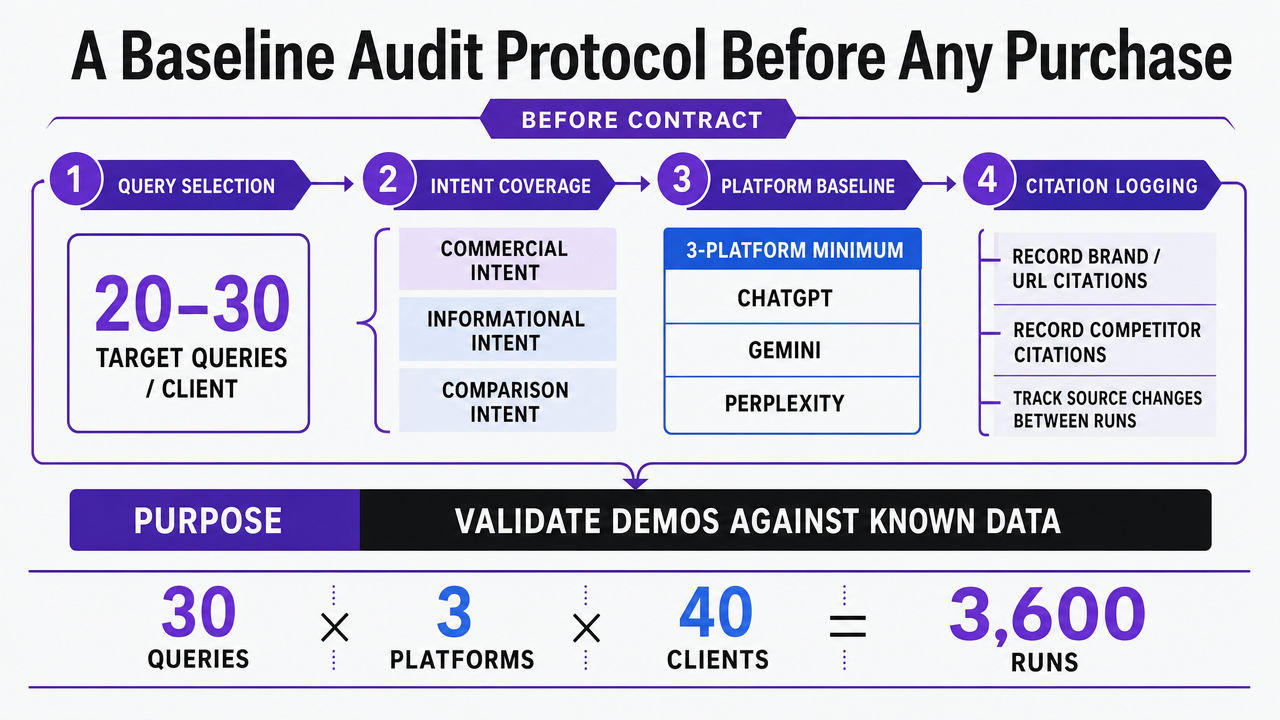
Effective tool selection is enhanced by an existing baseline audit. A repeatable process for Heads of SEO before signing a contract involves selecting 20 to 30 target queries per client, running them through at least three AI platforms, and recording brand/URL citations, competitor citations, and changes in citation sources between runs8. This manual baseline allows for validating vendor demonstrations against known data rather than relying on scripted pitches.
Query selection is critical. The 20-30 queries should cover:
- commercial intent (product/category prompts)
- informational intent (research questions feeding AI training)
- comparison intent ("X vs Y" or "best X for Y" prompts where citation share directly impacts consideration)
ChatGPT, Gemini, and Perplexity form the minimum three-platform baseline, with Claude and Google AI Overviews extending to the five-platform standard once the workflow is stable5.
The operational implications of this protocol often drive tool decisions. An agency manually performing this audit monthly for 40 clients would execute 3,600 individual prompt runs (40 clients × 30 queries × 3 platforms) before any recording, deduplication, or analysis. This workload transforms vendor evaluation from theoretical to a question of headcount.
See How Leading Agencies Use LLM Visibility Tools to Scale SEO Operations
Request a walkthrough of unified LLM-driven analysis and reporting workflows proven to increase efficiency and content consistency for multi-client SEO teams.
If You Manage a Multi-Location or Portfolio Book
The economics shift significantly when a Head of SEO manages the same measurement discipline across 20+ locations for a single client or 30+ separate accounts. Multi-location visibility—how a brand is cited in AI answers for geographically qualified queries across numerous countries and regional variants—has become a core capability for advanced AI monitoring platforms2. A national brand might have strong Share of Model for general prompts but lose citation share for queries like "best [category] in [city]" where local competitors dominate.
Portfolio operators face a different challenge. While coverage across 10+ AI systems with daily refreshes3 provides raw signals, the operational question is throughput: how many citation gaps are closed weekly per account, and how many require analyst attention versus routine remediation. Agencies managing 40 accounts either standardize on the execution-layer archetype or incur the headcount cost of manual triage for every dashboard alert.
For most portfolio books, this implies a two-tier procurement strategy: one platform for cross-platform citation intelligence with multi-location granularity, and an operational layer that converts alerts into approved content and link actions without requiring an additional analyst for every ten accounts.
Where Search Console Fits Before Anything Is Bought
Before any purchase order, the Generative AI performance report within Google Search Console serves as a free, essential baseline for every agency. Google's official guidance recommends using this report to monitor content visibility in generative AI features on Search6. For accounts heavily reliant on Google traffic, it provides first-party impression and click data that no third-party crawler can replicate.
However, Search Console does not offer cross-platform coverage. AI Overviews is just one surface; ChatGPT, Gemini, Claude, and Perplexity are outside Google's measurement stack. The five-platform standard5 is where comprehensive citation share reporting is built. Search Console acts as the foundational diagnostic for AI Overviews performance, validating or contradicting vendor claims on the one surface Google reports.
Matching Archetype to Portfolio Composition
The composition of an agency's client portfolio dictates its tool stack. An agency serving enterprise legal, financial services, or healthcare clients will prioritize Citation Authority and Share of Model diagnostics1 to justify content investments against entrenched competitors. This scenario calls for pairing an enterprise citation intelligence layer with a broader tracker. Conversely, a portfolio weighted towards mid-market SaaS and e-commerce clients with multi-region programs benefits from extensive coverage and frequent refreshes, where daily tracking across over 10 AI systems3 outperforms weekly incumbent reports.
For client books focused on Google-heavy verticals, tools like Semrush and Ahrefs are often sufficient, as AI Overviews measurement integrates into existing keyword and link workflows without requiring a separate contract. Regardless of client mix, the execution layer remains a constant. While measurement archetypes vary, the operational challenge of converting citation gaps into approved content, entity, and link work does not. Agencies that select a tracker before defining their remediation model often find themselves making duplicate purchases.
Frequently Asked Questions
References
- 1.LLM visibility tools SEO: An Exhaustive Analysis of the Post-Search Landscape.
- 2.10 best AI visibility tools for SEO teams in 2026.
- 3.Top 15 LLM Visibility Tools in 2026.
- 4.The 8 best AI visibility tools in 2026.
- 5.Top 11 Best LLM Visibility Tracking Tools for AI Search.
- 6.Google's Guide to Optimizing for Generative AI Features on Search and Discover.
- 7.Does AI Generated Content Work for SEO?.
- 8.Best LLM SEO Analysis Tools in 2026.
- 9.Search Quality Evaluator Guidelines.
- 10.Study: AI-Generated Content and Its Impact on SEO Visibility.