
Key Takeaways
- Evaluate any LLM visibility checker across four axes: surface coverage, prompt sampling rigor, citation versus mention granularity, and workflow fit, rather than comparing vendor feature lists.
- Apply a rubric covering ChatGPT, Gemini, Perplexity, AI Overviews, and Copilot, verifying live queries, refresh cadence, custom prompt imports, share of voice, and API-based white-label reporting.
- Google Search Console generative AI reports deliver an authoritative first-party baseline for AI Overviews and AI Mode, but exclude ChatGPT, Perplexity, Copilot, and Claude surfaces 11.
- Dedicated GEO trackers like Peec AI, SE Visible, and Rank Prompt shine on prompt-level fidelity and answer-text audits, though per-domain pricing scales linearly with client count 10.
- SEO-suite AI modules such as Ahrefs Brand Radar and Semrush's AI Visibility Toolkit inherit existing seats and BI exports, but often lean on vendor corpora rather than client-authored prompts 7.
- Prompt-database benchmarkers like Omnia and Semrush provide fast pitch snapshots at scale, yet fixed corpora can miss the decision-stage questions that actually drive client pipeline 4.
- Workflow-integrated brand intelligence platforms like Vectoron trade best-in-class benchmarking for routing visibility gaps into approved content, SEO, and PPC changes across a vertical.
- Compare archetypes on coverage, prompt sourcing, citation depth, share of voice, and pricing tier to build a shortlist rather than averaging incomparable vendor scores.
- Advanced checkers should expose feature-level signals like statistics, quotations, citations, and list position, which drove first-citation preference in controlled trials across six LLMs 13.
- Operationalizing 15 to 100 accounts depends on vertical prompt libraries with 70 to 90 percent portability, tiered weekly or monthly cadence, and API access for consolidated dashboards 3.
Why 'Best' Depends on Four Methodological Axes, Not a Feature List
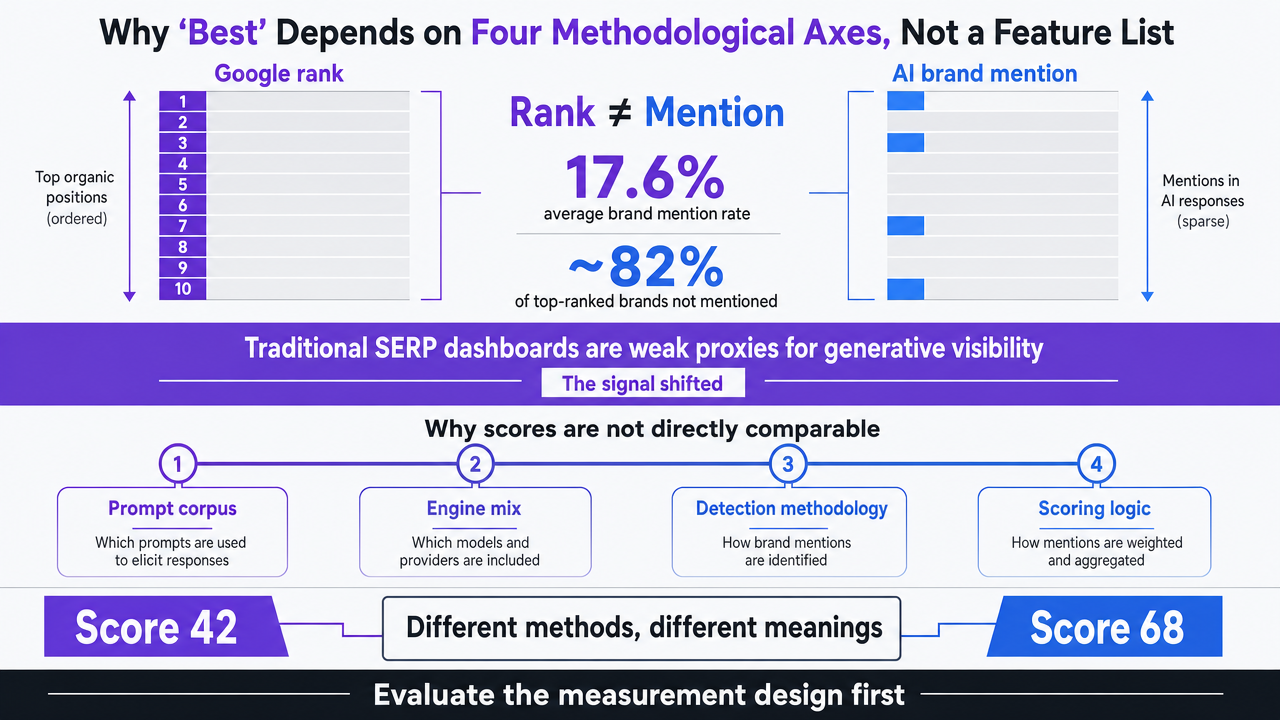
The most defensible way to evaluate an LLM visibility checker starts with a measurement finding, not a feature grid. In a study of 52,998 scored AI responses across major answer engines, the average brand mention rate landed at 17.6%, and in roughly 82% of observations where target brands held top Google organic positions, AI systems did not mention them at all 8. This gap between rank and mention highlights why traditional SERP dashboards are insufficient proxies for generative visibility; the signal has fundamentally shifted.
Consequently, framing the "best LLM visibility checker" as a features race is problematic. Vendor "AI Visibility Scores" are not directly comparable across tools because each employs a distinct prompt corpus, engine mix, and detection methodology 9. A score of 42 in one product and 68 in another could represent the same brand at the same time. Feature checklists often obscure this inherent incomparability.
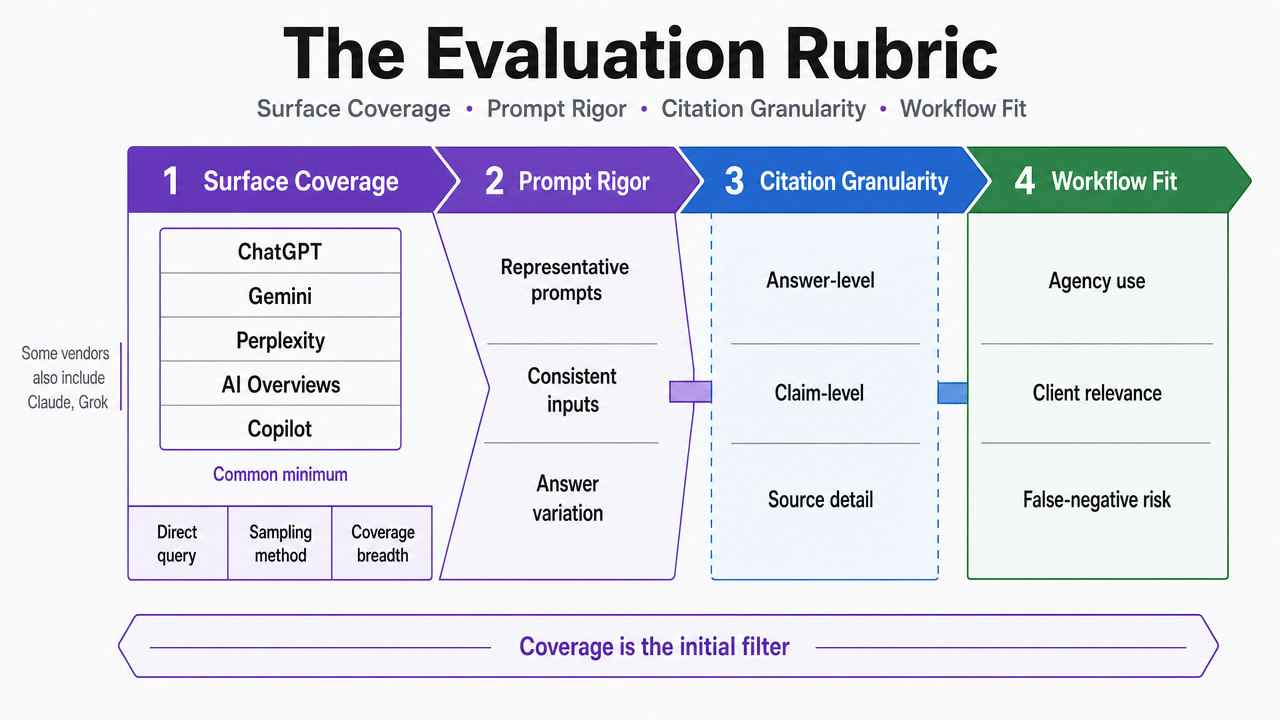
A more robust evaluation framework assesses any checker against four methodological axes: surface coverage across platforms like ChatGPT, Gemini, Perplexity, AI Overviews, and Copilot; the rigor of prompt sampling, including how prompts are sourced and weighted; the granularity of citation versus mention tracking, encompassing share of voice; and workflow integration for efficient multi-client delivery. Contextual precision, rather than raw rankings, is now the strongest predictor of LLM visibility 1. The tools worth adopting are those that reveal this context, prompt by prompt, engine by engine, in a format an agency can readily present to a client.
The Evaluation Rubric: Surface Coverage, Prompt Rigor, Citation Granularity, Workflow Fit
Surface Coverage: ChatGPT, Gemini, Perplexity, AI Overviews, Copilot
Surface coverage is the initial critical filter. A checker that overlooks an assistant commonly used by a client's customers will consistently produce false negatives. Current practitioner consensus identifies five core surfaces as a minimum: ChatGPT, Gemini, Perplexity, Google AI Overviews, and Microsoft Copilot, with more comprehensive vendors also including Claude and Grok 2, 10. The actual breadth of coverage often differs from marketing claims. Some tools prioritize ChatGPT and Perplexity, treating AI Overviews as a secondary scrape, while others excel at Overviews but sample Gemini via public interfaces, which can alter answer distributions.
Agencies should verify three key aspects for each surface: whether the tool queries the live engine or a cached snapshot, the refresh frequency for each surface, and if responses are stored for auditing purposes. A checker unable to provide the exact answer text used to score a mention is not suitable for client reviews. The fidelity of coverage on the two or three engines most relevant to a client's industry often outweighs sheer breadth.
Prompt Sampling Rigor: Corpus Size vs. Client-Derived Representativeness
Prompt sampling is a primary differentiator among vendors. While a 261-million-prompt corpus across 32 countries may sound impressive 4, sheer scale does not equate to representativeness. If a client's specific buyer journey involves five distinct questions, a massive generic corpus might still miss all of them if its prompts are derived from public search logs rather than the client's sales funnel.
Evidence suggests precision is more valuable than volume. A study of 52,998 AI responses found that keyword–brand alignment was the strongest predictor of brand appearance, with a marginal η² of 32.5% 8. This alignment is inherently prompt-level. For a mid-market client, a carefully constructed set of 150 to 300 prompts, sourced from call transcripts, Search Console queries, and sales team insights, will generally outperform a generic 10,000-prompt sample.
Operationally, agencies need to determine if a checker allows importing custom prompt lists, tagging prompts by intent and funnel stage, and re-running the same set on a consistent schedule. Tools that treat prompts as proprietary vendor IP force agencies to report on an external market model. Conversely, tools supporting prompt authoring, versioning, and per-prompt scoring empower agencies to build defensible measurement plans tailored to each client.
Citation vs. Mention Granularity and Share of Voice
Mentions and citations are distinct and should not be conflated in reporting. A mention is the appearance of a brand string within the generated text, while a citation is a linked source attributed by the model. These often diverge; a competitor might be cited while the client is merely mentioned, or vice versa. The landscape of discovery has shifted towards citation-based visibility, where being referenced, rather than clicked, signifies presence 6.
Share of voice builds upon both signals. A truly useful share of voice report will, for a defined prompt set, detail the percentage of answers mentioning the client, the percentage citing the client's domain, and how these figures compare against a specified competitor group 9. Simple averages across a prompt corpus can obscure critical insights. Effective checkers expose the underlying answer text, the detected mention span, and the cited URLs for each prompt, enabling agencies to audit false positives and understand why mention-only wins might still lead to traffic leakage to competitors due to citation gaps.
Workflow Integration: API Access, White-Label Reporting, Prompt Reuse
Workflow integration directly impacts agency economics. A tool that generates excellent single-brand dashboards but lacks API export capabilities forces delivery teams to manually reconstruct reports for numerous accounts. Essential criteria include authenticated API access with client-specific scoping, scheduled exports compatible with the agency's existing BI stack, white-label PDF or dashboard output, and the ability to reuse prompts across accounts within the same vertical.
Prompt reuse is particularly valuable. A behavioral health prompt set developed for one client can be 70 to 90 percent portable to another client in the same category, requiring only brand string adjustments. Checkers that treat prompts as tenant-scoped templates, rather than one-time inputs, offer compounding value across an agency's client portfolio. Reporting cadence is another operational consideration: weekly monitoring of AI answer inclusion across major surfaces is now standard for accounts where AI presence is a key performance indicator 3.
Five Archetypes of LLM Visibility Checkers, Scored Against the Rubric
First-Party Baseline: Google Search Console Generative AI Reports
The most underutilized measurement layer for many agencies is already available within their client accounts. In June 2026, Google introduced dedicated generative AI performance reports to Search Console, providing data on Impressions, Pages, Countries, Devices, and Dates for AI Overviews and AI Mode surfaces 11. This represents a first-party signal that no third-party checker can replicate, as it originates directly from Google's serving logs rather than a scraped or polled approximation.
Against the rubric, this archetype is narrow but highly authoritative. Surface coverage is limited to Google's generative features, excluding ChatGPT, Perplexity, Copilot, and Claude. Prompt sampling is not user-controlled; the report reflects actual query traffic, which is inherently representative but cannot be extended to prompts a client specifically wishes to target. Citation granularity is coarse, showing pages that appeared in AI features but not specific mention spans or internal citation URL structures. Workflow integration is strong via the Search Console API and existing client permissions.
For delivery teams, these reports serve as an essential baseline beneath any third-party checker. They are free, defensible in client meetings, and anchor the Google AI portion of a monitoring plan, allowing paid tool budgets to focus on non-Google surfaces.
Dedicated GEO Trackers (Peec AI, SE Visible, Rank Prompt)
Dedicated GEO trackers exemplify the core of this category. Peec AI, for instance, is described as a specialized GEO analytics system that monitors brand appearance across ChatGPT, Perplexity, Google AI Overviews, and other answer engines, functioning as a proactive visibility tracker rather than a post-hoc rank tracker 10. SE Visible operates in a similar vein, and Rank Prompt has been noted by practitioners for its ability to show prompt-level visibility variations across major assistants 2.
When evaluated against the rubric, this archetype excels in surface coverage and prompt-level fidelity. Most tools in this group allow agencies to define custom prompt sets, run them against multiple engines on a scheduled basis, and expose the underlying answer text for strategists to audit each mention. The distinction between citation and mention granularity is where quality varies; the strongest trackers differentiate between a brand name in the answer and a linked citation to the client's domain, and they report share of voice against a specified competitor cohort 9.
The primary trade-off is workflow. Purpose-built trackers often offer robust dashboards but weaker export capabilities, and per-domain pricing can quickly accumulate across a large client base. For agencies standardizing on a single tool per vertical, a dedicated tracker with API access and prompt versioning is the most defensible choice for accounts where GEO is a critical KPI.
SEO-Suite AI Modules (Semrush AI Visibility Toolkit, Ahrefs Brand Radar)
Existing SEO suites have integrated AI visibility modules into workflows already familiar to agencies. Ahrefs Brand Radar tracks brand presence across ChatGPT, Perplexity, Microsoft Copilot, Gemini, and Google AI Overviews 10. Semrush's AI Visibility Toolkit aims to quickly show brand presence across ChatGPT, Google AI Mode, Gemini, and Perplexity, leveraging a large vendor corpus for scaled visibility benchmarking 7.
The claim of scale for this archetype requires careful consideration. Some AI Visibility Toolkits boast prompt databases containing hundreds of millions of prompts across many countries 4. While valuable for macro benchmarks, this volume does not inherently outperform a smaller, client-specific 200-prompt set derived from call transcripts, Search Console queries, and sales team insights, because keyword–brand alignment is most effective at the prompt level 8.
Rubric-wise, SEO-suite modules score well on workflow integration due to inheriting existing seat allocations, client permissions, and BI exports. Surface coverage is generally broad. Prompt sampling rigor is the key area for scrutiny: agencies should confirm if the module supports importing custom prompt lists with intent tags, or if it mandates reliance on the vendor's default corpus. If the latter, the tool is best used for directional benchmarking alongside a client-specific prompt set managed elsewhere.
Prompt-Database Benchmarkers (Semrush AI Visibility Toolkit, Omnia)
Prompt-database benchmarkers share similarities with the previous archetype but are distinct due to their defining characteristic: the corpus itself. Omnia's free checker, for example, runs a fixed set of 40 prompts across ChatGPT, Perplexity, Google AI Overviews, and Google AI Mode to generate a consolidated visibility report. Semrush's toolkit represents the other end of the spectrum, offering a vendor corpus with hundreds of millions of prompts 4.
Against the rubric, this archetype performs well in terms of breadth and speed, allowing new-business teams to quickly generate pitch snapshots. However, it scores lower on client-specific representativeness because the prompt set is fixed. For clients whose buyers ask a narrow range of decision-stage questions, a benchmarker might report a mediocre visibility score while completely missing the 20 prompts that are crucial for pipeline generation. This archetype is best suited for competitive baselining and pitch decks, while prompt-authoring trackers are more appropriate for account-level monitoring where reporting must withstand rigorous quarterly business reviews.
Workflow-Integrated Brand Intelligence Platforms (Vectoron)
The fifth archetype, exemplified by Vectoron, differentiates itself not by prompt volume or dashboard aesthetics, but by its focus on actionability after a visibility gap is identified. These platforms combine visibility measurement with content production, approval routing, and execution across various channels including content, SEO, PPC, backlinks, and call intelligence, all within a single governed workflow.
Rubric fit for this archetype is intentionally uneven. Surface coverage and citation granularity are typically comparable to a robust dedicated tracker, rather than being best-in-class. The primary value lies in workflow integration and the ability to translate a visibility finding into an approved, published change. When a checker reveals a client is mentioned in 12% of ChatGPT answers compared to a competitor's 34%, the operational question becomes: which pages need statistics, quotations, or authoritative citations, and who approves these changes? Adding such content-structure signals can increase generative engine visibility by up to approximately 40% 15.
For agencies scaling GEO across many accounts, this archetype offers compounding advantages. A brand intelligence layer that captures voice, positioning, competitors, and market context per client allows prompt sets, competitor cohorts, and content interventions to be reused across a vertical, streamlining the process and reducing the need to rebuild briefs for each cycle. While less strong as a pure benchmarking tool, its strength lies in transforming benchmarks into billable delivery.
Test LLM visibility insights with real projects
Validate your agency’s LLM visibility strategies on live client content before making a commitment.
Archetype Comparison Table: Cost & Coverage Profile for Agencies
The five archetypes discussed map clearly onto the four evaluation axes when presented side-by-side. The following matrix is intended as a shortlist filter, not a scoring rubric. It highlights where each archetype justifies its cost and where agencies must accept trade-offs.
| Archetype | Surface Coverage | Prompt Sourcing | Citation vs. Mention | Share of Voice | Pricing Tier |
|---|---|---|---|---|---|
| Google Search Console generative AI reports | Google AI Overviews and AI Mode only | Real user queries, not editable | Page-level surfacing, no mention span | Not supported | Free with GSC access 11 |
| Dedicated GEO trackers | ChatGPT, Gemini, Perplexity, AI Overviews, Copilot | Agency-defined prompt sets, versioned | Both, with answer-text audit | Named competitor cohorts 9 | Mid to enterprise, per-domain |
| SEO-suite AI modules | Broad, engine list varies by vendor | Vendor corpus, some import support | Mostly mention-weighted | Median-based benchmarks | Bundled into existing suite seats 7 |
| Prompt-database benchmarkers | Four to five major surfaces | Fixed vendor corpus at scale 4 | Mention-first, citation secondary | Corpus-wide averages | Free tier to enterprise |
| Workflow-integrated brand intelligence | Comparable to dedicated trackers | Client-derived, reusable per vertical | Both, tied to content interventions | Yes, with execution routing | Platform subscription |
Agencies typically standardize on one paid tool per vertical, often pairing the free Google baseline with either a dedicated tracker or a workflow-integrated platform, and retaining a benchmarker for quick pitch snapshots.
What Advanced Checkers Should Surface Beyond Mention Counts
A mention count only confirms brand appearance; it doesn't explain the underlying reasons. Effective checkers, defensible in a QBR, expose the content-structure signals that can shift an answer from a competitor's citation to the client's, linking these signals to specific, editable pages. This distinction separates a mere reporting tool from a true delivery tool.
Feature-level optimization research quantifies this impact. A controlled study across three generative engines showed that structured content interventions increased citation visibility to 18.31% on GPT-4o-mini from a 13.34% baseline, and to 15.35% on Gemini from an 8.89% baseline 12. While the absolute gains are modest by design, the relative movement is significant. A checker that only reports the 13.34% baseline tells an agency the client is underperforming. A checker that also identifies which feature-level attributes—such as statistics density, quotation presence, authoritative citation depth, or list positioning—correlate with the 18.31% cohort, provides actionable insights for strategists.
Two other signals warrant primary consideration. List position and topical relevance were the strongest drivers of first-citation preference in 252,000 controlled trials across six LLMs 13. This implies checkers should score where a client's content ranks within a retrieved candidate set, not just whether it was retrieved. Furthermore, since adding statistics, quotations, and authoritative citations can boost generative visibility by approximately 40% 15, the audit layer should flag pages lacking these elements before the next content sprint is planned.
See How Leading Agencies Monitor LLM Visibility at Scale
Request a walkthrough of LLM visibility tracking tools and benchmark data to streamline oversight across high-volume client portfolios—without increasing headcount or manual audits.
Operationalizing Monitoring Across a 15–100 Client Book
Prompt Reuse, Seat Economics, and Reporting Cadence
For a single account, most competent checkers suffice. Operational challenges emerge when managing between 15 and 40 accounts, as prompt authoring, seat allocation, and reporting cadence transition from annual decisions to weekly cost drivers. Three key levers determine a tool's return on investment.
Prompt reuse offers the greatest leverage. Agencies specializing in vertical practices—such as behavioral health, dental service organizations, or personal injury law—should develop a canonical prompt library per vertical, tagging prompts by funnel stage and intent. This library can then be cloned for each client, with brand strings adjusted. A well-crafted library of 200 to 300 prompts typically achieves 70 to 90 percent portability across accounts within the same category, transforming prompt authoring from a per-client cost into a fixed asset amortized across the entire client book.
Seat economics vary by archetype. Dedicated GEO trackers often price per domain, leading to linear scaling with client count. SEO-suite modules are typically bundled into existing seats, which flattens marginal cost but may limit prompt authoring flexibility 7. Reporting cadence should be tiered: weekly polling across major surfaces for accounts where AI presence is a stated KPI, and monthly for accounts still primarily focused on organic traffic 3. Consistent cadence, rather than broad tool features, prevents a large client book from consuming excessive analyst hours on manual data pulls.
If You Manage Portfolio or Multi-Brand Delivery: Consolidating Dashboards
For portfolio or holding-company operators managing multi-brand books across shared infrastructure, the challenge shifts from individual checker accuracy to data consolidation. At this scale, the primary concern is which checkers provide data clean enough for aggregation.
API access is the critical prerequisite. A tool lacking authenticated per-client scoping and scheduled exports forces portfolio teams to manually rebuild shared dashboards each cycle. The effective approach involves pulling mention rates, citation rates, and share of voice per client into a central BI layer, then overlaying Google Search Console generative AI impressions as the first-party baseline 11. This combination provides portfolio leadership with a comparable cross-account view without mandating a single third-party vendor for every brand. Where methodologies differ across tools, the dashboard should clearly indicate the data source, rather than averaging incomparable scores.
A Defensible Selection Path for Agency Heads of SEO
The selection process becomes clear when the rubric is applied systematically. Begin with the free layer: integrate Google Search Console generative AI performance reports for every client where AI Overviews or AI Mode generate significant impression volume 11. This establishes a foundational, first-party data layer that no paid tool can replace. Next, layer a dedicated GEO tracker for accounts where GEO is a stated KPI, prioritizing tools that support agency-authored prompt sets, versioned per client, with answer-text audit capabilities for each detected mention. Keep an SEO-suite AI module or a prompt-database benchmarker available for competitive baselining and new-business snapshots, but avoid confusing its corpus-wide averages with precise account-level insights.
The workflow-integration layer is where scalability is achieved or lost. Once a checker identifies a gap between mention rate and citation rate, the operational challenge is determining which pages require statistics, quotations, and authoritative citations, and who approves these changes before implementation. This operational loop is central to Vectoron's design: measurement feeds into a brand intelligence layer that captures voice, positioning, and competitor context for each client, with every recommendation routed through human approval before execution across content, SEO, and other relevant channels. Standardize the measurement stack using the four axes, and leverage the workflow layer for compounding value across the client portfolio.
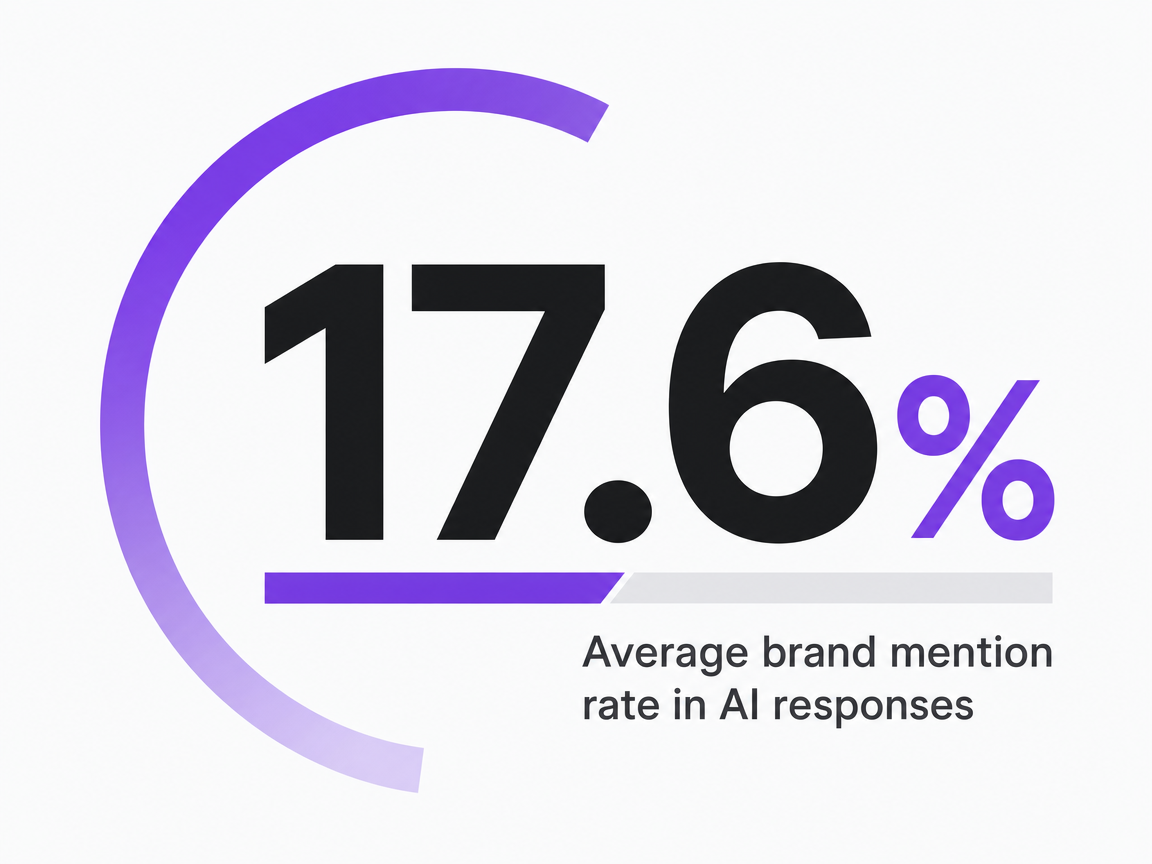 Average brand mention rate in AI responses
Average brand mention rate in AI responses
Frequently Asked Questions
References
- 1.Generative Engine Visibility Factors – GEO Guide for 2025.
- 2.Top LLM Monitoring Tools for AI Visibility.
- 3.How to Make Your Brand “LLM-Citation Friendly”.
- 4.Top 10 Tools for Tracking LLM Brand Visibility in 2026.
- 5.10-step framework for generative engine optimization (GEO).
- 6.LLM Citation Trends That Matter in AI Search.
- 7.5 AI Visibility Tools to Track Your Brand Across LLMs.
- 8.Measuring Brand Visibility Across AI Answer Engines.
- 9.14 best tools to track brand visibility in AI search.
- 10.How to Track Your Brand in AI Overviews & LLMs In 2026.
- 11.Introducing Search Generative AI performance reports in Search Console.
- 12.Feature-Level Multi-Objective Optimization for Generative Citation Visibility.
- 13.What Gets Cited: Competitive GEO in AI Answer Engines.
- 14.Search Engine Optimization: How LLM-Generated ....
- 15.Academic Citation Infrastructure: Infrastructure-Level Interventions for Generative Engine Optimization.
- 16.How to Measure Brand Visibility in AI Search.