
Key Takeaways
- Keyword volume ceiling and update frequency separate hobbyist trackers from portfolio-grade tools, since anything slower than daily refresh at 60,000-plus keywords leaves QBR narratives behind the SERP.
- Location, device, and language segmentation must attach at the keyword level, not the project level, so multi-location clients get parallel rank sets without configuration burden compounding per account.
- SERP feature and AI Overview tracking matters because features strongly influence organic CTR independent of rank, making position without feature context an incomplete data point 12.
- GSC and GA4 integration turns rank from a vanity metric into revenue-connected reporting by joining position, click behavior, and conversion data at the URL level 10.
- Multi-client governance and approval workflows carry the audit trail that resolves scope disputes, protects margin on account handoffs, and lets senior leads delegate without losing oversight 9.
- AI answer engine visibility deserves its own measurement layer, since rank checkers that only report ten-link positions understate performance in categories where AI surfaces have absorbed intent 9.
Why 'best rank checker' is the wrong question for agency portfolios
The query behind "best rank checking tool" tends to surface single-product comparisons: Semrush versus Ahrefs, SE Ranking versus AccuRanker, feature checklists priced per seat. That framing works for a solo consultant tracking 200 keywords. It breaks for an agency SEO lead running delivery across 40 clients, 60,000 tracked terms, and quarterly business reviews where rankings have to translate into pipeline.
The scaling constraint is not which tracker refreshes positions fastest. It is whether ranking data connects to click behavior, conversions, and share of voice across a portfolio without pulling senior strategists into dashboard assembly. Google itself frames search results as the output of many ranking systems that shift continuously 8, 11, which means a static position number carries less analytical weight than it did five years ago. Research on search evaluation reaches the same conclusion from the user side: click-through rate and average position are incomplete proxies for satisfaction, and dwell-based and attention-based signals correlate more strongly with what clients actually want, which is qualified traffic that converts 1, 3.
Reframing the question changes the shortlist. Agency SEO leads are not shopping for a rank checker. They are assembling a measurement stack, and the tool that wins is the one that makes the other layers work harder.
The three-layer measurement stack that replaces the single-tool search
Ground-truth layer: Search Console API as the first-party spine
Every credible rank measurement program starts with the data Google itself reports back to the property owner. The Search Console API exposes clicks, impressions, average position, and CTR at query, page, country, and device granularity through the searchanalytics.query() method, which returns the same fields visible in the Performance report but at a volume suitable for automation 10. That is the first-party spine: numbers pulled directly from the source, not modeled from a third-party crawl.
The catch is that GSC was not built for portfolio operators. Historical data is capped at 16 months, and there is no native unified dashboard for managing dozens of client properties side by side 5. An agency running 40 accounts cannot open 40 tabs each Monday and hand-compile trend lines. The API is the workaround. Piped into a warehouse or BigQuery, it becomes the substrate for retention-safe historical archives, custom segmentation, and cross-client aggregation that the native UI cannot deliver.
Treating GSC as the ground-truth layer of a three-part stack reframes the tool decision. The rank tracker sits above it as the coverage layer, and a governance system sits above both to route the data into client-facing outputs. Without the first-party base, the coverage numbers upstairs float free of anything the client can verify against their own console, which is where most agency reporting disputes begin.
Coverage layer: what an enterprise rank tracker must do that GSC cannot
Search Console reports on queries that already produced impressions for the property. It cannot tell an agency where a client sits on terms the client does not yet rank for, where a competitor is winning share, or how a SERP looks on a Tuesday morning in Phoenix versus a Friday evening in Toronto. That gap is what the coverage layer fills.
An enterprise rank tracker exists to sample the SERP directly and continuously across a defined keyword universe. Benchmarks for evaluating these systems focus on coverage breadth, rank movement precision, update frequency, and the evidence quality behind each measurement 6. For portfolio operators, three capabilities separate a coverage tool from a hobbyist checker:
- Volume without throttling. Tracking 1,500 to 3,000 keywords per client across 40 clients means the system has to sustain 60,000-plus daily checks without silently degrading refresh intervals.
- Segmentation depth. Location, device, and language filters have to work per-keyword, not just per-project, because a home services client in five metros needs five parallel rank sets.
- SERP feature capture. The tracker has to record which features appeared alongside the organic result, since position 3 with an AI Overview above it behaves nothing like position 3 without one.
Google's own documentation frames rankings as the output of many systems operating on hundreds of billions of pages, with results that shift as those systems update 11, 8. A tracker that samples once a week and reports a single position number cannot describe that behavior. Daily refresh, feature annotation, and change-log alignment with known ranking system updates are what make the coverage layer diagnostic rather than decorative.
Governance layer: multi-client workflow, approvals, and reporting automation
Ground-truth data and coverage data mean nothing to a client if they arrive as raw CSVs. The governance layer is where the stack earns its keep on delivery margin. Operational guidance for multi-client SEO platforms specifies the workflows this layer has to support: configuring keyword tracking per client, setting the correct target location and device type for accurate local and national reporting, and automating white-label reports that include rank movement, organic traffic trends, backlink growth, and a written commentary section for strategic insights 7.
Three functions define a working governance layer. First, per-client configuration that survives account handoffs, so a new strategist inheriting a book does not rebuild tracking sets from scratch. Second, approval routing on anything that ships externally, from monthly reports to on-page recommendations, with a log of who proposed, approved, and published each item 9. Third, scheduled report generation that pulls from the ground-truth and coverage layers automatically, applies client branding, and lands in the inbox on the same day each month without a strategist assembling it.
The distinction matters because rank data and reporting labor are not the same product. Buying a bigger rank tracker does not reduce the hours a senior lead spends translating position changes into a narrative the client's marketing director will accept. The governance layer is the piece that converts the two layers below it into deliverables at a cost structure that survives portfolio growth.
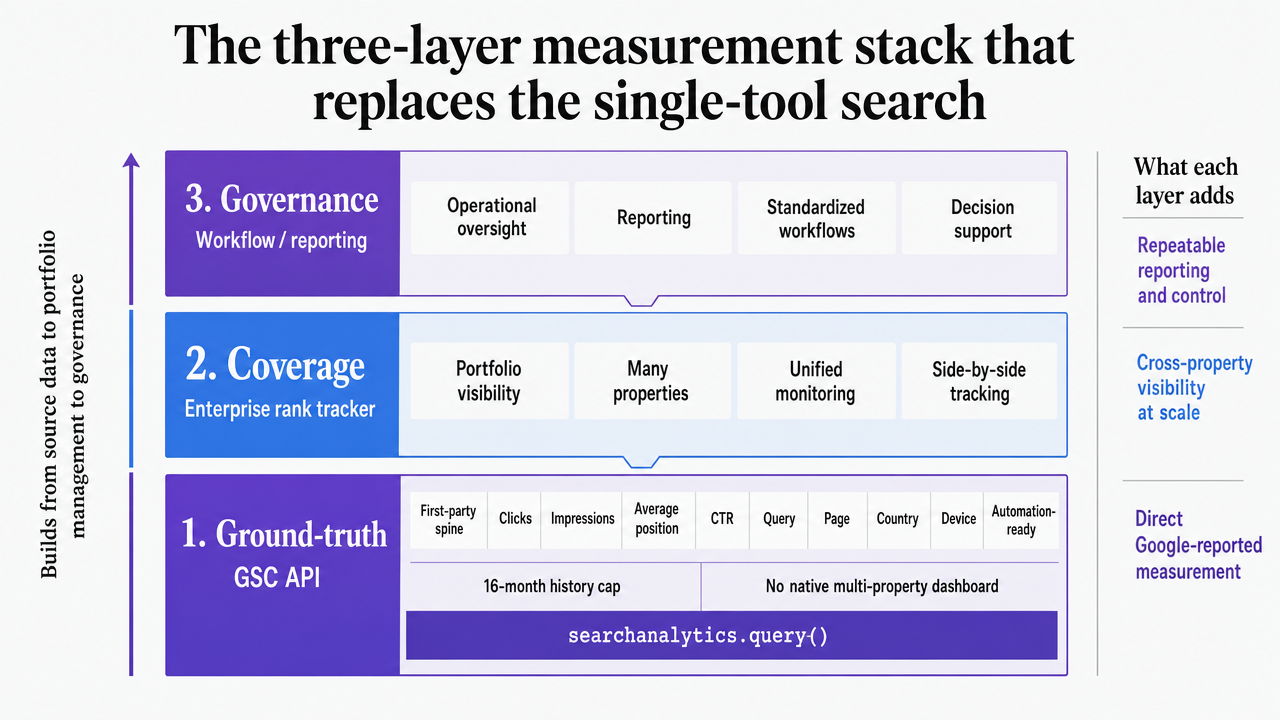 Visualize the three-layer measurement stack described in the section: ground-truth (GSC API), coverage (enterprise rank tracker), and governance (workflow/reporting), showing what each layer contributes and how they build on each other
Position is a weak proxy: the SERP feature evidence agencies keep ignoring
Rank position and traffic used to move together closely enough that agencies could report one and imply the other. That correspondence has weakened. A 2023 analysis of 67,000 keywords and 24 distinct SERP features across US e-commerce domains found that features such as ads, rich results, knowledge panels, and answer boxes strongly influence organic click-through rate independent of the underlying ranking, with an ablation study showing meaningful incremental predictive power for CTR once feature presence is added to the model 4. Scope matters: the dataset is US e-commerce, not every vertical will move by identical magnitudes, but the mechanism generalizes anywhere Google renders a feature-rich SERP.
The operational consequence for agency reporting is direct. A client property holding position 3 on a query with an AI Overview, a shopping carousel, and a People Also Ask block above the organic fold sits in a different traffic reality than the same position 3 on a plain ten-blue-links SERP. A rank tracker that reports both as "position 3" hands the strategist a number that clients will misread and competitors will exploit. The evidence from Google's own research points in the same direction, showing that click behavior alone correlates more weakly with satisfaction than dwell and attention signals, and that unified relevance metrics combining clicks, attention, and satisfaction outperform position-based measurements at predicting user-reported outcomes 3, 1.
What this means for the rank checking tool decision is narrow and specific. Any product that records the organic position without recording which SERP features rendered alongside it, and without allowing the strategist to segment position data by feature context, produces reports that will diverge from GSC clicks over time. The divergence gets blamed on tracking accuracy in QBRs, but the accuracy is fine. The metric is wrong.
Two adjustments follow. Rank movement should be reported next to CTR movement from the ground-truth layer, so a position gain that produced no clicks flags a feature-driven ceiling rather than a win. And SERP feature presence should be tracked as a first-class field per keyword, timestamped, so a client asking why organic traffic fell in a quarter where rankings held steady gets an answer grounded in what the SERP actually looked like on the days that mattered.
Test Advanced Rank Tracking at Scale Now
Experience enterprise-grade ranking insights with real-time data on your live SEO campaigns during your free trial.
Six criteria for evaluating any rank checking tool at agency scale
Keyword volume ceiling and update frequency
Agency shortlists collapse quickly on this criterion. A tool that comfortably tracks 500 keywords per project starts throttling refresh cadence, batching updates, or degrading daily checks into weekly ones once a portfolio pushes past 40,000 terms. Benchmark comparisons of ranking software specifically identify coverage breadth and update frequency as differentiators, alongside the evidence quality behind each measured position 6.
Two numbers matter to the delivery team. First, the hard ceiling: does the platform sustain daily refresh at 60,000-plus keywords without silent degradation, and what happens at 100,000? Second, the movement threshold: how quickly does a position change register after a confirmed ranking system update from Google, which the ranking systems guide describes as continuous rather than episodic 11? Anything slower than daily on core client terms leaves QBR narratives 48 hours behind the SERP.
Location, device, and language segmentation
A national brand and a five-metro home services client cannot share tracking geometry. Operational guidance for multi-client platforms specifies that keyword tracking must be configured per client with the correct target location and device type to produce accurate local and national reporting 7. Location and device have to attach at the keyword level, not the project level.
The test is granularity under load. A dental group with 18 offices needs 18 parallel rank sets on the same query, each pinned to a specific ZIP or metro, with mobile and desktop tracked as separate series. Language segmentation matters wherever a client operates bilingually. If the platform forces a strategist to duplicate projects to achieve per-location tracking, the configuration burden compounds with every new account and erodes the margin the tool was supposed to protect.
SERP feature and AI Overview tracking
Feature capture is where most rank trackers still underdeliver. The tool has to record which features rendered alongside the organic result on each check date and store that context as a queryable field, not a screenshot buried in a history panel. Research on feature-rich SERPs confirms that features strongly influence click behavior and organic CTR, meaning a position without its feature context is an incomplete data point 12.
Three capabilities separate a working feature layer from a decorative one. AI Overview presence must be logged per keyword per day, since its appearance can compress organic real estate above the fold. Feature stacks such as ads plus knowledge panel plus People Also Ask should be captured together, because the combined effect on CTR differs from any single feature. And feature history has to be time-stamped so a strategist can align a traffic drop to the exact date a feature appeared, not to a generic algorithm update narrative.
GSC and GA4 integration for revenue-connected reporting
Rank data that never meets first-party clicks and conversions stays a vanity metric. Native integration with the Search Console API, which exposes clicks, impressions, average position, and CTR through searchanalytics.query() at query, page, country, and device granularity, is the minimum bar 10. GA4 integration is the second half: without it, a position gain cannot be traced to a session, a conversion event, or a revenue-adjacent outcome.
The integration test is directional. Does the tool pull GSC and GA4 into the same view as tracked rank, or does it hand the strategist three export files to reconcile in a spreadsheet? Reconciliation labor is where senior time disappears. A platform that joins position, click behavior, and conversion data at the URL level lets a strategist answer why a client's revenue moved in a quarter without leaving the interface.
Multi-client governance and approval workflows
Governance is the criterion most rank tracker feature sheets skip. It shows up as boring plumbing on a demo and as the difference between a 20-client agency and a 100-client agency in practice. Operational best practices for multi-client platforms call out per-client keyword configuration, scheduled technical audits, and automated white-label reports covering rank movement, organic traffic trends, backlink growth, and written strategic commentary as the baseline workflow 7.
Approval routing is the underrated feature. Anything that ships to a client, whether a monthly report or a recommended on-page change, should pass through a logged approval step recording who proposed it, who signed off, and when it published 9. That audit trail becomes the artifact that resolves scope disputes, protects delivery margin on account transitions, and lets a Head of SEO delegate execution without losing oversight.
AI answer engine visibility as a new measurement layer
Traditional rank checking assumes the destination is a ten-blue-links SERP. That assumption breaks when a client's category triggers AI Overviews, or when qualified prospects arrive already citing an answer surfaced by ChatGPT or Perplexity. Practitioner guidance on enterprise SEO analytics for 2026 argues that measurement has to expand beyond rank and sessions to include AI referrals and zero-click influence that drives pipeline without direct clicks 9.
The evaluation question is whether the tool treats AI visibility as a first-class series or ignores it. Concretely: does the platform log when a client's content is cited inside an AI Overview, does it track prompt-level visibility across major answer engines, and does it surface those signals alongside organic position in the same client view? A rank checker that reports only ten-link position numbers will steadily understate performance in categories where AI surfaces have already absorbed a share of intent.
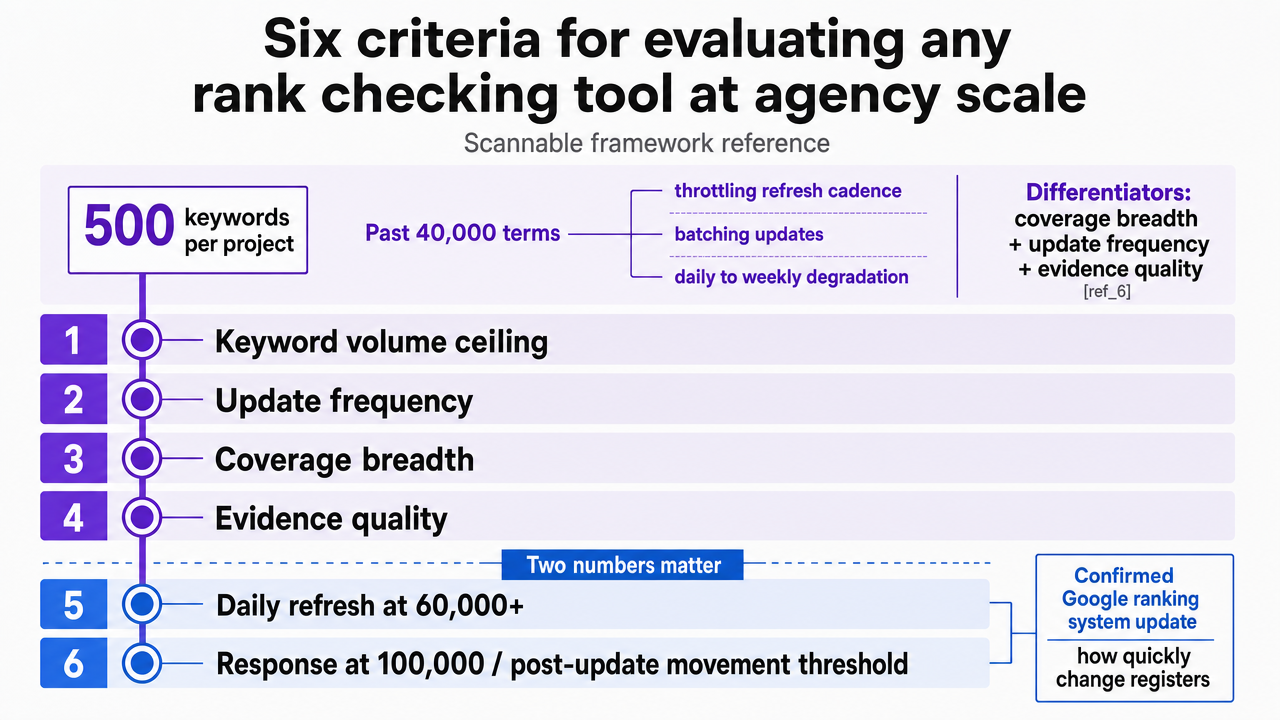 Summarize the six evaluation criteria enumerated in the section as a scannable framework reference for readers assessing tools
Reporting labor economics across a client portfolio
The next question shifts audience. Up to this point the analysis has treated tool capability as the constraint. For portfolio operators running 25, 50, or 100 client books, the binding constraint is senior labor absorbed by monthly reporting cycles. The math is worth working out explicitly before any tool decision gets made.
Operational guidance for multi-client SEO platforms describes the manual reporting workflow as a compound task: pull rank movement, layer in organic traffic trends, add backlink growth, and write a strategic commentary section per client each cycle 7. That workflow does not compress well. Even with templated exports, an experienced strategist tends to spend somewhere between 2 and 6 hours per client per month on the assembly, QA, and narrative layer, with the higher end tied to clients whose SERPs shift meaningfully or whose stakeholders read past the summary page.
Applied to portfolio size, the labor curve looks like this. Let N stand for client count and H for hours per client per month.
| Portfolio (N) | Low case (H=2) | High case (H=6) | FTE equivalent at 140 billable hrs/mo |
|---|---|---|---|
| 25 clients | 50 hrs/mo | 150 hrs/mo | 0.4 – 1.1 FTE |
| 50 clients | 100 hrs/mo | 300 hrs/mo | 0.7 – 2.1 FTE |
| 100 clients | 200 hrs/mo | 600 hrs/mo | 1.4 – 4.3 FTE |
The break-point sits somewhere between N=50 and N=100 depending on where H lands. At 50 clients on the high side, reporting alone consumes more than two full-time senior seats. At 100 clients, it approaches half of a five-person delivery team, before any actual optimization work gets done. Those hours are not junior-appropriate; the commentary section requires the same person who owns the strategic account.
Automation of the report assembly layer is where the governance component of the stack pays back its cost. A platform that generates the rank movement, traffic, and backlink sections on schedule collapses H toward the low end and pushes the FTE curve down by a full seat or more at 50 clients. The tool decision, framed this way, is not about which tracker is most accurate. It is about which combination of layers moves reporting labor off the senior bench.
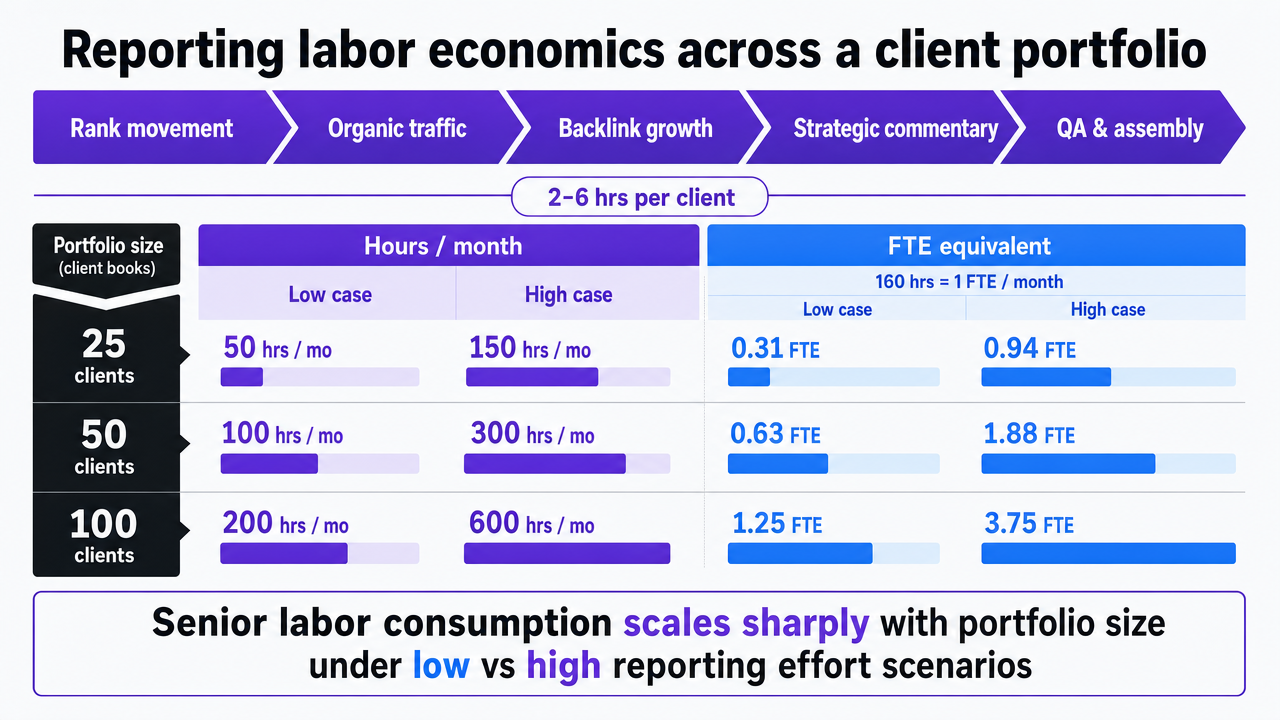 Visualize the reporting hours and FTE equivalents from the table in the section, showing how senior labor consumption scales with client portfolio size across low and high case scenarios
See How Leading Agencies Centralize and Scale Rank Tracking Across Hundreds of Clients
Request a walkthrough of unified rank reporting and automated SERP monitoring designed for high-volume, multi-client SEO operations—no manual exports or fragmented dashboards required.
From position to satisfaction: what to measure once rank alone stops explaining results
Once a stack is in place, the reporting question changes. Position tells the strategist where a URL appeared. It does not tell the strategist whether the visitor stayed, converted, or left dissatisfied enough to reformulate the query. Google's own research on the Clicks, Attention and Satisfaction model demonstrates that unified metrics combining clicks, attention, and dwell signals correlate more strongly with user-reported satisfaction than click or position measurements taken in isolation 3. Search evaluation literature reaches a compatible conclusion: click-based metrics correlate more weakly with satisfaction than dwell-time-based ones, and higher engagement does not always mean higher satisfaction 1, 2.
Four fields deserve a permanent place in the client view alongside rank. Successful clicks, defined in audit research as clicks with dwell time above roughly 30 seconds, filter out pogo-sticking that inflates raw CTR without indicating value 2. Scroll depth and dwell on the landing URL, pulled from GA4, indicate whether the ranked page actually held the visitor. Query reformulation rate, visible in GSC when the same session generates multiple refined queries, flags dissatisfaction that a position gain would otherwise mask. And conversion attribution at the query-to-URL level closes the loop back to pipeline.
The reporting shift is small in format and large in meaning. Rank movement stays on the page. Next to it sits a satisfaction column that answers the question clients actually ask, which is whether the ranking produced anything worth paying for.
Choosing the stack: how governance software sits on top of rank data
The shortlist question resolves once the stack is drawn. Rank trackers compete with rank trackers. Governance software does not. It sits above the coverage layer, pulls from the ground-truth layer, and turns both into deliverables that clients actually read.
A working selection sequence runs in this order:
- Wire the Search Console API into a warehouse so historical clicks and impressions survive past the 16-month native window 5, 10.
- Choose a coverage tool on the six criteria already established, weighting SERP feature capture and location granularity heavily because those are where position-only reporting fails clients 4.
- Select the governance layer on approval routing, per-client configuration inheritance, and scheduled white-label report generation with strategic commentary attached 7, 9.
Agencies running high-stakes verticals, including legal, behavioral health, dental groups, and multi-location home services, gain the most from the third layer because approval logs and audit trails carry compliance weight beyond convenience. Platforms such as Vectoron occupy that governance and execution slot, treating rank data as one input among several rather than the product itself.
Frequently Asked Questions
References
- 1.Web Archive Search Evaluation Metrics.
- 2.Auditing Search Engines for Differential Satisfaction.
- 3.Incorporating Clicks, Attention and Satisfaction into a Search Engine Relevance Metric.
- 4.Beyond Rankings: Exploring the Impact of SERP Features on Organic Click-through Rates.
- 5.13 Best SEO Tools for Agencies in 2026 (Scale Workflows).
- 6.Top 10 Best Search Ranking Software: 2026 Comparison.
- 7.Which Platforms Are Great for Managing SEO Across Clients?.
- 8.Introducing our new guide to Google Search ranking systems.
- 9.Best LLM SEO Analysis Tool for Scaling Client Strategies Fast.
- 10.Query your Google Search analytics data | Search Console API.
- 11.A Guide to Google Search Ranking Systems.
- 12.Exploring the Impact of SERP Features on Organic Click-through Rates.
- 13.Incorporating Clicks, Attention and Satisfaction into a Search Engine Relevance Metric.