
Key Takeaways
- Ahrefs Rank Tracker pairs position data with backlinks and traffic estimates, and its GSC integration surfaces clicks and impressions alongside tracked rank, though AI Overview coverage still requires reconciliation against GSC's generative views.
- Semrush Position Tracking pulls GSC's four Performance metrics into the same view as scraped rank, letting analysts spot cases where position improves but clicks flatten, at the cost of upfront template-building hours.
- AccuRanker wins on position accuracy, on-demand refreshes, and clean Looker Studio exports, making it a strong rank layer for agencies that already own separate backlink and site audit tools.
- SE Ranking earns its slot on portfolio economics, handling hundreds of projects with included white-label reporting and a GSC reconciliation view, though AI Overview citation depth trails GSC's native reports.
- Nightwatch's city and zip-level tracking matters for multi-location clients, and scheduled white-label reports with GSC metrics baked in save analyst hours, though it does not replace a broader SEO suite.
- Vectoron sits above the trackers as an execution and reporting layer, reconciling GSC signals with business outcomes like calls and bookings to rank what to ship next rather than reporting position as a KPI.
Why Position Data Alone No Longer Justifies a Retainer
The QBR script that ended with "we moved from position 4.2 to 3.8 on 62% of tracked keywords" stopped closing renewals two years ago. Clients now open the meeting with a pipeline question, and average position does not answer it. The reconciliation gap between what a rank tracker reports and what Google Search Console shows in clicks, impressions, and average position has become the credibility problem that most agency dashboards quietly ignore 4.
Search Console has closed enough of that gap to matter. A 24-hour performance view with only a few hours of delay, plus dedicated impression data for AI Overviews and AI Mode, means first-party data is now fresher, deeper, and closer to real behavior than any scraped SERP snapshot 1, 2. Practitioners increasingly treat GSC as the source of truth and the rank tracker as a competitive lens layered on top 10.
So the question for the next tool renewal is not which platform has the largest keyword database. It is which one produces a report an operator can defend to a CFO in under fifteen minutes.
The Reconciliation Problem: Third-Party Ranks vs. Search Console Reality
Why Scraped Positions Diverge From GSC Average Position
A third-party rank tracker and Search Console are measuring two different things, and once that is clear, the divergence stops feeling like a bug.
A rank tracker fires a query against a specified location, device, and language, then records where a domain sits on that snapshot SERP. It returns desktop and mobile positions, SERP feature presence, and competitor ranks for that moment. Search Console's Performance report reports four metrics — clicks, impressions, CTR, and position — aggregated across every real impression the property earned, filtered by whatever dimensions the operator applies 4. Position in GSC is an average weighted by impressions, computed across personalization, geography, device mix, and query variants that a scraper never sees.
Filtering compounds the gap. Grouping by page collapses queries. Grouping by query collapses pages. Adding a country or device filter can shift average position by a full point without any underlying ranking change 4. An agency exporting from GSC through the API also loses rows to Google's privacy threshold and quota limits when pulling at scale 3.
The practical consequence: a rank tracker answers "where did we show up for this exact query in this exact locale?" GSC answers "what did the actual population of searchers see and do?" Both are correct. Neither replaces the other, and a client-ready report should reconcile them rather than pick a winner.
The Click Probability Curve That Kills the Average-Position Metric
The average-position line on a client dashboard flatters the agency and misinforms the client. It smooths together queries where a one-point move is worth a fortune and queries where it is worth almost nothing.
A behavioral study of search click logs measured click probability by SERP rank and found the first result was clicked 44.51% of the time, while the fifth result was clicked 5.56% of the time 9. That figure is drawn from a single-study dataset on click probability by position, not a universal CTR curve — personalization, query type, and SERP features all shift the actual numbers a given site sees. Even with those caveats, the shape of the curve is the point. Traffic collapses faster than position.
Apply that shape to a QBR. A portfolio moving from an average position of 4.2 to 3.8 across a tracked keyword set can look like progress on a rank tracker while GSC clicks stay flat, because most of that improvement happened on queries that were never going to earn a click at rank 3.8 anyway. The gain on a rank-tracker chart is real. The revenue implication is not.
The fix is not to abandon position data. It is to stop reporting position as a headline number. Pair each position movement with the GSC clicks and impressions attached to it, weight by query value, and average position becomes a diagnostic input rather than a KPI a CFO is asked to accept.
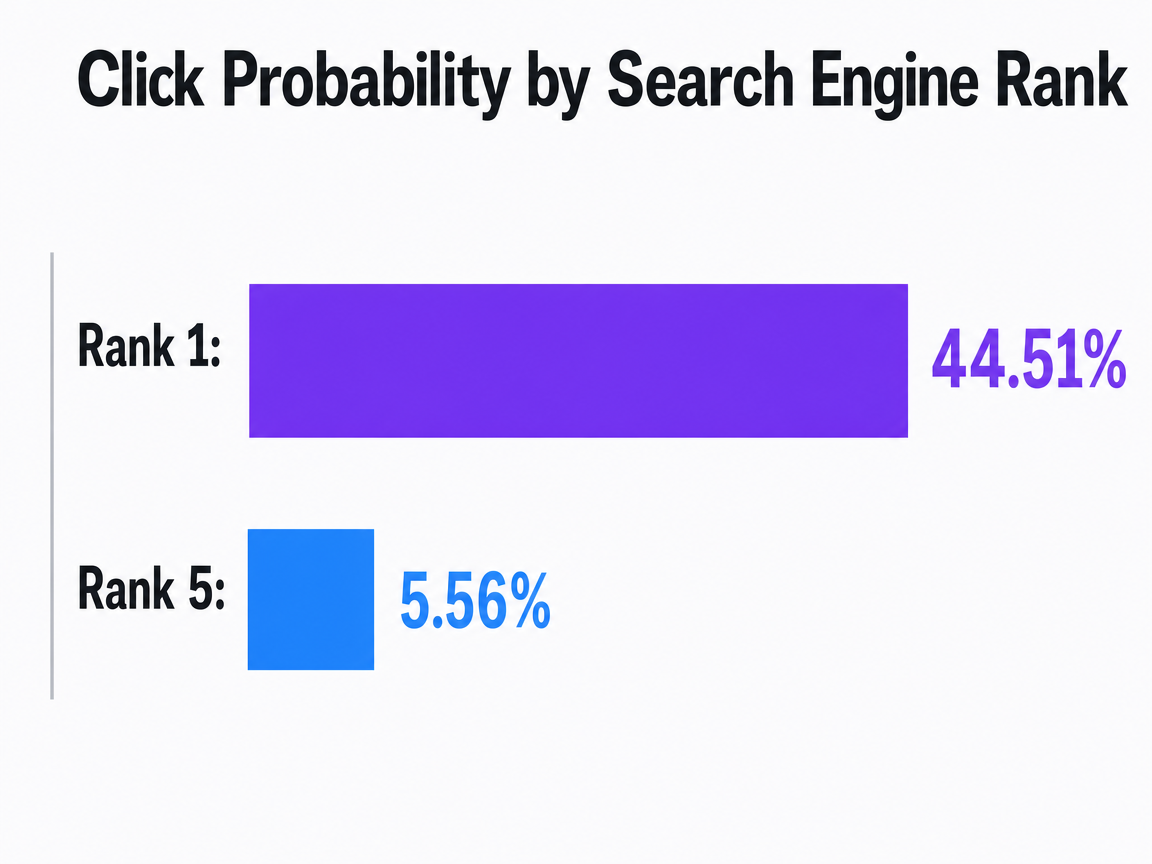 Click Probability by Search Engine Rank
A breakdown of click probability percentage for the first and fifth positions in search results, demonstrating the steep drop-off in user clicks with lower rank.
Three Axes That Actually Separate Rank Trackers in 2025
Axis 1: Data Fidelity Against Search Console
The first question to ask a vendor is not how many keywords the database holds. It is how closely the tool's reported positions reconcile with what Search Console shows for the same property, and how the tool handles the divergence when it appears.
High-fidelity trackers do three things:
- They pull GSC's four Performance metrics — clicks, impressions, CTR, and position — directly into the same view as scraped rank, so a client report shows both numbers side by side rather than forcing an analyst to toggle between tabs 4.
- They respect GSC API constraints: one day at a time, pagination for large row sets, and a two-to-three-day lag on availability, which shapes what "yesterday's data" can and cannot mean in a dashboard 3.
- They let the operator group by page, query, country, and device without silently collapsing dimensions in a way that shifts average position by a full point 4.
A tracker that treats GSC as an optional side integration is a tracker that will produce reports an SEO lead has to defend against Google's own numbers. Fidelity here is not a feature. It is the price of entry.
Axis 2: Coverage of AI Overviews and Generative Surfaces
Search Console now ships dedicated views for impressions inside AI Overviews and AI Mode, with hourly, daily, weekly, and monthly granularity across Search and Discover 2. That single product change moved generative visibility from a speculative concern into a line item a client will ask about by name.
Rank trackers are catching up unevenly. Some vendors scrape SERPs for AI Overview presence and record which citations appear inside the generated answer. Others report only a binary flag — AI Overview shown, yes or no — without capturing whether the client's domain was cited. A few still ignore the surface entirely and continue to report ten blue links as if the SERP had not changed.
Evaluate the vendor's approach on two questions:
- Does the tool detect AI Overview citations at the URL level and reconcile them against GSC's generative impression counts?
- Does it separate AI Mode impressions from classic organic impressions in exports, rather than blending them into a single position average that no one can interpret?
A tracker that cannot answer both questions is measuring a SERP that no longer exists.
Axis 3: Freshness and the Feedback Loop
For years, "daily rank checks" was a paid feature sold at a premium over weekly cadence. That premium has collapsed. Search Console's new 24-hour performance view includes data from the last available 24 hours and appears with a delay of only a few hours, and Google has reduced the average data delay by nearly half across the Performance report 1. First-party freshness has caught up with — and in many cases surpassed — what a scraped rank tracker can offer.
The implication for tool selection is not that daily cadence stopped mattering. It is that daily cadence stopped being a differentiator. What separates trackers now is what the operator can do inside the feedback loop that freshness enables:
- alerting on ranking drops that coincide with GSC impression collapses on the same URL,
- flagging queries where a position improvement did not translate to clicks within 48 hours,
- pushing those signals into whatever tool the SEO team already uses to prioritize work.
A rank tracker that ships fresh numbers into a static PDF has wasted the freshness. The value is in whether the tool closes the loop between detection and action fast enough to change the next week's roadmap, not the next quarter's QBR narrative.
Test Rank Reporting at Full Agency Scale
Experience live rank tracking and client-ready reporting workflows using your actual campaigns, risk-free for 7 days.
The Shortlist: Rank Trackers Evaluated on ROI-Defensibility
Ahrefs Rank Tracker
Ahrefs sells the rank tracker as a component of a larger platform, and that shapes how it earns its slot in an agency stack. Position data pulls into the same interface as backlink profiles, keyword difficulty, and traffic estimates, which shortens the analyst path from "position dropped" to "here is the competitor who moved."
For ROI-defensibility, the relevant question is how Ahrefs handles the reconciliation against Search Console. The GSC integration surfaces clicks and impressions alongside tracked positions, which lets an analyst pair a rank movement with its actual click delta rather than reporting position in isolation 10. The keyword database is deep enough that portfolio-scale tracking rarely hits gaps on U.S. English queries.
The honest limitation is AI Overview coverage. Ahrefs reports SERP feature presence, but agencies pushing generative visibility as a client line item still need to reconcile against GSC's dedicated AI Mode and AI Overview impression views to defend the number in a QBR 2.
Semrush Position Tracking
Semrush's Position Tracking is built for the operator who runs weekly client check-ins and needs a wide reporting surface without leaving one platform. Location and device targeting go granular enough for multi-location clients, and the tool tags SERP features on a per-keyword basis so an analyst can see which queries lost a snippet in the same view that shows the position change.
The integration with Search Console pulls in the four Performance report metrics — clicks, impressions, CTR, and position — so a client dashboard can show scraped rank next to first-party data on the same query set 4. That side-by-side is where credibility lives. It also means an analyst can catch the case where tracked position improves but GSC clicks flatten, which is the exact scenario the average-position curve warned about.
Where Semrush earns criticism from agency operators is report templating overhead. The My Reports builder is flexible, but building the first client-ready template still costs analyst hours that a portfolio operator should budget for explicitly.
AccuRanker
AccuRanker is the tracker most agencies choose when position accuracy is the primary buying criterion. It refreshes on demand, ships daily by default, and its keyword-level SERP history goes granular enough to reconstruct what a client's SERP looked like on a specific date — useful when a client asks why traffic dropped on a Tuesday.
The Search Console integration is direct, and AccuRanker's data studio and Looker Studio connectors mean the reporting layer can live wherever the agency already builds client dashboards. That matters for portfolio economics: a tracker that exports cleanly into an existing Looker template costs fewer analyst hours per report than one that requires manual copy-out.
AccuRanker does not pretend to be a full SEO suite. There is no backlink index, no content auditor, no site crawler at the depth Ahrefs or Semrush ship. For an agency that already owns those tools and needs a rank layer that respects GSC API constraints and one-day-at-a-time data pulls 3, that focus is a feature, not a gap.
SE Ranking
SE Ranking's argument to agency buyers is price efficiency at portfolio scale. The tracker handles hundreds of projects on a single account without the per-project surcharges that inflate other tools' portfolio costs, and white-label reporting is included rather than sold as an add-on.
The GSC integration surfaces clicks, impressions, CTR, and average position inside the same project view as scraped rank data, which is the minimum bar for producing a report an operator can defend against Google's own numbers 10. SERP feature tracking includes AI Overview detection, though the depth of citation-level reporting inside AI Overviews lags what a dedicated GSC generative report offers 2.
For a mid-market agency running 40 to 100 client sites where the reporting economics matter more than any single premium feature, SE Ranking's per-report cost tends to beat the more expensive suites without giving up the reconciliation view.
Nightwatch
Nightwatch is built around location granularity. Any keyword can be tracked from any specific city or zip code, which matters for agencies serving multi-location service brands where a single national keyword report hides most of the truth.
The reporting layer supports custom dashboards with GSC clicks, impressions, and average position pulled alongside scraped positions 4. Automated white-label reports go out on schedule without an analyst rebuilding the file each cycle, which is the operational detail that decides whether a tool actually saves hours or just claims to.
Where Nightwatch falls short is the broader SEO toolset. It is a tracker, not a suite, so an agency using it will still pay for a separate backlink and site audit tool. For clients where local SERP variance is the entire game, that tradeoff is easy.
Vectoron as an Execution and Reporting Layer
The other tools in this shortlist answer "where do we rank?" Vectoron answers a different question: "what should we ship next, and how did last month's work move the numbers?" It is an AI marketing execution platform with specialist strategists for content, SEO, PPC, backlinks, social, and call intelligence, coordinated through an approval workflow rather than a rank dashboard.
The SEO strategist reads live business signals — qualified calls, bookings, cost per lead — and reconciles them against Search Console's clicks, impressions, and position data to rank what to work on next 10. Position becomes an input to prioritization rather than a headline metric on a PDF.
For an agency head evaluating the reporting stack, Vectoron does not replace AccuRanker or Semrush for keyword-level position accuracy. It sits above them, turning the reconciled data into ranked recommendations that a human approves before anything ships.
If You Manage a Portfolio: The Reporting Economics Table
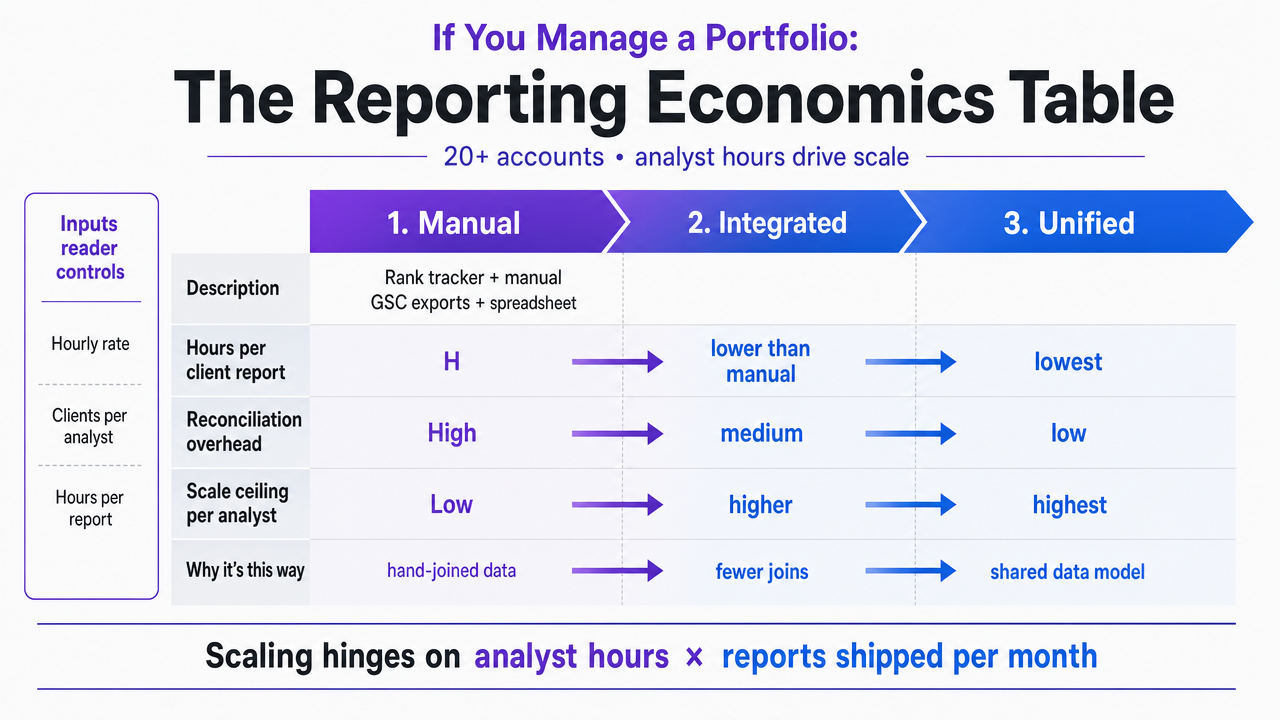
Scope shift: this section is for the operator running 20 or more accounts, not the single-site SEO lead. The math that matters here is not tool license cost. It is analyst hours per client report multiplied by the number of reports shipped every month, because that product decides whether the SEO practice scales or hits a hiring wall.
The three modes below use variables the reader controls. Analyst hourly rate, clients per analyst, and hours per report are inputs the operator plugs in from their own P&L. No competitor pricing is asserted because the supplied research does not disclose it.
| Reporting mode | Hours per client report | Reconciliation overhead | Scale ceiling per analyst |
|---|---|---|---|
| Rank tracker + manual GSC exports + spreadsheet | H | High — GSC pulled one day at a time via API, then hand-joined to scraped rank 3 | Low — analyst time scales linearly with client count |
| Rank tracker with native GSC integration + Looker Studio | ~0.5H after template build | Medium — template maintenance and dimension drift on filtered groupings 4 | Medium — one analyst covers a wider book |
| Unified execution and reporting layer with GSC signals routed into prioritization | Reporting becomes a byproduct of the approval workflow | Low — reconciliation happens once, upstream of the client view 10 | High — headcount decouples from client count |
The operator lesson is not that mode three always wins. It is that mode one has a ceiling most agencies hit around 12 to 15 accounts per analyst, and every hour spent hand-joining a CSV to a rank export is an hour not spent on the strategy work the retainer actually pays for.
See How Leading Agencies Automate Rank Tracking Without Compromising Accuracy
Connect with our team to explore advanced, multi-site rank tracking solutions that deliver audit-ready reporting and measurable ROI for every client—at scale.
Wiring Rank Data Into a Client-Ready Reporting Stack
The tool decision is the easy part. Wiring the outputs into a reporting layer a client will actually read is where most agencies lose the hours the shortlist was supposed to save.
Start with the data spine. Search Console is the source of truth for clicks, impressions, CTR, and position, pulled through the API one day at a time with pagination for large row sets and a two-to-three-day lag baked into whatever "latest" means in the dashboard 3. The rank tracker layers on top for competitor positions, SERP feature presence, and location-specific SERP snapshots that GSC cannot see. Both feeds land in a warehouse or a Looker Studio data source before either touches a client-facing page.
The generative surface gets its own row. GSC's dedicated AI Overview and AI Mode impression views ship separately from classic organic, and blending them into one position average destroys the interpretability of both 2. Keep them side by side in the report and label them by name.
The reporting layer itself should answer three questions on the first page:
- which queries earned more clicks than last period,
- which pages lost impressions without a matching position drop,
- which rank movements did not convert to traffic.
Everything else is an appendix.
A Selection Checklist for the Next Renewal Cycle
Six questions decide the renewal, and none of them are about keyword database size.
- Does the tool pull GSC's four Performance metrics — clicks, impressions, CTR, and position — into the same view as scraped rank, or does it force the analyst to reconcile in a spreadsheet 4?
- Does it respect the one-day-at-a-time API pattern and the two-to-three-day lag when pulling at portfolio scale 3?
- Does it separate AI Overview and AI Mode impressions from classic organic rather than blending them into a single position average 2?
- Does the freshness translate into alerting that changes next week's roadmap, or only next quarter's PDF?
- Does the export land cleanly in the reporting layer the team already uses?
- Can one analyst ship a client-ready report in under an hour after the template is built?
A tool that answers yes to all six earns the renewal. Anything less is a line item the CFO will question by year two.
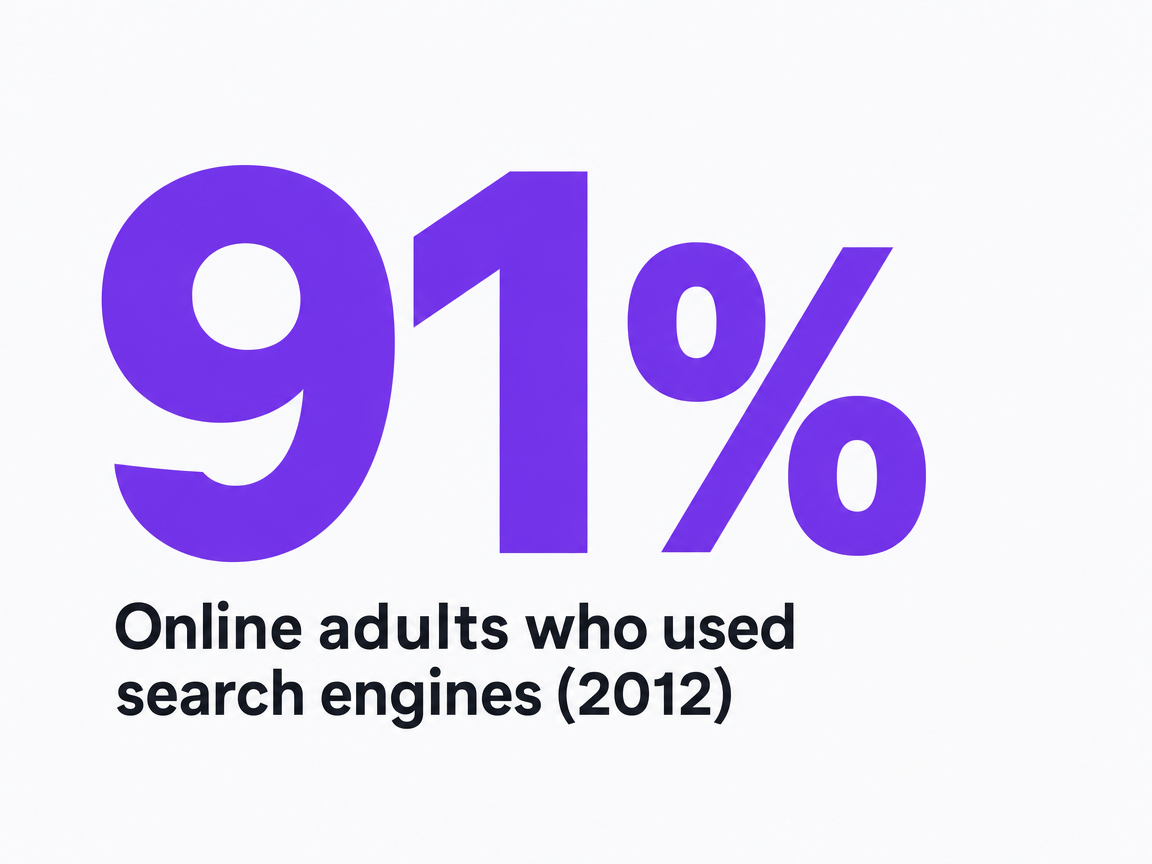 Online adults who used search engines (2012)
Online adults who used search engines (2012)
Frequently Asked Questions
References
- 1.An improved way to view your recent performance data in Search Console.
- 2.Introducing Search Generative AI performance reports in Search Console.
- 3.Getting your performance data | Search Console API.
- 4.A deep dive into Search Console performance data filtering ....
- 5.Search Engine Use 2012.
- 6.MARCH 9, 2012.
- 7.Search Quality Rater Guidelines: An Overview.
- 8.General Guidelines.
- 9.Search Personalization Using Machine Learning.
- 10.A Guide to Google Search Console Reporting for SEO Agencies.
- 11.Google Search Console & SEO Rank Tracking | Key SEO Tool.