
Key Takeaways
- Rank the URLs that map to CRM stages, not raw search volume; most teams find ten to thirty pages carry the pipeline load worth defending 7.
- Fix the technical floor before funding new content, since crawlability, render parity, and clean sitemaps are prerequisites for any page to compound 2.
- Audit pipeline-relevant landing pages against six proven design variables—page height, images, video, copy length, button placement, and form design—drawn from a 25,027-page study 8.
- Treat AI-assisted search as a content format problem: lead with direct answers, apply structured schema, and add comparison tables so assistants can extract and cite 4.
- Refresh existing rankers on a fixed cadence, allocating one refresh hour per four hours of net-new production, because sustained visibility drives downstream business impact 10.
- Close the attribution gap with entry URL capture, query intent categorization, and call tracking on phone-heavy pages so search earns a defensible budget line 5.
- Coordinate content, technical, and measurement inside one execution layer, because the seven plays break when specialists run on separate calendars and briefing cycles multiply 6.
Why pipeline concentration should reshape the SEO budget
Most SEO budgets are built as if organic traffic were a general-purpose asset. The pipeline data says otherwise. Insight Partners' 2025 pipeline generation survey found that 70% of marketing-sourced pipeline flows through just four channels: SEO, events, social media, and paid search 6. That concentration reframes the question a VP should be asking. The debate is not whether search deserves budget. It is which specific search plays feed one of the four channels that actually produce revenue.
That distinction matters because most search programs are still scoped around ranking counts, domain authority, and traffic curves. Those metrics describe activity, not contribution. A separate benchmarking study of inbound and outbound pipeline performance found that organic search leads tend to be more cost-effective than outbound prospecting and can represent a substantial share of total sales pipeline 7. The economic case for search is durable. The operational case for a generic SEO program is not.
The seven strategies below are filtered against two conditions. Each has to trace to a CRM stage a sales leader would recognize, and each has to hold up as AI-assisted search redistributes clicks and citations across new surfaces. Tactics that only move impressions did not make the list. Tactics that require a full agency stack to execute were reconsidered against leaner coordination models. What remains is a working system, not a checklist. For a VP running a team of four to twelve, that framing decides where the next dollar and the next hire go.
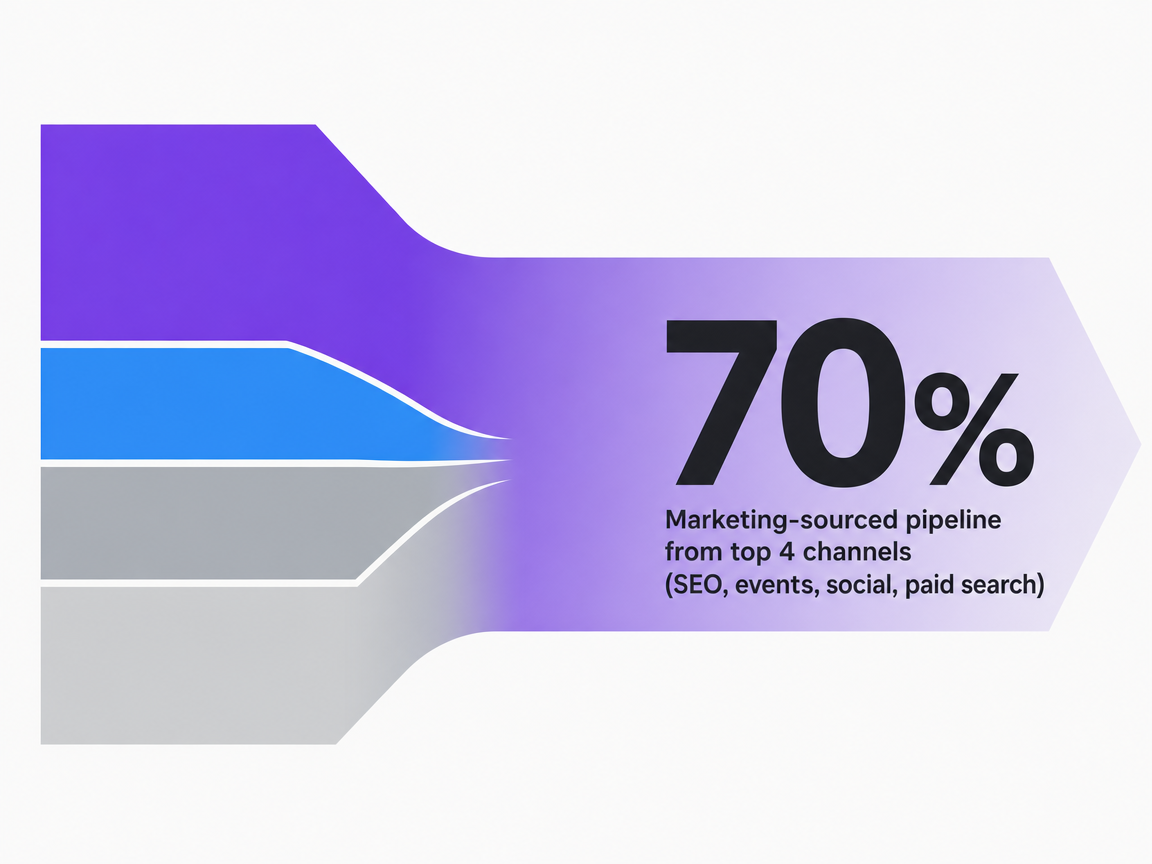 Marketing-sourced pipeline from top 4 channels (SEO, events, social, paid search)
Marketing-sourced pipeline from top 4 channels (SEO, events, social, paid search)
The seven plays that convert search visibility into pipeline
Rank the pages that map to a CRM stage, not the ones that map to volume
Start with a diagnostic question: which URLs on the site correspond to a stage a sales leader would name in a forecast review? Discovery guides, comparison pages, pricing explainers, and category landers each answer a different question, and only some of them belong in a pipeline conversation. A page ranking for a 40,000-volume informational query that never produces a demo request is a traffic asset, not a pipeline asset.
The filter works in two passes:
- Tag each URL with the CRM stage it plausibly serves: unqualified interest, marketing qualified, sales qualified, or opportunity influence.
- Pull the last two quarters of closed-won data and back-trace which URLs appeared in the touch history.
Most teams find that ten to thirty pages carry the load. A 2022 pipeline benchmarking study across inbound and outbound programs found that SEO leads tend to be more cost-effective than outbound prospecting and can represent a substantial share of total sales pipeline, but the share is concentrated in a narrow set of high-intent pages 7.
Once the pipeline-relevant set is identified, resource allocation changes. Editorial calendars stop chasing keyword universes and start defending the ten to thirty URLs that already convert, plus a shortlist of adjacent queries with matching intent. Peer-reviewed work on the broader SEO effect notes that search visibility drives exposure and engagement across an optimized landscape, but the business outcome depends on which pages absorb that visibility 9. A VP who cannot name the top five pipeline-contributing URLs from memory does not have a search strategy. They have a content inventory.
Fix the technical floor before funding new content
Consider the counterexample. A team publishes forty new articles in a quarter, and organic sessions barely move. The audit reveals that a third of the site's high-intent pages are blocked by inconsistent canonicals, orphaned from the main navigation, or rendered client-side in a way that leaves critical text absent from the initial DOM. New content cannot fix a floor problem.
Google's developer-focused guidance is unusually direct on what the floor looks like. Crawlable links, an accurate sitemap, descriptive titles and meta descriptions, and text that is present in the accessible DOM are treated as prerequisites for discovery, not optimizations layered on top 2. The starter guide reinforces the same point from the content side, emphasizing that well-organized, unique text is a baseline expectation for pages that expect to be indexed and surfaced 1. Google's own framing of the 2024 refresh clarified that the guidance targets presence in search results rather than ranking tricks, which is the correct standard for a pipeline-focused program 3.
A technical audit worth funding covers four checks:
- Index coverage for the pipeline-relevant URL set identified in the previous play
- Render parity between what a crawler sees and what a browser sees
- Internal link paths from the homepage to every priority page in three clicks or fewer
- Clean status codes across the sitemap
None of this requires a specialist retainer to diagnose. It does require someone to own the fixes and ship them on a defined schedule. Teams that skip this step and buy more content are paying for pages that will not compound.
Design landing pages against the six variables that move conversion
Search traffic becomes pipeline on a landing page or it does not become pipeline at all. The best available evidence on what actually moves the conversion rate on those pages comes from a 2025 peer-reviewed analysis of 25,027 landing pages, which isolated six design variables with measurable effects: page height, image volume, video use, copy length, button placement, and form design 8. The scope matters. This is a large-sample study of real pages, not a vendor case file.
Each variable translates into a concrete design decision. Page height controls how much narrative a visitor absorbs before encountering a conversion action, and pages that stretch too long without a decision point tend to lose intent. Image volume affects perceived credibility and load behavior; sparse pages read as thin, dense pages read as noisy. Video use, deployed selectively, gives complex offers a second explanation channel without expanding copy. Copy length has to match query intent rather than a house style guide, because a comparison query and a pricing query tolerate very different reading budgets.
Button placement and form design are where most B2B and multi-location service pages lose money. A primary action buried below three sections of proof loses the visitor who arrived ready to convert. A form asking for eleven fields to book a fifteen-minute call filters out the exact prospects a sales team wants. The 2025 study frames these six variables as design levers rather than aesthetic preferences 8.
The operational move is to build a single-page audit template against these six variables and run every pipeline-relevant landing page through it once per quarter. Design changes get prioritized against the variable most out of alignment with query intent, not the one a stakeholder finds most visually offensive. Academic work on SEO outcomes has separately noted that search visibility increases exposure and engagement time, but engagement without a conversion mechanism does not produce revenue 10.
Build for AI-assisted search as a content format problem
AI-assisted search is being treated by most marketing organizations as a novelty channel or a threat narrative. The operational reality is narrower and more useful. A 2026 Branch survey of 300 enterprise leaders found that 98% are optimizing for AI search or plan to within 12 months, and 28% are allocating more than half of marketing budget to it 4. Those numbers describe a specific population—enterprise marketing leaders participating in a benchmark—not the entire market, but they establish that the shift is well past experimental.
What that adoption looks like at the page level is a content-format problem. Assistants and answer engines extract text, cite structured passages, and reward pages that answer a discrete question in a self-contained block. Pages built as long scrolls of undifferentiated prose do not extract well. Pages built with clear question-answer structure, defined entities, tables where comparisons exist, and clean headings tend to appear in citations and summaries more consistently.
Three format adjustments carry most of the weight:
- Lead each pipeline-relevant page with a direct answer to the query the page targets, then develop the argument.
- Treat schema markup and internal entity consistency as required, not optional, so that assistants can parse what the page claims.
- Produce comparison tables and stat callouts where the underlying data supports them, because those blocks are disproportionately quoted.
This is not a separate AI-search program. It is a discipline applied to the same ten to thirty pages already carrying pipeline. Attempting to build a parallel content set for AI surfaces while the primary set stays unstructured produces two mediocre libraries. The 2026 benchmark makes clear that budget is following this shift, and the teams treating it as a format problem rather than a channel problem are the ones absorbing the citations.
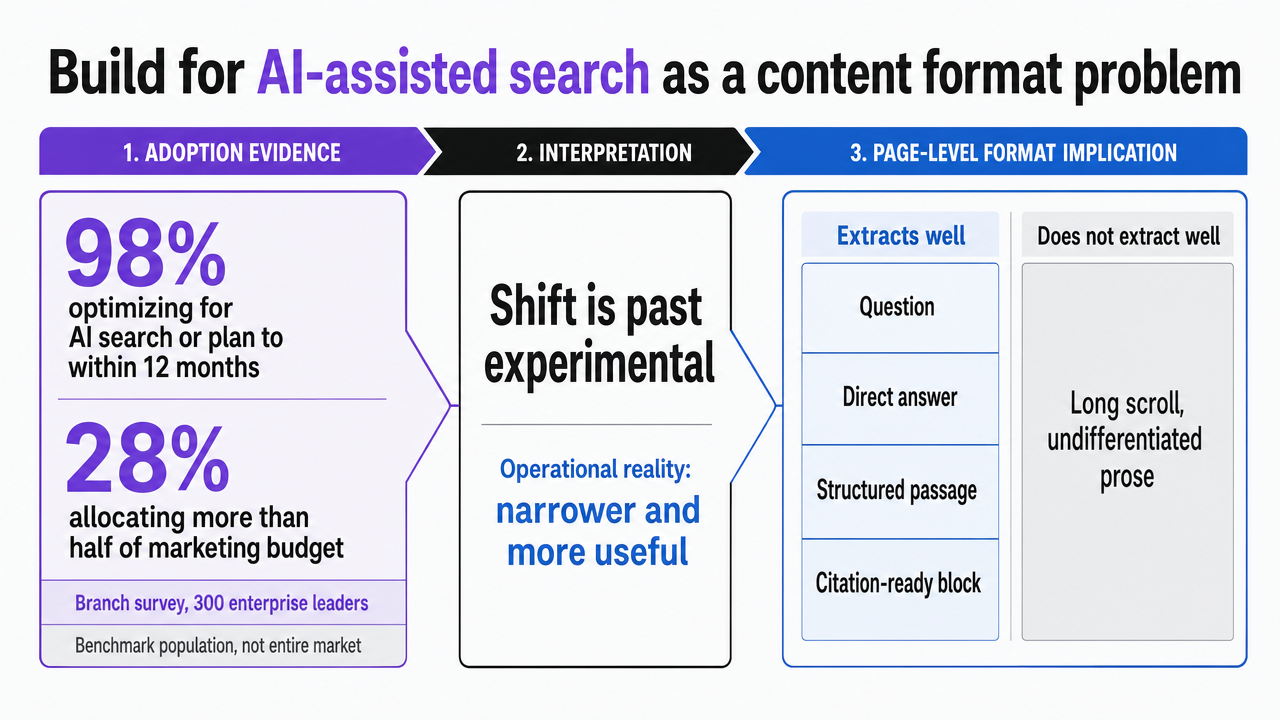 Support the section's cited adoption statistics on enterprise AI search optimization, which are quoted directly in the surrounding prose
Refresh existing rankers on a fixed cadence
New content gets the marketing budget. Existing content produces the pipeline. That imbalance is where most search programs quietly lose ground. Rankings decay as competitors publish, intent shifts, and product details change. A page that ranked third eighteen months ago and now sits at position seven on the same query has usually not been touched since it launched.
A refresh cadence solves this without adding headcount. The mechanics are unglamorous:
- Quarterly review of the pipeline-relevant URL set
- Targeted updates to pages that have slipped in position or CTR
- Annual structural rewrites for the top ten contributors
Refresh work covers factual updates, new statistics, revised examples, tightened introductions, updated internal links, and reconfirmed schema. Google's starter guide is explicit that unique, well-organized content is what sustains presence in results, and refresh work is how a page stays unique against a moving competitive set 1.
The budgeting question is where most VPs make the wrong call. Refresh hours are cheaper per pipeline dollar than net-new production, because the page has already earned its ranking equity and its internal links. Killing a decayed page and rebuilding an equivalent one on a new URL discards that equity. A journal analysis of SEO outcomes across exposure, engagement, and sales-related outputs found that sustained visibility, not initial visibility, correlates with downstream business impact 10.
The operational rule is simple. For every four hours of net-new content production, allocate one hour to refresh work on existing rankers. Teams running that ratio for two quarters typically see the refreshed pages contribute a larger share of demo requests than the new pages published in the same window.
Close the attribution gap between search sessions and CRM opportunities
The measurement layer is where most search programs fail their CFO conversation. A session-level analytics tool reports organic traffic. A CRM reports pipeline. Nothing on most marketing stacks reliably connects the two, and AI-assisted search is making the gap worse. A 2026 industry report found that 81% of companies say they optimize for AI search, and the same body of research highlights that most teams struggle to measure the impact of that work with any confidence 5. Attribution debt compounds while activity accelerates.
Closing the gap does not require a new analytics platform. It requires three connected data points on every pipeline-relevant page:
- A UTM or referrer schema that survives the trip from search result to form submission, including for AI-referred sessions where possible.
- A CRM field that captures the entry URL and the query intent category, not just the lead source.
- A call-tracking layer for pages that convert primarily by phone, which is standard for legal, dental, home services, and senior living operators. Without call tracking on those pages, half the pipeline is invisible.
Once those three data points exist, the reporting question changes from "how much organic traffic did we get" to "which URLs and query categories produced qualified opportunities this quarter, and at what conversion rate." That report is what earns search a defensible line in the marketing budget. The 2022 pipeline benchmarking study found organic search can represent a substantial share of total sales pipeline, but only teams that measure it that way get to make the argument 7.
Coordinate content, technical, and measurement inside one execution layer
The six plays above share a hidden dependency. Each one lives at the intersection of content, technical implementation, and measurement, and each one breaks when those functions run on separate calendars. A refresh is planned by a content strategist, blocked by a developer sprint, waiting on a schema fix, and never measured against CRM outcomes because the analytics owner sits outside the search program. The tactic is sound. The coordination is not.
Most in-house teams manage this by stacking vendors. A content agency, a technical SEO consultant, an analytics contractor, and sometimes a separate AI-search specialist each own a slice. Briefing cycles multiply. Status calls proliferate. The VP absorbs the coordination cost personally, and priority pages ship weeks later than they should. A 2025 pipeline generation survey found that 70% of marketing-sourced pipeline flows through just four channels, with SEO among them, which means the coordination tax is being paid on the single highest-leverage channel a marketing team owns 6.
The alternative is a single execution layer that holds content production, technical implementation, refresh cadence, and pipeline measurement in one workflow with human approval at each decision point. Whether that layer is built through consolidation of existing vendors, an internal operating model, or an AI-coordinated platform is a make-or-buy decision, not a philosophy question. Vectoron is one option in that shortlist, structured around specialist strategists for content, SEO, backlinks, and call intelligence coordinated through a single approval queue. Other operators build the same coordination layer internally with a small team and stricter process.
What matters is the test. If the person accountable for organic pipeline cannot get a technical fix, a content refresh, and a measurement update shipped in the same two-week window without chairing four separate meetings, the coordination layer is missing. Adding another vendor will not fix it. Removing the seams between the six plays will.
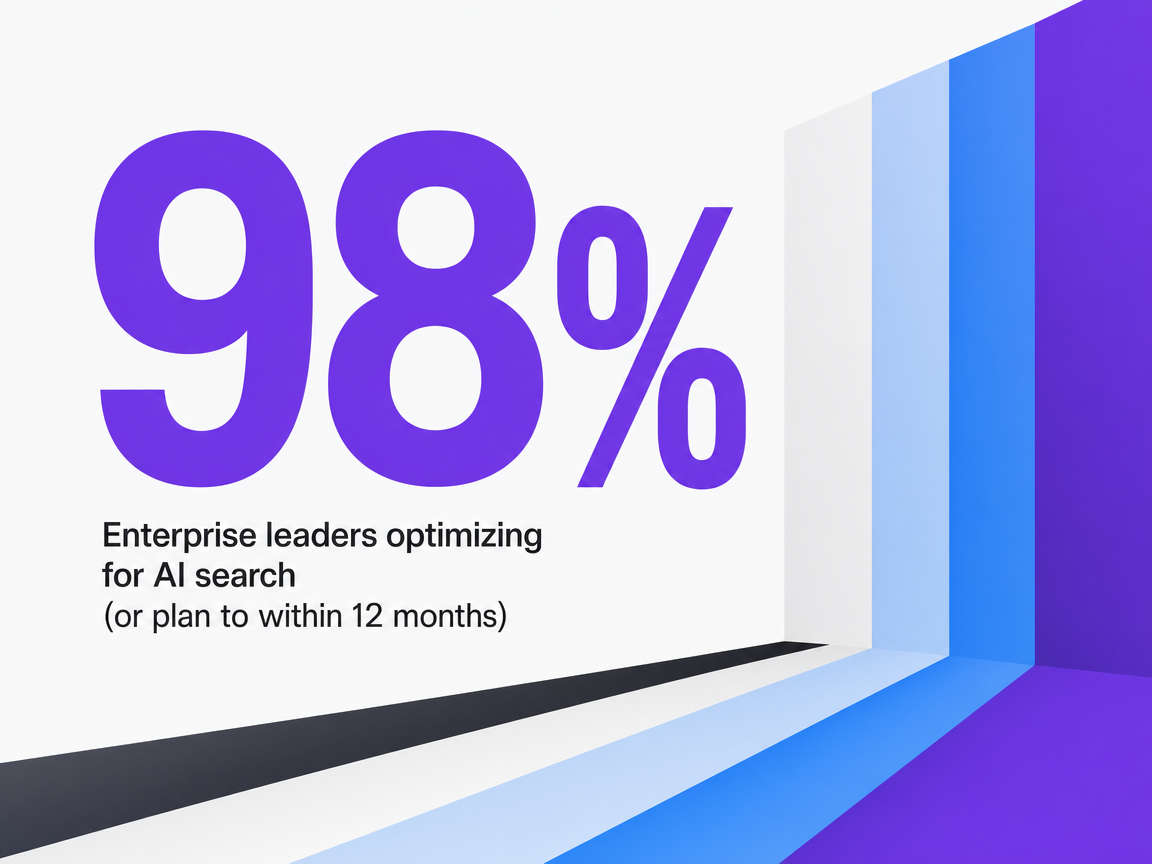 Enterprise leaders optimizing for AI search (or plan to within 12 months)
Enterprise leaders optimizing for AI search (or plan to within 12 months)
Test AI-driven search optimization in real workflows
Experience measurable search pipeline impact with live content published during your free trial.
If you manage multiple locations: staffing model economics
A brief scope shift here. The seven plays above apply to any pipeline-focused search program, but the coordination cost lands differently on operators running multiple locations — legal groups with regional offices, DSOs, home services franchises, senior living portfolios, and multi-site healthcare networks. Each location has its own service pages, local schema, review corpus, and call-tracking layer, and the search program has to move that whole set on the same cadence. That is where staffing model economics start to decide the pipeline outcome.
Three models dominate the market:
- A traditional agency plus in-house hybrid distributes work across a content shop, a technical SEO consultant, sometimes a local-listings vendor, and one or two internal marketers who broker the handoffs.
- A fully in-house team consolidates the roles under a marketing director but requires enough headcount to cover content, technical, design, and analytics across every location.
- An AI-coordinated execution layer with human approval routes strategy, production, and measurement through a single workflow, keeping decision authority with the marketing team while removing the briefing and status overhead.
The variables that actually differ across these three models are not always obvious in a pitch deck. The comparison below holds pricing to what is publicly stated and describes the rest as operational variables an operator can measure against their own baseline.
| Variable | Agency + in-house hybrid | Fully in-house team | AI-coordinated execution |
|---|---|---|---|
| Vendor relationships | 3–5 typical | 0–1 | 1 |
| Briefing cycles per month | Multiple per vendor | Internal, variable | Single approval queue |
| Time-to-publish (priority page) | Variable, gated by handoffs | Bounded by team capacity | Bounded by approval speed |
| Pipeline attribution granularity | Fragmented across tools | Depends on internal analytics | Unified across channels |
| Pricing signal | Retainers, variable | Salaried headcount, variable | $599/mo post-trial (Vectoron) |
The operator question is not which model is philosophically superior. It is which model gets a technical fix, a content refresh, and a measurement update shipped across twelve or forty locations in the same two-week window. Any model that cannot answer that with a scheduled workflow is paying a coordination tax that shows up in slower pipeline, not in the invoice line.
See How Leading Brands Operationalize Search Optimization for Predictable Pipeline
Request a walkthrough of AI-driven workflows that unify content, SEO, and cross-channel execution—designed for marketing teams aiming to increase conversion rates and pipeline efficiency without expanding headcount.
A Monday-morning diagnostic for the seven plays
The fastest way to test whether a search program is actually running the seven plays, rather than performing theater around them, is a short diagnostic a VP can complete before the first meeting of the week. Six questions, honest answers.
- Can the team name the ten to thirty URLs that appeared in the touch history of closed-won deals last quarter?
- Does render parity between crawler and browser hold on every priority page, with a sitemap that matches index coverage 2?
- Has each pipeline-relevant landing page been audited against the six variables from the 25,027-page study within the last quarter 8?
- Do the same priority pages lead with a direct answer, structured markup, and comparison blocks that AI assistants can extract?
- Is there a refresh log showing which existing rankers were updated in the last ninety days?
- Does the CRM capture entry URL, query intent category, and call-tracked conversions for phone-heavy pages?
- Can a technical fix, a content refresh, and a measurement update ship in the same two-week window without four separate status calls?
A program answering yes to five or more is compounding. Three or four, decent tactics without a system. Two or fewer, an activity report dressed as a strategy.
Frequently Asked Questions
References
- 1.Search Engine Optimization (SEO) Starter Guide.
- 2.SEO Guide for Web Developers.
- 3.The SEO Starter Guide got a makeover.
- 4.AI Search in 2026: Key Findings From 300 Enterprise Leaders.
- 5.Nearly 80% Of Businesses Struggle To Measure AI Search ....
- 6.Do less to drive more impact in 2025: Data from our pipeline generation survey.
- 7.2022 Inbound & Outbound Pipeline Performance Benchmarking Study.
- 8.The effect of landing page design and structure on conversion rates.
- 9.The SEO effect. Mapping the optimized landscape around ....
- 10.INTERNATIONAL JOURNAL OF RESEARCH IN BUSINESS AND SOCIAL SCIENCE 11(4)(2022) 59-68.