
Key Takeaways
- Ahrefs anchors stacks where backlink depth and content research drive pitches, though Lite's $129 monthly cost and traffic-estimate debates require a documented reporting policy 1, 3.
- SE Ranking reshapes mid-market stack math with its Pro plan plus agency pack at roughly $169 per month, delivering white-label reporting and multi-client rank tracking 10.
- Moz Pro holds its slot on report defensibility and junior-specialist onboarding, though backlink freshness and keyword database size trail Ahrefs and SE Ranking 11, 13.
- Sistrix earns anchor status only for DACH and European client books, where its Visibility Index is the reference metric in-house teams and press already accept 1.
- Screaming Frog remains the technical audit floor at roughly $22 per month amortized, compressing six-to-ten specialist hours per new account through custom extraction and JavaScript rendering 1, 5.
- Surfer and Clearscope pay back once brief volume clears four per week, removing the two hours per brief a strategist otherwise spends assembling topical outlines 3, 14.
- Similarweb fills the cross-channel traffic intelligence slot no SEO suite covers, but its estimates belong in pitches and teardowns, never in client performance reports 3.
- BrightEdge, Conductor, and seoClarity only justify their five- or six-figure annual investment when publisher-scale inventories or Fortune 1000 process maturity already exist 1, 4.
- AI marketing execution platforms shift the question from tool capability to specialist hours per account, coordinating content, SEO, and reporting under approval-first workflows 14.
The stack question underneath the tool question
Most Semrush replacement debates start in the wrong place. The real question for an agency running 15 to 80 accounts is not which single suite matches Semrush feature-for-feature. It is which stack shape lets a fixed-size specialist team deliver more clients at higher quality without another hire.
That reframing matters because the underlying search economics have gotten harder, not easier. An Ahrefs study of roughly 14 billion web pages found that 96.55% of them receive zero traffic from Google 1. The scope is worth naming: this is a crawl-scale sample of published URLs, not a client win rate, but it clarifies where tool spend actually pays back. Bigger indexes and prettier dashboards do not fix keyword selection, intent mapping, or brief quality. Process does.
Analyst comparisons keep landing on the same operational point. Many marketing teams buy enterprise suites before they have the workflows to exploit advanced features, and a lean stack of one primary suite plus Screaming Frog plus Google Search Console often outperforms heavier deployments 1. The nine picks that follow are organized around that reality: three tiers, each solving a delivery job an agency actually staffs, priced against a per-account book rather than a per-seat sticker.
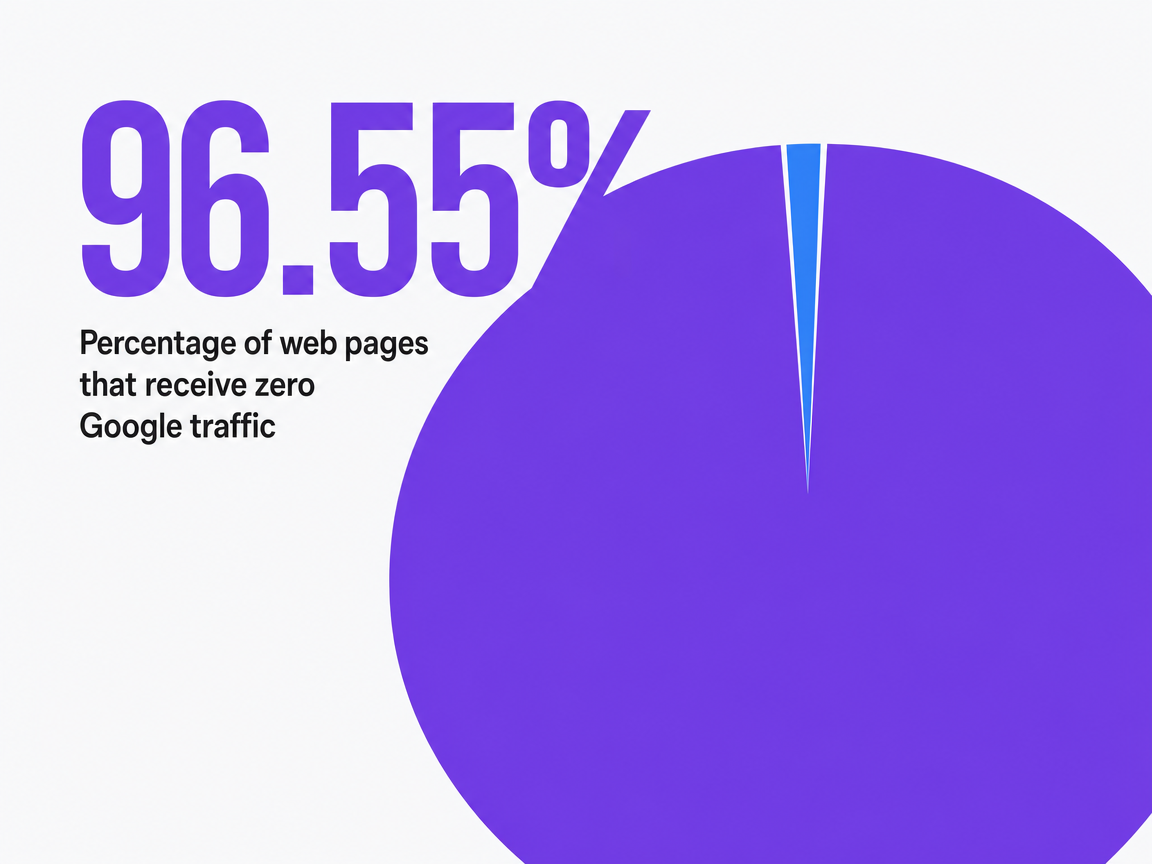 Percentage of web pages that receive zero Google traffic
Percentage of web pages that receive zero Google traffic
How to read this shortlist: three tiers, one delivery job each
The nine picks below are sorted by the job they take off a specialist's plate, not by which vendor has the biggest index. That framing matters because agency capacity is measured in hours per account, and every tool either compresses those hours or does not.
- Tier 1 covers primary suites that can anchor a stack: Ahrefs, SE Ranking, Moz Pro, and Sistrix. One of these sits at the center of most agency workflows 2.
- Tier 2 covers specialist layers a suite cannot replace on quality: Screaming Frog for technical audits, Surfer and Clearscope for content optimization, and Similarweb for market intelligence 3, 5.
- Tier 3 covers the enterprise platforms and AI execution tier — BrightEdge, Conductor, seoClarity, and the newer AI marketing platforms that shift the headcount math itself 4.
Read each profile for the delivery job it removes, not the feature set it advertises. The stack question comes back in Section 6, where cost-per-account math decides what a fixed team can actually run.
Tier 1: Primary suites that can anchor an agency stack
Ahrefs — the backlink and content-depth anchor
Ahrefs earns its Tier 1 spot on two jobs: backlink discovery at scale, and content research depth that survives a competitive audit. Analyst scoring frameworks consistently rate it as the strongest single tool for off-page work and competitor content teardown, and it remains the reference index most other vendors get compared against 1, 3.
For an agency running 15 to 50 accounts, the operational fit is specific. Site Explorer compresses what used to be a two-hour manual backlink profile into a fifteen-minute export. Content Explorer replaces the ad hoc Google search a strategist runs before every brief. Rank Tracker and Site Audit are competent but not the reason to buy — the link graph is.
The economics get uncomfortable at scale. Ahrefs Lite starts at $129 per month, and the export caps and project limits bite fastest on agencies with heavy reporting cadences 1. Practitioners also flag ongoing debate about traffic-estimate accuracy on smaller sites, which matters when Ahrefs numbers get pasted into a client pitch deck 3. A 30-account book running Lite absorbs the seat cost into overhead comfortably, but the team lead needs a documented policy on when Ahrefs traffic estimates go into a client report and when they get replaced with Google Search Console numbers.
SE Ranking — the mid-market agency workhorse
SE Ranking is the tool most likely to change stack math for an agency between 15 and 80 accounts. Hands-on reviews and 2026 comparison matrices repeatedly land it as the strongest all-around Semrush alternative for mid-market teams, citing its rank tracking depth, white-label reporting, and agency-pack bundling as the specific reasons 2, 10, 11.
The pricing floor is what forces the reconsideration. Entry-plan monthly costs across the three suites an agency is realistically choosing between look like this:
Entry-plan monthly cost, three primary suites (2026): SE Ranking Essential $39, Ahrefs Lite $129, Semrush Pro $139.95 1.
SE Ranking Essential at $39 per month is not a like-for-like replacement for Ahrefs Lite or Semrush Pro — the export limits and project caps are lower — but the Pro tier plus the agency pack lands at roughly $169 per month and covers rank tracking, branded reporting, and multi-client workflows that Semrush charges materially more for 10. That is the seat cost most mid-market agencies actually run.
What SE Ranking gives up is index prestige. Backlink depth trails Ahrefs, and enterprise-scale competitive intelligence trails Semrush 2. What it wins is the reporting layer clients see. For agencies where a specialist ships 20 to 40 branded reports a month, SE Ranking's white-label output and Looker Studio integration remove hours of manual assembly per cycle 2. The tool the client sees is often the tool worth centering the stack on.
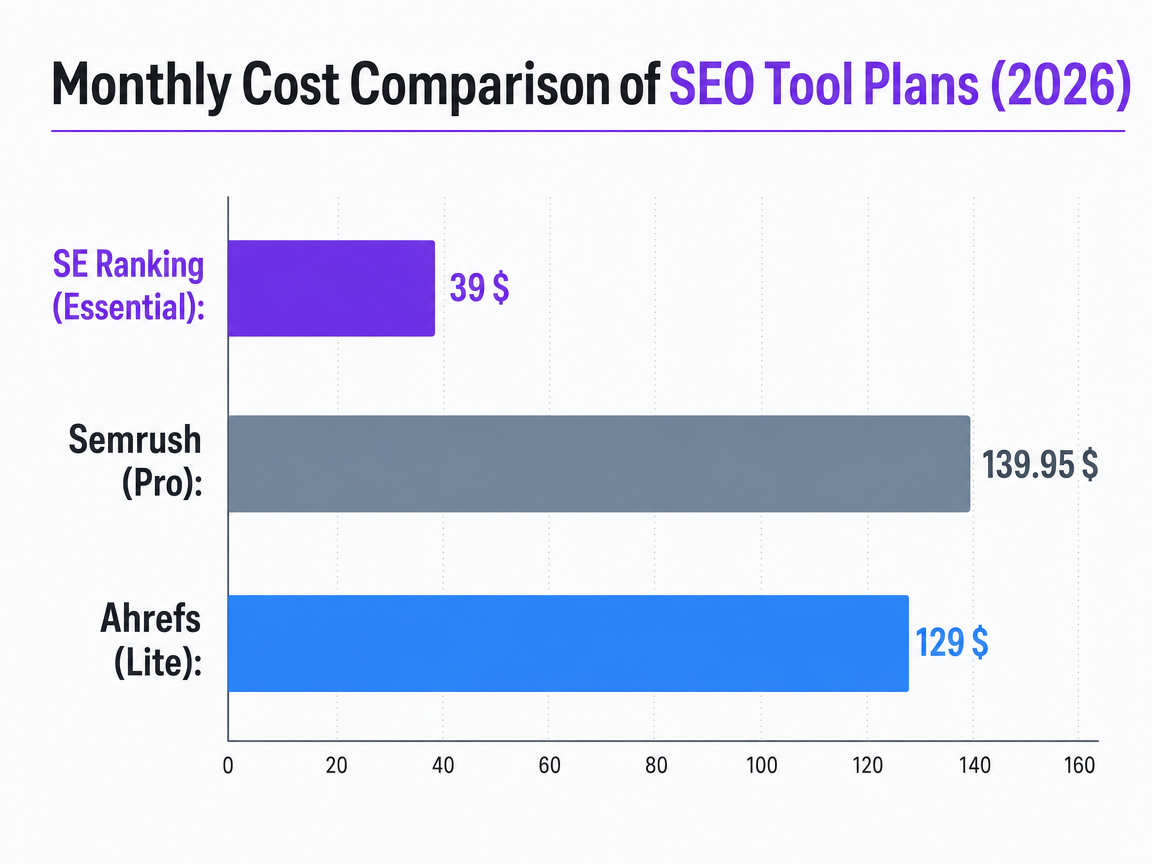 Monthly Cost Comparison of SEO Tool Plans (2026)
Compares the entry-level monthly pricing for three major SEO suites: SE Ranking, Semrush, and Ahrefs, as of 2026.
Moz Pro — the white-label reporting default
Moz Pro's staying power in agency stacks has less to do with its keyword index than with the reports it produces. Hands-on reviewers and 2025 comparison editions single it out for white-label client reporting, ease of onboarding, and educational scaffolding that lowers the cost of bringing junior specialists onto accounts 11, 13.
The delivery job Moz removes is report defensibility. Domain Authority is not a Google ranking factor, but it is a metric clients already recognize and ask about, and Moz owns that language. Campaigns, custom dashboards, and its rank tracking module produce client-ready outputs faster than assembling equivalent views in Ahrefs. For an agency with a mixed-seniority team, the interface itself is part of the value — fewer training hours per new hire 13.
The trade-offs are honest ones. Backlink data lags Ahrefs on freshness and depth, and the keyword database is smaller than Semrush or SE Ranking 8. Moz Pro also does not carry the strongest AI search visibility tooling in the current generation of updates 2. For agencies with 15 to 40 accounts weighted toward content and reporting cadence rather than backlink acquisition, Moz Pro anchors the stack. For teams whose delivery centers on link-building or enterprise-scale competitive analysis, it belongs in a supporting role or gets replaced.
Sistrix — the visibility-index specialist for European books
Sistrix earns its Tier 1 slot on a narrow, defensible claim: its Visibility Index is the reference metric for German-speaking markets and remains one of the most trusted longitudinal SEO datasets in Europe 1. Agencies with client books weighted toward DACH, France, Italy, Spain, or the UK often center Sistrix rather than a US-first suite because the market data is deeper and the historical baseline goes further back.
The delivery job Sistrix removes is defensible European market reporting. When a client asks whether a Google core update hurt them relative to competitors in Germany, Sistrix produces a chart the market already accepts as the reference. Ahrefs and Semrush can produce comparable views, but not with the same recognition from European in-house teams and press.
Outside that geography, Sistrix loses its edge. US and APAC data depth is thinner, and the modular pricing model can add up quickly once toolboxes for optimizer, links, and content get stacked 1. For an agency running fewer than three European accounts, Sistrix belongs in the specialist tier, not the anchor slot.
Test AI-powered SEO execution for agencies now
See how automated workflows can scale SEO content delivery across your client portfolio, risk-free.
Tier 2: Specialist layers a suite cannot replace
Screaming Frog — the technical audit floor
No primary suite audit module has closed the gap on Screaming Frog for site-level technical work, and the analyst comparison that scored seven major tools puts it in the same tier as Semrush and Ahrefs for one specific job: technical crawling depth 1. That is the reason it sits in nearly every agency stack a Head of SEO would call mature.
The delivery job Screaming Frog removes is the six-to-ten hours a specialist spends on a full technical audit for a new account. Custom extraction pulls schema, hreflang, and structured data at scale. JavaScript rendering catches the issues that break most suite crawlers. Log-file analysis, when paired with server access, surfaces crawl-budget waste on large sites that a suite dashboard glosses over 5.
The license runs roughly $259 per year, amortized under $22 per month per seat 1. On a 30-account book, that is negligible against the audit hours it compresses. Screaming Frog is not the tool a client sees in a report. It is the tool that makes the report defensible.
Surfer and Clearscope — content optimization for brief-heavy teams
Content optimization tools earn their stack slot when a specialist is writing or editing more than four briefs a week. Surfer and Clearscope both compress the same job: turning a target keyword into a defensible content brief with topical coverage, competitor structure, and semantic recommendations a writer can execute without a strategist rewriting from scratch 3.
Clearscope's positioning is editorial-first. Hands-on reviews single it out for content optimization workflows where a senior editor grades drafts against a topical model before publication 3. Surfer sits closer to the production line — it is repeatedly named as the content-scale layer agencies pair with a primary suite when scaling output across many accounts 9, 14. A 2026 benchmark of AI content platforms describes Surfer as a top choice for agencies needing data-driven efficiency at scale 14.
The trade-off is honest. Neither tool replaces a strategist's judgment on intent or angle. What they remove is the two hours per brief a specialist otherwise spends assembling a topical outline manually. For a team producing 40 briefs a month across a client book, that math compounds fast.
Similarweb — market and traffic intelligence, with caveats
Similarweb occupies a slot no primary SEO suite fills cleanly: cross-channel traffic and market intelligence at the domain level. G2 reviewers point to it as the tool of choice when the question is not what a competitor ranks for, but where their traffic actually comes from — direct, referral, paid, social, and organic across time 3. For agencies pitching new business or defending share in a competitive vertical, that view carries weight a keyword tool cannot produce.
The caveat is the one every hands-on reviewer names. Similarweb's estimates diverge from first-party analytics, sometimes materially, and practitioners have flagged the discrepancies as a recurring accuracy concern 3. The number is directional, not definitive.
Operational rule for an agency: use Similarweb for competitive framing and market sizing in pitches and quarterly reviews. Do not paste its numbers into a client's own performance report where Google Analytics or GSC data exists. That single boundary keeps the tool valuable without exposing a credibility risk downstream.
Tier 3: Enterprise and AI-execution platforms that change the headcount math
BrightEdge, Conductor, and seoClarity — when the enterprise tier is honest
The enterprise SEO tier earns its slot in this shortlist only under specific conditions, and honesty about those conditions matters more than feature enthusiasm. BrightEdge, Conductor, and seoClarity each carry capabilities a mid-market suite cannot match: BrightEdge's DataCube for predictive search-trend modeling, Conductor's cross-functional collaboration layer, and seoClarity's real-time visibility across large page inventories 4, 7. Botify sits alongside this tier for log-file analysis and crawl-budget management on sites where those are actual constraints 4.
The threshold is the part most listicles gloss over. Enterprise SEO platforms typically require five- or six-figure annual investment and dedicated teams to realize return, and buying one before the workflows exist to exploit it is the most expensive mistake in SEO tooling 1, 4. For an agency running 15 to 80 accounts on mid-market clients, the math does not work — the seat cost eats the margin before the platform's predictive layer produces incremental wins.
The tier becomes honest at a different agency shape: multi-brand holding-company work, publisher accounts with hundreds of thousands of URLs, or Fortune 1000 in-house programs where a specialist team already has the process maturity. Botify's log-file view, specifically, pays back when crawl budget is a real constraint rather than a theoretical one 4. Outside those conditions, the enterprise tier belongs on a roadmap, not a current-quarter purchase order.
AI marketing execution platforms — the ninth pick
The ninth pick is a category, not a feature. AI marketing execution platforms sit outside the suite-versus-specialist debate because they change the question underneath it: not which tool a specialist uses, but how many accounts one specialist can carry. Industry benchmarks now segment AI content platforms — SurferSEO, AirOps, Jasper, and adjacent tools — by whether they optimize a single draft or coordinate execution across content, SEO, and reporting workflows at scale 14.
The delivery job this tier removes is the coordination tax. A traditional stack still requires a specialist to move data between the suite, the content tool, the crawler, and the reporting layer. AI execution platforms compress that handoff by connecting strategy, production, and publishing in one governed workflow, with human approval before anything ships. For an agency where the constraint is not tool capability but specialist hours per account, that shift matters more than another point of index depth.
Vectoron sits in this tier for agencies wanting specialist AI strategists across content, SEO, backlinks, and reporting with an approval-first workflow. The evaluation question is not feature parity with Semrush. It is whether the platform lets a fixed team carry more accounts at defensible quality.
Stack cost per account: three configurations most agencies actually run
Tool spend gets defended one seat at a time and evaluated in aggregate. Divided across a 20 to 50 account book, the per-account math is often what actually decides whether a stack scales or eats the margin. Three configurations show up repeatedly in mid-market and enterprise agency operations, and the pricing spread between them is wider than most quarterly reviews acknowledge.
Stack cost per account, three common agency configurations. Lean: SE Ranking Pro + agency pack ~$169/mo, Screaming Frog ~$22/mo amortized, GSC free — roughly $191/mo total, or $3.82 per account across 50 clients 1, 10. Standard: Ahrefs Lite $129/mo, Surfer content layer, Screaming Frog ~$22/mo amortized — mid-hundreds per month before add-ons, roughly $10 to $14 per account across 50 clients 1. Enterprise: BrightEdge, Conductor, or seoClarity at five- to six-figure annual investment with dedicated team requirement, per ref_4 — often $200 to $800 per account per month depending on book size and platform tier 4.
The lean configuration is the one most 20 to 50 account books actually run when the Head of SEO is measured on margin. SE Ranking's Pro plan plus agency pack lands at roughly $169 per month with white-label reporting and multi-client rank tracking built in 10. Screaming Frog handles the technical floor for another $22 per month amortized 1. Google Search Console provides the measured baseline every estimated number gets checked against. Across 50 accounts, that stack costs under $4 per client per month before labor.
The standard configuration trades cost for index prestige. Ahrefs Lite plus a content optimization layer plus Screaming Frog is a defensible mid-market build, but the export limits and project caps on Lite start binding above 30 active accounts, and the next tier up changes the math 1. The enterprise configuration only pays back when the process maturity exists to exploit it — a condition ref_4 flags explicitly, and most agencies underestimate.
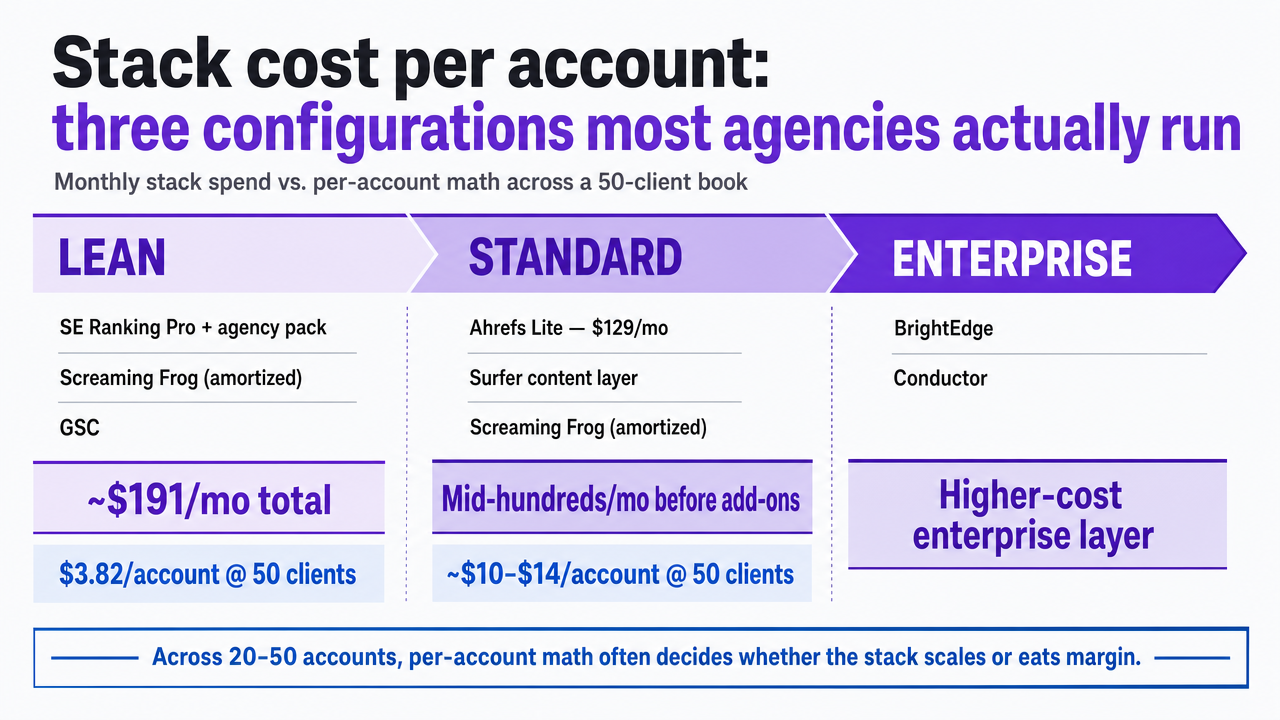 Visualize the three agency stack configurations compared in the section — lean, standard, enterprise — with their component tools, monthly cost, and per-account math, matching the numbers cited in prose
See How Leading Agencies Replace Semrush for Scalable SEO Execution
Request a walkthrough of multi-channel SEO automation platforms built for agencies managing high-volume clients, with transparent workflows, approval-first controls, and measurable ROI—ideal for teams seeking operational efficiency beyond traditional toolsets.
The data-quality debates nobody in a listicle wants to name
Every tool on this shortlist estimates. Google Search Console measures 1. That single distinction is the one most agency reports blur, and the credibility risk shows up when a client cross-checks vendor numbers against their own analytics.
Three debates are worth naming directly:
- Ahrefs traffic estimates draw recurring practitioner concern on smaller sites, where the sample thins and the modeled number can diverge from what the client actually sees 3.
- Similarweb's cross-channel traffic view carries the same caveat at the domain level — G2 reviewers repeatedly flag discrepancies against first-party analytics as a real accuracy concern 3.
- Ubersuggest's keyword volumes and traffic numbers have been called inconsistent at scale by hands-on testers, which matters when a budget stack is doing the work of a paid suite 11.
The operator move is simple. Estimated numbers belong in pitches, competitive teardowns, and internal strategy work. GSC numbers belong in the client's own performance report. That boundary keeps every tool in this list valuable without importing its data-quality debate into a monthly review a client actually reads.
If you manage multiple brands or a portfolio of agencies
Scope shifts here: the reader running one agency is not the reader running three, or the holding-company operator overseeing a portfolio of specialist shops. The stack math changes when tool spend crosses brand boundaries and consolidated reporting becomes a contractual expectation, not a nice-to-have.
Two operational patterns show up. The first is centralizing on SE Ranking's Pro plan plus agency pack at roughly $169 per month per brand, which keeps white-label reporting consistent across sub-agencies while preserving separate client workspaces 10. The second is pairing a shared enterprise tier — Conductor's cross-functional collaboration layer or seoClarity's real-time visibility — with brand-level suite seats, but only where process maturity exists to exploit the five- or six-figure annual commitment 4, 7. Portfolio operators without that maturity end up paying enterprise prices for mid-market outcomes.
How to pick, in the order a Head of SEO actually picks
Selection order matters more than shortlist length. A Head of SEO running 15 to 80 accounts picks in four steps, not by feature-comparison spreadsheet.
- Name the client-facing report format. That decision points to SE Ranking for white-label agency-pack economics or Moz Pro for interface familiarity with junior specialists 10, 11.
- Decide whether backlink depth or European market data drives the majority of pitches — Ahrefs for the former, Sistrix for the latter 1.
- Add Screaming Frog as the technical floor and one content optimization layer, Surfer or Clearscope, once brief volume clears four per week 1, 3.
- Treat enterprise platforms and AI execution tiers as roadmap decisions tied to process maturity, not current-quarter purchases 4.
The stack that scales is the one where every seat maps to a delivery job a specialist would otherwise staff manually. Everything else is sunk cost dressed as capability.
Frequently Asked Questions
References
- 1.Best SEO Tools in 2026: Scored Vendor Comparison.
- 2.Top 10+ Semrush alternatives for 2026 worth trying.
- 3.I Compared 6 Semrush Alternatives for Content and SEO Tasks.
- 4.Top 10 Enterprise SEO Tools & Platforms 2025.
- 5.9 Best Independent Semrush Alternatives & Competitors.
- 6.6 Best Semrush Alternatives of 2026 (Free & Paid).
- 7.11 Best Enterprise Semrush Alternatives for 2026.
- 8.SEMRush Competitors, Alternatives, Pricing, Features and ....
- 9.Best Semrush Alternatives in 2026: Cheaper SEO, PPC ....
- 10.The 8 Best Semrush Alternatives in 2025 (For All Budgets).
- 11.11 Semrush Alternatives I've Tested (2026).
- 12.Best Semrush Alternatives 2026: 9 SEO Tools Reviewed.
- 13.Best Semrush Alternatives (2025 Edition).
- 14.What are the best AI content creation platforms for scaling agencies? - CheckThat.ai.