
Key Takeaways
- Research and GEO platforms replace analyst hours on brief assembly and add visibility tracking in ChatGPT, Perplexity, and Google AI Overviews, though vendor metrics remain directional inputs rather than definitive signals.
- Content production systems compress writer and junior editor capacity, with McKinsey estimating 5-15% productivity gains against total marketing spend, not agency revenue 1, provided editorial rubrics keep pace with draft volume.
- Technical and on-page engines automate crawl audits and remediation drafting, freeing technical SEOs for architecture and Core Web Vitals work, but coverage of AI-blended SERPs and structured data for AI Overviews is still maturing.
- Link intelligence tools cut outreach coordinator time by drafting messages and scoring prospects, yet AI outreach at scale triggers aggressive filtering, so editorial judgment on angles and target sites still determines placement quality.
- Orchestration platforms consolidate the coordination tax across categories, with McKinsey citing up to 30% ROI gains and execution effort dropping from 60-70% to 10-15% of marketing work 2, provided approval checkpoints stay explicit.
Why category, not tool ranking, is the right frame for evaluating AI SEO software
Adoption of AI in agencies is widespread, with over 60% of agency decision-makers reporting current use, a figure that rises to 78% among large US agencies4. This indicates that AI tooling parity is nearly universal at the top of the market. The critical question for a Head of SEO is no longer whether to deploy AI SEO software, but rather which category of software effectively addresses specific delivery bottlenecks.
Ranked leaderboards often obscure this crucial distinction. A tool designed for long-form content generation operates on a different budget line than one for technical crawl audits or an orchestration platform coordinating content, links, and reporting. Comparing these diverse tools solely by star rating can lead to an acquisition without a strategic decision.
Categorizing AI SEO tools forces a more precise analysis. Each category directly addresses a specific delivery cost an agency already incurs: research and Generative Engine Optimization (GEO) software reduces analyst hours, content production systems replace writer and editor capacity, technical engines automate on-page quality assurance, link intelligence streamlines prospecting, and orchestration platforms mitigate coordination overhead. Once a category is selected, comparing tools within that category becomes more straightforward and relevant.
This article analyzes AI SEO software through these five primary categories. Representative software is presented within each, highlighting what it replaces on the profit and loss statement and where human approval is essential in the workflow.
The five functional categories of AI SEO software
Research and Generative Engine Optimization platforms
Traditional research tools focused on keyword volume, difficulty, and SERP scraping. This scope is now insufficient. Forrester's search marketing coverage emphasizes that leading programs integrate human judgment with AI-driven insights to manage complexity, warning that reliance on manual processes will cause firms to fall behind as AI overviews and generative search experiences transform discovery9. The research category now includes Generative Engine Optimization (GEO), which involves engineering content and entities to appear in AI-generated answers, not just traditional blue links.
Platforms in this category generally take three forms. Established SEO suites like Ahrefs, Semrush, and Moz have integrated AI briefs, intent clustering, and topic-model outputs with their existing crawl and index data. Newer GEO-specific tools, such as Profound, Otterly, and Athena, monitor brand visibility within platforms like ChatGPT, Perplexity, and Google's AI Overviews, then analyze the passages and citations these systems favor. A third group, including Clearscope and MarketMuse, specializes in semantic coverage scoring against top-ranking competitors.
For an agency SEO lead, this category primarily replaces analyst time. Previously, a senior strategist would spend hours gathering SERP data, mapping intent, and preparing briefs for writers. AI-native research can condense this into a reviewable draft brief in minutes and adds a monitoring layer for AI-answer visibility that was unavailable just two years ago.
A key challenge for this category is confidence in its metrics. GEO metrics are still evolving, sampling methodologies vary significantly among vendors, and vendor dashboards often report on prompts that clients would not typically use. Outputs from these tools should be treated as directional inputs for a human strategist, not as definitive ranking determinants.
Content production systems
The AI SEO market saw its initial rapid growth in content production, and this remains its most competitive segment. Enterprise-level generation tools include Jasper, Writer, Copy.ai, and Anyword. Frase, Surfer, and NeuronWriter combine SERP analysis with drafting capabilities to ensure comprehensive topical coverage. Tools like Byword, Cuppa, and Journalist AI offer fully automated publishing pipelines, targeting programmatic SEO at scale.
The economic rationale for this category aligns with McKinsey's productivity estimates: generative AI could boost marketing productivity by 5% to 15% of total marketing spending1. For an agency Head of SEO, two aspects of this estimate are critical. First, the baseline is total marketing spend, not agency or client revenue, so the percentage should be applied to the marketing cost line before considering margin. Second, this figure represents potential gains, not guaranteed realization, and depends on reallocating saved time to higher-value tasks rather than simply creating slack.
Generative AI's productivity potential in marketing sits between 5% and 15% of total marketing spending, per McKinsey1. The base is spend, not revenue.
Content systems primarily replace writer and junior editor capacity on an agency's P&L. For example, a location-page build for a client with 40 offices, which previously required six weeks of freelance writing and internal QA, can be completed in a two-week production sprint with a senior editor overseeing the workflow. The trade-off is an increased load on quality control: draft volume can outpace review capacity, leading to an accumulation of undifferentiated output if editorial standards are not clearly defined in templates and rubrics.
Programmatic tools warrant a specific mention. They can generate thousands of pages based on a schema, making them suitable for local landing pages, product comparison hubs, and service-area templates. However, they are less effective for editorial thought leadership, where unique voice and argumentation are paramount.
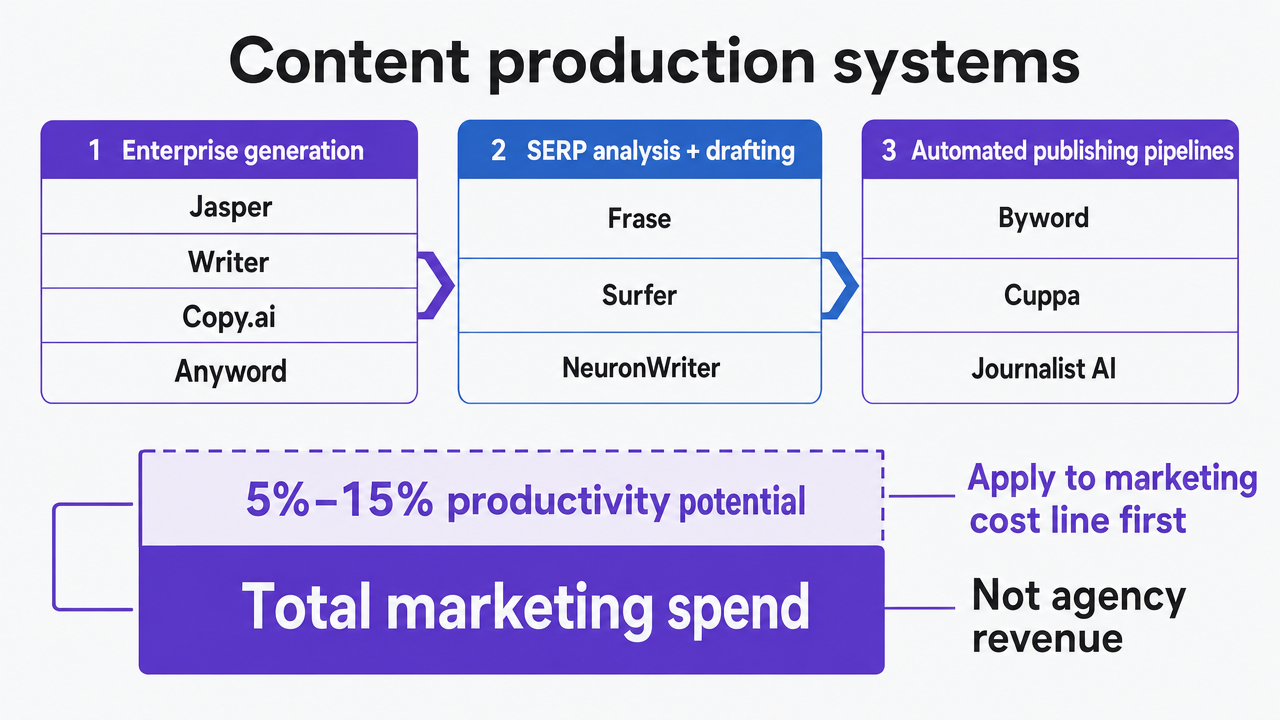 Reinforce the McKinsey productivity range cited in this section, clarifying that the base is total marketing spend, not agency revenue
Technical and on-page optimization engines
Technical tooling is often considered the least glamorous category, yet it offers some of the clearest ROI. Tools like Screaming Frog, Sitebulb, Lumar, and OnCrawl specialize in crawl analysis and log-file review. Google's own AI-powered analysis layer, Search Console Insights, along with third-party wrappers around Search Console data, automate anomaly detection. On-page engines such as Surfer, Clearscope, and PageOptimizer Pro evaluate existing pages against ranking competitors and suggest structural improvements.
A recent development in this category is the rise of agentic capabilities. Several vendors now provide crawl-to-fix workflows that not only identify issues like broken canonicals or duplicate titles but also propose replacement markup. Some products even integrate with CMS platforms to push these changes for approval. This streamlines a process that technical SEOs previously managed through ticket queues.
Agencies should evaluate this category by focusing on the line item of on-page QA hours per site per quarter. A mid-sized agency managing 60 client sites often spends more on recurring technical audits than on any single content contract. Automating audit synthesis and remediation drafting can free up a technical SEO's time for higher-level tasks such as site architecture, internal linking strategy, and Core Web Vitals engineering, which still require human expertise.
A limitation of these tools is their coverage of AI-blended SERPs. Traditional technical tools were designed to optimize for ten blue links. Areas like structured data for AI Overviews, entity disambiguation for large language model retrieval, and llms.txt-style declarations are emerging, and mature technical suites are still catching up. Agencies serving clients in AI-visible verticals should inquire about the roadmap for AI-answer optimization before committing to multi-year contracts.
Link intelligence and digital PR tools
Link acquisition remains one of the most labor-intensive components of most agency SEO delivery models. While AI has not eliminated prospecting or outreach, it has significantly improved the efficiency of hours spent per placement. Tools like Pitchbox, BuzzStream, and Respona leverage AI to draft initial outreach messages and assess prospect quality. Ahrefs and Semrush have incorporated AI-assisted backlink gap analysis and toxic-link filtering. Newer platforms such as Postaga and Roxhill focus on matching journalists for digital PR campaigns.
This category primarily addresses the role of the outreach coordinator. A campaign that once required a full-time coordinator to research 200 sites, personalize 200 emails, and manage follow-up sequences can now be executed by a senior link strategist supervising an AI-generated pipeline. The strategist's focus shifts from execution to developing angles and managing relationships, which are critical for placement quality.
Two important caveats apply to this category:
- First, AI-generated outreach at scale can lead journalists and site owners to filter more aggressively, increasing the baseline for effective personalization.
- Second, tools that grade link quality using their proprietary indexes often disagree significantly, and none accurately measure what a human editor at a target publication truly values.
Link intelligence tools accelerate the tedious aspects of the workflow but do not negate the need for editorial judgment in selecting sites and angles that will earn placements and pass authority.
Orchestration platforms that unify the stack
Orchestration is a rapidly evolving category with a clear analytical thesis. McKinsey's analysis of always-on marketing operations suggests that unified orchestration can boost marketing ROI by 30% and reduce the time spent on execution tasks from 60-70% of marketing effort to as little as 10-15%2. These gains stem not from a superior generator or crawler, but from eliminating the coordination overhead between various point solutions.
An agency that uses one tool for research, another for drafting, a third for optimization, a fourth for link prospecting, and a fifth for reporting incurs a hidden cost in briefing cycles, status calls, and file handoffs. This "coordination tax" is precisely the friction Forrester identified when it characterized AI as a current cost center within agencies rather than a revenue driver5. Stacks of point tools often perpetuate the very handoff problems they were intended to solve.
Traditional workflows spend 60-70% of marketing effort on execution tasks. Always-on AI orchestration compresses that share to 10-15% while lifting ROI by 30%, per McKinsey2.
Orchestration platforms integrate specialized AI functions into a single approval workflow. HubSpot's Breeze layer and Salesforce's Agentforce approach this from a CRM perspective. Adobe GenStudio and Optimizely Opal target enterprise content operations. Vectoron, along with a few other platforms, focuses on the agency-delivery model: coordinating specialist strategists for content, SEO, PPC, backlinks, social, and call intelligence through a shared command center, with human approval preceding execution.
Evaluation criteria for orchestration platforms differ from those for point tools. Buyers should consider where approval checkpoints are located in the workflow, whether recommendations include strategic reasoning, how the platform resolves conflicting signals across channels, and if automation degrades gracefully when a client vetoes a specific tactic. For an agency Head of SEO, a platform that automates effectively but conceals its reasoning is less valuable than a slower tool that demonstrates its process, as the former makes quality assurance impossible at scale.
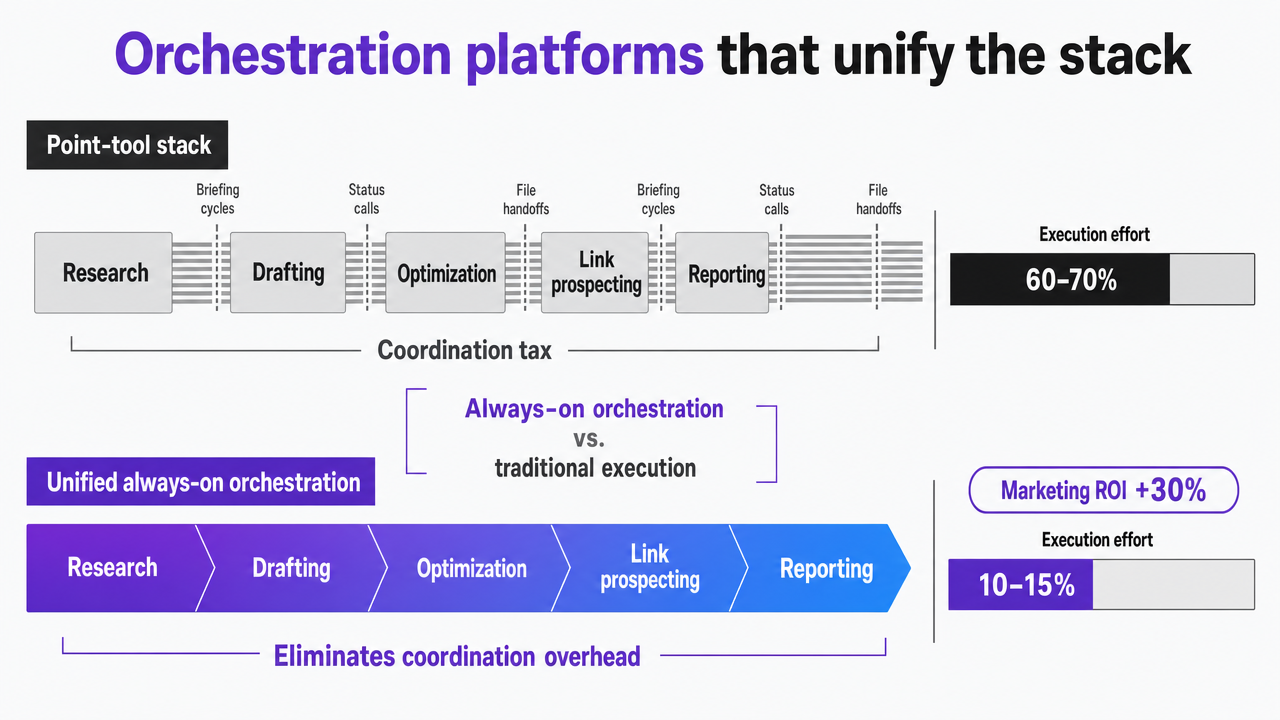 Visualize the McKinsey comparison between traditional execution effort share and always-on AI orchestration cited in this section
Test AI-driven SEO execution with live campaigns
Launch and measure real SEO content across client accounts in a live environment before making any commitment.
Representative software worth evaluating in each category
Named tools mapped to the delivery problem they solve
The purpose of naming specific tools is not endorsement, but to provide a Head of SEO with a clear shortlist within each category. This ensures procurement discussions are based on established reference classes rather than vendor presentations.
Research and GEO. Ahrefs and Semrush remain standard for competitive analysis, keyword clustering, and SERP diffing, offering an index-plus-AI-brief combination. Clearscope and MarketMuse provide semantic coverage scoring for editorial teams seeking a robust topical model per URL. For AI-answer visibility, Profound, Otterly, and Athena track brand presence in ChatGPT, Perplexity, and Google AI Overviews. These tools address the delivery problem of analyst hours spent on brief assembly and monitoring client visibility across generative surfaces.
Content production. Jasper and Writer cater to enterprise governance with brand voice models and role-based access. Surfer, Frase, and NeuronWriter integrate drafting with SERP coverage scoring. Byword, Cuppa, and Journalist AI extend into programmatic pipelines suitable for location pages, service-area builds, and comparison hubs. These platforms solve the delivery problem of writer and junior editor capacity for high-volume, template-driven output.
Technical and on-page. Screaming Frog, Sitebulb, Lumar, and OnCrawl handle crawl and log-file analysis at an agency scale. Surfer, Clearscope, and PageOptimizer Pro score on-page structure against ranked competitors. These tools resolve the delivery problem of recurring QA hours per site per quarter and the backlog between audit and remediation tickets.
Link intelligence. Pitchbox, BuzzStream, and Respona automate outreach drafting and prospect scoring. Postaga and Roxhill specialize in journalist matching for digital PR. Ahrefs and Semrush enhance the workflow with gap analysis and toxic-link filtering. These tools address the delivery problem of outreach coordinator time and improve the ratio of research hours to earned placements.
Orchestration. HubSpot Breeze and Salesforce Agentforce approach coordination from a CRM perspective. Adobe GenStudio and Optimizely Opal target enterprise content operations. Vectoron and a select group of similar platforms align with the agency-delivery model, coordinating specialist AI functions across content, SEO, PPC, links, social, and call intelligence within a shared approval workflow. This category solves the delivery problem of the coordination tax incurred across the other four categories.
Where Vectoron sits in the orchestration category
Vectoron is an orchestration platform and should be evaluated as such, not as a content-generation tool. It integrates six specialist strategists—content, SEO, PPC, backlinks, social, and call intelligence—into a unified command center. Each recommendation includes its underlying reasoning, and every action requires human approval before execution.
Relevant evaluation questions for Vectoron align with the category criteria: the location of approval checkpoints, how conflicting signals across channels are reconciled, and whether the platform incorporates live business data such as qualified calls, bookings, and cost per lead, beyond just crawl and keyword data. Vectoron's design prioritizes approval-first automation, allowing strategists to retain veto power at each stage.
The trade-off is scope. Agencies already committed to best-of-breed point tools in the other four categories may find some overlap with existing contracts. Vectoron is a better fit for agencies experiencing significant coordination overhead across multiple client portfolios, aligning with Forrester's observation that agencies are moving from service hours toward packaged AI-powered solutions7.
Consolidation economics for agency operators
Audience note: this section is written for agency operators sizing internal delivery economics across a client portfolio, not for in-house SEO teams staffing a single brand.
A typical agency SEO team involves five recurring cost centers:
- a strategist,
- a writer or content lead,
- a technical SEO,
- a link builder or outreach coordinator,
- and a project manager to coordinate them.
The total fully loaded cost per team varies by market, but the underlying structure remains consistent. Each cost center corresponds to one of the software categories discussed, and each category aims to reduce, rather than eliminate, that cost line.
Two consolidation models are worth comparing. In a stacked point-tool model, an agency licenses a research suite, a content system, a technical engine, a link intelligence tool, and a reporting layer. While software costs increase, headcount costs may decrease as specialists manage more accounts. However, a hidden cost emerges: coordination. Briefings, handoffs, status calls, and reconciling tool outputs create a "coordination tax." Forrester notes that AI within agencies currently acts as a cost center rather than a revenue driver due to this inefficiency5. Productivity gains in individual roles are often lost in the transitions between tools.
In a unified orchestration model, the agency consolidates the coordination layer into a single approval workflow, retaining point tools only for functions not covered by the orchestration platform. This increases the software line further, but significantly reduces the project manager's workload. Specialists then spend more time on judgment-based tasks rather than status reporting.
The framework for quantifying this difference is straightforward:
- Calculate the fully loaded cost of each team role at the agency's actual rates.
- Multiply this by the number of clients each role currently covers.
- Apply McKinsey's estimated productivity gain of 5% to 15% of total marketing spending as a reasonable upper limit for AI-driven improvements against the marketing cost base, not agency revenue1.
- Then, subtract the coordination tax that the point-tool approach leaves in place.
The resulting figure reveals the true economic benefit of orchestration and determines whether AI SEO software becomes a margin lever or another cost center.
See How Leading Agencies Are Scaling SEO With AI-Driven Precision
Request a demo to benchmark AI-powered SEO automation workflows that deliver higher content velocity, measurable ranking gains, and full oversight—without increasing headcount or sacrificing quality.
Governance, approval checkpoints, and the shape of the delivery team
AI SEO software fundamentally alters the delivery team structure, often more profoundly than organizational charts suggest. Forrester predicts that approximately 7.5% of agency roles will be automated by the end of the decade, with a much larger proportion augmented rather than eliminated7. For a Head of SEO, this means the team doesn't shrink to a single operator running prompts; instead, it reshapes around critical approval checkpoints.
Three distinct approval checkpoints require explicit design:
- First is brief approval, where a strategist confirms that AI-generated research and topic models accurately reflect the client's positioning before drafting commences. Bypassing this step can lead to undifferentiated output that erodes editorial trust.
- Second is publication approval, where an editor signs off on drafts, on-page changes, and outreach copy before anything is deployed to a client property or external site.
- Third is signal approval, where a strategist verifies which live business inputs—such as qualified calls, bookings, or cost per lead—will inform the next planning cycle.
Automating any of these three without a designated human owner can turn AI SEO software into the cost center Forrester describes.
The resulting team structure is flatter and more senior. Junior execution roles are compressed as drafting, auditing, and outreach production become automated. Senior strategist, editor, and technical lead roles can manage more accounts because the bottleneck shifts from production to review. Project management shrinks where orchestration handles coordination, but grows where explicit ownership is needed for governance policies, brand voice rules, client approval routing, and content escalation paths. Agencies that establish these policies before deploying new software tend to maintain quality standards. Those that treat governance as a runtime decision often rediscover why the coordination tax existed in the first place.
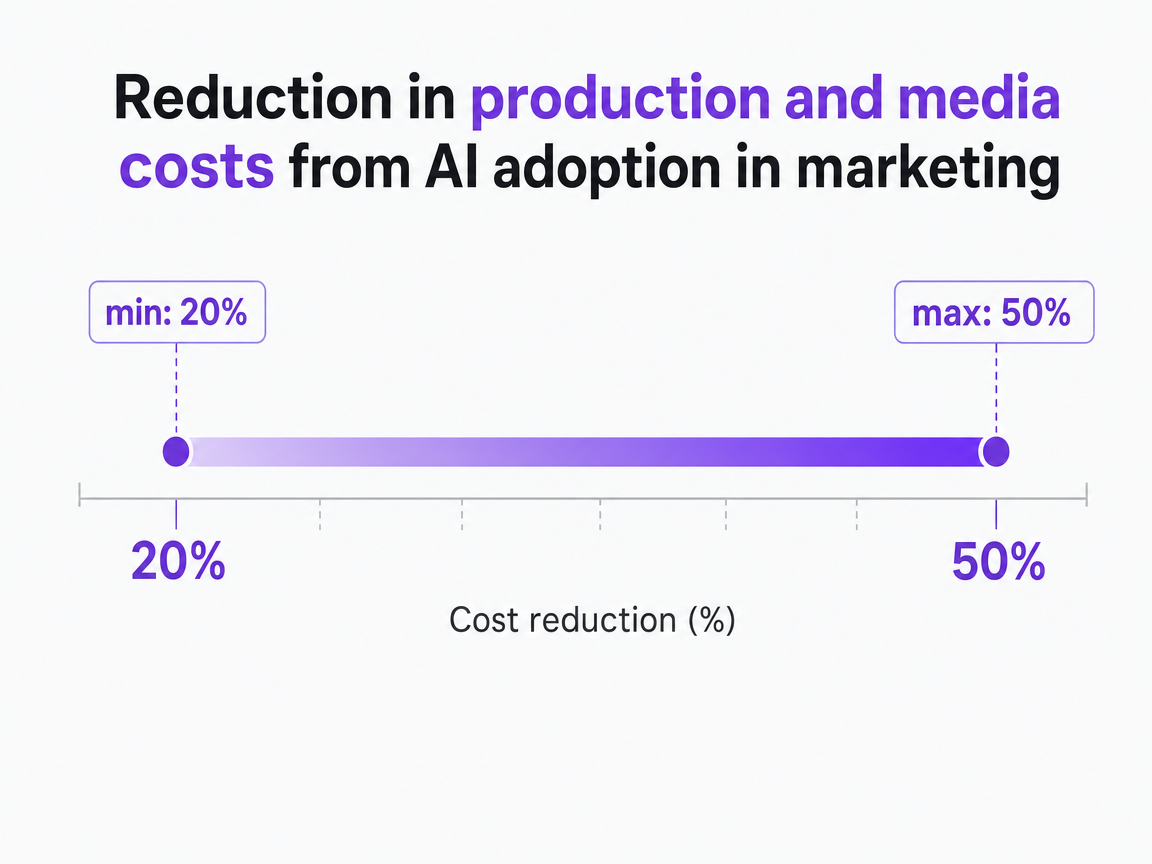 Reduction in production and media costs from AI adoption in marketing
PwC reports a 20-50% reduction in production, third-party, and media costs from AI adoption in various marketing use cases.
Frequently Asked Questions
References
- 1.Economic potential of generative AI.
- 2.The future of marketing in the age of AI.
- 3.How generative AI can boost consumer marketing.
- 4.US Agencies Are Currently Leading Generative AI Adoption.
- 5.The State Of Generative AI Inside US Marketing Agencies, 2025.
- 6.The State Of Generative AI Inside US Agencies, 2024.
- 7.Predictions 2024: AI Accelerates Agencies' Shift To Solutions.
- 8.The economic potential of generative AI: The next productivity frontier.
- 9.The State of Search Marketing, 2024.