
Key Takeaways
- Semrush anchors the stack at the research layer, compressing keyword gap analysis and SERP tracking into roughly 30 minutes per account while leaving prioritization to the strategist.
- Frase turns target keywords into structured briefs in minutes, cutting brief production from 45–90 minutes to 15–20 minutes of strategic editing per piece.
- Claude and ChatGPT handle first-draft production, but output quality scales entirely with the context, briefs, and style samples the strategist feeds in.
- Screaming Frog with AI extraction reduces onboarding technical audits from two specialist days to about two hours of crawl configuration and analysis.
- Surfer grounds on-page optimization in the live SERP, operationalizing the SEO half of McKinsey's high-value A/B testing pattern at the page level 5.
- InLinks automates the internal linking layer most agencies skip, converting a two-to-three-day manual pass on a 400-page site into a review-and-approve workflow.
- Schema App handles structured data deployment across varied CMSs and templates, removing weeks of dev backlog for multi-location clients in legal, healthcare, and home services.
- AirOps consolidates reporting and repeatable deliverables, producing defensible client reports in 30 minutes instead of three hours and improving retention economics.
- Vectoron orchestrates the other eight layers with human approval gates, routing recommendations against live business data like bookings, cost per lead, and pipeline.
The stack, not the tool, is what scales client work
Agency heads searching for the best SEO AI tools are usually asking the wrong question. The bottleneck across a client book of 20, 40, or 80 accounts is rarely a missing feature in a single platform. It is the handoff cost between research, brief, draft, technical audit, on-page fix, internal link pass, schema deployment, and reporting. Each layer has a best-in-class AI tool. Almost none of them talk to each other.
That gap is where portfolio economics break down. Forrester's 2024 read on US agencies documents the same pattern: teams are racing to integrate generative AI across content, media, SEO, and internal use cases, but adoption is fragmented and quality control is inconsistent 1. Buying a better drafting tool does not fix a stack with nine seams.
The nine tools that follow are organized by the specific job each does best, not by feature parity. Read them as a workflow map. The interesting question is not which tool ranks first. It is which layer an agency is still running by hand, and what that costs per client per month.
Why AI is now the default execution layer in SEO
Generative AI has already crossed the line from experiment to baseline behavior inside marketing teams. The American Marketing Association's 2024 survey with Lightricks put numbers on it: nearly 90% of marketers have used GenAI tools at work, 71% use them weekly, 20% use them daily, and 85% of users report productivity gains 4. Those figures were pulled from more than 1,000 professional marketers surveyed in September 2024, not a hand-picked panel of early adopters.
For an agency head of SEO, the practical read is that AI is no longer a competitive edge. It is table stakes. The clients an agency pitches next quarter are running these tools in-house. The junior strategists it hires already draft with them. The question shifts from whether to adopt AI to which layer of the SEO workflow still lacks a defined tool, owner, and QA gate.
That framing changes how a stack gets built. Agencies that treat AI as a single drafting shortcut capture a slice of the possible gain and inherit new QA work. Agencies that map tools to specific layers, from keyword research through internal linking and reporting, compound the savings across every account. The nine tools in the sections that follow are evaluated on that basis: what job each one does inside a portfolio, and where it stops.
How the nine tools map to workflow layers
Nine tools, nine jobs. The stack breaks down cleanly when each layer has one clear owner and one clear output that feeds the next layer.
- Research and competitive gap analysis sit at the top: Semrush.
- Brief generation comes next, translating research into a production-ready spec: Frase.
- Drafting runs on general-purpose models with strategist-supplied context: Claude and ChatGPT, treated as one layer because the choice between them is stylistic, not structural.
- Technical audits and on-page work split into two adjacent jobs: Screaming Frog with AI extraction handles crawl-level diagnostics, Surfer handles page-level optimization against a live SERP.
- Internal linking and entity coverage go to InLinks.
- Structured data at scale goes to Schema App.
- Client reporting and deliverables consolidate in AirOps.
- Orchestration across all eight, with human approval gates between layers, is the ninth job: Vectoron.
The sections that follow evaluate each tool on the same terms: what job it owns, where it stops, and how much strategist time it returns per client per month.
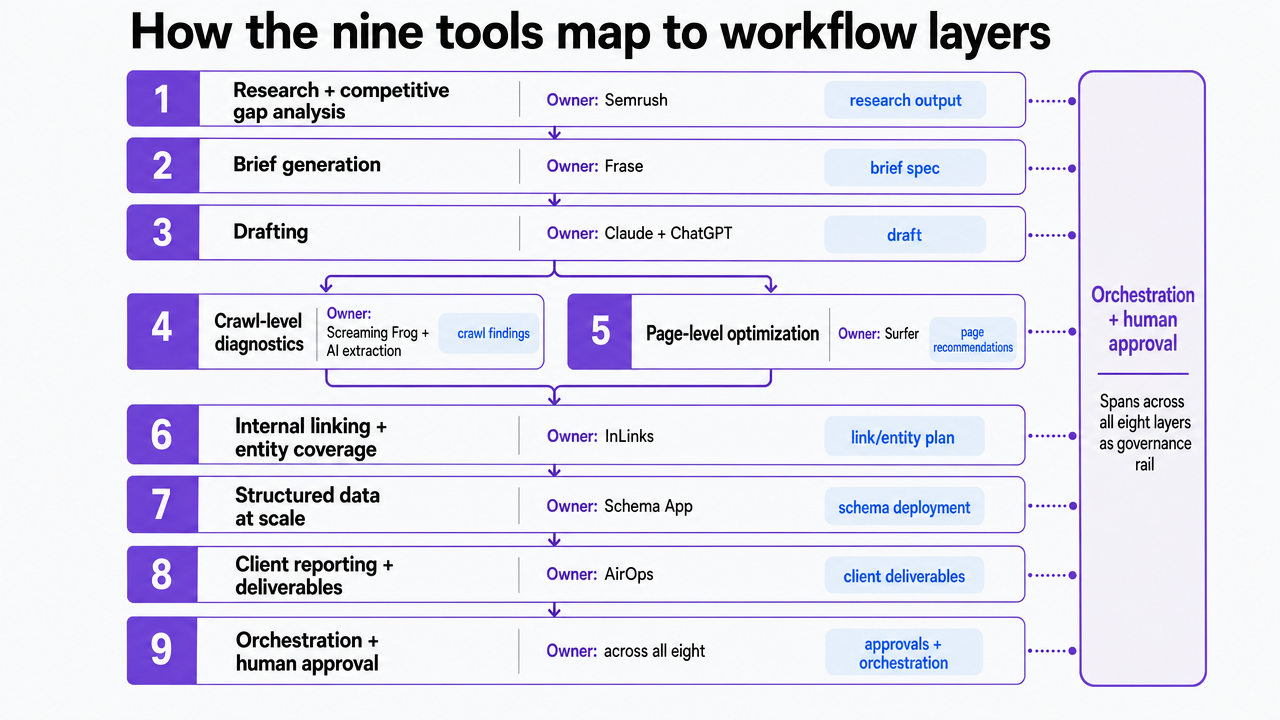 Visualize the nine-layer workflow map described in the section, showing which tool owns which job and how outputs feed downstream layers
Test Real-Time AI SEO Execution Workflows Now
Experience hands-on workflow automation and publish live SEO content before making a commitment.
The nine tools ranked by the job each does best
Semrush: research and competitive gap analysis
Semrush earns the top of the stack because keyword research, SERP feature tracking, and competitive gap analysis are the highest-leverage inputs into everything downstream. A bad brief starts with bad research, and every hour a strategist spends manually pulling ranking data for 40 clients is an hour not spent on strategy.
The AI additions matter less than the data infrastructure underneath them. Position tracking, keyword gap analysis against three or four competitors per client, and the Topic Research module compress what used to be a half-day exercise into roughly 30 minutes per account. Copilot surfaces ranking drops and new keyword opportunities without a strategist opening the project.
Where it stops: Semrush recommendations are directional, not editorial. It will flag a content gap but not decide which of forty gaps a client should attack this quarter. That call remains with the strategist reading the client's pipeline data.
Job owned: research and prioritization inputs. Output: a ranked opportunity list that feeds the brief layer.
Frase: brief generation at portfolio scale
Frase exists to solve one problem: turning a target keyword into a brief a writer can actually work from. It scrapes the top-ranking pages for a query, extracts headings, questions, entities, and word count ranges, and hands back a structured outline in three to five minutes.
For an agency running 15 to 30 briefs a month per client, that math compounds fast. A senior strategist writing briefs from scratch spends 45 to 90 minutes each. Frase brings that to 15 to 20 minutes of editing and strategic overlay, with the raw SERP analysis already done.
Where it stops: Frase produces competent briefs, not differentiated ones. The strategist still has to inject the client's angle, proprietary data, and point of view. Briefs shipped as-is produce content that ranks in a crowded middle and converts poorly.
Job owned: SERP-informed brief scaffolding. Output: a structured brief that a writer or drafting model can execute against.
Claude and ChatGPT: drafting with strategist-supplied context
These belong together because the choice between them is a matter of house style, not workflow architecture. Claude tends to hold long-form structure better and produces cleaner prose on first pass. ChatGPT wins on tool integration, custom GPTs for repeatable client voices, and speed. Most agencies end up running both.
The honest read is that drafting quality now scales with the quality of the context fed in. A model handed a Frase brief, three client style samples, a positioning document, and specific SME quotes produces something a strategist can edit in 30 to 45 minutes. The same model handed a keyword and a topic produces filler that costs more to fix than to rewrite.
Where it stops: neither model knows the client's actual business. They will confidently invent case studies, misattribute quotes, and drift from brand voice when context runs thin.
Job owned: first-draft production against strategist-supplied context. Output: a draft ready for editorial review, not publication.
Screaming Frog with AI extraction: technical audits under one hour
Screaming Frog has been the technical SEO standard for a decade. The relevant addition is its custom JavaScript and AI-driven extraction, which lets a strategist point a crawl at any site and pull structured data the platform was never built to surface: heading intent, thin-content classifications, product schema completeness, alt text quality.
For an agency onboarding a new client, a technical audit that used to require two days of a specialist's time now runs closer to 45 to 60 minutes of crawl configuration and roughly the same in analysis. Recurring monthly crawls across a client book can be scheduled and diffed automatically.
Where it stops: Screaming Frog reports issues. It does not fix them, prioritize them against business impact, or push tickets to a dev team. That translation from crawl output to remediation queue stays with the strategist.
Job owned: technical diagnostics at scale. Output: a ranked issue list ready for on-page and dev workflows.
Surfer: on-page optimization tied to a real SERP
Surfer's contribution is that its recommendations are grounded in the live SERP for a target query rather than a generic content score. Its Content Editor scores drafts against the top-ranking pages for a keyword, flagging term coverage, structure, and internal signals that correlate with pages already winning.
McKinsey identifies A/B testing of page layouts, ad copy, and SEO strategies as one of the highest-value generative AI applications in marketing 5. Surfer operationalizes the SEO half of that pattern at the page level, without a strategist writing test hypotheses from scratch.
Where it stops: Surfer optimizes what already exists. It cannot decide whether a page should exist, what business outcome it serves, or how it fits the client's topic authority map.
Job owned: page-level SERP optimization. Output: a scored draft with specific term, structure, and coverage adjustments ready for a final editorial pass.
InLinks: internal linking and entity coverage
Internal linking is the layer most agencies quietly skip. It is tedious, it does not photograph well in a client report, and it compounds slowly. InLinks automates it by mapping a site's entities, identifying semantically related pages, and suggesting or auto-inserting contextual internal links.
For a client with 400 pages, a manual internal linking pass takes a strategist two to three days. InLinks reduces that to a review-and-approve workflow measured in hours, with the entity graph updating as new content publishes. The entity coverage view also surfaces topic gaps a keyword tool would miss, since it evaluates conceptual coverage rather than string matches.
Where it stops: automated link insertion needs governance. Left unchecked, it will over-link a money page or bury useful contextual anchors in low-priority posts. The strategist still owns the internal linking priority map.
Job owned: internal linking and entity coverage at site scale. Output: an approved link map that ships with each publish cycle.
Schema App: entity and structured data at scale
Structured data is where most SEO stacks fall apart across a portfolio. Hand-coded JSON-LD works for a single site. It fails at 40 clients with different CMSs, page templates, and vertical-specific schema requirements.
Schema App handles the deployment layer. It manages entity relationships, generates schema across page templates, and pushes updates without dev involvement once configured. For multi-location clients, particularly in legal, healthcare, and home services, that removes weeks of dev backlog per rollout.
Where it stops: schema is a technical publishing layer, not a strategy. The tool will not decide which schema types serve a client's search visibility goals or how entity markup should tie into a broader content plan.
Job owned: structured data deployment and entity management across sites. Output: consistent, validated schema shipped with every page without competing for dev cycles.
AirOps: reporting and client-ready deliverables
AirOps sits at the reporting and deliverable layer, where AI-assisted workflows pull ranking data, GSC exports, and analytics into structured outputs a strategist can send without three hours of formatting. Custom workflows chain LLM steps with data sources, so a monthly client report or a competitor teardown becomes a repeatable pipeline rather than a manual build.
The returns show up in retention economics. Clients cancel when they cannot see progress. A senior strategist producing a defensible, insight-driven report in 30 minutes instead of three hours means either more accounts per strategist or more strategic time per account.
Where it stops: AirOps produces the deliverable. It does not read the account's business context, decide what the client actually needs to see this month, or write the strategic narrative that frames the numbers.
Job owned: reporting and repeatable deliverable production. Output: client-ready reports and analyses that ship faster without losing analytical depth.
Vectoron: orchestration across the stack
Vectoron sits at the ninth layer, which most agencies underinvest in: coordination across the other eight. The eight tools above each own a job. None of them govern the handoffs, route decisions for human approval, or track which recommendations shipped against which KPI.
The platform runs specialist AI strategists across content, SEO, PPC, backlinks, social, and call intelligence, feeding recommendations into a Command Center where a human signs off before execution. The signal it reads is live business data, qualified calls, bookings, cost per lead, pipeline, not tool outputs in isolation. Every recommendation includes the reasoning behind it.
Where it stops: orchestration presumes the underlying execution layers are staffed, whether by point tools or in-house work. It coordinates decisions and executes approved work; it does not replace a strategist's judgment on which client priorities matter this quarter.
Job owned: cross-channel orchestration with approval gates. Output: ranked recommendations, executed after human sign-off, tracked to KPI impact.
Hours reclaimed per client, per month
Scope note: this section shifts from single-tool evaluation to portfolio math. The reader running one site can ignore the multipliers. The reader running 20 to 80 clients should read the table as an agency-supplied worksheet, not a benchmark.
Deloitte's 2024 research on generative AI in marketing found that users save an average of 11.4 hours per week, roughly 28% of a standard 40-hour week, redirected from production toward higher-value work 3. That figure was measured across marketers using GenAI broadly, not agency SEO specialists specifically, so it is the ceiling to work backward from, not a floor to promise clients.
The table below distributes that reclaimed time across the nine workflow layers on a per-client, per-month basis. The manual hours column reflects a mid-sized client, roughly 15 briefs and one technical pass per month. Agencies with heavier or lighter accounts should overwrite both columns.
| Workflow layer | Manual hours/client/month (agency variable) | AI-assisted hours/client/month (agency variable) ||---|---|---|| Research and gap analysis | 4–6 | 1–2 || Brief generation (15 briefs) | 11–22 | 4–5 || Drafting and editorial review | 20–30 | 10–15 || Technical audit and diffs | 3–4 | 1 || On-page optimization | 6–8 | 2–3 || Internal linking pass | 4–6 | 1 || Schema deployment | 2–4 | <1 || Reporting and deliverables | 3–4 | 1 || Orchestration and approvals | ad hoc | 1–2 |
Across 40 accounts, the compounded delta lands inside McKinsey's 5–15% marketing productivity range without inventing a dollar figure the research does not support 2.
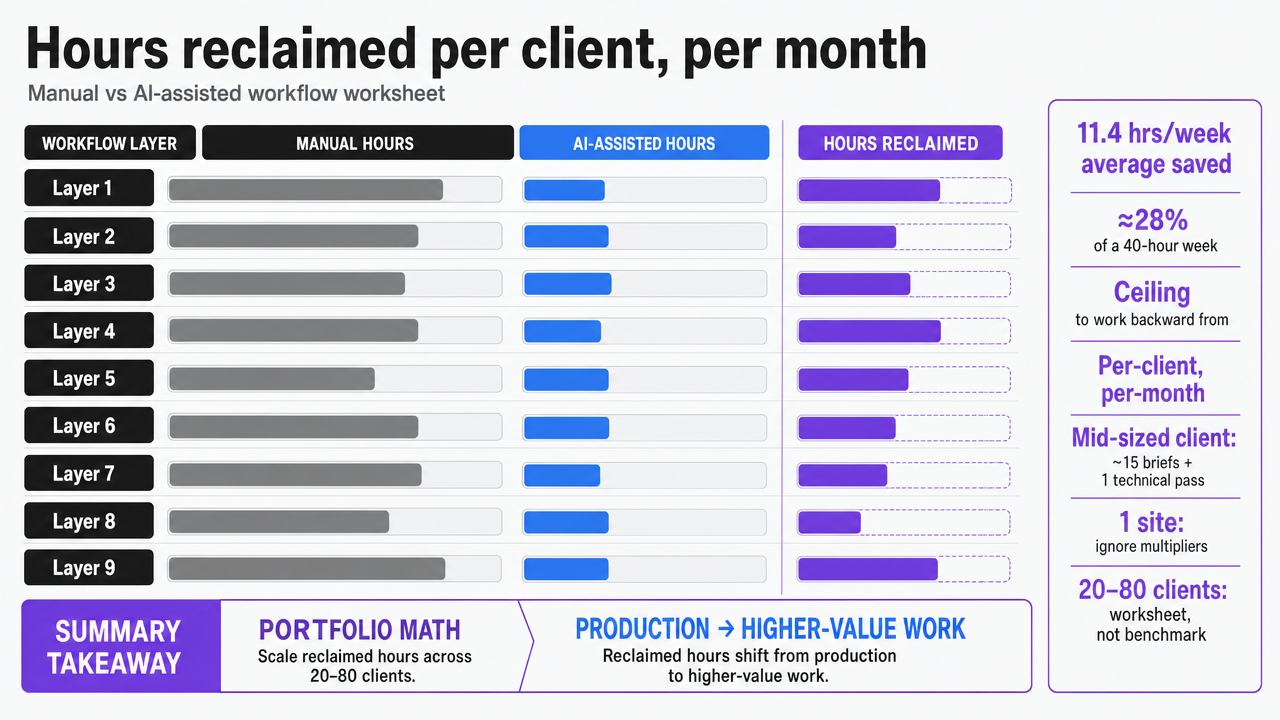 Turn the section's per-layer manual vs AI-assisted hours table into a scannable comparison, reinforcing the 11.4 hours/week and 5–15% productivity figures cited nearby
If you manage 20+ clients: governance before capacity
Scope note: this section is written for agency leads running 20 or more accounts. Single-site operators can skip ahead. The governance problem below only appears at portfolio scale, where the same AI stack touches enough surface area that quality control becomes a math problem, not a checklist.
SEO teams hit that math problem faster than most functions. McKinsey's State of AI 2024 survey found that sales and marketing saw the largest jump in generative AI adoption between 2023 and 2024 among the business functions studied 7. The consequence is not just more output. It is more places where a hallucinated case study, an over-optimized meta description, or an auto-inserted internal link can ship without a human reading it.
The governance failure mode at 20-plus clients is predictable: brand drift on three accounts, a schema misfire on a fourth, and a factual error on a fifth, all in the same week, because no single strategist saw every publish. Capacity gains evaporate into remediation work.
The fix is architectural, not procedural. Approval gates need to sit between layers, not after publish. Every AI-generated output, brief, draft, link map, schema payload, needs a named human owner and a sign-off record before it moves downstream. Agencies that add capacity before adding governance rebuild the same QA bottleneck they were trying to eliminate, only now spread across nine tools instead of one editor's queue.
See How Leading Agencies Automate SEO Workflows with AI-Driven Precision
Request a walkthrough of unified AI SEO platforms that streamline content production, approvals, and reporting—enabling your team to scale client delivery without increased headcount or loss of oversight.
What the strategist still owns
AI covers execution. It does not cover judgment. Across every layer in the stack, the residue of work that stays with a human strategist is the same shortlist:
- deciding which client priorities matter this quarter,
- reading the account's business context against its pipeline,
- catching factual and brand drift before publish,
- and negotiating tradeoffs the tool cannot see.
McKinsey's work on generative AI in marketing and sales is explicit that AI use cases in SEO, A/B testing, and content optimization work best when paired with governance and human oversight, particularly on customer-facing output where hallucinations and trust erosion carry real cost 5. That is the strategist's territory. Reviewing an AI-drafted brief takes 15 minutes. Deciding it should not exist because the client's real problem is conversion, not traffic, takes experience the model does not have.
Agencies that internalize that split hire fewer producers and more strategists. The stack does the work. The humans decide which work is worth doing.
How to sequence adoption across a client book
The mistake most agencies make is deploying the full stack at once. Nine tools introduced simultaneously across 40 accounts produces nine half-configured workflows and no clear ownership. A staged rollout compounds returns faster.
- Start with the two layers that gate everything downstream: research and briefs. Semrush and Frase together unlock the largest single time recovery per client, because every piece of content shipped that quarter depends on the input they produce. Roll them out across the full client book before touching drafting tools.
- Second wave: drafting and on-page. Claude or ChatGPT paired with Surfer moves once briefs are consistent, since drafting quality is bounded by brief quality.
- Third wave: technical and structural layers, Screaming Frog, InLinks, Schema App, prioritized against clients with the largest technical debt.
- Reporting and orchestration close the loop last, once the underlying execution layers are producing enough signal to coordinate.
Agencies that reverse this order, buying orchestration before the layers exist to orchestrate, end up with a Command Center coordinating manual work.
Frequently Asked Questions
References
- 1.The State Of Generative AI Inside US Agencies, 2024.
- 2.A marketing organization that thrives with AI.
- 3.Deloitte Digital's latest research forecasts generative AI's impact on marketing content production.
- 4.Generative AI Takes Off with Marketers.
- 5.Marketing and sales soar with generative AI.
- 6.The economic potential of generative AI: The next productivity frontier.
- 7.The state of AI in early 2024: Gen AI adoption ....