
Key Takeaways
- AI search now returns summaries on roughly half of Google queries, making the traditional agency retainer built for ten blue links a poor fit for how visibility actually gets decided 1.
- Reframe the buying question as build, buy, or orchestrate — most in-house teams sit in the middle case where an AI execution platform beats both a full retainer and a point-tool stack.
- Any modern SEO operation must cover eight functions, from keyword intent mapping and technical SEO through GEO and substantiation QA, and gaps in any one surface in the pipeline months later.
- Stop budgeting GEO and classical SEO as separate vendor tracks; one editorial calendar with two output specifications closes the 20–50% performance gap McKinsey documents 1.
- Paid and organic interact at the query level, so splitting SEO and PPC across two vendors hides the joint economics that determine where the next dollar should go 4.
- Judge any service on page-level quality against a defined query set, not on brief volume — the peer-reviewed evidence is blunt that content quality and keyword discipline decide outcomes 5, 6.
- Substantiation risk stays with the advertiser regardless of who drafts the copy, so a compliance QA gate with an auditable log belongs inside the approval workflow 9.
- For multi-location operators, consolidation pays off when per-location content and coordination overhead collapse into fixed costs and cost per qualified lead holds flat or drops.
The SEO services question changed when AI search arrived
The phrase "best SEO marketing services" used to point to a shortlist of agencies. That framing is stale. McKinsey's analysis of AI search finds that roughly 50% of Google searches now return an AI summary, and forecasts push that figure above 75% by 2028 1. The surface where organic visibility is decided is shifting under the retainer model that most agencies were built to sell.
For a VP of marketing running a small in-house team, the practical consequence is straightforward: the deliverables a traditional agency ships each month — a keyword report, a few briefs, some link placements — describe a pipeline optimized for the ten blue links, not for generative overviews that summarize answers before a user clicks. McKinsey's diagnostics point in a different direction, toward content built for credibility, structure, and machine readability across both classical results and AI answer surfaces 1.
That reframes the buying question. Marketing leaders are no longer choosing between Agency A and Agency B. They are choosing between three operating modes: keep the function fully in-house with point tools, layer an AI execution platform on top of the existing team, or contract narrow specialists for specific gaps. Each mode has a different cost curve, a different oversight profile, and a different fit with the AI-search shift.
The remainder of this piece is a diagnostic for that decision. It maps eight SEO functions any modern operation must cover, compares four delivery models against them, addresses the GEO-versus-SEO budget question, and closes with a compact framework for when to keep work internal, when to add a platform, and when a specialist contractor still wins. It is written for in-house operators, not for buyers looking for a retainer.
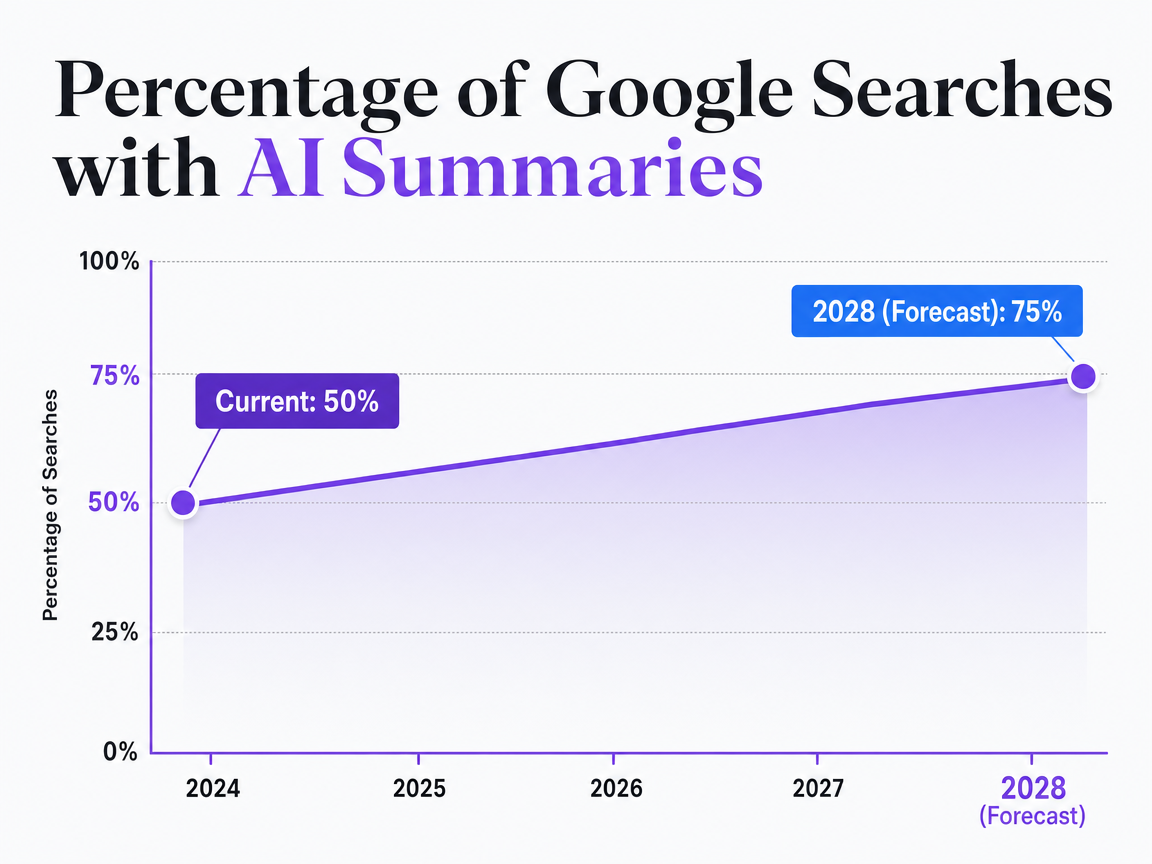 Percentage of Google Searches with AI Summaries
Shows the rapid adoption and presence of AI summaries in Google search results, with a current estimate and a 2028 forecast from McKinsey.
Reframing 'best services' as build-vs-buy-vs-orchestrate
The retainer question is the wrong starting point. A more useful one: which parts of the SEO function does the in-house team already own, which parts should be bought as software, and which parts need a human specialist on call?
Three operating modes sit under that question. Build means running SEO end-to-end with the existing team and a stack of point tools — a rank tracker, a crawler, Search Console, GA4, and a content brief tool. Buy means signing a monthly agency retainer that bundles strategy, production, and reporting under one vendor. Orchestrate means keeping strategy and approval in-house while an AI execution platform handles production, publishing, and cross-channel coordination across content, technical fixes, local listings, and paid overlap.
The orchestrate mode is the newer option, and it is the one that changes the economics. Peer-reviewed work on SEO performance drivers keeps returning to the same conclusion: content quality and disciplined keyword selection determine outcomes, not the volume of deliverables a vendor ships each month 5, 6. A team that owns judgment on those two variables can push execution volume through software without losing the quality that makes rankings hold.
Build wins when the team is technically deep, publishing volume is low, and the vertical is not compliance-heavy. Buy wins when there is no in-house SEO literacy at all and the company can absorb the retainer as a training cost. Orchestrate wins in the middle case — a two-to-six person team, a publishing schedule that already strains capacity, and a leadership mandate to grow organic pipeline without adding headcount. Most in-house VPs reading this piece are sitting squarely in that middle case.
The capability matrix marketing leaders should actually evaluate
Eight functions any modern SEO operation must cover
Before comparing delivery models, the function list has to be fixed. Any SEO operation worth the budget line covers eight distinct jobs, and gaps in any one of them tend to show up in the pipeline three to six months later.
- Keyword research and intent mapping. Not a spreadsheet of volumes. A prioritized set of queries tied to specific service lines, buyer stages, and conversion actions. The peer-reviewed evidence is direct: disciplined keyword selection drives marketing performance, and overuse actively degrades results 5, 6.
- Technical SEO. Crawl health, site architecture, Core Web Vitals, structured data, log-file analysis, indexation control. The plumbing that decides whether anything else the team ships gets discovered.
- Content production. The volume-plus-quality problem. Publishing schedules that outpace the team's editorial capacity are where most in-house operations quietly fail. Content quality, not deliverable count, decides outcomes 5.
- Local SEO. Google Business Profile management, citation consistency, review velocity, location-page architecture. For a dental DSO with 40 practices or an HVAC operator across six metros, this is where organic revenue actually lives.
- Link acquisition. Digital PR, unlinked mention reclamation, resource-page outreach, partnership placements. The category most vulnerable to vendor fraud and the one most likely to sit unowned inside an in-house team.
- Analytics and attribution. GA4, Search Console, call tracking, CRM pipeline joins, cohort analysis. Without this layer, the VP cannot tell the CFO what organic actually produced.
- Generative engine optimization (GEO). Structuring content for citation and inclusion inside AI answers, monitoring share of voice across ChatGPT, Perplexity, and Google's AI Overviews. A distinct workflow from classical SEO, not a subset of it 1.
- Substantiation and compliance QA. Every claim, price, testimonial, and endorsement on a page has to survive an FTC read. In legal, healthcare, and financial services, this function is the one that gets a general counsel out of the marketing team's inbox.
Four delivery models mapped against those functions
Four models compete for those eight jobs. Each covers a different subset of the matrix, and each carries a different oversight cost. The American Marketing Association's KPI set — organic traffic, keyword rankings, CTR, bounce and dwell time, indexation status, and conversion rate — is the honest scoring rubric for all four 7. A model that cannot report against those six metrics is not a serious option regardless of price.
- In-house solo operator or small team with point tools. Highest control, tightest strategic alignment, and the tightest capacity ceiling. A two-person team can run keyword research, technical SEO, analytics, and compliance QA well. Content production at scale and link acquisition are where the model breaks. GEO coverage tends to be aspirational rather than executed.
- Agency retainer. Broad coverage on paper across all eight functions. The trade-off is control latency: strategy shifts route through account managers, briefs, and revision cycles. Substantiation risk sits with the client regardless of who drafted the copy. Attribution reporting is usually the agency's weakest deliverable, because honest measurement threatens the retainer.
- Freelancer stack. A technical SEO consultant, a content writer or two, a link-building specialist, and a local SEO contractor stitched together by the VP. Coverage can be excellent on individual functions, but coordination overhead becomes a second job. Compliance QA and GEO tend to fall between contractors.
- AI execution platform with human approval. The newer model. Software handles production, publishing, and cross-channel coordination; the in-house team keeps strategy, judgment, and sign-off. Coverage on content production, technical SEO monitoring, local SEO at scale, analytics, and GEO is where these platforms concentrate. Link acquisition still typically needs a human partner. Vectoron sits in this category, coordinating specialist AI strategists across content, SEO, PPC, backlinks, and call intelligence under one approval workflow.
The matrix below maps coverage strength against the eight functions and grades each model on the six AMA KPIs it can actually report against 7. Two patterns emerge. Agency retainers score wide but shallow on measurement. Freelancer stacks score deep but narrow, with coordination as the hidden line item. AI execution platforms score wide and deep on production and measurement but still require a human specialist for link acquisition in most verticals. The in-house-only model wins on control and loses on capacity — the exact trade-off that pushes most VPs toward a hybrid.
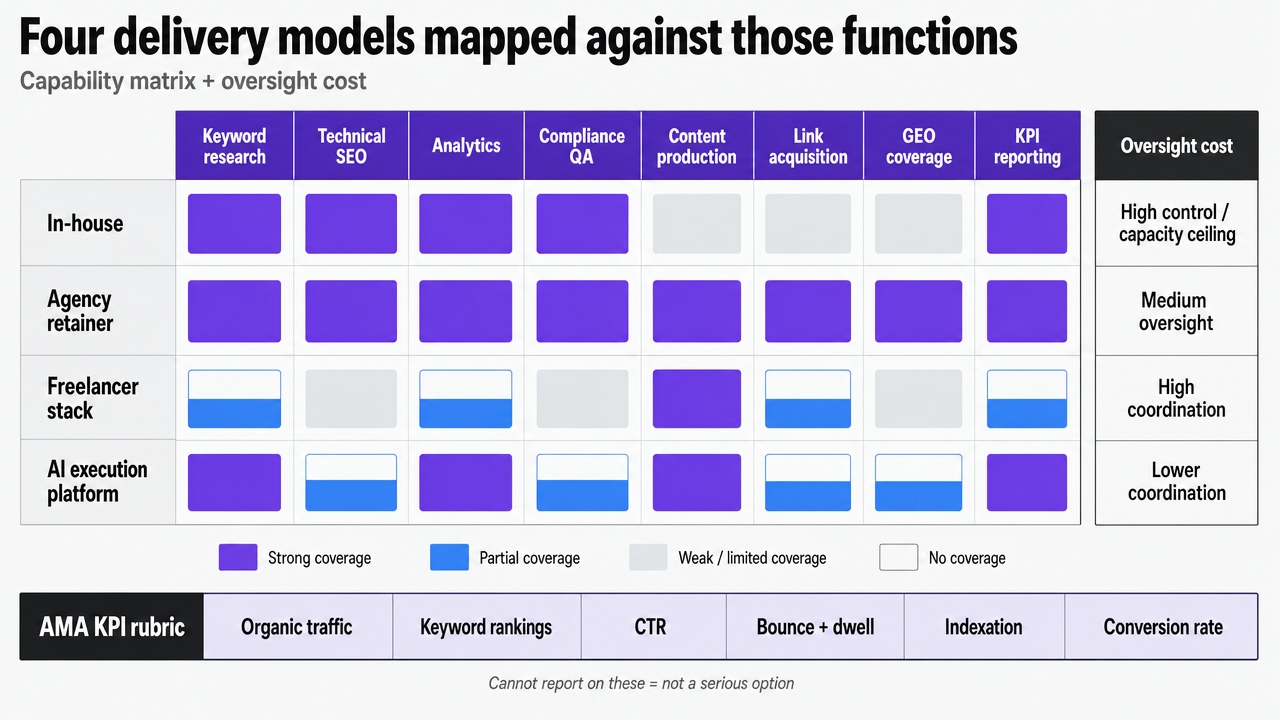 Visualize the section's explicit comparison of four delivery models (in-house, agency retainer, freelancer stack, AI execution platform) against the eight SEO functions enumerated in the prior subsection, serving as the capability matrix the section describes
Test Data-Driven SEO Execution in Real Time
Experience how streamlined workflows deliver measurable SEO impact before making a long-term commitment.
GEO and SEO now share one budget line
Splitting the budget between classical SEO and generative engine optimization is a bookkeeping habit, not a strategic one. The two disciplines pull from the same content asset, the same site architecture, and the same authority signals. Separating them into two vendor tracks doubles the coordination overhead and produces the visibility gap McKinsey has been documenting.
That gap is measurable. McKinsey's analysis of AI search finds that brands' generative engine optimization performance currently lags classic SEO performance by roughly 20 to 50 percent, a spread wide enough to distort any dashboard that treats the two channels as one line item 1. The distortion runs the other way, too: teams that pour resources into GEO tactics without shoring up the classical SEO foundation tend to underperform on both surfaces, because the same crawlable structure, entity clarity, and citation footprint feed both engines.
The operational implication for a lean in-house team is a single content and technical workflow with two output specifications. Every long-form asset gets built for the ten blue links and for the answer surface: schema markup, clear entity anchoring, extractable summary passages, source attribution the AI engines can parse, and topical depth that survives being compressed into a two-sentence overview. Every technical audit checks indexation, Core Web Vitals, and the emerging signals that determine whether Gemini or ChatGPT will cite the page.
One team, one editorial calendar, one measurement layer, two output surfaces. That is the budget line marketing leaders should defend, not two separate ones stapled to two separate vendors.
Why paid and organic should sit in one workflow, not two vendors
The habit of running an SEO agency on one contract and a PPC agency on another survives because it is easy to procure, not because it produces better results. The academic evidence points the other way. Ghose and Yang's work at NYU Stern, the first study to estimate how sponsored search ads shape consumer search, click, and conversion behavior in the presence of organic listings, finds that the two channels interact — clicks on one affect the economics of the other, and the mix has to be modeled jointly to be optimized 4.
Split vendors cannot model that interaction. The SEO agency reports on organic sessions and rankings. The PPC agency reports on cost per click and ROAS. Neither can tell the VP what the combined query landscape looks like when a branded PPC bid suppresses an organic click that would have converted anyway, or when an organic ranking gain lets the team pull spend off a defensive keyword. That question sits between two invoices.
A single workflow — one keyword universe, one attribution layer, one weekly cadence covering both surfaces — closes the gap. The in-house team keeps strategy and approval; the execution layer, whether that is a shared analyst or an AI platform coordinating both channels, decides where the next dollar and the next brief go. One P&L line for search, not two.
Content quality and keyword discipline still decide outcomes
Every delivery model discussed so far rises or falls on the same two variables. The peer-reviewed literature on SEO performance is unusually blunt on this point: content quality is described as "everything," and keyword overuse is called out as a direct route to worse results, not better ones 5, 6. The volume of briefs, backlinks, and audits a vendor ships each month is a proxy metric. It is not the driver.
That has three practical consequences for the operating decision.
The first is that any service or platform under evaluation should be judged on what it produces at the page level, not on the size of its content calendar. A team publishing four rigorously researched, entity-rich pieces a month against a defined query set tends to outperform one shipping twenty thin posts against a keyword volume list. The 2024 literature review is explicit that actionable data on search intent, not raw volume tallies, is the right input to keyword strategy 6.
The second is that keyword discipline is a judgment function, and judgment sits with the in-house team. Software can surface clusters, gaps, and cannibalization risks. It should not choose which service line the next ten pieces target. That decision belongs to the VP and the revenue owner, informed by pipeline data the tools cannot see.
The third is a filter for platform selection. A production layer that can absorb a tight editorial standard — voice, evidence rules, internal linking logic, compliance checks — is worth paying for. One that produces volume without those constraints is not, regardless of the monthly output number on the pitch deck 5.
See How Leading Teams Execute Enterprise-Grade SEO Without Expanding Headcount
Request a walkthrough of unified, AI-powered SEO workflows designed for agencies and multi-location brands seeking predictable results—no hiring, no vendor management, full pipeline visibility.
Substantiation and compliance: the VP's legal exposure
Every page an outside service publishes under the client's domain becomes the client's problem when the FTC reads it. That is the sentence most "best SEO services" comparisons skip, and it is the one that changes the vendor scorecard.
The rule set is not ambiguous. The FTC's position is that advertisers must have evidence to back up their claims, and claims made on the internet must be truthful and substantiated 9. That standard applies to the service page a content writer drafted at 2 a.m., the meta description an AI tool auto-generated, and the schema markup a technical vendor pushed live. The SBA reinforces the same baseline for small and mid-sized operators: marketing content must be truthful and legally compliant, full stop 2.
Three enforcement surfaces matter for the SEO workstream specifically. Pricing and fee disclosure sits on top. The FTC's Rule on Unfair or Deceptive Fees, effective May 12, 2025, targets bait-and-switch pricing and tactics that obscure total prices, initially covering live-event tickets and short-term lodging but signaling the enforcement posture for landing pages that quote incomplete prices 3. Testimonials and reviews sit next. Endorsement content cannot mislead consumers, and vendors that generate review widgets, testimonial carousels, or influencer placements as part of an SEO reputation play inherit that standard 10. General claim substantiation covers the rest — outcome numbers, comparative superlatives, and "leading" or "best" language on service pages all require proof on file 8.
The operational fix is a compliance QA gate inside the approval workflow, not a separate contract with a law firm. Every asset — page, brief, snippet, structured data field, ad extension — passes a substantiation check before publish: claim inventory, evidence source, disclosure placement, review authenticity. Services and platforms that cannot expose that check in an auditable log are shifting risk onto the client without saying so.
If you manage multiple locations: the consolidation math
Audience switch: this section is written for multi-location operators — dental DSOs, personal injury firms with satellite offices, HVAC brands across metros, senior living portfolios. Single-location readers can skip to the decision framework.
The consolidation argument for portfolio operators is not about lower prices. It is about eliminating the coordination tax that scales with location count. A 40-practice DSO running a national SEO agency, a local listings tool, a separate content vendor, a link-building contractor, and an in-house analyst spends more staff hours reconciling those five outputs than the outputs themselves cost. That reconciliation is where the paid-plus-organic interaction effect the NYU Stern work identified gets lost — nobody is modeling the joint economics across locations because nobody owns the whole dataset 4.
The table below compares a traditional multi-vendor stack against an AI-platform-led in-house stack for a mid-market multi-location operator. Retainer and per-location content figures are left as variables the reader fills in from actual invoices; the platform column uses Vectoron's published $599/mo trial pricing. The figures marked illustrative are placeholders, not benchmarks.
| Monthly line item | Multi-vendor stack | AI-platform-led in-house stack |
|---|---|---|
| Core platform or retainer fee | $X/mo agency retainer | $599/mo trial pricing |
| Per-location content production | $Y per location × N locations | Included in platform output |
| Local listings management | Separate tool subscription | Included |
| Link acquisition | Separate contractor | Separate contractor (unchanged) |
| Analytics and reporting labor | 4–8 hrs/week internal (illustrative) | 1–2 hrs/week approval time (illustrative) |
| Coordination overhead | 3–6 hrs/week status and briefs (illustrative) | Consolidated in one queue |
Two lines drive the delta. Per-location content collapses from a variable that multiplies with N into a fixed platform cost. Coordination overhead — the meetings, briefs, and revision loops that a five-vendor stack demands — folds into a single approval queue that scales with location count without scaling headcount. Link acquisition stays external because human relationship work still outperforms software on that function.
The math a portfolio operator should run before signing anything: total current spend, minus the platform-covered lines, plus the retained specialist cost, divided by qualified lead volume across all locations. If the resulting CPQL is flat or lower and the reporting layer finally lets one analyst see paid and organic in one view, consolidation earned its keep.
A decision framework: keep in-house, add a platform, or hire a specialist
The three-mode question resolves faster than most VPs expect once four variables are on the table: team size, vertical risk, publishing volume, and attribution maturity. Each variable pushes the decision toward one of the operating modes, and the modes stack rather than compete.
Keep it fully in-house when the team is technically deep, publishing volume runs below eight assets a month, and the vertical carries low substantiation risk. A two-person operation covering B2B SaaS with a mature Search Console and GA4 practice can hold ground here. The AMA KPI set — organic traffic, rankings, CTR, bounce and dwell, indexation, conversion rate — is trackable without a vendor layer 7. The ceiling arrives when the content calendar outpaces editorial capacity.
Add an AI execution platform when publishing volume has already broken the team, when GEO coverage is aspirational rather than executed, or when the vertical demands a compliance QA gate that a freelancer stack cannot maintain in an auditable log. This is the middle case — a two-to-six person team, a growth target, a headcount freeze. Platform execution absorbs content production, technical monitoring, local SEO across locations, and cross-channel coordination that the paid-plus-organic interaction effect the NYU Stern work identified makes necessary 4. Strategy and approval stay in-house.
Hire a specialist contractor for the jobs software still loses. Link acquisition through digital PR and relationship work belongs on this list. A one-time technical migration, a Core Web Vitals overhaul, or a schema rebuild for a legal vertical belongs here too. These are bounded projects with defined deliverables, not retainers.
Most in-house operations end up running two of the three modes at once: an internal team on strategy, an AI platform on execution, a specialist on call for the narrow work. Vectoron sits in the platform slot for teams that want that middle layer under one approval workflow. The retainer agency, notably, is absent from the recommended stack — its coverage overlaps every other mode without matching any of them on control or cost.
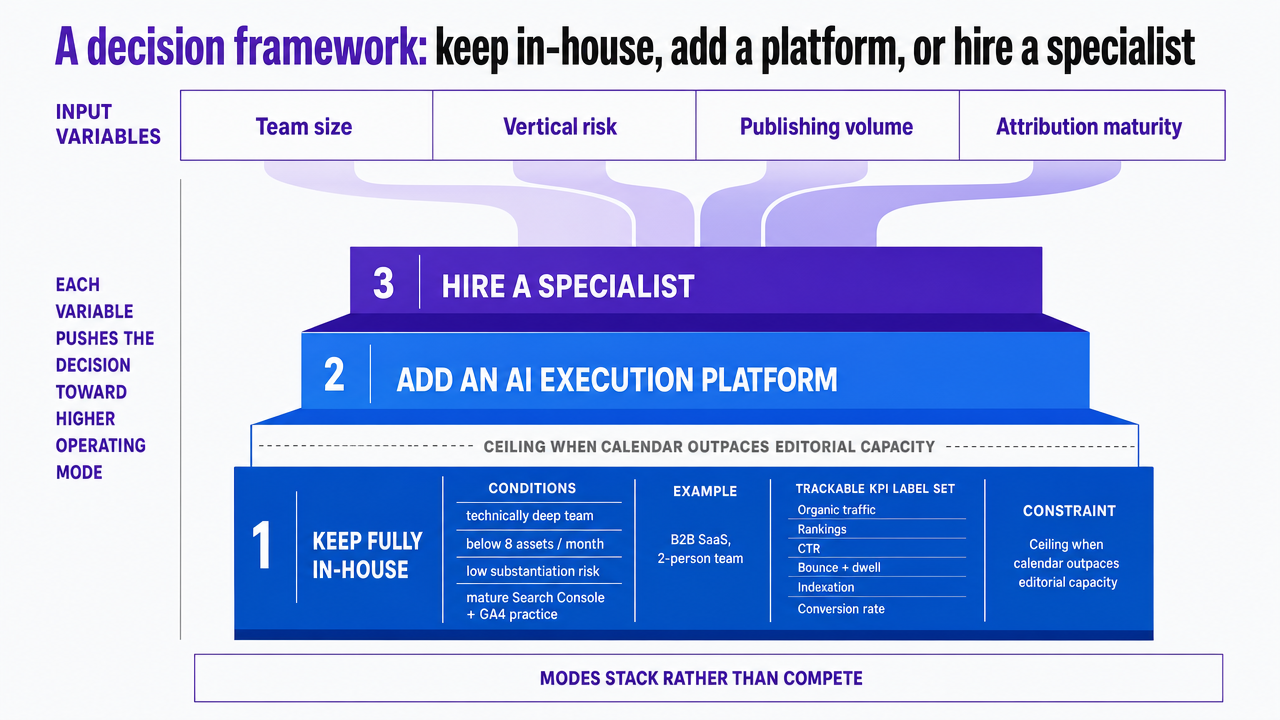 Visualize the section's explicit decision framework mapping four variables (team size, vertical risk, publishing volume, attribution maturity) to three stackable operating modes described in the prose
Frequently Asked Questions
References
- 1.Winning in the age of AI search.
- 2.Marketing and sales | U.S. Small Business Administration.
- 3.Online Advertising and Marketing.
- 4.Analyzing the Relationship Between Organic and Sponsored Search Advertising.
- 5.Search engine optimisation (SEO) strategy as determinants to enhancing the marketing performance of online entrepreneurs.
- 6.The Significant Role of SEO in Effective Web Marketing.
- 7.What is SEO Marketing? [A Comprehensive Overview].
- 8.Advertising and Marketing Basics | Federal Trade Commission.
- 9.Advertising FAQ's: A Guide for Small Business.
- 10.Endorsements, Influencers, and Reviews - Federal Trade Commission.