
Key Takeaways
- Semrush consolidates keyword research, competitor analysis, and rank tracking into one interface junior analysts can operate, moving utilization rate rather than raw data accuracy per point.
- Ahrefs anchors client retention conversations through backlink depth, giving strategists concrete referring-domain deltas to defend progress in quarterly business reviews.
- BrightEdge and Conductor only pencil out for enterprise retainers where workflow depth, role-based dashboards, and CMS integrations justify per-domain seat costs 9.
- Moz functions as a cross-check platform, providing a third data source that shortens dispute resolution when Ahrefs and Semrush disagree on the same domain 1.
- Screaming Frog remains irreplaceable for technical audits because file-level crawl data exposes render-path issues that all-in-one audit tabs summarize into indicators 12.
- Siteimprove earns its seat cost on regulated accounts where WCAG conformance and SEO audit reporting collapse into one document, preventing scope-creep escalations.
- Vectoron sits in the execution layer, absorbing the brief-to-publish production relay through six coordinated specialists and human sign-off, substituting for FTE hours rather than research licenses.
Why Tool Selection Is Now a Margin Decision, Not a Feature Decision
A 2026 study in the Journal of Information Science ran the same domains — the open-access publishers MDPI and Frontiers — through Ahrefs, Semrush, Serpstat, and Ubersuggest. The four tools disagreed materially on organic keyword counts, search volumes, and URL-based traffic, with low overlap across the reported figures for identical URLs 1. The authors concluded that tool selection alone can shift what an analyst reports about a site's visibility.
For agency owners, that finding reframes the entire vendor conversation. When two crawlers describe the same client site differently, the argument that one platform is objectively "more accurate" collapses. What remains is a question about which platform produces defensible reporting fastest, at what license cost per managed account, and with what downstream production consequences for the strategists using it.
That question is an economic one. An agency running 40 accounts on a $500-per-seat platform absorbs licensing costs differently than one running 400 accounts on the same seats. The variance in reported metrics 1 also means junior analysts spend measurable hours reconciling numbers across tools — hours that get billed at cost, not at margin. Multiply that by every monthly report cycle and tool selection stops being an IT decision and starts showing up in gross margin per account.
The picks in the sections that follow are organized around that economic frame. Each tool is evaluated for what it does to utilization rate, delivery speed, and retention risk — not for whether it has the biggest index or the newest feature list. Feature parity is largely a solved problem across the leading platforms. The remaining differences are operational, and operational differences are where agency margin lives or dies.
How to Read the 8 Picks: A Three-Layer Agency Stack
The list that follows is not a ranking. Ranking Ahrefs against a technical crawler against an execution platform produces the same category confusion that leads agencies to buy overlapping licenses and still run short on production capacity. The picks are grouped into three functional layers, and each layer answers a different question about how work actually moves through an agency.
The research and intelligence layer is where keyword sets, competitor gaps, backlink profiles, and SERP data get sourced. Semrush, Ahrefs, BrightEdge, Conductor, and Moz sit here — the platforms Forrester has repeatedly grouped in its enterprise SEO Wave 9. These tools generate the inputs a strategist needs, and they are also the tools whose reported figures diverge most sharply from one another on identical URLs 1.
The technical audit layer covers site health, crawlability, page performance, and accessibility. Screaming Frog and Siteimprove sit here. All-in-one platforms replicate slices of this work, but neither the crawl depth of Screaming Frog nor the compliance overlay of Siteimprove is fully absorbed by a research suite.
The execution layer is the newer category and the one where agency margin is currently being redistributed. It is where research outputs get turned into published deliverables without a full brief-to-draft-to-QA relay. Vectoron is the pick here. Read the sections that way — by role, not by rank.
The Research and Intelligence Layer
Semrush: Breadth That Absorbs Junior Analyst Hours
Semrush earns its place in most agency stacks by consolidating keyword research, competitor analysis, position tracking, and content briefs into one interface that a junior analyst can operate without a senior strategist sitting next to them. That breadth is the operational argument. A single seat replaces two or three point tools, and the reports it exports plug into monthly client decks with minimal reformatting.
The trade-off is the one flagged by the Journal of Information Science analysis of MDPI and Frontiers domains: Semrush's reported organic keyword counts and traffic figures diverged noticeably from Ahrefs, Serpstat, and Ubersuggest on the same URLs 1. For an agency, that variance shows up in client conversations when a prospect quotes a competitor's Ahrefs traffic figure and the strategist has to explain why the Semrush number reads lower. Reconciliation eats hours.
Semrush belongs in the stack for agencies where the majority of monthly deliverables — keyword universes, competitor snapshots, rank tracking, on-page recommendations — can be produced by mid-level analysts working inside a single interface. It is a utilization-rate play. The lever it moves is the ratio of billable production hours to total hours worked, not the raw quality of any individual data point.
Ahrefs: Backlink Depth as a Retention Argument
Ahrefs and Semrush get lumped together in most vendor comparisons, but they do different jobs inside an agency. Ahrefs's backlink index remains the reference point strategists reach for when a client asks why a competitor is outranking them despite thinner on-page content. The answer is usually referring domains, and Ahrefs surfaces that answer faster and with more depth than the alternatives named in the cross-tool study 1.
The retention argument follows from that. Clients cancel when they cannot see progress. Backlink acquisition is one of the slower SEO levers, but it is also one of the most defensible in a quarterly business review because the deltas are concrete — domains added, domain rating shifts, referring page counts. A strategist who can walk a client through a month-over-month backlink report from Ahrefs is holding a retention tool, not just an analytics tool.
The cross-tool variance point matters here too. Ahrefs's keyword and traffic numbers will not match Semrush's on the same domain 1, so agencies running both need an internal rule for which platform's figures appear in client reports. Picking one platform as the reporting source of truth — and disclosing it in the engagement scope — removes an entire category of client dispute.
BrightEdge and Conductor: Enterprise Platforms for Portfolios Above a Certain Size
The reader scope shifts here. BrightEdge and Conductor are not built for agencies managing a portfolio of SMB accounts on shared seats. They are enterprise platforms, and their economics only work for agencies that serve clients with in-house marketing teams, multiple stakeholders, and reporting requirements that spill across content, technical, and executive dashboards.
Forrester's argument for the category is that SEO has become complex enough that most companies should adopt a dedicated SEO platform rather than assemble modular tool stacks, and its Wave named seven representative vendors: BrightEdge, Conductor, Moz, Searchmetrics, SEMrush, seoClarity, and Siteimprove 9. For agencies, that list functions as a shortlist for enterprise engagements. When a client's procurement team asks which platforms are considered category-leading, pointing to the Forrester-named group shortens the vendor-approval conversation.
BrightEdge and Conductor differentiate on workflow depth — content recommendations tied to opportunity forecasts, integrations with enterprise CMS environments, and role-based dashboards that let a CMO see a portfolio view while a strategist works at page level. That workflow depth is the argument for putting them in the stack for accounts above roughly seven figures in annual retainer. Below that threshold, the license cost per managed account inverts the margin advantage.
The operational takeaway for agency owners: use these platforms as the anchor for a named enterprise practice, not as a general-purpose replacement for Semrush or Ahrefs across the book. Segment the client roster before the renewal, and price the enterprise engagement to absorb the seat cost explicitly.
Moz: The Cross-Check Tool That Keeps Reported Metrics Honest
Moz occupies a narrower role now than it did a decade ago, but the role it retains is a useful one. Domain Authority and Page Authority remain the metrics clients recognize from their own reading, and Moz's link index provides a second reference point when Ahrefs and Semrush disagree on a domain — a disagreement the cross-tool study documents as routine rather than exceptional 1.
Forrester's Wave named Moz alongside BrightEdge, Conductor, Searchmetrics, SEMrush, seoClarity, and Siteimprove as representative enterprise SEO platforms 9, but its practical value inside a modern agency stack is less as a primary research suite and more as an audit check. When a strategist needs to defend a backlink-acquisition report against a client's own analytics team using a third tool, having a third data source cited in the deck reduces the argument to a methodology conversation rather than a credibility one.
The lever Moz moves is dispute-resolution time. That is not a headline metric, but it shows up in senior strategist hours reallocated away from client escalations and back into production. For agencies with a mature reporting stack, one Moz seat serving the QA function is often enough.
Test SEO workflows with real client projects
Trial lets you execute and measure live campaigns before making a commitment.
The Technical Audit Layer
Screaming Frog: The Crawler Agencies Still Cannot Replace
Every all-in-one platform now ships a site audit module, and yet Screaming Frog remains open on the second monitor of most technical SEOs. The reason is depth. When a strategist needs to interrogate 200,000 URLs for redirect chains, hreflang mismatches, or orphaned pages tied to a specific crawl depth, the desktop crawler surfaces the raw data faster and with fewer sampling caveats than the audit tabs bolted onto research platforms.
The case for keeping a specialized crawler in the stack becomes concrete when performance data enters the conversation. A 2025 evaluation of three mobile websites combined SimilarWeb, Pingdom, and SEOSiteCheckup to assess load times, responsiveness, and SEO health, and found one site loading in 0.81 seconds while another took 6.33 seconds on the same test protocol 12. A spread that wide is not a rounding error — it is a diagnosis that a single all-in-one dashboard will summarize into a green or red indicator without exposing the underlying render path. Crawlers like Screaming Frog give the strategist the file-level view that turns a red indicator into a fix ticket.
For agency operations, the lever is triage speed. One senior technical SEO running Screaming Frog against a client site during onboarding can produce a prioritized fix list in hours rather than the days a platform-only audit workflow tends to take.
Siteimprove: Audit Depth Where Compliance and SEO Intersect
Siteimprove sits in the Forrester-named enterprise SEO platform group alongside BrightEdge, Conductor, Moz, Searchmetrics, SEMrush, and seoClarity 9, but its center of gravity is different from the others in that list. It layers accessibility auditing, content quality scoring, and policy compliance onto the technical SEO view, which makes it the pick for agencies with clients in regulated verticals — healthcare systems, financial services, higher education, government contractors — where an accessibility complaint can cost more than a year of retainer.
The operational argument is unglamorous. When a client's legal team asks whether the site meets WCAG conformance, a Siteimprove report answers the question in the same document that flags broken links and missing metadata. That collapses two vendor conversations into one and removes a category of scope-creep request that otherwise lands on senior strategists.
Agencies without regulated clients get less out of the platform. The seat cost is meaningful, and the accessibility features are the differentiator. Slot Siteimprove into the stack when the client roster includes accounts where compliance reporting is already a line item in the contract, not as a general-purpose audit replacement.
The Execution Layer: Where Brief-to-Publish Cycles Get Compressed
Why Agencies Now Need an Execution Layer at All
Forrester's early work on enterprise SEO automation reported that 85% of enterprise marketers planned to employ organic SEO strategies in the coming year, and that standalone automation technology offered measurable cost efficiencies for organizations willing to build dedicated in-house capacity around it 10. That finding, framed for enterprise buyers at the time, now describes the agency problem directly. Client demand for organic work has not softened, but the labor model that delivers it has not scaled at the same rate.
A research-layer platform surfaces a keyword gap. A technical crawler surfaces a fix list. Neither ships a page. The interval between insight and published deliverable is where agency capacity is consumed — brief writing, draft cycles, editorial QA, CMS handoff, meta and schema application, internal linking, and the review-approve-publish loop that follows. For an agency running 40 to 100 accounts, that interval is the single largest input into gross margin per account, and it does not shrink by adding another research seat.
The execution layer is the category that addresses this interval directly. It reads outputs from the research and audit tools an agency already runs, converts approved recommendations into production work, and routes deliverables through human sign-off before anything publishes. The lever is throughput per strategist, not data quality.
Vectoron: Pairing Research Output With Production Throughput
Vectoron sits in the execution layer, not the research layer. That distinction matters because it defines what the platform replaces and what it leaves alone. It does not compete with Ahrefs on backlink depth or with Semrush on keyword universe size — the metric-variance problem documented across those tools stays a research-layer question 1. What Vectoron replaces is the production overhead that sits downstream of a research platform's output: the strategist hours spent turning a keyword cluster into a brief, a brief into a draft, a draft into a QA'd, schema-marked, internally linked page that a client account manager can approve.
The platform organizes work through six specialist strategists — content, SEO, PPC, backlinks, social, and call intelligence — coordinated through an approval workflow that routes every recommendation and every deliverable for human sign-off before execution. For agency owners, the operational read is straightforward: the strategist keeps editorial judgment and client-facing control, and the platform absorbs the production relay that currently consumes junior and mid-level FTE hours.
Two agency economics move as a result. Utilization rate improves because senior strategists spend more hours on decisions and client conversations and fewer on brief writing and draft QA. Retention risk drops because the brief-to-publish interval compresses, and clients experience more shipped work per retainer month. Vectoron belongs in the stack as the production complement to whichever research and audit tools an agency has already standardized on.
Consolidation Economics for Agencies Managing Client Portfolios
Agency owners running 40 to 400 client accounts operate on a different economic model than the individual practitioners most vendor pricing pages address. A single mid-tier research seat can look inexpensive at the account level and expensive at the portfolio level once it multiplies across strategists, contractors, and reporting analysts. The consolidation question is whether one platform license, amortized across a defined tier of accounts, delivers better cost-per-managed-account than a modular stack that duplicates capabilities.
The macro numbers make the stakes concrete. Analyst estimates of the 2024 SEO tools market range from roughly USD 8.6 billion 2 to USD 13.85 billion 7 to USD 67 billion 6 to USD 89.1 billion 5, with projected CAGRs from 9.75% 7 to 23% 5. Agencies cannot reconcile that spread, and they do not need to. The takeaway is that vendor claims about category leadership rest on methodology choices that vary widely, so procurement decisions should be anchored in internal cost-per-account math, not analyst-report positioning.
The table below frames the calculation without inventing dollar figures. Pricing is vendor-published and shifts by contract, so the useful comparison for renewal planning is the ratio of license cost to managed accounts within a service tier.
| Stack Layer | License Model | Portfolio Economics Signal |
|---|---|---|
| Research (Semrush, Ahrefs, Moz) | Per-seat, tiered by usage limits | Cost-per-account drops as accounts per seat rises; reconciliation hours across tools erode the gain |
| Enterprise SEO platform (BrightEdge, Conductor, Siteimprove) | Annual contract, priced per client domain and user role | Only accretive on retainers large enough to absorb the seat cost as a line item |
| Technical audit (Screaming Frog) | Flat annual license per analyst | Lowest cost-per-account layer; scales linearly with senior technical headcount |
| Execution layer | Platform subscription, priced by output volume or account tier | Substitutes for production FTE hours rather than research seats; measured against fully loaded labor cost |
Forrester's argument for platform consolidation applies most cleanly to the enterprise tier, where a single SEO platform replaces overlapping vendor conversations for larger clients 9. For SMB-heavy portfolios, the consolidation lever sits in the execution layer instead, where the substitute is labor rather than another license.
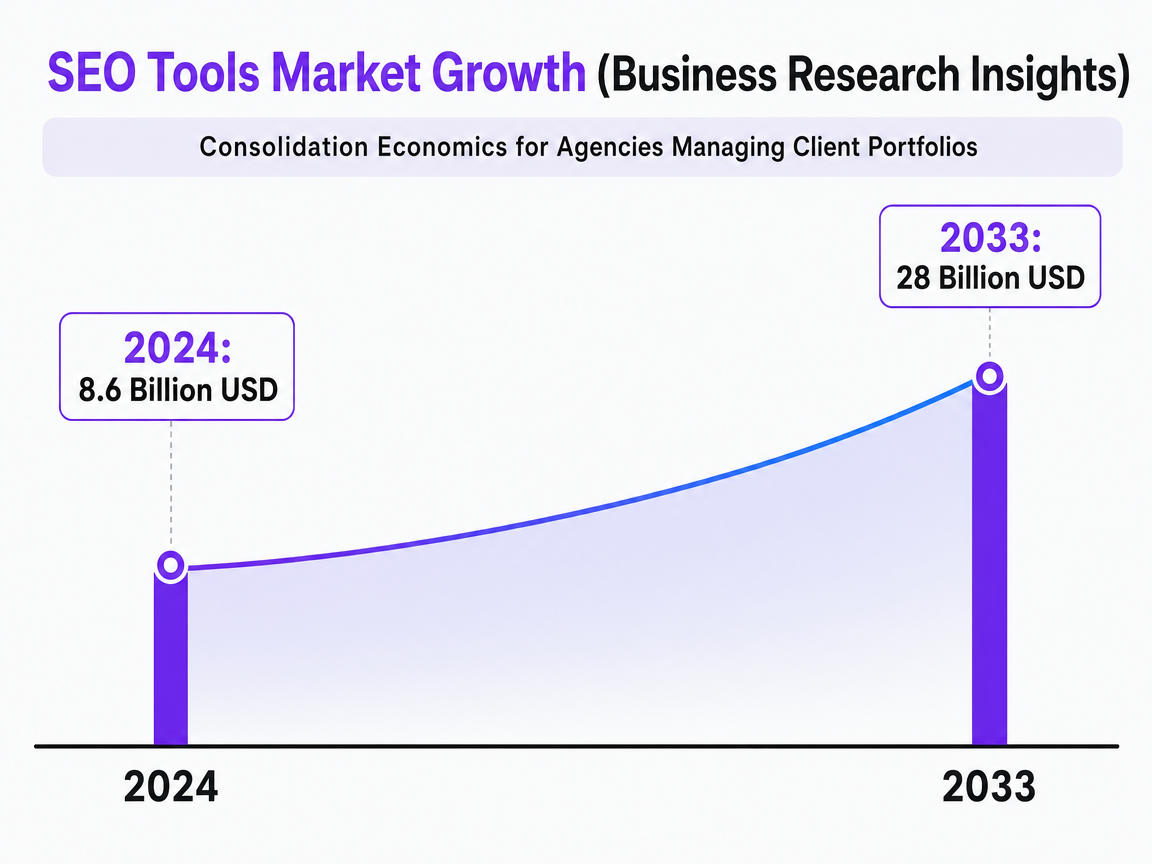 SEO Tools Market Growth (Business Research Insights)
Market size projection from Business Research Insights, showing growth from $8.6B in 2024 to $28B by 2033.
See How Leading Agencies Automate SEO Execution Without Sacrificing Oversight
Request a walkthrough of unified workflows that streamline multi-channel SEO management, eliminate manual bottlenecks, and deliver measurable efficiency for high-volume client portfolios.
Where SEO Tools Sit Alongside Paid Search Platforms
Agencies rarely sell SEO in isolation. Retainers typically bundle organic and paid search, and the tool-selection decision has to account for how the two channels share attribution, keyword intelligence, and reporting cadence. A 2024 comparative study of SEO and SEM found that both channels remain critical for visibility, but their effectiveness varies by business objective, industry context, and target audience, with the authors recommending a hybrid approach for growth 11.
The practical read for agency owners: SEO tools should feed the paid team, not compete with it. Keyword universes exported from Semrush or Ahrefs inform negative-match lists, quality-score diagnostics, and landing-page briefs for the PPC side of the account. Rank tracking and SERP-feature data explain why paid CTR shifts when an organic result gains or loses a featured snippet. Agencies that treat the two stacks as separate procurement decisions end up paying twice for overlapping keyword data and losing the cross-channel signal in client reporting.
A Working Selection Framework for the Next Renewal Cycle
The renewal calendar is the right forcing event for stack decisions. Before the next contract cycle, agency owners can run three questions against every seat currently on the books.
- Which layer does this tool actually serve — research, technical audit, or execution? Overlap inside a layer is where duplicated spend hides. Two research platforms rarely earn their combined seat cost unless one is dedicated to backlink analysis and the other to keyword and rank tracking, with a documented rule for which figures appear in client reports.
- What is the cost-per-managed-account at current portfolio size, and how does it change at the next growth tier? A seat that pencils out at 40 accounts can invert at 80 if the vendor's next license tier steps up sharply. Renewal is the moment to ask that question, not the quarter after the invoice lands.
- Which tool moves which economic lever? Semrush and Ahrefs move utilization rate. Screaming Frog moves triage speed. Siteimprove reduces scope-creep on regulated accounts. BrightEdge and Conductor anchor an enterprise practice. An execution platform like Vectoron substitutes for production labor rather than another research license.
Naming the lever forces the renewal conversation into margin terms, which is where the cross-tool variance study first placed it 1.
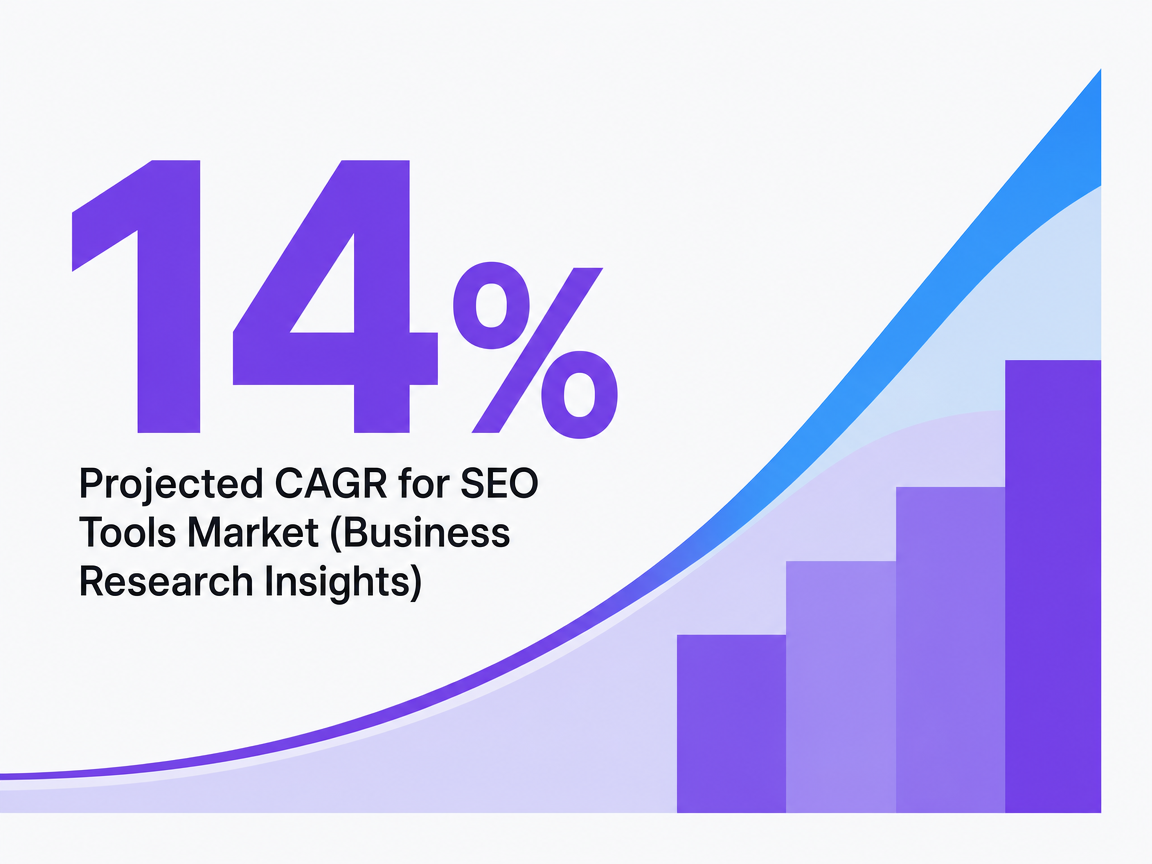 Projected CAGR for SEO Tools Market (Business Research Insights)
Projected CAGR for SEO Tools Market (Business Research Insights)
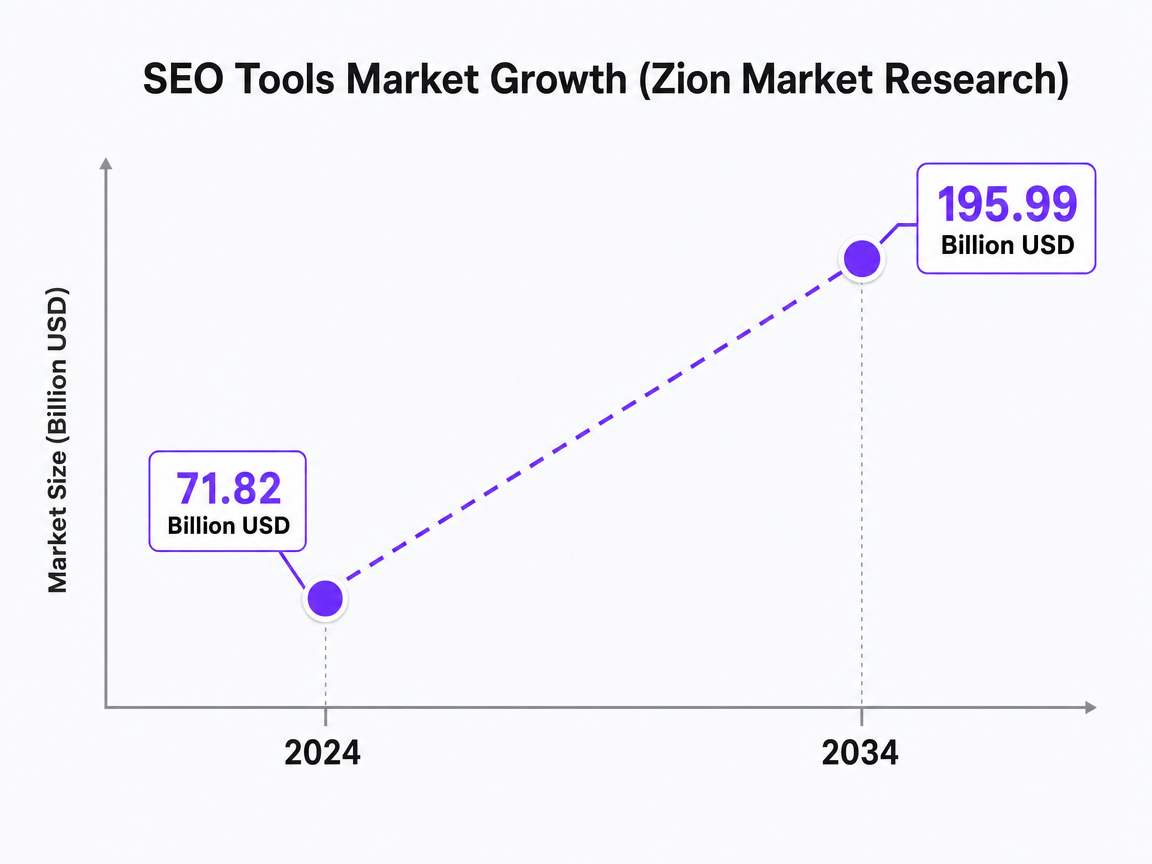 SEO Tools Market Growth (Zion Market Research)
Market size projection from Zion Market Research, showing growth from $71.82B in 2024 to $195.99B by 2034.
Frequently Asked Questions
References
- 1.Assessing discrepancies across SEO tools in the collection of scholarly web metrics.
- 2.Search Engine Optimization (SEO) Tools Market.
- 3.Search Engine Optimization (SEO) Tools Market Size, Share, Growth, and Industry Analysis.
- 4.Search Engine Optimization (SEO) Tools Market.
- 5.Search Engine Optimization (SEO) Tools Market Size, Future Growth and Forecast 2033.
- 6.Global Search Engine Optimization (SEO) Tools Market Size, Industry Share, Growth Trends & Forecast 2026-2034.
- 7.Search Engine Optimization SEO Tools Market Market Size, Share, and Forecast.
- 8.Global SEO Tools for Digital Marketing Research Report.
- 9.Every Company Needs An SEO Platform.
- 10.Forrester Research Publishes 1st Report On Enterprise SEO Automation Tools.
- 11.A Comparative Study on Search Engine Optimization and Search Engine Marketing: Optimizing Strategies in Business Growth.
- 12.Comparative Web Performance Evaluation of Leading Mobile Platforms.