
Key Takeaways
- BrightEdge fits agencies needing single-system coverage across auditing, ranking, and process management, though onboarding and per-client reporting configuration still consume strategist time 11.
- Conductor's content intelligence and workflow coordination suit agencies with in-house writers, but portfolio-wide rollups across 50-plus clients still require analyst normalization 11.
- seoClarity's scale-oriented data model fits enterprise clients with large page counts and is overbuilt for books weighted toward local service businesses 11.
- Siteimprove and Searchmetrics fit governance-heavy or European content use cases rather than serving as default choices for legal, healthcare, or multi-location agency rosters 11.
- Enterprise platforms hit ceilings around adjacent data expansion, outcome-based measurement, and seat-based pricing that scales with delivery teams instead of client books 8.
- Semrush anchors research and competitive intelligence for strategists daily, but its per-project structure leaves portfolio-scale coordination dependent on exports and project managers 11.
- Ahrefs clears auditing and ranking analysis for scoping and diagnostics but does not attempt the process management function that governs delivery teams 11.
- Moz supports local SEO and multi-location service agencies, though its steadier AI and workflow posture typically forces pairing with separate content and reporting tools 11.
- Research and workflow tools shorten the path from question to answer but leave the briefing-to-published-page gap where agency delivery margin erodes 4.
- Screaming Frog and Sitebulb remain essential for log analysis, redirect mapping, structured data validation, and complex migrations that platform-tier crawlers cannot match 11.
- Specialist crawlers stay on a technical lead's second monitor because platform and agentic tiers audit at breadth while depth work still requires purpose-built tools 8.
- Vectoron represents the agentic execution tier, pairing specialist AI across channels with enforced human approval gates, though it lacks a Forrester Wave placement 10.
Why the Category Definition Has Shifted
Ask ten agency heads of SEO what "best SEO optimization software" means and most will still answer with crawler depth, keyword database size, or rank-tracking granularity. That answer is now roughly a decade out of date. Forrester's guidance for enterprise buyers narrows the category to systems that manage the full SEO process across stakeholders, combining technical auditing, ranking analysis, and workflow management under one roof 8. Point tools sit inside that definition. They no longer define it.
The pressure on agency delivery has moved in the same direction. Forrester's 2024 outlook argued that agencies would have to recast services-based offerings into solutions-based ones built from creativity plus technology products, with AI accelerating the shift 7. Heads of SEO managing 20 to 150 client accounts feel that pressure as retainer compression, specialist recruiting costs, and expanding scopes after AI Overviews reshaped SERPs.
The evaluation question changes as a result. The stronger frame is not which tool has better data. It is which system removes the most routine execution work from the delivery pipeline while keeping strategic judgment with humans. The rest of this analysis evaluates named vendors against that frame.
From Tool Stacks to Delivery Systems
What Forrester Now Counts as an SEO Platform
Forrester draws a specific line between point tools and platforms. A true SEO platform helps enterprise marketers manage the search process across stakeholders, supports keyword research, tracks organic performance, and audits the technical foundation of the site 8. Three functions do the gatekeeping: auditing, ranking analysis, and process management 11.
The vendor list Forrester uses to describe this tier is narrow. BrightEdge, Conductor, Moz, Searchmetrics, SEMrush, seoClarity, and Siteimprove appear as the reference set for what qualifies 11. That list matters less than the criteria behind it. A dashboard that ranks keywords is not a platform. A crawler that surfaces errors is not a platform. Neither manages the delivery process a 25-account book actually runs on.
Forrester also flags that the SEO tools market is ripe for consolidation, with growth opportunities tied to better measurement, expansion into adjacent data such as call analytics and social listening, and broader organizational use of platform data 8. Agency leaders reading that signal see the direction of travel: fewer systems, wider scope, tighter integration.
The Agentic Layer Reshaping Execution
The platform definition is the floor. The ceiling is moving faster. McKinsey estimates that agentic AI could come to power as much as two-thirds of current marketing activities and accelerate campaign creation and execution by 10 to 15 times 1. That figure covers McKinsey's projection for current marketing activities broadly, not SEO specifically, and it describes potential scope rather than realized adoption today. Even scoped that way, it reframes what "execution capacity" means at an agency.
McKinsey's operating guidance is the more useful piece for heads of SEO. The recommendation is to reimagine workflows, not tools, embedding agents at decision points instead of bolting them onto legacy steps 4. The same body of research pushes organizations to rewire the operating model for the human-agent era, defining roles, governance, and handoffs so AI systems sit inside the org structure rather than beside it 5.
Applied to SEO delivery, that means the software question splits in two. Which system manages the process, and which system executes inside it. Enterprise platforms answer the first. Agentic execution layers are starting to answer the second. Agency leaders evaluating vendors this cycle are effectively picking a governance model, not a feature set.
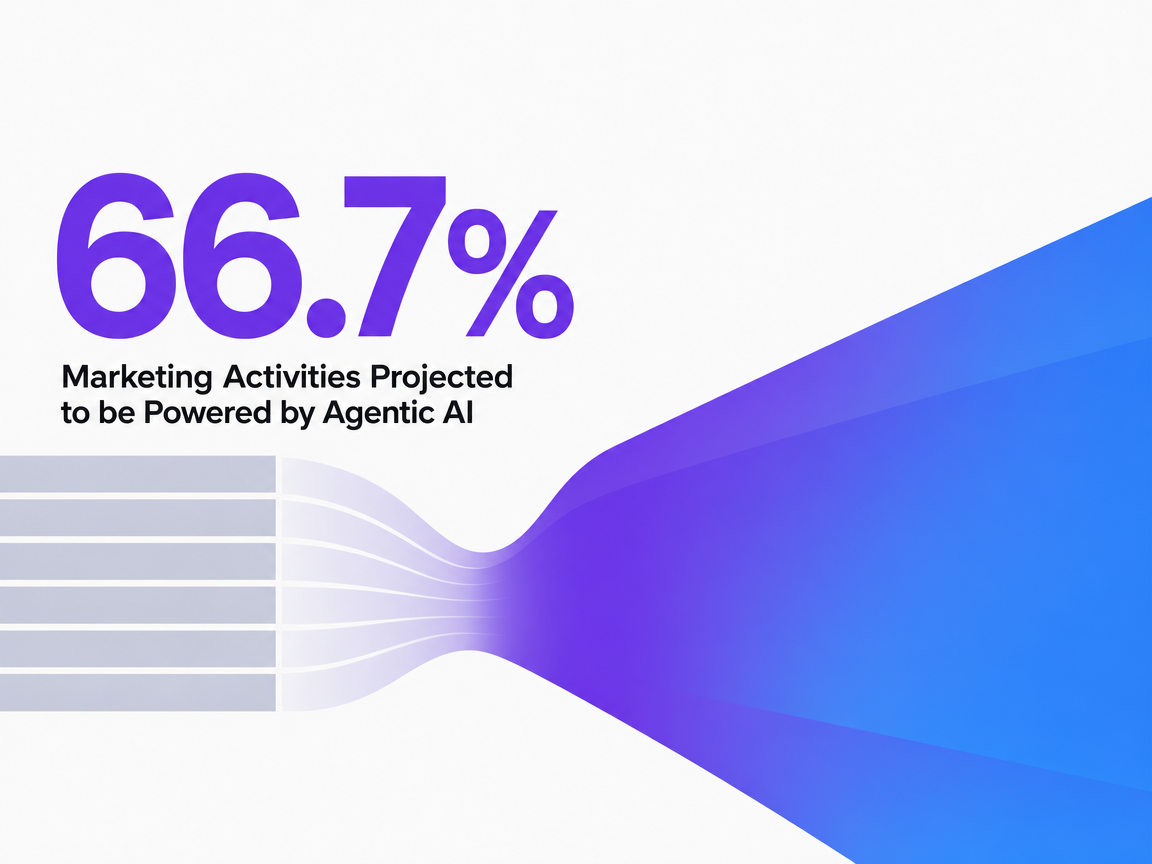 Marketing Activities Projected to be Powered by Agentic AI
Marketing Activities Projected to be Powered by Agentic AI
An Evaluation Rubric Built for Delivery Margin
Platform Criteria: Auditing, Ranking Analysis, Process Management
Forrester's three gatekeeping functions translate directly into agency delivery math. Auditing has to cover the full technical foundation of client sites and produce prioritized issues a delivery team can route to production without a manual triage step 8. Ranking analysis has to move past keyword position lists into organic performance tracking that a strategist can defend in a QBR. Process management has to coordinate work across the stakeholders who actually touch a page: strategist, writer, editor, developer, account lead 11.
Two secondary criteria decide margin. First, does the platform expand into adjacent data streams Forrester specifically flags as growth areas for the category, including call analytics and social listening 8. Second, does it push measurement toward business outcomes rather than rank-only reporting, which Forrester critiques as an overused proxy 8. Platforms that clear the three primary functions but stop at rankings still leave agencies rebuilding the reporting layer per client.
Agentic Criteria: Decision Points, Human-in-the-Loop, Interoperability
The second half of the rubric evaluates what the platform executes and how governed that execution stays. McKinsey's guidance to reimagine workflows rather than tools points to the practical test: map the decisions inside an SEO delivery cycle, then check where the software actually intervenes 4. Software that only surfaces recommendations leaves the execution bottleneck untouched. Software that executes without approval creates client risk.
Human-in-the-loop is the middle setting agency leaders should require. McKinsey frames this as rewiring the operating model so AI systems sit inside the org structure with defined roles, governance, and handoffs rather than beside it as loose assistants 5. Applied to vendor selection, that means asking where the approval gate lives, who owns it, and whether the platform enforces it or trusts humans to remember.
Interoperability is the third test. McKinsey's work on personalization stresses that AI has to be interoperable across systems, with workflows rebuilt from the ground up rather than layered on top 6. For SEO software specifically, that means how cleanly the platform exchanges data with content production, PPC, analytics, and CRM systems. Isolated intelligence is a downgrade at portfolio scale.
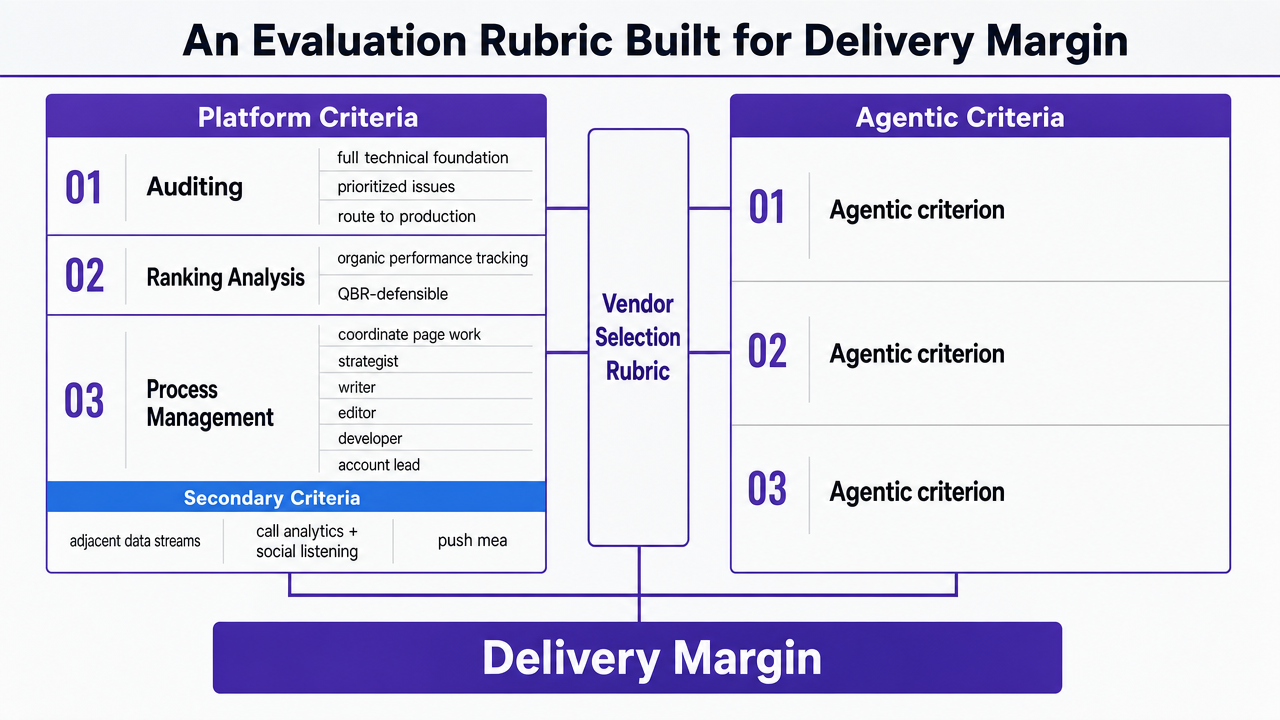 Visualize the two-part evaluation rubric (platform criteria + agentic criteria) that structures vendor selection across the article
Enterprise SEO Platforms
BrightEdge
BrightEdge sits inside Forrester's reference set for what qualifies as a true SEO platform, alongside Conductor, Moz, Searchmetrics, SEMrush, seoClarity, and Siteimprove 11. Its core proposition maps cleanly to the three gatekeeping functions: technical auditing, ranking and organic performance analysis, and process management across stakeholders 8.
For agency heads managing large portfolios, the practical draw is coverage. A single system tracks keyword universes, surfaces content recommendations, and audits site health across dozens of client domains without a separate license per function. The tradeoff is weight. Onboarding a new account into an enterprise platform takes a strategist's time, and the reporting layer still needs configuration per client before it defends a QBR.
Conductor
Conductor appears in the same Forrester reference set and competes on the same three functions 11. The platform emphasizes content intelligence and workflow coordination between SEO strategists and the writers and developers who ship the work, which is closer to the process-management criterion Forrester treats as gatekeeping 8.
Agencies with in-house content teams tend to get more out of Conductor than agencies that outsource writing, because the workflow layer assumes writers are inside the system. Reporting depth is strong at the account level. Portfolio-wide rollups across 50-plus clients still require a reporting analyst to normalize, which is a recurring cost line most agency leaders underestimate before signing.
seoClarity
seoClarity rounds out the enterprise trio Forrester surfaces most often, again evaluated against auditing, ranking analysis, and process management 11. The platform leans on scale in its data model, positioning itself for organizations tracking large keyword universes and running frequent technical crawls across many domains.
For agencies, that scale profile is a fit when the client mix includes enterprise brands with six- or seven-figure page counts. It is overbuilt for a book weighted toward local service businesses or single-location practices. Forrester's own critique of the category applies here too: rank-tracking depth is easy to buy, but measurement tied to business outcomes is the harder problem the platform layer is expected to solve 8.
Siteimprove and Searchmetrics
Siteimprove and Searchmetrics occupy the other end of Forrester's platform list 11. Siteimprove's center of gravity is site quality, accessibility, and governance, which pulls it toward regulated industries and public-sector clients where compliance reporting sits next to SEO in the same delivery scope. Searchmetrics leans further into content and search intelligence, with a stronger European footprint.
Neither is a natural default for an agency serving legal, healthcare, or multi-location service brands unless the client roster already skews toward the governance or international-content use cases each platform was built around. The lesson for agency leaders is that platform tier and platform fit are separate questions, and Forrester's list is a starting point, not a shortlist 8.
Where Enterprise Platforms Hit Their Ceiling at Agencies
Enterprise SEO platforms solve the visibility and coordination problem. They do not, on their own, solve the execution problem. Forrester's own framing of the category growth path calls out expansion into adjacent data such as call analytics and social listening, plus measurement tied to business outcomes rather than rank-only reporting 8. Both point past what these platforms currently ship.
The second ceiling is economics. License-per-seat pricing scales with the delivery team, not with the client book. An agency that doubles its accounts without doubling strategists still pays for every strategist seat that touches the platform. And the briefing cycle between strategist recommendation and executed work sits outside the tool entirely. That is the gap the next two tiers address.
Test AI-driven SEO workflows at agency scale
Experience full-scale SEO execution and publish live content risk-free for seven days.
Research and Workflow Tools
Semrush
Semrush appears in Forrester's reference set for enterprise SEO platforms, though its center of gravity remains research and competitive intelligence rather than process management 11. The keyword universe, backlink index, and SERP feature tracking are deep enough that most agency strategists open it daily for pitch work, competitive audits, and gap analysis.
The limit shows up at portfolio scale. Semrush is priced and structured around individual strategists running individual projects. Rolling insights across 40 client accounts into a governed workflow still requires exports, spreadsheets, and a project manager to chase the handoffs. Strong research surface, thinner delivery layer.
Ahrefs
Ahrefs sits alongside Semrush as a research-first tool that agency strategists trust for backlink data, keyword difficulty scoring, and content gap analysis. Forrester's platform criteria treat auditing, ranking analysis, and process management as the gatekeeping trio 11. Ahrefs clears the first two with room to spare and does not seriously attempt the third.
For an agency, that shapes the role Ahrefs plays. It is the diagnostic layer strategists reach for when scoping a new client or defending a strategy shift. It is not the system that coordinates the writers, developers, and account leads who deliver against that strategy.
Moz
Moz shows up in Forrester's platform reference set and has the longest tenure of any vendor on that list 11. Its domain authority metric, link index, and local SEO tooling still anchor a lot of agency workflows, particularly for teams serving multi-location service businesses where local pack visibility drives lead volume.
The platform reads as steady rather than aggressive on the AI and workflow front. Agencies using Moz tend to pair it with a content operations tool and a separate reporting layer, which is exactly the fragmentation the platform tier was supposed to end.
The Briefing-Cycle Tax This Tier Cannot Solve
The research and workflow tier does one thing well: it shortens the distance between a question and an answer. It does not shorten the distance between an answer and a shipped page. That gap is where agency delivery margin quietly erodes.
The pattern is familiar. A strategist runs a Semrush or Ahrefs analysis, writes a brief, hands it to a writer, waits, edits, hands to a developer, waits, publishes, then reports. McKinsey's guidance to reimagine workflows rather than tools names this directly: growth comes from embedding intelligence at decision points, not from better research at step one 4. This tier stops at step one.
Technical and Site-Health Specialists
Screaming Frog and Sitebulb
Screaming Frog and Sitebulb sit outside Forrester's enterprise platform reference set for a reason 11. Neither tries to manage the SEO process across stakeholders. Both are diagnostic instruments built to crawl, parse, and expose the technical state of a site with a depth the platform tier does not match.
Screaming Frog remains the default for log analysis, redirect mapping, and structured data validation on complex migrations. Sitebulb layers a heavier visualization and reporting shell on top of a similar crawl engine, which shortens the distance between a technical finding and a client-ready deliverable. For an agency book with regular site launches, replatforms, or Core Web Vitals remediations, at least one of these tools stays open on a technical lead's second monitor.
Where Specialists Stay Essential
Enterprise platforms audit at breadth. Specialists audit at depth. Forrester's own criteria treat technical foundation auditing as gatekeeping for the platform tier 8, but the practical work of debugging a JavaScript rendering issue or reconciling a 400,000-URL crawl still lives with tools built for that job.
For heads of SEO, the operational takeaway is simple. Keep one technical specialist license per pod. Do not expect the platform tier or the agentic tier to retire it. The consolidation argument applies everywhere else in the stack.
Agentic Execution Platforms
What Makes This Tier Different
The first three tiers surface information. This one closes the loop between recommendation and shipped work. McKinsey's guidance for the human-agent era pushes organizations to rewire the operating model so AI systems sit inside the org structure with defined roles, governance, and handoffs, rather than beside it as loose assistants 5. Agentic execution platforms are the software expression of that rewire.
Three traits separate this tier from the platform and research tiers:
- The system executes work after approval, not just recommends it.
- Approval gates are enforced by the software, not left to human memory.
- The platform coordinates across adjacent channels Forrester flagged as category growth areas, including content, call analytics, and social signals 8.
Feature depth in any single function is not the point. Removing the briefing cycle without removing human judgment is.
Vectoron
Vectoron sits in the agentic execution tier rather than the Forrester Wave platform tier 10. Its structure pairs specialist AI strategists across content, SEO, PPC, backlinks, social, and call intelligence with a single approval workflow that routes every recommendation for human sign-off before execution. The design maps to McKinsey's human-in-the-loop framing: agents handle signal reading, prioritization, and production, while judgment stays with the strategist 5.
For an agency head managing a 25-to-150 account book, the operational read is that the system absorbs briefing, coordination, and publishing work that currently sits between the platform tier's recommendations and the finished page. Recommendations arrive with the reasoning attached, approval creates the work, and KPI impact is tracked back to the decision. The tradeoff is category maturity. This tier does not yet carry a Forrester Wave placement, and agencies adopting it are picking a governance model earlier in its curve than the enterprise platforms above.
See How Leading Agencies Automate SEO Execution—Without Expanding Headcount
Request a walkthrough of unified AI-powered SEO and content workflows proven to scale delivery, maintain quality, and streamline approvals for multi-client agency teams.
Stack Consolidation Economics for Agency P&L
Scope shift: this section is about agency delivery economics, not client-side ROI. The variables that matter are tool categories in the stack, the human roles required to run a 25-client book, and where governance sits. Forrester's argument that agencies must recast services into solutions built from creativity plus technology products 7 lands here as a P&L question, not a positioning slide.
| Stack Configuration | Typical Tool Categories Included | Human Roles per 25-Client Book | Governance Model |
|---|---|---|---|
| Traditional point-tool stack | Research tool, rank tracker, technical crawler, content brief tool, reporting builder, project management | 3–4 strategists, 1 technical lead, 1–2 project managers, 4–6 writers, 1 reporting analyst | Tool-based; approval lives in email, docs, and PM tickets |
| Enterprise SEO platform plus separate content and PPC tools | Enterprise SEO platform, content operations tool, PPC platform, technical specialist, separate reporting layer | 2–3 strategists, 1 technical lead, 1 project manager, 3–5 writers, 1 reporting analyst | Platform-based inside SEO; handoffs to content and PPC still manual |
| Agentic execution platform with unified approval workflow | Unified platform across SEO, content, PPC, backlinks, social, call intelligence; technical specialist retained | 2 strategists, 1 technical lead, 0–1 project manager, review-only editor roles | Approval-first; every recommendation routes through a human sign-off enforced by the software |
The pattern the table renders is the one Forrester flagged in its solutions shift 7. Each row down consolidates categories and thins the coordination roles that exist to move work between tools. Strategists do not disappear. Project managers and reporting analysts thin out first because the platform absorbs the handoffs they used to manage.
Two cautions belong here. The role counts are typical, not guaranteed, and vary with client complexity, vertical mix, and how much technical work sits in the book. And the agentic row assumes the approval gate is real. A platform that executes without enforced sign-off collapses the governance column and reintroduces client risk the earlier rows at least made visible.
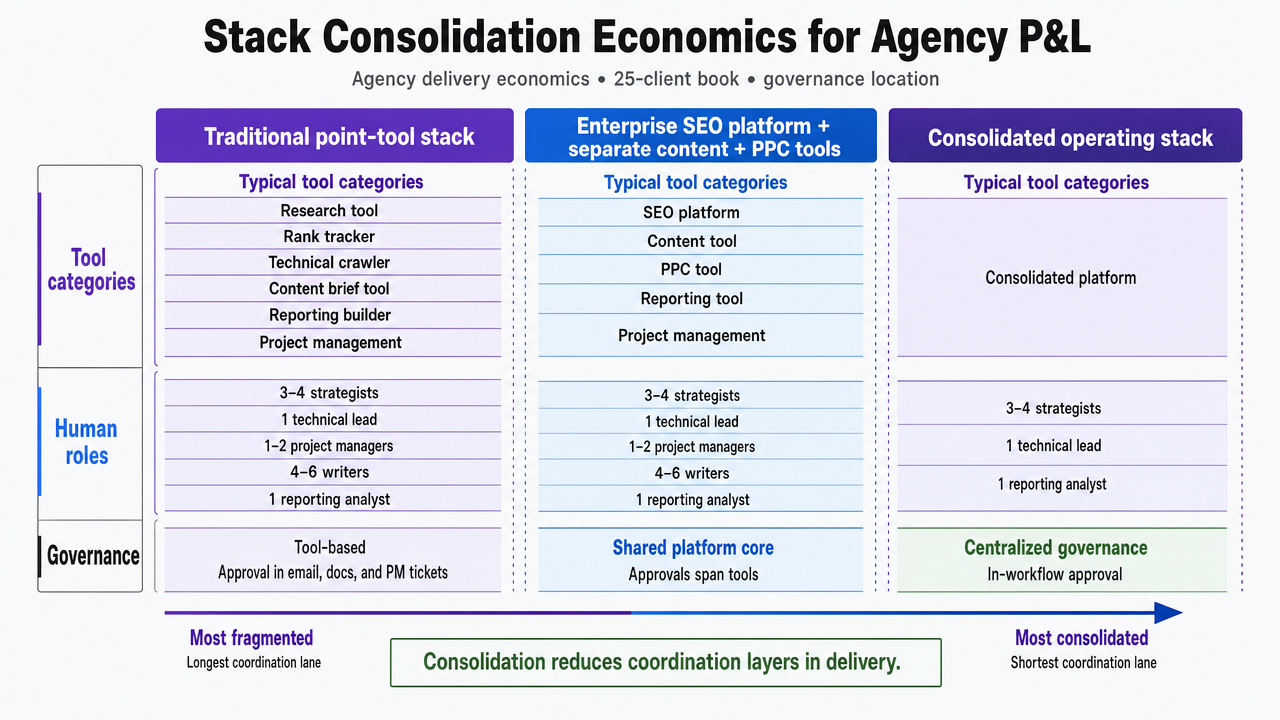 Visualize the three-tier stack configuration comparison from the article's table, showing how consolidation thins coordination roles
How Agencies Are Actually Using AI Inside the Stack
The theory of AI-embedded SEO delivery has run ahead of the practice. Forrester's read on US agencies puts current generative AI use in three buckets: content creation, optimization, and insights. The barriers agency leaders cite are governance, talent, and integration into existing processes rather than model quality 9. That gap between what AI can do and what agencies have wired into their delivery pipeline shapes every software decision this cycle.
The pattern inside agency stacks tends to look the same. Writers use generative AI for first drafts. Strategists use it for topic clustering and brief acceleration. Analysts use it for reporting summaries. Each use sits inside a person's workflow, not the agency's. The output does not route through an approval gate the platform enforces, and the client rarely sees where AI touched the work.
Forrester's finding also flags the data privacy, client consent, and IP ownership questions that surface when generative content moves into client deliverables 9. Those are governance problems, not tooling problems. Software selection over the next 24 months is largely a bet on which platforms make governance a default rather than a policy document.
Selecting for the Next 24 Months
The selection question narrows to three decisions:
- Which platform tier will manage the SEO process across stakeholders — Forrester's gatekeeping test of auditing, ranking analysis, and process management still holds 8.
- Which agentic layer will execute inside that process without breaking the approval gate.
- Which technical specialist stays on the second monitor.
Most agency stacks that scale profitably over the next 24 months will pick one answer per row, not three enterprise platforms and no execution layer.
Two disciplines separate agencies that consolidate cleanly from those that layer more tools onto a services-era workflow. Map the decisions inside a delivery cycle before mapping vendors, per McKinsey's guidance to reimagine workflows rather than tools 4. Then require the software to enforce approval gates rather than trust humans to remember them. Vendors that clear both tests move up the shortlist. Vendors that ship dashboards move down it.
Frequently Asked Questions
References
- 1.Reinventing marketing workflows with agentic AI.
- 2.Marketing and sales soar with generative AI.
- 3.The future of marketing in the age of AI.
- 4.Agents for growth: Turning AI promise into impact.
- 5.A marketing organization that thrives with AI.
- 6.Discussing the future of AI-powered personalization.
- 7.Predictions 2024: AI Accelerates Agencies' Shift To Solutions.
- 8.Every Company Needs An SEO Platform.
- 9.The State Of Generative AI Inside US Agencies, 2024.
- 10.The Forrester Wave™: Search Engine Optimization Solutions, Q3 2025.
- 11.Every Company Needs An SEO Platform.