
Key Takeaways
- Helpful, original content is the non-negotiable input: Google cut low-quality, unoriginal results by 45% after the March 2024 core update, raising the bar for every brief 5.
- Scaled content abuse now covers human, AI, and hybrid output, so legitimate scale requires per-page originality, depth, and sourcing rather than templated rewrites 4.
- Site reputation abuse arrangements need immediate auditing because Google's November 2024 clarification treats third-party content on client domains as a violation even with editorial oversight 6.
- A standardized technical baseline covering anchor-href links, canonicals, indexability, sitemaps, metadata, and freshness lets mid-level auditors maintain quality across accounts 3, 8.
- Search Console should be the single source of truth, with weekly triage of manual actions, coverage, and query performance across every client 7.
- Templated structured data paired with Search Console verification after deployment, template changes, and monthly sweeps prevents silent breakage across the portfolio 9, 10.
- AI assistance must be governed through approval gates covering provenance, editorial review, named sign-off, and change logs, following NIST's control set 11, 2.
- A governed content supply chain linking planning, creation, launch, measurement, and management delivered 22% higher content ROI and 30% higher gen-AI ROI than siloed teams 12.
- Delivery metrics like cycle time, revision ratio, and specialist hours per account expose margin erosion that ranking dashboards hide, with McKinsey projecting 5-15% marketing efficiency gains from AI 16.
- Codifying weekly next-best-action reviews turns a large client book into a prioritized queue with the paper trail Google's spam framework rewards 4, 17.
The 2024 quality bar reset what agency delivery has to look like
Google's March 2024 core update significantly altered the landscape for agencies managing scaled content operations. New spam policies, including those targeting expired-domain abuse, scaled content abuse, and site reputation abuse, became enforceable as of May 5, 2024 5. A subsequent clarification in November 2024 further refined the definition of site reputation abuse, impacting syndication and partner-content programs 6.
For agency SEO leads, this means that previous tactics for high-volume content production now carry a higher risk of manual actions. Google's spam policies explicitly list keyword stuffing, machine-generated traffic, scaled content abuse, and thin affiliation as triggers for demotion or removal 4. Violating these policies can lead to significant drops in search rankings or complete removal from results 5. While the risk impacts the client's domain, the reputational cost falls on the agency.
Despite these changes, the demand for scale persists. Deloitte Digital reported that 26% of marketers were already using generative AI in content production, with an additional 45% planning adoption 13. Agencies must embrace this shift while implementing robust governance to avoid client losses. The following ten practices outline an operating system for SEO delivery, emphasizing standardized quality inputs, human-approved automation, and continuous measurement through Search Console 7 to proactively identify and address issues.
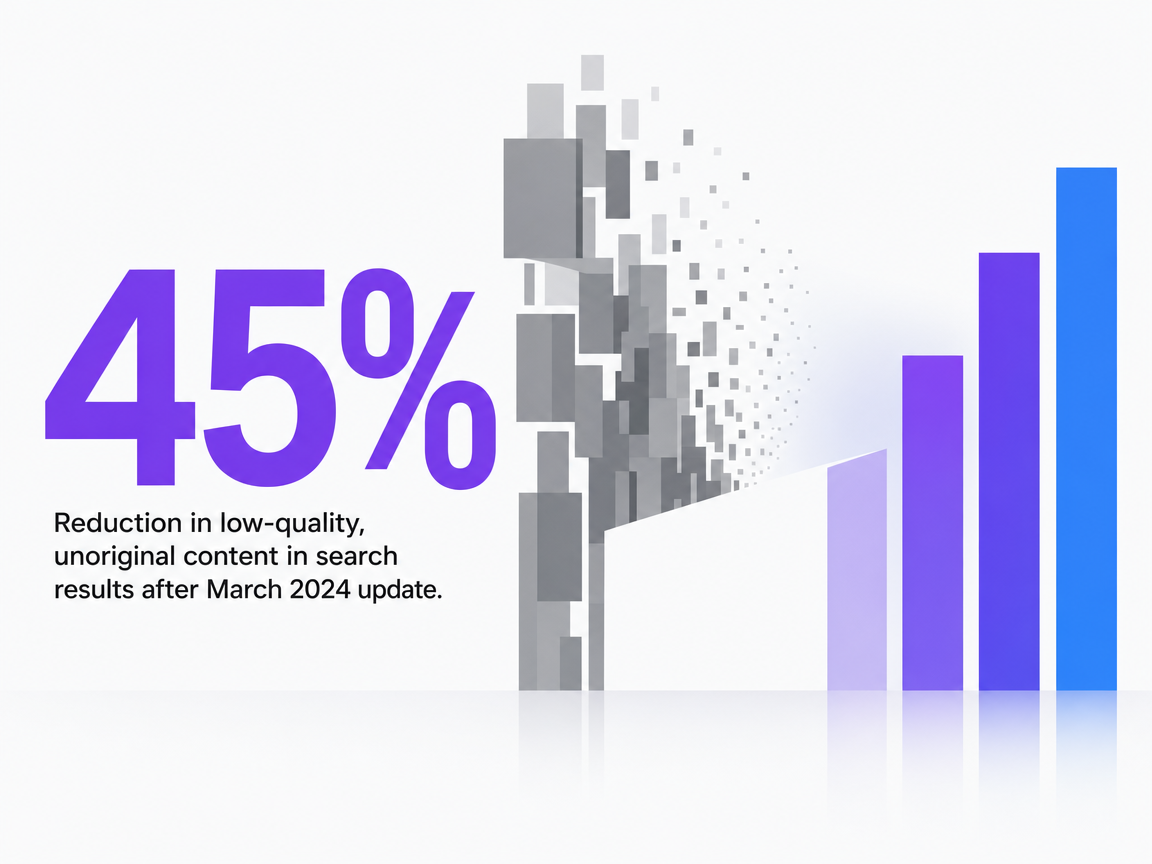 Reduction in low-quality, unoriginal content in search results after March 2024 update
Reduction in low-quality, unoriginal content in search results after March 2024 update
Practice 1: Treat helpful, original content as the non-negotiable input
The foundation of effective SEO delivery is defensible content. If the input quality is compromised, high-volume production becomes a liability. Google reported a 45% reduction in low-quality, unoriginal content in search results after the March 2024 core update, surpassing its 40% target 5. This indicates a significant shift in what Google considers publishable, particularly impacting the template-heavy production models common in many agency retainers.
Google's people-first guidance emphasizes that content should offer original information, comprehensive topic coverage, and clear sourcing, and its primary purpose should not be to manipulate rankings 2. The guidance also cautions against extensive automation and summarizing existing sources without adding unique value 2. The Starter Guide reinforces this by advocating for content that is unique, current, and written for human readers 3.
To meet this standard, delivery specifications must be rigorous. Briefs should require documented expertise, a unique angle or dataset, and a stringent QA process that rejects drafts merely rephrasing existing content. Failing to adhere to these standards places the retainer at risk of demotion 5.
Practice 2: Draw the line between legitimate scale and scaled content abuse
Google's definition of scaled content abuse is more precise than many agencies realize. It encompasses producing numerous pages primarily to manipulate search rankings rather than to genuinely assist users, irrespective of whether the content is generated by automation, humans, or a combination 4. This policy explicitly includes content created through a mix of human writing and machine generation, indicating that a human editorial pass alone does not legitimize high-volume, low-value output.
The critical distinction lies in the originality of information, depth of coverage, and clear sourcing on each page 2. Legitimate scale involves producing many pages, each meeting these quality criteria. Conversely, scaled content abuse refers to numerous pages that rely on a template of superficial value, whether compiled from other search results, spun from a single source, or drafted by an AI model without subject-matter input.
Practically, agency SEO leads should implement three intake checks:
- Every page must have a documented purpose beyond merely targeting a keyword, addressing a search task more effectively than current top results.
- Thin affiliation and rewrites of competitor content are explicitly named as spam violations by Google and should be rejected at the brief stage 4.
- The volume of production itself is not the issue; rather, it is producing volume without substantive value on a per-page basis.
Practice 3: Kill site-reputation-abuse arrangements before Google does
The November 2024 clarification significantly altered the risk assessment for any arrangement where a client's domain hosts third-party content. Google now defines site reputation abuse as publishing third-party pages to exploit the host site's ranking signals, even if the host site is involved in oversight 6. Editorial review no longer neutralizes this violation; the intent behind the content's publication is key.
This policy directly impacts common agency arrangements, such as:
- Coupon and deals subdirectories on publisher sites
- Product-review sections created by external affiliate teams under a trusted brand
- Syndicated partner content published under the host's byline
Previously defensible, these arrangements now fall within the policy's scope 6. Google's broader spam list also identifies thin affiliation as a separate violation, further increasing the risk for these types of arrangements 4.
Agencies must conduct an immediate audit. Delivery teams should identify all URL paths on client sites hosting externally produced content, document the editorial chain, and either integrate the content into the host's core editorial standards or remove it to prevent manual actions. Waiting for a notice in Search Console 7 means waiting until traffic has already declined.
Test AI-driven SEO workflows on live projects
Experience hands-on execution and approval of real SEO content across multiple client accounts during your trial.
Practice 4: Standardize the technical baseline every client site inherits
Technical inconsistencies across a client portfolio can significantly erode agency margins. Each account with a unique crawl configuration, canonical logic, or internal-link structure necessitates a bespoke audit, consuming valuable time. The solution is to establish a single technical baseline that all new clients adopt during onboarding and existing clients are gradually migrated towards.
Google's Starter Guide provides the essential specifications: pages should be crawlable, unique, current, and readable, with correctly declared canonical tags and human-friendly metadata 3. Search Essentials further emphasizes that crawlable links are crucial for Google to discover other pages on a site, setting the standard for internal linking 1. The guidance on link formats is stricter than many templates assume; Google primarily crawls standard anchor elements with href attributes, and most non-anchor link formats are not reliably parsed 8. This rule invalidates many JavaScript-driven navigations and button-styled links found in common theme frameworks.
A robust technical baseline should cover six key items, verifiable quickly per account:
- Valid anchor-href internal links 8
- Correct canonical declarations
- Indexable status of primary templates
- XML sitemap submission via Search Console 7
- Metadata reflecting page content rather than keyword lists 3
- Freshness dates on evergreen pages
Any deviation below this standard requires remediation before new content is published. Codifying this baseline into a checklist transforms senior-specialist judgment into a task manageable by a mid-level auditor across multiple accounts.
Practice 5: Make Search Console the single source of truth across the book
Portfolio-level visibility is compromised when each client account relies on a different analytics stack. Search Console is Google's own data source, providing critical signals that predict client risk and opportunity: crawling status, indexing coverage, manual actions, and query-level performance broken down by page and country 7. Any client site not verified in Search Console represents a significant blind spot for the agency.
To scale effectively, agencies must standardize how delivery teams utilize Search Console. A weekly triage across all accounts should follow a specific sequence:
- Check for manual actions, as these provide the earliest warning of a March 2024 or November 2024 policy violation 5, 6.
- Review coverage and indexing to identify pages that have dropped from the index or new templates that failed to be indexed.
- Analyze performance, filtering for significant query and page shifts against the account's baseline 7.
Structured data validation is also integrated into Search Console. Google advises checking manual actions for structured-data issues 9 and recommends using Search Console after initial deployment, following new template releases, and during periodic traffic analysis 10. Incorporating these checks into the weekly pass allows mid-level auditors to efficiently manage a large client list, rather than specialists handling individual exports.
Practice 6: Template structured data, then verify it in Search Console
Hand-coding structured data for every page becomes inefficient at scale. Client sites with custom JSON-LD per page are prone to breakage whenever a developer modifies a template. A more scalable approach involves creating a small library of validated schema templates for common page types: articles, product pages, FAQs, local business, and organization. Each template is built once, tested against Google's guidelines, and deployed across accounts with variable slots for dynamic fields.
Templating alone is insufficient; verification is crucial. Google instructs site owners to check manual actions in Search Console for structured-data issues 9 and specifically recommends verification after initial deployment, following new template releases, and during periodic traffic analysis 10. These three checkpoints form a critical verification loop. New client onboarding triggers the first pass, any template revision triggers the second, and a monthly sweep across the portfolio handles the third.
This approach ensures enhanced search appearance remains consistent across all accounts without requiring senior specialists to audit every deployment. Breakage is identified in Search Console 7 within a reporting cycle, preventing prolonged organic click declines.
Practice 7: Govern AI assistance with approval gates, not word counts
The adoption of AI in content production is no longer a debate. Deloitte Digital reported that 26% of marketers were using generative AI, with another 45% planning to adopt it by the end of 2024 13. This trend indicates that within a single planning cycle, a significant majority of marketing teams will utilize some form of AI assistance. For agency SEO leads, the key question is not whether AI will be used, but how its output is governed before it reaches a client's domain.
Relying on word-count quotas or per-writer draft targets is an ineffective control mechanism. These metrics prioritize volume, which Google's scaled content abuse policy views with suspicion when it lacks per-page substance 4. Instead, approval gates measure whether each page has undergone a documented human review against a defined standard before publication.
NIST's generative AI profile outlines a valuable control set, recommending auditing, change-management controls, data provenance, and transparency policies for generated data 11. Translated to SEO production, this means four gates for every AI-assisted draft:
- A logged subject-matter input before drafting to document provenance.
- An editor pass to verify originality, sourcing, and coverage against Google's people-first standard 2.
- A named approver sign-off before publication.
- A change log linking the final URL to who touched it and when.
Delivery teams implementing these gates can leverage AI for throughput gains without incurring demotion risk. Agencies that bypass these controls risk operating a content mill under a new guise, precisely the failure mode the March 2024 update aimed to address 5.
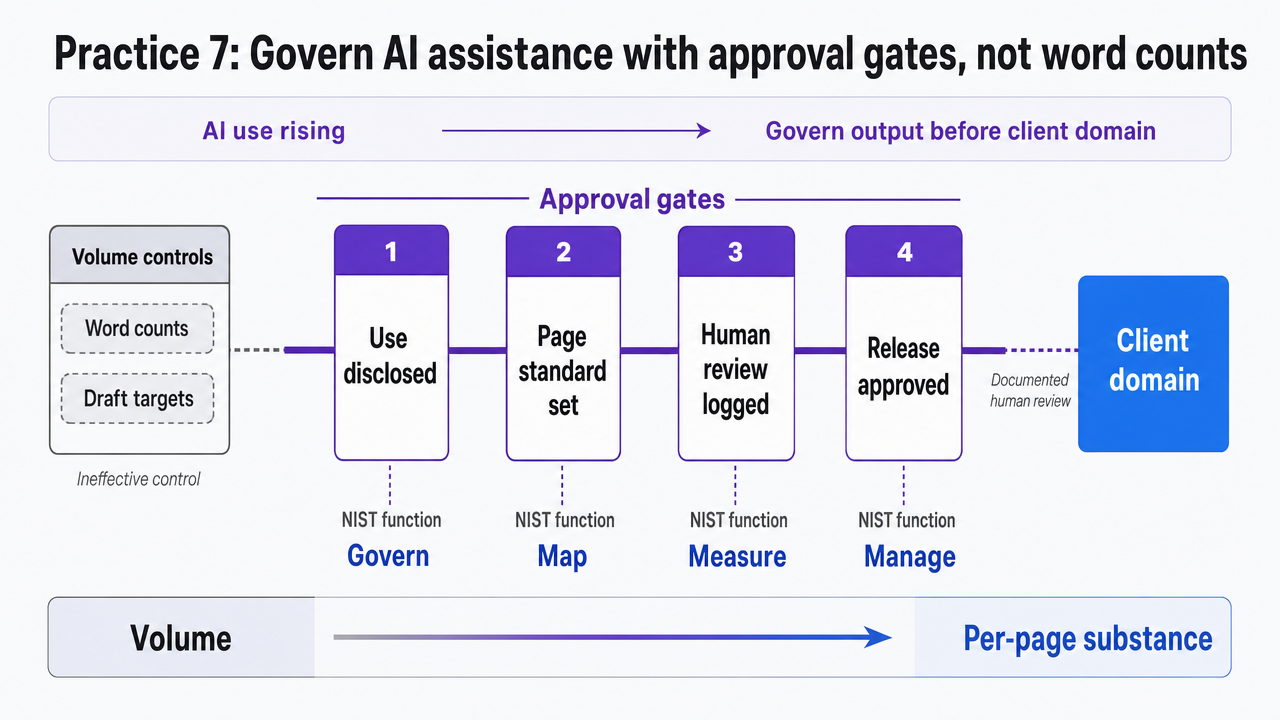 Visualize the four sequential approval gates the section prescribes for governing AI-assisted SEO drafts, mapped to NIST's control set
Streamline Multi-Client SEO Execution With Data-Driven Automation
See how leading agencies leverage AI-powered workflows to optimize SEO delivery, reduce manual oversight, and scale high-quality content production across multiple client accounts—without increasing team size.
Practice 8: Build a governed content supply chain, not a content mill
The fundamental difference between a content supply chain and a content mill lies in governance. A mill prioritizes output volume and views review as a bottleneck. A supply chain, however, integrates planning, creation, launch, measurement, and management as interconnected stages, each with a designated owner and a clear hand-off standard. IBM's research on content operations revealed that agencies adopting this holistic view achieved a 22% higher return on content-supply-chain investment and a 30% higher ROI on gen-AI integration compared to teams optimizing isolated stages 12. This improvement stems from planning, QA, and measurement sharing a common intake specification rather than operating as disparate queues.
For agency SEO leads, this translates into five linked stages:
- Planning defines the specific search task each page must accomplish and the subject-matter input required. Planning defines the specific search task each page must accomplish and the subject-matter input required.
- Creation adheres to this brief, whether executed by a specialist, freelancer, or AI-assisted workflow.
- Launch ensures content passes the established technical baseline and structured-data templates.
- Measurement involves regularly monitoring Search Console for coverage, manual actions, and query performance 7.
- Management closes the loop by feeding these signals back into the next planning cycle, ensuring underperforming pages are revised before republication.
A common failure mode is the "parallel-queue agency," where content, technical, and reporting teams operate independently with their own definitions of "done." This structure often conceals the very defects Google's spam policies target at scale: pages lacking substantive input, silently broken structured data templates, and unaddressed manual actions 4. A single, governed supply chain with a unified intake spec and measurement surface is the delivery structure that retains throughput gains within the retainer, rather than incurring penalties.
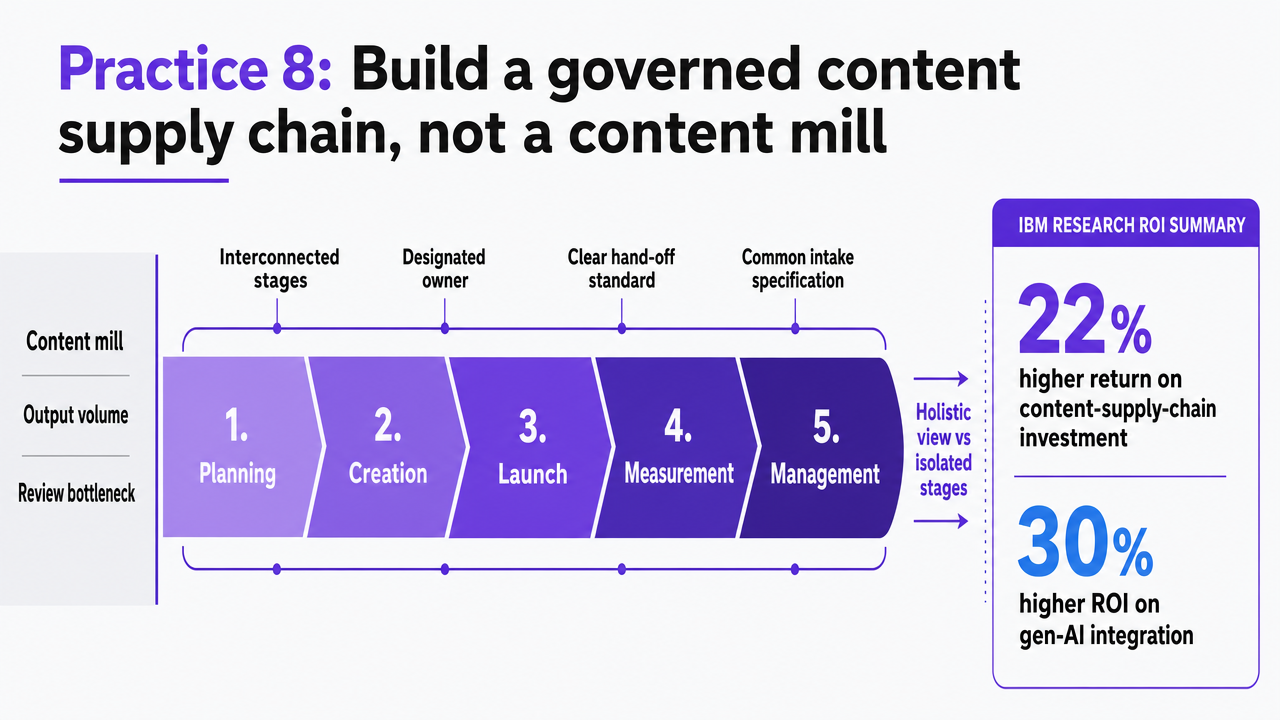 Visualize the five-stage governed content supply chain the section describes and pair it with the IBM ROI figures cited in the same paragraph
Practice 9: Measure throughput and margin, not just rankings
This practice shifts the focus from client-facing SEO metrics to agency profitability. While ranking dashboards report client site performance, they don't reflect the health of the retainer. Agency SEO leads managing a growing number of accounts need a secondary measurement layer focused on delivery metrics: pages shipped per specialist per week, revision cycles per draft, hours per structured-data deployment, and the gross margin these numbers generate against the retainer floor.
McKinsey estimates that generative AI could boost marketing efficiency by 5% to 15%, generating over $460 billion annually in marketing productivity value across the sector 16. This broad forecast, while not an audited agency benchmark, highlights the potential for efficiency gains. An agency lead managing a 40-account portfolio can use this range to project the impact of a 5% versus a 15% efficiency improvement on specialist workload and gross margin before implementing workflow changes. The specific calculations depend on actual client counts and hourly costs, but the McKinsey band provides an outer limit for plausible returns from workflow redesign 16.
Measurement discipline is crucial for capturing gains and preventing leakage. Three key metrics should be included in weekly delivery reviews alongside Search Console outputs 7:
- Draft-to-publish cycle time indicates whether QA and approval gates are functioning efficiently or causing delays.
- Revision ratio, tracked as revisions per published page, reveals issues with brief quality that lead to rework.
- Specialist hours per account, benchmarked monthly, helps determine if adding new accounts can be absorbed by current headcount or necessitates new hires.
Rankings can improve even as these internal metrics deteriorate, leading to silent margin erosion that client reports may not reveal.
Practice 10: Codify next-best-action reviews across the client portfolio
This final practice integrates the preceding nine. A delivery lead managing 40 accounts cannot personally review every Search Console report, draft, or technical audit weekly. Instead, the lead can codify a "next-best-action" review: a recurring meeting where each account presents one ranked recommendation, its rationale, and the estimated specialist hours required for approval. Forrester's research on leading AI adopters in B2B marketing found that their success stemmed from orchestration, performance insights, and recommended next actions, rather than just raw automation 17.
The process is straightforward. Each Monday, account owners submit one client recommendation, ranked by expected impact against stated retainer goals. Recommendations should reference a specific Search Console signal, a policy exposure, or a template gap identified during the previous week's triage 7. The delivery lead then approves, defers, or rejects each item in a single pass. Approved work enters the production queue with a named owner and a due date. Rejected work is returned with a reason, which helps train account owners on established standards.
This structure transforms a large client book from a series of reactive firefights into a prioritized queue. It also generates the paper trail favored by Google's spam framework: every published page can be traced back to an approved recommendation, an owner, and a documented reason for its existence 4.
What breaks first when these practices are skipped
The sequence of failures is predictable and can serve as a diagnostic. Manual actions typically appear first, often on client sites with extensive externally produced content, as site-reputation-abuse enforcement targets paths clarified in Google's November 2024 update 6. Coverage drops follow within a reporting cycle, as templates lacking valid anchor-href internal links fail to pass crawl signals effectively 8. Subsequently, query-level performance declines, particularly for page clusters published without documented subject-matter input, a pattern Google's people-first guidance and spam policies identify as a demotion trigger 2, 4.
Retainer margin erodes last, and often silently. Specialist hours increase as senior staff are diverted to remediation across accounts, revision ratios spike on drafts that bypassed approval gates, and draft-to-publish cycle times lengthen while delivery leads address Search Console notices instead of prioritized recommendations 7. By the time a client report indicates a ranking drop, the financial damage is already incurred. The ten practices outlined are not merely a checklist; they represent a sequence designed to prevent this chain of failures from initiating.
Frequently Asked Questions
References
- 1.Google Search Essentials (formerly Webmaster Guidelines).
- 2.Creating Helpful, Reliable, People-First Content.
- 3.SEO Starter Guide: The Basics.
- 4.Spam Policies for Google Web Search.
- 5.our March 2024 core update.
- 6.Updating our site reputation abuse policy.
- 7.How To Use Search Console.
- 8.SEO Link Best Practices for Google.
- 9.General Structured Data Guidelines.
- 10.Dataset Structured Data.
- 11.Artificial Intelligence Risk Management Framework: Generative Artificial Intelligence Profile.
- 12.The content supply chain's AI awakening.
- 13.Deloitte Digital's latest research forecasts generative AI's ....
- 14.2.
- 15.Gen AI adoption spikes and starts to generate value.
- 16.State of Marketing 2024.
- 17.The State Of Artificial Intelligence And Machine Learning Adoption In B2B Marketing 2024.