
Key Takeaways
- SE Ranking is the agency value tier, absorbing high-volume core tracking across most accounts with daily updates, white-label reports, and granular keyword grouping at a lower price than premium suites.
- AccuRanker earns its seat on refresh cadence, giving account leads on-demand SERP snapshots to distinguish transient thrash from durable drops during algorithm updates within 24–48 hours.
- Advanced Web Ranking is a reporting-first tracker, removing senior specialists from monthly deck assembly through branded, scheduled reports structured around visibility narratives rather than raw position dumps.
- Ahrefs anchors competitor analysis with 78% exact-position match accuracy versus Moz's 71% 11, plus position history across domains and locations without provisioning a second tool.
- Semrush earns the in-house label because it's the suite most likely already sitting in the client's stack, reducing onboarding friction on co-managed accounts and cross-discipline workflows.
- Nightwatch and Local Viking handle geo-grid sampling around each business location — now a first-class 2026 evaluation criterion 7— making local reporting defensible past the client meeting.
- ProRankTracker handles multi-user, client-scoped operations for agency day-to-day delivery, while Nozzle pipes SERP data into custom BI environments for agencies that have outgrown templated dashboards.
- Google Search Console is the free ground-truth baseline pairing position with actual click and impression data 3, but lacks the multi-engine, competitor, and automation surface a 20+ account book requires.
What agency-scale rank tracking has to do in 2026
For agency Heads of SEO, a rank tracker stopped being a scoreboard several product cycles ago. It became the sensor layer feeding client dashboards, prioritization queues, and content production pipelines across dozens of accounts at once. The 2026 field is judged less on how positions are displayed and more on whether the underlying position data is accurate, high-cadence, and pipeable into the systems that actually ship work.
Three shifts have hardened that requirement:
- Editorial reviewers now benchmark trackers against manual incognito SERPs rather than vendor self-reports, exposing meaningful accuracy gaps between suites 11.
- The evaluation criteria used in live agency tests have expanded to include SERP feature detection, geo-grid local coverage, and AI search citation tracking alongside classic position monitoring 7.
- Ranking reporting software is increasingly defined by its integration surface — branded reports, alert automation, and content and backlink data feeds — not by the tracker in isolation 13.
The practical implication for an agency running 20 to 100+ accounts: the best tracker is the one whose position data holds up under audit, refreshes fast enough to catch volatility, and exits cleanly into the reporting stack and execution loop where the work actually gets approved and shipped.
How to evaluate a tracker when you run 20+ client accounts
Accuracy tested against manual SERPs, not vendor claims
Accuracy is the first gate, and vendor scorecards fail it. The only defensible benchmark for agency reporting is reported position against manual incognito SERPs, ideally from a consistent IP, run at scale over weeks rather than a single afternoon.
The clearest public example of that method compared Ahrefs and Moz across 12 sites, tracking 50 keywords per site and matching reported rankings against manual incognito checks from a U.S. IP. Ahrefs matched the manual position exactly 78% of the time versus Moz's 71%, while both suites landed within three positions of the manual result for 96–97% of tracked keywords 11. A separate 2026 evaluation tested 16 trackers across five live client accounts over eight weeks, using manual incognito checks across 200 keywords daily for two weeks as its accuracy baseline 7.
Two operational reads follow from those numbers. First, at exact-match resolution, the spread between suites is meaningful — a seven-point gap across a 5,000-keyword portfolio is roughly 350 keywords where one tool tells a client story the SERP does not support. Second, within-three-positions parity means directional trend reporting holds up even on the weaker tool, which matters when the deliverable is a monthly movement narrative rather than absolute rank claims.
Practitioner sentiment tracks this. G2 reviewers rated one leading tracker's accuracy at 4.8/5 across 220+ reviews, with agencies citing it as the tool they trust most for client-facing data 10. Treat that as a corroborating trust signal, not an audited benchmark — and hold every tracker on the shortlist to a manual-SERP audit before it goes into production reporting.
Update cadence, SERP feature detection, and geo-grid local coverage
Accuracy without cadence is a stale spreadsheet. Agencies watching volatility during algorithm updates or seasonal SERP shuffles need daily refreshes as a floor and on-demand refresh for priority keywords when a client escalates. Editorial reviewers consistently frame regular position updates, keyword grouping, and historical trend analysis as the non-negotiable feature set for professional users 1, and 2026 comparative testing formally added update speed and SERP feature detection to the evaluation rubric alongside accuracy 7.
SERP feature detection is where cadence pays off. A keyword that lost its featured snippet to an AI Overview last Tuesday did not lose ranking — it lost real estate. Trackers that only report the blue-link position miss the reason organic clicks dropped, and the client meeting goes sideways. Look for detection of featured snippets, People Also Ask, local packs, image packs, video carousels, and AI Overview citations, with historical timelines showing when each feature appeared or disappeared for each tracked query.
Local coverage is the other cadence-sensitive axis. Geo-grid tracking — sampling rankings across a matrix of coordinates around a business location rather than a single city centroid — is now a standard evaluation criterion, not a niche add-on 7. If any part of the client book is multi-location, geo-grid capability determines whether local reporting is defensible or theatrical.
Integration surface: what feeds your BI stack and approval queue
The tracker's second job is to leave the tracker. Position data has to land in the systems where agencies actually build client reports, prioritize work, and route decisions — Looker, BigQuery, GA4, the CMS, the content queue, the backlink pipeline. Ranking reporting software is increasingly defined by that integration surface: branded reports, scheduled exports, API access, and feeds into content and backlink data rather than the tracker in isolation 13.
Two integration patterns matter at 20+ accounts:
- Automated alerting: import each client's 20–50 core keywords, layer competitor tracking, and wire threshold alerts into the team's notification channel so movements get triaged before the client emails 2.
- Bulk export or API access with enough rate headroom to refresh a BI warehouse nightly across the full portfolio without hitting throttle limits.
Every shortlisted tracker should answer three concrete questions before it goes to procurement:
- Does it expose the API endpoints and refresh rates the reporting stack needs?
- Does it produce white-label PDFs or shareable dashboards without manual assembly?
- Can its alert output trigger a task in the approval queue rather than dying in an inbox?
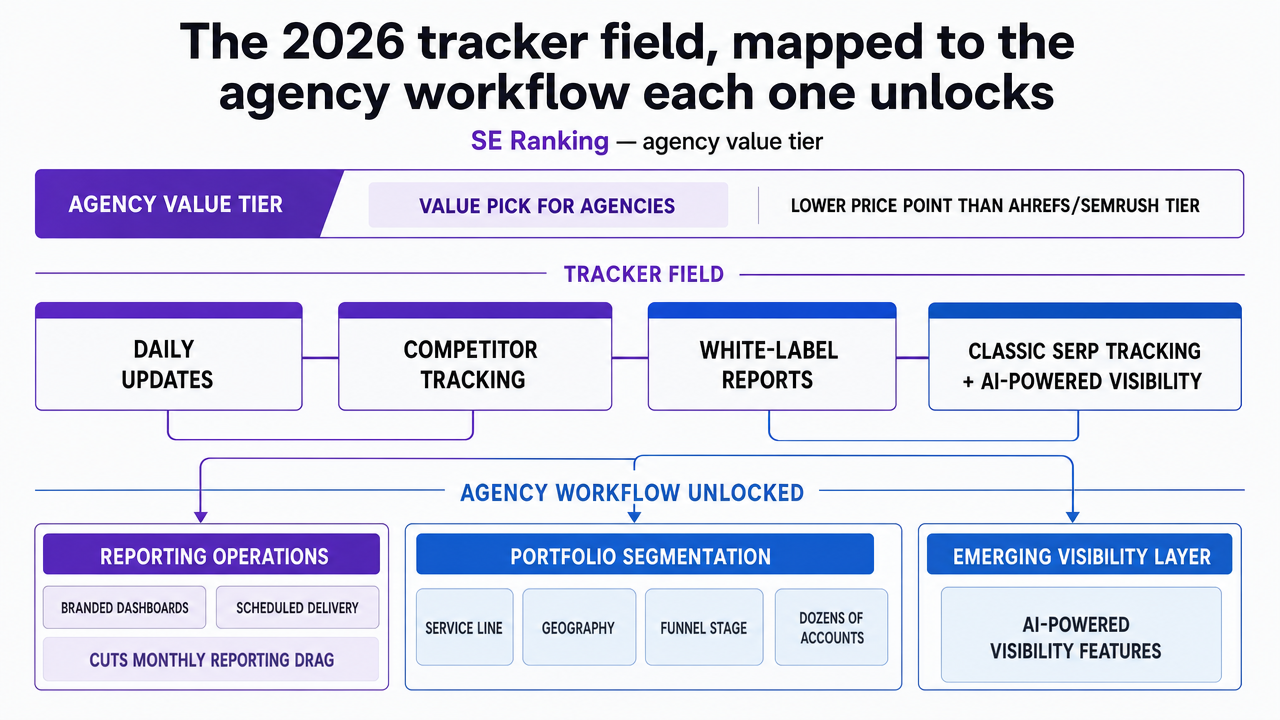
The 2026 tracker field, mapped to the agency workflow each one unlocks
SE Ranking — the agency value tier
SE Ranking earns its practitioner label as the value pick for agencies on cost per tracked keyword and breadth of client-facing features. Multiple 2026 reviews name it the best value option for agency work, citing daily updates, competitor tracking, and white-label reports at a lower price point than the Ahrefs/Semrush tier 5, 6.
The operational fit shows up in three places. Client dashboards can be branded and scheduled without manual assembly, which cuts the monthly reporting drag on senior specialists. Keyword grouping is granular enough to segment by service line, geography, or funnel stage across dozens of accounts. And AI-powered visibility features have started appearing in the SE Ranking stack alongside classic SERP tracking 5, which matters when clients begin asking about AI Overview coverage.
For agencies onboarding new accounts at a steady clip, the practical read is: SE Ranking absorbs volume without a proportional cost spike, and the reporting output is defensible enough to hand to clients without a producer sanitizing it first.
AccuRanker — live volatility and enterprise-grade update speed
AccuRanker is the tracker of choice when refresh cadence is the deliverable. Reviewers consistently describe it as ideal for agencies needing real-time, high-precision ranking updates, and specifically for live volatility analysis during algorithm updates and SERP shuffles 3, 5. MarketerMilk's 2026 list frames it as the fit for marketplaces and large enterprise websites where thousands of keywords need to be scanned on demand 6.
The workflow that unlocks: on-demand refresh means an account lead can pull a fresh SERP snapshot mid-meeting when a client challenges a movement, rather than waiting for the next scheduled crawl. During confirmed algorithm updates, AccuRanker's cadence lets the team distinguish transient thrash from durable drops within 24–48 hours, which changes what gets escalated to production versus watched.
The trade-off is cost per keyword at high volume. Reserve AccuRanker for the accounts and keyword clusters where volatility monitoring is the point — head terms, competitor watchlists, revenue-critical queries — rather than the long tail that a cheaper tracker can handle overnight.
Advanced Web Ranking — white-label client reporting
Advanced Web Ranking gets named the best-in-class option for reporting across practitioner-led lists 4, and the best fit for white-label client reporting in real-campaign testing 5. The distinction matters: it is a reporting-first tracker, not a tracker with reports bolted on.
What that unlocks for a mid-size agency: the monthly deliverable stops being assembled by hand. Reports are fully branded, scheduled, and structured around narratives — visibility share, competitor movement, SERP feature capture — rather than raw position dumps. For agencies whose reporting labor scales linearly with account count, that shift is where the seat cost pays for itself.
Advanced Web Ranking also carries deeper historical trend depth than most cheaper trackers, which matters when client conversations turn to year-over-year visibility rather than month-over-month noise. If the current bottleneck is a senior specialist spending two days a month formatting decks, this is the tool that removes the specialist from that loop.
Ahrefs — competitor analysis with position history depth
Ahrefs anchors its position in the 2026 field on two axes: it scores highest across aggregate rankings of search ranking software 8, and it holds a measurable accuracy edge over adjacent suites — 78% exact-position match versus Moz's 71% across the 12-site test cited earlier 11. Practitioners consistently label it best for competitor analysis 6.
The workflow it unlocks is competitive intelligence at scale. Ahrefs tracks keyword rankings with position history and provides ongoing visibility across domains and locations 9, which means an agency can watch a client's top three competitors on the same tracked keyword set, on the same cadence, without provisioning a second tool. Cross-search-engine insights and historical depth are called out as the reasons Ahrefs sits at the top of ranking monitor evaluations 12.
Where Ahrefs fits in the stack: use it as the intelligence layer feeding competitor gap analysis and content-priority calls, and pair it with a cheaper tracker for long-tail portfolio monitoring if the seat math gets uncomfortable.
Semrush — in-house teams and cross-discipline workflows
Semrush earns the in-house label in 2026 practitioner reviews 6for a reason that matters to agencies too: it is the suite most likely to already be sitting in the client's own stack. That reduces onboarding friction on co-managed accounts, where the agency and the client's in-house team share dashboards.
The tracker itself sits inside a broader SEO, content, and PPC toolset, which is where the cross-discipline value shows up. Position data joins keyword research, on-page auditing, and paid intelligence in one interface, cutting the number of tabs an account lead has open during a review.
The read for agencies: Semrush is rarely the sharpest specialist tool in any single category, but it is the default connective tissue when the client's team lives in it and the agency has to plug in cleanly.
Nightwatch and Local Viking — local pack and geo-grid specialists
For any book with multi-location accounts, local specialists earn their own line item. Nightwatch is named the fit for local SEO in the 2026 practitioner lists 6, and Local Viking sits alongside it as the map tracking specialist called out for modern rank tracking stacks 4.
The workflow both tools unlock is geo-grid tracking — sampling rankings across a coordinate matrix around each business location rather than a single city centroid — which is now a standard 2026 evaluation criterion rather than a niche feature 7. That granularity is what makes local reporting defensible when a client asks why their Google Business Profile shows position two but the map pack shows nothing three miles east.
Practical stack pattern: run Nightwatch or Local Viking as the local layer for accounts with physical locations, and keep the primary agency tracker for organic web positions. Trying to force a general-purpose tracker to answer geo-grid questions consistently produces reports that survive the client meeting but not the follow-up questions.
ProRankTracker and Nozzle — agency specialist and data-visualization at scale
ProRankTracker gets the explicit best-for-agencies label in the Traffic Think Tank guide 4, built around the operational realities of managing many client accounts: multi-user access, client-scoped reporting, and the kind of bulk keyword handling that breaks lighter tools past a few hundred accounts.
Nozzle occupies a different slot in the same list — best for data visualization at scale 4. It targets agencies that have already outgrown standard dashboarding and need SERP data piped into custom BI environments where visualization is built to spec rather than templated by a vendor.
The pairing is instructive. ProRankTracker handles the day-to-day tracking and client delivery motion; Nozzle handles the internal analytics and executive reporting where the visualization requirements exceed what a tracker's native UI provides. Agencies rarely need both, but the ones that do have crossed the threshold where SERP data is a first-class dataset in their operational stack.
Google Search Console — free ground-truth baseline, not a full solution
Google Search Console holds a specific and limited job in an agency stack. It is the free baseline with no keyword limit and Google's own click and impression data attached 3, which makes it the only ground-truth source that pairs position with actual query performance.
What it cannot do at agency scale: multi-engine coverage, competitor tracking, geo-grid local, scheduled white-label reports, or the automation surface that 20+ accounts require. Editorial reviewers frame Search Console as a starting point, not a full solution 2, 3. Use it to audit paid tracker output against Google's own numbers, not as the reporting layer clients see.
 Visualize the tier-to-tool mapping so readers can scan the agency stack at a glance, reinforcing the section's core comparison framework
Test advanced rank tracking on real campaigns now
Track and optimize live keyword performance for your client sites during your free trial—no limitations on usage.
AI search visibility: the second tracker category most listicles conflate
Classic rank trackers answer one question: where does a URL sit in the blue-link SERP for a given query? AI search visibility trackers answer a different one: does the brand get cited inside an AI Overview, a ChatGPT answer, or a Perplexity response when a user asks a related prompt? Both matter. Neither substitutes for the other, and 2026 listicles that mix them into a single ranking are measuring two different signals with one ruler.
The 2026 comparative test that ran 16 trackers across five client accounts over eight weeks made this split explicit by adding AI search citation tracking as a formal evaluation criterion alongside classic SERP position accuracy 7. The evidence that these are distinct signals is quantitative. Analysis referenced in the 2026 enterprise-platform comparison found that brand web mentions correlate with AI Overview visibility at 0.664, while backlinks correlate at just 0.218 — meaning the input variables that drive AI citation coverage are not the same ones that drive organic position 14.
The operational read for agency leads: keep the classic tracker as the source of truth for SERP position, and layer a dedicated AI visibility tool onto accounts where AI Overview coverage or LLM citation share is a client KPI. Practitioner lists have already started calling out LLM-focused trackers as an emerging category rather than a feature of the incumbents 6. Treat AI visibility as a parallel measurement stack — different queries, different sampling logic, different reporting cadence — and design the client dashboard so the two data sets stay labeled, not blended.
Portfolio economics: cost per tracked keyword across a client book
Once a book crosses 20 accounts, the tracker line item stops being a tool decision and starts being a unit-economics decision. The variable that matters is cost per tracked keyword across the full portfolio — and the input that drives it is how many keywords each client actually needs monitored to support the reporting narrative.
Zapier's editorial guidance sets a defensible floor: import each client's top 20–50 keywords, then layer competitor tracking and threshold alerts on top 2. Anchoring on that range, the arithmetic is straightforward. A 30-account book at 35 core keywords per client sits at roughly 1,050 tracked keywords; a 60-account book at the same density lands near 2,100; a 100-account book pushes past 3,500 before competitor keyword sets are layered in. Competitor tracking typically doubles or triples the total, which is where per-keyword pricing starts to dictate which tier a tracker sits in.
The practical move is to map tiers to keyword-volume brackets rather than shopping one tool for the whole book.
| Tier | Representative tool | Where it earns its seat |
|---|---|---|
| Agency Value | SE Ranking | High-volume core tracking across most accounts 5, 6 |
| Enterprise Accuracy / Volatility | AccuRanker | On-demand refresh for revenue-critical clusters 5 |
| White-Label Reporting | Advanced Web Ranking | Branded, scheduled client deliverables 4 |
| Local / Geo-Grid | Nightwatch, Local Viking | Multi-location coordinate sampling 4, 6 |
| Competitor Analysis | Ahrefs | Cross-domain intelligence and history 6 |
| In-House Suite | Semrush | Co-managed accounts, cross-discipline reporting 6 |
| Agency Specialist | ProRankTracker | Multi-user, client-scoped operations 4 |
| Visualization | Nozzle | Custom BI piping at scale 4 |
The operator read: run the agency-value tier as the volume workhorse, reserve the enterprise-accuracy tier for the keyword clusters where volatility drives client conversations, and treat local and visualization tiers as add-ons tied to specific account types rather than as portfolio-wide seats.
See How Leading Agencies Track SEO Performance at Scale
Discuss advanced rank tracking workflows and discover solutions engineered for agencies managing multi-client SEO campaigns—without adding to operational overhead.
If you manage multi-location or franchise portfolios
A shift in scope here: multi-location and franchise books change the tracking math before they change the tool choice. A single brand with 40 locations is not a 40-account book — it is one account with 40 geo-grid sampling requirements, each of which needs coordinate-level position data around the physical address rather than a city-centroid rank.
The evaluation criteria used in 2026 comparative testing formally treat geo-grid local as a first-class capability, on par with SERP feature detection and update speed 7. Practitioner lists reinforce the split: Nightwatch is named the fit for local SEO 6, and Local Viking sits alongside it as the map tracking specialist for modern stacks 4. Neither replaces the primary tracker on organic web positions — they run in parallel, feeding the local layer of the client report.
The operator move on franchise portfolios: standardize a coordinate matrix per location (typically a 5x5 or 7x7 grid at fixed radius), lock the keyword set to the service categories the brand actually competes on locally, and treat the geo-grid tracker's output as its own dataset in the reporting stack rather than merging it into blue-link position tables.
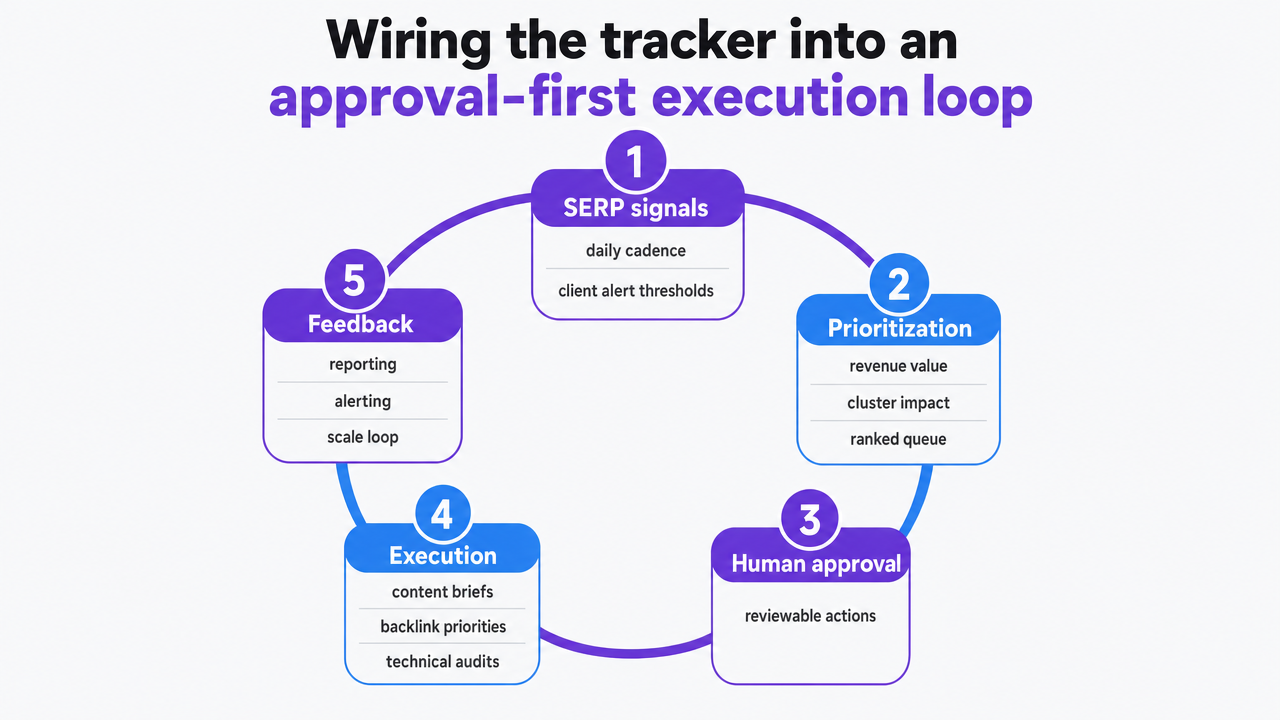
Wiring the tracker into an approval-first execution loop
The tracker's output is only as useful as the workflow it triggers. For agencies scaling past a few dozen accounts, position data has to leave the dashboard and become a queue of ranked, reviewable actions — content briefs on slipping clusters, backlink priorities on competitor gains, technical audits on SERP feature losses. Editorial guidance already frames rank trackers as the front end of automated reporting and alerting flows rather than standalone dashboards 2, and 2026 comparative testing evaluates reporting quality as a first-class criterion alongside accuracy and update speed 7.
The loop that holds up at scale has four stages:
- SERP signals land in the tracker at daily cadence with alert thresholds set per client.
- Those alerts route into a prioritization layer that weights movement by revenue value and cluster intent, not raw position delta.
- Ranked recommendations then hit a human approval queue where an account lead confirms scope before anything ships.
- Approved work executes across content, backlinks, and on-page — and the KPI feedback closes the loop by feeding outcome data back to the tracker's tracked-keyword set.
Vectoron sits at stages two through four of that loop as the execution layer that converts tracker signals into approved, produced work.
 Visualize the four-stage loop described in the section (SERP signals → prioritization → human approval → execution → feedback) since this is a process flow explicitly enumerated in the prose
Frequently Asked Questions
References
- 1.Best rank checking tool of 2024.
- 2.The 12 best rank tracker tools.
- 3.10 Best Website Rank Tracker Tools Compared [Free+Paid].
- 4.10 Top Rank Tracker Tools (for Serious SEOs) in 2026.
- 5.15 Best Rank Tracking Software (Tested on Real Campaigns).
- 6.14 best rank tracker software I'm using for SEO in 2026.
- 7.Best Rank Tracker Tools Comparison 2026: 16 Trackers | SEO Agency USA.
- 8.Top 10 Best Search Ranking Software: 2026 Comparison.
- 9.Top 10 Best Search Ranking Monitoring Software of 2026.
- 10.10 Best Rank Trackers for Accurate SEO Data in 2026.
- 11.Is Ahrefs More Accurate Than Moz? Tested Across 12 Sites.
- 12.Top 10 Best Ranking Monitor Software of 2026.
- 13.The 12 Best SEO Ranking Reporting Software for 2026.
- 14.BrightEdge Alternatives 2026.