
Key Takeaways
- Enterprise diagnostic platforms Semrush and Ahrefs treat rank as one field in a broader intelligence graph, joining position data to backlinks, content, and GSC for competitive investigation.
- High-frequency SERP monitors AccuRanker, Nozzle, and STAT prioritize refresh speed and feature depth, with AccuRanker's on-demand refreshes and Nozzle's structured SERP storage suiting AI Overview-era diagnostics.
- SE Ranking fits mid-market agencies managing 20 to 80 clients by consolidating rank tracking, audits, and white-label reporting into one operationally efficient platform without enterprise seat pricing.
- Local specialists BrightLocal and Local Falcon handle multi-location clients through grid-based tracking and Google Business Profile monitoring, geometry that enterprise rank trackers cannot report honestly.
- Vectoron sits above rank trackers as an execution-coordination layer, converting position data and GSC signals into approval-gated work orders across content, backlinks, PPC, and social.
Why Rank Tracking Became a Diagnostic Layer in 2026
The category shifted the moment position stopped predicting traffic. A 2025 Pew Research analysis of U.S. adult browsing behavior found that when a Google result page included an AI Overview, users clicked a traditional organic link in just 8% of visits, compared with 15% on pages without one. Clicks on the citation links inside the AI summary itself landed at roughly 1% 1. Even with caveats, the direction is clear enough that agency directors can no longer report a client's #3 ranking as good news without checking what the SERP around that #3 looks like.
That reframes what a rank tracker is for. Position data is now an input into a diagnostic question, not the answer itself. The best tools of 2026 pair raw rankings with SERP feature presence, AI Overview detection, and first-party Google Search Console signals so an analyst can explain, inside 24 hours, whether a traffic dip came from a lost position, a suppressed click yield, an indexing fault, or a demand shift.
Everything that follows evaluates tools against that standard.
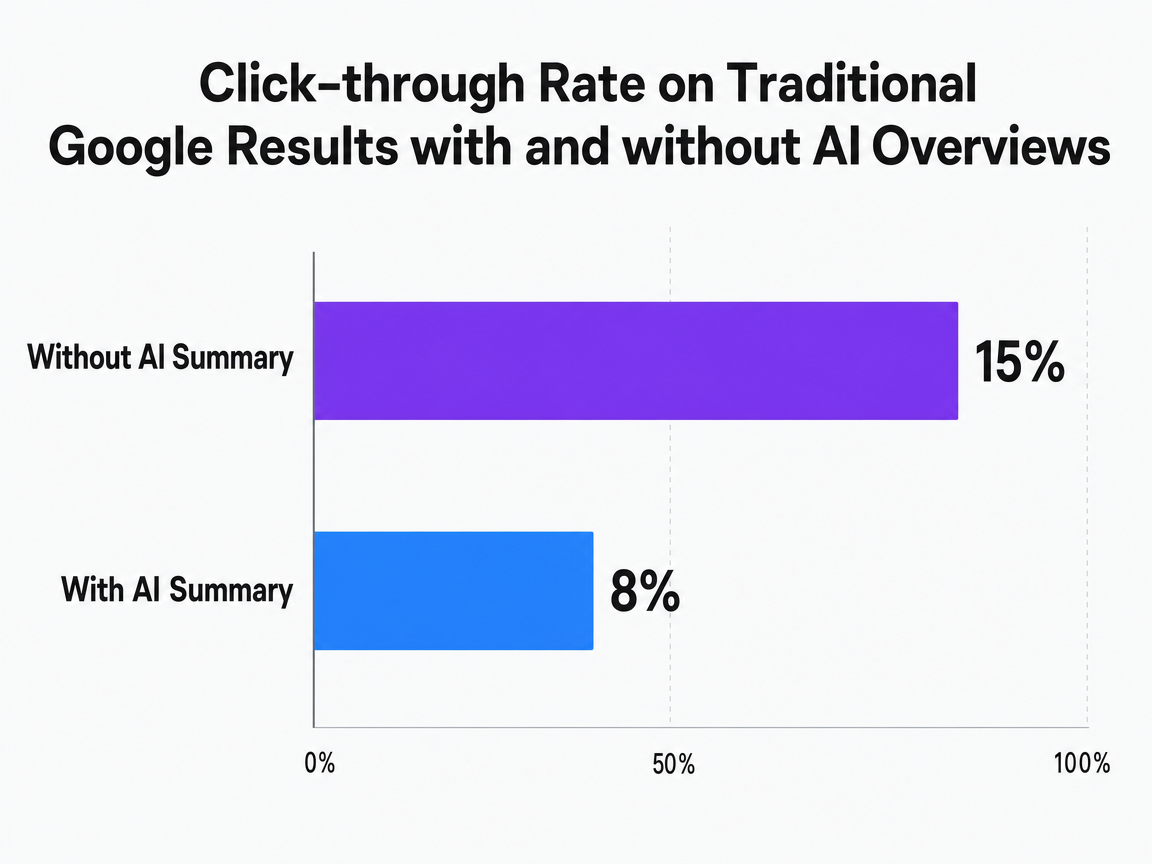 Click-through Rate on Traditional Google Results with and without AI Overviews
Comparison of the percentage of user visits where a traditional search result was clicked, contrasting SERPs with an AI summary against those without. Data is from a 2025 Pew Research study.
What Agency Directors Should Score Tools On
Diagnostic Velocity: Time from Rank Drop to Client Explanation
The single most useful metric for evaluating a 2026 rank tracker is how quickly it can answer the question a client will ask on Tuesday morning: why did we lose position 4 on our money term over the weekend? A tool that reports the drop but leaves the analyst hunting through five other dashboards has already failed.
Diagnostic velocity means the platform surfaces the adjacent evidence next to the rank change. Did impressions fall in Google Search Console during the same window? Did an AI Overview appear on that query? Did the ranking URL lose its indexed status? Did a competitor gain a featured snippet? Agency teams should score each vendor by walking a real historical rank drop through the interface and timing how many minutes pass before the cause narrows to two or three candidates. Anything past 30 minutes forces analysts into manual triage, which does not scale across a book of 40 or more clients.
The tools that survive this test share one trait: they treat rank as one column in a diagnostic table, not as the headline number.
SERP Feature and AI Overview Coverage
A tracked position of 3 means something different when an AI Overview, a People Also Ask block, a video carousel, and a local pack sit above it. Directors should confirm the tool captures which features render on each tracked query, on which device, and in which location, and flags AI Overview presence as a distinct field rather than burying it inside a generic feature tag.
The evaluation should go further. Does the platform record whether the client's domain is cited inside the AI summary itself? Does it track feature volatility over time, so an analyst can distinguish a query where AI Overviews appear on 90% of daily checks from one where they surface intermittently? Feature presence data without frequency data leads to overreaction. Tools that log a boolean AIO flag once per week and call it coverage are two years behind the SERP.
GSC Depth: Hourly Data, Row Limits, and Index Inspection
Google Search Console is the first-party source of truth, and in 2025 it became materially more useful. The Search Analytics API now returns up to 10 days of hourly data through the new HOUR and HOURLY_ALL dimensions 4, which means a rank tracker that still pulls GSC once every 24 hours is throwing away resolution the platform is giving away for free.
Agency directors should check three things during vendor demos. First, does the tool ingest hourly Search Analytics data and align it against ranking timestamps, so a Saturday afternoon impression drop can be tied to a Saturday afternoon position shift? Second, how does it handle the API's pagination and row limits 12, 13? Enterprise properties routinely hit those limits, and vendors that silently truncate the long tail will underreport query coverage on the largest clients. Third, does the platform call the index.inspect endpoint to report indexed or indexable status on ranking URLs 5? That single check separates a canonicalization or crawl issue from a genuine ranking loss, which is often the difference between a 15-minute answer and a two-day investigation.
Technical Health Context: CWV and CrUX Integration
Rank movement on mobile without performance context is a guess. The 2025 HTTP Archive Web Almanac, based on the July 2025 crawl, found that 56% of desktop origins passed all three Core Web Vitals, compared with 48% on mobile. The gap widens sharply on Interaction to Next Paint: 97% of desktop experiences scored good, against 77% on mobile 2. A rank tracker that reports a mobile position drop without checking whether INP or LCP regressed against Google's thresholds of 200 milliseconds and 2.5 seconds 8 is asking the analyst to ignore the most likely cause on a device where a quarter of experiences already struggle with responsiveness.
Directors should score each platform on whether it pulls CrUX field data 14 for ranking URLs and flags regressions alongside position changes. Bonus points if the tool separates origin-level from URL-level CrUX, because a category page that quietly slipped past the LCP threshold will not show up in a site-wide average.
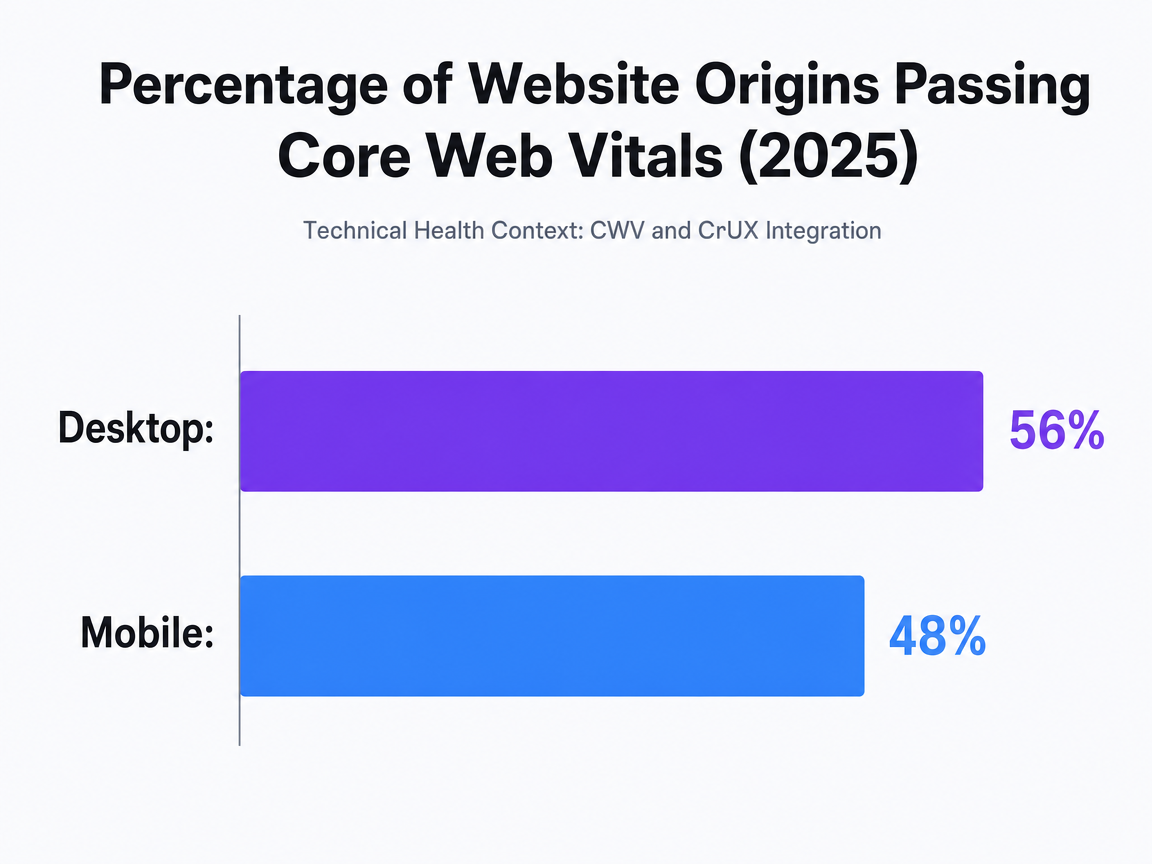 Percentage of Website Origins Passing Core Web Vitals (2025)
Comparison of the percentage of desktop vs. mobile website origins that passed all three Core Web Vitals metrics in 2025, from the HTTP Archive's Web Almanac.
The Shortlist, Grouped by Job-to-be-Done
Enterprise Diagnostic: Semrush and Ahrefs
Semrush and Ahrefs earn their place on an agency shortlist because they treat rank as one field inside a broader intelligence graph. Both platforms crawl their own link and content indexes, then join that data to Google Search Console when the client grants access. For an analyst chasing down a position drop on a competitive term, that join is the difference between a partial answer and a full one.
Semrush's Position Tracking module handles device, location, and SERP feature segmentation on a daily refresh, and its Sensor tool provides volatility context so an analyst can separate a client-specific loss from a broader SERP shake-up. The platform also flags AI Overview presence on tracked queries, though the frequency and citation-inclusion detail still trail specialist SERP monitors. Ahrefs takes the opposite emphasis. Its Rank Tracker is competent rather than category-leading, but the Site Explorer and Content Explorer layers let an analyst investigate why a competitor moved up: a fresh backlink cluster, a rewritten page, or a topical expansion the client has not matched.
Both tools ingest Search Console data, but neither yet exposes the hourly HOUR and HOURLY_ALL dimensions Google released in 2025 at the same resolution the API allows 4. Agencies running enterprise clients should treat that as a temporary gap and pair either platform with a direct Search Console pipeline for the top-value properties. The Search Analytics API's row limits and pagination behavior 12, 13 also mean the largest properties will exceed what either vendor surfaces natively, so a supplementary warehouse pull is standard practice.
High-Frequency SERP Monitoring: AccuRanker, Nozzle, STAT
When diagnostic velocity is the priority, dedicated SERP monitors outperform the all-in-one suites. AccuRanker, Nozzle, and STAT (part of Moz) all built their businesses on refresh speed and SERP feature depth, and each one has adapted differently to the AI Overview era.
AccuRanker offers on-demand refreshes on tracked keywords, which matters when a client asks a question at 10 a.m. and the analyst needs the current SERP by 10:05. Its SERP feature coverage is thorough, and the platform records AI Overview presence as a discrete field with historical frequency, which is the level of resolution the Pew 2025 findings on click compression make necessary 1. Nozzle takes the most engineered approach to SERP data. It stores the full SERP as structured data on every check, which means an analyst can retroactively query things like "on which days did the client's URL appear as an AI Overview citation" without a re-crawl. That flexibility comes with a steeper learning curve and a higher price per tracked keyword, which is why Nozzle tends to land at agencies with a dedicated analytics engineer on staff.
STAT remains the workhorse for enterprise SEO teams that need daily coverage across tens of thousands of keywords with tight share-of-voice reporting. Its share-of-voice rollups by market segment are still among the cleanest available for board-level agency reporting. The tradeoff: STAT's technical health context is thin, so an analyst who spots a mobile position drop still needs to pull CrUX field data 14 and check Core Web Vitals against the LCP 2.5s, INP 200ms, and CLS 0.1 thresholds 8 in a separate tool.
All-in-One Platform for Mid-Market Agencies: SE Ranking
SE Ranking sits in a specific slot: agencies with 20 to 80 clients that need one tool to cover rank tracking, backlink monitoring, technical audits, and white-label client reporting without paying enterprise seat prices. The platform's rank tracker handles daily refreshes, device and location splits, and SERP feature detection including AI Overview flags, though the historical depth on feature volatility does not match AccuRanker or Nozzle.
Where SE Ranking earns its shortlist spot is the reporting layer. White-label report templates can be built once and deployed across every client, with GSC data pulled in through the Search Analytics API 12 alongside position data and technical audit findings. For an agency director trying to reduce analyst hours per client, that consolidation is the operational payoff. The limitation is depth: SE Ranking's competitive intelligence and content research modules are useful but shallower than Semrush or Ahrefs, and enterprise clients running six-figure content programs will hit the ceiling. The right frame is portfolio breadth over per-domain depth, which fits the mid-market brief.
Local and Multi-Location Coverage: BrightLocal and Local Falcon
This section addresses agencies with multi-location clients: home services, dental groups, law firm networks, senior living portfolios, and similar operators where a single "brand" resolves to 20, 200, or 2,000 physical locations. Enterprise rank trackers do not handle this geometry well, and forcing them to produces reports that miss the entire point of local SEO.
BrightLocal remains the default for local rank tracking, citation management, and Google Business Profile monitoring at scale. Its grid-based rank tracking shows position across a geographic grid around each location, which is the only honest way to report local visibility because a single ZIP-code check hides the drop-off in surrounding blocks. Local Falcon specializes further. Its grid density and Google Business Profile snapshot depth are stronger for agencies where local pack visibility is the primary lever, and its share-of-local-voice metric is more actionable than a plain average position across a grid.
Neither tool substitutes for a general SERP tracker on organic blue-link terms. Multi-location agencies typically run BrightLocal or Local Falcon for the local pack and Google Business Profile layer, and pair it with Semrush, AccuRanker, or SE Ranking for organic and informational queries. The overlap is worth the cost when a client's revenue depends on the map pack.
Execution-Linked: Vectoron as an Adjacent Layer
Vectoron does not compete with Semrush or AccuRanker on raw rank tracking. It sits one layer above, as an execution-coordination platform that consumes rank signals and turns them into ranked, approval-gated work orders across content, backlinks, PPC, and social. For an agency director, the relevant question is not whether Vectoron replaces a dedicated rank tracker but whether it closes the loop between what the rank tracker surfaces and what an analyst actually does about it.
The platform's SEO strategist ingests position data, Google Search Console signals through the Search Analytics API 12, and technical health context, then proposes prioritized actions: rewrite this cluster, request these backlinks, refresh these pages, adjust these bids. Every recommendation carries the reasoning behind it and routes through a Command Center for human approval before execution. That approval-first model matters for agencies because it preserves analyst judgment while removing the briefing, handoff, and QA cycles that consume the hours a rank tracker was supposed to save.
The honest positioning: an agency serving 40 clients still needs a dedicated rank tracker for the position data itself. Vectoron is what determines whether that data becomes billable work inside 48 hours or sits in a dashboard until the next quarterly review.
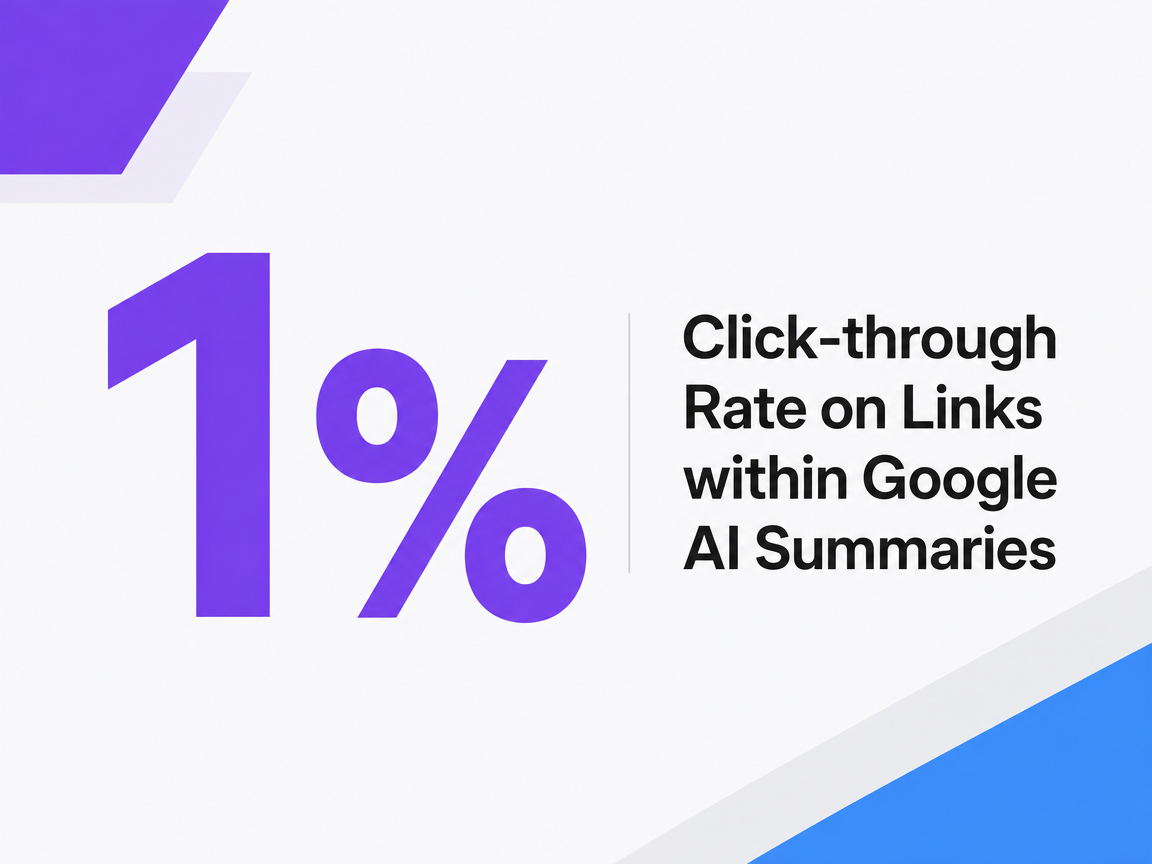 Click-through Rate on Links within Google AI Summaries
Click-through Rate on Links within Google AI Summaries
Test live rank tracking workflows risk-free now
Monitor actual client rankings and publish real reports during your full-access trial, no restrictions or sandbox limits.
The 2026 Diagnostic Workflow the Best Tools Support
A rank drop is a signal, not a verdict. The workflow that separates useful platforms from decorative ones runs a predictable sequence, and the best tools compress it into a single interface rather than five browser tabs.
- The alert: a tracked query lost position, or share of voice fell against a competitor set.
- Pivot to Google Search Console. The Search Analytics API now returns up to 10 days of hourly data through the HOUR and HOURLY_ALL dimensions 4, which lets an analyst align a position change with the exact hour impressions and clicks shifted. If GSC shows impressions holding while clicks collapsed, the cause is SERP composition, not ranking. If impressions dropped in parallel, the cause is upstream.
- Index status. A call to the index.inspect endpoint 5 confirms whether the ranking URL is still indexed and indexable, or whether a canonicalization change, a robots directive, or a crawl fault removed it from consideration. Skipping this step is how analysts spend two days chasing a link gap that was actually a rogue noindex tag.
- Audit the SERP itself. Did an AI Overview appear on the query? Did a video carousel, a local pack, or a fresh featured snippet push the tracked URL below the fold?
- Close the loop on technical health by pulling CrUX field data 14 for the ranking URL and comparing it against Google's Core Web Vitals thresholds of 2.5 seconds for LCP, 200 milliseconds for INP, and 0.1 for CLS 8.
Five steps, one narrative for the client. Any tool that cannot walk an analyst through this sequence inside a single session is a scoreboard, not a diagnostic layer.
If a Portfolio Spans Dozens of Clients: The Per-Keyword Math
The audience scope shifts here from single-account thinking to portfolio economics. An agency director running 40 clients does not evaluate rank trackers on the headline per-keyword rate. The relevant number is what the vendor bills after the multiplier stack runs.
The formula is simple and rarely written down. Tracked keywords per client, times refresh frequency, times device splits, times location splits, equals the true tracked-query count that determines the invoice. A modest configuration for a home services client illustrates the compounding: 200 keywords tracked across 3 service-area locations on 2 devices at a daily refresh yields 1,200 tracked queries per client per day, or 36,000 per month for that single account. Multiply across 40 clients with similar geometry and the portfolio sits at 1.44 million tracked queries per month, not 8,000.
Three variables move the invoice more than the sticker rate:
- Refresh frequency compounds fastest, because moving from weekly to daily is a 7x multiplier on every other dimension.
- Location splits punish multi-location clients specifically, which is why local-focused vendors price grids differently from organic vendors.
- Device splits are the quietest cost driver, but skipping mobile tracking on a portfolio where Core Web Vitals pass rates already lag desktop by eight points 2 means an agency loses visibility on the device where ranking volatility is highest.
Directors negotiating renewals should walk vendors through the actual multiplier stack rather than accepting a per-keyword quote at face value.
See How Leading Agencies Streamline SEO Rank Tracking at Scale in 2026
Connect with specialists to evaluate integrated rank tracking workflows designed for multi-client management, approval-first automation, and real-time visibility—purpose-built for agency teams managing complex SEO portfolios.
Demand Context: Pairing Rank Data with Trends and First-Party Signals
Rank data without demand data explains half the story. A tracked term that slides from position 3 to position 6 while overall search interest for the category drops 40% is a different problem than the same slide in a flat market, and the client conversation should reflect that difference.
The Google Trends API alpha, announced in July 2025, gives agency teams a structured feed of search-interest data going back 1,800 days with daily, weekly, monthly, and yearly aggregations, and the latest data lands within two days of the current date 9, 15. Access is still rolling out, so most agencies will pair the Trends Explore interface with their rank tracker in the interim. Explore supports up to five terms with filters for country, date, category, and property, which covers most competitive-set comparisons an analyst needs to run against a client's tracked keyword list 16. The workflow: overlay category-level demand against the client's position and click curves, and the causal story usually resolves in one chart rather than three meetings.
How to Run a 30-Day Vendor Trial Across a Client Book
A 30-day trial that only tests dashboard aesthetics is a wasted month. The trial that actually resolves a purchase decision runs three parallel workloads against the same client sample, on the same date range, and forces each vendor to answer the diagnostic questions the agency will ask in production.
Directors should pick five clients that span the portfolio: one enterprise property with tens of thousands of tracked queries, two mid-market accounts with active content programs, one multi-location operator, and one client currently mid-recovery from a ranking loss. Load the same keyword set, device splits, and locations into each candidate platform on day one. Then run the same three tests every week:
- Timed diagnostic drills: pick a real historical rank drop and clock how many minutes each tool takes to narrow the cause to two or three candidates, checking whether it aligns hourly Search Console data against the rank timestamp 4 and whether it calls the index.inspect endpoint to rule out indexability 5.
- SERP feature audits on 20 queries known to trigger AI Overviews, comparing detection accuracy and citation-tracking depth.
- A full white-label report build measured in analyst minutes, not features shipped.
The vendor that wins is the one that shortens the Tuesday-morning client call, not the one with the prettiest dashboard.
Frequently Asked Questions
References
- 1.Do people click on links in Google AI summaries?.
- 2.Performance | 2025 | The Web Almanac by HTTP Archive.
- 3.Methodology | The Web Almanac.
- 4.The Search Analytics API now supports hourly data.
- 5.Method: index.inspect | Search Console API.
- 6.Google Search Essentials (formerly Webmaster Guidelines).
- 7.Overview of crawling and indexing topics.
- 8.Understanding Core Web Vitals and Google search results.
- 9.Introducing the Google Trends API (alpha): a new way to access search trends data.
- 10.General Guidelines.
- 11.Search Quality Rater Guidelines: An Overview.
- 12.Search Analytics | Search Console API.
- 13.Query your Google Search analytics data.
- 14.Overview of CrUX | Chrome UX Report.
- 15.Einführung der Google Trends API (Alpha): eine neue ....
- 16.Get started with Google Trends | Google Search Central.