
Key Takeaways
- AccuRanker suits reporting-heavy shops because scheduled reports, white-label PDFs, and a Looker Studio connector cut analyst time on client deck assembly across weekly cadences.
- Semrush wins on stack consolidation, folding position tracking into backlinks, audits, and keyword research so generalist agencies can replace three specialist tools with one.
- Ahrefs Rank Tracker earns its slot on SERP archive depth, letting strategy-led practices answer who took a position and with what snippet without switching apps.
- SE Ranking is the mid-market workhorse whose predictable per-project economics let 20-to-80 client practices add accounts without triggering a quarterly stack review.
- Nightwatch tracks by geo-coordinate rather than city, giving multi-location and franchise clients per-store local pack visibility instead of averages that flatter underperformers.
- Keyword.com is API-first, making ranking data flow directly into internal dashboards and alerting systems for programmatic agencies with engineering capacity past 100 clients.
- Serpstat gives lean teams under 30 clients most of the agency-scale rubric plus backlink and audit modules at a lower operating cost for tool consolidation.
What breaks first when rank tracking scales past 50 clients
The failure points are predictable. Somewhere between 40 and 60 active clients, the SEO practice stops arguing about which tool has the prettiest dashboard and starts triaging which parts of its measurement stack are actively lying to it. Reporting cadence slips first. Analysts spend Friday afternoons stitching CSV exports into client decks instead of interpreting movement. Then the API rate limits start throwing errors during weekly pulls, and someone quietly drops half the tracked keywords to keep pulls under quota.
The second thing that breaks is the definition of "ranking" itself. Google's introduction of dedicated generative AI performance reports in Search Console in June 2026 confirmed what practitioners already suspected: impressions inside AI Overviews and AI Mode now sit alongside classic organic positions as a measured surface 3. A tool that only reports blue-link positions is answering a question the client stopped asking.
The third break is structural. Agency-ready platforms are supposed to handle multiple projects, grouped keyword sets, competitor comparison, and client-facing reporting inside one workflow 7. Most tools handle two of those cleanly. The rest get patched with spreadsheets, Looker Studio connectors, and an analyst who knows where the bodies are buried.
The seven platforms below are ranked by how they hold up when those three things break at once.
The agency-scale evaluation rubric
Five criteria that separate agency tools from solo dashboards
The rubric agency leads actually use in procurement conversations rarely matches the feature grid on vendor websites. Five criteria carry the weight when a tool has to survive contact with 75 client accounts and a Monday morning reporting deadline.
- API access. Once a practice crosses roughly 50 clients, dashboards stop being the primary interface. Ranking data needs to land in internal reporting systems, client portals, and BI stacks without an analyst clicking export buttons. The API is what lets teams integrate keyword position data into internal dashboards, run multi-location monitoring at volume, and aggregate rankings with other performance metrics rather than depending on a standalone tool 8.
- Multi-project structure. Agency-ready platforms have to hold multiple projects, grouped keyword sets, competitor comparison, and client-facing reporting inside one workflow 7. If those functions live in separate accounts or require workarounds, the practice loses hours per week on tool administration alone.
- Competitor SERP capture. Position deltas without competitor context are half a story. Tools that snapshot the actual SERP — features, competitor URLs, snippet ownership — are the ones that support strategy conversations, not just status updates.
- Local pack granularity. For any client with physical locations, tracking by ZIP or geo-point rather than city-level is the difference between real local visibility data and averages that hide underperforming stores.
- AI-surface visibility. Google's June 2026 introduction of dedicated generative AI performance reports in Search Console formalized what practitioners had been improvising against for months: impressions inside AI Overviews and AI Mode are now a measured surface with its own reporting view 3. A rank tracker that ignores AI surfaces is scoring against a rubric Google itself has already updated.
Why per-market coverage now belongs in the rubric
Global averages hide the exact variance an agency lead needs to see when scoping tracking coverage for international clients. Google held 90.39% of worldwide search engine share in May 2026, which reads as a settled question until the country-level data lands beside it 4. Iceland sat at 86.49% in the same month 5. Hungary reached 95.1% in June 2026 6. A four-point spread inside Europe alone is enough to change how a practice sizes secondary-engine coverage for a client with distributed markets.
The operational consequence is straightforward. A tool that only tracks Google positions works for a US-focused portfolio. It underreports for an agency running campaigns across the Nordics, Central Europe, or any region where Bing, Yandex, or Seznam pick up measurable share. The rubric line to add is per-market engine coverage — the ability to configure which engines get tracked at which locations, per client, without spinning up separate accounts.
This is also where Search Console's per-country breakdowns become useful as a baseline data source that rank trackers should complement rather than replace 1. The tracker provides the position-level detail and competitor context. Search Console provides the ground truth on which countries actually generate impressions. Agencies that treat the two as one integrated view catch coverage gaps before a client points them out.
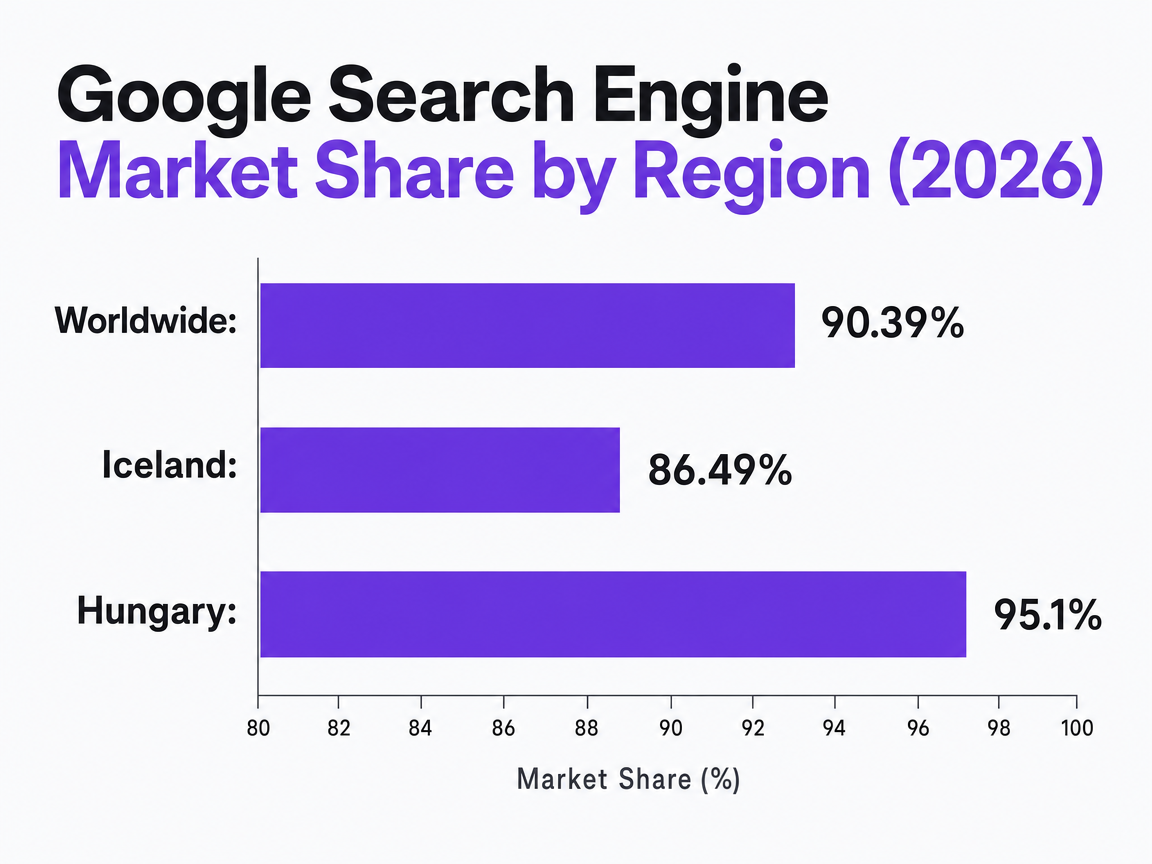 Google Search Engine Market Share by Region (2026)
A comparison of Google's search engine market share in different regions (Worldwide, Iceland, Hungary) in mid-2026, based on Statcounter data. This can be visualized as a bar chart to show regional variations from the global average.
Test enterprise rank tracking workflows risk-free
Experience live rank tracking and client reporting in your real environment before making a commitment.
The seven platforms, ranked by workflow fit
1. AccuRanker — the reporting-heavy shop's default
AccuRanker earns its slot because it treats reporting as a first-class object rather than an export button. Agencies running weekly or bi-weekly cadences across 60+ clients get scheduled reports, white-label PDFs, and a Looker Studio connector that pipes ranking data into whatever client portal the practice already runs. The tool refreshes daily by default, which matters when a client escalation lands on a Tuesday and no one wants to explain why the last data point is six days old.
Multi-project structure is where it holds up under weight. Grouped keyword sets, tagging, and share-of-voice calculations sit inside the project layer rather than requiring separate workspaces, which is the exact structural requirement agency-ready platforms are supposed to meet 7. Competitor SERP capture is competent without being the deepest in this list.
When it breaks: AccuRanker's pricing model tiers on keyword volume, and practices that track deep long-tail sets for every client hit budget ceilings before they hit performance ceilings. AI-surface tracking is available but still maturing relative to what Search Console now reports natively 3.
Best fit: reporting-heavy shops where analyst time saved on deck assembly directly funds account growth.
2. Semrush — the generalist stack that absorbs adjacent work
Semrush is not the sharpest pure rank tracker on this list. It is the one that removes three other tools from the stack. Position tracking sits inside a platform that also covers backlinks, content audits, technical crawls, and keyword research, which is why practices with mixed-discipline analysts default to it. The consolidation math often beats the specialist-tool math once a shop crosses roughly 40 clients.
Project-level structure supports grouped keyword sets, tagging, and competitor comparison in one workflow — the exact capability set agency-ready platforms are expected to hold together 7. Local pack tracking works at city and ZIP granularity, and the SERP feature capture is broad enough that most client reporting questions get answered inside the tool rather than through screenshots.
Position tracking accuracy is competent but not the tightest here. Analysts who run daily comparative pulls against Search Console impressions occasionally see drift, which becomes an issue when a client asks why the tool shows position 4 and Search Console shows 6.2 1.
When it breaks: Enterprise-scale keyword volumes push practices into custom pricing conversations quickly, and the API is available but rate-limited in ways that frustrate teams building programmatic reporting layers.
Best fit: generalist agencies where one platform serving six workflows beats six platforms serving one each.
3. Ahrefs Rank Tracker — competitor SERP capture without a second tool
Ahrefs earns its rank tracker slot on the strength of the SERP archive behind it. Position deltas without competitor context are half a story, and Ahrefs is the tool most likely to answer the follow-up question — who took the position, what snippet did they win with, what features shifted — without an analyst switching apps.
Historical SERP data goes back years for most tracked keywords, which turns quarterly business reviews into actual analysis instead of screenshot archaeology. Share-of-voice calculations, visibility trends against a defined competitor set, and SERP feature ownership are all first-class views. For practices where strategy conversations lean on "what changed and why," that depth pays for itself.
Local tracking is present but less granular than dedicated local tools. AI-surface visibility signals are improving but do not yet match what Search Console reports natively for generative AI features 3.
When it breaks: Client reporting is functional but not the tool's strength — most agencies end up piping Ahrefs data into an external dashboard for client-facing views. API access exists on higher tiers.
Best fit: strategy-led practices where competitor SERP analysis drives account-level recommendations, not just position updates.
4. SE Ranking — the mid-market agency workhorse
SE Ranking is the tool most often chosen on operating math rather than feature envy. It covers the agency-ready capability set — multiple projects, grouped keyword sets, competitor comparison, white-label reporting — inside a single workflow at a cost structure that scales predictably across a portfolio 7. Practices in the 20–80 client range keep landing on it after evaluating pricier options.
Local tracking supports ZIP-level configuration, competitor visibility is charted alongside client movement, and the reporting builder is flexible enough that most client decks generate without post-processing. SERP feature capture is solid across the surfaces that show up in typical client SERPs.
When it breaks: Enterprise-scale keyword volumes and high-frequency API pulls surface performance limits that don't appear at mid-market scale. AI-surface visibility tracking is present but not yet the tool's differentiator, which matters more each quarter as Google formalizes AI feature reporting inside Search Console 3.
Best fit: mid-market agencies where predictable per-project economics matter more than best-in-class depth in any single dimension. It's the tool that lets a practice add clients without triggering a stack review every quarter.
5. Nightwatch — local pack granularity for multi-location work
Nightwatch is the pick when a client's portfolio includes physical locations and city-level averages hide the story. The tool tracks by precise geo-coordinates rather than city or metro, which means a dental group with 40 locations gets 40 distinct local pack views instead of one averaged number that flatters underperformers.
That granularity is the entire argument. Multi-location clients live or die on whether the tracker can show which stores rank in the local pack for the queries that drive foot traffic, and which don't. Nightwatch's competitive tracking at the geo-point level is deeper than most tools in this list, and the reporting supports segmentation by location group — franchise region, DMA, state — without spreadsheet gymnastics.
Multi-project structure handles agency workflows cleanly, and the API supports the programmatic pulls needed when a practice is tracking 20,000+ location-keyword combinations across a portfolio 8.
When it breaks: For agencies without local clients, the geo-granularity is more capability than the work requires, and simpler tools cost less. AI-surface tracking is nascent here.
Best fit: agencies with franchise, multi-location, or dealer network clients where per-store visibility drives the actual business conversation.
6. Keyword.com — API-first for programmatic agencies
Keyword.com is the entry for practices that treat dashboards as the exception, not the interface. The API is the product, and the pitch is that ranking data flows directly into internal dashboards, reporting systems, and custom workflows rather than living inside a standalone tool 8.
The concrete use cases matter here. Rank-tracker APIs let agencies integrate keyword position data into internal dashboards, run multi-location monitoring at volume, wire automated alerts to the operations team when positions drop past a threshold, and aggregate rankings alongside conversion and pipeline metrics in a single view 8. For a practice pushing past 100 clients, that programmatic layer is what keeps analyst headcount flat while account count grows.
Position accuracy is competitive with the top of this list, and the platform offers a functional web interface for analysts who don't want to write SQL against the API. Competitor tracking and share-of-voice views are present without being the marketing story.
When it breaks: Agencies without engineering capacity to consume an API get less differentiated value from this tool than from a dashboard-first competitor. Reporting is functional but expects downstream systems to do the client-facing rendering.
Best fit: technical agencies with a data or engineering function that already owns the reporting layer.
7. Serpstat — competitive coverage for lean teams
Serpstat rounds out the list as the option that gives smaller or leaner agencies most of the agency-scale rubric at a lower operating cost. Multi-project structure, grouped keyword sets, competitor SERP capture, and client reporting all sit inside one workflow, which covers the core capability set 7. The tool also includes backlink and technical audit modules, which lets a lean team consolidate work that would otherwise sit across two or three tools.
Position tracking runs daily, local granularity is competent at city and region levels, and competitor tracking supports the head-to-head views most client conversations require. The reporting builder handles white-labeling without pushing the practice into external dashboarding for standard weekly decks.
When it breaks: Very large keyword portfolios or heavy API usage push the practice into higher tiers that erode the cost advantage. AI-surface visibility tracking lags behind what Google now reports natively 3, which becomes a real gap for practices whose clients ask about AI Overview presence.
Best fit: agencies under 30 clients or teams optimizing for tool consolidation over specialist depth. It's the pragmatic choice for practices where every seat and every dollar of tool spend has to justify itself.
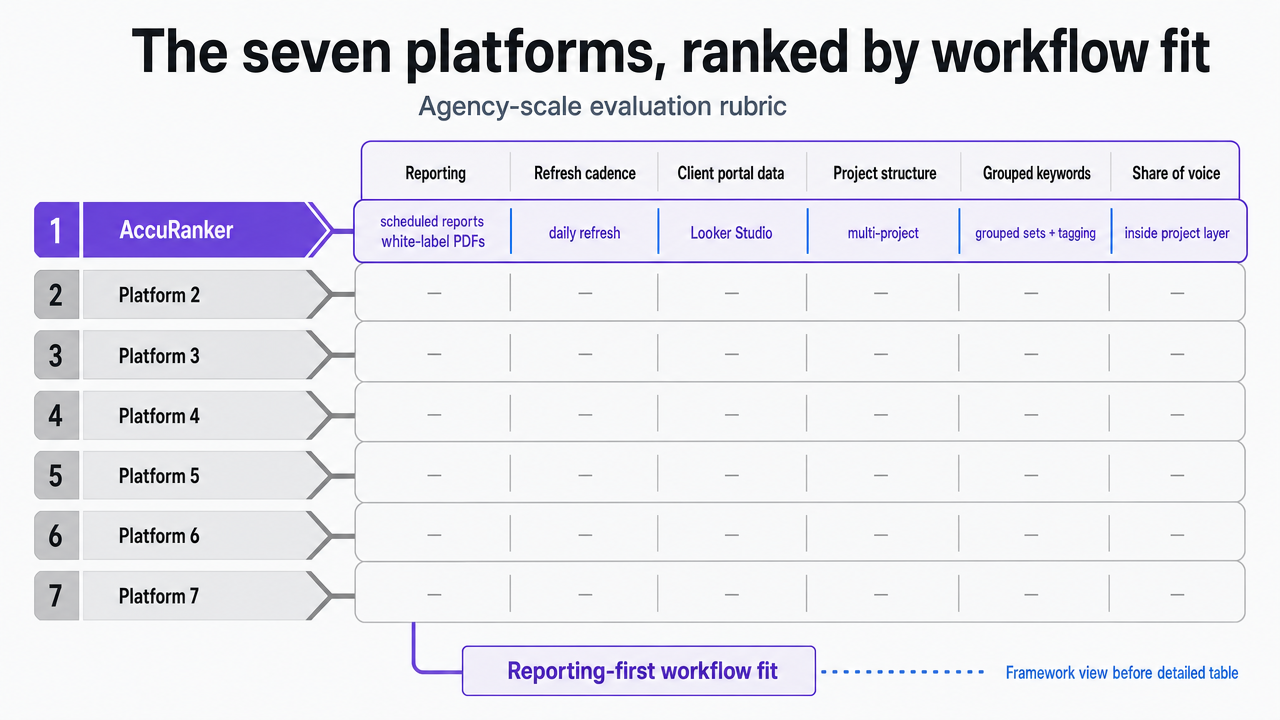 Visualize the agency-scale evaluation rubric and how the seven platforms map against it, giving readers a structured framework view before the detailed table in the next section
How the seven compare on agency operating math
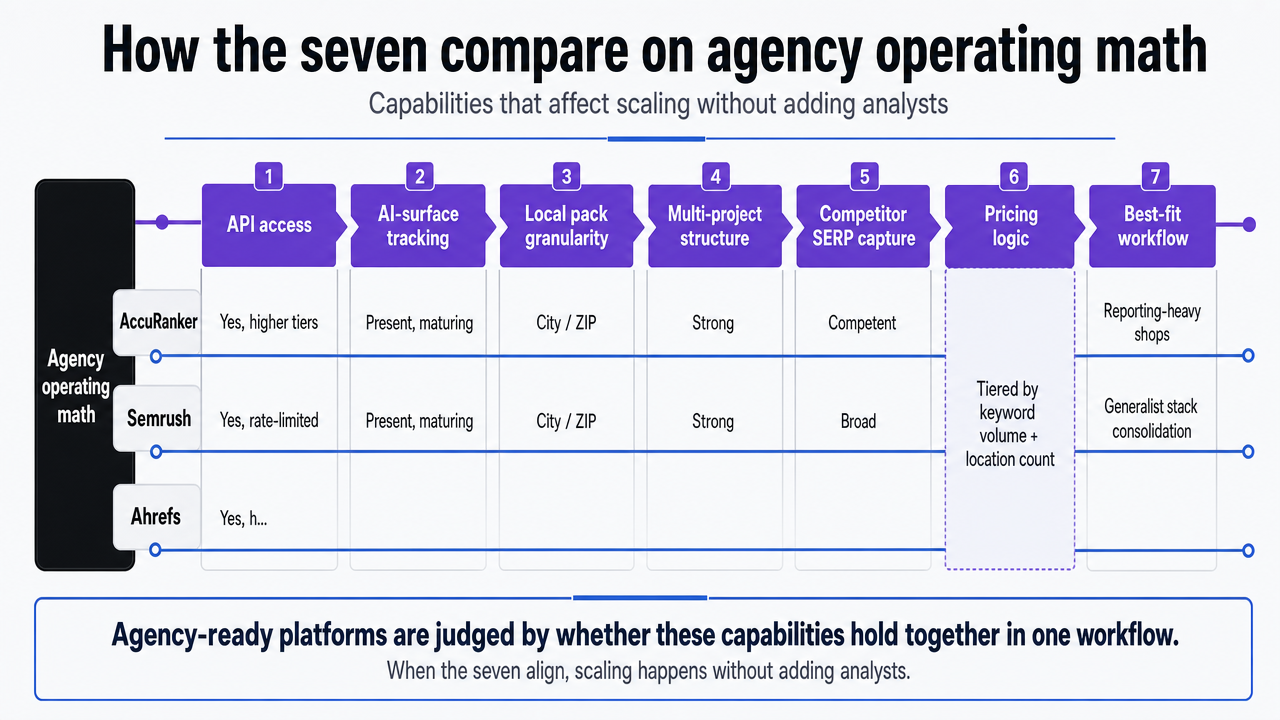
The comparison below scores the seven platforms against the criteria that actually determine whether a practice can add clients without adding analysts. API access, AI-surface tracking, local granularity, multi-project structure, and competitor SERP capture map to the capability set agency-ready platforms are expected to hold together in one workflow 7. Pricing is described by tiering logic rather than dollar figures because vendors adjust rates by keyword volume and location count on a per-quote basis.
| Platform | API access | AI-surface tracking | Local pack granularity | Multi-project structure | Competitor SERP capture | Best-fit workflow |
|---|---|---|---|---|---|---|
| AccuRanker | Yes, higher tiers | Present, maturing | City / ZIP | Strong | Competent | Reporting-heavy shops |
| Semrush | Yes, rate-limited | Present, maturing | City / ZIP | Strong | Broad | Generalist stack consolidation |
| Ahrefs | Yes, higher tiers | Nascent | City-level | Strong | Deepest historical | Strategy-led practices |
| SE Ranking | Yes | Present, developing | ZIP-level | Strong | Solid | Mid-market workhorses |
| Nightwatch | Yes | Nascent | Geo-coordinate | Strong | Deep at geo level | Multi-location portfolios |
| Keyword.com | API-first | Present | City / ZIP | Adequate | Functional | Programmatic / engineering-led |
| Serpstat | Yes, higher tiers | Lagging | City / region | Strong | Solid | Lean teams under 30 clients |
The pattern that emerges is that no single tool wins across all five criteria. AI-surface visibility remains the softest column across the board, which tracks with how recently Google formalized generative AI reporting as a distinct surface inside Search Console 3. Practices selecting a primary tracker in 2026 should assume the AI-surface gap gets closed by a combination of the tracker plus native Search Console reporting rather than by any single vendor solving it standalone 1.
 Support the article's argument that per-market engine coverage matters by visualizing Google's search share variance across regions cited in the article prose
See How Top Agencies Streamline Rank Tracking and Reporting at Scale
Connect with our team for a demo of automated SEO rank tracking workflows that eliminate manual reporting, ensure data accuracy, and support efficient multi-client management.
If you manage multi-location or franchise portfolios
A quick scope note: this section is for practices whose client roster leans heavily on multi-location operators — dental groups, home services franchises, senior living portfolios, dealer networks — where a single client can represent 40 to 400 tracked locations. The tool selection math shifts here.
City-level tracking averages the good stores with the bad ones and produces a number that satisfies no one. A franchise director wants to see which specific locations own the local pack for the queries that drive walk-ins, and which locations Google barely returns. Geo-coordinate tracking — the ability to pin a query to a lat/long or ZIP and pull the SERP that user actually sees — is the capability that turns local rank data into a store-manager conversation rather than a regional average.
The operational load matters as much as the granularity. A 40-location client with 50 tracked keywords per location generates 2,000 keyword-location pairs. Ten such clients push a practice past 20,000 pairs before competitor coverage is added. At that volume, API-driven pulls into an internal dashboard stop being a preference and start being the only workable pattern for keeping analyst time flat as location counts grow 8.
Where ranking data ends and execution begins
Ranking data answers one question well: is the client's visibility trending in the right direction against the right competitors on the right surfaces. It does not answer what to do next, which is where most agency margin gets made or lost. The tools ranked above are measurement infrastructure. They tell the practice what changed. Deciding which of the seventy things that changed actually deserves an analyst's Tuesday is a separate discipline.
Search monitoring — the broader practice that rank tracking sits inside — is defined as the ongoing analysis of keywords, competitors, and industry topics across engines and platforms to inform strategy 9. In an agency operating model, that definition splits cleanly into two layers. The measurement layer captures signals: positions, SERP features, AI Overview presence, competitor movement. The execution layer decides which signals become work: which pages get rewritten, which local listings get audited, which content gaps get filled first.
The gap between the two layers is where AI-assisted execution platforms are starting to matter. Vectoron sits on the execution side of that line, consuming ranking signals rather than producing them, which is the shift agency leads should plan for as measurement stacks mature.
Frequently Asked Questions
References
- 1.How To Use Search Console | Documentation - Google for Developers.
- 2.AI Features and Your Website | Google Search Central.
- 3.Introducing Search Generative AI performance reports in Search Console.
- 4.Search Engine Market Share Worldwide | Statcounter Global Stats.
- 5.Search Engine Market Share Iceland | Statcounter Global Stats.
- 6.Search Engine Market Share Hungary | Statcounter Global Stats.
- 7.Agency Rank Tracking Software: What Agencies Should Look For.
- 8.The Top 7 SEO API Use Cases for Rank Tracking.
- 9.What is Search Monitoring and Why Your Business Needs It.
- 10.Search Engine Market Size & Share Analysis.
- 11.Search Engine Market Size, Share | Growth Report [2026-2035].
- 12.15 of the Best Market Research Tools To Use in 2026.
- 13.14 Best Market Research Tools & Software (by Category) in 2026.