
Key Takeaways
- Agency heads in 2026 need rank data that feeds delivery workflows, not standalone dashboards, because position numbers alone no longer answer the revenue questions CFOs and clients are asking.
- The operator rubric judges platforms on four axes: data fidelity against GSC, multi-account workflow at scale, integration with content and links, and reporting that survives a QBR.
- Enterprise platforms like BrightEdge and Conductor justify their cost only when a portfolio includes two or three large clients with multi-domain footprints already operating inside those interfaces 6.
- AccuRanker suits event-driven refresh speed, Nightwatch fits local geographic granularity, and SE Ranking covers mid-market unit economics, but all three diverge from GSC averages without API reconciliation 4.
- Ahrefs and Semrush earn their place as research and backlink analysis tools, not as the system of record for client positions, since their tracking modules duplicate focused trackers 9.
- An execution layer like Vectoron converts ranking signals into approved content briefs, link prospects, and title rewrites, closing the gap that has quietly eroded agency margins for a decade.
- Stack math for fifty-plus client portfolios exposes triple payment for position data across enterprise suites, research tools, and dedicated trackers, with a GSC-fed BI layer often removing the redundancy 5.
- Three line items to cut in 2026: the rank module inside research suites, a second overlapping tracker, and bespoke strategist-built reporting decks that the GSC API can automate 5.
Why Agency Heads Are Rethinking the Rank-Tracker Buy
The signal most agency Heads of SEO are picking up in 2026 is not that their rank tracker is broken. It is that the rank tracker, by itself, has stopped being the answer to the question the CFO and the client are both asking: where is the revenue moving, and what did the team ship this month that moved it. Position data is still required. It is no longer sufficient.
The global SEO software market was valued at $85.97 billion in 2025 and is projected to reach $271.9 billion by 2034, with North America leading adoption among SMEs and multi-location operators that need scalable execution rather than agency-only delivery 1. This growth is driven by buyers who want rank data integrated into content, links, and reporting workflows, not just by agencies purchasing more keyword seats.
For an agency managing delivery across 20 to 200+ client accounts, the operational question has shifted. The primary consideration is no longer "which tool reports positions most accurately," but "which tool produces the cleanest feed into the work my analysts actually do." This reframe forms the basis of this ranking. The platforms below are evaluated as components of a delivery system, not as standalone dashboards, with categories kept distinct to reflect how agency tech stacks are assembled.
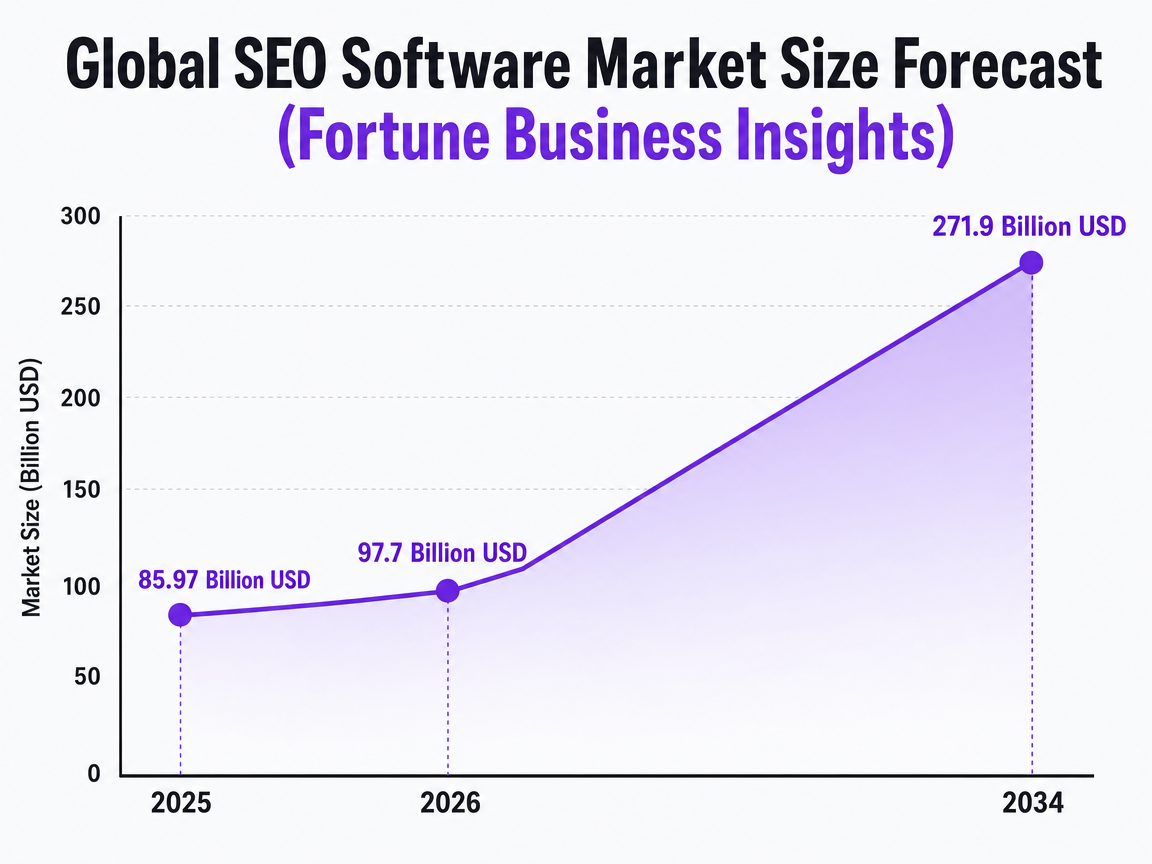 Global SEO Software Market Size Forecast (Fortune Business Insights)
Projected growth of the global SEO software market from $85.97B in 2025 to $271.9B by 2034.
The Operator Rubric: Four Axes That Decide Client Outcomes
Data Fidelity Against GSC Ground Truth
Every rank tracker provides a number. The critical question is whether that number aligns with what Google itself reports for the same query, page, and country. Google Search Console (GSC) remains the most reliable source of truth for an agency, and discrepancies between a third-party position and the GSC Performance report can impact client trust.
Reconciling these data points is complex. GSC counts an impression whenever a page appears on a loaded SERP, even if not scrolled into view, and positions are averaged across all searches for a given query 4. A third-party tracker, capturing a single SERP snapshot from one location at one moment, will frequently differ from GSC. Neither is inherently wrong; they measure different aspects.
The most effective ranking software addresses this gap by integrating GSC data via API alongside its own SERP scrapes. It flags divergences and highlights query-level variations that averaged numbers obscure 4. Agencies unable to demonstrate how their tracker reconciles with GSC often find themselves debating minor decimal differences in quarterly business reviews (QBRs) instead of discussing strategic growth.
Multi-Account Workflow at 50+ Clients
A platform that performs well for five clients often struggles with fifty. Operational friction emerges in areas not typically covered in vendor demonstrations:
- granular project-level user permissions,
- efficient bulk keyword import across new accounts,
- robust tagging schemes that persist through analyst turnover, and
- white-label report generation that doesn't require senior strategist oversight.
Forrester's Q3 2025 Wave on SEO solutions explicitly evaluates platforms on workflow efficiency, alongside data quality and customer references, indicating that operational fit is now a primary evaluation criterion 6. For agency operators, workflow directly impacts analyst utilization. A tool that saves twenty minutes per client per week across eighty clients generates more margin than one offering marginally superior SERP accuracy.
The operational test is straightforward: Can a junior analyst onboard a new client, configure tracked keywords by location, set up competitor sets, and schedule the first client report in under thirty minutes without needing senior escalation? If this process requires custom scripting or a services engagement, the platform fails the workflow axis, irrespective of its data quality.
Integration With Content, Links, and Revenue
Rank data that doesn't feed into the team's actual work is merely a dashboard, not a functional tool. This axis assesses how seamlessly a platform integrates position data into three key areas: content production queues, backlink acquisition tracking, and revenue reporting.
Content integration means the tracker can identify queries in positions four through fifteen with strong impressions, push them into a content brief queue, and confirm completion when the optimized page is published 12. Backlink integration requires the platform to either ingest link data or export cleanly to a tool that does, as external links remain strongly correlated with rankings 9. The platform must also differentiate between topic-relevant authoritative links and low-quality ones, as search engines treat backlinks as weighted votes, not just counts 10.
Revenue integration presents a greater challenge. GSC clicks and average position correlate with traffic, not booked revenue, and this gap often causes agency reporting to falter. Tools that expose data via API or native warehouse connectors enable agencies to combine position data with GA4, CRM, and call-tracking sources downstream.
Reporting That Survives a QBR
A client report that a CFO can understand in three minutes without a strategist present sets the standard. Most rank-tracker exports fall short. They often display position movement without traffic context, traffic without conversion context, and averages that obscure query-level variations that senior stakeholders will inquire about.
Defensible reporting requires three elements:
- Reconcile tracked positions against GSC clicks and impressions to prevent client discrepancies 5.
- Surface click-through rate (CTR) by position and flag queries underperforming the expected curve. CTR is both an outcome metric and a contributing signal, where underperformance can negatively impact rankings 7.
- The narrative should be inherent, not an afterthought. The best platforms generate clear, plain-language explanations of changes and their causes, saving senior strategists significant time before QBRs.
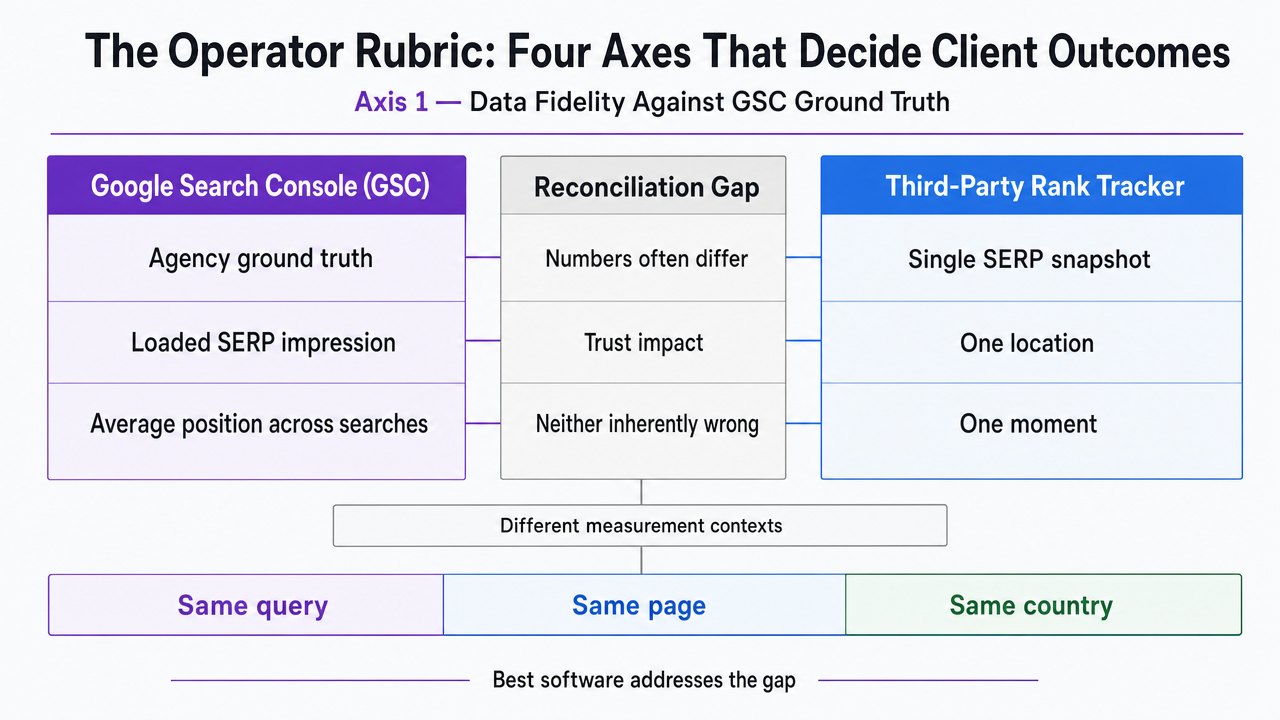 Visualize the four-axis evaluation framework that structures the entire article's ranking methodology
Enterprise SEO Platforms: BrightEdge and Conductor
BrightEdge and Conductor occupy a distinct category. Grouping them with focused trackers misrepresents their intended purpose. These platforms serve large organizations and their agencies by integrating rank data with content recommendations, technical audits, multi-domain governance, and executive reporting within a single system. The typical buyer is not a single SEO but a director coordinating five to fifty contributors across business units or client portfolios.
This category has its own economic dynamics. The enterprise SEO platforms market was valued at $4.38 billion in 2024 and is projected to reach $12.5 billion by 2032, with a 14% CAGR 3. This growth is concentrated among organizations managing search strategy across geographies and business units, a challenge structurally similar to what an agency faces across multiple client accounts 3. The category's existence is driven by a real workflow demand, not by fundamentally different rank-tracking methodologies compared to specialized tools.
Forrester's Q3 2025 Wave evaluates SEO solutions based on data quality, platform capabilities, workflow, and customer references—the actual rubric enterprise buyers use for multi-year contracts 6. The same report highlights a trend towards platforms that can ingest cross-channel data and support continuous optimization. This is where BrightEdge and Conductor heavily invest: content recommendation engines, share-of-voice modeling against competitor sets, and CMO-ready dashboards 6.
For an agency Head of SEO, the reality of these platforms is this: their rank-tracking core is competent, but not industry-leading. AccuRanker and Nightwatch offer faster, more granular SERP snapshots at a lower cost. What an enterprise platform provides is workflow infrastructure: role-based permissions across numerous properties, content brief generation linked to opportunity queries, scalable technical audit automation, and a reporting layer suitable for board-level review. The trade-offs are cost and inflexibility. Annual seat costs can be tens of thousands, configuration can take a quarter or more, and the contract often assumes the agency will adopt the platform's content workflow rather than its own.
The practical decision rule is whether the agency's largest accounts justify the investment. A portfolio of mid-market clients rarely does. However, a portfolio anchored by two or three enterprise clients with multi-domain footprints and internal stakeholders already familiar with BrightEdge or Conductor interfaces often does. Forrester's customer-reference scoring is particularly relevant here, as the platforms' value increases when the client side is already operating within them 6. Otherwise, the agency pays enterprise prices for capabilities that could be assembled more cost-effectively from a focused tracker, a backlink tool, and a robust reporting layer.
Test Real-Time SEO Ranking Impact Immediately
Validate ranking improvements on live client sites before committing to a full platform rollout.
Focused Rank Trackers: AccuRanker, Nightwatch, SE Ranking
AccuRanker, Nightwatch, and SE Ranking are the preferred tools for agency operators when the objective is to precisely determine, with minimal latency and reconciliation gaps, a client's current ranking for a defined keyword set. They do not aim to be comprehensive content platforms or link-building suites. This specialized focus makes them valuable for specific tasks, though they cannot form a complete SEO stack on their own.
AccuRanker is renowned for its refresh speed and ability to capture SERP features. Its design prioritizes on-demand position checks over overnight crawls, which is crucial when clients inquire about launches, algorithm shifts, or competitor movements that require immediate answers. For agencies handling event-driven work, its value is primarily operational.
Nightwatch excels in geographic granularity, offering position tracking by city, ZIP-equivalent, and competitor set. This makes it a strong choice for portfolios focused on local service verticals where keyword performance varies significantly across small geographic areas. However, its broader research and content features are less developed than those of Ahrefs or Semrush, meaning Nightwatch often complements another tool rather than replacing one.
SE Ranking offers a cost-effective solution. For agencies managing fifty or more accounts that require reliable position data, a competent backlink overview, and white-label reports that account managers can send without extensive rework, SE Ranking provides essential functionality at a per-seat cost that enterprise platforms cannot match. Its capabilities, however, are less extensive, with custom integrations, advanced workflow automation, and content-recommendation depth being less robust than enterprise-tier offerings.
All three of these tools share a fundamental limitation relevant to the operator rubric: their reported positions will not perfectly align with GSC's averaged figures. This discrepancy is often larger for queries with high SERP feature density or significant personalization 4. The most effective platforms address this by ingesting GSC data via API, displaying impressions, clicks, CTR, and average position alongside their own tracked positions, making reconciliation transparent 5. Agencies that manually reconcile this data in spreadsheets are effectively paying senior strategists to perform tasks the tool should automate.
The decision for this tier is more specific than for the enterprise tier:
- AccuRanker is justified when refresh latency is critical for client discussions.
- Nightwatch is the choice when geographic granularity is a core service offering.
- SE Ranking is suitable when unit economics across many mid-market accounts necessitate that every dollar of tooling cost per client is justified by retention metrics.
Stacking two of these tools is common but often inefficient, as their data layer capabilities overlap, and differentiation lies in unique features one platform offers over the others.
All-In-One Suites: Where Ahrefs and Semrush Actually Fit
Ahrefs and Semrush rarely fall short on capability in tool reviews; their primary challenge is overlap. Many agencies already using a focused tracker and a reporting layer find themselves paying for redundant rank-tracking modules within these suites, which duplicate work better and faster performed by dedicated tools.
Ahrefs and Semrush are fundamentally research and competitive-intelligence platforms, with rank tracking as a secondary feature. Their position data is competent, and their interfaces are widely familiar to analysts, which aids in onboarding speed. Their true value lies upstream of tracking: keyword universe expansion, SERP feature analysis, content gap modeling against competitors, and extensive backlink databases that support proactive link prospecting rather than just monitoring. The critical role of external links in rankings 9, and the understanding that backlinks are weighted votes rather than simple counts 10, underscore the operational value of a deep, queryable link index that isolated rank trackers cannot replicate.
Where they often become redundant in an agency stack is their rank-tracking module. AccuRanker offers faster refreshes, Nightwatch provides cleaner geographic granularity, and SE Ranking covers basic needs more affordably. An agency paying for Semrush Position Tracking in addition to a dedicated tracker is paying twice for the same data, and analysts often trust the Semrush number less when it conflicts with GSC 4.
The strategic approach is to utilize Ahrefs and Semrush as primary research and link analysis tools, not as the definitive source for client positions. Employ one of them for keyword discovery, competitor mapping, and backlink analysis. Then, feed position data from a focused tracker into the reporting layer. Agencies that maximize the value from these suites have stopped trying to make them do everything and instead leverage them for their core strengths.
The Execution Layer: Where Ranking Data Has to Go Next
A position number that doesn't initiate action is an overhead cost. The platforms discussed so far—enterprise suites, focused trackers, research suites—all generate ranking signals. However, none of them automatically create content briefs, file link prospects, or publish optimized pages. This gap has quietly eroded agency margins for a decade, and a newer category of execution-layer platforms is designed to bridge it.
The required actions are clear:
- A query in position eleven with strong impressions warrants a content brief.
- A page with an underperforming CTR for its position needs a title and meta description rewrite 7.
- A competitor's new backlink on a relevant domain becomes an outreach target, given that link quality and topical fit outweigh raw link counts 10.
Each of these actions is small, but across eighty clients and a senior strategist's schedule, they collectively determine the difference between a profitable and a break-even book of business.
Vectoron exemplifies this category. It ingests ranking and GSC signals from other trackers, prioritizes work by projected impact, routes recommendations through an approval queue, and executes approved tasks across content, links, and reporting—all without requiring additional analyst headcount for the agency.
See How Leading Agencies Streamline SEO Ranking at Scale
Request a walkthrough of unified SEO workflow automation—compare how top agencies use AI-powered platforms to monitor, prioritize, and execute ranking improvements for multiple clients without expanding team size.
Stack Math for Multi-Client and Multi-Location Operators
The financial calculations change significantly when an agency scales from a single-account view to a portfolio of fifty mid-market clients or a multi-location operator managing eighty locations under one brand. Per-seat tooling cost transforms from a mere line item into a critical margin lever. The following analysis is geared towards operators making purchasing decisions based on profit and loss, not analysts configuring tools.
Redundancy often occurs in the rank-tracking layer. Enterprise SEO platforms include rank tracking. Dedicated trackers also provide it. Research suites offer their own position modules. Furthermore, reporting platforms can directly pull impressions, clicks, CTR, and average position from GSC via API, bypassing third-party trackers entirely 5. Agencies frequently pay for the same data three times and then task a senior strategist with reconciling these discrepancies in a spreadsheet.
| Stack line item | Per-client/month cost | What it replaces |
|---|---|---|
| Enterprise SEO platform seat (BrightEdge, Conductor) | $ enterprise seat ÷ clients | Content brief tooling, technical audit scripts, executive reporting |
| Dedicated rank tracker (AccuRanker, Nightwatch, SE Ranking) | $ tracker seat ÷ clients | Position modules inside research suites and enterprise platforms |
| Research and backlink suite (Ahrefs, Semrush) | $ suite seat ÷ clients | Standalone keyword research and backlink databases |
| Reporting/BI layer (GSC API + warehouse) | $ BI seat ÷ clients | Manual dashboard assembly and rank-tracker export cleanup 5 |
| AI execution layer | $ execution seat ÷ clients | Hours per client per month spent briefing, prioritizing, and shipping |
The most justifiable cuts typically involve the rank-tracking module within research suites and redundant position views in enterprise platforms. The defensible additions are a BI layer that directly pulls GSC data and an execution layer that translates signals into completed work. Pricing remains variable due to contract size and client count. The operator's task is to input actual figures and eliminate redundant payments for the same position data.
What to Stop Buying in 2026
Three line items in an agency's tech stack often prove redundant upon close examination.
- The rank-tracking module within a research suite. If Ahrefs or Semrush is used alongside AccuRanker, Nightwatch, or SE Ranking, the suite's position view is duplicate inventory. Retain the research and link database, but cancel the redundant tracker seat.
- The second rank tracker. Agencies that adopt AccuRanker for refresh speed and then add Nightwatch for local granularity often find a 70 to 80 percent overlap in keyword sets. A single, properly configured tracker can handle both functions for most portfolios. The need for a second tracker based on geographic specificity must be justified by the agency's actual client verticals, not just by a demo.
- Bespoke reporting decks. Senior strategists manually building client reports from CSV exports are performing work that the GSC API can automate, pulling impressions, clicks, CTR, and average position directly into a warehouse or BI layer without an intermediary 5. This labor should be integrated into a templated reporting workflow, not consume a strategist's Friday afternoon. The funds saved here can typically be reallocated to an execution layer that converts signals into tangible work.
An Operator Decision, Not a Recap
The optimal SEO ranking software for client results is not a single product, but a carefully constructed stack. This includes one focused tracker selected for the specific needs of the agency's portfolio, one research and link analysis tool utilized for its unique strengths, a reporting layer that directly pulls GSC data for accurate client reports, and an execution layer that transforms signals into completed content, links, and title optimizations. Enterprise platforms are considered only when the client roster genuinely justifies the investment.
For 2026, the strategic move for operators is to audit their current stack against this framework, eliminate redundant position views, and redirect freed resources into the layer that drives actual work. Vectoron fills this execution role for agencies seeking to convert ranking signals into approved, completed tasks without increasing analyst headcount. This decision rests with the Head of SEO who manages the P&L. The ranking software provides the data feed; the crucial question is what is built upon it.
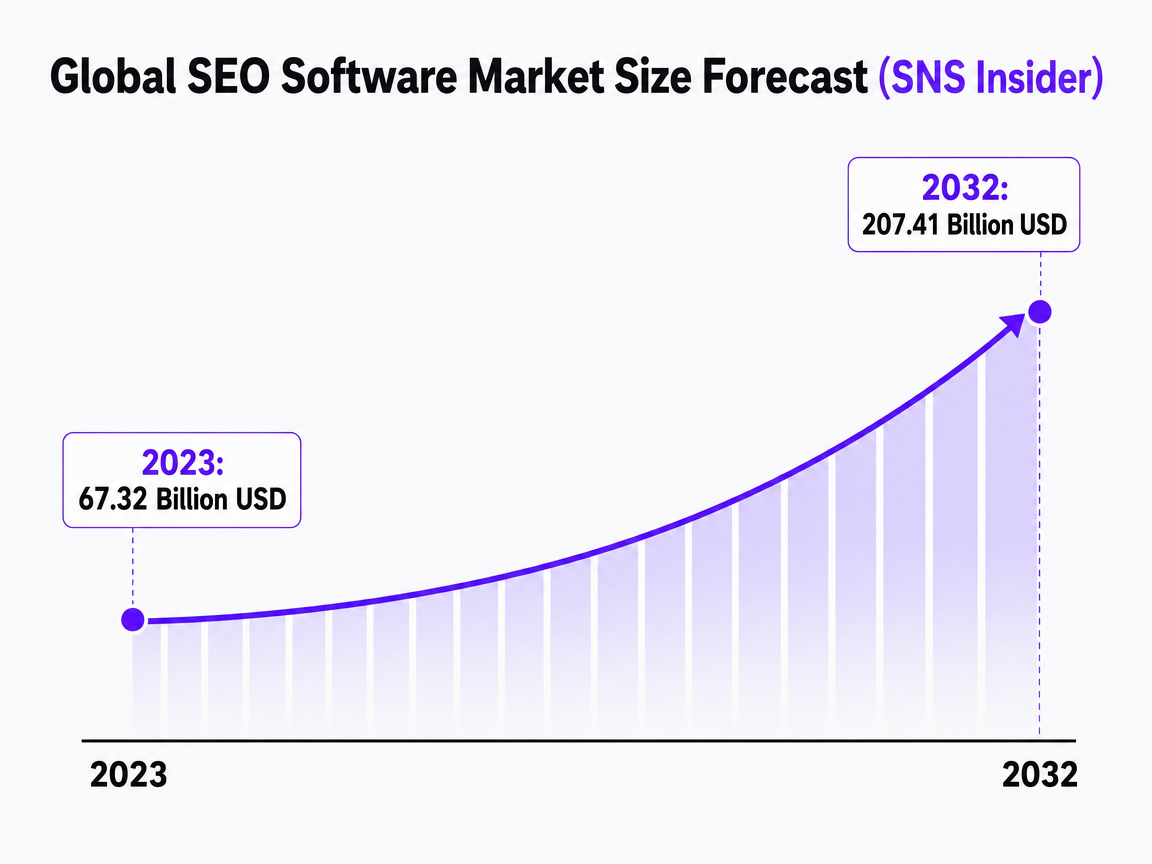 Global SEO Software Market Size Forecast (SNS Insider)
Projected growth of the global SEO software market from $67.32B in 2023 to $207.41B by 2032.
Frequently Asked Questions
References
- 1.SEO Software Market Size, Share & Forecast 2026-2034.
- 2.SEO Software Market Size, Share & Growth Report 2032 - SNS Insider.
- 3.Enterprise SEO Platforms Market Size, Share and Forecast 2032.
- 4.Google Search Console Performance Data Guide.
- 5.Google Search Console Report | Rows template.
- 6.The Forrester Wave™: Search Engine Optimization Solutions, Q3 2025.
- 7.The SEO Impact of Click-Through Rate (What You Need to Know).
- 8.CTR Case Study: Click Through Rate Influences Organic Rankings.
- 9.4 Strategies to Earn Natural, High-Quality Links for Your Content.
- 10.SEO Gold: High-Quality vs. Low-Quality Backlinks Explained.
- 11.The Forrester Wave™: Text Mining And Analytics Platforms, Q2 2024.
- 12.How to use Google Search Console for Keyword Research in 2025.
- 13.GSC Performance Report - 5 Actionable Insights.