
Key Takeaways
- Google Search Console is the non-negotiable measurement layer, reporting first-party clicks, impressions, CTR, and position data no paid tool should duplicate before it is fully instrumented 4.
- Ahrefs earns its place at the research stage, exposing competitor keywords and backlink profiles that Search Console structurally cannot show for topics a client has not yet covered.
- Semrush anchors the portfolio-review layer, tracking competitor share-of-voice movement and compressing recurring client reporting through templated exports and scheduled white-label PDFs.
- Screaming Frog handles crawl diagnostics at throughput, letting one strategist surface broken links, redirect chains, and duplicate tags across large sites and hand developers a defensible fix list.
- Sitebulb produces client-ready page-experience audits mapped to Core Web Vitals, HTTPS, mobile-friendliness, and interstitial thresholds Google publishes directly 7.
- Clearscope structures the content brief against Google's helpful-content criteria for originality, comprehensiveness, and added value, compressing brief-writing from two hours to under thirty minutes 3.
- Execution platforms form a separate category that coordinates ranking, crawl, and content signals into approved actions, recovering the reconciliation hours that leak between stages rather than within any single stage.
The specialist-hour problem behind agency tool selection
Agency SEO leaders do not scale by adding rank trackers. They scale by removing specialist hours from every account. The constraint is labor, not data. A senior SEO can be spread across eight retainers or twenty, and the difference is almost entirely a function of how quickly ranking signals turn into approved production work.
That reframes what a ranking tool is supposed to do. Google itself describes its ranking systems as operating across "hundreds of billions of web pages," combining page-level and site-wide signals, spam detection, reliability systems, and link analysis into a single evaluation 1. No dashboard can replicate that model. What a tool can do is surface the subset of signals a strategist would otherwise dig for manually: which pages moved, which queries shifted intent, which technical faults are suppressing crawl depth, which content lacks the originality and completeness Google says it rewards 3.
The gap between tools shows up in a specific place. Some feed a strategist raw position data and stop there, leaving the interpretation, prioritization, and brief-writing to a human. Others compress that path, delivering a ranked, defensible next action a lead can approve in minutes. Empirical work on SEO strategy backs the direction of travel: content quality and positioning, not keyword volume alone, are the measurable determinants of organic traffic outcomes 9.
The seven tools that follow are evaluated on that single axis. Not features. Not price tiers. How many specialist hours per client per month each one recovers, and where in the workflow that recovery lands.
What separates a ranking tool from a ranking dashboard in 2025
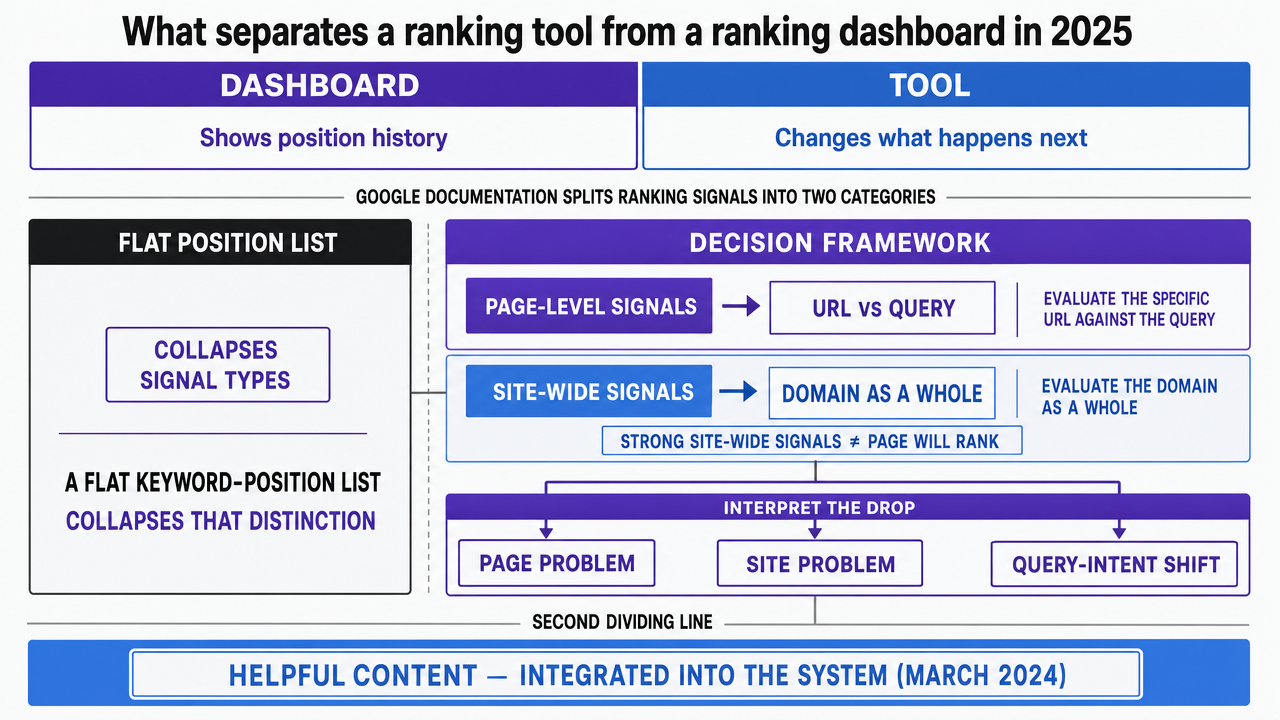
A dashboard shows position history. A tool changes what a strategist does next. That distinction has hardened in the past eighteen months, and it maps directly to how Google itself describes ranking.
Google's own documentation splits ranking signals into two categories that any serious tool has to address separately. Page-level signals evaluate the specific URL against the query. Site-wide signals evaluate the domain as a whole, and Google explicitly warns that strong site-wide signals do not guarantee any individual page will rank 1. A dashboard that reports keyword positions in a flat list collapses that distinction. A tool preserves it, so a strategist can tell whether a drop is a page problem, a site problem, or a query-intent shift.
The second dividing line is what happened to the Helpful Content system. In March 2024, Google folded it into the core ranking systems, meaning content quality signals no longer arrive as a separate periodic update but as a continuous input alongside link, spam, and reliability systems 1. Tools built around the old model, where content optimization was a discrete step run before a scheduled refresh, now lag the ranking behavior they claim to predict. Tools that treat content quality as an always-on diagnostic, tied to originality and completeness criteria Google publishes directly 3, stay aligned with how the systems now score work.
The practical test is short. A ranking tool surfaces which signal category is moving, points to the specific asset producing the drift, and hands a strategist a ranked action a lead can approve. A ranking dashboard produces a chart and waits for a human to interpret it. The seven tools that follow are graded on which side of that line they fall.
 Visualize the framework distinguishing a ranking dashboard from a ranking tool, using the two signal categories Google documents and the March 2024 Helpful Content integration referenced in the section
Google Search Console: the non-negotiable measurement layer
No paid SEO tool should enter the stack before Search Console is fully instrumented across every client property. It is the only source that reports what Google actually saw, indexed, and served, and the gap between third-party estimates and first-party impression data has narrowed further in the past year as Google has extended what the platform surfaces natively.
The recent-data view now delivers clicks, impressions, average CTR, and average position, broken down by query, page, country, and device, with a shorter latency than the older performance report 4. For an agency running weekly check-ins across a portfolio, that closes a feedback loop that used to require a paid rank tracker running daily crawls to approximate. A page that moved from position 8 to position 4 on a commercial query, on mobile, in a single country, is visible in Search Console within days rather than weeks.
Google has also added an AI-powered configuration that applies filters, sets up comparisons, and selects the right metric among clicks, impressions, average CTR, and average position 5. The practical effect on agency workflow is specific: the setup work a junior analyst used to do before every client review, choosing date ranges, isolating branded traffic, comparing period-over-period, is now handled inside the interface. Reporting hours compress accordingly.
URL Inspection remains the other operational lever. It confirms index status, exposes the rendered HTML Google used, and lets a strategist request a recrawl on a specific URL after a fix or refresh 6. That is the difference between shipping a content update on Tuesday and knowing by Thursday whether Google has seen it.
The consequence for tool selection is direct. Any paid platform in the stack has to justify what it adds beyond this baseline. Rank history at a larger keyword universe, competitor comparison, crawl-level diagnostics, and content-quality scoring are all legitimate reasons to layer on. Duplicating what Search Console already reports is not.
Ahrefs: keyword and backlink depth for the research stage
Ahrefs earns its place in the stack at a single point in the workflow: the research stage, before a brief is written. Its value is the size and refresh cadence of its keyword and link indices, not its dashboards. For a strategist deciding whether a client should compete for a term at all, that depth is what separates a defensible content plan from a guess.
The keyword database matters because it exposes queries Search Console cannot show a strategist yet. Search Console only reports what a client's own pages have already been served against 4. Ahrefs surfaces the queries competitors rank for, the SERP features attached to them, and the parent topics that cluster underneath. For a new client or a topic the site has never covered, that closes a gap first-party data structurally cannot fill.
The backlink index carries similar weight in the audit phase. Link analysis remains a foundational input to how ranking systems evaluate authority, tracing back to the PageRank model of measuring attention through citation structure 8, and Google confirms that link signals still sit inside its core ranking systems alongside page-level, site-wide, spam, and reliability inputs 1. An agency comparing a client's referring-domain profile against three competitors, on a specific topic cluster, needs an index deep enough to reveal what is actually earning links in that space.
The specialist-hour recovery is narrow but real. A senior SEO who used to spend three or four hours per client per month assembling keyword universes and competitor gap lists can compress that to under an hour once the queries and link targets are pulled directly. Brief-writing accelerates from there. The tool does not produce the brief, and it does not decide priority against a client's commercial goals. It removes the manual assembly step that sits between a strategist and the first defensible recommendation.
Test AI-Driven SEO Execution at Scale Now
See measurable ranking impact on live client sites before committing to a subscription.
Semrush: competitive intelligence and reporting for portfolio review
Semrush lands in the stack for a different job than Ahrefs. Where Ahrefs anchors the research stage, Semrush earns its keep in the recurring portfolio-review layer: the weekly or monthly sweep across every client account where a lead has to see share-of-voice movement, competitor gains, and reporting output in one place.
The competitive intelligence side matters because Google's ranking systems weigh site-wide signals alongside page-level ones 1. A client losing three positions on a commercial cluster while a competitor picks up featured snippets and a sitelink block is not a page problem a strategist can diagnose from Search Console alone. Semrush's position-tracking module, mapped against a fixed competitor set per client, exposes which domains are absorbing that visibility and on which SERP features. That shortens the diagnostic step from a manual SERP inspection to a filtered view.
The reporting layer is where portfolio hours actually compress. Templated client reports, scheduled exports, and white-label PDFs remove the assembly work a junior analyst used to do the day before a review call. Combined with Search Console's new AI-powered configuration handling filter and comparison setup on the first-party side 5, the reporting stack a lean team runs across fifteen or twenty clients starts to look genuinely operable by one person.
The caution is specific. Semrush's traffic estimates are modeled, not measured, and should never overwrite Search Console's impression data in a client narrative 4. It is a competitive lens and a reporting engine, not a source of truth on what Google actually served.
Screaming Frog: crawl diagnostics for technical throughput
Screaming Frog occupies the audit stage. It is the tool a technical SEO opens when a client's traffic drops and the cause is not visible in position data or content scores. The value is throughput: a single strategist can crawl a fifty-thousand-URL site, filter for the specific fault pattern, and hand a developer a defensible fix list in an afternoon.
The diagnostic surface matches what Google itself flags in its ranking guidance. Broken internal links, redirect chains, orphaned pages, duplicate title tags, and blocked resources all sit inside the crawlability and site-structure recommendations Google publishes for practitioners 2. Screaming Frog exposes each fault as a filtered list a strategist can export, prioritize by traffic contribution, and turn into a ticket. Site-wide signals that Google says feed into ranking evaluation 1 are precisely the class of problem this crawl surface makes visible.
The integration with Search Console tightens the loop. Once a fix ships, URL Inspection handles the recrawl request on a per-URL basis 6, so a strategist auditing on Monday can confirm indexation of the corrected pages by mid-week rather than waiting on the next scheduled crawl. That compression is where the specialist-hour recovery actually lands.
The caution is that Screaming Frog does not tell a strategist what to prioritize against commercial goals. It produces a fault inventory, not a business case. Pairing it with the ranking and content layers already in the stack is what turns the audit into an approved production sprint rather than a technical wish list.
Sitebulb: page experience audits tied to what Google actually documents
Sitebulb sits next to Screaming Frog in the audit stage, but the two tools answer different questions. Screaming Frog produces a fault inventory. Sitebulb produces a prioritized audit report a strategist can hand a client without rewriting it first. The distinction matters when a lead has to defend a recommendation on a review call and cannot spend an hour translating raw crawl data into a narrative.
The page-experience coverage is where Sitebulb earns its place. Google is explicit that page experience is not a single signal, and that its core ranking systems weigh a variety of inputs including Core Web Vitals, HTTPS, mobile-friendliness, and intrusive interstitials 7. Sitebulb's audit surface maps to exactly those categories, scoring each against the thresholds Google publishes and flagging the specific URLs pulling a site's aggregate down. A strategist looking at LCP failures on template pages, or an interstitial firing on mobile checkout, gets the fault and the affected URL set in the same view.
The reporting output is the second reason it stays in the stack. The tool generates client-ready audit documents with prioritization scores built in, which compresses the write-up step that eats junior-analyst hours after every technical sweep. Paired with URL Inspection for post-fix recrawl confirmation 6, the audit-to-verification loop tightens to days rather than weeks.
The caveat is that page experience helps at the margin. Google says content quality remains the stronger driver when pages differ in relevance 7, so a Sitebulb audit that recommends technical fixes without a parallel content review will move numbers a little, not a lot.
See How Leading Agencies Use Unified SEO Ranking Tools to Scale Delivery
Connect with our team to compare platform features, benchmark automation ROI, and discover frameworks for managing multi-client SEO reporting without increasing headcount.
Clearscope: content quality signals aligned to helpful-content criteria
Clearscope belongs in the brief and production stage, where a strategist has to decide what a piece of content needs to cover before a writer starts drafting. Its job is not to grade prose after the fact. It is to expose the topical surface area a query actually rewards, so a brief goes to production with a defensible outline instead of a keyword list.
The alignment with how Google now scores content matters more than it did two years ago. Since the Helpful Content system was folded into core ranking in March 2024, content quality signals arrive continuously rather than as a scheduled update 1. Google's published criteria emphasize whether a piece provides original information, a comprehensive description of the topic, and substantial additional value beyond what copied sources offer 3. Clearscope's term coverage and content grading translate that framework into an operational checklist a writer can work against, and a strategist can approve without a line-by-line review.
The specialist-hour recovery lands in two places. Brief-writing compresses from a two-hour research task to under thirty minutes, because the topical model is already assembled. Editorial review compresses further, since a lead can spot-check the grade and coverage against the brief rather than rereading the entire draft. Peer-reviewed work on SEO strategy supports the direction: content quality and positioning are the empirical determinants of organic traffic, not term density alone 9.
The limit is that Clearscope grades coverage, not originality. A piece can score well and still fail the helpful-content test if it restates what competitors already published. The tool sets the floor. A human editor still has to enforce the ceiling.
The execution platform category: coordinating signals into approved actions
The seventh entry is not another rank tracker. It is a different category of tool entirely: an execution platform that treats ranking data as one input among several and coordinates the path from signal to approved production work in a single governed loop. For an agency lead running fifteen or twenty accounts, the constraint that limits scale is not the absence of ranking data. It is the number of hours a strategist spends translating that data into a brief, a fix ticket, or a client-approved sprint.
The category answers a specific gap that the six preceding tools leave open.
- Ahrefs surfaces the research.
- Semrush handles competitive movement and reporting.
- Screaming Frog and Sitebulb produce the audit inventory.
- Clearscope structures the brief.
- Search Console reports what Google actually served 4.
None of them decide what to do next, sequence the work against commercial priority, or route a recommendation for human approval before execution.
An execution platform sits above that stack. It ingests ranking, crawl, and content signals, ranks the actions a strategist could take, attaches the reasoning behind each recommendation, and holds the work at an approval gate before anything ships. That structure matches how Google itself describes ranking evaluation: page-level and site-wide signals combined with link, spam, reliability, and the content quality signals now folded into core ranking 1. A tool that surfaces one signal in isolation forces a strategist to reconcile the rest manually. A platform that coordinates them removes the reconciliation step.
The specialist-hour recovery lands across every stage rather than in one. Vectoron is the platform in this category built for that coordination pattern, with approval-first automation as the default rather than an add-on.
Portfolio economics: hours recovered per client per tool category
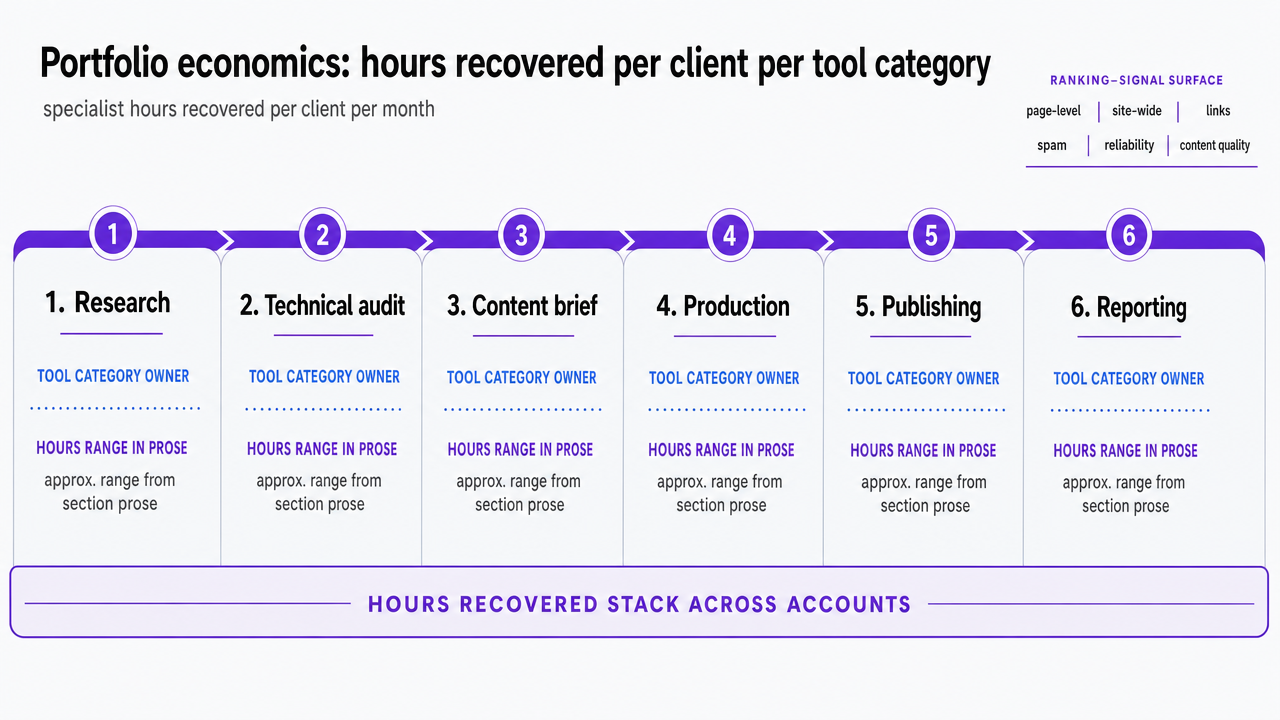
This section shifts scope from single-account tool evaluation to the multi-client portfolio case an agency lead actually operates against. The unit that matters is not features per tool. It is specialist hours recovered per client per month, across the six workflow stages a retainer moves through: research, technical audit, content brief, production, publishing, and reporting.
The reason the math has to be framed this way ties back to how Google itself describes ranking. Its systems combine page-level and site-wide signals, link analysis, spam detection, reliability, and the content quality signals folded into core ranking in March 2024 1. No single tool covers all of that surface. An agency stack works when each tool owns one signal category and one workflow stage, and the hours recovered stack across accounts rather than duplicating within them.
The distribution is uneven. Research tools such as Ahrefs recover the most hours at the front of the workflow, roughly two to three per client per month for a portfolio with active content programs, because they replace the manual assembly of keyword universes and competitor gap lists. Content optimization tools such as Clearscope recover a similar range at the brief stage, compressing a two-hour research task into thirty minutes. Technical audit tools such as Screaming Frog and Sitebulb recover hours in concentrated bursts rather than steadily, since audits happen on a quarterly cadence for most accounts.
Reporting is where the numbers have shifted most in the past year. Search Console's AI-powered configuration handles filter and comparison setup that used to eat a junior analyst's morning before every review 5, and Semrush's templated exports compress the rest. Combined, reporting hours per client per month drop from four or five to under two on a well-instrumented account.
Execution platforms sit in a different column entirely. They do not recover hours in one stage. They compress the reconciliation work between stages, which is where most senior-strategist time actually leaks. A lead who stops manually translating an Ahrefs gap list into a Clearscope brief into a production ticket recovers hours that never appeared on any single tool's ROI page.
 Map each tool category to the workflow stage it owns and the approximate specialist hours recovered per client per month, directly matching the ranges and stages described in the section prose
Frequently Asked Questions
References
- 1.A Guide to Google Search Ranking Systems | Google Search Central | Documentation | Google for Developers.
- 2.Search Engine Optimization (SEO) Starter Guide.
- 3.Creating Helpful, Reliable, People-First Content.
- 4.An improved way to view your recent performance data in Search Console.
- 5.Streamline your Search Console analysis with the new AI-powered configuration.
- 6.Ask Google to recrawl your URLs.
- 7.Understanding page experience in Google Search results.
- 8.The PageRank Citation Ranking: Bringing Order to the Web..
- 9.Search engine optimisation (SEO) strategy as determinants to organic traffic: empirical evidence from a peer-reviewed study.
- 10.Augmenting Web Pages and Search Results to Support Credibility Assessment.
- 11.What creators should know about Google's August 2022 helpful content update.