
Key Takeaways
- Pattern 1, Number + Keyword + Outcome, uses numerals to signal specificity and delivers a documented +20% CTR lift on list-intent queries 11.
- Pattern 2, the bracketed content-type badge, produces the largest single-element lift at +33% by communicating format instantly to scanners 11, 4.
- Pattern 3, direct question titles, wins informational queries by 14% because question stems mirror how users phrase 'how,' 'what,' and 'why' searches 9.
- Pattern 4, the '5 Ways To' feature format, beats question titles by 17% on commercial queries where searchers want actionable methods, not exploration 9.
- Pattern 5, keyword-first with a front-loaded benefit, captures a 20% lift by aligning with left-anchored SERP scanning behavior 11, 9.
- Pattern 6, current-year references, adds a modest +9% lift and works only for freshness-sensitive queries like statistics, trends, and best-practices guides 11.
- Pattern 7, power word plus specificity, delivers a +12% lift but requires restraint since overuse dilutes brand voice across a portfolio 11, 5.
- Pattern 8, comparison and versus formats, targets evaluation-stage searchers and gains impact when a decision criterion follows the two named options 2.
- Pattern 9, pain-solution framing, resonates with problem-oriented queries by mirroring the searcher's internal thought process through emotional triggers 7.
- Pattern 10, location plus keyword plus differentiator, serves local intent where a specific angle prevents near-duplicate titles across multi-market clients 2.
- Pattern 11, placing a numeral within the first four words, is a positional constraint that amplifies the general number-in-title lift 4.
Why title patterns beat title inspiration at portfolio scale
An agency managing numerous client sites cannot rely on individual copywriting to solve CTR issues. A 2023 study revealed that well-crafted titles can increase clicks by up to 36% compared to poorly optimized versions of the same content 9. This highlights the significant potential for improvement without requiring new content, links, or ranking gains.
The challenge isn't recognizing the importance of titles, but rather scaling the solution. Custom copywriting for every low-CTR URL across a client portfolio is inefficient. A more effective approach involves using a catalog of proven patterns—such as brackets, numerals, question stems, and benefit-first phrasing—as reusable templates. These are applied to pages triaged from Google Search Console and then measured over defined periods 2. The following 11 patterns serve as building blocks for this library, each with a formula, a measured lift, and a specific query intent it addresses.
The CTR-lift-by-element decision reference
Before deploying any pattern, an agency needs a clear understanding of which elements impact CTR and by how much. A cross-source analysis of data from Backlinko, Moz, and Yoast quantifies the average lift attributable to common title elements:
- Brackets and parentheses yield a +33% CTR lift
- Numbers +20%
- Question format +14%
- Power words +12%
- Current-year references +9% 11
While these are averages, they help prioritize efforts when triaging a portfolio.
Prioritization is key. For pages with high impressions and low CTR in Search Console, brackets and numbers offer the highest leverage. Combining a bracketed content-type badge with a numeral in the title can capture two of the most significant documented lifts. Questions and power words follow, tailored to specific intent. Year references are least impactful, primarily useful for freshness-sensitive queries.
This hierarchy also guides testing. Stacking too many elements into one variant makes attribution impossible. Agencies conducting structured A/B tests typically hold four of the five elements constant and vary one at a time. This allows the 28-day measurement window to provide clear data on which lever caused the change 11.
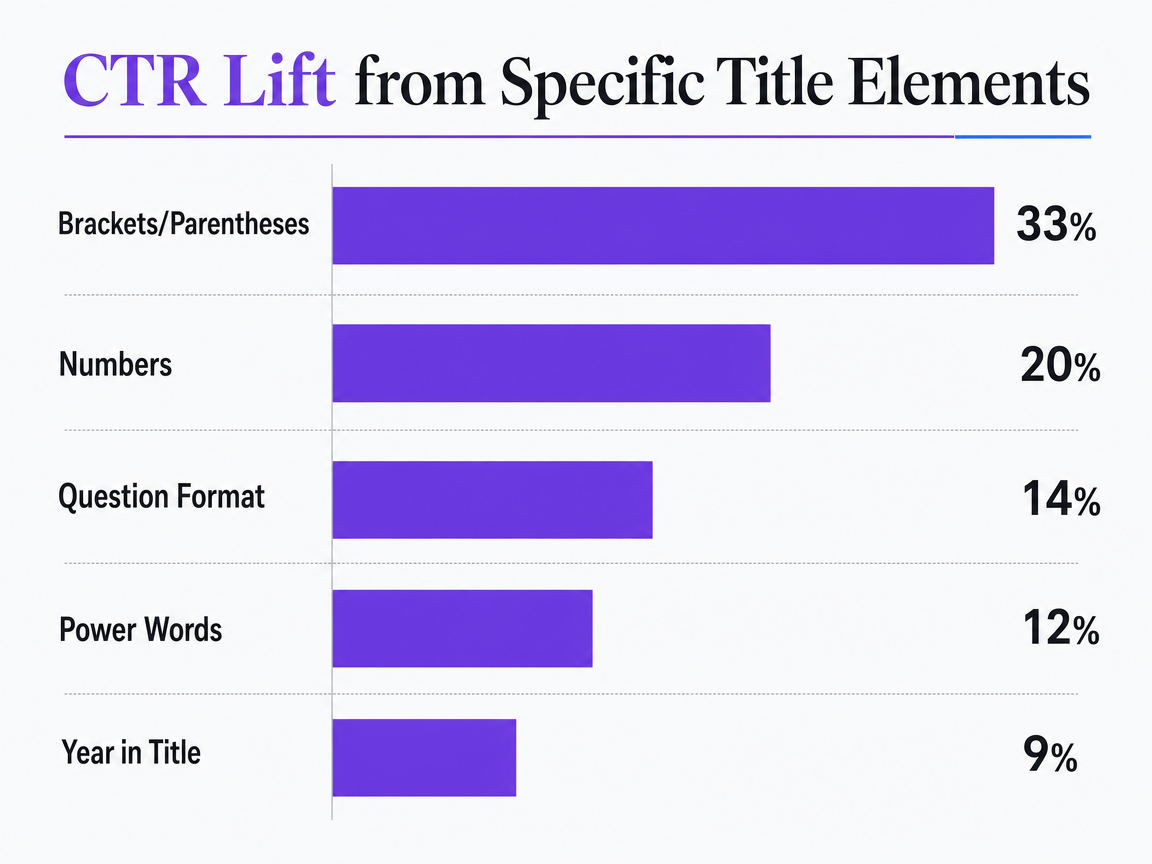 CTR Lift from Specific Title Elements
Data from multiple industry datasets shows the average percentage lift in Click-Through Rate (CTR) from adding specific elements to an SEO title.
11 title patterns that produce measurable CTR lift
Pattern 1: Number + Keyword + Outcome
The formula is: [Number] + [Keyword] + [Outcome]. For example: 11 SEO Titles That Boost CTR by 33%. Numerals in a title contribute to a documented +20% CTR lift on average 11, by signaling specificity in a scannable SERP.
This pattern is effective for list-intent queries where users seek enumerable options like templates, examples, or tools. It works well for GSC pages ranking in positions 4-10 with strong impressions but low CTR. Odd numbers between 7 and 15 often appear more thoroughly researched, though the lift comes from the presence of a numeral itself.
The outcome part of the formula is crucial. A title promising a specific, measurable result (e.g., percentage, dollar figure, time saved) is more likely to convert scanners into clickers than one offering abstract value like "insights" or "tips."
Pattern 2: Bracketed content-type badge
Formula: [Keyword]: [Angle] [Content-Type Badge]. Example: SEO Title Testing: Framework and Template [Guide]. Brackets and parentheses generate the largest single-element lift, averaging +33% CTR 11. HubSpot data also confirms higher CTR for bracketed titles 10.
A 2026 A/B test across 423 pages found that bracketed content-type badges—such as [Guide], [Checklist], [Case Study], [Template]—consistently improved CTR when combined with a numeral in the first four words and a title under 60 characters 4. The bracket quickly communicates the content format, reducing cognitive load for searchers.
This pattern is suitable for resource pages, downloadable assets, and long-form guides. It is less effective for transactional pages, where a badge like [Guide] might mislead searchers looking for a product or service.
Pattern 3: Direct question for informational intent
Formula: [Question Word] + [Keyword] + [Qualifier]?. Example: What Makes an SEO Title Rank in 2024?. Question-format titles outperform statement-format titles by 14% for informational queries 9, with another dataset reporting a 15.5% CTR advantage from question words generally 1. The +14% average lift is also noted in the cross-source element breakdown 11.
Questions are less effective for commercial intent. The same dataset showing a 14% win for questions on informational queries indicates that feature-focused "5 Ways To" headlines beat questions by 17% on commercial queries 9. The effectiveness depends on the query's position in the sales funnel.
Deploy questions for "how," "what," "why," and "can" queries—informational stems identified in GSC for educational pages. Pair the question with a specific qualifier (year, audience, condition) to prevent vague questions that might trigger Google title rewrites.
Pattern 4: Feature-format '5 Ways To' for commercial intent
Formula: [Number] Ways To + [Verb] + [Commercial Outcome]. Example: 5 Ways To Cut Cost Per Lead in Q4. For commercial queries, this format outperforms question-format titles by 17% 9, reflecting the opposite trend seen with informational queries.
This format is action-oriented. Commercial searchers are past initial research and seek concise, actionable methods to achieve a specific outcome. The number indicates scope, the verb implies action, and the outcome highlights value.
This pattern suits bottom-of-funnel content like service pages, comparison content, and category pages where searchers are evaluating options. Strong verbs (e.g., cut, scale, capture) are more effective than passive ones. Use GSC filtering for commercial modifiers (best, top, vs, pricing) to identify suitable URLs.
Pattern 5: Keyword-first with front-loaded benefit
Formula: [Primary Keyword] + [Benefit] + [Optional Brand]. Example: SEO Title Templates That Lift CTR 20%+. Placing the primary keyword first results in a documented 20% CTR lift, with Backlinko, Moz, and Yoast data consistently identifying keyword-first as a high-yield structural rule 11, 9.
Placement is critical because SERP scanning is left-anchored; the first few words significantly influence click decisions. Titles that obscure the keyword with brand names or unnecessary modifiers lose the immediate match signal searchers seek.
This pattern can include a brand suffix if character limits allow. It becomes less effective if the primary keyword appears in position five or later. A GSC audit that analyzes top 100 queries and title-tag word order can quickly identify candidates for this optimization.
Pattern 6: Current year for freshness-sensitive queries
Formula: [Keyword] + [Angle] + [Year]. Example: SEO Title Best Practices 2024. Year references provide a +9% CTR lift on average 11, the smallest documented element lift, but valuable for queries where recency is important.
This pattern is appropriate for statistics, trend content, best-practices guides, and topics where users mentally filter by publication date. It is less effective for evergreen how-to content, where the year adds noise without signal.
The 423-page test noted a caveat: year markers become redundant if other freshness signals (e.g., updated dates, version references) are already present 4. Agencies should annually refresh the year for this pattern across their portfolio to avoid signaling staleness.
Pattern 7: Power word + specificity
Formula: [Power Word] + [Keyword] + [Specific Outcome]. Example: Proven SEO Title Formulas That Rank Page One. Power words—such as proven, essential, complete, ultimate, definitive—yield a +12% CTR lift on average 11.
While effective, the lift is conditional. Overusing emotional and power words can lead to diminishing returns and dilute brand voice across a portfolio 5. One power word per title, combined with a specific outcome, provides the clearest signal.
This pattern suits guides, resource pages, and category pages where an authoritative framing aligns with user expectations. It is less effective for transactional pages, where power words may sound like marketing jargon. Agencies should limit power-word usage to maintain variety and credibility across their titles.
Pattern 8: Comparison and versus formats
Formula: [Option A] vs [Option B]: [Decision Criterion]. Example: Question Titles vs Feature Titles: Which Wins by Intent. Comparison titles target searchers in active evaluation mode, a query state with high commercial value and strong click intent.
This pattern leverages specificity, similar to numbered lists. Naming both comparison elements in the title signals immediate relevance. GSC often reveals "vs" and "or" queries for category pages, indicating candidates for this rewrite 2.
The decision criterion at the end distinguishes effective comparison titles. "X vs Y" is less impactful than "X vs Y: Which Fits Enterprise SEO," as the qualifier assures the searcher that the article resolves the comparison.
Pattern 9: Pain-solution framing
Formula: Stop [Pain] + [Verb] + [Solution]. Example: Stop Losing Clicks: SEO Title Fixes for Low-CTR Pages. Pain-solution titles combine an acknowledged problem with a corrective action, attracting searchers with problem-oriented queries.
This mechanic works by mirroring the searcher's internal thought process. A user querying "why is my CTR dropping" has already identified a pain; a title that acknowledges this creates immediate resonance. Emotional triggers like this are documented CTR levers 7.
Care is needed when scaling this pattern. Overuse can create a monotonous, alarmist tone that erodes credibility. Reserve pain-solution framing for pages addressing explicit problem queries—such as troubleshooting or diagnostic guides—and use neutral framings on adjacent pages to maintain variety in the client's SERP presence.
Pattern 10: Location + keyword + differentiator
Formula: [Keyword] + [Location] + [Differentiator]. Example: SEO Agency Chicago: Same-Day Audit Turnaround. Location-anchored titles are highly relevant for local intent queries, where the geo-modifier is a strong match signal 2.
The differentiator is crucial for standing out. "SEO Agency Chicago" alone competes with many similar titles. Adding a specific differentiator—like turnaround time, specialization, or a guarantee—distinguishes the title without exceeding character limits.
For multi-location clients, a differentiator matrix is needed rather than a single boilerplate. Varying differentiators by market (e.g., regulatory specialization in one city, vertical focus in another) prevents near-duplicate titles that can be flagged in GSC.
Pattern 11: Numeral in the first four words
Formula: [Numeral in Positions 1–4] + [Keyword] + [Modifier]. Example: 7 SEO Title Patterns Agencies Ship Weekly. A 2026 A/B test across 423 pages found that placing a numeral within the first four words of the title positively impacted CTR 4.
This differs from Pattern 1's general number-in-title lift; placement enhances the effect. A title like "The Best SEO Title Patterns: 11 Examples for Agencies" buries the numeral, losing some of the documented benefit, while "11 SEO Title Patterns for Agencies" captures it.
This pattern is structural and can be combined with brackets, power words, or year markers. For large-scale rewrites, treat "numeral-in-first-four" as a positional constraint rather than a standalone template, focusing on word order rather than content.
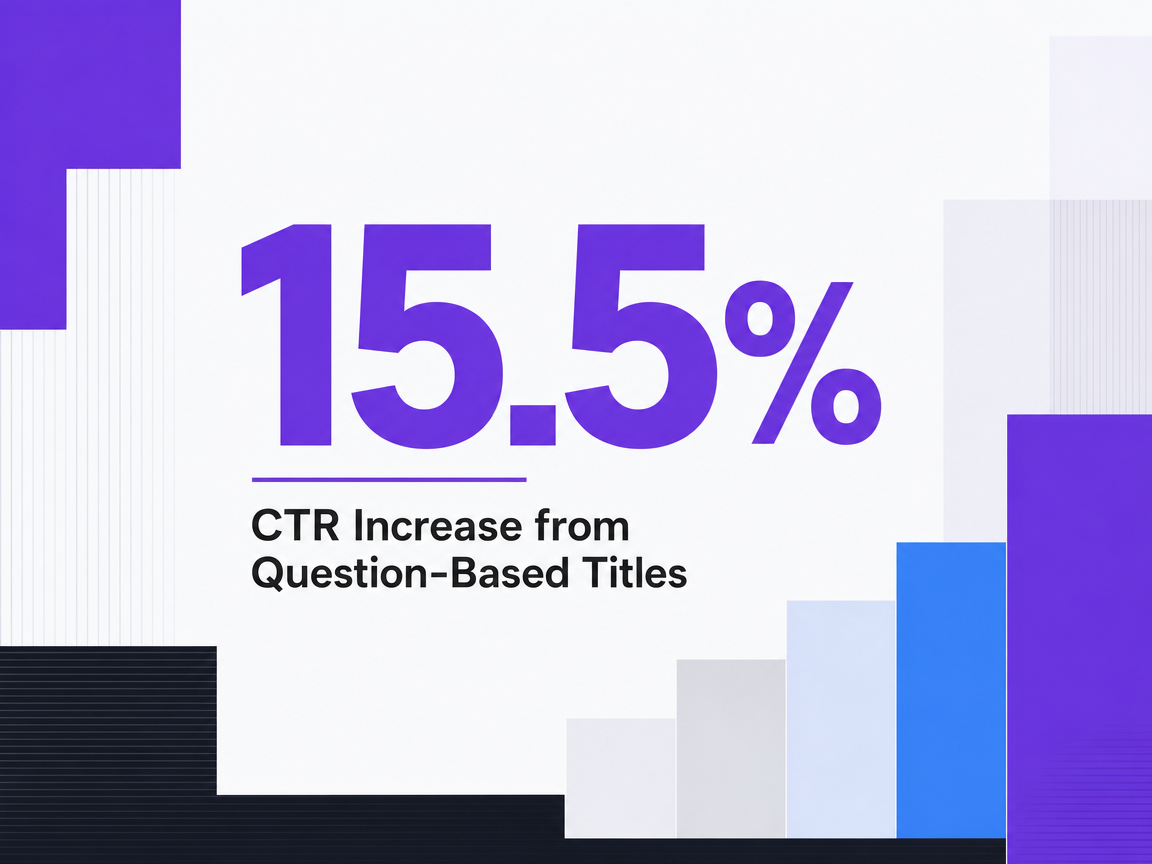 CTR Increase from Question-Based Titles
CTR Increase from Question-Based Titles
Test High-Impact SEO Titles in Live Campaigns
Run live SEO title experiments and measure performance before committing to ongoing workflows.
Matching patterns to query intent without guessing
Pattern selection should be driven by query intent, not subjective preference. Search Console reveals the top queries for a URL, which carry intent signatures that map directly to the 11 patterns:
- "How," "what," "why," and "can" queries suit questions.
- "Best," "top," "vs," and "pricing" modifiers align with feature-format or comparison structures.
- "Near me," city names, and service-plus-geo queries fit location-anchored patterns with a differentiator 2.
Intent also dictates which elements can be effectively combined. A commercial query addressed by a question title misses the 17% feature-format advantage 9. An informational query with an overly aggressive power-word title may underperform a neutral question. Intent acts as a filter, determining which of the five documented element lifts 11 a URL can truly capture. Applying the wrong pattern to the right page can negate the intended CTR improvements.
Length and pixel constraints that gate every pattern
All title patterns are subject to SERP truncation. Convergent guidance from Backlinko, Moz, and Yoast suggests 50–60 characters or about 580 pixels 11, with a 40–60 character sweet spot 1, 6. A 2026 analysis extends the upper limit to approximately 600 pixels, or 55–65 characters on typical devices 7. The 423-page test confirmed that titles under 60 characters consistently improved CTR 4.
Pixel width is more important than character count. A title with many narrow letters may fit, while the same character count with wide letters might truncate. Agencies performing portfolio-scale rewrites should check pixel width before deployment, not just character count 5.
This constraint affects all other patterns. Brackets, numerals, years, and power words consume budget. If the title exceeds pixel width, truncation can remove the differentiator, brand, or year intended to drive the CTR lift.
Title Resilience when Google rewrites your work
Google frequently rewrites titles in the SERP, changing the approach for agencies. The solution is Title Resilience: ensuring alignment between the H1, title tag, og:title, and meta description. This way, if a rewrite occurs, the substituted title remains accurate, on-brand, and conversion-relevant 8. Discrepancies between these signals give Google's algorithm more leeway to substitute an unapproved title.
Rewrites also serve as diagnostic feedback. When Google replaces a title, it indicates a mismatch between the original phrasing and the query 7. Portfolio audits should track rewrite rate as a distinct metric. URLs where the submitted title remains unchanged signal alignment, while frequent rewrites suggest the H1 or meta stack needs revision before the next test cycle.
See How High-Performing Agencies Optimize SEO Titles at Scale
Connect with our team to review data-backed frameworks for scalable SEO title creation, tailored for agencies managing multiple client portfolios across high-impact verticals.
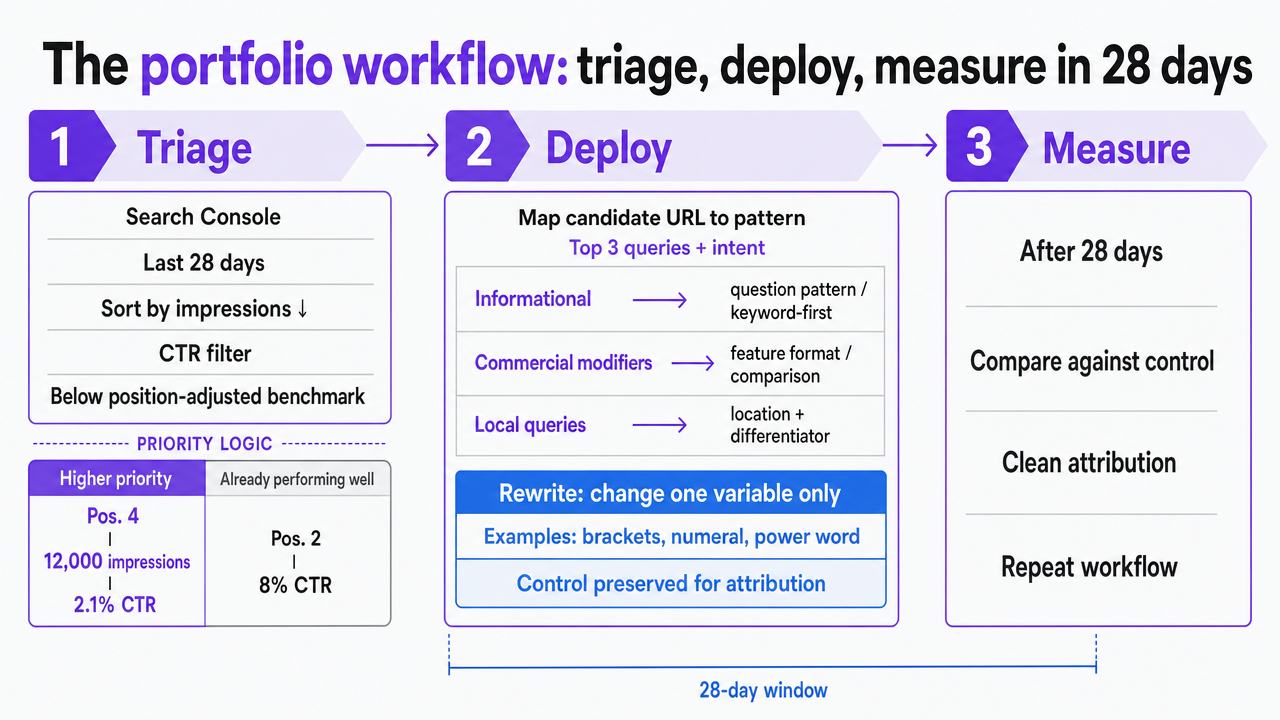
The portfolio workflow: triage, deploy, measure in 28 days
The workflow begins in Search Console. Filter data for the last 28 days, sort URLs by impressions descending, then apply a CTR filter to identify pages below their position-adjusted benchmark 2. For example, a page at position 4 with 12,000 impressions and 2.1% CTR is a higher priority than a position-2 page at 8% CTR that is already performing well.
Once triaged, each candidate URL is mapped to a pattern based on its top three queries and their intent. Informational queries are routed to question or keyword-first patterns. Commercial modifiers go to feature-format or comparison structures. Local queries use location-plus-differentiator patterns 2. The rewrite should change only one variable against the control (e.g., brackets, numeral, or power word) to ensure clean attribution after 28 days 7.
Measurement involves comparing impressions-weighted CTR across matched query sets, not just aggregate page CTR, which can fluctuate with query mix. Successful patterns are added to the library. Unsuccessful ones are rolled back, and the URL is re-triaged for the next-best pattern.
Throughput reference for agencies running the program
Portfolio-scale title work requires a consistent cadence. A program for a 40-client roster typically moves 15–25 titles into active testing per week, with each test running for a full 28-day measurement window before promotion or rollback 2, 7. This throughput assumes weekly triage from Search Console, rather than quarterly audits that create unmanageable backlogs.
Three cadences drive the operation:
- Triage runs weekly, identifying low-CTR, high-impression URLs against position-adjusted benchmarks.
- Deployment is continuous as candidates clear intent mapping and pattern selection.
- Measurement uses rolling 28-day windows, so tests from week one are clean by week five, as the next batch begins.
Google's rewrite rate is tracked alongside CTR delta as a signal-alignment metric 8. Agencies that neglect measurement risk building a pattern library based on untested assumptions rather than proven assets.
Where Vectoron fits in an industrialized title program
Portfolio-scale title work often fails due to three issues: inconsistent triage, subjective pattern selection, and neglected measurement. A platform that industrializes this process can manage the coordination layer. This includes surfacing low-CTR, high-impression URLs from Search Console, mapping them to patterns from a documented CTR-lift library 11, routing rewrites for human approval, and maintaining measurement windows against rewrite-rate signals 8. Vectoron provides this coordination layer through an approval-first workflow, allowing SEO leads to control every title while eliminating the manual overhead that limits portfolio throughput.
Frequently Asked Questions
References
- 1.SEO Title Tag Statistics You Should Know in 2023 (Complete List, Latest).
- 2.25 SEO Title Examples That Improve CTR - Posicionament-Web.
- 3.10 Best Title Tag CTR Optimization Practices - Toolshero.
- 4.423-Page Title Test: What Lifts Organic CTR in 2026 | US Tech Automations.
- 5.SEO Title Tag Best Practices 2026: Length, Format, CTR Tips.
- 6.How to Optimize SEO Title Tags to Improve Rankings (with studies) - Astrak.
- 7.Optimizing Title Tags for Better CTR: A Simple Guide.
- 8.Google Tests AI-Generated Titles in Search Results - SEO-Kreativ.
- 9.The Connection Between Meta Tags and Click-Through Rates: What the Data Shows.
- 10.A/B Test Your Titles (Title Tags Section).
- 11.CTR-Boosting Title Tag Length, Pixel Width & Format for SEO.