
Key Takeaways
- Semrush anchors the portfolio visibility layer with position tracking and competitive intelligence at breadth, though deep technical audits still belong in a purpose-built crawler.
- Ahrefs earns its place for backlink governance, competitor content teardown, and gap discovery, especially where editorial and digital PR sit inside the SEO practice.
- Google Search Console delivers first-party truth, and its 24-hour view 14plus Search Generative AI reports 15make it essential for freshness and AI visibility.
- Screaming Frog is the technical truth layer for defensible audits, but its raw outputs need a reporting layer to become client-ready at agency scale.
- Sitebulb translates technical findings into prioritized, client-facing audit narratives, working best as a standardized audit template across the roster.
- AccuRanker delivers daily rank data with clean exports into Looker Studio and BigQuery, powering the weekly tactical cadence recommended for large organizations 7.
- Looker Studio turns SEO tools into a client-facing product, letting a Head of SEO template one dashboard and clone it across the entire client base.
- Bing Webmaster Tools adds a second-source performance view 16and captures AI-visibility signal from engines built on Microsoft's index at zero cost.
- Vectoron sits above the stack, connecting approved SEO work to KPI movement so monthly reports can defend whether the last 90 days moved the business.
What Agency Delivery Actually Demands From Tracking Software
Running SEO delivery across 15 to 80 client accounts is a data consolidation problem before it is a strategy problem. The Head of SEO who spends Friday afternoons stitching rank exports into slide decks is not short on tools. They are short on a system that makes rank, crawl, analytics, and revenue data legible to three different audiences on three different cadences.
Forrester's Q3 2025 evaluation of SEO solutions scores vendors on collaboration, reporting and analytics, competitive intelligence, and keyword research 1, and the analyst position is direct: every company benefits from a dedicated SEO platform rather than a scatter of point tools 19. Practitioner guidance points the same way. MarTech's buyer's guide argues that centralized platforms reduce the time and errors involved in managing organic search programs 4, which matters more with each new client added to the roster.
Tracking software for client work has to do four things at once:
- pull first-party performance data,
- monitor competitive movement,
- diagnose technical health, and
- translate all of it into reports a CFO will read.
The nine choices below are evaluated against that job, not against a feature checklist.
The Selection Framework: Four Criteria That Separate Platforms From Point Tools
Forrester's Q3 2025 Wave scores SEO solutions across a set of criteria that map neatly onto agency delivery pain points: collaboration, reporting and analytics, competitive intelligence, and keyword research 1. Reading those four categories as a rubric — rather than as vendor marketing bullets — gives the Head of SEO a defensible way to sort a crowded market.
Collaboration is the criterion most listicles undersell. At 40-plus client accounts, the bottleneck is rarely data collection; it is handoffs between strategists, writers, and account leads. Platforms that expose shared workspaces, task assignment, and approval trails compress the coordination tax that eats agency margin.
Reporting and analytics is where point tools consistently fail. A rank tracker that cannot roll up into a portfolio view, or a crawler whose findings have to be re-keyed into a client deck, forces the same manual assembly work every month. MarTech's buyer's guide frames this bluntly: consolidated platforms reduce time and errors in managing organic search programs 4.
Competitive intelligence separates dashboards from decision systems. Share-of-voice trend lines, SERP feature ownership, and content gap detection at competitor level are what let a strategist walk into a QBR with a defensible plan instead of a rankings screenshot.
Keyword research remains foundational, but the modern read is broader: topic clustering, intent classification, and — increasingly — visibility inside AI-generated answers. Any tool evaluated for client work in 2026 needs to earn a score across all four dimensions, not just the one it markets hardest.
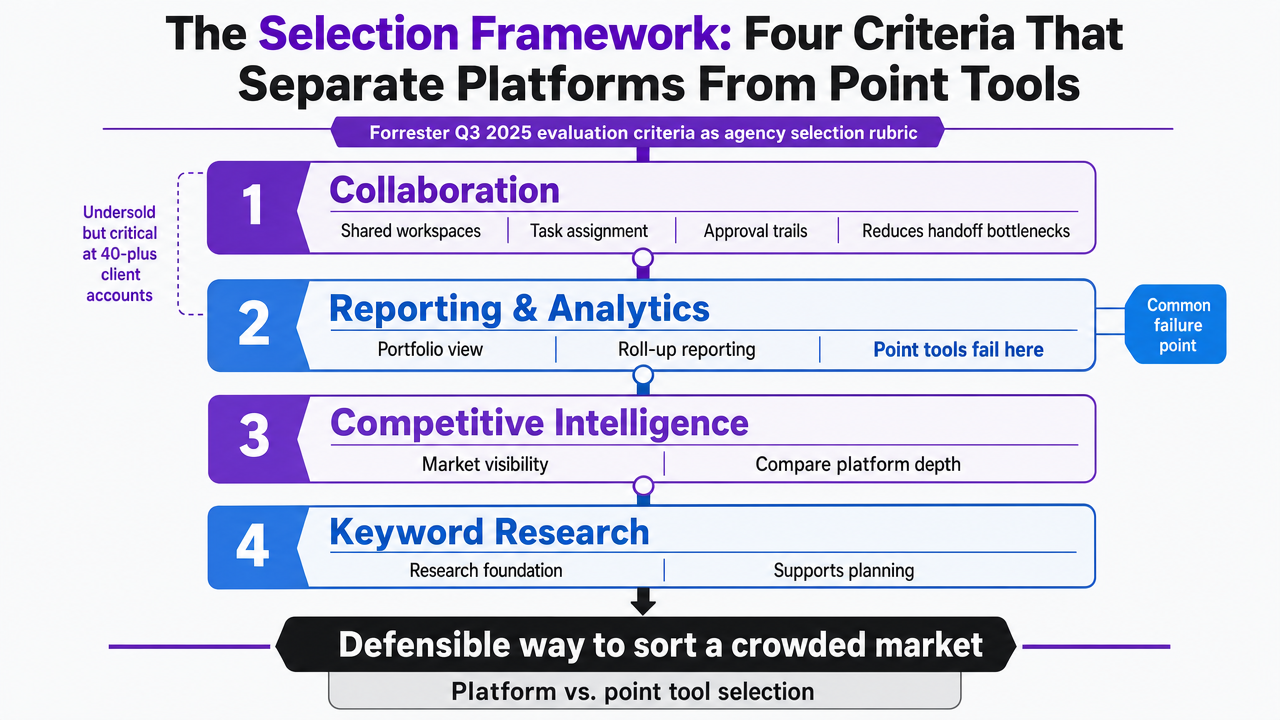 Visualize the four Forrester Q3 2025 evaluation criteria as a decision framework for agency tool selection, directly supporting the section's rubric
The Nine Tracking Choices, Mapped to Delivery Jobs
Semrush — Portfolio Rank and Competitive Intelligence at Breadth
Semrush earns its place in agency stacks by covering the two Forrester criteria most teams overspend on separately: competitive intelligence and keyword research 1. Position tracking scales to hundreds of domains, and the share-of-voice, SERP feature ownership, and competitor gap views turn a Monday QBR from a rankings recap into a market read.
Where Semrush earns its recurring cost at 40 or more clients is Projects: technical audits, on-page checks, and backlink monitoring roll up under a single account, which is closer to the consolidated diagnostics model MarTech describes for enterprise SEO platforms 2. The tradeoff is depth. Its site crawler is competent for weekly hygiene checks but rarely replaces a dedicated crawler on complex enterprise sites. The pattern that works: use Semrush as the portfolio visibility layer and delegate deep technical audits to a purpose-built crawler. Strategists who try to make it do everything end up with reports that are broad, shallow, and hard to defend in a technical review.
Ahrefs — Link Intelligence and Content Gap Analysis for Editorial Teams
Ahrefs remains the reference tool for backlink analysis, and that is still the concrete delivery job it does best. For agencies where editorial and digital PR sit inside the SEO practice, its referring-domains history, anchor profiles, and lost-link alerts give writers and outreach leads something to act on rather than to admire.
Content Explorer and the topic-cluster views map cleanly onto MarTech's core enterprise capability of content analysis alongside link and rank data 2. Site Explorer's traffic-share estimates are useful for prospecting and pitch decks, though experienced strategists treat them as directional rather than authoritative — the numbers are modeled, not first-party. At portfolio scale, Ahrefs shines when paired with a rank tracker that handles daily updates more efficiently; running Ahrefs alone as a rank monitor across 50 clients gets expensive fast. Assign it the jobs it wins: backlink governance, competitor content teardown, and gap discovery for new client onboarding.
Google Search Console — Freshness, First-Party Truth, and the 24-Hour View
Search Console is the only tool in this list that reports what Google actually served, and two recent product changes make it more useful for client work than it has been in years. The 24-hour performance view now surfaces data from the last available 24 hours with only a few hours of delay 14, which changes how quickly a team can catch a botched migration, a de-indexed template, or a traffic drop after a core update.
The second change matters more for 2026 client conversations. Search Console's new Search Generative AI performance reports show impressions, pages, countries, devices, and dates for generative AI features in Search and Discover 15. That is the first time AI-answer visibility becomes measurable inside a first-party surface most clients already trust. Agencies still need external tooling for cross-domain analysis and historical archives beyond GSC's 16-month window, but the platform now anchors the freshness and AI-visibility layers of any credible client stack.
Screaming Frog — Technical Governance and Crawl Diagnostics
Screaming Frog is the workhorse behind most defensible technical audits, and it maps directly onto the diagnostics job Fishtank describes as central to any enterprise SEO platform: uncovering the on-page and off-page errors that quietly suppress performance 13. Its scheduled crawls, log-file integration, and JavaScript rendering handle the cases where lighter SaaS crawlers hit a wall.
The catch is that Screaming Frog outputs raw findings, not client-ready narratives. At two or three clients, that is fine. At 40, a strategist spends more time formatting crawl exports than interpreting them. Agencies that keep it in the stack usually pair it with a reporting layer that ingests its CSVs and a governance policy that dictates which crawl configurations get run per client tier. Treat Screaming Frog as the truth layer for technical SEO, not the reporting layer.
Sitebulb — Prioritized Technical Reporting for Client-Facing Audits
Sitebulb solves the reporting problem Screaming Frog leaves behind. Its audits ship with prioritized hints, visual crawl maps, and explanations written in language a marketing director can actually read. For agencies where account leads present technical findings to non-technical clients, that translation layer is the difference between an audit that gets approved and one that sits in a shared drive.
Depth is comparable to Screaming Frog on most mid-sized sites, though Screaming Frog still wins on log analysis and very large crawls. Sitebulb's stronger positioning is at the audit-report boundary — the moment technical findings have to become a scope of work. Pair it with a heavier crawler for enterprise sites and use Sitebulb as the standardized audit template across the client base, which is exactly the kind of consolidation MarTech's buyer's guide credits with reducing error and time in organic search programs 4.
AccuRanker — High-Frequency Rank Tracking for Weekly Cadences
Rank tracking is a commodity until it isn't. AccuRanker's edge is daily-by-default updates, on-demand refreshes, and a data model built for teams that need clean position data hourly during a launch or a core update. For agencies running weekly tactical dashboards — the cadence the 2026 KPI playbook explicitly recommends for large organizations 7— that responsiveness is the difference between reacting inside a business day and explaining a drop two weeks later.
Feature breadth is narrower than Semrush or Ahrefs, and that is the point. AccuRanker does one job well, exports cleanly into Looker Studio and BigQuery, and prices per keyword rather than per seat, which suits agencies with many analysts touching the data. The operational move: run AccuRanker as the rank feed powering weekly client dashboards, and let the suites handle competitive intelligence and content analysis on longer cycles.
Looker Studio — The Reporting Layer That Sits On Everything Else
Looker Studio is not an SEO tool. It is the reporting layer that turns SEO tools into a client-facing product. Native connectors for Search Console, GA4, and BigQuery, plus community connectors for every major rank tracker and crawler, let a Head of SEO build a single templated dashboard and clone it across the entire client base.
The strategic argument is the one the DigitalApplied 2026 guide makes plainly: reports must answer the client's business question, not just show data, and organic traffic is a lagging indicator while rankings and impressions are leading indicators 12. Looker Studio is where that distinction gets built into the layout — leading indicators up top for weekly reviews, lagging revenue and conversion metrics reserved for the monthly and quarterly cuts. The maintenance cost is real. Templates drift, connectors break, and someone owns the schema. Agencies that treat Looker Studio as a product with a maintainer, not a side task, get compounding returns on it.
Bing Webmaster Tools — The Second-Source Performance View
Bing Webmaster Tools rarely makes lead-tool lists, and that is exactly why it belongs in a serious agency stack. Its Search Performance reports 16give a second-source view of impressions, clicks, and query-level demand that clients cannot see anywhere else, and Bing data feeds into a meaningful share of AI answer engines built on Microsoft's index.
The delivery job is narrow but real: catch demand and indexation issues that Google surfaces don't reveal, and support clients in verticals where Bing traffic is disproportionately valuable — B2B, enterprise IT, and older demographics in service categories. It costs nothing to add. Skipping it in 2026 leaves an AI-visibility signal on the table.
Vectoron — Tying Approved SEO Work to KPI Impact
Every tool above tracks something. Vectoron sits one layer up, connecting approved SEO work to the business outcomes clients actually pay for. It functions as an execution layer with specialist AI strategists for content, SEO, backlinks, and adjacent channels, routing every recommendation through a Command Center approval workflow before anything ships.
The delivery job it does that a rank tracker cannot: read live signals from qualified calls, bookings, and cost per lead, rank the next set of SEO actions by expected KPI impact, and produce a trail linking each approved change to its downstream result. That maps onto the business-outcome KPIs — organic revenue, leads, cost per organic lead — that the 2026 reporting guidance treats as the core of effective client reporting 9. It does not replace Search Console for first-party data, Screaming Frog for crawl diagnostics, or Looker Studio for dashboarding. It is the layer that answers the question those tools leave unresolved: given everything the trackers surface, what should the agency do next, and did the last thing it did actually work.
Test real-time SEO tracking workflows now
Run live client SEO tracking and reporting during your trial with unrestricted platform access.
Building a Reporting Cadence That Survives 50 Clients
Cadence is where agency reporting quietly falls apart. A single client at monthly is easy. Fifty clients at monthly, all landing in the first week, is a fire drill that pulls strategists off delivery for ten working days. The fix is not more tools. It is tiering the cadence so the right data reaches the right audience at the right frequency.
The 2026 KPI playbook recommends monthly executive reports paired with weekly tactical dashboards for large organizations 7. A separate 2025 reporting guide extends that into quarterly deep-dives for business impact, with the argument that most metrics do not need weekly scrutiny — technical health, rankings, and top-of-funnel indicators do, while conversion and revenue trends need longer observation windows to be trustworthy 8.
The working tier for a 50-client portfolio looks like this:
- Weekly tactical dashboards live in Looker Studio, powered by AccuRanker for rank data and Search Console for freshness and click-through — automated, self-serve, and reviewed by strategists rather than emailed to clients.
- Monthly executive reports pull the same data into a narrated PDF or slide format, with the KPI focus shifting from movement to outcome: organic sessions, conversions, revenue attribution 7.
- Quarterly business reviews reset the strategy: competitor share of voice, technical audit deltas, AI visibility trend, and the plan for the next 90 days.
The operational discipline that makes this survive is templating. One dashboard schema, one monthly deck template, one QBR structure — cloned across the client base, edited at the data layer, not the design layer. Agencies that let each account manager build their own reporting workflow burn margin they cannot recover.
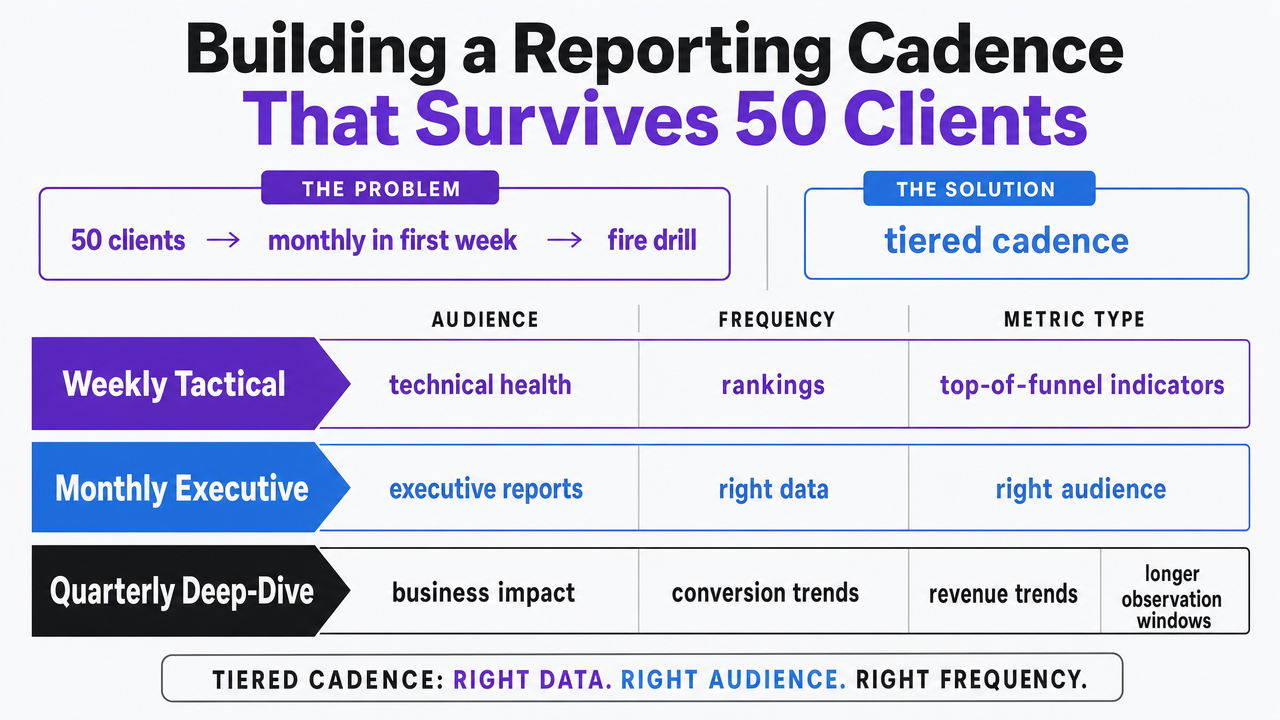 Process infographic showing the three-tier reporting cadence (weekly tactical, monthly executive, quarterly deep-dive) cited in the section from refs 7 and 8
Choosing KPIs That Answer the Client's Business Question
Ranking movement is not a client KPI. It is an input to one. The 2026 reporting guidance that has held up best in agency practice narrows client-facing measurement to three to five core KPIs: organic revenue or leads, organic traffic trend, cost per organic lead, keyword visibility score, and forward indicators like impression growth 9. Everything else belongs in internal dashboards where strategists can act on it without asking a client to interpret it.
The order matters. Organic revenue and leads answer whether the engagement is working. Cost per organic lead answers whether it is working efficiently against the client's paid alternatives. Keyword visibility score and impression growth answer whether next quarter will be better than this one — the leading indicators that a lagging revenue line will follow 12. A CFO reading a monthly report should be able to move top to bottom through those five and know exactly where the program stands.
The discipline this forces on tool selection is useful. Any tracker in the stack has to feed at least one of those five KPIs cleanly, or it is a research tool, not a reporting tool. Striking-distance clusters, SERP feature ownership, and page-type performance breakdowns 5belong inside the strategist workflow that decides what to work on next — surfaced in client reports only when they explain a movement in the top-line numbers.
If You Manage Multi-Location or Franchise Portfolios
A note on audience: this section narrows to Heads of SEO running multi-location clients — DSOs, home services franchises, senior living groups, regional law firms — where a single logo can represent 30, 200, or 800 individual location pages, each with its own local pack, GBP profile, and citation footprint. The tracking problem changes shape at that scale.
MarTech's multi-location governance guidance is direct about the choice: agencies either commit to an all-in-one SEO suite or run a mix of specialized tools, and either path has to automate repetitive work and deliver insights at the location level so teams can see what's working and where 3. Neither approach is universally right. Suites simplify governance and reporting but often flatten location-level nuance. Specialized stacks preserve depth but multiply the coordination load — the same tax that scales linearly with every new location added to the account.
The pattern that survives at 200-plus locations is a hybrid. Portfolio rank tracking rolls up in one platform, local pack and GBP monitoring runs in a specialized local tool, and the reporting layer aggregates both into a location-scored dashboard the client's regional managers can actually use. The governance discipline is non-negotiable: naming conventions, tag schemas, and audit templates cloned across every location, edited centrally, never per-account.
See How Leading Agencies Track and Optimize SEO Performance at Scale
Request a walkthrough of unified SEO tracking workflows proven to increase operational efficiency and reporting accuracy across multiple client accounts—without additional headcount.
AI Answer-Engine Visibility Is Now a Tracking Dimension, Not a Side Project
Clients who read a rankings report in 2026 already know the position-one screenshot doesn't explain the traffic line anymore. AI Overviews, chat-based search, and answer summaries have inserted themselves between impression and click, and any tracking stack that ignores that layer is reporting on a shrinking share of the visibility pie.
The good news is that measurement is catching up. Google's new Search Generative AI performance reports surface impressions, pages, countries, devices, and dates for generative AI features across Search and Discover 15— first-party data inside a surface clients already trust. The rollout is gradual, which means portfolio coverage will be uneven for a while, but the direction is set. Enterprise analytics guidance now recommends measuring AI visibility at the topic level, over time, against a fixed competitor set, with enough prompt repetition to trust the trend 10. That framing matters: single-prompt spot checks are anecdotes, not metrics.
The operational move is to add an AI visibility row to the same monthly executive report that already carries organic revenue and impression growth, sourced from GSC's GenAI report where available and a topic-level prompt-sampling process everywhere else. Treating it as a separate deliverable trains clients to see it as optional. It isn't.
How the Nine Tools Actually Combine in a Working Agency Stack
None of these tools is the answer on its own. The stack is the answer. A working configuration for a 50-client agency has four layers, each doing a job the others cannot.
- The truth layer is Search Console and Bing Webmaster Tools 16— first-party performance data, no modeling, and the only surfaces that will show AI-answer impressions natively 15.
- The visibility layer is Semrush or Ahrefs, chosen by whether competitive intelligence or link intelligence dominates the client base.
- The diagnostics layer is Screaming Frog for depth and Sitebulb for the client-facing audit narrative, with AccuRanker feeding daily rank data into weekly cadences.
- The reporting layer is Looker Studio, templated once and cloned across the roster.
Vectoron sits above that stack, connecting approved work to KPI movement so the monthly executive report has a defensible answer to the question every client eventually asks: did the last 90 days of SEO investment actually move the business.
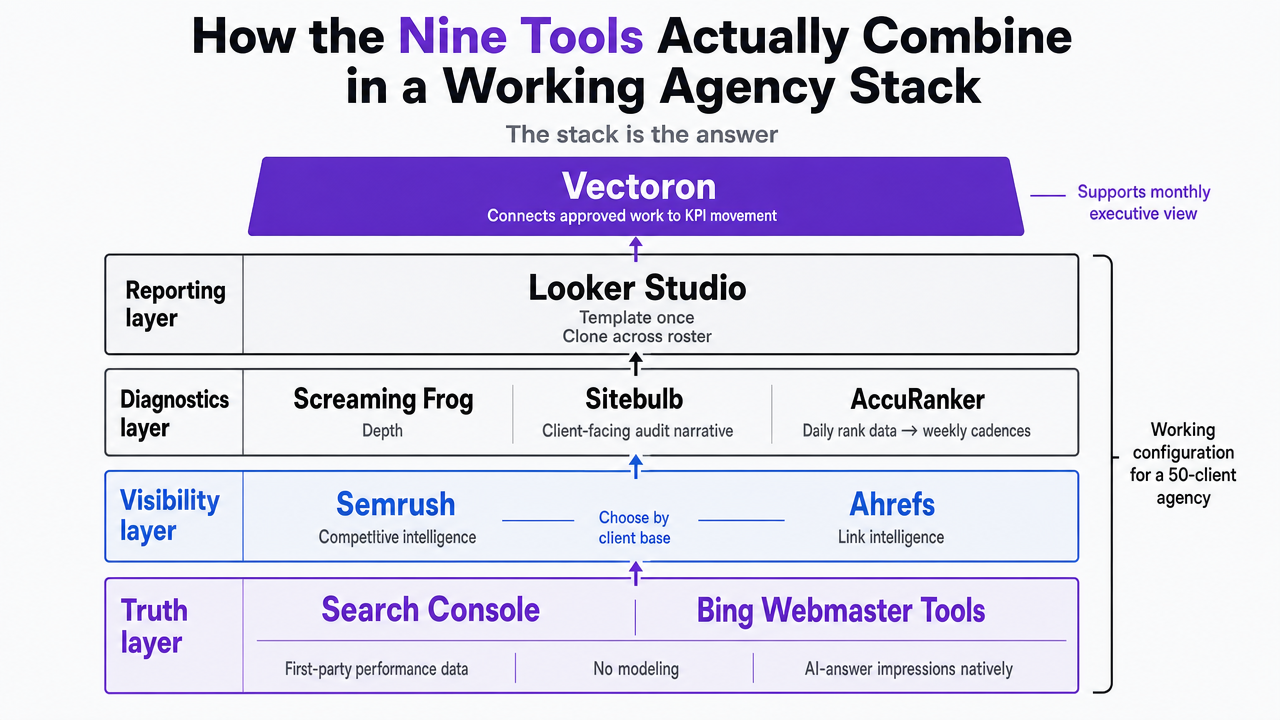 Layered stack diagram showing how the nine tools combine into four functional layers (truth, visibility, diagnostics, reporting) plus Vectoron on top, directly reflecting the section's argument
Frequently Asked Questions
References
- 1.Search Engine Optimization Solutions, Q3 2025.
- 2.Enterprise SEO Platforms: A Marketer’s Guide.
- 3.Enterprise tech stack & governance for multi-location SEO | MarTech.
- 4.SEO buyer's guide.
- 5.Enterprise SEO Reporting: Tips For Developing Effective Dashboards.
- 6.Best Enterprise SEO Dashboard and How to Use it for Reporting.
- 7.Enterprise SEO Analytics & Reporting (2026 KPI Playbook).
- 8.SEO Reporting Best Practices: A Comprehensive Guide.
- 9.SEO Reporting Best Practices 2026 - Sunil Pratap Singh.
- 10.Enterprise SEO Analytics: A Complete Guide for 2026.
- 11.SEO Reporting (2026): Strategies, Tactics & Examples.
- 12.SEO Reporting: Client Dashboard & Metrics Guide.
- 13.What Is An Enterprise SEO Platform?.
- 14.An improved way to view your recent performance data in Search Console.
- 15.Introducing Search Generative AI performance reports in Search Console.
- 16.Search Performance - Bing Webmaster Tools.
- 17.The Forrester Wave™: SEO Platforms, Q4 2012.
- 18.The Forrester Wave™: SEO Platforms, Q3 2020.
- 19.Every Company Needs An SEO Platform.