
Key Takeaways
- Position 1 no longer reflects performance because AI Overviews, snippets, and knowledge panels now sit above organic results, changing what rank actually delivers to clients.
- Classic rank trackers report a single numeric position that ignores whether an AI Overview answered the query or a snippet captured the click, misrepresenting real visibility.
- AI-answer visibility is the new baseline, since AI Overviews appear on over 54.61% of searches when weighted by volume 2, demanding per-keyword citation tracking.
- Commercial and transactional queries now fall inside the AI Overview blast radius, with informational share dropping from 89% to 57% in one year 2.
- Feature ownership belongs on the scorecard because SERP features negatively correlate with organic CTR 3and receive user attention in 74% of cases 6.
- AI-visibility trackers are mandatory for high-volume revenue keywords, exposing AI Overview presence, citation ownership, and cited-link position as distinct filterable fields.
- Feature-level trackers earn their place by exposing snippet type, PAA membership, and ownership status alongside position, replacing manual screenshot review at scale.
- Local grid trackers reveal true catchment-area visibility for service verticals by sampling pin-level rankings, which citywide averages cannot capture for multi-location clients.
- Enterprise stack platforms deliver scale and tagging, but agency heads should audit AI-visibility and feature-detection depth rather than trusting keyword ceilings or overall feature counts.
- Unified AI execution platforms link tracking to production and approval workflows, turning snippet losses into queued fixes and attributing outcomes to specific actions.
- Multi-location portfolios should track 20-30 business-critical keywords per location 7, since maximalist lists inflate costs without improving account-team decisions.
- Tying rank movement to revenue requires a shared location key across the tracker, GA4 custom dimensions, and call-tracking pools 10, not screenshots in QBRs.
Position 1 Isn't What You're Selling Anymore
Agency SEO leads still present keyword rankings in QBRs, but this metric no longer accurately reflects performance. Google's ranking systems now integrate core ranking, helpful content, and topic-specific systems, producing results with AI Overviews, featured snippets, People Also Ask sections, and knowledge panels that often appear above the traditional ten blue links 1. A number one organic result positioned beneath a 900-pixel AI Overview does not hold the same value it did in 2019, and client revenue trends reflect this shift.
This article provides an audit framework for agency heads of SEO who recognize that current measurement approaches overstate performance for critical client queries. The focus has shifted from identifying the best rank tracker to determining the optimal combination of trackers, feature-level signals, and revenue integrations that effectively link organic work to pipeline generation across an entire portfolio.
The Measurement Problem Trackers Were Built to Solve No Longer Exists
What Classic Rank Trackers Actually Report
Traditional rank trackers were designed for a SERP structure that is now obsolete. Their primary output is a numerical position for a keyword-domain pair on a specific day, aggregated into share-of-voice charts and visibility indexes. Buying criteria historically centered on refresh frequency, keyword volume limits, and desktop-versus-mobile splits, as these were the competitive differentiators among tools.
This output indicates a URL's placement within the ten organic slots but fails to convey crucial context. It doesn't show whether those slots appear above the fold, if an AI Overview has already answered the query, or if a featured snippet has captured the click. A position 3 ranking on a query with a large generative answer is fundamentally different from a position 3 ranking on a plain SERP, yet trackers report them identically.
Why Google's Own Guidance Undermines Single-Position Scoring
Google's public documentation describes ranking as the outcome of numerous interconnected systems, including core ranking, the helpful content system, reviews systems, and topic-specific systems. These combine billions of pages with various relevance and quality signals to generate a result page 1. The result page itself is composed of multiple elements: generative answers, snippets, People Also Ask, knowledge panels, local packs, and the classic organic list.
Reducing this complex architecture to a single integer position is insufficient. It cannot convey whether a client secured a snippet, was cited within an AI Overview, or was pushed below multiple ad units and a map pack. Agencies still using weighted average position as the primary KPI are oversimplifying a multi-system environment into a metric that Google itself does not use to describe the SERP. The measurement layer must evolve to match the current SERP landscape.
AI-Answer Visibility Is the New Baseline
A modern rank tracker's initial focus should be on whether the client's answer is even visible on the page, rather than just its position. Data from Ahrefs, analyzed by Fokal, indicates that AI Overviews appear on 9.46% of all keywords, 16% of U.S. desktop searches, and over 54.61% of searches by volume, as the feature prioritizes high-traffic queries 2. This disparity between keyword-level and volume-weighted numbers highlights a critical issue: a tracker sampling a client's 2,000-keyword list uniformly will report AI Overview coverage in the 10-16% range, thereby under-reporting exposure on queries that actually drive sessions.
When weighted by impressions, more than half of the searches a client competes for now display a generative answer before the organic list. This is the new baseline. Any tracker that cannot identify AI Overview presence per keyword, confirm if the client's domain is cited within the panel, and differentiate between volume-weighted and unweighted coverage is reporting on a SERP that no longer represents the majority of user sessions.
Agency heads should consider two key operational questions when evaluating tools:
- Does the crawler render the complete SERP, including AI Overview expansion states, or does it only scrape the static HTML that predates this feature?
- Does the reporting layer provide AI Overview presence and citation status as filterable dimensions alongside position, enabling client dashboards to segment revenue-driving keywords based on whether they trigger a generative answer?
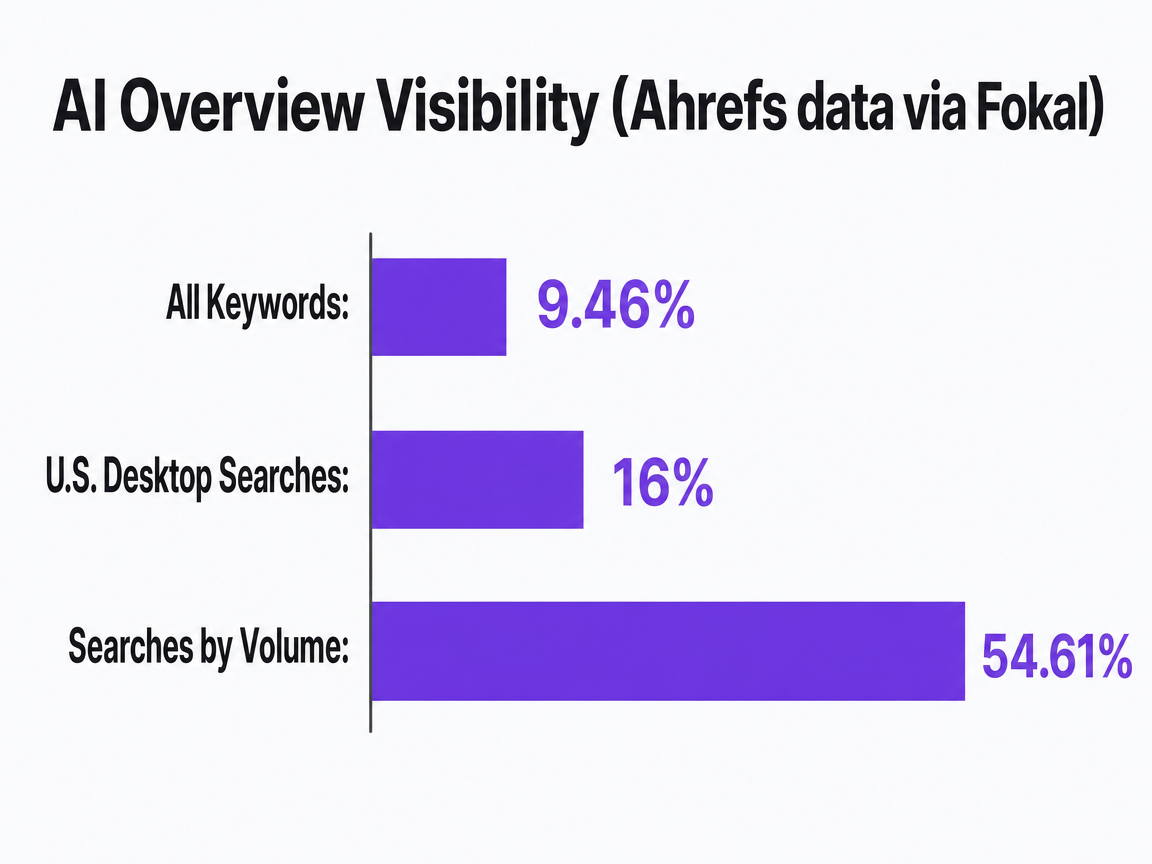 AI Overview Visibility (Ahrefs data via Fokal)
A breakdown of how frequently AI Overviews appear across different query sets, showing they are disproportionately present on high-volume searches.
Test AI-Driven SERP Tracking in Real Scenarios
Evaluate advanced SERP tracking accuracy and workflow efficiency with your actual client projects, risk-free for seven days.
Commercial Queries Are Now Inside the AI Overview Blast Radius
Initial assessments suggested AI Overviews primarily impacted informational traffic, but this is no longer accurate. The proportion of AI Overview-triggering searches classified as informational decreased from 89% to 57% within a year, meaning the remaining 43% now includes commercial and transactional intent 2. The feature has extended its reach further down the sales funnel.
For agency heads analyzing a client's revenue-driving keywords, this shift changes what a rank tracker needs to flag. Queries like "Best [service] near me," "[product] vs [product]," and comparison searches, which previously yielded clear commercial SERPs, now increasingly return a generative answer summarizing options before users reach the organic list. If a tracker treats these queries as standard blue-link competitions, client dashboards will show stable positions while sessions and form fills decline.
The operational solution is to segment the tracked keyword list by commercial intent and demand AI Overview presence data for every keyword in that segment, not just informational ones. Any tool under consideration should offer a filterable view of commercial keywords ranking in the top ten that also trigger an AI Overview, and separately indicate if the client is cited within the panel. This intersection is where organic revenue is being re-evaluated, and it's a view that most legacy trackers still do not provide by default.
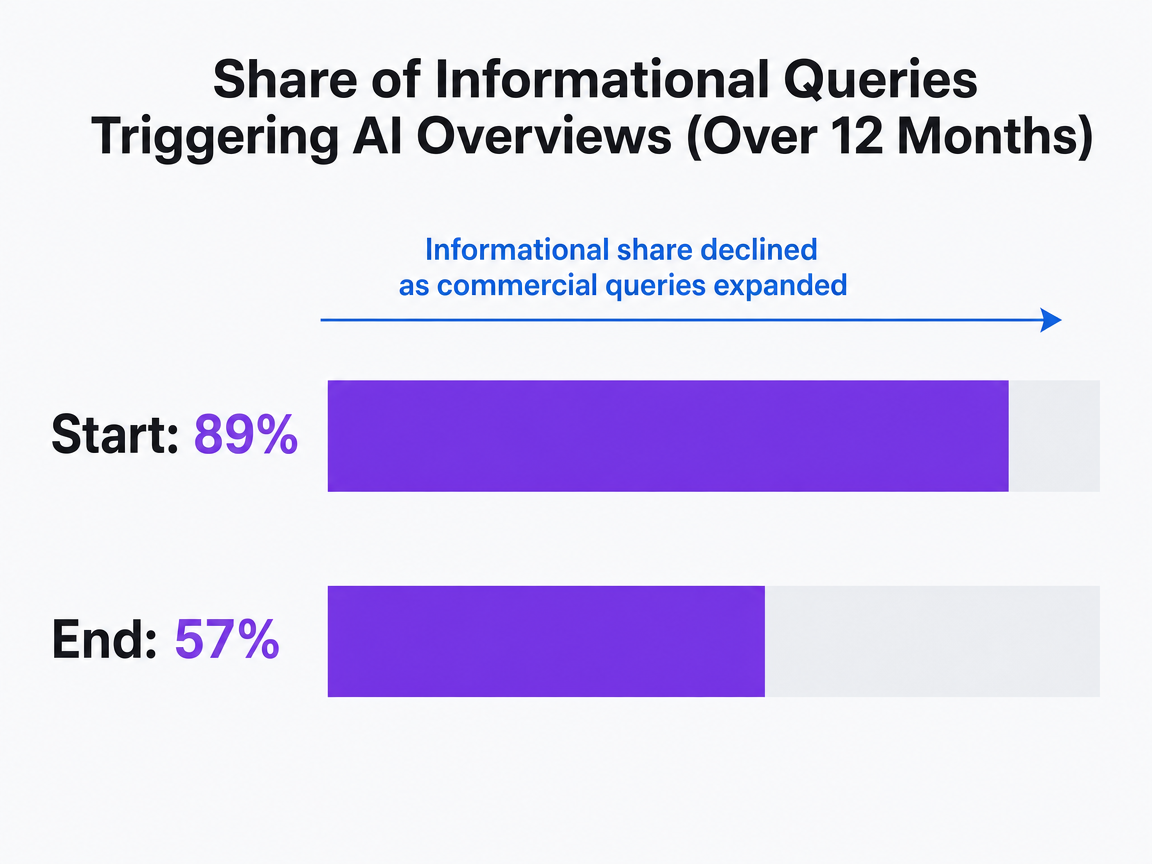 Share of Informational Queries Triggering AI Overviews (Over 12 Months)
This comparison shows that the proportion of AI Overview-triggering searches that are informational in nature fell from 89% to 57% over a 12-month period, indicating an expansion into more commercial query types.
Feature Ownership Belongs on the Scorecard
The CTR Case for Feature-Adjusted Position Scoring
Position without context inflates performance metrics. An arXiv analysis of SERP features and organic click behavior found that the presence of most SERP features negatively correlates with CTR to organic listings 3. This means the same numerical rank can yield significantly different traffic depending on other elements present on the page. For example, a position 2 on a query with an AI Overview, a featured snippet, and a four-item People Also Ask stack is not economically equivalent to a position 2 on a plain SERP, yet many agency dashboards score them identically.
Feature-adjusted position scoring addresses this by weighting each ranking based on the SERP layout it occupies. The process involves capturing which features are present for each tracked keyword, whether the client owns any of them, and then applying a CTR modifier derived from that layout. Trackers that expose feature presence as a filterable field enable this without requiring custom pipelines, unlike those that only provide an integer position.
Agency heads should prioritize feature presence as a primary dimension in their reporting schema. Without it, weighted average position increasingly diverges from actual sessions with each SERP redesign, leading to QBR narratives that don't align with GSC data.
Where Attention Actually Lands on a Modern SERP
Eye-tracking research by Nielsen Norman Group revealed a "pinball" scanning pattern on complex SERPs, where users navigate between rich features and organic listings rather than reading sequentially from top to bottom. When SERP features were present, they received user attention in 74% of cases, with a 95% confidence interval of 66–81% 6. This measured behavioral rate from a controlled usability study redefines "visibility" on a multi-surface page.
Operationally, this means a client owning the featured snippet on a commercial query captures attention in approximately three out of four sessions where the snippet appears, regardless of whether the underlying URL ranks at position 1 or 4. Conversely, a client at position 1 on the same query without the snippet competes for residual attention after users scan the feature. Numeric rank alone cannot differentiate these outcomes.
Rank trackers that report feature ownership as a distinct metric, alongside position, provide agency heads with a robust method to score visibility based on what users actually see. Trackers that omit this force analysts to infer feature presence from screenshots, which is not scalable for multiple clients.
The Surfaces a Tracker Must Cover by Name
Feature coverage is a critical checklist item. Nielsen Norman Group's taxonomy identifies three modules that dominate attention on rich SERPs: featured snippets, People Also Ask, and knowledge panels 5. Featured snippets, appearing as boxed excerpts above organic results with a source URL, effectively pre-answer queries 4. Any tracker under evaluation should report presence, ownership, and content type (paragraph, list, table, video) for each of these three surfaces at a per-keyword level.
For service-vertical clients, AI Overviews, local packs, and image and video carousels should be added to the coverage set. A tracker lacking any of these surfaces creates a blind spot regarding the exact modules users prioritize. The key evaluation question is not merely whether a tool tracks features, but which specific features, at what update frequency, and whether ownership status is exposed as a filterable field alongside position.
Categories of Tracker, Mapped to Agency Workloads
AI-Visibility Trackers
This category emerged because traditional trackers do not address the current SERP dynamics. AI-visibility trackers monitor whether a client's domain appears within AI Overviews, identify cited sources, and track how citation status changes across query segments and geographies. The most effective tools report AI Overview presence, citation ownership, and the position of the cited link within the panel as distinct fields.
Agency heads should consider this coverage mandatory for clients with high-volume revenue keywords, as AI Overviews concentrate on these queries and account for over half of searches when weighted by volume 2. Without a dedicated AI-visibility layer, a portfolio dashboard cannot differentiate between a keyword the client wins and one where the generative panel provides the answer first.
Feature-Level Trackers
Feature-level trackers report the presence and ownership of featured snippets, People Also Ask stacks, knowledge panels, image and video carousels, and local packs on a per-keyword basis. This category is essential because SERP feature presence negatively correlates with organic CTR, meaning a position without feature context misrepresents potential traffic 3.
Their operational value lies in reporting schema. A feature-level tracker exposes snippet type (paragraph, list, table, video) 5, PAA question membership, and ownership status as filterable fields alongside position. This allows agency analysts to answer questions like "which top-ten commercial rankings are beneath a snippet the client doesn't own?" through a query, rather than manual screenshot review. Trackers that only report feature presence as a boolean flag, without ownership details, address only half the problem.
Local Grid Trackers
Local grid trackers sample rankings across a geographic grid surrounding each business location, generating heatmaps of local pack and organic position by pin. This category is designed for service-vertical clients where proximity is a ranking signal, and a single citywide check fails to capture the actual visibility a customer experiences.
For agencies managing law firms, dental groups, home services, or senior living clients, grid data is the only way to determine if a location ranks effectively within its actual catchment area, not just at its street address. Trackers in this category should offer configurable inputs for grid density, radius, and refresh cadence, and export per-pin data that can be integrated with GA4 location segments downstream 8. Grid tools that only provide a citywide average do not solve the local measurement challenge.
Enterprise Stack Platforms
Enterprise stack platforms integrate keyword tracking, feature detection, competitor share of voice, and content analytics into a single interface. Agencies adopt them for scalability, offering bulk keyword management, API access, tagging systems to group keywords by client, campaign, and location, and permission models that allow account teams to work in isolated views.
The risk here is mistaking breadth for depth. A platform tracking hundreds of thousands of keywords across a portfolio might still have inadequate AI Overview coverage or lag in reporting feature ownership status. Agency heads evaluating enterprise tools should specifically audit the AI-visibility and feature-detection modules, rather than just the overall feature list. They should also confirm that the tagging schema supports location-level segmentation without requiring custom pipelines 7. Keyword volume ceilings and refresh frequency are less important than whether the reporting layer exposes the fields required by the modern SERP.
Unified AI Execution Platforms With Tracking Built In
A newer category integrates tracking directly into a production and approval workflow, rather than treating it as a standalone dashboard. These platforms link rank movement, feature ownership, and AI Overview citation status to the content, technical, and local work that generated them. This means the same system that identifies a snippet loss can also queue the fix for human approval. Vectoron exemplifies this category, coordinating specialist strategists across content, SEO, backlinks, and call intelligence through a unified approval layer, while tracking KPI impact post-publication.
The evaluation question is not merely the presence of tracking within the platform, but whether the tracking data drives ranked recommendations that analysts can approve or reject, and if outcomes are attributed to specific actions. Agency heads aiming to scale delivery without increasing strategist headcount should compare this category against the cost of maintaining a fragmented enterprise stack combined with a separate execution layer.
See How Leading Agencies Track SERP Rankings at Scale—With AI Oversight
Connect with specialists to explore AI-driven SERP tracking workflows that enable multi-client visibility, granular reporting, and strategic control—without expanding your SEO headcount.
If You Manage Multi-Location Portfolios: The Keyword Bloat Problem
Why 200 Keywords Per Location Doesn't Improve Decisions
For multi-location clients in sectors like law, dental, home services, senior living, and healthcare, the measurement problem changes significantly. Agency contracts often price rank tracking by keyword volume, leading to a common inefficiency. A regional dental group with forty offices might purchase a two-hundred-keyword-per-location package, resulting in a dashboard tracking eight thousand keywords that the account team will never fully review. LocalHQ's multi-location checklist recommends focusing on 20-30 business-critical keywords per location and establishing baseline rankings for this set before commencing optimization 7. Tracking beyond thirty keywords often includes queries with no local commercial intent, no revenue signal, and no practical path to action for the account team. While the dashboard grows, the quality of decisions does not.
A Disciplined Baseline Tied to GA4 Location Segments
A more focused keyword list is effective only when integrated with location-level behavioral data. Multi-location analytics guidance from Practical SEO suggests configuring GA4 custom dimensions for each location and integrating call tracking with unique numbers per location into GA4. This allows organic sessions and calls to be segmented using the same location key 10. Complementary advice from llmrefs advocates building GA4 segments based on location URL patterns and treating Google Business Profile insights, clicks-to-call, driving directions, and website clicks as essential metrics alongside local organic traffic 8.
Operationally, this means aligning a shared location key across three systems: the rank tracker's location tag, the GA4 segment definition, and the call tracking number pool. When these are aligned, a snippet win for "emergency [service] [city]" in Denver will show a visible increase in Denver organic sessions and call volume within the same weekly report. Without this alignment, rank movement becomes disconnected from revenue, and QBRs revert to relying on screenshots.
Multi-Location Tracking Economics at Portfolio Scale
The decision regarding keywords per location directly impacts agency margins at portfolio scale. Two identical clients, each with forty locations, will incur vastly different tracker costs depending on whether the account team uses a disciplined baseline or a maximalist list. The table below illustrates this using LocalHQ's recommended 20-30 keyword range 7and treating per-keyword cost as a variable.
| Configuration | Keywords per location | Locations | Tracked keywords | Monthly tracker cost |
|---|---|---|---|---|
| Disciplined baseline | 25 | 40 | 1,000 | 1,000 × $X |
| Standard vendor package | 100 | 40 | 4,000 | 4,000 × $X |
| Maximalist list | 200 | 40 | 8,000 | 8,000 × $X |
The maximalist configuration costs eight times more than the disciplined baseline but does not yield eight times the actionable insights. It provides the same 25 revenue-driving keywords per location, plus 175 keywords that the account team will likely ignore. Trimming to the baseline recovers margin without compromising client outcomes.
Tying Rank Movement to Revenue, Not Screenshots
A change in rank is a leading indicator, not a final result. The measurement stack agencies build should integrate with the client's revenue system, using the same location or campaign identifier as the tracker. Practical SEO's guidance on multi-location analytics outlines this structure: custom GA4 dimensions per location, unique call tracking numbers integrated with GA4, and location-level goals that convert a snippet win into a measurable call, form fill, or booking on the same dashboard 10. Search Engine Journal emphasizes the importance of review velocity, local backlinks, and a single master data repository as key signals that influence local rankings and thus warrant tracking budget 9.
For QBRs, the operational rule is precise: every reported rank movement to a client should include three accompanying fields: the SERP feature context, the observed GA4 segment lift during the same period, and the call or lead delta from that location's tracking pool. Screenshots cannot provide this comprehensive view. A reporting layer that does is crucial for defending organic budget and demonstrating tangible value.
A Reordered Evaluation Framework for 2025-2026
The evaluation criteria commonly used by agencies—keyword ceiling, refresh frequency, desktop-mobile split, competitor share of voice—are based on an outdated SERP. A revised framework prioritizes AI-answer coverage first, feature ownership second, position third, and revenue attribution as the unifying key.
Five questions should be central to any tool evaluation:
- Does the crawler render AI Overview presence and citation status per keyword, weighted by search volume rather than raw keyword count?
- Does the reporting schema expose feature ownership across snippets, People Also Ask, and knowledge panels as filterable fields alongside position 5?
- Does the local layer generate per-pin grid data that integrates seamlessly with GA4 location segments 10?
- Does the tagging model support portfolio segmentation by client, location, and campaign without custom pipelines?
- Does rank movement translate into a measurable lead, call, or booking on the same dashboard, or does it merely stop at a screenshot?
Tools that satisfactorily answer these five questions are viable candidates. Those that emphasize keyword volume ceilings are optimizing for the wrong metric. Agencies that successfully scale delivery through 2026 without increasing strategist headcount will be those whose measurement stack accurately reflects the user's actual SERP experience.
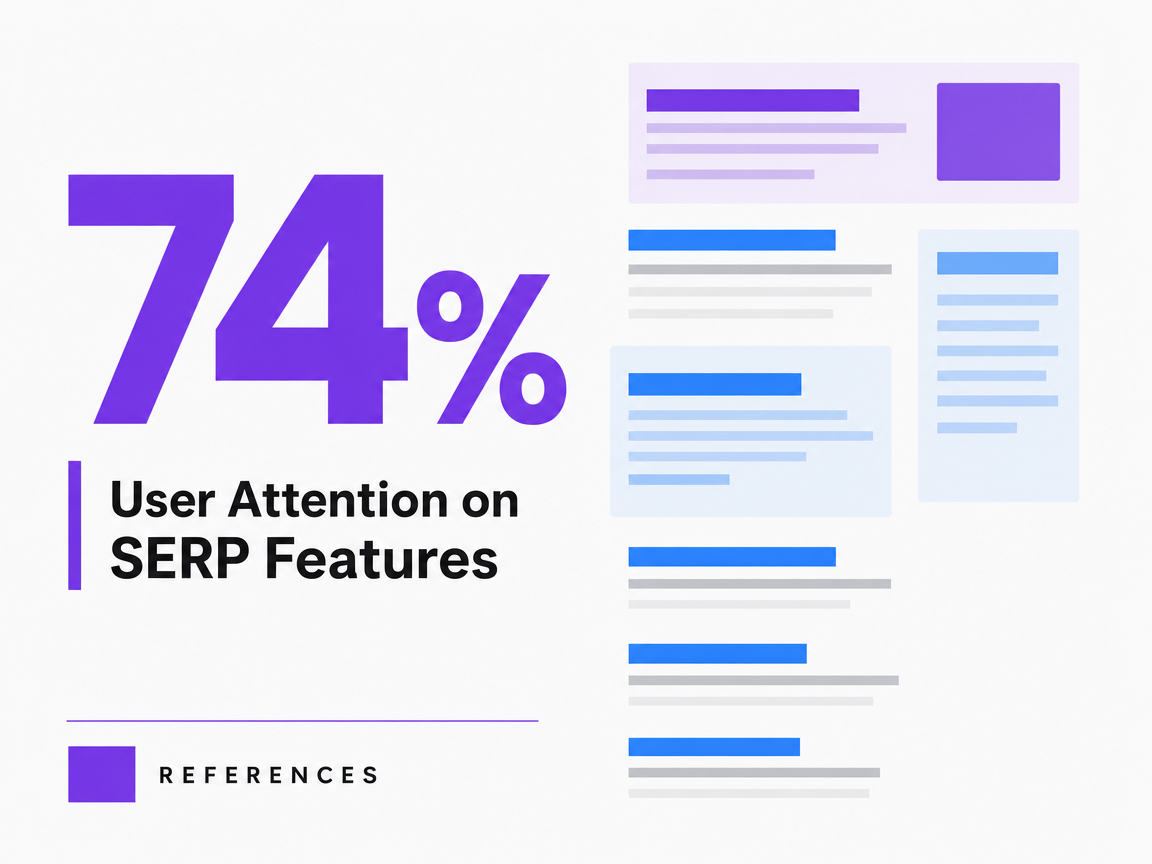 User Attention on SERP Features
User Attention on SERP Features
Frequently Asked Questions
References
- 1.A Guide to Google Search Ranking Systems.
- 2.AI Overview Statistics: What the Data Says About Google's New Search Experience.
- 3.Exploring the Impact of SERP Features on Organic Click-through.
- 4.Featured Snippets Results in Google Web Search: An Exploratory Study.
- 5.Three Key SERP Features: Featured Snippets, People Also Ask, and Knowledge Panels.
- 6.Complex Search-Results Pages Change Search Behavior.
- 7.The Multi-Location SEO Checklist: 47 Points for Enterprise Brands.
- 8.A Complete Guide to Local SEO for Multiple Locations.
- 9.The Complete Guide To Local SEO For Multiple Locations.
- 10.Local SEO for Multiple Locations: Best Practices & Multi-Location Analytics.