
Key Takeaways
- AccuRanker fits data-heavy portfolios needing near-real-time rank updates and share-of-voice reporting when intraday movement on high-value keywords is a paid deliverable 5, 14.
- Advanced Web Ranking doubles as reporting layer and data feed, producing white-label PDFs while piping rank data into BigQuery and Data Studio without middleware 5, 14.
- Semrush Position Tracking remains the default for mixed portfolios, consolidating rank, keyword, backlink, and content workflows under one contract and seat structure 10.
- Ahrefs Rank Tracker earns its budget line when backlink acquisition, content gap analysis, and rank monitoring share reporting cadence inside the same delivery pod 1, 11.
- SE Ranking's drag-and-drop white-label report builder shortens the distance from rank data to client inbox, protecting margin for lean teams running 30 to 80 accounts 13.
- Nightwatch wins for multi-location and franchise portfolios where flagship terms must be tracked by metro or ZIP, with Map Pack shifts monitored location by location 6.
- ProRankTracker shifts reporting load off analysts through deep rank history and client-share URLs that let hands-on marketing managers self-serve between scheduled reports 6, 10.
- Mangools SERPWatcher bundles rank tracking with KWFinder, LinkMiner, and SiteProfiler, making it the sensible pick for shops under 30 accounts at a compressed price band 6, 10.
- STAT Search Analytics clears the volume ceiling other suites hit, landing six-figure keyword sets into BigQuery or Snowflake via its API for enterprise BI workflows 11, 14.
What agency Heads of SEO are actually buying in 2026
The purchase decision has moved. A Head of SEO running 20 to 200-plus client accounts is no longer shopping for the most accurate rank checker on the market. That box was ticked years ago. The active question is which tracker collapses reporting hours per account, exposes clean data to downstream automation, and holds up when the portfolio spans local franchises, national ecommerce, and enterprise keyword sets in the same week.
Recent 2026 roundups converge on a familiar shortlist—AccuRanker, Advanced Web Ranking, Semrush, Ahrefs, SE Ranking, Nightwatch, ProRankTracker, Mangools, and STAT Search Analytics—but they diverge sharply on which tool fits which operating model 5, 6, 11, 14. Independent reviewers now weigh accuracy alongside update frequency, location coverage, API access, and pricing as co-equal criteria 9, and specialist guides increasingly frame tracker selection around white-label report builders and scheduled client deliverables rather than dashboards for internal use 13.
The rest of this piece ranks nine tools by that agency-fit lens, then maps them to portfolio size so the shortlist collapses into a procurement decision.
The evaluation lens: reporting layer vs. strategy layer
Two philosophies now split the SERP tracking market, and the choice determines how much of an agency's reporting stack can actually be automated. On one side sit GUI-based agency platforms like Raven Tools and AgencyAnalytics, built to turn SERP snapshots and rank trends into scheduled, client-ready dashboards and exports. On the other sit API-first data solutions such as SERP API and DataForSEO, which power custom rank monitoring pipelines for developer-led teams that would rather own the reporting layer themselves 12.
That split matters because it dictates where SERP data lives in the workflow. A tracker with a strong report builder and white-label templates functions as the reporting layer—it produces the artifact a client receives on Monday morning. A tracker with a fast, well-documented API functions as a data feed—it lands rank changes, SERP feature shifts, and share-of-voice deltas into a warehouse, a BI tool, or an AI orchestration layer that decides what to do next.
The practical implication for a Head of SEO is this: evaluating tools on rank accuracy alone misreads the procurement question. The 2026 evaluation criteria that hold up across independent reviews are accuracy, update frequency, location coverage, API access, and pricing, weighed together 9. The tool that wins is the one whose data flows cleanly into whatever sits downstream—whether that is a white-label PDF or an AI system prioritizing next-quarter content bets.
Test Automated SERP Reporting on Live Data
Experience hands-on SERP tracking and reporting automation using your actual client projects during the free trial.
The nine tools, ranked by agency operating-model fit
AccuRanker — real-time updates for data-heavy portfolios
AccuRanker earns its slot on this list for a specific reason: it is the tool independent reviewers reach for when the portfolio requires near-real-time rank data across thousands of keywords. One Little Web's 2026 agency roundup names it "Best for real-time updates," a distinction that matters when a client campaign lives or dies by same-day movement on high-value terms 5. Astrid.IQ echoes the pattern, describing AccuRanker as
"one of the best SERP tracking tools, renowned for its precision and ability to provide real-time insights"
3.What sells it to agencies is share-of-voice reporting layered on top of on-demand refreshes. ScrapX's 2026 review positions AccuRanker as
"built for agencies and SEO teams who need instant ranking updates across thousands of keywords,"
pairing that speed with the analytics depth data-heavy portfolios require 14. DesignRush groups AccuRanker with Advanced Web Ranking as the pair that
"deliver fast updates and deep analytics for data-heavy or enterprise SEO"
6.
The operational read: use AccuRanker when volatility monitoring is a paid deliverable and clients expect intraday answers. Analyst time saved on manual refreshes tends to justify its position at the higher end of the pricing spectrum.
Advanced Web Ranking — white-label reporting and BI pipelines
Advanced Web Ranking (AWR) is the tool that earns its place through the reporting pipeline itself. One Little Web's agency practitioners rank it "Best for white-label client reporting," the exact deliverable that consumes analyst hours across a 50-plus client roster 5. That reputation extends to custom report builders and integrations into BigQuery and Data Studio, which land rank data into the same warehouse an agency already uses for cross-channel analytics 14.
For a Head of SEO, this is where the reporting-layer versus data-feed choice collapses—AWR does both. Its report builder produces client-ready PDFs on schedule, while its BI connectors feed downstream dashboards without a middleware layer. DesignRush pairs it with AccuRanker as the enterprise-grade option for data-heavy portfolios, adding forecasting and AI brand visibility features that push it beyond pure rank reporting 6.
The practical fit: agencies whose clients demand branded weekly reports and whose internal analysts need the same underlying data in a warehouse. AWR eliminates the export-transform-load step that eats hours when rank data has to flow from a tracker's UI into a BI tool for executive review.
Semrush Position Tracking — the default all-in-one for mixed portfolios
Semrush earns its slot by breadth. It appears in every major 2026 roundup surveyed for this piece 2, 5, 10, 11, 12, 14, and Worldmetrics' 2026 comparative scoring rates it 9.2/10 overall—the highest score in that ranking, edging Ahrefs at 8.9/10 10. That comparative signal matters because it reflects industry confidence across features, ease of use, and pricing weighted together, not a single-criterion win.
For a mixed portfolio spanning national ecommerce, local service brands, and content-led SaaS clients, Position Tracking rarely gets displaced. It handles SERP-feature visibility across Map Pack, image pack, and answer boxes 1, 7, schedules automated exports, and slots into the same workspace where the delivery team already runs keyword research, backlink audits, and content gap analysis. That workflow consolidation is the real procurement argument—one contract, one seat license structure, and one data model feeding client reports.
Where Semrush loses is at the extremes: enterprise keyword volumes push analysts toward STAT or AccuRanker for speed, and lean small-agency operators find its per-seat pricing heavier than Mangools. For everyone in between, Position Tracking remains the default. The scoring signal from Worldmetrics reflects that default status rather than a feature-by-feature knockout 10.
Ahrefs Rank Tracker — when link and content data must ride the same rail
Ahrefs Rank Tracker's case is not about ranking accuracy in isolation. It is about what sits next to the rank data in the same platform. When an agency's delivery model treats backlink acquisition, content gap analysis, and rank monitoring as one coordinated workflow, Ahrefs collapses three tools into one contract 1, 11.
Elevenwriting groups Ahrefs Rank Tracker with Semrush Position Tracking and Advanced Web Ranking as the trio
"highly efficient for tracking SERP performance over time,"
reflecting broad industry confidence in its core rank data 1. Independent 2026 reviews consistently name it among the leading all-in-one suites for agencies 2, 10, 14.
The operational read for a Head of SEO: Ahrefs earns its budget line when content teams and link acquisition analysts share reporting cadence with the SEO delivery pod. Rank movements can be traced back to referring-domain growth or content refreshes without exporting between tools. Where it loses ground is in white-label report depth against SE Ranking and in real-time update speed against AccuRanker—two lanes where specialists still outperform the suite.
SE Ranking — drag-and-drop white-label reporting for lean delivery teams
SE Ranking's reputation among agencies rests on one feature set: its report builder. Marketing Arsenal's 2026 guide is direct on this point—SE Ranking
"has one of the best report builders in the market… fully customizable, very easy-to-use drag and drop… and can be fully white labeled"
13. That capability, paired with template libraries, scheduled daily and weekly summaries, and multiple export formats, makes it the default choice when reporting output has to scale ahead of headcount 13.
DesignRush lists SE Ranking among the six rank trackers built specifically for agencies, alongside ProRankTracker, AccuRanker, AWR, Nightwatch, and Mangools 6. Its integration with Google Analytics and Search Console lets a delivery lead assemble a full performance narrative—rank movement, traffic delta, conversion trend—inside a single branded PDF 13.
For a lean delivery team running 30 to 80 client accounts, SE Ranking hits the seam that Semrush and Ahrefs miss: it prices lower per seat, and its report builder requires less analyst configuration per deliverable. The result is a shorter distance from rank data to client inbox, which is the metric that determines margin per account when the delivery team is the constraint.
Nightwatch — local and multi-location granularity
For agencies whose portfolios lean on local service brands, franchise networks, or multi-location healthcare and dental groups, Nightwatch earns its slot on the operational strength of location-level tracking. DesignRush's 2026 agency guide is explicit:
"Nightwatch excels in local SEO"
6. It appears alongside the standard shortlist in multiple 2026 roundups 2, 4, 5, but its differentiator is the depth of location and device segmentation rather than headline rank accuracy.
The operational point for a Head of SEO managing multi-location accounts: tracking a national keyword set at the domain level tells the client almost nothing. What matters is how the flagship service term ranks in each metro or ZIP the client actually serves, and how Map Pack presence shifts location by location. Nightwatch's granularity is built for that reporting shape, and its API supports automated pulls into custom dashboards when the client portfolio outgrows a standard template.
The practical caveat: Nightwatch's local depth costs analyst time to configure at onboarding, since each location requires its own tracked keyword set and geo. That configuration cost is why it fits multi-location specialists rather than mixed portfolios where local is one deliverable among many.
ProRankTracker — deep rank history and client-share reporting
ProRankTracker appears across the 2026 agency roundups for a narrower reason than the all-in-one suites 2, 4, 6, 10. Its strength is the depth of historical rank data and the reporting formats clients can access directly, which shifts some of the reporting burden away from the agency's analyst pod.
DesignRush includes it in the six-tool agency shortlist alongside SE Ranking, AccuRanker, AWR, Nightwatch, and Mangools 6. Worldmetrics' 2026 scoring places it in the same competitive set as SERPWatcher and AccuRanker for value-per-dollar 10. For agencies whose clients want on-demand access to their own rank data between scheduled reports, ProRankTracker's client-share URLs and mobile access reduce the volume of ad-hoc data pulls that eat into analyst hours.
The operational read: ProRankTracker fits agencies whose client base skews toward hands-on marketing managers who want to check rankings themselves rather than wait for the Monday PDF. That self-service layer is the throughput gain, not a feature the delivery team uses internally.
Mangools SERPWatcher — the small-agency all-in-one
Mangools SERPWatcher is on this list because independent reviewers keep naming it the sensible option when portfolio size and price band both compress. DesignRush frames it directly:
"Mangools is a simple, all-in-one toolkit for small agencies"
6. Worldmetrics' 2026 ranking includes both Mangools and SERPWatcher in its comparative set alongside the enterprise-grade suites 10.
The operational fit for a Head of SEO running a lean shop under 30 client accounts: SERPWatcher lands in the Mangools bundle with KWFinder, LinkMiner, and SiteProfiler, meaning rank tracking sits inside the same subscription as keyword research and competitor analysis. For a delivery team where two or three analysts cover the full stack, that consolidation is the margin lever.
Where it loses ground is exactly where the larger suites earn their premium: multi-location depth, white-label report customization, and API access for downstream automation. Mangools is a fit-for-portfolio-size choice, not a scale-up path.
STAT Search Analytics — enterprise-scale keyword volume and API
STAT Search Analytics enters this list at the enterprise end of the spectrum. The 2026 SEO Pros guide describes it as
"an enterprise-grade SERP tracking solution built for handling massive keyword volumes with precision and reliability… ideal for integrating SERP data into larger business intelligence workflows via its robust API"
11. ScrapX's 2026 review reinforces the positioning, grouping STAT with AccuRanker and AWR as the tools built for high-volume tracking and BI integration 14.
For a Head of SEO whose largest accounts run six-figure keyword sets or whose enterprise clients demand daily SERP snapshots piped into an internal warehouse, STAT is the tool that clears the volume ceiling most suites hit. Its API is the point of the purchase—rank data lands in BigQuery or Snowflake, then flows into whatever forecasting, prioritization, or executive dashboard layer the client's data team already runs.
The procurement caveat: STAT is priced for enterprise volume and is rarely the right fit below that scale. Agencies whose largest account tops out at 5,000 tracked keywords will over-buy. Agencies whose largest account tracks 50,000-plus will find nothing else in the shortlist that competes on throughput.
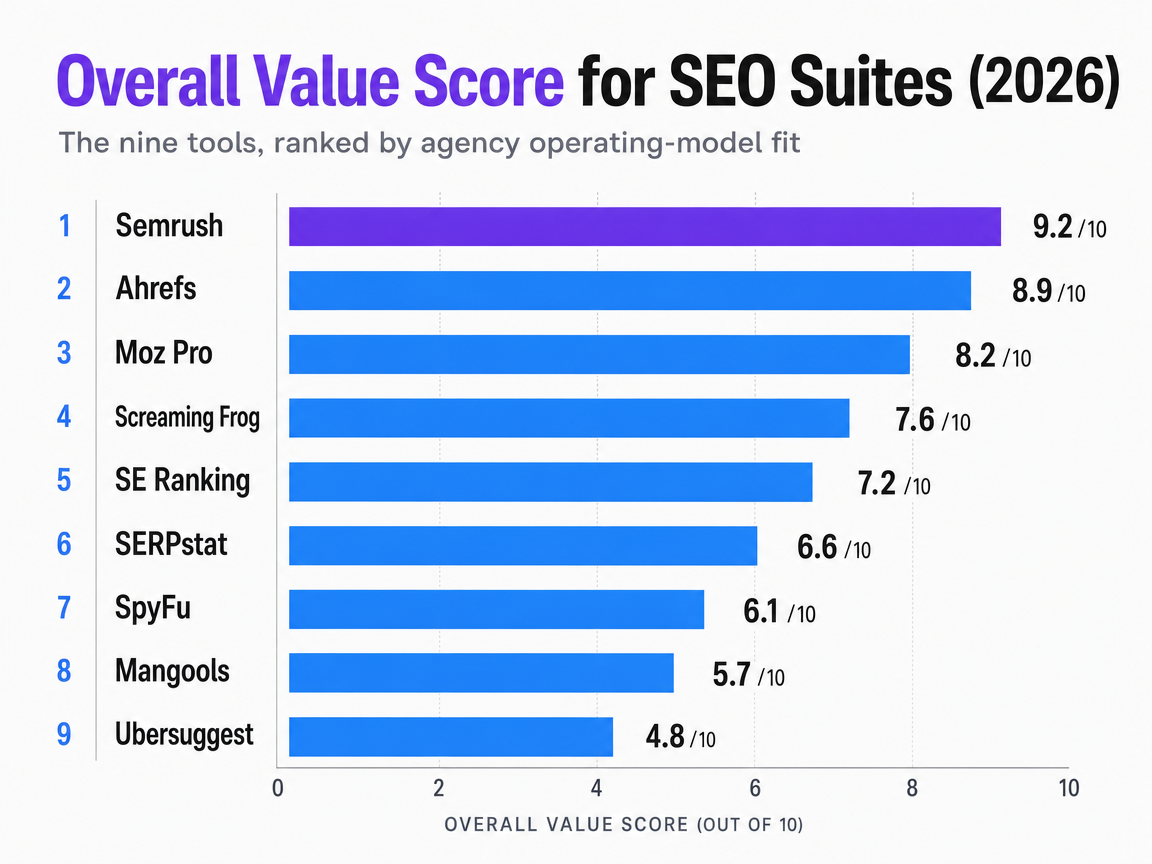 Overall Value Score for SEO Suites (2026)
A comparative rating from Worldmetrics' 2026 rankings, scoring Semrush at 9.2/10 and Ahrefs at 8.9/10 for overall value. This data is useful for a bar chart comparing the two platforms.
Matching tool tier to portfolio size
The shortlist collapses cleanly when a Head of SEO overlays portfolio size and reporting shape on top of the nine tools. Four tiers do most of the sorting work, and each tier maps to specific best-fit language that recurs across the 2026 agency roundups 5, 6, 11, 14.
| Portfolio tier | Best-fit tools | Why the tier lands here ||---|---|---|| Enterprise / high-volume | STAT Search Analytics, AccuRanker, Advanced Web Ranking | Built for massive keyword volumes, real-time updates, and BI/API pipelines feeding warehouses 6, 11, 14|| Agency all-in-one (mixed portfolios) | Semrush, Ahrefs, SE Ranking | Broad suite coverage; rank data sits next to keyword, content, and backlink workflows 10, 13|| Local / multi-location specialist | Nightwatch, ProRankTracker | Location and device granularity plus client-share reporting for franchise and multi-metro accounts 6|| Lean small-agency | Mangools SERPWatcher | Consolidated toolkit priced for shops under 30 accounts 6, 10|
Two procurement rules follow from the matrix. First, tools do not stack cleanly across tiers—an agency running enterprise clients alongside 30 local accounts usually pairs a high-volume tracker with a local specialist rather than forcing one platform to do both. Second, the reporting layer decision is separate from the tier decision: SE Ranking wins on report builder depth even when a bigger suite handles the underlying rank data 13. Heads of SEO who treat these as two purchases—data feed plus reporting artifact—tend to land on a stack that scales without renegotiating contracts every twelve months.
See How Leading Agencies Automate SERP Tracking and Reporting at Scale
Connect with our team to explore advanced SERP monitoring workflows, automated cross-client reporting, and benchmark data that streamline oversight for high-volume SEO portfolios.
If you manage a multi-location or franchise portfolio
A note on scope: this section speaks to Heads of SEO whose portfolios are weighted toward multi-location service brands—dental groups, home services franchises, senior living operators, regional healthcare networks—rather than mixed content-and-ecommerce rosters. The procurement math changes when every client account fans out into 15, 80, or 400 geo-specific ranking sets.
The shortlist narrows fast. Nightwatch is the tool DesignRush names outright for local SEO depth, and its location and device segmentation is the reason it appears in every 2026 agency roundup covering multi-location work 6, 4, 5. ProRankTracker sits alongside it for portfolios where clients want direct access to their own location-level rank data through client-share URLs, reducing the ad-hoc pull volume that scales linearly with location count 6, 10. SerpWatch adds a third option when Map Pack and image pack monitoring across global and local searches is the paid deliverable 7.
One operating rule holds across this tier: bulk keyword configuration and API access matter more than report builder polish. A 200-location dental group generates thousands of geo-keyword pairs at onboarding, and the tool that survives is the one whose API lands that data into a warehouse where a reporting layer—SE Ranking, AgencyAnalytics, or an internal BI stack—can compose the client-facing artifact on schedule 12, 13.
Where SERP data ends and AI-orchestrated execution begins
The nine tools above solve the measurement problem. None of them solve the prioritization problem that follows. A weekly export showing that 12 keywords moved into position 4-7 across three client accounts is data, not a decision—the decision is which of those 12 warrants a content refresh, an internal link push, or a fresh backlink target next sprint, and which client's margin can absorb the analyst hours to execute.
That prioritization layer sits above the tracker. It reads rank deltas, share-of-voice shifts, and SERP-feature changes as inputs, then weighs them against pipeline signals, call quality, and cost per lead to rank next actions across content, SEO, PPC, and backlinks in a single queue 12. The 2026 shift toward BI and warehouse integration in enterprise trackers—STAT, AccuRanker, AWR—reflects the same recognition: rank data is most valuable when it flows into a system that decides what to do about it 11, 14.
Heads of SEO who treat SERP tracking as the reporting endpoint cap their leverage at the deliverable. Those who treat it as the data feed into an AI-orchestrated execution layer—platforms like Vectoron that route ranked recommendations through human approval before shipping work—scale delivery without adding headcount. The tracker is the input. The stack around it decides the output.
Frequently Asked Questions
References
- 1.The Importance of Tracking Search Engine Results Pages (SERPs).
- 2.The 12 Best SERP Tracking Tools in 2025.
- 3.The 13 Best SERP Tracking Tools to Use in 2024.
- 4.15 SERP Tracking Tools To Closely Monitor Your Rankings In 2026.
- 5.15 Best Rank Tracking Software We're Using for 2026.
- 6.Top 6 Agency Rank Tracking Software for 2026.
- 7.Top 11 SERP Monitoring Tools for 2024: Features, Pricing and Recommendations.
- 8.5 Best SERP Tracking Tools 2024.
- 9.We Reviewed 35 SERP Tracker Tools.
- 10.Best Serp Software | 2026 Rankings.
- 11.The 12 Best SERP Tracking Tools for SEO Pros in 2026.
- 12.Top 10 Best Seo Serp Report Software of 2026 - Worldmetrics.
- 13.9 Best SERP Tracking Tools For Monitoring Keyword Rankings.
- 14.8 Best SERP Monitoring Tools for 2026.