
Key Takeaways
- OtterlyAI works as a portfolio-wide default monitor, consolidating six major AI engines into one dashboard so agencies can standardize reporting across every retainer without juggling exports 6.
- Profound suits enterprise pods with internal analysts, tracking 8+ engines and diagnosing whether citation gaps stem from weak content or infrastructure blocks against AI crawlers 3, 9.
- ZipTie goes deep on Google AI Overviews, replacing ad hoc SERP screenshots with query-level citation and competitor overlap data for mid-market retainers focused on that surface 12.
- Semrush's AI Visibility Toolkit trades specialist depth for consolidation, extending an incumbent 60% of agencies already use to cover ChatGPT, Perplexity, Gemini, and AI Overviews 9.
- Ahrefs Brand Radar monitors 286M+ monthly prompts, making it a fit for quarterly competitive benchmarking inside shops already contracted with Ahrefs for rank and backlink work 9, 12.
- SE Ranking paired with Rankability unifies traditional rank tracking and AI citation monitoring in one lightweight stack, giving mid-market portfolios dual coverage without enterprise-tier contracts 11.
- Vectoron sits in the execution tier, routing approved citation-gap fixes into production with human sign-off so agencies scale delivery without adding writer headcount 1.
How Agency Leaders Should Read the 2026 AI Visibility Market
The 2026 vendor landscape for AI search visibility has expanded beyond simple tool comparisons. Roundups now catalog 8 to 22 platforms tracking brand mentions across Google AI Overviews, ChatGPT, Perplexity, Gemini, Copilot, Claude, and Grok 26. Forrester notes that answer engines are becoming the primary interface for many search journeys, shifting optimization targets from blue-link rankings to synthesized answers 7.
For an SEO leader managing client portfolios, the key operational question is: which tool combination covers each client's essential engines, integrates with the existing SEO stack, and minimizes the human effort between identifying a citation gap and implementing a fix?
Research categorizes tools by functional splits often blurred in listicles. Some platforms only measure, others measure and recommend, and a smaller group closes the loop into production 31. Understanding this distinction, rather than just feature checklists, is crucial for making informed stack decisions. The seven tools reviewed below are ranked by their role in agency delivery, not by individual performance.
The Three-Tier Framework: Monitor, Monitor+Optimize, Execute
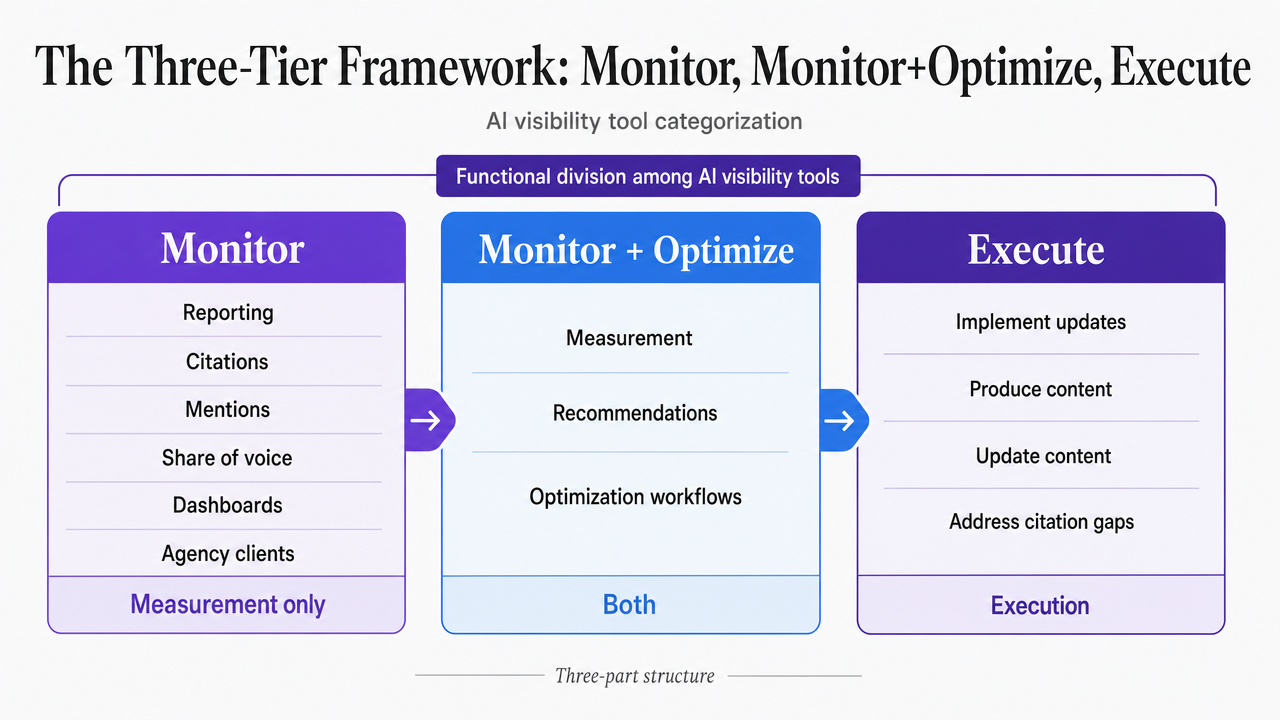
Vendor comparison tables consistently highlight a functional division among AI visibility tools. Some platforms are purely for measurement, others add content change recommendations, and a third group implements those recommendations by producing or updating content to address citation gaps. One comparison labels platforms as either "Measures" or "Both (optimization engine)," distinguishing pure analytics from tools that facilitate optimization workflows 3. Another roundup categorizes 14 platforms for visibility tracking, enterprise optimization, and multi-location execution, reinforcing this three-part structure 1.
The Monitor tier includes tools designed for reporting. They gather citations, mentions, and share-of-voice data from AI engines, presenting results in dashboards for agency clients. Examples include OtterlyAI, Profound, and ZipTie. Their primary focus is signal quality and engine breadth, not remediation.
The Monitor+Optimize tier incorporates a recommendation layer. These platforms compare a brand's citations against competitors, identify content gaps preventing pages from appearing in AI Overviews, and suggest on-page modifications. Semrush's AI Visibility Toolkit, Ahrefs Brand Radar, and the SE Ranking–Rankability pairing fit this category. They guide strategists on what to fix but do not handle content production.
The Execute tier completes the process. Instead of a list of recommended edits, these systems route approved changes directly into production and publishing. This is the smallest segment of the 2026 market and offers the most significant shift in agency delivery economics by eliminating manual handoffs between insight and content deployment 1.
The Seven Tools, Ranked by Where They Sit in Delivery
OtterlyAI — Broadest Monitor for Agency Reporting
OtterlyAI is distinguished by its extensive engine coverage. Independent reviews credit it with the "broadest AI platform coverage in one dashboard," tracking Google AI Overviews, Google AI Mode, ChatGPT, Perplexity, Gemini, and Microsoft Copilot 6. For agencies managing monthly reporting across numerous client brands, this consolidation is highly valuable, offering a single export, prompt library, and share-of-voice metric across all relevant surfaces.
In contrast, enterprise monitors like Profound cover 8+ engines, including Claude, Grok, Meta AI, and AI Overviews, extending into more niche surfaces 3. Advanced Web Ranking's AI Brand Visibility module tracks ChatGPT, Gemini, Claude, and Perplexity, leveraging its existing SEO suite 10. Semrush and Ahrefs cover the four largest engines through their AI toolkits but exclude Meta AI and Grok 9.
OtterlyAI is ideal as a default monitor across all client accounts, priced and scoped for portfolio deployment 12. It streamlines AI mention audits, replacing manual prompt-testing spreadsheets used in 2024 and 2025. However, it does not prescribe fixes or integrate with content workflows, making it a strong pairing with an optimizer or execution layer.
Profound — Enterprise Monitor with Diagnostic Depth
Profound is designed for "large enterprises with a data team," tracking over 8 engines, including Claude, Grok, Meta AI, and Google AI Overviews 3. Its key differentiator is the diagnostic layer beneath the monitoring.
The platform identifies issues like CDN configurations, bot management rules, or firewall settings that prevent AI crawlers from accessing client content 9. For agencies managing client sites with inconsistent AI citations, this diagnostic capability answers whether a brand's absence from AI answers is due to weak content or infrastructure visibility issues.
Zapier's 2026 review positions Profound as suitable "for all-in-one enterprise needs," reflecting its focus on organizations with in-house analysts who can utilize granular data 12. In agency delivery, Profound is best for accounts where the client has internal SEO or engineering support. It is less suitable for smaller retainer accounts where the agency handles both diagnosis and execution and requires a simpler reporting layer.
Operationally, Profound is best deployed on enterprise pods, not standard retainer tiers. Agencies standardizing it across all clients may find themselves spending more time explaining dashboards than implementing solutions.
ZipTie — AI Overviews Analysis for Retainer Accounts
ZipTie's narrower focus in the 2026 market is often more practical for agencies. Zapier describes it as "for deep analysis and reporting" with a specific emphasis on Google AI Overviews 12. While OtterlyAI and Profound offer broader engine coverage, ZipTie provides deeper insights into the surface clients prioritize most.
This focus is significant because AI Overviews are often the starting point for client discussions about AI-driven SEO. The Evergreen Media guide emphasizes the importance of "actively monitor[ing] your own presence in AI Overviews" and conducting regular SERP analyses to track content appearance 5. ZipTie's reporting is built around this specific analysis loop, rather than a general mentions feed.
For agencies managing mid-market retainer accounts, ZipTie replaces the ad hoc SERP screenshots and prompt tests that consumed strategist time in previous years. It provides detailed data on citation frequency, competitor overlap in AI Overviews, and query-level appearance, which consolidated monitors often simplify.
However, ZipTie does not offer the same depth of monitoring for ChatGPT, Perplexity, or Gemini. Agencies serving B2B clients, where LLM chat surfaces are more critical, will need to supplement ZipTie with a broader monitor.
Semrush AI Visibility Toolkit — The Consolidation Play
The value of Semrush's AI Visibility Toolkit lies not in outperforming specialist monitors, but in its integration. Semrush is already part of 60% of agency SEO stacks, and its 25.4B keyword database combined with the AI Visibility Toolkit tracks mentions across ChatGPT, Perplexity, Gemini, and Google AI Overviews without requiring an additional vendor contract 9.
Ahrefs Brand Radar offers a similar advantage, monitoring over 286M monthly prompts across AI engines 9. Together, these incumbent suites cover the four largest AI surfaces, addressing 90% of client inquiries. While neither matches Profound's engine breadth or OtterlyAI's dashboard consolidation, both integrate AI visibility into existing reporting environments for backlinks, rank tracking, and content audits.
For an SEO leader evaluating stack decisions, this is a matter of contract efficiency. Adding a specialist monitor means a new vendor, login, billing line, and export format. Extending Semrush or Ahrefs maintains a unified reporting layer.
The limitation is that neither incumbent tracks Meta AI, Grok, or Claude with Profound's depth, nor do they offer optimization or execution capabilities 2. Consolidation is the primary benefit, with depth being the trade-off.
Ahrefs Brand Radar — Prompt-Scale Monitoring for Existing Ahrefs Shops
Ahrefs Brand Radar addresses AI visibility with a focus on scale, monitoring over 286M monthly prompts across AI engines 9. This volume is crucial for brand benchmarking, allowing agencies to demonstrate client presence across a vast prompt landscape rather than a limited tracking set.
Zapier's 2026 review specifically positions Ahrefs "for benchmarking brand performance" 12. Agencies typically use Brand Radar for competitive baselines and quarterly benchmarking reports, rather than for the daily citation monitoring provided by tools like OtterlyAI or ZipTie.
Integration is straightforward for agencies already using Ahrefs for backlinks and rank tracking; Brand Radar extends the existing contract. Its reporting integrates into current client dashboards, eliminating the need for new tool training or export reconciliation.
Brand Radar's limitations include real-time alerting for citation gaps and the prescriptive recommendations offered by optimizer-tier tools. It is a monitor focused on scale, not an optimizer, and will not fulfill expectations for closing content briefs 2.
SE Ranking + Rankability — Dual Tracking for Mid-Market Portfolios
The combination of SE Ranking and Rankability addresses the needs of mid-market agencies that report on both Google rankings and AI visibility, and cannot justify separate contracts. TECHSY's 2026 review highlights SE Ranking's strength in tracking "visibility across both traditional and AI search" within a single interface 11. Rankability, in the same review, is noted as a GEO-specific tool monitoring content appearance in ChatGPT responses, Google AI Overviews, and Perplexity results 11.
For an SEO leader managing 15 to 40 client accounts where traditional rank tracking is still central to monthly reports, this dual-tracking model is valuable. It unifies reporting without ignoring the continued relevance of traditional SERPs for local, transactional, and long-tail queries where AI Overviews may not always appear.
SE Ranking offers a lighter-weight, portfolio-friendly alternative to the classic Semrush-plus-specialist stack. Rankability can be added when dedicated tracking for AI Overviews and chatbot citations is needed.
This pairing's limitation becomes apparent with enterprise accounts. Neither tool matches Profound's diagnostic depth or Ahrefs Brand Radar's prompt scale. For agencies with a majority of clients on six-figure retainers, this combination serves as a baseline rather than a comprehensive solution, making it a mid-market default, not an enterprise answer.
Vectoron — Execution Tier That Closes the Citation Gap
While other tools provide insights, Vectoron moves beyond the brief to execution. AI Clicks' 2026 roundup distinguishes platforms that "pair visibility data with optimization workflows" from those that only track, and further separates them from platforms built for multi-location and enterprise execution 1. Vectoron falls into the execution category.
Operationally, this means citation gaps are not queued for manual translation into briefs, routing to writers, draft reviews, and publishing. Vectoron's specialist AI strategists take approved recommendations directly into production. All changes undergo human sign-off before publishing, ensuring agencies maintain creative control and strategic oversight while eliminating the manual handoff between insight and content deployment.
For an SEO leader scaling delivery across a portfolio, this approach transforms delivery economics. The Monitor tier identifies what needs fixing. The Monitor+Optimize tier suggests how to fix it. Vectoron implements the fix. For retainer accounts with persistent AI visibility gaps, this alleviates headcount pressure without compromising the essential approval gates agencies require.
Test AI-led search visibility at operational scale
Benchmark real campaign impact on search rankings and efficiency before making any commitment.
Side-by-Side: Tier, Engines, Client Fit, and Stack Placement
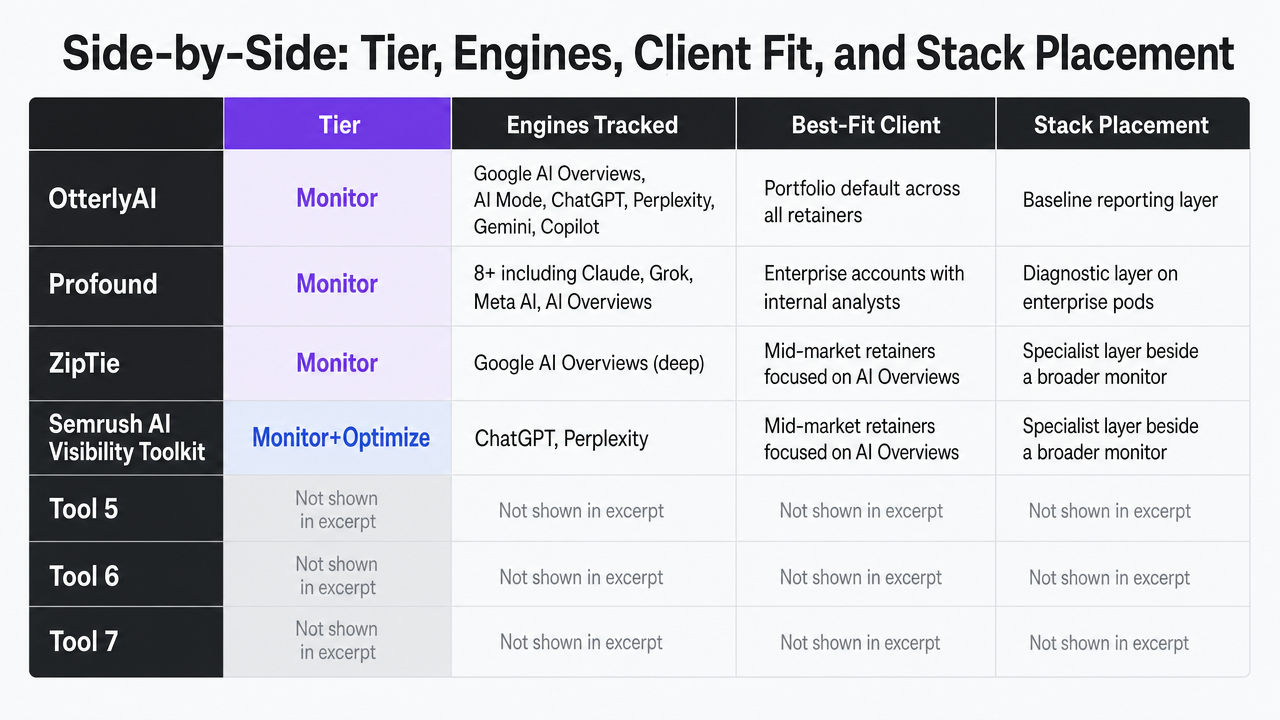
The seven tools can be clearly categorized by four key questions relevant to agency stack reviews: their tier, tracked engines, ideal client fit, and placement within the delivery workflow.
| Tool | Tier | Engines Tracked | Best-Fit Client | Stack Placement |
|---|---|---|---|---|
| OtterlyAI | Monitor | Google AI Overviews, AI Mode, ChatGPT, Perplexity, Gemini, Copilot 6 | Portfolio default across all retainers | Baseline reporting layer |
| Profound | Monitor | 8+ including Claude, Grok, Meta AI, AI Overviews 3 | Enterprise accounts with internal analysts | Diagnostic layer on enterprise pods |
| ZipTie | Monitor | Google AI Overviews (deep) 12 | Mid-market retainers focused on AI Overviews | Specialist layer beside a broader monitor |
| Semrush AI Visibility Toolkit | Monitor+Optimize | ChatGPT, Perplexity, Gemini, AI Overviews 9 | Existing Semrush shops | Extension of the incumbent suite |
| Ahrefs Brand Radar | Monitor+Optimize | Major AI engines, 286M+ monthly prompts 9 | Existing Ahrefs shops running benchmarks | Quarterly benchmarking layer 12 |
| SE Ranking + Rankability | Monitor+Optimize | Traditional SERPs, ChatGPT, AI Overviews, Perplexity 11 | Mid-market portfolios reporting on both surfaces | Unified rank plus AI tracking |
| Vectoron | Execute | Fed by upstream monitors | Retainers where citation gaps compound | Production layer after approval |
Analyzing the tier column reveals the structure of an effective stack: a primary monitor for portfolio-wide reporting, a specialist monitor for specific engines or client types, and an optimizer or execution layer to convert insights into deployed content 1.
What Visibility Tools Actually Reward in Content
All tools in this shortlist score citations, though not identically. The underlying pattern that recommendation engines converge on is E-E-A-T, specifically Trust. Google's Search Quality Evaluator Guidelines define Trust as "the most important member of the E-E-A-T family," characterized by content that is "accurate, honest, safe, and reliable" 8.
This is significant because optimizer-tier recommendations often focus on similar fixes: named-author attribution, primary-source citations, structured claims that AI engines can extract without hallucinating, and updated dates on evergreen pages. Both Semrush's AI Visibility Toolkit and Ahrefs Brand Radar highlight these gaps by comparing them against competitors already cited in AI Overviews 9. The signal is not about keyword addition, but about identifying missing trust markers that prevent AI engines from citing a page.
Strategists who view AI visibility recommendations as mere ranking tweaks will be less effective than those who treat them as trust audits.
If You Manage Multi-Location or Regulated-Vertical Clients
Agency portfolios serving law firms, behavioral health, dental groups, senior living, or multi-location home services have specific governance requirements that influence tool selection. For clients operating under HIPAA, state bar advertising rules, or franchise disclosure obligations, the monitoring layer becomes a component of compliance, not just reporting.
Omnia's 2026 review of AI search monitoring tools highlights Scrunch AI for its "security and governance with SOC 2 certification and features real-time bot crawling feeds" 4. This combination is more critical for agencies handling sensitive client data than for those serving DTC brands, as it ensures documented controls.
Multi-location considerations also act as a filter. The AI Clicks 2026 roundup categorizes tools for "multi-location brands" separately from enterprise optimization and single-brand tracking 1. Reporting citation share for a 40-location dental group requires a different data model than for a single flagship site. Consolidated monitors that generalize location-level performance will not adequately serve these accounts.
Practical filters for these clients include
- SOC 2 or equivalent governance documentation,
- location-level reporting, and
- a contract structure that withstands client legal review.
See How Top Agencies Optimize for AI Search Visibility at Scale
Request a walkthrough of workflow automation and brand intelligence systems proven to deliver consistent, high-quality search visibility improvements across multiple client portfolios—without increasing team headcount.
From Signal to Published Content: Where AI Visibility Data Belongs in the Brief
Most agency workflows currently treat AI visibility data as a reporting artifact, discussed in client reviews and then often forgotten. This misplaces it in the workflow. Citation gaps should inform content briefs, not merely be discussed after client meetings.
The operational shift involves feeding monitor output directly into brief creation. When a monitor identifies a client's absence from AI Overviews for a query cluster where competitors are cited, that gap becomes the brief's central focus: identifying the trust markers competitors possess and prescribing fixes to bridge the gap 1. Common solutions include named authors, primary-source links, structured data, and updated evidence dates.
Strategists who integrate visibility data into the brief stage can shorten the cycle from signal to published content by weeks per client. Those who keep it in the reporting stage will repeatedly audit the same issues without improving citation share.
Building the Stack: Standardize the Monitor, Layer the Rest
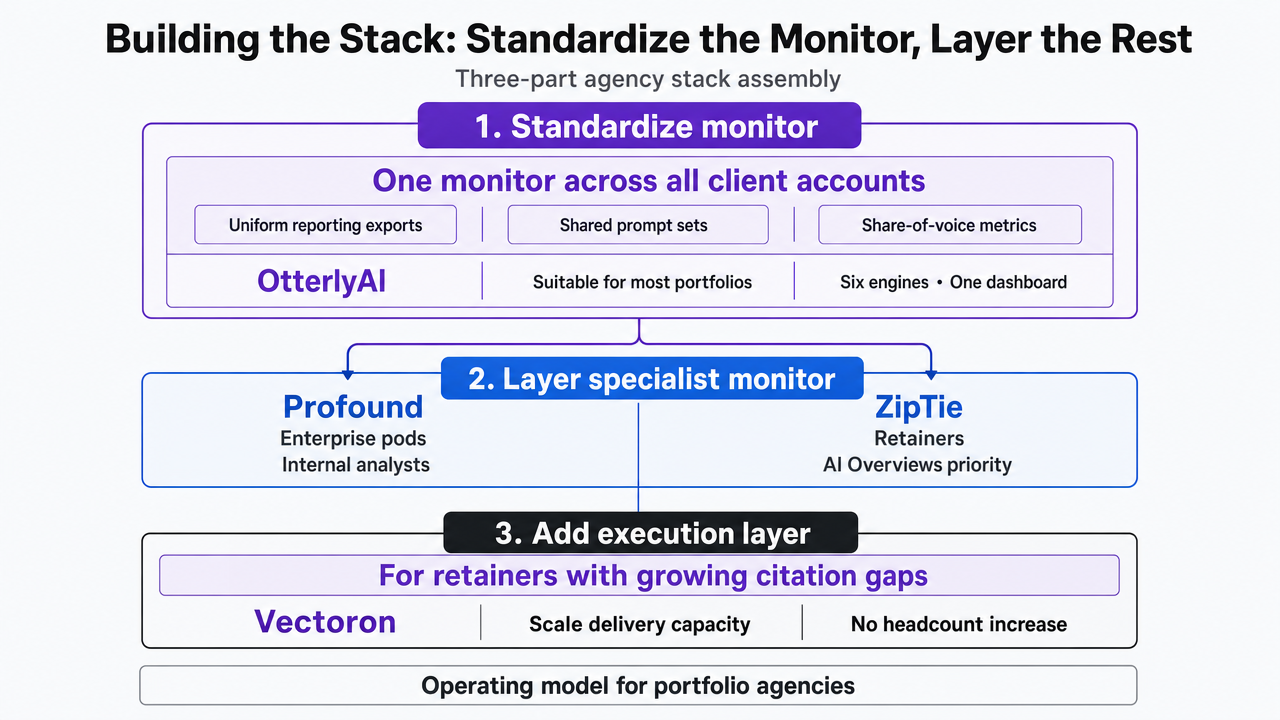
For a portfolio agency, the optimal solution is not a single tool but a three-part stack.
- Standardize a single monitor across all client accounts to ensure uniform reporting exports, prompt sets, and share-of-voice metrics. OtterlyAI is suitable for most portfolios, consolidating six engines into one dashboard 6.
- Layer a specialist monitor for accounts with specific needs: Profound for enterprise pods with internal analysts 12, or ZipTie for retainers where AI Overviews are paramount 5.
- Add an execution layer for retainers where citation gaps accumulate faster than strategists can brief. This is where Vectoron fits, enabling delivery capacity to scale without increasing headcount 1.
Frequently Asked Questions
References
- 1.14 Best AI Search Visibility Optimization Tools in 2026.
- 2.22 Best AI Search Rank Tracking & Visibility Tools for 2026.
- 3.Best AI Search Visibility Tools 2026 (Comparison Table).
- 4.AI Search Monitoring Tools 2026: The Best Platforms to Track AI Visibility.
- 5.Google AI Overviews: What's Changing for SEO & SEA in 2024/2025.
- 6.10 Best AI Visibility Tools in 2026 for Tracking Brand Presence Across AI Search Platforms.
- 7.The Future Of SEO Is Answer Engine Optimization.
- 8.Search Quality Evaluator Guidelines.
- 9.AI SEO Tools for 2026: 9 Picks by Use Case.
- 10.Top 10 AI Search Visibility Tracking Tools to Try in July 2026.
- 11.Best SEO Tools 2026: 12 Tested, 4 Track AI Search - TECHSY.
- 12.The 8 best AI visibility tools in 2026.