
Key Takeaways
- Answer engineering shapes pages so a model can lift a clean, self-contained response—an editorial discipline that tools like Clearscope, MarketMuse, and Frase support but cannot replace.
- Structured data QA is a governance job at portfolio scale: markup must match visible content and validate cleanly, or it hurts more than it helps 3.
- Retrieval simulation tests whether pages surface for the queries models actually generate internally, a step traditional SEO tools skip despite retrieval accuracy gains of up to 29% 12.
- Content production at velocity is now bottlenecked by editorial review, not draft cost, after a 285-fold drop in model query pricing between 2022 and 2024 7.
- AI-surface measurement proves the work moved something by tracking citation share across a fixed prompt set of 100 to 300 queries per client, trended monthly.
Why the AEO tool market is mostly noise for agencies that already do SEO well
The clearest measurement of what AI answers actually do to search behavior comes from Pew Research, whose 2025 browsing panel of U.S. desktop and mobile users found that AI summaries appeared in 18% of Google searches. When a summary was present, users clicked a traditional result in just 8% of visits, compared with 15% of visits where no summary appeared. Only 1% clicked a link inside the summary itself 2.
This represents a meaningful and growing share of the top of the funnel where organic used to reliably send traffic. For a Head of SEO running multiple accounts, ranking without being cited inside the AI answer is worth roughly half of what it used to be on queries most likely to trigger a summary.
The AEO tool market often misrepresents this shift. Vendors have packaged separate optimization stacks—schema generators, entity extractors, prompt-visibility trackers, AI-answer rank checkers—as if AI Overviews and AI Mode operated on a different infrastructure than Search. They do not. Google's own guidance is direct: pages must be indexed and eligible to show a snippet, and "there are no additional technical requirements" to appear in AI features 1. The May 2025 Search Central post reinforces this, adding that structured data should match visible content and be validated before deployment 3.
This guidance reframes roughly half the AEO tool category as feature-overlap with existing SEO work. The question is not what new stack to buy, but which two to four tools genuinely address the demands of answer-surface visibility, and which existing line items can be cut.
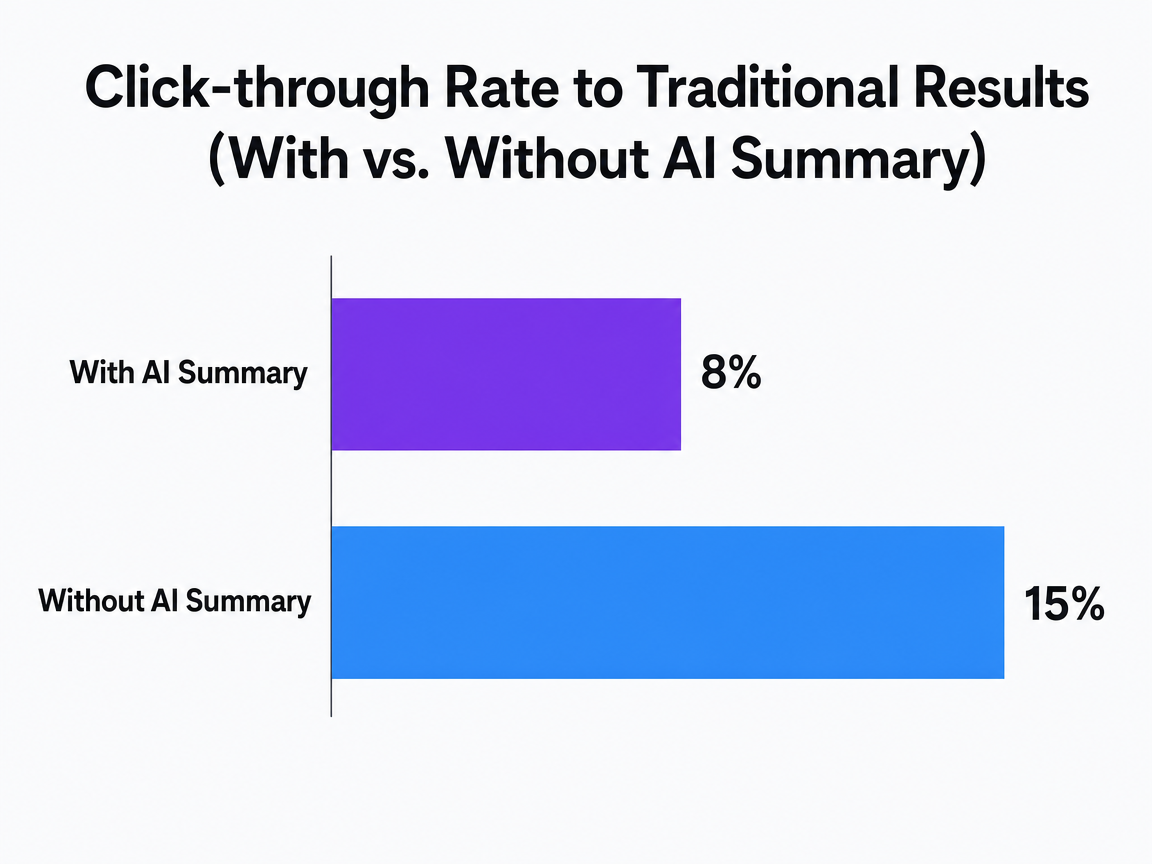 Click-through Rate to Traditional Results (With vs. Without AI Summary)
Pew Research found that when a Google AI summary was present, users clicked on a traditional search result link in 8% of visits, compared to 15% of visits where no summary appeared.
The five jobs an AEO workflow actually has to do
Stripped of vendor jargon, answer-engine optimization involves five distinct jobs. An agency must perform each of these well to be cited in AI answers.
The first is answer engineering: structuring the page so a model can extract a short, correct, self-contained response without needing to synthesize multiple paragraphs or guess at intent. This is an editorial task with a retrieval focus, not merely a schema exercise.
The second is structured data QA: ensuring that the markup on every published page accurately reflects the visible content and validates cleanly. Google explicitly states that mismatched or invalid structured data is detrimental 3. For agencies managing many accounts, this is a governance challenge, not a simple plugin solution.
The third is retrieval simulation, a category often overlooked. Modern AI answers are generated by systems that create their own queries, rewrite them, and perform multiple retrieval calls before composing a response 14, 15. If a page cannot be found by the queries the model actually generates, it will not be cited, regardless of its ranking for human-typed queries.
The fourth is content production at velocity. Deloitte Digital reports that content demand nearly doubled from 2023 to 2024, and teams leveraging automation saw a 29% greater revenue impact from content marketing 8. Achieving answer-ready coverage across a client portfolio is primarily a production challenge before it becomes an optimization one.
The fifth is AI-surface measurement: identifying which prompts, models, and query variations actually cite client pages, and connecting this data back to business outcomes. Without this measurement, the effectiveness of the other four jobs cannot be assessed.
Every valuable tool in an agency's stack should map to one of these five jobs. Any tool that doesn't is likely redundant.
Test AEO content workflows with real outputs
Evaluate AEO delivery speed and quality by publishing live content during your trial—no commitment required.
The shortlist, organized by job
Answer engineering: shaping pages so a model can lift a clean answer
Answer engineering is the editorial practice of crafting pages where the response to a probable prompt is clearly stated in one place, in plain language, without requiring the model to reconcile conflicting information. This is a content design task for editors and strategists who understand how questions are actually posed.
This category is largely integrated into broader platforms rather than offered as standalone products. Clearscope, MarketMuse, and Frase provide features like question-cluster mapping and passage-level guidance. These tools enable editors to structure page content around query variants a model is likely to issue. Frase excels in extracting questions from SERPs, MarketMuse focuses on topical coverage scoring, and Clearscope integrates closely with the editor's workflow. While not strictly AEO products, they contribute to answer engineering.
These tools do not, however, assess the correctness or completeness of the lifted answer, which remains a human editorial judgment. WARC data on marketer AI usage shows AI is primarily used for summarizing large texts (76%), competitor analysis (74%), and customer insights (60%) 19. This highlights that AI-assisted drafting is most effective for summarization and synthesis, fitting seamlessly into the existing content brief-to-publish workflow for answer engineering.
A limitation across this category is that no tool can compensate for a client site that buries answers under excessive introductory text. Effective answer engineering begins with strong editorial standards, such as a house rule for legal accounts requiring a self-contained response block above the fold on every page.
Structured data QA: markup that matches visible content, validated at scale
The structured data QA segment of the AEO tool market has been particularly aggressive and often redundant. Google's May 2025 guidance is clear: markup must match the visible content and validate cleanly before deployment 3. This simplifies the task to two questions: is the schema accurate, and does it validate? Both can be answered using free first-party tools like Google's Rich Results Test and Schema.org validator.
Paid tools prove their value at portfolio scale. Screaming Frog is effective for crawling large sites, such as 40-location home services businesses, and identifying schema errors across all URLs in a single pass. Schema App and Schema Pro integrate with CMS platforms to enforce templated markup, preventing errors when non-technical users edit pages. Sitebulb combines crawling with a validation layer, surfacing discrepancies between rendered content and declared schema—a critical issue Google warns against.
A common pitfall in this category is purchasing an "AI schema generator" that creates markup based on page content without human verification. If the generated JSON-LD does not accurately reflect the visible copy, it is worse than having no schema at all, according to Google's rules 3.
For a Head of SEO standardizing agency operations, the key consideration is not interface aesthetics, but which tool can run autonomously on a weekly schedule across all client accounts, pushing exceptions into a queue that an editor can resolve quickly. Structured data QA is fundamentally a governance function and should be treated as such.
Retrieval simulation: the tool category most listicles skip
This category distinguishes a serious AEO shortlist from a rehashed SEO one. Modern AI answer systems do not process a page like a human searcher. Instead, they generate and rewrite queries, perform multiple retrieval calls, and then synthesize an answer 15. If a page is not discoverable by the queries the model actually generates, it will not be cited, regardless of its ranking for human-typed queries.
Research underscores the importance of this. SEARCH-R1, a reinforcement-learning framework that trains models to autonomously generate multiple search queries during reasoning, improved answer performance by 26% on Qwen2.5-7B, 21% on Qwen2.5-3B, and 10% on LLaMA3.2-3B compared to strong baselines 14. Other studies on retriever-preference alignment demonstrate that query rewriting alone can significantly impact retrieval metrics on conversational search benchmarks 13. Retrieval-enhanced methods have boosted absolute retrieval accuracy by up to 29% 12.
The practical implication is that how the model searches is as crucial to citation as the page's content.
Tool coverage in this area is nascent. Profound, Peec AI, and Otterly.ai automate prompts across various LLMs (ChatGPT, Perplexity, Gemini, Claude) and log cited sources for different prompt variations. AthenaHQ and Scrunch AI expand into prompt-set generation, creating query variations a user might ask and testing citation coverage. Semrush and Ahrefs have integrated AI-visibility modules into their platforms, offering convenience at the expense of depth.
A current limitation of these tools is their inability to simulate the internal query rewriting processes models perform before retrieval. They test the output of a given prompt, not the underlying mechanism. This poses a challenge for a Head of SEO trying to understand why a page ranks well in traditional search but is never cited in an AI answer for the same topic.
This category warrants inclusion in the stack for agencies serving verticals where AI answers are prominent at the top of the funnel, such as legal informational queries, medical symptom searches, or home-services how-to content. Ignoring it means optimizing blindly for a critical surface.
Content production at velocity: where AI-native drafting pays for itself
The economics of content production have shifted significantly between late 2022 and late 2024, a change most agency pricing models have yet to reflect. Stanford HAI's 2025 index reports that business adoption of generative AI in at least one function surged from 33% in 2023 to 71% in 2024. Concurrently, the cost of querying a GPT-3.5-level model plummeted from $20 per million tokens in November 2022 to $0.07 per million tokens by October 2024 7. This represents a roughly 285-fold cost reduction during a period when adoption more than doubled.
For an agency Head of SEO, this means AI-native drafting is no longer the expensive component of the stack. Editorial review, subject-matter validation, and answer-engineering are. An agency that still budgets content production based on $300 per freelancer draft is misallocating resources.
Deloitte Digital reports that content demand nearly doubled from 2023 to 2024, following a 55% increase the prior year. Teams using automation achieved a 29% greater revenue impact from content marketing and were 24% more likely to meet demand 8. The velocity challenge is real. The key is selecting tools that solve it without generating undifferentiated drafts that Google's quality systems might deprioritize.
Jasper and Copy.ai serve as marketing-focused generalists. Writer caters to enterprises, offering stricter brand-voice controls essential for agencies managing diverse client tones. Vectoron offers a distinct approach: an approval-first workflow that combines specialist strategists for content, SEO, and related channels with a Command Center. This system routes every draft through human sign-off before publication, addressing the governance gaps often present with standalone drafting tools at agency scale.
A fundamental limitation across all tools in this category is that a fast draft based on a mediocre brief will still result in a mediocre page. Adobe's 2025 content trends report indicates that while two-thirds of organizations are testing or using generative AI for ideation and creation, only 14% have implemented solutions with proven ROI 17. The issue is not model quality, but the lack of robust editorial and strategic frameworks surrounding the drafting process.
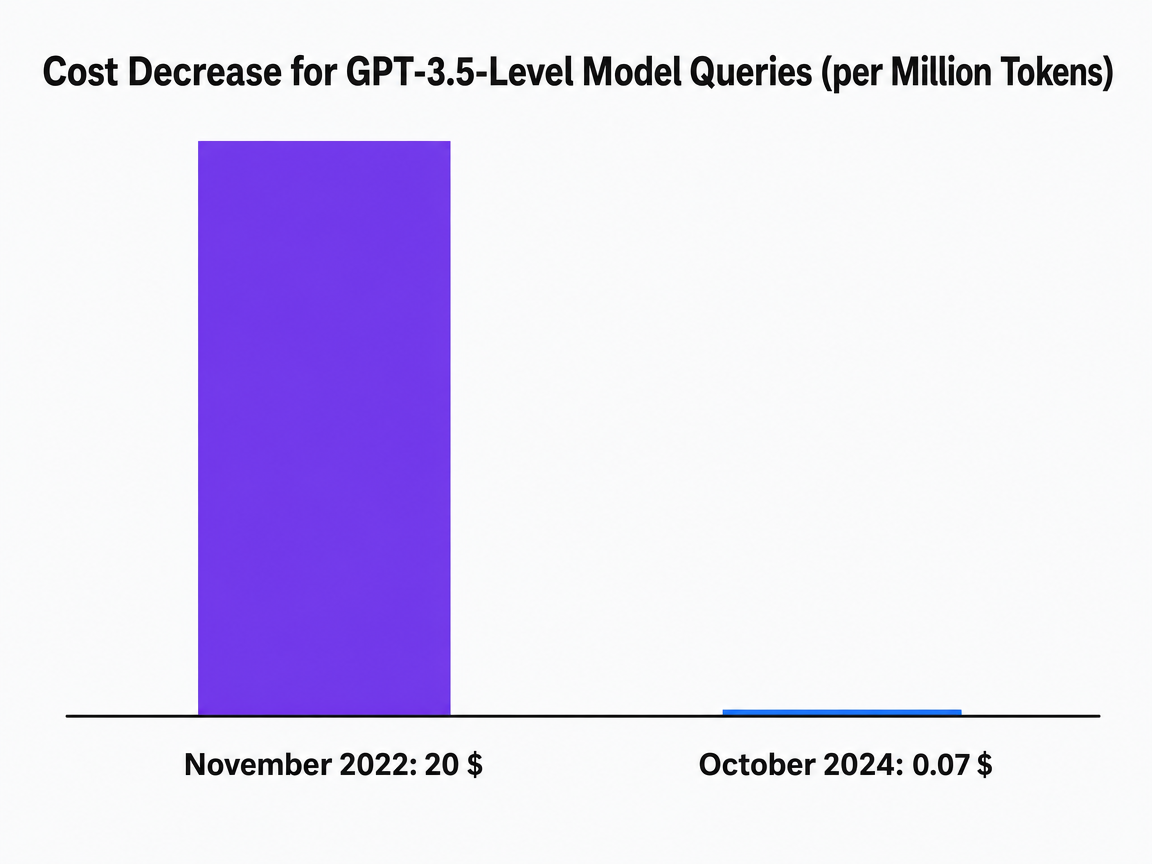 Cost Decrease for GPT-3.5-Level Model Queries (per Million Tokens)
The cost to query a GPT-3.5-level model dropped from $20 per million tokens in November 2022 to $0.07 per million tokens by October 2024.
AI-surface measurement: proving the work moved something
Measurement is often underfunded by agencies, yet it is crucial for securing continued budget for the other four jobs. If a Head of SEO cannot demonstrate to leadership that answer-engineering efforts increased citation share within AI answers, that budget line item becomes vulnerable during quarterly reviews.
Google Search Console now includes AI Mode traffic in standard performance reports 1, which partially addresses this need. However, it does not inform agencies which prompts triggered a citation, which competitor pages were cited alongside the client, or how citation share evolves week-over-week for a defined set of prompts.
Dedicated measurement tools often overlap with retrieval simulation, as the same tools that generate prompt sets and log responses also produce visibility metrics. Profound, Peec AI, AthenaHQ, and Otterly.ai fall into this category. Semrush's AI Toolkit and Ahrefs' Brand Radar integrate AI-answer tracking into existing rank-tracking dashboards, which is often sufficient for reporting to non-technical clients.
WARC's 2025 measurement research suggests that AI-driven measurement is most effective when combined with human evaluation for key assets, rather than being a complete replacement 18. This aligns with AEO reporting: the tool logs the citation, and the strategist assesses whether the citation is relevant to the correct query and points to the appropriate page.
A concrete standard for agencies is a monthly report showing citation share across a fixed prompt set of 100 to 300 queries per client, trended over time, with pipeline attribution where call tracking and CRM data allow. Without this, AEO work lacks tangible justification.
If you manage multiple locations or a client portfolio: the consolidation math
This section targets Heads of SEO managing portfolios—20 or more accounts, or a single client with 40+ locations—where tool licensing costs (per-seat, per-domain, or per-project) can quickly escalate. For an agency with three strategists, two editors, and a QA analyst serving a legal roster, most SaaS AEO tools charge for each user, for every account, every month.
The argument for consolidation is straightforward. The AEO tool market is often priced as if each of the five jobs requires a dedicated product. In reality, many tools offer overlapping capabilities, leading to agencies paying multiple times for the same function. McKinsey's 2025 survey found that 88% of organizations use AI in at least one function, but only 39% report an EBIT-level impact 16. The issue isn't the tools themselves, but the need for workflow redesign—a principle equally applicable at the agency level.
The table below illustrates how the five jobs map to typical stacked tools versus a consolidated approach. Prices are represented as variables due to fluctuating list prices and per-seat costs based on team size.
| Job to be done | Typical point tools stacked today | Consolidated approach |
|---|---|---|
| Answer engineering | Clearscope + Frase + MarketMuse (N seats × list price) | One editorial platform with question-cluster mapping built in |
| Structured data QA | Screaming Frog + Schema App + Sitebulb (per-domain fees) | Weekly automated crawl piped into one exceptions queue |
| Retrieval simulation | Profound + AthenaHQ + Semrush AI module (per-prompt-set fees) | One prompt-set platform covering ChatGPT, Perplexity, Gemini, Claude |
| Content production at velocity | Jasper + Writer + freelancer network (per-seat + per-word) | Approval-first workflow platform, e.g. Vectoron at $599/mo post-trial |
| AI-surface measurement | Peec AI + Otterly.ai + Brand Radar (per-client-report fees) | Shared dashboard fed by the retrieval-simulation layer |
Two key observations for a Head of SEO reviewing renewal lists: First, retrieval-simulation and measurement often converge into a single vendor if chosen carefully, as these tools are often developed by similar companies. Second, content production typically represents the largest recurring expenditure, as freelancer and seat costs scale linearly with client count, unlike an approval-first platform.
Compare the Top AEO Tools for Scalable Multi-Client Delivery
Request a tailored walkthrough of unified AEO solutions that streamline search optimization, automate implementation, and maintain quality control across all client accounts—without expanding your specialist headcount.
How to pick two to four tools and defend the choice to your COO
A COO requires more than a features grid; they want to understand why an agency is renewing multiple contracts instead of fewer, and what incremental spend delivers in terms of delivery margin or client retention.
The selection method should be concise. Begin with the five core jobs: answer engineering, structured data QA, retrieval simulation, content production, and AI-surface measurement. Assign each current tool to exactly one primary job. Any tool that cannot claim a single primary function is a candidate for cancellation. Any job with three competing tools indicates overspending.
From this refined list, two filters further narrow the selection to what leadership will approve. First, does the tool produce an artifact that appears in the monthly client report—such as a citation-share metric, a schema exceptions log, a validated draft, or a prompt-set trend? If not, the agency is paying for a dashboard that goes unread. Second, does the tool scale sub-linearly with account count? Per-domain and per-seat pricing that increases with every new client erodes margins. McKinsey's 2025 survey highlights this: 88% of organizations use AI, but only 39% see EBIT-level impact because adoption without workflow redesign fails to compound benefits 16.
The target of two to four tools aligns with the jobs that cannot be easily combined. Retrieval simulation and measurement often consolidate into one vendor. Answer engineering and content production frequently combine into a second. Structured data QA typically stands alone as a governance tool. This results in three tools, occasionally four if a vertical demands a dedicated reporting layer for measurement.
The defense to the COO becomes clear when framed this way: each tool owns a distinct job, each job produces a measurable artifact, and the total seat count does not increase with client growth. Anything else becomes a discussion about features, not margins.
Operationalizing the stack across a pod without adding headcount
Tool selection is the simpler part. The greater challenge is operating the stack across a team of strategists, editors, and QA analysts without each new client onboarding becoming a lengthy integration project.
Mailchimp and WARC research on skills gaps is relevant here: 98% of mid-market marketers believe AI will enhance marketing effectiveness, yet only about a third use it widely. The top three barriers are lack of expertise, integration challenges, and data privacy concerns 20. Within an agency, this mirrors the issues that arise when a new AEO tool is introduced without adequate training or integration time.
Three operational rules ensure the stack remains usable. First, one person should own each of the five jobs across all accounts in the pod, rather than one person per tool. If the retrieval-simulation role rotates weekly, no one develops the pattern recognition needed to diagnose why a legal client's practice-area pages are cited for symptom-style queries but not procedural ones. Second, all tool outputs must converge into a single weekly review artifact—one document, five sections, with each client on a separate row. If schema QA logs are in Sitebulb and citation-share numbers in Peec AI, and no one synthesizes them, the team is running multiple tools but delivering reports late.
Third, onboarding a new client to the stack should take under four hours, not four days. This requires templated prompt sets, standardized schema audits, and a consistent editorial standard for answer blocks that is not renegotiated for each account.
Agencies that adhere to these three rules can manage 20-plus accounts with the same headcount that previously handled 12. Those that don't will find themselves hiring additional strategists with every new vertical, creating the very margin problem that tool consolidation was intended to solve.
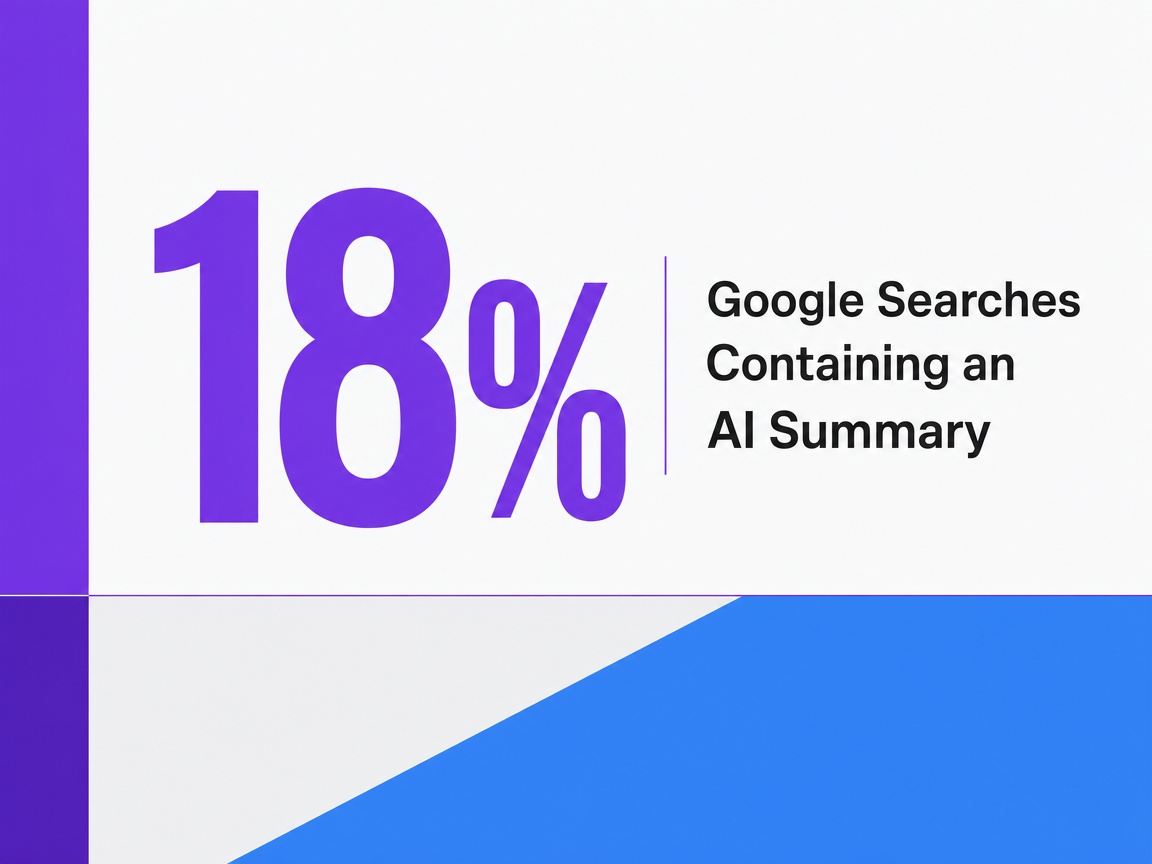 Google Searches Containing an AI Summary
Google Searches Containing an AI Summary
Frequently Asked Questions
References
- 1.AI Features and Your Website | Google Search Central.
- 2.Do people click on links in Google AI summaries?.
- 3.Top ways to ensure your content performs well in Google's AI features.
- 4.Web Content Accessibility Guidelines (WCAG) 2.2.
- 5.W3C WCAG 2.2 Now Available.
- 6.The 2025 AI Index Report | Stanford HAI.
- 7.AI Index 2025: State of AI in 10 Charts.
- 8.Marketing content automation.
- 9.IAB State of Data 2025: The Now, The Near, and The Next Evolution of AI for Media Campaigns.
- 10.The Impact of AI on Digital Advertising Report 2025.
- 11.Web Content Accessibility Guidelines (WCAG) 2.2 is a W3C Recommendation.
- 12.LLMs with Reinforcement Learning-Enhanced Retrieval.
- 13.Aligning Large Language Models with Retriever's Preference in Conversational Search.
- 14.SEARCH-R1.
- 15.Analyzing Search-Augmented Large Language Models.
- 16.The State of AI: Global Survey 2025.
- 17.2025 AI and Digital Trends in Content Creation and Management.
- 18.The Future of Measurement 2025: experiments, price, and AI on the rise.
- 19.The Voice of the Marketer - WARC.
- 20.Intuit Mailchimp and WARC Examine the AI Skills Gap Among Mid-Market Marketers.
- 21.The Impact of AI on Digital Advertising Report 2025.