
Key Takeaways
- AI answer engines broke the agency measurement stack because rank trackers cannot see inside generated summaries, and click curves collapse when those summaries appear on informational queries 1.
- An AI visibility stack has four distinct jobs: citation measurement, prompt monitoring, content structure optimization, and portfolio execution, and few tools do more than one or two well.
- Citation measurement records which sources each engine names per prompt, and only becomes trustworthy when it reports sampled distributions with confidence intervals rather than a single percentage 10.
- Prompt and query monitoring replaces keyword tracking because a single offering now attracts dozens of conversational variants across ChatGPT, Perplexity, and Google AI Overviews 11.
- Content structure optimization targets the document-level features that drive citation, including topic relevance, numeric mentions, recency, and list position, which moved retrieval Hit Rate by 22% 9, 6.
- Portfolio execution is where most stacks stall, since measurement produces findings faster than briefs, reviews, and deploys can ship approved edits across a 40-account book.
- Agency portfolio math turns on hours per client per job, not headcount, so tool selection should be judged by how much it lowers H per cycle.
- Current tools cannot stabilize run-to-run citation variance, cannot overcome the earned-media bias in AI source selection, and cannot resolve open governance questions around disclosure 10, 4, 12.
- A 30-day rollout sequences the four jobs deliberately: seed prompts and baselines, audit pages against citation drivers, ship prioritized edits, then re-sample the same distributions.
Why AI Answer Engines Broke the Agency Measurement Stack
Rank tracking used to tell most of the story. A page held position three for a commercial query, the click curve did the rest, and the monthly report wrote itself. That story now has a large blank space at the top of the search result, and rank trackers cannot see into it.
Pew Research studied the browsing behavior of 900 U.S. adults and found that 18% of Google searches in March 2025 returned an AI-generated summary. When one of those summaries appeared, the share of searches that ended with a click on a standard result fell from 15% to 8% 1. Google has publicly disputed the study's methodology and sample, so it should be read as one strong independent signal rather than a settled market number. Even taken conservatively, it describes a click pattern that no keyword-position tool captures.
The scope problem is wider than one dataset. A Reuters Institute survey across six countries reported that 54% of respondents had seen an AI-generated answer to a search in the previous week 11. Client-side executives are seeing the same interface their customers see, and they are asking their agency why the brand is not inside it.
For an SEO director running 10 to 75 accounts, three things break at once:
- Reporting loses fidelity because impressions and average position no longer explain traffic changes on informational queries.
- Diagnosis loses precision because a page can rank well and still be omitted from the summary that captured the session.
- Prioritization loses its anchor because the levers that move blue-link rank are not the same levers that move citation inside a generated answer.
The rest of this piece treats those three failures as a tooling problem with four distinct jobs to staff.
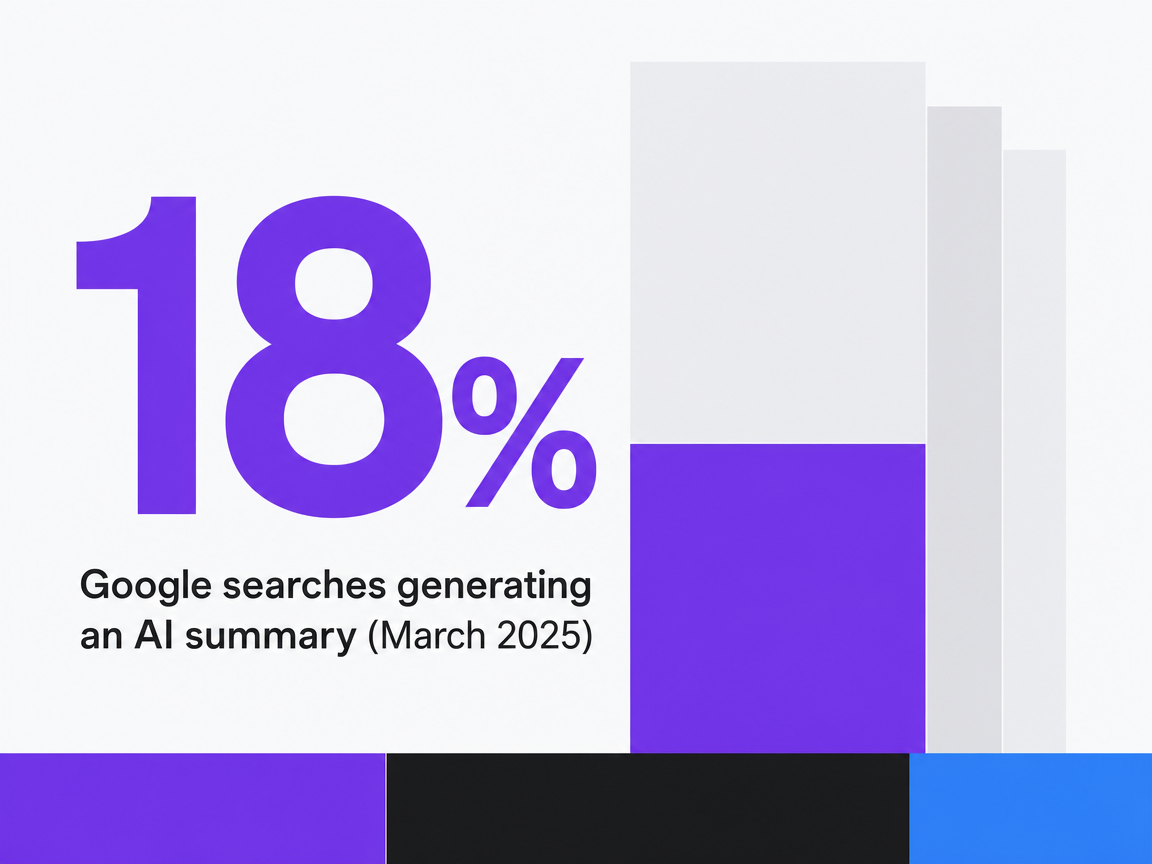 Google searches generating an AI summary (March 2025)
Google searches generating an AI summary (March 2025)
The Four Jobs an AI-Visibility Stack Has to Do
Treating AI visibility as one product category is where most agency stacks go wrong. It is four separate jobs, and the tools that do one well rarely do the others well.
Citation measurement : Answers a narrow question: for a defined set of prompts, which sources does each model actually cite, and where does the client sit in that set? This is a sampling job. Citation results vary across model runs, which means any single-shot check is a snapshot, not a score 10.
Prompt and query monitoring : The AI-era equivalent of keyword tracking, but the unit of observation is the question, not the phrase. It watches how prompts evolve across ChatGPT, Perplexity, and Google AI Overviews, and it flags when a client's brand appears, drops, or gets replaced by a competitor.
Content structure optimization : The engineering job. It reshapes pages so retrieval systems can find the right chunk and answer engines can quote it cleanly. Structural changes at the document level, not just the paragraph level, moved retrieval Hit Rate by 22% in one benchmark study 9.
Portfolio execution : Where findings become shipped edits across 10 to 75 clients without a hiring cycle. It is the job most stacks under-invest in, and the one that decides whether the other three produce revenue.
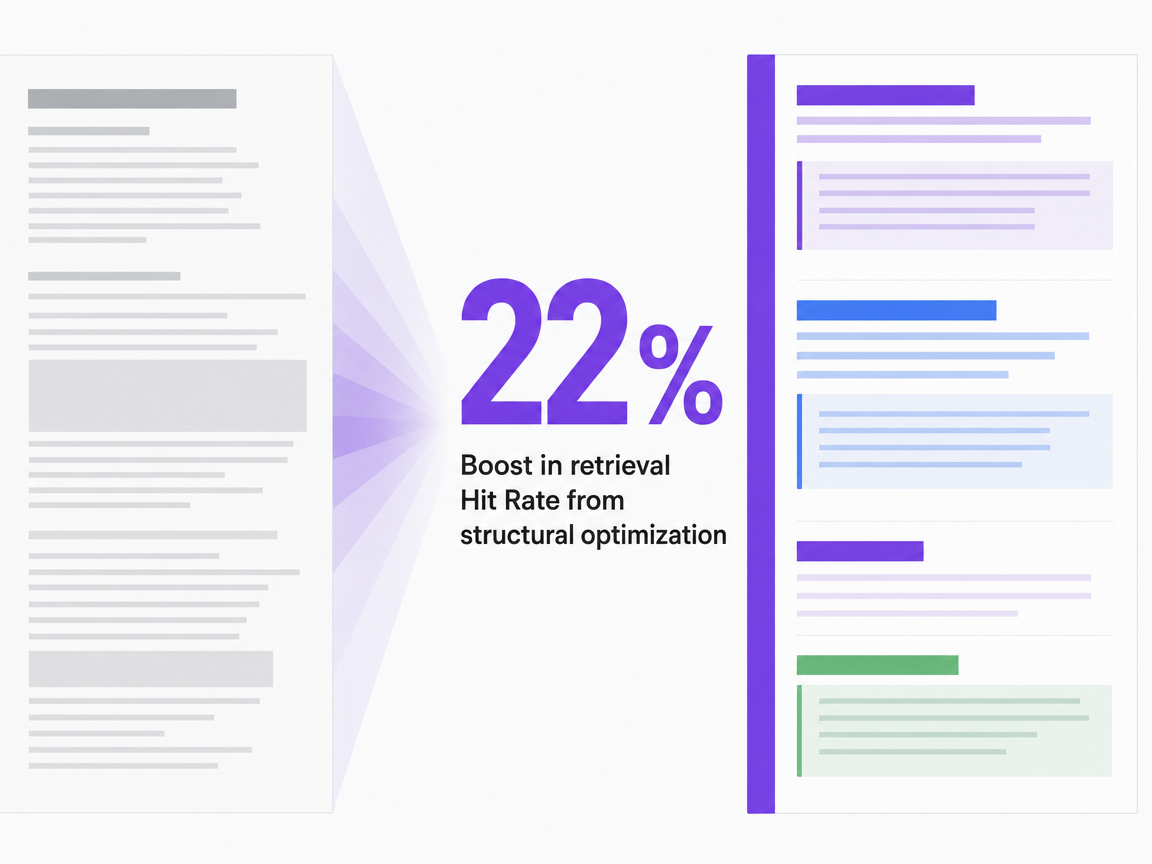 Boost in retrieval Hit Rate from structural optimization
Boost in retrieval Hit Rate from structural optimization
Citation Measurement: Knowing Which Prompts Surface Which Sources
What This Category of Tool Actually Measures
Citation measurement tools answer one operational question: for a defined set of prompts, which URLs does each AI answer engine name as a source, and where does the client sit in that list? The output is not a rank number. It is a citation frequency across sampled runs, usually broken down by model, prompt cluster, and competing domain.
That output has become a P&L conversation, not a curiosity metric. Seer Interactive's large-scale analysis, summarized by Search Engine Land, found that organic click-through rate on informational queries where AI Overviews appear dropped 61% since mid-2024, and paid CTR on those same queries dropped 68% 3. The study covers informational intent specifically, so commercial and transactional queries behave differently, but the direction is clear enough that any client with a content-driven acquisition model needs a citation view of the pages that used to carry the traffic.
A well-scoped citation tool records four things per prompt:
- Which models were queried
- The raw generated answer
- The ordered list of cited sources
- The position of the client and each named competitor inside that list
Without those four fields captured on a repeating schedule, an agency cannot separate a real drop in AI visibility from run-to-run noise.
Selection Criteria: Prompt Coverage, Model Coverage, and Sampling Depth
Three variables separate a serious citation-measurement tool from a dashboard skin over a single API call.
Prompt coverage. The unit of measurement is the prompt, not the keyword. A single commercial keyword can map to a dozen buyer-stage prompts, each producing a different citation set. An agency evaluating a tool should ask how prompt lists are built, whether they can be seeded from Search Console query data, and whether the tool supports client-specific prompt libraries per vertical. A behavioral health client and a home services client will not share prompt patterns.
ND research on citation drivers found that 11 of 18 tested content features were statistically significant in four or more of the six LLMs studied across 252,000 trials 6. Different models weight features differently, which means prompts have to be tested against each engine, not one proxy.
Model coverage. At minimum, a stack needs Google AI Overviews, ChatGPT with web browsing, Perplexity, and one Claude-based interface. Tools that scrape only AI Overviews miss the assistants where users increasingly start research sessions.
Sampling depth. A citation captured once is an anecdote. A tool that queries each prompt 20 or 50 times per cycle produces a distribution, which is what the next section requires.
Why Any Citation Score Needs a Confidence Interval
Generative answers are stochastic. The same prompt sent to the same model on the same day can return different citation sets, and any tool that reports AI visibility as a single stable percentage is hiding that variance from the client report.
Recent work treating AI visibility as a statistical estimation problem argues that citation visibility metrics are sample estimators of an underlying response distribution rather than fixed values 10. Practically, that means an agency running one query per prompt per week is measuring noise as often as signal. The fix is not exotic. It is repeated sampling per prompt, per model, per reporting window, and reporting the mean with a confidence interval rather than a lone number.
For client reporting, this reshapes the conversation. Instead of "the client is cited 32% of the time," the honest version reads "cited in 28 to 36% of sampled runs at 95% confidence, across 40 prompts and four models." Tools that cannot produce that framing should not be trusted to inform pricing decisions or retainer scope.
Test LLM visibility workflows with real content
Evaluate LLM-driven SEO execution using live client data and publishable outputs during your trial period.
Prompt and Query Monitoring: Watching the Questions Clients Actually Get Answered On
From Keyword Tracking to Prompt Tracking
Keyword tracking assumed one query mapped to one intent and one ranked list. Prompt tracking accepts that a single client offering now attracts dozens of conversational variants, each answered by a different generative engine with its own citation logic. The unit of observation shifts from "personal injury lawyer near me" to the actual questions users type into ChatGPT and Perplexity when they are two prompts deep into a research session.
The volume behind that shift is real. A Reuters Institute survey across six countries reported that 54% of respondents had seen an AI-generated answer to a search in the previous week, and 67% believed search engines use generative AI "always or often" 11. Client questions no longer stop at the SERP. They continue inside an assistant, and each follow-up is a fresh prompt the agency has never seen inside Search Console.
A prompt tracking tool logs the question, the model, the answer text, the sources cited, and the position of the client in that list. Agencies running this discipline start every account with a seeded prompt library built from GSC queries, sales-team question logs, and competitor content gaps, then expand it monthly as new variants surface.
Brand Mention Monitoring Across ChatGPT, Perplexity, and Google AI Overviews
Brand mention monitoring inside AI answers is a different job than citation tracking, even though the two are often bundled. Citation tracking asks whether the client's URL is in the source list. Brand mention monitoring asks whether the client's name appears inside the generated answer text, cited or not, and in what context.
Those two signals move independently. A client can be quoted by name in an AI Overview response about a service category and still not be linked in the source chips beneath it. A competitor can be cited as a source and never mentioned by name in the visible answer. For a director defending retainer scope, both signals need to be on the same dashboard because they represent different failure modes: one is a discoverability problem, the other is an authority problem.
The 252,000-trial analysis of citation drivers across six LLMs found that 11 of 18 tested content features were statistically significant in four or more models, and that topic relevance, price mention, recency, and list position drove first citations most strongly 6. Different engines weight those features differently, which is why a serious monitoring tool has to sample each surface separately: Google AI Overviews, ChatGPT with browsing, Perplexity, and a Claude-based interface. A tool that reports one blended "AI visibility" score across engines is averaging away the signal that tells an SEO team where to intervene next.
Content Structure Optimization: Making Pages Easier to Retrieve and Quote
Structural Levers That Move Retrieval, Not Just Ranking
Content structure optimizers are the engineering layer of the stack. They evaluate a page against the features that predict whether an answer engine will retrieve the right chunk and quote it cleanly, then propose edits at the document level, not just the sentence level.
The evidence base for this category is unusually specific. A 252,000-trial study across six large language models identified the content features that drive first citation, and the ranked drivers are actionable: topic relevance to the prompt, explicit price or numeric mention, recency signals, and list position within the source pool. Eleven of the 18 tested features were statistically significant in four or more of the six models 6. That means a structural optimizer should score a page on those features individually, not blend them into a composite grade.
Structure at the document level matters as much as the prose inside it. A benchmark study on generative search retrieval reported a 22% boost in Hit Rate when documents were optimized for structural signals rather than body copy alone 9. The earlier GEO paper measured up to a 40% visibility gain when pages added citations, quotations, and statistics to the body 5. A serious tool in this category surfaces both: it recommends structural edits, and it flags where a claim needs a supporting statistic or attributed quote to become quotable by the model.
Earned-Media Weighting and Why PR Tools Now Belong in the SEO Stack
Answer engines do not treat all sources equally. A controlled comparative analysis of AI search versus traditional web search found a systematic bias toward earned media over brand-owned pages and social content when engines select which sources to cite 4. A well-optimized product page can lose the citation slot to a third-party review, a trade publication, or an industry roundup covering the same topic.
That finding changes what belongs inside an agency's optimization stack. Digital PR tools, unlinked-mention monitors, and journalist-outreach platforms are no longer adjacent to SEO delivery. They feed the same citation outcome that content structure tools try to improve. If a client's owned pages are structurally sharp but the surrounding earned-media footprint is thin, structural edits alone will not close the gap against a competitor with stronger third-party coverage.
For an SEO director, the practical response is a two-track content plan per client: on-domain structural edits handled by the optimization tool, and an earned-media pipeline handled by a PR or link-building workflow. Both tracks feed the same measurement layer described earlier, so citation gains can be attributed to the correct lever rather than credited to whichever team ships last.
Portfolio Execution: Turning Findings into Shipped Edits Across a Client Book
The Bottleneck is Not Analysis, It Is Approved Changes
Most agency stacks over-invest in the first three jobs and stall on the fourth. Citation dashboards fill up. Prompt libraries expand. Structural audits generate long lists of page-level edits. Then the work sits in a queue behind briefs, client reviews, staging deploys, and legal sign-off, and the citation gap that measurement identified in week one is still open in week six.
The scale of that queue is not abstract. An SEO director running 40 accounts, each with 30 to 50 pages that need structural edits keyed to the citation drivers identified in the 252,000-trial study 6, is looking at 1,200 to 2,000 pending edits per cycle. Traditional agency delivery routes each of those through a strategist, writer, editor, and account manager. The measurement layer produces findings faster than the production layer can ship them.
Portfolio execution tools compress that queue by pre-drafting edits from the audit findings, routing them through a single approval interface, and publishing the approved version to the CMS. The lever is not headcount. It is the number of decisions a human still has to make per shipped edit, and where those decisions sit in the workflow.
Where Vectoron Fits: Approval-First Automation Across Content, SEO, and Backlinks
Vectoron sits in the execution layer as an approval-first workflow across content, SEO, and backlinks. Specialist strategists read live account signals, rank the edits most likely to move citation or ranking outcomes, and draft the change. Nothing ships until a human approves it, and each recommendation carries the reasoning that produced it, so an SEO director can accept, reject, or amend without rebuilding the analysis.
The design fits the portfolio math. Instead of routing every structural edit through a full brief-write-edit cycle, the platform prepares the edit in a state that a reviewer can approve in minutes. Findings from the citation and structure layers described earlier flow into that queue directly. The output is a governed loop: measurement identifies the gap, the execution layer drafts the fix, the director approves, and the change ships to the CMS. Position papers on GEO have flagged transparency and disclosure as open concerns in AI-influenced visibility work 12, which is one reason approval remains attached to every action rather than delegated to a background job.
See How Top Agencies Monitor and Optimize LLM Visibility at Scale
Request a walkthrough of AI-powered workflows for tracking, benchmarking, and improving client LLM visibility—purpose-built to streamline multi-site SEO reporting and accelerate execution, without scaling overhead.
Agency Portfolio Math: Where Tool Selection Compresses Hours Per Client
Scope note: this section is for directors running a client book, not single-brand in-house teams. The math changes when the same workflow has to run 10 to 75 times a month.
The agency lever is not headcount. It is hours per client per month, per job. Tool selection compresses those hours; it does not reduce the number of clients that need the work done. Every job identified earlier has its own hour profile, and the multiplier effect is what decides whether AI-visibility work is a margin sink or a scalable line item.
| Job to be done | Manual hours per client per month | Frequency | Portfolio load |
|---|---|---|---|
| Citation measurement | H₁ | Weekly | H₁ × N × 4 |
| Prompt monitoring | H₂ | Weekly | H₂ × N × 4 |
| Structural optimization | H₃ | Monthly | H₃ × N |
| Portfolio execution | H₄ | Continuous | H₄ × edits shipped |
Two variables move under a director's control. The first is H, the manual hours each job takes per client. Tools compress H by automating sampling, scoring, and drafting. The second is the ratio between H₁ through H₃ and H₄. Measurement hours produce findings; execution hours produce shipped edits. When the ratio tilts too far toward measurement, dashboards fill and the citation gap identified by the 252,000-trial drivers stays open 6.
N, the client count, is not a lever the director should try to shrink. Scaling comes from cutting H, not clients. That is the math test to apply to any tool under evaluation: does it lower H for a defined job, and by how much, per client, per cycle.
What These Tools Cannot Do Yet
Every category described so far has real limits, and any director building a stack should price those limits into the client conversation before the tool does it for them.
- Citation results are not stable across runs. Recent work treating AI visibility as a statistical estimation problem shows that citation metrics behave as sample estimators of an underlying response distribution, not fixed values 10. A tool that reports a single weekly citation percentage without a confidence interval is presenting noise as precision. That gap widens on low-volume prompts, where a handful of runs can swing the reported share by double digits.
- Owned-page optimization has a ceiling. The controlled comparative analysis of AI search found a systematic bias toward earned media over brand-owned and social content when engines select sources 4. A structural optimizer can score a client's page against citation drivers and still lose the slot to a trade publication covering the same topic. No on-domain tool closes that gap alone.
- Governance is unresolved. The GEO position paper flags concentrated influence and undisclosed commercial influence as open risks in AI-visibility work 12. Directors should assume disclosure standards will tighten and keep an audit trail of every automated edit shipped on a client's behalf.
A 30-Day Rollout for an Agency SEO Director
A four-job stack does not need a four-quarter deployment. A director running 10 to 75 accounts can stand up a working AI-visibility discipline in 30 days if the sequence respects what depends on what.
- Week 1: seed the measurement layer. Pick five accounts that already generate the most informational traffic. For each, build a prompt library of 30 to 50 questions from Search Console queries, sales-team question logs, and the top competing sources named in current AI Overviews. Run each prompt 20 times per model across at least three engines to establish a baseline citation distribution rather than a single score 10.
- Week 2: score the pages behind those prompts. Run every URL currently ranking or being cited through a structural audit keyed to the ranked drivers from the 252,000-trial study: topic relevance, explicit numeric or price mentions, recency, and list position within source pools 6. Flag pages missing supporting statistics or attributed quotes.
- Week 3: ship the first wave of edits through the execution layer, prioritizing pages where the citation gap and the structural gap overlap. Approve in batches, not one-by-one.
- Week 4: re-sample. Same prompts, same models, same run count. Compare distributions, not point estimates. Then expand the pattern to the next five accounts.
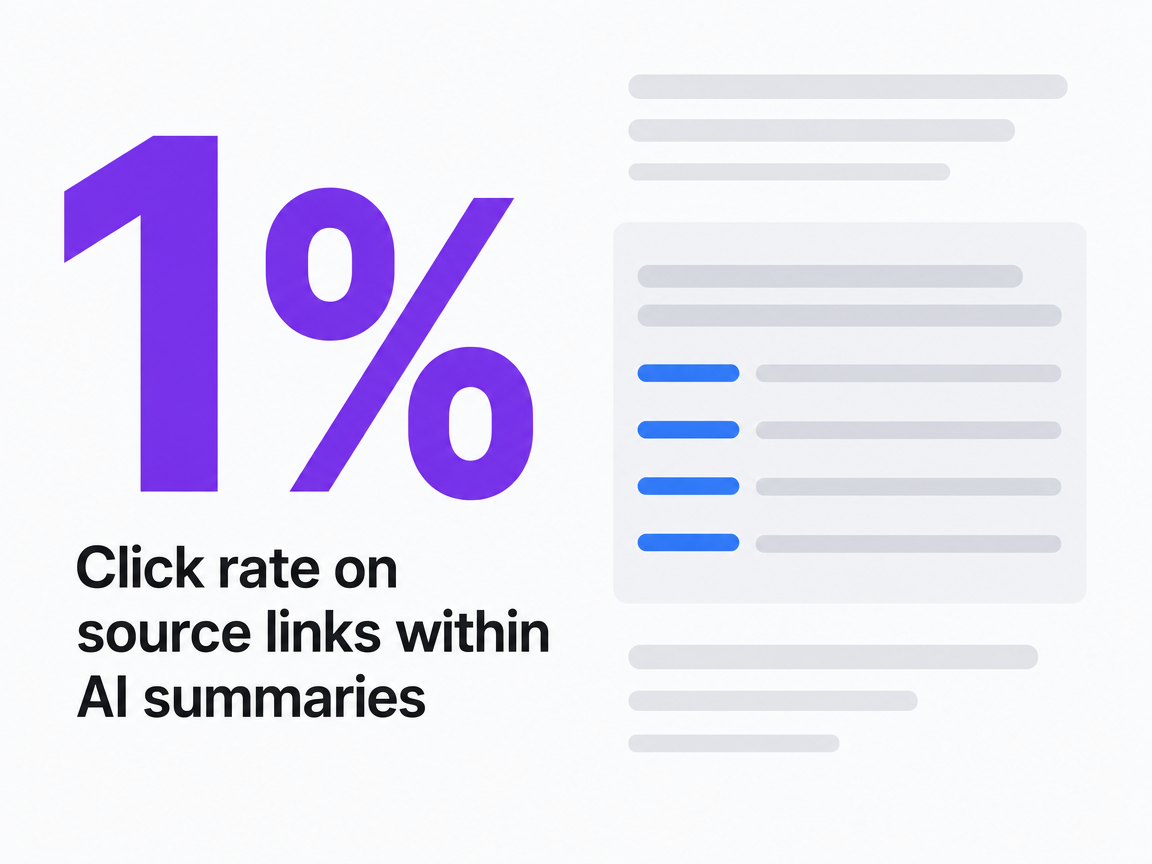 Click rate on source links within AI summaries
Click rate on source links within AI summaries
Frequently Asked Questions
References
- 1.Do people click on links in Google AI summaries?.
- 2.By Athena Chapekis, Anna Lieb, Sono Shah and Aaron Smith.
- 3.Google AI Overviews drive 61% drop in organic CTR, 68% ....
- 4.Generative Engine Optimization: How to Dominate AI Search.
- 5.GEO: Generative Engine Optimization.
- 6.What Gets Cited: Competitive GEO in AI Answer Engines.
- 7.Generative Engine Optimization at Scale: Measuring Brand ....
- 8.Feature-Level Multi-Objective Optimization for Generative ....
- 9.SAGEO Arena: A Realistic Environment for Evaluating ....
- 10.Quantifying Uncertainty in AI Visibility: A Statistical Framework for Generative Search Measurement.
- 11.Generative AI and News Report 2025 - Reuters Institute.
- 12.Position: Generative Engine Optimization ....