
Key Takeaways
- TubeBuddy works best as a metadata assembly line for descriptions, chapters, and end screens across many channels, though its tag scoring reflects an outdated ranking model 1.
- VidIQ earns its place through outlier detection that flags competitor videos beating their channel baseline, revealing topic-format pairs the recommender is currently rewarding.
- Ahrefs and Semrush video modules add value upstream by surfacing question-format queries with weak existing video coverage, especially for how-to and educational verticals 8.
- Thumbnail testing tools like Spotter Studio, Tubular, and ThumbnailTest turn CTR into an experiment, but must be reconciled with post-click retention to avoid misleading wins 1.
- Native YouTube Studio remains the only true source for retention curves because its data comes from the same telemetry the recommender uses, though it offers no portfolio view 1.
- 1of10 and Rivals act as topic radar for narrow verticals like senior living or behavioral health, where broader outlier tools lack sufficient dataset coverage.
- Vectoron functions as an approval-first coordination layer above point tools, routing titles, thumbnails, descriptions, and retention edits through a single human-reviewed queue for portfolio operators.
Why the 2026 tool stack has to serve watch time, not tag fields
YouTube's recommender is a deep neural network that weighs personal signals, video performance, and external context together, with weights that shift over time 1. This means a YouTube SEO tool must focus on moving click-through rate, average view duration, and quality watch time on individual videos across a portfolio.
Empirical work on creator SEO practices confirms this shift. A graduate thesis found that title construction, keyword placement, well-crafted descriptions, and timestamps are key levers for views and engagement, with tag placement being one input among several, not the dominant one 3. While institutional guides still detail tags, hashtags, and channel descriptions, these fundamentals now operate within the algorithmic reality described above 2.
For agency SEO leads, this translates into a stack selection problem focused on current algorithmic realities. A tool that automates tag generation across 40 client channels addresses an outdated ranking model. A tool that surfaces retention drop-off points, tests thumbnail variants against CTR, or flags topic gaps based on actual watch-time performance aligns with YouTube's current algorithm. This analysis evaluates tools against this distinction.
The four scaling levers that separate useful tools from noise
Topic and format selection at portfolio scale
Topic selection is a common failure point for agency YouTube programs. Pew's analysis of popular channels revealed that successful uploads often cluster into specific formats like entertainment, how-to instruction, and commentary, and top channels publish frequently 7. This suggests that format concentration and consistent cadence are more important than novelty for portfolio operators.
For legal or dental portfolios, this means developing a repeatable menu of educational explainers, procedure walkthroughs, and case-commentary formats. A single strategist can then plan these across 20 or 30 channels without reinventing the structure weekly. Effective tools for this lever surface topic gaps against watch-time performance, cluster subjects by vertical, and allow strategists to assign format templates to clients rather than briefing each video individually.
Keyword-only research tools often miss this nuance. The critical question isn't just about search volume for phrases, but which format-topic pairs have historically captured audience attention within a specific niche, and which can be produced at a sustainable cadence 7.
Metadata optimization that respects algorithmic reality
Metadata remains important, but its function has evolved. YouTube's recommender combines personal signals, video performance, and external context through a deep neural network 1. Watch time and quality watch time are key performance indicators. Therefore, metadata's primary role is to secure the initial impression and click, allowing performance signals to accumulate.
In 2026, a useful metadata tool helps strategists craft titles that achieve high CTR against competitive impression sets, structure descriptions to reinforce topical context for the recommender, and produce thumbnails that complement titles effectively. While tags and hashtags are still documented in institutional guides 2, they are foundational elements, not primary levers for algorithmic success.
The evaluation is straightforward: a metadata tool that reports how a proposed title impacts a video's CTR in the first 48 hours serves the current algorithm. A tool primarily focused on generating longer tag lists optimizes for an outdated scoring model.
Retention diagnostics and thumbnail-title iteration
Retention is where high-performing agency work distinguishes itself. While titles, keyword placement, descriptions, and timestamps correlate with views and engagement 3, viewers must also stay engaged after clicking. A significant drop-off at 12 seconds, for instance, indicates a specific issue with the opening hook, not necessarily the title.
Tools must offer diagnostic granularity. A strategist managing multiple client channels needs to compare retention curves, identify key moments of audience loss, and translate these findings into actionable improvements for the hook, the pacing of the first 30 seconds, or the thumbnail-title combination that may have oversold the content.
Thumbnail and title testing are integral to this lever. Running a thumbnail variant without analyzing its impact on retention after the click can lead to a higher-CTR video that loses more viewers, which the recommender interprets as a lower-quality video. Both experiments should be monitored on the same dashboard.
Portfolio monitoring across dozens of client channels
For strategists managing multiple clients, the focus shifts from single-channel optimization to portfolio monitoring. While YouTube Studio suffices for one channel, it becomes impractical for 25 channels across three verticals.
Effective portfolio monitoring provides a consolidated view, highlighting client channels with underperforming videos, retention anomalies, or thumbnails that are no longer generating clicks. The output should be a ranked worklist for the week, rather than a series of dashboards requiring sequential review.
This lever also includes a governance function. In regulated verticals like legal or healthcare, the recommender's opacity means agencies cannot fully predict which optimized videos will reach which audiences 1. Portfolio monitoring allows small teams to quickly identify when a client's video gains unexpected traction in a new audience segment, enabling a review before it accumulates further watch time.
Test advanced YouTube SEO automation workflows now
Evaluate YouTube SEO strategies with real client channels and measure actual ranking impact before you commit.
The 2026 short list, scored against the four levers
TubeBuddy: metadata workflow and bulk edits for high-volume channels
TubeBuddy excels at compressing metadata production time across numerous videos. Features like bulk find-and-replace for descriptions, card templates, and canned end-screen configurations streamline workflows for strategists managing many client channels, eliminating repetitive tasks.
However, TubeBuddy's tag-heavy scoring layer is less relevant today. While institutional guides still include tags as part of metadata and the first tag may hold some weight 2, the recommender treats tags as one input among many performance and personalization signals 1. Over-reliance on TubeBuddy's tag score can lead to wasted effort on metrics that have minimal algorithmic impact.
The pragmatic use of TubeBuddy is as a metadata assembly line for descriptions, chapters, cards, and end screens across a portfolio. Its tag optimization features should be de-emphasized. Titles and thumbnails still require strategist input and separate CTR measurement.
VidIQ: outlier detection and daily coaching against competitive sets
VidIQ's competitive intelligence is a strong feature for portfolio work. Its outlier scoring identifies videos on tracked channels that significantly outperform their baseline, indicating topic-format pairs that the recommender is actively rewarding in that niche. For legal or dental portfolios, this provides weekly insights into successful content from competitors.
VidIQ's daily ideas and coaching prompts are less distinctive, often relying on keyword volumes and title suggestions, which tools like Ahrefs or Semrush handle more rigorously. Strategists who use VidIQ's suggestions as a primary research source risk optimizing for search phrases without meaningful watch-time history 3.
VidIQ is best deployed for its unique ability to flag outlier videos within a defined competitive set, directly benefiting the topic-selection lever. Metadata output should still be managed by tools designed for assembly line efficiency, not VidIQ's title recommendations.
Ahrefs and Semrush video modules: search demand upstream of YouTube
Ahrefs and Semrush do not focus on metadata or retention. Their value lies upstream, in identifying existing search demand on Google and YouTube for a client's topics, and pinpointing queries with weak existing video results.
For high-stakes verticals, this upstream view is crucial. Pew's research shows YouTube is a significant source for how-to and educational content 8, aligning with informational queries in legal, dental, and healthcare. Search-demand tools that highlight question-format keywords with limited video coverage guide strategists toward topics with both explicit demand and low competition for retention.
A limitation is that these modules do not track post-publication performance. Search volume for a phrase does not predict whether a video will retain viewers past the first 30 seconds, which is a key metric for the recommender 1. These tools are best for topic selection, not for evaluating video performance.
Thumbnail Test (Spotter Studio, Tubular, ThumbnailTest): CTR as an experiment, not a guess
Thumbnail and title testing tools are essential because they transform CTR optimization from guesswork into measurable experimentation. Tools like Spotter Studio, Tubular, and ThumbnailTest enable strategists to run controlled variant tests against actual impression traffic to determine which combination yields the best click-through rate.
A common pitfall is testing variants without considering downstream impact. A thumbnail that boosts CTR by 30% but reduces average view duration by 25 seconds results in a worse video according to the recommender, as performance signals combine impression response with watch outcomes 1. An effective thumbnail tool should track both CTR and post-click retention.
The rule for procurement is simple: any thumbnail testing tool that cannot link variant CTR with post-click retention provides only half the experiment. While this half is still valuable, the strategist must manually reconcile it with Studio retention data to declare a true winner.
Native YouTube Analytics and Studio: the only source of truth for retention curves
No third-party tool offers the retention granularity of native YouTube Studio. Absolute and relative audience retention, the moment-by-moment engagement graph, and audience-retention comparisons against similar videos are all derived from the same telemetry YouTube's recommender uses 1. Third-party tools often import this data with sampling gaps and lag.
Consequently, Studio is indispensable for tool selection. It serves as the diagnostic layer that all other tools either feed into or draw from. Strategists iterating on hooks, pacing, or thumbnail-title consistency inherently rely on Studio's retention curves.
However, Studio lacks a portfolio view. Reviewing retention across 25 client channels one dashboard at a time is not scalable. This gap necessitates the portfolio monitoring category, explaining why agencies require tooling beyond, not instead of, Studio.
1of10 and Rivals: outlier and competitor benchmarking for niche verticals
1of10 and Rivals specialize in identifying videos within a defined competitor set that have significantly outperformed their channel baseline. For portfolio operators in niche verticals like senior living or behavioral health, where competition is limited and topic overlap is high, these tools provide more precise answers than broader platforms.
The output is a ranked feed of breakout videos from tracked channels, filtered by outlier magnitude. This directly supports the topic-selection lever, as a competitor's breakout in a narrow vertical is a stronger signal than a generic keyword-volume score. The recommender's blend of topic interest and performance signals suggests that a successful format in one channel's audience is a reasonable candidate for a similar audience elsewhere 1.
These tools do not extend to metadata production or retention analytics. They function as a topic radar for niches too small for VidIQ's broader dataset, earning their place on that basis alone.
Vectoron: The AI-powered coordination layer for scaling agencies
Vectoron addresses the critical need for coordination and quality control across multiple client channels. Unlike point solutions that focus on individual tasks, Vectoron provides an execution layer that integrates signals from various tools, prioritizes weekly tasks across the portfolio, and routes proposed changes through a human approval process before publication. This ensures that titles, thumbnails, descriptions, and retention-driven edits move through a single, streamlined queue.
Vectoron's AI-powered approach allows marketing teams to scale content production without increasing headcount. It replaces the traditional agency model by delivering measurably better outcomes at a fraction of the cost. For agencies managing ten or more client channels, Vectoron acts as the essential coordination surface, ensuring consistent quality and strategic alignment across a large volume of content.
Vectoron is not another keyword tool but an approval-first execution platform that sits above the point stack. It enables small teams to maintain high quality across dozens of client channels, making it indispensable for agencies looking to scale efficiently and effectively.
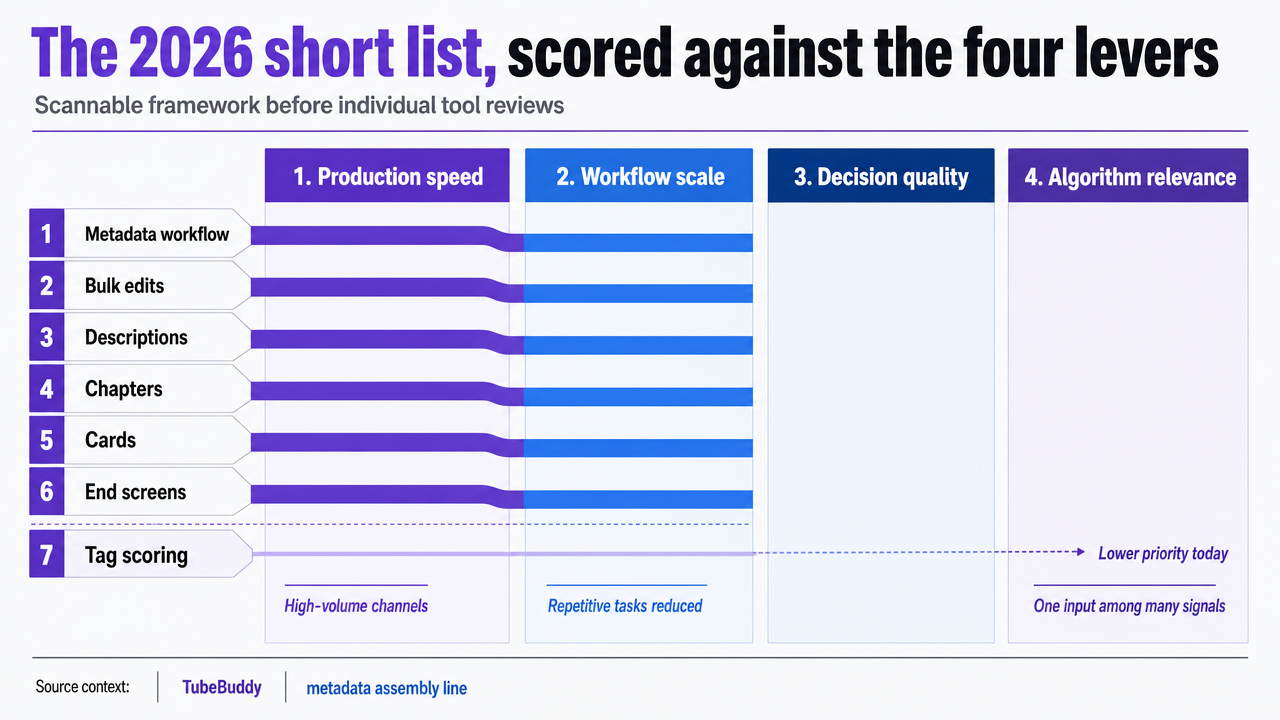 Visualize the seven tool categories mapped to their primary scaling lever, giving readers a scannable framework of the short list before diving into individual tool reviews
Where the stack breaks: regulated verticals and the engagement trap
While tools optimize for recommender signals, this can lead to specific failures in legal, healthcare, and behavioral health portfolios. A systematic review of 23 studies on YouTube's recommender concluded that the system can facilitate pathways to problematic content, with most studies implicating the algorithm or showing mixed results 4. An audit of recommendation trails also found a growing proportion of suggestions deeper in the trail came from extremist or conspiratorial channels for certain user segments 5.
For a strategist managing a behavioral health portfolio, this has direct operational consequences. A client explainer on medication-assisted treatment that boosts CTR and retention performs well by tool metrics. However, once surfaced by the recommender, it might appear alongside content the agency did not select and cannot audit. A metadata or thumbnail win that places the video in such a neighborhood is not a complete success.
The solution is a review layer, not a different tool. Titles, thumbnails, and hooks optimized for general audience engagement require a second pass for regulated verticals. The question becomes: does the framing hold up if the recommender pairs this video with adjacent content the agency would not endorse? This critical question is addressed in the approval workflow, not within tools like VidIQ or TubeBuddy.
Optimize YouTube SEO at Scale With Data-Driven Automation in 2026
Connect with our team to see how leading agencies are automating YouTube SEO workflows across client portfolios—without increasing headcount or sacrificing oversight.
If a portfolio operator manages ten or more client channels
Consolidation math: tool categories, scaling levers, and channels per strategist
The audience perspective shifts for strategists managing multiple client channels. Consolidation becomes key, as every additional login, dashboard, and export step compounds across the portfolio.
Pew's 2025 tracking indicates that YouTube is widely adopted, with roughly eight in ten U.S. adults using it 9. This widespread reach makes YouTube essential for high-stakes service clients needing educational visibility. The operational challenge is determining how many client channels one strategist can competently manage.
The table below maps each tool category to its primary scaling lever, typical seat model, and a realistic channel-per-strategist coverage limit. These variables are qualitative, as verified pricing benchmarks are not available.
| Category | Primary lever | Seat model | Channels per strategist |
|---|---|---|---|
| Metadata workflow (TubeBuddy-class) | Metadata assembly | Per-user, per-channel authorization | 15–25 with template discipline |
| Outlier and competitive intelligence (VidIQ-class) | Topic selection | Per-user, tiered by tracked channels | 10–20 before signal fatigue |
| Search-demand research (Ahrefs, Semrush) | Upstream topic demand | Per-user, portfolio-wide | Unlimited; not the bottleneck |
| Thumbnail and title testing | CTR experimentation | Per-channel or per-test | 5–10 if tests run in parallel |
| Native YouTube Studio | Retention diagnostics | Per-channel access | 8–12 before review lag |
| Niche outlier tools (1of10, Rivals) | Vertical-specific topic radar | Per-user | Additive; low overhead |
| AI-powered coordination (Vectoron) | Portfolio management & approval | Per-user, tiered by channels | 20-50+ with AI automation |
The data suggests a common ceiling: a single strategist can manage topic and metadata work for about fifteen channels. However, incorporating retention iteration and thumbnail testing reduces the sustainable number to eight or ten channels for quality portfolio work.
The coordination layer above point tools
Managing six tools in six browser tabs is inefficient for strategists overseeing more than ten client channels. The primary constraint shifts from individual tool capabilities to the coordination required between them: identifying which video needs retention analysis, which thumbnail test is complete, which competitor breakout is relevant, and which draft awaits approval.
Historically, this coordination relied on project managers, spreadsheets, and meetings, none of which scale linearly with channel count. An alternative is an execution layer that processes signals from point tools, prioritizes weekly tasks across the portfolio, and routes proposed changes through a human approval step before publication. This consolidates titles, thumbnails, descriptions, and retention-driven re-edits into a single queue.
This is the role Vectoron fills for portfolio operators: it is not another keyword tool, but an approval-first execution surface that sits above the point stack. This enables small teams to maintain quality across dozens of client channels without increasing specialist headcount, aligning with Vectoron's mission to replace traditional agency models with AI-powered content production.
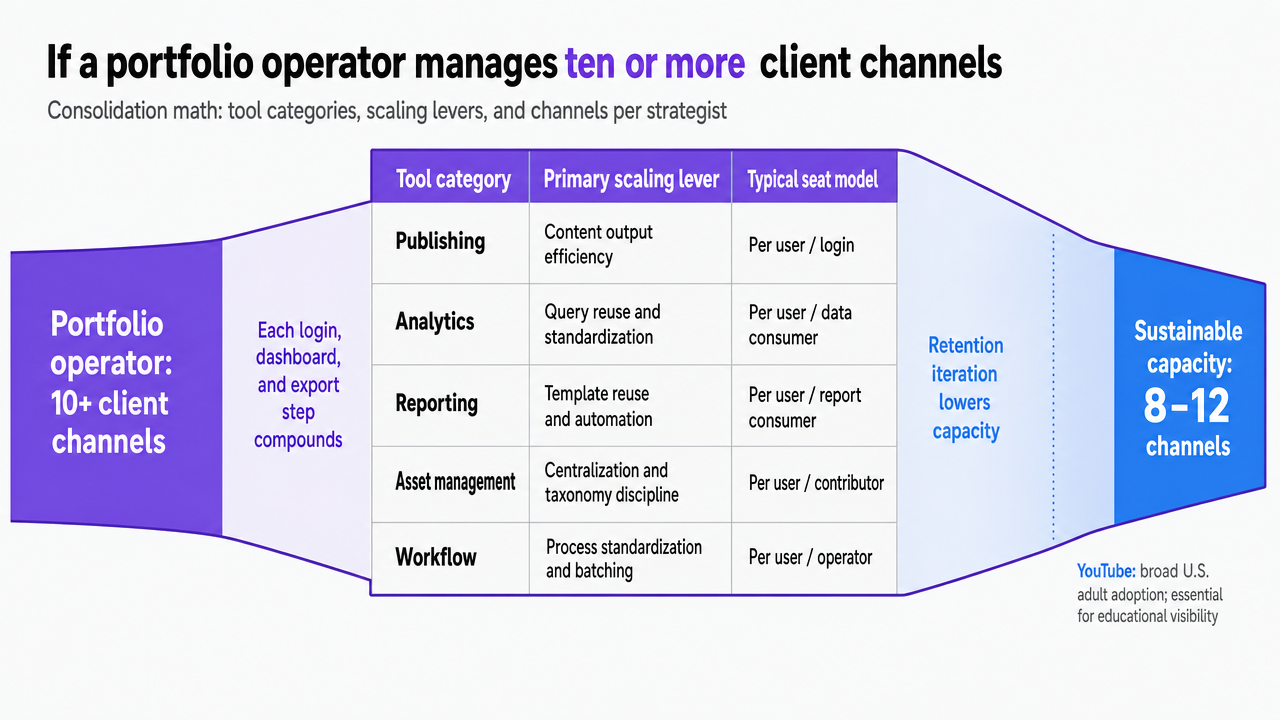 Visualize the channels-per-strategist ceiling across tool categories, reinforcing the article's central operational claim that retention iteration reduces sustainable capacity to 8-12 channels
A working agency evaluation rubric for 2026 procurement
The key to effective procurement is a robust rubric. Agency SEO leads should evaluate each candidate tool against five critical questions, in order of importance.
- Does the tool generate or measure a signal that the recommender actually prioritizes? YouTube's system heavily weighs performance signals like watch time and quality watch time 1. A tool focused on tag scores is addressing an outdated model.
- Can the tool operate at portfolio scale, or does it demand individual channel management? A tool that requires ten minutes of manual work per channel per week is impractical for twenty-five channels.
- Does it integrate CTR with retention data, or does it measure clicks in isolation? Thumbnail lifts without post-click watch data can lead to misleading "wins."
- Does the tool address a specific lever, or does it duplicate functionality already covered by another tool? Overlapping subscriptions across platforms like TubeBuddy, VidIQ, and search-demand tools are a common cause of stack bloat.
- Does the tool assume general-audience optimization, or does it support a review layer for regulated verticals where the recommender's downstream pairings pose reputational risks 4?
Tools that satisfy all five criteria are suitable for inclusion in the stack. Those that meet three or fewer should be considered for a trial account, not a portfolio-wide rollout.
Frequently Asked Questions
References
- 1.Exploring YouTube's Recommendation System in the Context of ....
- 2.Search Engine Optimization (SEO) for YouTube: A Step-by-Step Guide.
- 3.Investigating Effective Strategies of SEO for YouTube Content Creators.
- 4.Systematic review: YouTube recommendations and problematic content.
- 5.Auditing YouTube's recommendation system for ideologically congenial, extreme, and problematic recommendations.
- 6.YouTube's recommendation algorithm is left-leaning in the United States.
- 7.A Week in the Life of Popular YouTube Channels.
- 8.YouTube as a Source of Information and Entertainment (Pew report PDF).
- 9.Americans' Social Media Use 2025.
- 10.5 facts about Americans and YouTube.
- 11.Many Americans Get News on YouTube, Where News Organizations and Independent Producers Thrive Side by Side.