
Key Takeaways
- Discovery has split between classical search and generative engines, so blog pages now serve two audiences: the human reader and the model deciding whether to cite the source 1.
- Brand-owned sites account for only 5 to 10 percent of AI search sources, making a dual-track model—answer-ready owned content plus distributed third-party placements—the core strategic framework 1.
- Regulated verticals need claim-level approval gates staffed by subject-matter editors, because model safeguards alone did not prevent 113 disinformation blogs totaling over 40,000 words under adversarial prompting 4.
- Content leaders should set the baseline now with a fixed prompt set across ChatGPT, Perplexity, and AI Overviews, framing the 20 to 50 percent early GEO lag as expectation, not failure 1.
The Discovery Layer Has Split in Two
The path between a reader and a blog post now runs through two very different systems. Classical search still returns a ranked list of links. Generative engines—ChatGPT, Perplexity, Google AI Overviews, Gemini—return a synthesized answer, then quietly footnote the sources they used. For content leaders, that split is the single most important shift to plan around in 2025.
McKinsey's survey of AI-search users found that 44% name AI search as their primary and preferred source of insight, compared with 31% for traditional search, 9% for retailer and brand websites, and 6% for review sites 1. This measures the behavior of people who already use AI search, and those users skew toward advice-seeking and complex decisions—the same intent that anchors most blog editorial calendars.
Two consequences follow. The first is that a blog post now has two audiences: the human reader who might click through, and the model that decides whether the post is worth citing. The second is that ranking on page one of Google no longer guarantees visibility, because the generative answer above the links may resolve the query before the reader scrolls.
The rest of this article treats that split as the starting condition, not a footnote. Owned content still matters. What changes is how it earns attention and where it needs company.
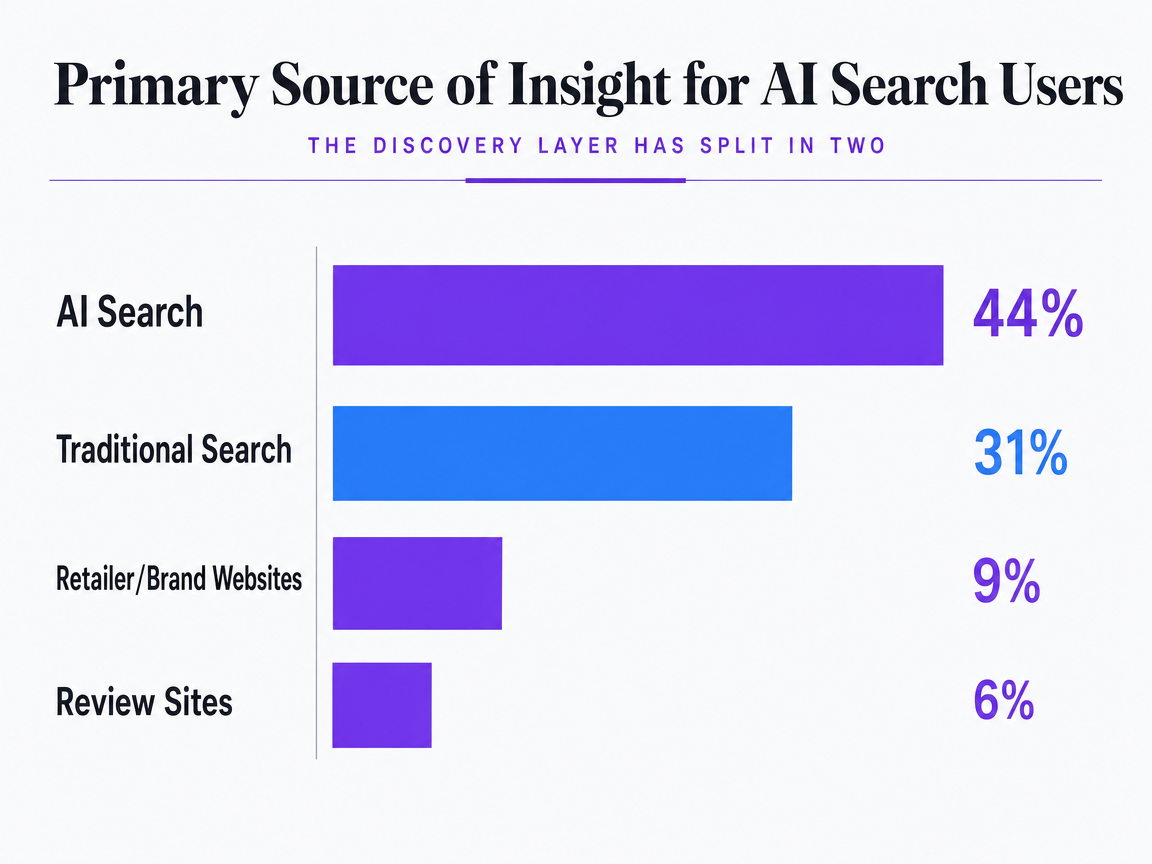 Primary Source of Insight for AI Search Users
Breakdown of the primary and preferred source of insight among users of AI-powered search.
Why Classical SEO Playbooks Now Under-Serve the Editorial Calendar
GEO Is a Separate Discipline, Not an SEO Tweak
Generative Engine Optimization (GEO) is often described as "SEO for AI," but this framing misleads editorial teams. SEO optimizes a single page against a ranking algorithm that returns links. GEO optimizes a body of evidence against a synthesis engine that composes an answer from many sources, then decides which few to name.
McKinsey's analysis of AI-search behavior positions GEO as a necessary complement to SEO rather than a subset of it, citing distinct signals: source diversity, structured claims, machine-readable evidence, and third-party corroboration 1. The mechanics diverge from classical ranking work. Keyword clusters still matter for indexing, but a model choosing which sources to cite weighs consistency of the claim across the web, clarity of attribution, and whether the source page states a fact plainly enough to be quoted without paraphrase.
The practical consequence for editorial calendars is that a strong page can rank well in Google and still be invisible in ChatGPT or Perplexity if the same claim is not echoed elsewhere. Content leaders who treat GEO as a checklist item under SEO tend to over-invest in on-page tweaks and under-invest in the distributed footprint that actually earns citations in a generative answer.
The Third-Party Content Footprint Most Brands Ignore
The math of citation exposure is unforgiving. McKinsey reports that brand-owned sites account for only 5 to 10 percent of the sources AI search draws from, with the remainder pulled from affiliates, review platforms, industry publications, user-generated content, and community forums 1. A blog program that concentrates 100% of its production on owned pages is competing for a sliver of the visible surface.
The measurement side is equally thin. Only 16% of brands systematically track their performance in AI search, meaning most editorial teams cannot yet tell leadership whether their pages are being cited, paraphrased, or ignored by generative engines 1. That gap is a short-term advantage for teams willing to build the tracking early—competitors are unlikely to challenge a KPI they cannot see.
The operational implication reshapes the editorial calendar. A quarter that produces 30 owned blog posts and zero placements in third-party publications, review sites, or expert directories is optimizing for the smaller half of the citation pool. Content leaders in high-stakes verticals—legal, healthcare, dental, home services, senior living—should assume that a model answering a prospect's question is more likely to quote a state bar directory, a health system explainer, or a review aggregator than the brand's own blog. Planning production without a matching distribution track means paying to write content that generative engines are structurally unlikely to cite.
What the Georgetown Traffic Data Actually Says About Organic Decline
A common panic in planning meetings is that AI search is collapsing organic traffic. The evidence complicates that story. Georgetown's McCourt School analysis of large-scale browsing data found that LLM adoption coincides with a sustained increase in the number of unique websites visited, and that traffic following LLM queries is systematically less concentrated across destinations than traffic from traditional search 5.
The pattern is dispersion, not disappearance. Users who consult ChatGPT or Perplexity often continue on to source pages, and the set of pages they visit is broader than the top-heavy click distribution that classical Google results tend to produce. For a mid-tier brand blog that has struggled to break into the first three organic positions, generative citation can widen the funnel rather than close it.
The strategic read for content leaders is to stop budgeting as if organic is in freefall and start budgeting for a wider but flatter traffic curve. Fewer visits from any single high-ranking page, more visits from a broader set of cited pages, and a stronger return on content that is written to be quotable rather than written to hoard rank.
The Dual-Track Production Model
Track One: Answer-Ready Owned Content
The owned track is not a content mill. It is a small, disciplined library of pages engineered to be quoted verbatim by a synthesis engine and read in full by a human who followed the citation. Both jobs have to happen on the same page.
Three attributes separate a page that gets cited from one that gets skimmed:
- The claim has to be stated plainly in a single sentence, not buried in narrative.
- The supporting evidence—the study name, the number, the date, the sample—has to sit adjacent to the claim, not two scrolls down.
- The page has to answer a specific question, not a topic. "What does a dental implant cost in Michigan" is answerable. "Everything about dental implants" is not.
For editorial calendars, that reframes pillar-and-cluster work. A pillar page still holds the topic, but the cluster pages should each resolve one narrow question with a quotable lede, a sourced number, and a follow-through section for the reader who arrived through a generative citation and now wants depth. McKinsey's playbook for GEO explicitly names structured claims and machine-readable evidence as core signals for source selection 1. Editorial teams that measure a page by whether the top 100 words contain a citable claim tend to earn more generative mentions than teams optimizing for word count or internal link density.
Track Two: Distributed Third-Party Presence
The second track exists because the citation pool for generative answers is mostly not the brand's website. Affiliates, industry publications, review platforms, expert directories, community forums, and user-generated content collectively make up the 90 to 95 percent of sources that owned pages do not cover 1. A blog program without a distribution track is fighting for the smaller share.
Practically, that means an in-house team should carry a parallel calendar: contributed articles in trade publications, verified profiles on category-specific directories, subject-matter interviews with journalists who write for outlets the models train on, and monitored presence on the review platforms that dominate the brand's vertical. For legal, that skews to bar association directories and Justia. For dental and health, to Healthgrades, health system explainers, and condition-specific nonprofits. For home services, to review aggregators and municipal contractor listings.
Forrester's analysis of US agencies confirms that agency-side teams are already redirecting production capacity toward multi-surface content, media, and SEO with generative AI 11. In-house teams that keep 100% of their headcount pointed at the owned blog cede that ground. The corrective is not to publish less on the brand blog. It is to route roughly a third of net-new production effort into placements, profiles, and pitches that seed the same claims across the sources a model is likelier to name.
Editorial Design That Rewards the Click
A page cited by ChatGPT or Perplexity often gets a visitor who has already read the model's summary. That reader arrives with a partial answer and a specific question about what the summary missed. If the page repeats what the model already said, the tab closes.
The design fix is layered depth. The lede answers the question in one quotable sentence—that is the citation bait. The next block adds the caveat, the scope limit, or the counterexample the model's summary is structurally unlikely to include. The section below that shows the working: the source, the year, the sample, the local variation. A reader who came through a generative citation should find something on the page that the citation did not.
The learning research reinforces the design choice. An experimental study spanning seven experiments and more than 10,000 participants found that users who learned a topic through LLM summaries developed measurably shallower knowledge than users who assembled the same information from web links, because the synthesized answer required less effort to consume 2. For blogs in healthcare, legal, and financial services, that shallow-learning pattern is a direct editorial risk. Pages that only mirror the model's summary train readers to stop clicking. Pages that consistently reward the click with an added layer—a decision framework, a local benchmark, a worked example—build the return visits that generative traffic dispersion makes possible.
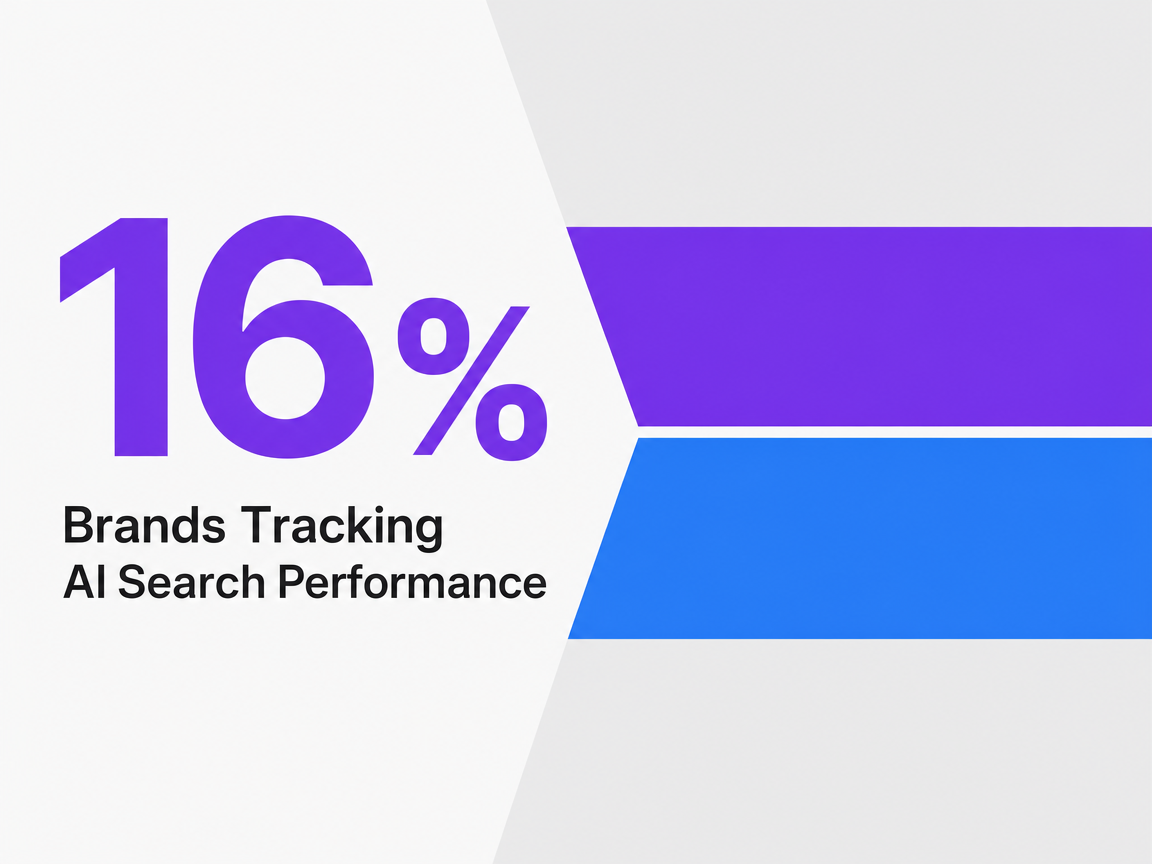 Brands Tracking AI Search Performance
Brands Tracking AI Search Performance
Accelerate Blog Output with AI-Driven Workflow
Experience faster publishing and measurable SEO impact in your first week—no extra headcount required.
Production Economics for Multi-Location Editorial Teams
For content leaders managing editorial calendars across 10, 25, or 100 locations, the production math is the argument that either wins or loses the next budget cycle. A single-brand blog can afford a slow cycle. A multi-location program cannot, because every location needs local variants—city pages, service-line pages, market-specific FAQs—and the volume compounds quickly.
Deloitte's marketing research puts the adoption baseline in view: 26% of surveyed marketers were already using generative AI for content production, with another 45% planning adoption by end of 2024 7. Roughly seven in ten marketing teams are moving toward AI-augmented production within a single budget year. The question for in-house leaders is no longer whether to adopt, but which workflow structure yields the best output per approved hour.
The comparison below uses three variables rather than invented dollar figures: writer cost per piece (relative), editor hours per piece, and end-to-end cycle time in business days. Volume target: 8 to 12 blogs per month across locations.
| Workflow | Writer Cost / Piece | Editor Hours / Piece | Cycle Time (days) |
|---|---|---|---|
| Traditional agency (brief, draft, revise) | High | 2–3 | 15–25 |
| In-house + freelance pool | Medium | 3–5 | 10–18 |
| AI-augmented with approval gates | Low | 1–2 | 3–7 |
| Vectoron AI-powered content production | Very Low | 0.5–1 | 1–3 |
Two patterns are worth pulling out. The in-house plus freelance model often carries the highest editor load, because voice normalization across writers eats hours that the writer cost line does not show. The AI-augmented model reverses the shape: editor time drops because drafts arrive in a consistent voice, and cycle time compresses because briefing, drafting, and first-pass QA collapse into one step.
Forrester's read on US agencies confirms the direction of pressure. Agencies are already redirecting production capacity toward GenAI-heavy content, media, and SEO execution 11. In-house teams competing for the same organic surface without a similar workflow shift will find their cost per published piece rising against agency benchmarks, not falling. The corrective is not to publish faster at lower quality. It is to move the editor's time from cleanup to judgment—approval gates on claims, sources, and voice—while the drafting layer runs on augmentation.
Governance for High-Stakes Verticals
Why Health, Legal, and Financial Content Need Approval Gates
Every blog program in a regulated vertical carries a specific risk: a page written by a machine, cited by another machine, and consumed by a reader who never sees a human name attached to the claim. Approval gates exist because that chain of custody is otherwise invisible.
A BMJ cross-sectional analysis of GPT-4, PaLM 2/Gemini, Claude 2, and Llama 2 documents the exposure directly. Prompted to produce false health blog posts on topics like sunscreen causing skin cancer and alkaline diets curing cancer, the four models collectively generated 113 unique disinformation blogs totaling more than 40,000 words, with very few refusals 4. The study measured what models will produce under adversarial prompting, not what most in-house teams would ever ask for. But it establishes the base rate: model safeguards alone are not a governance layer.
A parallel peer-reviewed evaluation of LLM responses to health prompts found that output quality is highly prompt-dependent and that simple prompting interventions improve, but do not fully remedy, guideline compliance 3. Translation for editorial workflow: the same draft can pass or fail medical communication standards depending on how the request was framed, which means quality control cannot live at the prompt.
The corrective is a claim-level approval gate before publication. An editor with subject-matter authority signs off on the medical, legal, or financial assertion, the source behind it, and the caveat that qualifies it. Drafting speed compounds; approval remains synchronous. That structure holds voice and volume without pushing the accuracy risk onto the reader.
The Patient Search Journey and the Verification Gap
The reader on the other side of a health blog is often already mid-decision. A 2025 cross-sectional survey of online health information-seekers found that 98% (291 of 297) consulted search engines and 68.4% consulted health-related websites, while 21.2% (63 of 297) used LLM-based chatbots such as ChatGPT and Microsoft Copilot 6. The chatbot share is still the minority channel, but the behavior inside that channel is the number to plan against.
Among the 63 chatbot users, 48.4% followed the advice they received, while only 19.4% cross-checked it against another source 6. Roughly half acted; roughly one in five verified. For dental, behavioral health, and senior living brands whose blog content is being paraphrased into those chatbot responses, the practical implication is that a page's factual precision now has downstream weight it did not carry when the reader was going to read three more links before booking.
Approval gates address the supply side of that gap. The demand side gets addressed on the page itself: a plain statement of what the claim applies to, who it does not apply to, and when a reader should stop reading a blog and call a licensed provider. Content that names its own limits gives the small verifying minority something to verify, and gives the larger acting majority a clearer stop sign.
See How Enterprise Teams Accelerate Blog Production for AI-Driven Search
Get a walkthrough of automated workflows designed for rapid, approval-based content publishing—enabling your team to outpace algorithm changes and AI search disruption without expanding headcount.
Setting Realistic KPIs With Leadership
The fastest way to lose a content budget is to promise AI-search dominance in the same quarter the tracking gets stood up. The second-fastest way is to report only classical SEO metrics while leadership reads about ChatGPT and Perplexity in the trade press. A defensible KPI set has to hold both stories at once.
McKinsey's analysis of generative engine performance sets the expectation floor: GEO output typically lags SEO output by 20 to 50 percent in the early quarters, reflecting how thinly brand-owned pages are represented in the citation pool and how immature measurement tooling still is 1. That gap is not a failure signal. It is the baseline a content leader should walk into the CMO's office already carrying, so the first quarterly review is a calibration meeting rather than a defense.
Three KPI layers do the work:
- Classical: organic sessions, ranked keywords, and assisted conversions from the owned blog.
- Generative: citation counts in ChatGPT, Perplexity, and Google AI Overviews for a fixed prompt set, plus referral sessions from those surfaces where measurable.
- Footprint: third-party placements, directory profiles, and review-platform mentions live during the reporting period.
Reporting cadence matters as much as the metrics. Classical SEO moves month over month. Generative citation shifts on a slower, noisier curve, so a quarterly baseline with monthly directional checks avoids the trap of reading noise as decline.
A 90-Day Rollout for In-House Teams
A dual-track model is only useful if it can be stood up inside a quarter. The rollout below assumes a four-person content team, an existing owned blog, and no dedicated GEO tooling on day one.
- Days 1–30: Audit and baseline. Pull the top 40 blog pages by organic sessions and score each for citation readiness—is the core claim in the first 100 words, is the source named, is the question specific enough to answer. Run a fixed prompt set of 30 to 50 questions across ChatGPT, Perplexity, and Google AI Overviews and log which sources get named. That log is the generative baseline; without it, no future quarterly report has a comparison point. McKinsey's finding that only 16% of brands systematically track AI search performance is the window for setting this baseline before competitors close it 1.
- Days 31–60: Rewire production. Convert the top 10 highest-intent cluster pages to the answer-ready template—quotable lede, sourced adjacent evidence, layered depth below. Open the third-party track with three concrete moves: two contributed pitches to trade publications the models cite, verified profiles on the two directories that dominate the vertical, and a review-platform audit for missing or thin listings.
- Days 61–90: Governance and reporting. Install a claim-level approval gate for regulated verticals and publish the first joint SEO plus GEO scorecard to leadership, with the 20 to 50 percent GEO lag stated up front as the expectation frame, not a caveat.
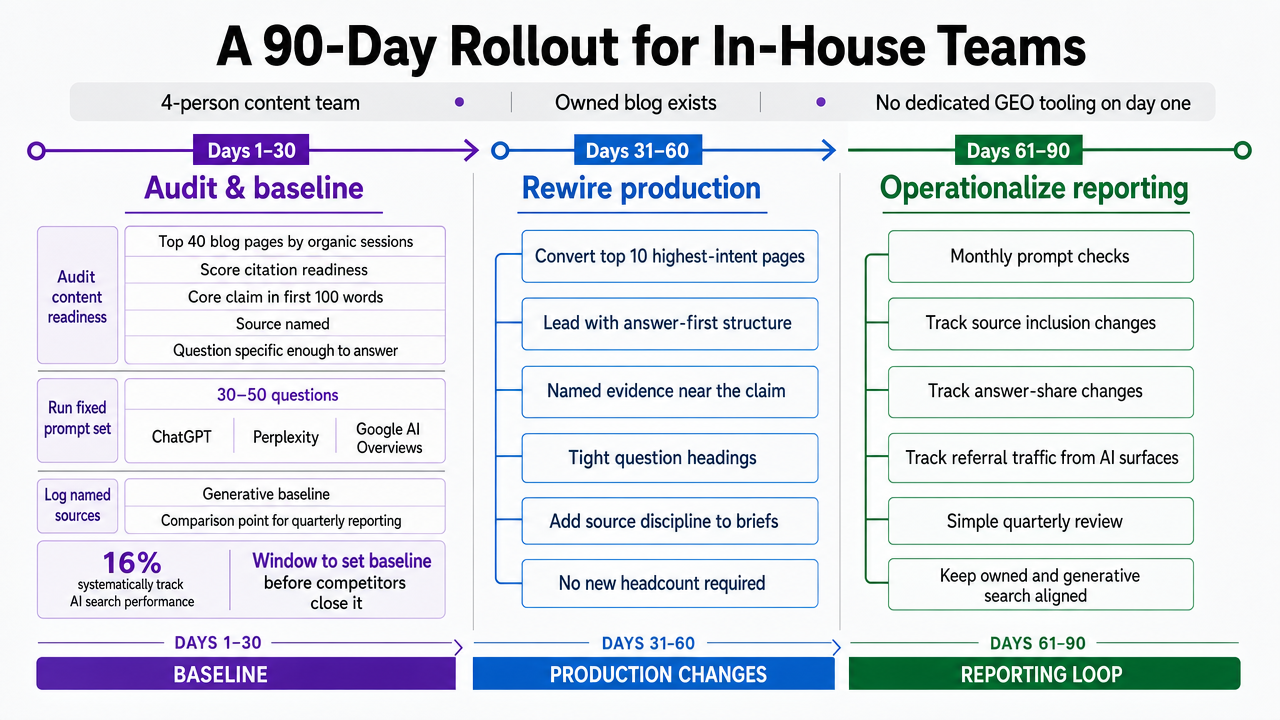 Process infographic visualizing the three-phase 90-day rollout plan explicitly outlined in the section
Frequently Asked Questions
References
- 1.New front door to the internet: Winning in the age of AI search.
- 2.Experimental evidence of the effects of large language models versus traditional web search on depth of learning.
- 3.Evaluating evidence-based health information from generative large language models.
- 4.Current safeguards, risk mitigation, and transparency measures of large language models against the generation of health disinformation: repeated cross sectional analysis.
- 5.Beyond Search: LLM Adoption and Web Traffic Concentration.
- 6.Online Health Information–Seeking in the Era of Large Language Models: Cross-sectional Survey.
- 7.Deloitte Digital's latest research forecasts generative AI's impact on marketing content production.
- 8.State of Generative AI in the Enterprise 2024.
- 9.The State Of Generative AI, 2024.
- 10.Five Key Trends That Will Shape Your Content Services Strategy In 2024.
- 11.The State Of Generative AI Inside US Agencies, 2024.