
Key Takeaways
- Ranking and converting are different problems: posts fail when their structure ignores how users scan pages, extracting keywords and headings rather than reading sequentially 10.
- The inverted pyramid should govern every H2, with the claim in sentence one and supporting evidence next, so scanning readers get the answer before deciding to continue 9.
- Accessibility markup and SEO share the same semantic foundation—descriptive headings, meaningful link text, and alt text satisfy WCAG Level AA while exposing signals crawlers use 2, 8.
- Audit existing posts with a binary rubric covering section openings, headings, link text, alt text, citation density, and reading level; failing three or more rows warrants a rebuild 5, 8.
The Diagnostic Gap Between Posts That Rank and Posts That Convert
Most content teams know how to publish a blog post that ranks. The challenge lies in understanding why many ranked posts fail to drive engagement or pipeline. This gap isn't about keywords or word count, but rather whether the post is structured for how people read on the web, which differs significantly from reading a book.
Users scan pages, extracting individual words and headings instead of processing sentences sequentially 10. This behavior invalidates common blog optimization practices like dense introductions, buried conclusions, decorative subheadings, and generic link text. A post can meet every technical SEO requirement and still lose the reader quickly.
The crucial diagnostic question isn't "does this rank?" but "does its structure align with the behavior of the audience arriving from search?" This reframing transforms quality from a subjective matter to a set of measurable properties: front-loaded answers, clear heading hierarchy, descriptive links, accessible markup, and plain language tailored to intent. Each property is auditable and supported by usability research, eye-tracking studies, and accessibility standards. This article outlines that diagnostic, applied to creating posts that both rank and convert.
How Readers Actually Consume a Blog Post
Scanning Is the Default, Not the Exception
A fundamental insight for editorial decisions is that people rarely read web pages word by word. Instead, they scan, picking out key words and sentences 10. This behavior, documented by Jakob Nielsen, remains the baseline for web writing.
The quantitative impact of scannability is significant. In usability tests, a concise version of a page improved usability by 58%, while a scannable version improved it by 47%. Combining concise, scannable, and objective writing led to a 124% improvement in usability 10. While these percentages are directional, they highlight that structural writing choices can yield substantial gains for users with specific tasks.
For content managers, this implies that a post with a linear argument may still fail users who are not reading it linearly. Users are often searching for a specific answer, a qualifier, a number, or the next heading that guides them. Every design choice within the post, from paragraph length to keyword emphasis to the placement of the first substantive claim, should support this scanning behavior.
What SERP Eye-Tracking Says About Earning the Click
Before a post can be scanned, it must first be selected from search results. Cornell researchers used eye-tracking to study user interaction with search engine results pages (SERPs), observing what participants viewed, in what order, and for how long 1. The study, focused on SERP behavior before the prevalence of rich results, showed that attention concentrates on the top results and moves down the list in a compressed vertical path. Titles and snippets carry disproportionate weight in the decision to click 1.
This has practical implications for editorial teams. A meta description that hides the specific answer, or a title that prioritizes brand over benefit, can lose the click before any on-page content is even seen. The same discipline of concrete nouns and front-loaded meaning required in the body of the post is even more critical at the SERP level. Ranking without capturing attention is a common failure, evident in impressions-to-click ratios.
The Architecture of a Post That Performs
Inverted Pyramid: Front-Loaded Answers, Layered Depth
Journalism adopted the inverted pyramid structure long before SEO: present the conclusion first, follow with supporting evidence, and conclude with background information for interested readers. Applied to blog posts, this aligns with how scanning users allocate attention: they read the first line of a section and then decide if the rest is worth their time.
Web writing literature suggests editorial teams aim for roughly half the word count of conventional writing, use an inverted pyramid style, and divide long passages into manageable sections with meaningful headings 9. Government usability guidance similarly advises placing the most important information at the top and using headings, lists, and meaningful links to aid scanning 7.
The common mistake is treating the inverted pyramid as solely a headline technique. In a high-performing post, each H2 functions as a miniature pyramid. The first sentence states the claim, followed by two or three sentences providing evidence, numbers, or qualifiers. Additional detail comes after, accessible to motivated readers but skippable for scanners.
This structure doesn't sacrifice depth; it repositions it. An 1,800-word B2B post can still be effective if each section delivers on its opening claim before expanding on context. What is eliminated is introductory "throat-clearing" that delays the substantive answer.
Heading Hierarchy That Both Users and Machines Can Parse
Headings serve a dual purpose: they provide a scannable table of contents for readers and a structural map for search crawlers and assistive technologies. When these purposes diverge, the post suffers.
Federal accessibility standards, specifically WCAG Level AA, mandate that headings and labels describe topic or purpose, and content sections require descriptive headings that convey structure 2. This rules out vague or decorative subheadings. Every heading must summarize the content within its section.
Hierarchy is as important as wording. An H1 identifies the post, H2s mark main sections, and H3s denote subordinate points. Skipping levels or using an H3 for visual styling when the content is structurally an H2 disrupts the outline relied upon by assistive technology and crawlers. Accessibility guidance emphasizes that headings should form a useful outline and sections should remain concise 6.
For content managers, a simple check is to read only the headings of a draft. If this outline answers the post's query, the hierarchy is effective. If it reads as vague labels, the post fails both scanners and machines, regardless of the quality of the paragraphs.
Descriptive Links, Alt Text, and Structural Elements Search Rewards
While direct evidence linking SEO structure to readability and accessibility is still developing, a 2024 study on diabetic retinopathy websites found that basic SEO implementations correlated with readability and accessibility. It identified specific structural features: detailed yet succinct HTML headers, descriptive alt text on images, meta descriptions, intuitive site navigation, and audience-appropriate keyword use 8. These elements are foundational for any post designed for both search and users.
Descriptive link text is often underutilized by editorial teams. Phrases like "click here" or "read more" are structurally weak. They hinder scanning readers, who use link text as a signal for content, and screen readers, which present links without surrounding context. Government usability guidance considers meaningful link text a baseline expectation for web writing 7, a point echoed in accessibility guidance regarding descriptive labels 6.
Alt text serves a similar function. It's not decorative; it describes what an image conveys for users who cannot see it or crawlers that cannot render it. Meta descriptions function at the SERP level, providing the specific answer needed for a click decision before the page loads. These elements are crucial for a post to be fully understood by both human and machine audiences.
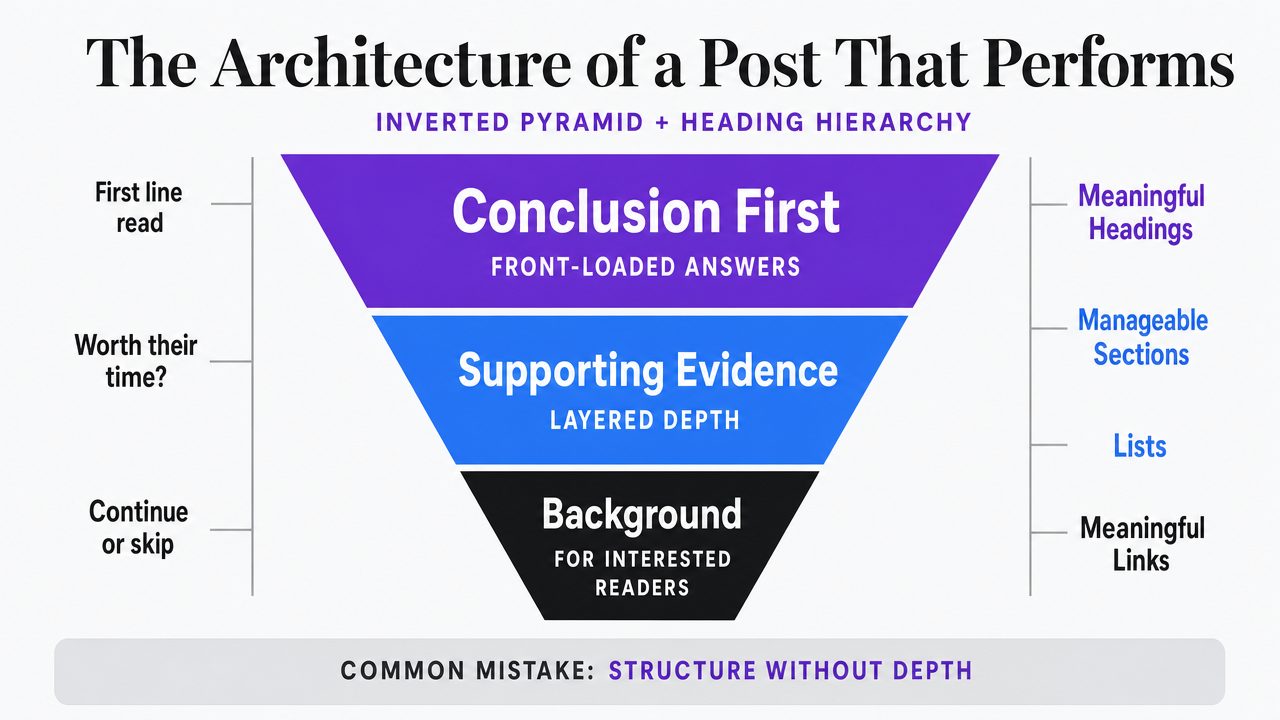 Visualize the inverted pyramid structure and heading hierarchy discussed in the section, giving readers a clear structural framework they can apply to their own posts
Publish SEO-optimized blog posts in one week
Experience end-to-end blog content creation and see measurable SEO improvements before your trial ends.
Plain Language as an SEO Input, Not a Style Preference
Plain language should be categorized as a structural input determining a post's readability, comprehension, and effectiveness, rather than merely a brand voice preference. Federal guidance defines plain language as communication the audience can understand upon first reading or hearing it 5. This is an operational definition, not an aesthetic one.
The evidence supporting this standard is robust. Digital.gov links plain language directly to task completion and user satisfaction 3. Indian Affairs guidance advises using short, familiar words and explaining technical terms upon their first appearance 4. Colorado's accessibility office adds tactical advice: organize content predictably, favor active voice, keep sentences and paragraphs short, and use headings and lists liberally 5. Cross-agency resources connect these practices to reduced cognitive load and improved readability, considering typography, whitespace, and left-justified text as part of the same discipline 6.
For SEO, plain language serves three functions:
- it reduces friction for scanning readers,
- provides concrete nouns and specific phrasing that match user queries, and
- offers crawlers and language models cleaner text to parse, free from dense corporate prose.
Content managers can audit drafts by reading a paragraph aloud. If a peer outside the vertical would struggle to follow it on the first pass, the paragraph likely fails the plain language standard and will fail scanning readers. Rewriting for first-pass comprehension naturally improves SEO signals.
Accessibility Signals That Also Feed Machine Understanding
Accessibility markup and SEO parsing rely on the same foundation: semantic HTML that informs non-visual consumers about each element, its content, and its relation to surrounding elements. In this context, a screen reader and a crawler are similar audiences; neither sees the rendered page, and both depend on underlying structure to build a model of the post.
Section 508 guidance specifies key elements: headings and labels must describe topic or purpose at WCAG Level AA, and content sections require descriptive headings that convey structure 2. The same guidance mandates descriptive labels for links, form controls, and interactive elements. These requirements produce the same artifacts a crawler uses to understand a page: a clear outline, meaningful anchor text, and labeled objects.
Peer-reviewed evidence confirms this overlap. The 2024 study on diabetic retinopathy websites found that SEO features most strongly associated with readability and accessibility were the same semantic elements required by accessibility standards: succinct HTML headers, descriptive alt text, meta descriptions, and intuitive navigation 8. While the vertical is specific, the mechanism is generalizable. Posts that pass an accessibility audit often expose the structural signals rewarded by search systems.
For content managers, this means accessibility work is not separate from SEO. A rubric checking heading hierarchy, alt text, and link descriptiveness satisfies both audits simultaneously, using markup decisions already controlled by the editorial team.
Length, Depth, and the Case Against a 1,500-Word Default
The common 1,500-word target for editorial calendars isn't based on usability evidence. It's a heuristic that became a rule as SEO tools began scoring drafts against averages of top-ranking pages. However, these averages describe what ranks, not necessarily what performs. A 1,500-word post can rank on page one but still lose a scanning reader within the first 300 words.
Usability literature suggests the opposite. Nielsen-inspired guidance recommends roughly half the word count of conventional writing, based on the premise that scanning readers extract information more efficiently from concise, structurally dense text 9. While this prescription was for consumer web pages, it reframes the length question. The key is not word count, but how much substantive content each section delivers before demanding more reader attention.
Intent dictates length. A query like "what is a meta description" can be satisfied in 400 words with an example. A query like "how to structure a B2B content audit" might require 2,500 words because the reader expects a framework, not just a definition. Length that matches intent conveys depth. Length that exceeds intent appears as filler, which scanning behavior penalizes more quickly than any algorithm.
Content managers can audit long posts by cutting any paragraph that doesn't add a claim, number, qualifier, or example. If the post remains effective at 1,100 words, it was never an 1,800-word post. If it genuinely requires 2,400 words, then that length serves a purpose.
See How Enterprise Teams Accelerate SEO Content at Scale—Without Sacrificing Quality
Connect with Vectoron to benchmark your current blog production workflow against AI-powered strategies proven to increase output and search rankings—while maintaining full editorial control.
E-E-A-T Signals That Survive Editorial Scale
E-E-A-T (Experience, Expertise, Authoritativeness, and Trust) signals are not metadata bolted onto a finished draft. They are embedded in the same structural elements that support scanning behavior and accessibility: who wrote the post, the specific evidence cited, how claims are qualified, and whether the page exposes semantic signals that allow both readers and machines to verify the source 8. While a byline and headshot are surface-level, the core signals are deeper.
Three signals reliably scale across a publishing calendar.
- First, every non-obvious claim should include a source named within the sentence, not just in a footnote. Editorial teams enforcing this at the paragraph level produce posts that appear authoritative to skimming readers because the qualifier and citation are immediately visible 7.
- Second, headings and labels must describe topic or purpose specifically enough for the outline itself to convey expertise, a standard codified by Section 508 at WCAG Level AA 2. Vague headings can erode trust even if the content is strong.
- Third, plain language on technical topics demonstrates experience, as writers who truly understand a subject explain it using short, familiar words rather than jargon 4.
For content managers, E-E-A-T is a rubric to apply during structural review, not a final rewrite pass. Enforcing these three signals ensures posts are published with E-E-A-T intact.
An Auditable Rubric for Existing Posts
The Typical Post vs. the High-Performing Post
A rubric transforms subjective quality debates into objective pass-fail checks. Content managers auditing an existing library need a scoreable list that yields consistent results across reviewers.
The structural attributes below distinguish typical posts from high-performing ones in a library audit. The comparison is binary: a post either exhibits the attribute or it doesn't.
| Attribute | Typical Post | High-Performing Post |
|---|---|---|
| Section opening | Throat-clearing paragraph before the claim | Claim in sentence one, evidence in sentences two and three 9 |
| Heading text | Vague or decorative labels | Describes topic or purpose at WCAG Level AA 2 |
| Link text | “Click here,” “read more” | Descriptive anchor text carrying the destination's meaning 7 |
| Alt text | Missing or filename-based | Describes what the image conveys 8 |
| Evidence density | Claims without sources | Cited number or qualifier next to each non-obvious claim 8 |
| Reading level | Dense corporate prose | Plain language, first-pass comprehension 5 |
A post failing three or more rows requires a complete rebuild. Posts failing one or two rows can be corrected with a single structural pass, without altering the underlying research.
Production Economics: Enforcing Standards Across a Publishing Calendar
While easy to apply to one post, scaling this rubric across eighty posts per quarter without increasing reviewer headcount is an operational challenge. Many in-house programs struggle here, as standards outlined in style guides are not consistently enforced, leading to gradual quality degradation.
Key variables determine a calendar's ability to maintain standards:
- articles produced per FTE per month (setting review capacity),
- structural QA checks per article (setting quality floor), and
- time-to-publish (indicating if checks are actually performed).
When production volume increases without a corresponding rise in reviewer headcount, QA checks are often sacrificed, leading to declines in engaged-time metrics later on.
AI-assisted production addresses this by automatically enforcing structural standards before human review. Heading hierarchy, descriptive link text, alt text presence, plain-language reading level, and citation density can all be machine-checked against the rubric 5, 8. Human reviewers can then focus on subjective judgment: whether evidence supports claims, if framing suits the audience, and if the post offers valuable insights. Vectoron's approval-first workflow is designed around this division of labor, ensuring structural standards are maintained as production velocity increases.
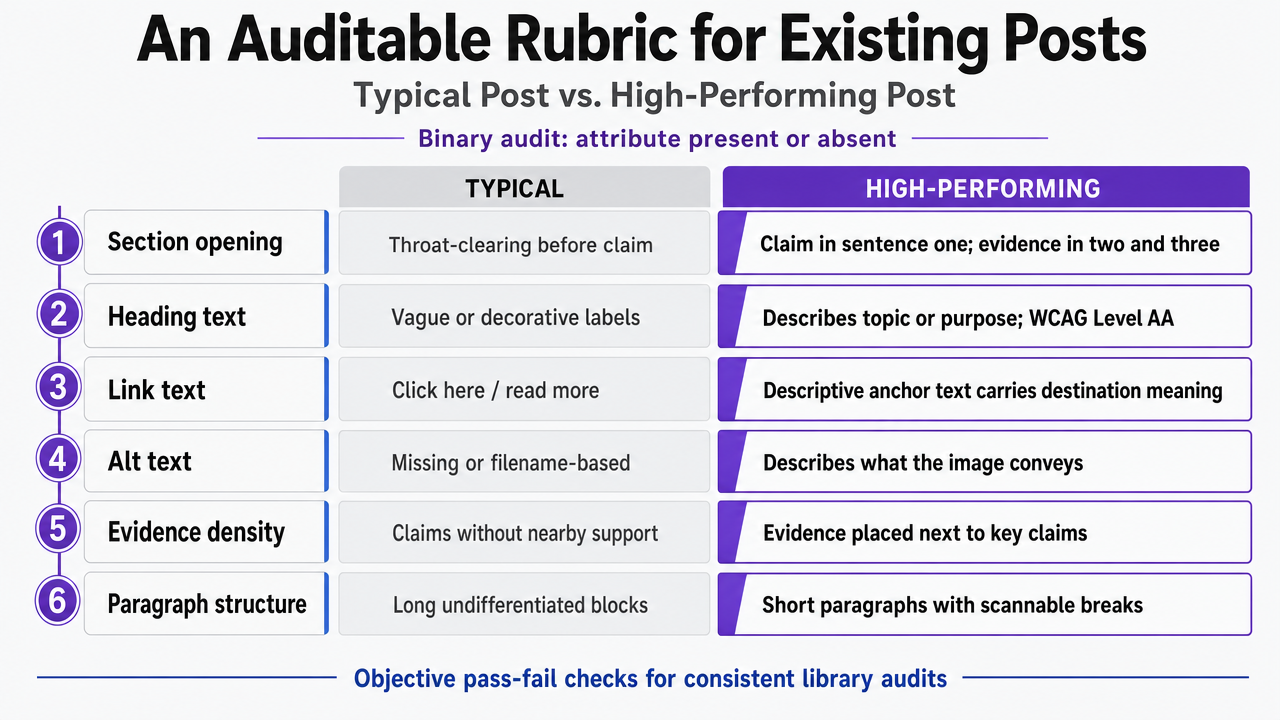 Reinforce the six-row binary audit rubric described in the section by presenting the Typical vs High-Performing attributes as a scannable visual checklist tied to the article's own guidance
Frequently Asked Questions
References
- 1.Eye-Tracking Analysis of User Behavior in WWW Search.
- 2.Guide to Accessible Web Design & Development.
- 3.Plain language guide series.
- 4.Use Plain Language | Indian Affairs.
- 5.Plain Language | Office of Information Technology (Colorado).
- 6.Accessibility and Plain Language in Government.
- 7.Writing for the Web (Usability.gov archived guidance).
- 8.Search engine optimization and its association with readability and accessibility of diabetic retinopathy websites.
- 9.Writing for the Web, Usability and Accessibility.
- 10.How Users Read on the Web.