
Key Takeaways
- Blog posts now serve two audiences at once: the ranking algorithm and the generative engine that summarizes results, and each evaluates the same page differently.
- Passages, not full posts, are the unit of value for generative retrieval, so definitions, statistics, and comparisons must sit together in extractable, self-contained form.
- Anchor AI content budgets on throughput and cost per published unit, since reported revenue lifts most commonly land below 5% 1.
- Move governance inside the approval stage by logging provenance, verifying claims, and capturing human editorial contribution to keep posts defensible 4, 5.
The two customers your blog now has to serve
A content marketing manager writing a blog post in 2025 is producing for two readers at once. The first is the ranking algorithm that has organized results for two decades. The second is the generative engine that reads those results and writes a summarized answer above them, sometimes citing the source and sometimes not. Both audiences pull from the same page, but they evaluate it differently, and a post engineered for only one of them loses ground on the other.
This is not a theoretical shift. Marketing content sits at the densest point of enterprise AI adoption, which means the competitive pressure on every published post has increased faster than most editorial calendars have adjusted. McKinsey's 2025 survey found that nearly nine in ten respondents said their organizations regularly use AI, though most were still early in scaling it into measurable value 3. The pipeline of AI-drafted blog posts entering the index is expanding, and the surfaces that used to reward volume are now compressing clicks into summarized answers.
The rest of this piece treats blog SEO as a dual-surface discipline. It covers what has actually changed in retrieval, how to structure a post so a generative engine can cite it, how to recalibrate expectations for AI-assisted output, and how to run a governed production line that scales without eroding brand trust or legal footing.
What actually changed in blog SEO
From ranking pages to being cited inside answers
The traditional unit of blog SEO was the ranked page. A post competed for a position, earned a click, and the click was the outcome. That model still exists, but a second contest now sits above it. Generative engines read the top results, extract claims, and assemble a synthesized answer. The page that gets cited inside that answer wins visibility even when the click never happens.
This changes what a blog post has to do at the sentence level. A ranked page can carry its argument across several scrolls. A citable passage has to survive extraction. That means the definition, the number, the comparison, and the source have to sit close together in the same paragraph, phrased in a way a language model can lift without distorting the meaning. Long throat-clearing intros, ambiguous pronouns, and buried statistics do not get pulled into an answer.
The Princeton-led GEO research formalized this problem, defining generative-engine visibility as its own optimization surface with metrics distinct from rank position 6. The practical read for a content marketing manager: a post can rank in the top three, get summarized into an AI answer, and lose the click while still winning the citation. Both outcomes now matter, and they are optimized differently. Retrieval-friendly structure is not a cosmetic change to on-page SEO; it is a second production requirement layered on top of the first.
Where AI content sits in the marketing adoption curve
The competitive pressure on any given blog post has intensified because content is the single densest application of generative AI inside enterprises. Stanford HAI's 2025 economy chapter reports that marketing strategy and content support is the most common reported generative-AI business application at 27%, followed by knowledge management and personalization at 19% each 10. The concentration is not spread evenly across functions. It is stacked directly on the work a content marketing manager owns.
That figure is a use rate, not an effectiveness rate. It reflects what surveyed organizations report doing, not what they have proven works. The operational consequence is still material: the volume of AI-assisted drafts entering the queue for keywords a content team cares about is rising faster than the volume in finance, HR, or supply chain applications. A comparison post targeting a category head term is now competing against a wider field of similarly structured, similarly sourced, similarly optimized drafts.
Two things follow. First, undifferentiated AI output no longer clears the bar. If a post can be reproduced from the same public sources any competitor's model can access, it will not stand out to a ranking algorithm evaluating quality signals or to a generative engine choosing which source to cite. Second, the marginal value of proprietary inputs, whether original data, customer evidence, or expert commentary, has increased. The teams pulling ahead are the ones feeding the production line something a competitor's model cannot retrieve.
Engineering a blog post for generative retrieval
Structure that a generative engine can parse
A generative engine does not read a blog post the way a subscriber reads a newsletter. It slices the page into passages, scores those passages against a query, and lifts the ones that carry a self-contained claim. The unit of value is the passage, not the post.
That reframing changes several structural decisions a content marketing manager makes before a draft ever goes to a writer. Subheads should be phrased as the entity or question they answer, not as clever labels. A section titled "What HIPAA marketing rules cover in 2025" is more retrievable than one titled "The rules of the road." Definitions belong in the first sentence under the subhead, not the fourth. A comparison should sit inside a single paragraph or a labeled table, so the extraction pulls the full contrast rather than half of it.
Three structural patterns tend to survive extraction well:
- The definition block: a term, a one-sentence definition, and a source citation in the same paragraph.
- The numeric claim in context: a statistic, the population it describes, and the year, phrased so a model cannot lift the number without the qualifier.
- The comparison row: two named options, the axis of comparison, and the outcome, held together in a table or a parallel-construction paragraph.
Structured data still matters, but its job has expanded. Schema markup helps a ranking algorithm classify the page and helps a generative engine confirm what the passage claims. FAQ schema, HowTo schema, and Article schema all give the model a second, machine-readable copy of the same assertion, which reduces the chance of a misquoted summary.
GEO as its own optimization layer
Generative Engine Optimization is not a rebrand of SEO. The foundational GEO research from Aggarwal and colleagues frames it as a distinct problem with its own visibility metrics and a black-box optimization framework designed for generative-engine responses rather than ranked lists 6. The output being optimized is inclusion and prominence inside a synthesized answer, not position in a result page.
Two practical implications follow. First, the tactics that raise generative visibility are not identical to the tactics that raise rank. The GEO work tested modifications such as adding cited statistics, quoting authoritative sources, and tightening fluency, and found that these changes moved visibility inside generative responses even when they did not necessarily move classical rank. A content marketing manager running a program against both surfaces should expect to instrument them separately.
Second, the same study cautions that benchmark results do not automatically generalize to every industry, query type, or production engine 6. A tactic that lifts citation rate for a technical how-to query may do nothing for a local-intent legal query. Treat GEO experiments the way a paid team treats creative tests: hypothesis, variant, measurement window, decision.
The operating cadence looks like this:
- Pick a set of target queries where generative answers already appear.
- Log which sources those answers cite today.
- Publish or revise posts with the structural patterns above, then track two things in parallel: whether the post enters the citation set, and whether classical rank holds.
- When the two signals disagree, and they will, the disagreement itself becomes the input to the next revision.
Trial AI-Driven SEO for Real Blog Results
Test live AI-powered SEO workflows and publish actual blog content before you commit.
Recalibrating what AI content is worth
Budget conversations about AI-assisted blog production tend to run on the wrong number. The adoption rate is high, so the assumed revenue lift is high, and the internal case gets built against a return that the underlying research does not actually promise. A content marketing manager who plans a program against inflated expectations will over-invest in output volume and under-invest in the parts of the workflow that determine whether any of that output converts.
Stanford HAI's 2025 economy chapter reports that 71% of respondents using AI in marketing and sales saw revenue gains, but the most common reported increase was below 5%, and most cost savings landed below 10% 1. That figure is drawn from surveyed organizations self-reporting outcomes across functions, not a controlled study isolating AI content as the cause. The correct read is not that AI content does not work. It is that the median lift is modest, the distribution is wide, and the teams pulling gains toward the top of that distribution are doing something beyond turning on a model.
Two operating implications follow. First, an AI content program justified on a 30% revenue lift is not being justified on the evidence available. A defensible internal case anchors on throughput, cycle time, and cost per published unit, then treats revenue lift as a hypothesis to be measured post-launch against a matched baseline. Second, the gap between the 71% who see any gain and the small share who see meaningful gain is where the real work sits. That gap is closed by proprietary inputs, human editorial judgment, and measurement discipline, not by adding another draft to the queue.
The practical budgeting frame: model the program on production economics that hold even if revenue lift comes in at the low end of the reported range. If the numbers work at a 3% lift, the program is durable. If it only works at 15%, it is a bet against the evidence.
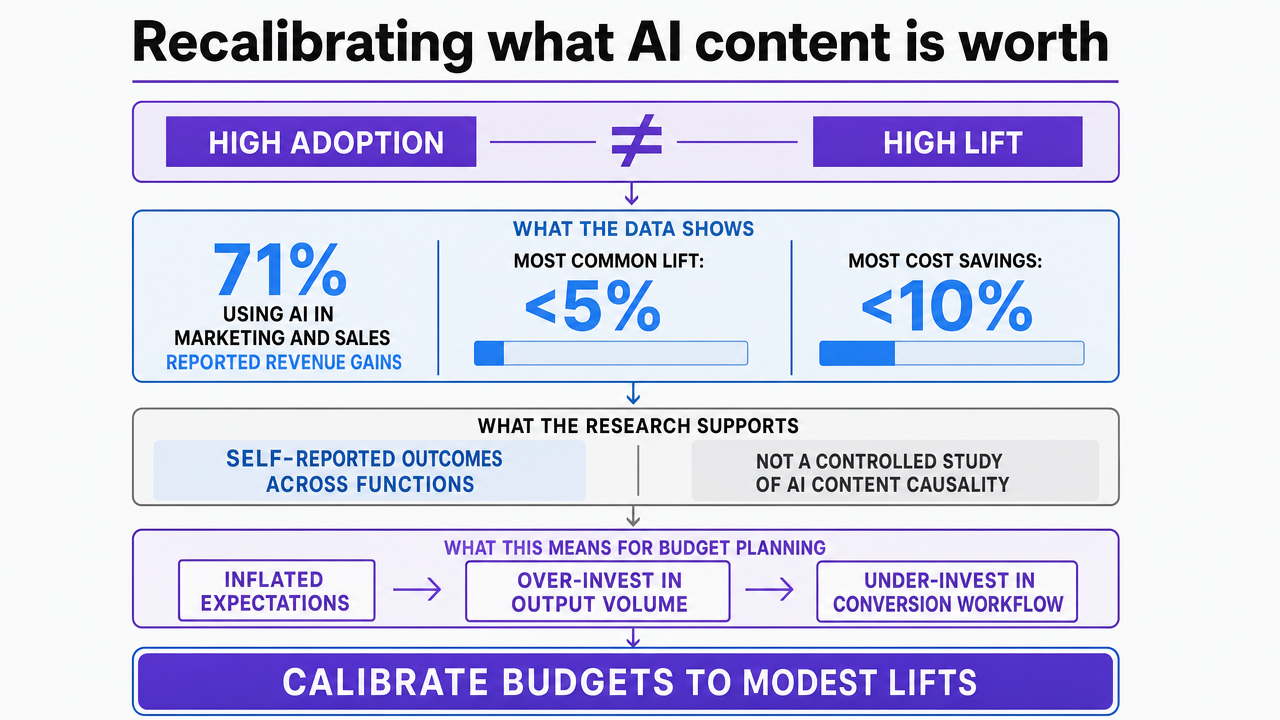 Anchor the section's central claim that reported revenue lifts from AI in marketing/sales are typically modest, giving readers a visual reference for budget calibration
The governed production line
Signal, brief, draft, approval, publish, measure
Access to a capable model is not the constraint anymore. McKinsey's 2025 global survey found that nearly nine in ten respondents said their organizations regularly use AI, while most were still early in scaling it into enterprise-level value 3. The teams closing that gap are not the ones with better prompts. They are the ones running content through a defined production line where each stage has an owner, an input, and a decision.
Six stages carry a blog post from idea to measured outcome:
- Signal is the trigger: a query gaining generative citations, a services page losing rank, a sales call surfacing an objection no post answers.
- Brief translates the signal into a specific assignment, including the target query, the entity the post has to own, the passages that need to be citable, and the proprietary inputs the model cannot retrieve on its own.
- Draft is model-assisted composition against that brief.
- Approval is where a human editor makes the go or no-go call, verifies claims against sources, and signs off on the passages that will be exposed to extraction.
- Publish pushes the approved post with schema, structured data, and internal linking intact.
- Measure closes the loop with classical rank, generative citation presence, and downstream conversion tracked on a defined cadence.
The governance checkpoints sit inside the approval stage, not around it. Every draft should carry a provenance log that records which model produced which passage, which sources were consulted, and which claims the human editor verified 4. Every approval should include a factual QA pass against the cited references and a copyright review confirming the post reflects human expressive judgment, not model output pasted into a template 5. When those checkpoints live outside the workflow, they get skipped under deadline pressure. When they live inside it, the post cannot advance without them.
The output of this system is not just posts. It is a repeatable unit of work with a known cost, a known cycle time, and a known quality floor. That is what separates a team scaling AI content from a team accumulating drafts.
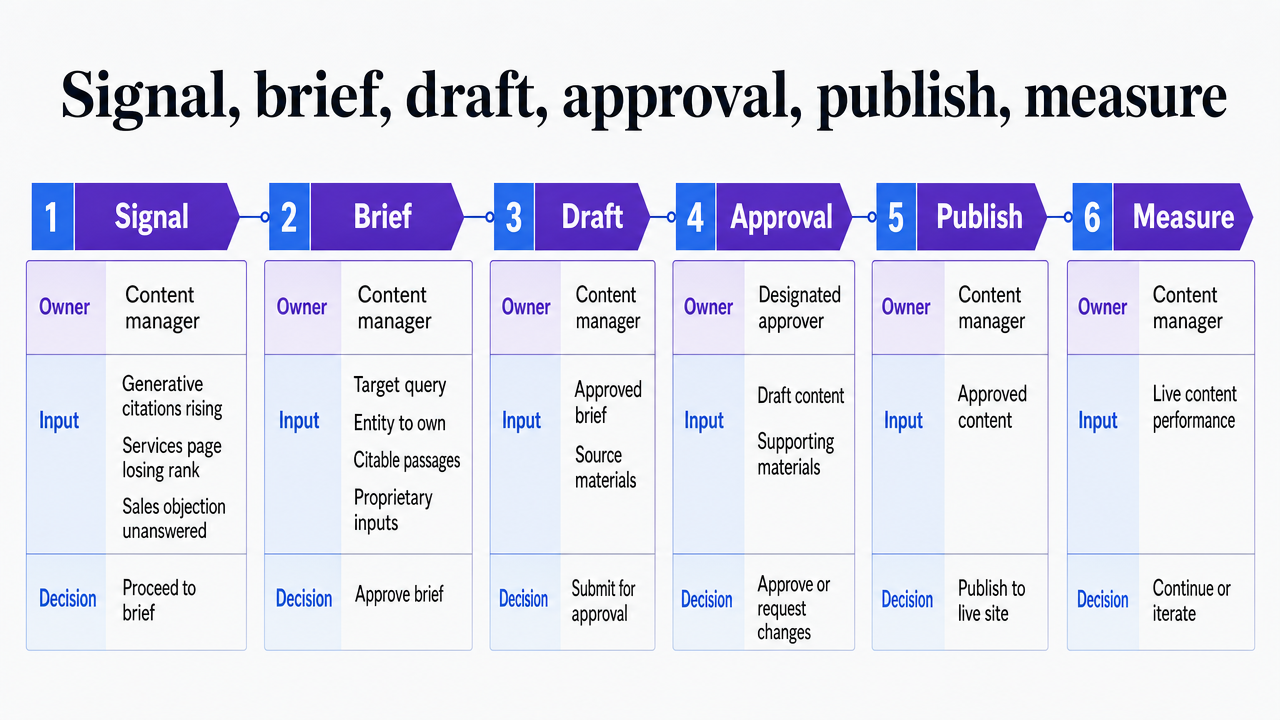 Visualize the six-stage governed production workflow the section describes, making the operating model scannable for content managers
Provenance, copyright, and repurposed customer content
Three legal and trust exposures sit on any AI-assisted blog program at scale, and they compound if the workflow does not address them at the point of publication. Consolidating them into a single approval checkpoint is cheaper than handling them post-hoc when a claim, a takedown, or a regulator inquiry surfaces.
Provenance is the first. NIST's synthetic-content report frames transparency as documenting the origin and history of digital content across the production chain, using a layered combination of metadata, provenance tracking, and audit records rather than a single mechanism 4, 8. For a blog operation, the minimum defensible record includes which model produced which draft, which sources the writer or editor consulted, which images were generated versus licensed, and who approved the final version. That record does not need to be public. It needs to exist and be retrievable when someone asks how a specific post was made.
Copyright is the second. The U.S. Copyright Office's Part 2 report concludes that purely AI-generated material is not copyrightable and that prompts alone are unlikely to establish sufficient human authorship, though AI-assisted work with meaningful human creative contribution, including selection, arrangement, modification, and original expression, can be protected 5, 7. Operationally, that means the approval stage has to capture what the human editor actually changed, chose, or wrote. A workflow that logs edits, restructured arguments, and added original analysis produces a defensible record. One that ships model output with light copy-editing does not.
Repurposed customer content is the third. The FTC's Consumer Reviews and Testimonials Rule holds businesses liable for creating or purchasing fake or false reviews they knew or should have known were false, and notes that AI-generated stock avatars can fall within the testimonial concept depending on presentation 9. Blog programs that convert reviews, case studies, or intake calls into on-page proof need a source-of-truth record tying each quoted outcome to a real customer and a documented result. Composite personas, invented quotes, or AI-generated faces presented as customers are the exposure.
If you manage multiple locations: the consolidation economics
The audience shifts here. Content marketing managers running a single brand blog can skip ahead. This section is for operators supporting multiple locations under one parent: a 40-office DSO, a five-state law firm network, a home services franchise, a senior living portfolio, or a behavioral health group with a dozen clinics. The blog production math for these operators is different, and the AI era changes which structure is cheaper.
The traditional pattern is per-location outsourcing. Each site gets a local agency retainer or a freelance writer producing a handful of posts a month, with brand oversight distributed across regional marketing leads. The pattern scales linearly. Cost per location times number of locations equals total spend, and quality drifts because no one editor sees the full corpus.
A centralized AI-assisted operation inverts that curve. One editorial team runs the production line described earlier, feeds it location-specific inputs (service mix, local intake questions, market data, licensed provider names), and outputs posts that carry consistent structure, provenance, and citation across the network. The variable cost per additional location falls sharply once the workflow is built.
The comparison below is a variable-driven model, not a benchmark. Plug in the figures a finance team can defend from actual invoices.
| Variable | Per-location agency model | Centralized AI-assisted model |
|---|---|---|
| Locations | L | L |
| Articles per location per month | A | A |
| Blended cost per article | C_agency | C_internal + platform subscription / (L × A) |
| Editorial review hours per article | R_local | R_central |
| Monthly total | L × A × C_agency | (L × A × C_internal) + subscription |
Worked example, assumptions labeled: 20 locations, 4 articles each per month (L=20, A=4, so 80 posts). If C_agency is what the operator currently pays each local vendor per post, the per-location model bills 80 × C_agency every month regardless of shared structure. In the centralized model, the platform subscription is fixed, C_internal covers model use and internal editing time, and the workflow investment amortizes across all 80 posts. The break-even point is the ratio at which (L × A × C_internal) + subscription drops below L × A × C_agency. For most portfolios above 10 locations publishing more than 2 posts each per month, the centralized model crosses that line quickly.
Two operational notes. Governance gets easier at scale, not harder, because one provenance log and one copyright review process cover the network instead of 20 inconsistent ones 4. And the proprietary inputs that raise generative citation rates — local intake data, procedure mix, real customer outcomes reviewed under FTC substantiation rules — are already sitting inside the parent organization. The centralized model is the one that can use them.
See How Leading Teams Accelerate Blog Post SEO With AI-Driven Workflows
Connect with our specialists to benchmark your current blog SEO process against AI-powered standards proven to increase publishing velocity and measurable ranking impact—without expanding headcount.
A measurement rubric when clicks and impressions diverge
Legacy blog SEO reporting assumed impressions and clicks moved together. That correlation is breaking. When a generative answer summarizes a post above the classical results, the impression can still register while the click never lands. A content marketing manager who reports only on clicks will show a program in decline while the same program is winning citations inside the answers competitors would kill to appear in.
Four metrics carry a program through this divergence:
- Classical rank still matters for queries where the blue-link result set drives most of the traffic.
- Generative citation presence tracks whether the post is being pulled into AI answers for its target queries, and at what prominence within the response.
- Assisted conversions capture the sessions that arrive on other pages after a user first encountered the brand inside an AI answer, which requires a self-reported field on lead forms or a branded-search lift analysis.
- Cost per published unit closes the loop on the production side, holding the program accountable for throughput and quality at a defined cycle time.
Report these on the same cadence, not in separate dashboards. The point of the rubric is to catch the disagreements early: a post losing clicks but gaining citations is a signal to double down on retrieval structure, not to rewrite the page.
What to stop doing
Three habits from the pre-AI blog era now actively drag on performance:
- Stop publishing thin, undifferentiated posts that any competitor's model can reproduce from the same public sources; they neither rank nor get cited, and at scale they trip spam signals.
- Stop reporting on clicks in isolation, which will show a program in decline while it is quietly winning citations inside AI answers.
- Stop treating human review as a copyedit pass. The approval stage is where provenance, source verification, and original expressive contribution get logged, which is what makes the post defensible under current copyright guidance and what separates protectable work from model output pasted into a template 5.
Programs that keep chasing volume without changing the workflow underneath will produce more drafts, more risk, and less measurable lift. The teams pulling ahead cut the low-value output and reinvest the hours in proprietary inputs and editorial judgment.
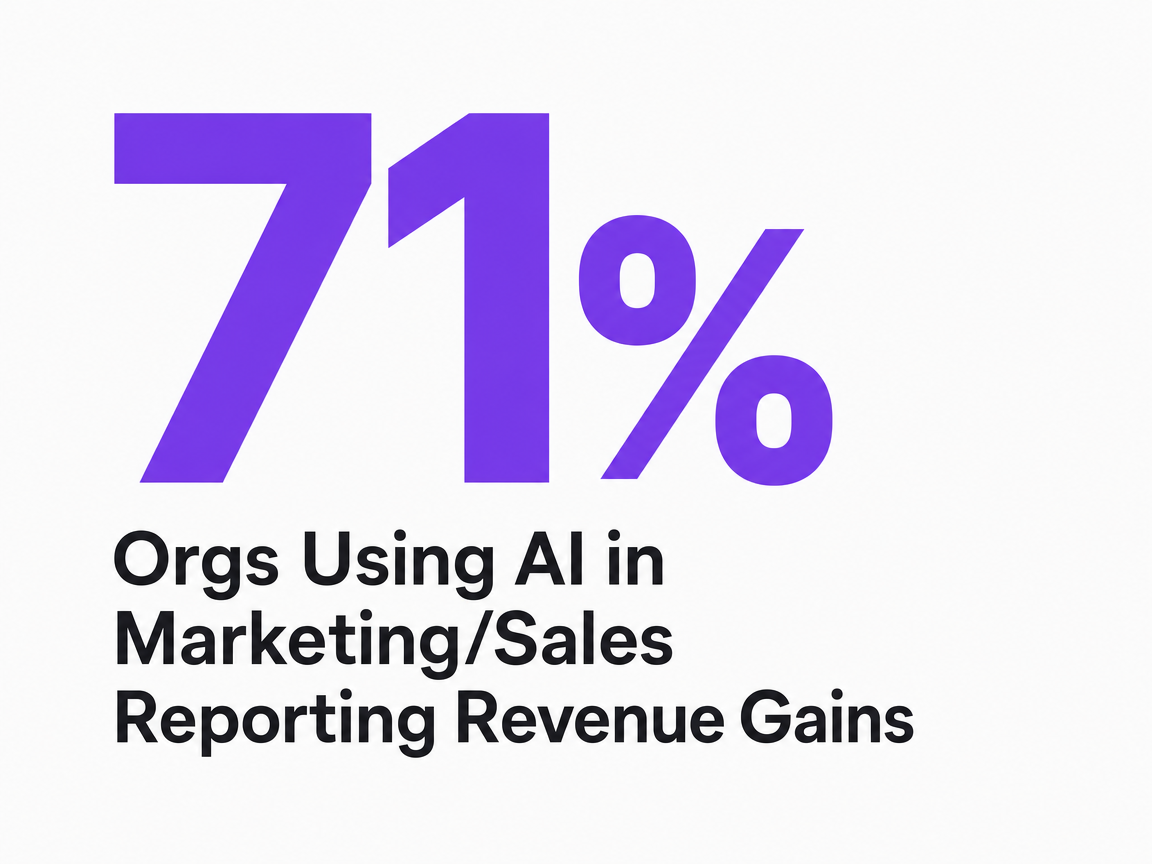 Orgs Using AI in Marketing/Sales Reporting Revenue Gains
Orgs Using AI in Marketing/Sales Reporting Revenue Gains
Frequently Asked Questions
References
- 1.Economy | The 2025 AI Index Report.
- 2.Gen AI's broad reach.
- 3.The state of AI in 2025: Agents, innovation, and transformation.
- 4.Reducing Risks Posed by Synthetic Content.
- 5.Copyright and Artificial Intelligence, Part 2: Copyrightability.
- 6.GEO: Generative Engine Optimization.
- 7.NewsNet Issue 1060.
- 8.Reducing Risks Posed by Synthetic Content: An Overview of Technical Approaches to Digital Content Transparency.
- 9.The Consumer Reviews and Testimonials Rule: Questions and Answers.
- 10.AI Index Report 2025: Chapter 4, Economy.