
Key Takeaways
- Blog pages are now judged by two systems at once: classic SERP ranking and answer-layer inclusion, and a page can win one while losing the other.
- Citation is a testable variable. GEO research showed content interventions lifted generative-response visibility by up to 40% in controlled experiments, though effects varied by domain 9.
- Reporting needs a second column. Pair rank with citation frequency, CTR with AI-feature impressions, and sessions with assisted conversions from branded and direct traffic.
- Governance is production, not overhead. Approved source sets, claim review, subject-matter sign-off, and preserved version history protect against NIST-named risks and support human-authorship claims 10, 1.
The Two-Layer Ranking Problem Content Teams Now Face
Blog rank used to mean one thing: the position a URL held on a search engine results page. That definition still matters, because indexed and crawlable pages remain the substrate generative engines pull from. It is no longer sufficient.
Content managers now operate against two ranking layers at once. The first is the classic SERP, where organic position, impressions, and click-through rate still drive measurable traffic. The second is the answer layer, where AI Overviews, ChatGPT, Perplexity, and Gemini synthesize responses and either cite a source, name a brand, or do neither. A page can hold position three on the blue-link result and still be invisible inside the synthesized answer that sits above it.
The strategic consequence is that a single blog post is now being evaluated by two different judges. Traditional ranking rewards topical authority, backlinks, and query match. Answer-layer inclusion rewards something narrower: a distinct claim, a verifiable source behind it, a structure a retrieval system can parse, and expertise signals that survive summarization.9 NIST's guidance on generative AI reinforces why the second judge is stricter, naming confabulation and information-integrity risks that push engines toward sources with clear provenance.10
The rest of this article works through what changes in production, measurement, and governance when the goal shifts from earning the click to earning the citation, and when both still have to happen on the same page.
Why Citation Has Become the New Rank
What the GEO Research Actually Measured
The clearest empirical starting point for citation optimization comes from a KDD 2024 paper that formalized the practice as Generative Engine Optimization. The authors built GEO-bench, a benchmark of 10,000 queries spanning multiple domains, then tested a set of content interventions to see which ones changed how often a source was included or cited inside a generative engine's response.9
The headline result: tested optimization strategies improved generative-response visibility by up to 40% in controlled experiments, with effects that varied by domain.9 That number is worth using precisely, not loosely. It was measured against a defined document set and a fixed query mix, not against live web results being crawled, re-ranked, and personalized in production. The paper itself frames the finding as evidence that citation-oriented interventions are testable, not as a promise of traffic.
Two details matter for content managers reading past the headline. First, the effects were domain-dependent, meaning a tactic that lifted visibility on factual queries did not necessarily lift it on subjective or comparative ones.9 Second, the study measured inclusion inside synthesized answers, which is a different dependent variable than clicks, conversions, or ranking position.
The strategic implication is narrower than most agency summaries suggest. GEO does not replace SEO, and it does not guarantee that a cited page will receive traffic from the engine that cited it. What it does establish is that the probability of being cited responds to content structure and evidence density in a way that can be measured and improved. That reframes citation from a mystery to a testable variable.
Six Signals That Increase the Probability of Being Cited
The interventions that performed best in the GEO experiments share a structural pattern. They make a page easier for a retrieval system to parse a discrete claim, verify it against a named source, and reproduce it inside an answer without introducing error.9 NIST's guidance on synthetic content transparency reinforces the second half of that pattern by treating source provenance and version history as basic controls for information integrity.3
Six signals recur across both bodies of work. Together they form what content teams can run as a Citation Readiness Audit against any page in the editorial calendar.
- A clear, standalone claim. Each significant section leads with a sentence a retrieval system can lift without surrounding context. Buried claims and hedged framings reduce the chance the passage is selected.
- Cited evidence next to the claim. Statistics, benchmarks, and quoted findings appear adjacent to a named source rather than at the bottom of the page. Retrieval-augmented systems perform better on citation accuracy when evidence and attribution travel together.7
- A structured answer block. Definitions, comparisons, and step lists use headings, short paragraphs, and consistent formatting. This is not a formatting preference; it is what makes a passage extractable.9
- An author expertise signal. A byline tied to a real person with a credential, a role, or a documented track record gives the engine a reason to treat the page as a source rather than a rewrite. NIST's generative-AI profile flags inadequate transparency as a named risk category, which pushes engines toward pages that resolve it.10
- Source provenance. Original research, primary documents, and firsthand data carry more weight than paraphrased secondary coverage. Preserved edit history and documented AI involvement support the provenance claim rather than replace it.3
- Next-step utility. The page answers the question and then tells the reader what to do with the answer. Utility increases the odds of being cited on task-oriented queries, where the engine is looking for a source that resolves the user's next move rather than restating the definition.
None of these signals is exotic. What is new is treating them as a rubric a page has to pass before it is published, rather than optional polish added late in the editorial cycle.
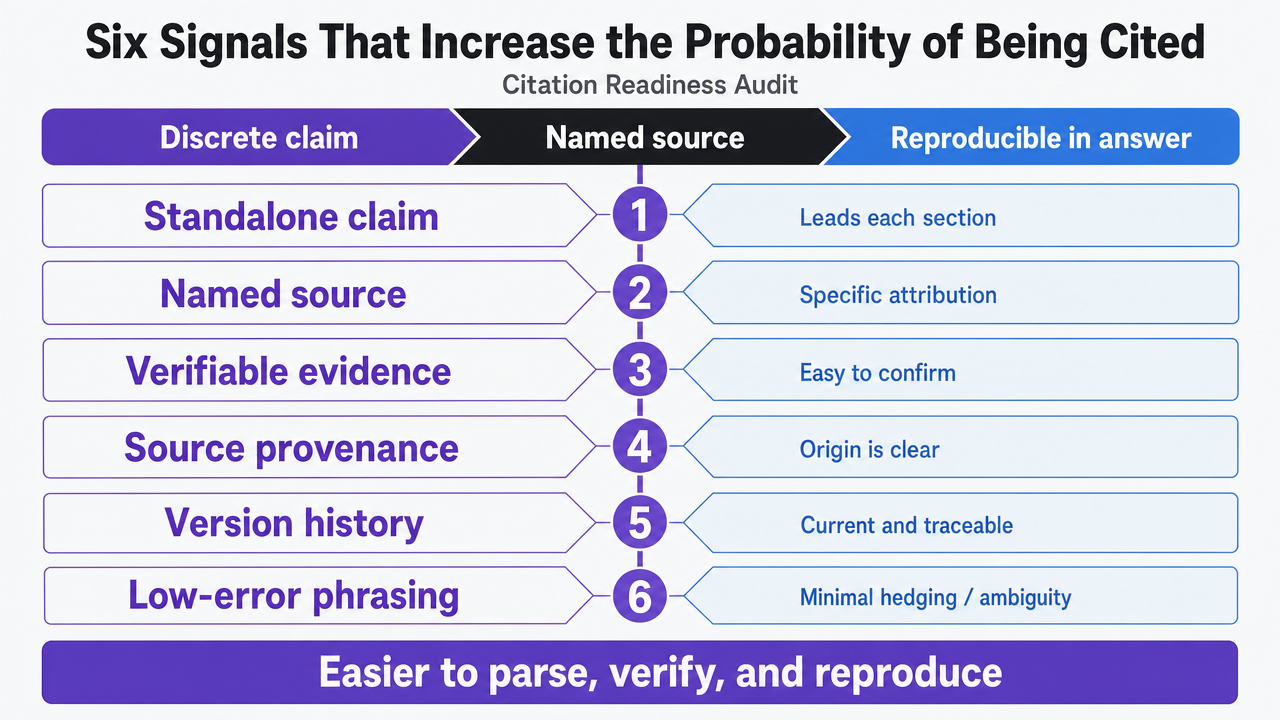 Visualize the six citation-readiness signals listed in the section as a structured rubric content teams can audit against
Measuring What AI Search Actually Rewards
The Visibility-Up, Clicks-Down Dashboard Problem
The standard content dashboard was built for a world in which visibility and clicks moved together. Impressions rose, CTR held, sessions followed, and the funnel filled from the top. That correlation is weakening.
When a generative answer resolves the query on the results page, the source that fed the answer may see its impression counted while its click never lands. The page did its job, and the analytics stack registers a loss. Content managers who report only on organic sessions and CTR are now punished for the exact work that earns citations in synthesized answers.
The measurement gap has three practical consequences. First, ranking reports understate the value of pages that are being cited but not clicked. Second, CTR benchmarks pulled from prior years no longer describe the same query environment, because the SERP surrounding the blue link has changed. Third, executives who ask "what are we doing about AI search?" cannot be answered with a dashboard that has no field for citation frequency or AI-feature presence.
NIST's generative-AI profile frames the underlying issue as one of information integrity and transparency, which is why engines increasingly surface sources inside answers rather than only beneath them.10 The reporting stack has to catch up to that behavior. A dashboard that treats AI-answer inclusion as invisible will keep telling the same story it told in 2022, and it will be wrong in a way that is hard to defend at a quarterly review.
A Two-Column Measurement Stack for the Next QBR
The fix is not a new tool. It is a second column on the same report.
Content teams already track a familiar set of classic SERP metrics: average rank position, organic CTR, impressions, indexed pages, and the sessions and conversions that follow. Those numbers stay. What changes is that each one now sits next to a parallel AI-answer metric that describes the second judge introduced in section one.
The paired stack looks like this in practice:
- Rank position pairs with citation frequency, meaning how often the domain or URL appears as a named source inside a synthesized answer for tracked queries.
- Organic CTR pairs with AI-feature impressions, capturing how often a page's content is used to compose an answer even when the click does not resolve.
- Impressions pair with branded query lift, because a citation that does not produce an immediate click often produces a branded search minutes or days later.
- Sessions and conversions pair with assisted conversions from branded and direct traffic that follow AI-answer exposure.
Framing the report this way does two things at a quarterly review. It shows executives that visibility is being measured on both surfaces, and it separates the metrics that reward citation-quality work from the metrics that reward click-capture work. Those two goals no longer move together on every page, and averaging them hides the trade-off.
The GEO research supports the shift by demonstrating that inclusion inside generative responses is itself a measurable dependent variable, not a mystery.9 What the paper does not do is prescribe a specific tool. Content managers should expect to combine search-console data, third-party AI-visibility trackers as they mature, branded-query trend lines, and manual citation audits on priority queries. The point is not tool selection. It is refusing to report one column when the query environment now has two.
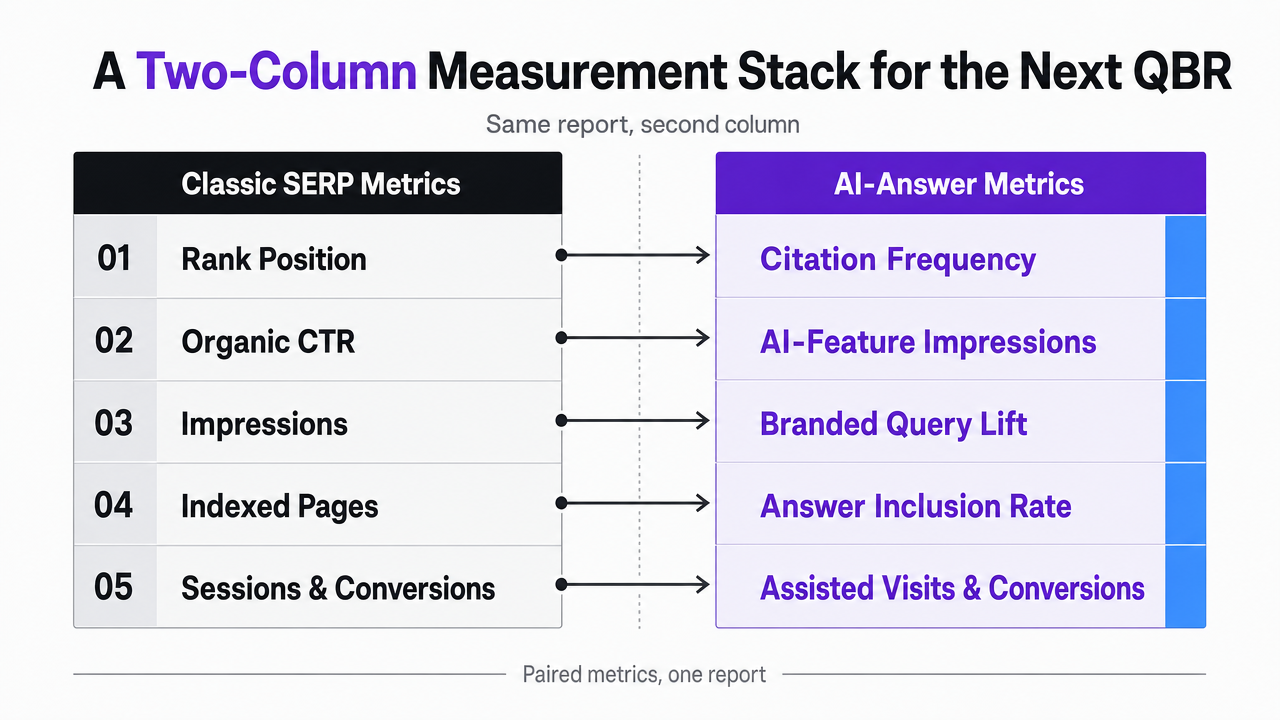 Show the paired-metric measurement framework described in the section: each classic SERP metric sitting next to its AI-answer counterpart
Test AI-Driven Blog Ranking in Real Time
See measurable impact on your blog rankings with live, publish-ready content during your trial.
Governance Is Now Part of the Production Line
The Risks That Make Approval Gates Non-Optional
Citation-worthy content and unreviewed AI drafts live on opposite sides of a short list of named risks. NIST's Generative AI Profile catalogs them plainly: confabulation, misinformation, harmful bias, privacy exposure, information-integrity failures, and inadequate transparency about how a piece of content was produced.10 Each risk maps to a failure mode a content manager has already seen at least once, whether it was a fabricated statistic in a draft, a hallucinated source URL, or a claim about a regulated service that no clinician or attorney had reviewed.
Approval gates exist to catch those failures before publication rather than after. NIST frames the recommended controls as actions an organization uses to identify and manage generative-AI risks to information integrity and reliability.10 Translated into a blog production line, that means at least four gates:
- Source selection
- Claim review
- Expert or subject-matter sign-off for regulated topics
- Final publication approval that ties a named human to the version being shipped
The gates are not bureaucratic overhead. They are the mechanism that lets a team scale draft volume without scaling risk exposure at the same rate. A page produced quickly by an AI draft and shipped without review carries every risk on the NIST list. The same draft, run through gates that verify sources, escalate uncertain claims, and record who approved what, carries the risks the profile was written to contain.
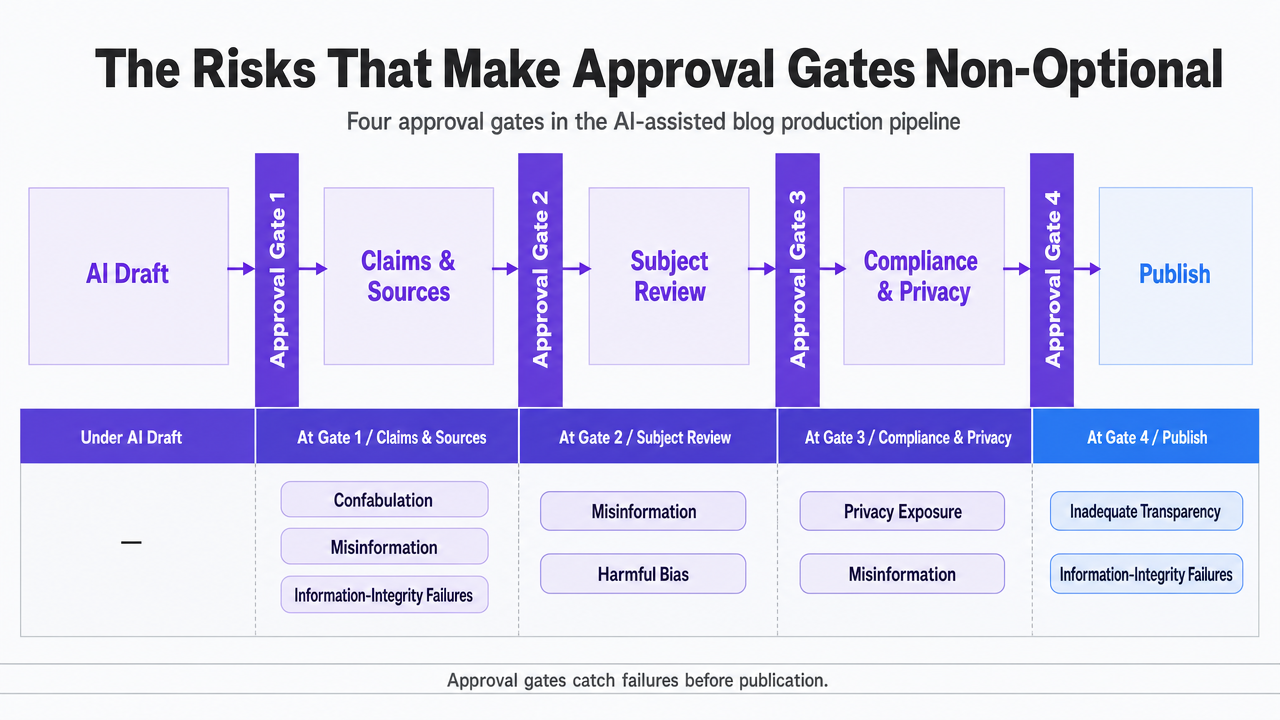 Diagram the four approval gates in the AI-assisted blog production pipeline described in the section, mapped against the NIST-named risks they contain
Provenance, Version History, and Human Authorship
Two separate questions sit under the word "provenance."
Technical : Can the team reconstruct where a claim came from, which sources fed the draft, what was edited, and who approved the final version.
Legal : Does the finished blog post qualify as a work of human authorship the publisher can defend as its own.
NIST's synthetic-content report treats the technical side as a set of practices, not a single tool. Authenticating content, tracking provenance, labeling synthetic content, and auditing systems that produce it are presented as complementary controls rather than a mandatory standard.3 The DoD Content Credentials guidance extends the same principle to multimedia, encouraging creators to preserve records that identify AI involvement and the transformations a file has passed through.8 Applied to blog production, that translates into concrete artifacts: the approved source set behind a draft, the diff between the AI-generated version and the human-edited one, the byline and reviewer, and a timestamped record of the final approval.
The legal side lands squarely on human contribution. The U.S. Copyright Office's Part 2 report concluded that AI-generated material is not protected by copyright on its own, while AI-assisted work can be protected where a human author determines sufficient expressive elements through selection, arrangement, editing, or original contribution.1 A follow-up Copyright Office notice reinforced that prompts alone do not clear the bar, but AI assistance embedded in a larger human-created work does not automatically forfeit protection either.4
The operational consequence is the same in both directions. A production line that preserves version history, documents human editorial decisions, and keeps a byline tied to a real reviewer produces content that is easier to defend as authored work and easier to trace when a claim is later challenged. A pipeline that discards those artifacts loses both defenses at once.
Testimonials, Case Narratives, and the FTC Boundary
Blog content in service verticals routinely borrows from client stories, patient outcomes, and case results. That practice now sits inside a specific federal rule. The FTC's 2024 final rule prohibits businesses from creating, selling, buying, or disseminating consumer reviews and testimonials they know or should know are fake or false, and the agency explicitly named AI-generated fake reviews as within scope.5
The rule does not restrict ordinary AI-assisted editorial writing. What it restricts is representation. The FTC's practical Q&A clarifies that there is no blanket prohibition on AI-generated avatars or AI-assisted drafting, but a testimonial becomes prohibited when the underlying experience it represents is fake, misattributed, or misleading about the reviewer's actual relationship to the business.6
For a content team, the boundary is drawn at a single question: does this paragraph claim someone had an experience they did not actually have. An AI-drafted case narrative that summarizes a real, documented client outcome with the client's permission is editorial work. A composite "patient story" generated to sound authentic, or a review-style quote assembled from training data, crosses the line the rule was written to enforce.
The gate that catches this is not technical. It is an approval step in which someone with access to the underlying record confirms the person, the experience, and the permission before the passage is published.
Retrieval-Constrained Drafting: The Workflow That Preserves Trust at Speed
The production bottleneck in most content teams is not writing speed. It is the review cycle that follows a draft written from open-ended prompts, where an editor spends more time verifying claims and hunting sources than shaping prose. Retrieval-constrained drafting inverts that sequence.
The workflow is simple to describe and specific in what it forbids. Sources are selected and approved first. The draft is generated only from that fixed set, with each claim tied to a passage in one of the approved documents. Editors then work on structure, voice, and expertise layering rather than fact reconstruction. The AI is not asked what it knows. It is asked what the approved sources support.
The evidence that this changes output quality comes from a peer-reviewed study on scientific-literature synthesis using retrieval-augmented language models. Non-retrieval baselines struggled to generate correct citations, while retrieval was reported as "almost always conducive" to better performance on the evaluated tasks.7 The study's setting is specialized, and the authors are clear that gains in literature synthesis do not automatically transfer to marketing or local-service content without domain-specific controls.7 What transfers is the mechanism: constraining the draft to a vetted source set reduces the two failure modes that break editorial trust at scale, fabricated statistics and hallucinated citations.
Three operational details make the difference between a workflow that scales and one that only sounds like it does:
- The approved source set is documented per article, not per topic cluster, so a reviewer can reconstruct exactly what the draft had access to.
- The final version preserves the diff between the AI-generated draft and the human-edited output, which supports both the provenance record described earlier and the human-authorship posture the Copyright Office requires.1
- The reviewer who signs off is the same person named in the byline, which closes the loop between the expertise signal on the page and the human accountable for it.
Speed comes from removing the fact-hunting step, not from removing the reviewer.
See How AI Search Is Redefining Blog Ranking Tactics for Agencies
Connect with a specialist to analyze your current blog ranking strategy and learn how leading brands are adapting to AI-powered search for measurable SEO performance gains.
If You Manage Multiple Locations, the Math Changes
The framing so far applies to any content team publishing a single brand blog. The economics shift when a content manager is responsible for editorial output across a portfolio of locations: law firms with regional offices, DSOs with dozens of practice sites, home-services franchises, senior-living communities, or health systems with distinct service lines. The unit of work multiplies, but the governance requirements do not scale down.
Each location typically needs some volume of location-specific content: service pages that reflect local providers, blog posts that address regional questions, and case narratives tied to real clients or patients at that site. Running that stack through a traditional agency-plus-freelancer pipeline means the same brief-write-edit-approve cycle repeats at every site, and the review burden grows linearly with the location count. Retrieval-constrained drafting compresses the drafting step, but the FTC's boundary on testimonials still requires a human at each location to confirm the underlying record before a case narrative publishes.5, 6
The honest way to size the trade-off is a worksheet, not a benchmark. Content managers can populate four variables they already know:
- Number of locations
- Articles per location per month
- Average fully loaded cost per article in the current pipeline
- The review hours each article consumes across editorial, subject-matter, and compliance sign-off
Multiplying those variables produces the current monthly load. Comparing it against a governed AI-assisted pipeline requires only two substitutions: a per-seat platform cost and a revised review-hours figure that reflects fact-hunting removed from the reviewer's job.
The variable most teams underestimate is review hours, because they price the draft and not the approval gates the NIST profile requires.10 A pipeline that halves drafting time but preserves the same fact-verification burden will not scale to fifty locations. A pipeline that constrains drafts to approved sources and preserves version history collapses the verification step into a diff review, which is where the multi-location math actually changes.
What the Research Does Not Say
A strategist's job includes naming the limits of the evidence the strategy rests on.
The GEO benchmark measured inclusion inside synthesized answers under controlled conditions with a selected document set. It did not model live crawling, personalization, competitive re-ranking, or downstream conversion, and the authors are explicit that the up-to-40% visibility lift was domain-dependent rather than uniform.9 Citation lift is not the same as traffic, and neither is the same as revenue.
The retrieval-augmented generation study that supports constrained drafting was run on scientific-literature synthesis. The authors caution that gains in that setting do not automatically transfer to marketing, legal, or local-service content without domain-specific controls.7
NIST's guidance is voluntary risk management, not a search-ranking rule.10 Provenance metadata can be stripped or lost across platforms and should complement editorial review rather than replace it.3 The strategy in this article is defensible because its sources are named. It is not a guarantee. Treat every tactic as a hypothesis worth testing against the team's own query set.
Frequently Asked Questions
References
- 1.Copyright and Artificial Intelligence: Part 2, Copyrightability.
- 2.Part 3: Generative AI Training pre-publication version.
- 3.Reducing Risks Posed by Synthetic Content: An Overview of Technical Approaches to Digital Content Transparency.
- 4.NewsNet Issue 1060.
- 5.Federal Trade Commission Announces Final Rule Banning Fake Reviews and Testimonials.
- 6.The Consumer Reviews and Testimonials Rule: Questions and Answers.
- 7.Synthesizing scientific literature with retrieval-augmented language models.
- 8.Strengthening Multimedia Integrity in the Generative AI Era.
- 9.GEO: Generative Engine Optimization.
- 10.Artificial Intelligence Risk Management Framework: Generative Artificial Intelligence Profile.