
Key Takeaways
- Semrush delivers strong keyword breadth and competitive gap analysis but lacks CRM write-back, multi-touch models, and account-level rollups, keeping it in a research role rather than a reporting one.
- Ahrefs excels at backlink depth and share-of-voice tracking for content architects, yet produces rank diagnostics rather than revenue narratives without a downstream attribution layer paired to it.
- Clearscope compresses briefing cycles and lifts production velocity, which matters because pipeline attribution needs published volume in the numerator, but it offers no CRM join or attribution model.
- HubSpot Content Hub gives teams a native CRM join and account-level rollup through company records 4, though SEO depth stays shallow enough that most pair it with Semrush or Ahrefs.
- Dreamdata stitches GA4, product analytics, and CRM records into account-level journeys with configurable multi-touch credit 7, placing blog posts as timestamped touches on opportunity records.
- 6sense and Demandbase resolve anonymous blog traffic to accounts through intent data, adding buying-committee signal at the account level 6rather than throughput or keyword research coverage.
- GA4 joined to a CRM through BigQuery is the buildable baseline that answers the pipeline-influence question 5, though it demands a data function and a two-quarter horizon.
- Vectoron routes content, SEO, backlinks, and call intelligence through one approval workflow at $599/mo platform pricing, shifting the denominator of any cost-per-influenced-opportunity calculation.
- Pathmonk and Factors.ai fill the mid-market gap between GA4 and enterprise attribution, offering pre-built multi-touch models and CRM integration without a data engineering project.
Why keyword-first tooling underreports content's revenue impact
Rank trackers answer a narrow question: did the page move up the SERP? That answer stopped satisfying finance around the same time B2B buying committees stopped behaving linearly. In the 2024 B2B campaign ROI benchmark set, 42% of pipeline traces back to marketing-influenced touchpoints, and multi-touch models expose 67% more influenced pipeline than single-touch measurement records, a 1.67x uplift over what last-click and first-click dashboards report 3. A keyword-first stack, tuned to position and session volume, sits on the wrong side of that gap.
The measurement failure is structural, not cosmetic. When a blog post assists an opportunity three touches before a demo request, a rank tool credits the demo request page and the paid campaign that triggered it. The blog visit disappears from the revenue story even though it entered the account's journey. Content marketing carries a meaningful share of assist credit in algorithmic B2B attribution 2, and that share is precisely the credit rank-only tooling erases.
Content managers defending budget against CFO scrutiny inherit the consequence. The blog looks like a traffic line item instead of a pipeline contributor. The fix is not more keyword coverage. It is tooling that joins content interactions to CRM opportunities so the assist credit shows up in the same report as the closed-won number.
The pipeline-attribution rubric: five capabilities that separate revenue tools from rank tools
Every tool in the next section is scored against the same five capabilities. Content managers can apply the same rubric to anything not covered here, including whatever their current stack already includes.
- Buying-committee keyword research. The tool has to surface queries by demand state and by committee role, not just by monthly search volume. A economic buyer researching vendor consolidation and a practitioner troubleshooting a workflow use different language, and blog coverage tuned to one rarely reaches the other. Volume-first keyword tools blur that distinction.
- GA4 and CRM join. The tool has to either write content interactions into the CRM opportunity record or expose an identity graph that a data team can join. Without that join, blog visits stay in the analytics layer and closed-won stays in the CRM layer, and no report crosses the seam. This is the technical requirement behind every pipeline-influence metric the reader will be asked to produce 4.
- Multi-touch attribution model. Last-touch dashboards credit the demo-request page. Multi-touch models distribute credit across the sequence, which is where blog content sits. In algorithmic B2B attribution, content marketing carries 28–34% of total assist credit 2, and only a model that assigns fractional credit will surface that share.
- Account-level reporting. B2B pipeline attribution is defensible at the account level, not the visitor level, because buying committees involve multiple people on different devices 6. Tools that only report on session-level conversions cannot roll up to opportunity records.
- Production velocity. A tool that scores well on the first four but adds a week to every brief still fails the budget defense. Throughput matters because pipeline attribution needs volume in the numerator, not just precision in the denominator.
How attribution-aware tools close the dark-funnel gap
Multi-touch attribution adoption in B2B measurement stacks climbed from 31% in 2023 to 47% in 2026, and the average dark-funnel gap, the share of B2B pipeline that current attribution tools cannot see, still runs about 38% 1. Half the market has moved to multi-touch models, and a third of the pipeline remains invisible to those models. Blog SEO tooling sits directly on that fault line.
Attribution-aware tools close the gap in three ways. First, they collect content interactions with identity signals, not just cookies: form fills, gated asset downloads, newsletter subscriptions, and identity-graph resolution against enriched account data. A rank tracker records the position. An attribution-aware tool records who read the post and which account they belong to. Second, they write those interactions into the CRM opportunity record as timestamped touches, so a closed-won deal carries a readable history of which blog posts appeared in the journey. Third, they apply a fractional credit model across the sequence, which is where the 38% dark-funnel share starts becoming reportable rather than lost.
The practical consequence for a content manager is narrower than the category language suggests. It means blog posts that assisted an opportunity three weeks before the demo request show up in the same pipeline report the CFO already reads.
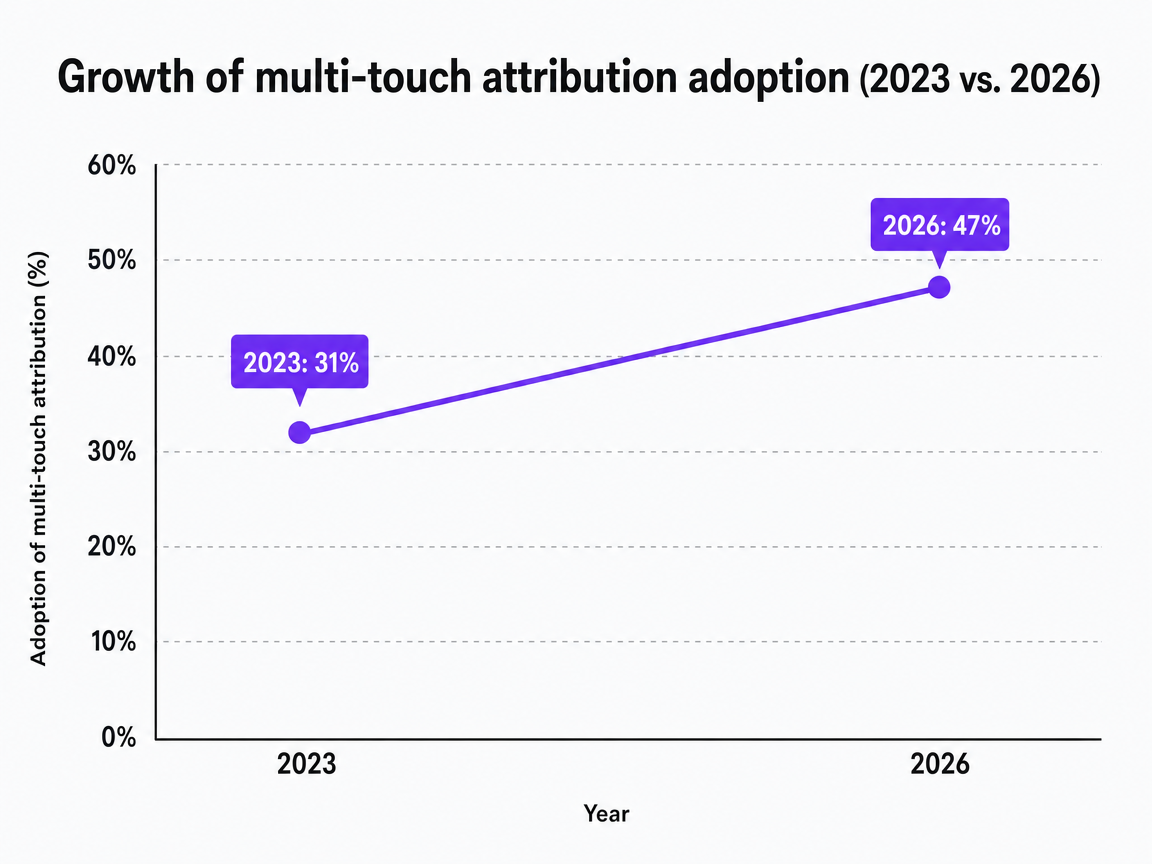 Growth of multi-touch attribution adoption (2023 vs. 2026)
Shows the actual (2023) and projected (2026) adoption rate of multi-touch attribution, indicating significant growth.
Test Pipeline-Driven Blog SEO Execution Now
Experience end-to-end SEO content delivery tied directly to measurable pipeline impact—risk free for seven days.
Nine blog SEO tools evaluated against the pipeline rubric
Semrush: keyword breadth without the CRM join
Semrush earns its shelf space on keyword breadth. Its database covers query variants, SERP feature tracking, competitive gap analysis, and topic clusters at a scale that few tools match. For a content manager mapping a topical footprint before a quarter of production, that breadth still matters.
Against the pipeline rubric, Semrush scores on capability one and falters on the other four. Buying-committee segmentation is possible through manual filtering, but the tool ranks queries by volume and difficulty, not by demand state or committee role. There is no native write-back to a CRM opportunity record, no multi-touch model that credits blog assists across a sequence, and no account-level rollup. Production velocity depends on how a team layers briefs onto the keyword data.
Semrush belongs in the stack as a research layer. It does not, on its own, answer the pipeline question a CFO asks.
Ahrefs: rank and backlink depth for content architects
Ahrefs remains the reference tool for backlink analysis and organic share-of-voice tracking. Content teams building topical authority around a cluster use its site explorer and content gap features to map which competing pages already own the assist positions in a category.
The rubric exposes the same limits as Semrush. Ahrefs scores strongly on keyword and link intelligence, weakly on CRM integration, and not at all on multi-touch attribution or account-level reporting. Rank and referring domains are the outputs. Pipeline is not.
Content architects who need to prove that a specific post moved a specific opportunity through stages will pair Ahrefs with a downstream attribution layer. Used alone, it produces excellent SEO diagnostics and no revenue narrative. That is a legitimate use, but it is a research role in a pipeline-aware stack, not the reporting role.
Clearscope: brief-level optimization at production scale
Clearscope operates one layer down from Semrush and Ahrefs. It scores drafts against the semantic profile of top-ranking pages, gives writers a target term list, and produces briefs that reduce revision cycles. For teams pushing throughput, that compression on production velocity is the point.
Against the rubric, Clearscope is a production-velocity tool, not an attribution tool. It has no CRM join, no multi-touch model, and no account-level reporting. It does not claim to. What it offers is a measurable reduction in the time between keyword selection and publish, which matters because pipeline attribution needs published volume in the numerator.
A pipeline-aware stack uses Clearscope to keep output moving and routes the reporting question to a different tool.
HubSpot Content Hub: native CRM join, uneven SEO depth
HubSpot Content Hub inverts the tradeoff. The CRM join is native because the CMS, the marketing automation, and the CRM sit on one record. A blog visit from a known contact writes into the timeline of that contact's associated deal, which is exactly the chain of evidence pipeline reporting requires 4. Content managers running HubSpot inherit the join for free.
The rubric scores are uneven. HubSpot handles CRM integration, account-level rollup through company records, and reasonable session-to-opportunity attribution. Multi-touch models are available in higher tiers with variable configurability. SEO depth, keyword research, SERP feature tracking, and competitive analysis remain shallower than the dedicated tools above, so most teams pair HubSpot with Semrush or Ahrefs upstream.
For teams already on HubSpot, the CRM join is the fastest path to reporting content-influenced pipeline in the same view as revenue.
Dreamdata: content-to-opportunity attribution for B2B teams
Dreamdata was built for the reporting question the earlier tools sidestep. It ingests GA4 content path data, product analytics, CRM opportunity records, and enrichment identifiers, then stitches them into account-level journeys with multi-touch credit distribution. Blog posts appear as timestamped touches on opportunity records, which is the join content managers need to report pipeline influenced by content alongside direct attribution 7.
Rubric scores are strongest where the earlier tools were weakest. CRM join is native. Multi-touch models are configurable, including data-driven and Markov-based options. Account-level reporting is the default view. Buying-committee keyword research is not a Dreamdata function, so it does not replace research tools. Production velocity is unaffected because it operates downstream of publishing.
Dreamdata is a reporting layer that pairs with a keyword tool and a production tool. Used correctly, it is where the CFO's pipeline number and the content team's assist number meet on one row.
6sense and Demandbase: account-level content signal
6sense and Demandbase approach the rubric from the account side. They resolve anonymous blog traffic to identified accounts through intent data and reverse-IP graphs, then surface account-level engagement scores that sales and marketing operations use to prioritize outreach. For content managers, the value is turning anonymous blog sessions into account signal that can be joined to opportunity records.
Rubric strengths are account-level reporting and buying-committee visibility through intent taxonomies. CRM join is well-established through Salesforce and HubSpot integrations. Multi-touch attribution is available but is typically account-scoped rather than session-scoped, which matches how B2B pipeline attribution is defensibly reported 6. Neither platform is a keyword research tool or a production tool.
These platforms make sense for content programs where the account list is finite and the sales motion is targeted. They add signal, not throughput.
Google Analytics 4 with CRM sync: the buildable baseline
GA4 joined to a CRM through a data warehouse is the baseline every other tool competes with. BigQuery export, a Salesforce or HubSpot connector, and a modeling layer produce content path data joined to opportunity records without a new vendor. The reporting question, what percentage of pipeline interacted with content before entering, is answerable with this setup 5.
Rubric scores depend on the data team. CRM join is buildable. Multi-touch attribution requires modeling work, and account-level rollup requires identity resolution the team has to configure. Keyword research is not covered. Production velocity is unaffected.
Teams with a data function and a two-quarter horizon can reach a defensible pipeline report from GA4 and CRM alone. Teams without that function will spend the same money on a packaged attribution layer and start reporting sooner.
Vectoron: approval-first content production with pipeline join
Vectoron sits at a different point on the rubric than the tools above. It is a production platform coordinated through a specialist strategist layer, with content, SEO, backlinks, and call intelligence routed through a single approval workflow. The pipeline join comes from reading live business data, qualified calls, bookings, cost per lead, and pipeline, and ranking content recommendations against that data before execution.
Rubric coverage is broader than a single tool but narrower than a full attribution suite. Buying-committee coverage is handled through the strategist layer rather than a keyword database. CRM integration and account-level reporting depend on the connected systems. Multi-touch attribution is inherited from whichever measurement layer is joined. Production velocity is the strongest score because approval-first automation removes briefing cycles and vendor coordination overhead.
Platform pricing is $599/mo after a two-week trial. That is platform pricing, not per-post cost, and it changes the denominator of any cost-per-influenced-opportunity calculation.
Pathmonk and Factors.ai: session-level intent for mid-market stacks
Pathmonk and Factors.ai target the mid-market gap between GA4 and enterprise attribution platforms. Both capture session-level intent signals from blog and site behavior, resolve identities where possible, and push events into CRM and marketing automation records. They are lighter-weight than Dreamdata and more attribution-focused than 6sense.
Rubric scores are moderate across the board. CRM integration is available, multi-touch models are pre-built rather than deeply configurable, and account-level rollup depends on the identity graph the team supplies. Keyword research and production velocity are outside their scope.
For content teams whose measurement budget rules out a full attribution suite, these tools provide a workable path to reporting content-influenced pipeline without a data engineering project.
Case pattern: what a pipeline-focused stack produced for one mid-market SaaS team
One mid-market SaaS team reworked its blog SEO stack around the pipeline rubric: buying-committee keyword research feeding demand-state content, GA4 content paths joined to CRM opportunity records, and account-level rollups instead of session-level conversion reports. Six months in, the program produced a 73% lift in qualified organic leads, $2.1M in influenced pipeline, and a qualified lead conversion rate 67% higher than the generic traffic approach it replaced 9.
The pattern worth borrowing is not the headline number. It is the sequence. Keyword research anchored on committee roles produced posts that matched how economic buyers and practitioners actually searched. GA4-to-CRM join wrote those blog visits into opportunity timelines. Account-level reporting rolled the credit up to the same records finance already reviewed. Rank movement was a byproduct, not the goal.
Content managers should read this as a mid-market SaaS case, not a universal outcome. The mechanism generalizes: pipeline reporting requires the join. The magnitude depends on baseline, deal size, and sales cycle.
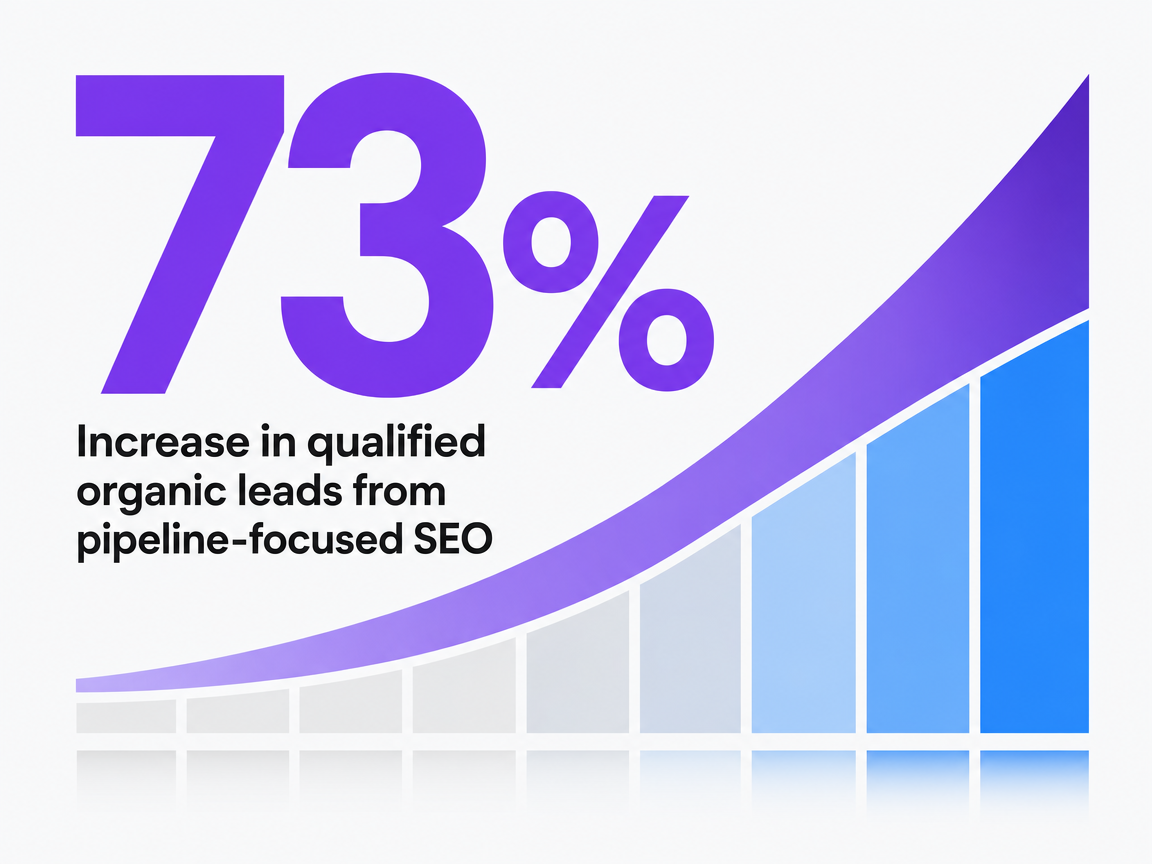 Increase in qualified organic leads from pipeline-focused SEO
Increase in qualified organic leads from pipeline-focused SEO
ROI math when attribution matures: what to expect over 24 months
The measurement literature gives content managers a defensible window to negotiate against. Peer-reviewed work on multi-touch attribution finds organizations post average performance gains of 15–25% within 24 months of implementing multi-touch models 8, and analyst-sourced B2B benchmarks put mature multi-touch programs at 15–30% higher marketing ROI than last-touch peers 2. The two ranges overlap for a reason: the gains come from crediting assists that single-touch dashboards were already erasing, and blog content sits inside that assist layer.
The practical read for a content budget defense is narrower. A 24-month ramp does not mean 24 months of silence. It means the first two quarters go to instrumentation and cohort baselining, the next two go to reporting content-influenced pipeline against untouched pipeline, and the back half is where the ROI delta stabilizes into a number finance will hold the program to. Content managers who commit to that sequence trade a slower reporting start for a durable revenue narrative.
Scale Blog SEO Output Without Adding Headcount or Compromising Quality
See how enterprise teams and agencies use unified AI-powered workflows to connect blog content directly to pipeline impact—eliminating manual status checks, briefing cycles, and coordination bottlenecks.
If you manage blogs across multiple locations, practices, or brands
Scope shift: this section is written for content managers running blog programs across DSO practices, multi-office law firms, senior living portfolios, or home services brands, not single-site operators. The economic argument here is different because the duplication is different.
Per-location blog production usually repeats the same three cost drivers: keyword research redone brand by brand, briefing cycles negotiated with the same agency or freelancers across each entity, and attribution setups rebuilt for each CRM instance. The keyword research layer is where the duplication is most wasteful, because demand-state and buying-committee queries generalize across locations far better than local operators assume. One research pass tuned to committee roles feeds twenty brand blogs with local variants layered on top.
The consolidation math depends on variables a portfolio operator already has: posts per location per month, blended cost per post across current production models, and the number of separate attribution joins the stack currently maintains. Fewer briefing cycles plus a shared research layer plus one attribution join across brands lowers the cost per influenced opportunity, which is the denominator finance actually tracks against content-sourced CAC 7. Platform-priced tooling changes that denominator differently than per-post agency pricing does, and portfolio operators should model both against their current post cadence before committing.
A 30-day plan to move your stack from rankings to revenue reporting
Thirty days is enough to change what a blog SEO stack reports on, not enough to change what it produces. That distinction matters, because the first defensible pipeline number a content manager delivers to finance comes from instrumentation work, not from a new production sprint.
- Days 1–7: baseline the join. Confirm GA4 content path data is flowing, then audit whether blog interactions write into CRM opportunity records today. If the answer is no, that is the single blocking issue. Nothing downstream reports pipeline influence without the join 4.
- Days 8–15: tag the cohort. Pick the last 90 days of closed opportunities and flag which ones had at least one blog touch before entering the pipeline. That cohort split, content-influenced versus untouched, is the reporting spine finance will actually read 5.
- Days 16–23: layer the model. Move from last-touch to a fractional multi-touch view on the tagged cohort, rolled up to the account level rather than the session level 6.
- Days 24–30: report in the CFO's language. Deliver one page: revenue attributed to content, cost per influenced opportunity, and quarter-over-quarter pipeline growth from content 10.
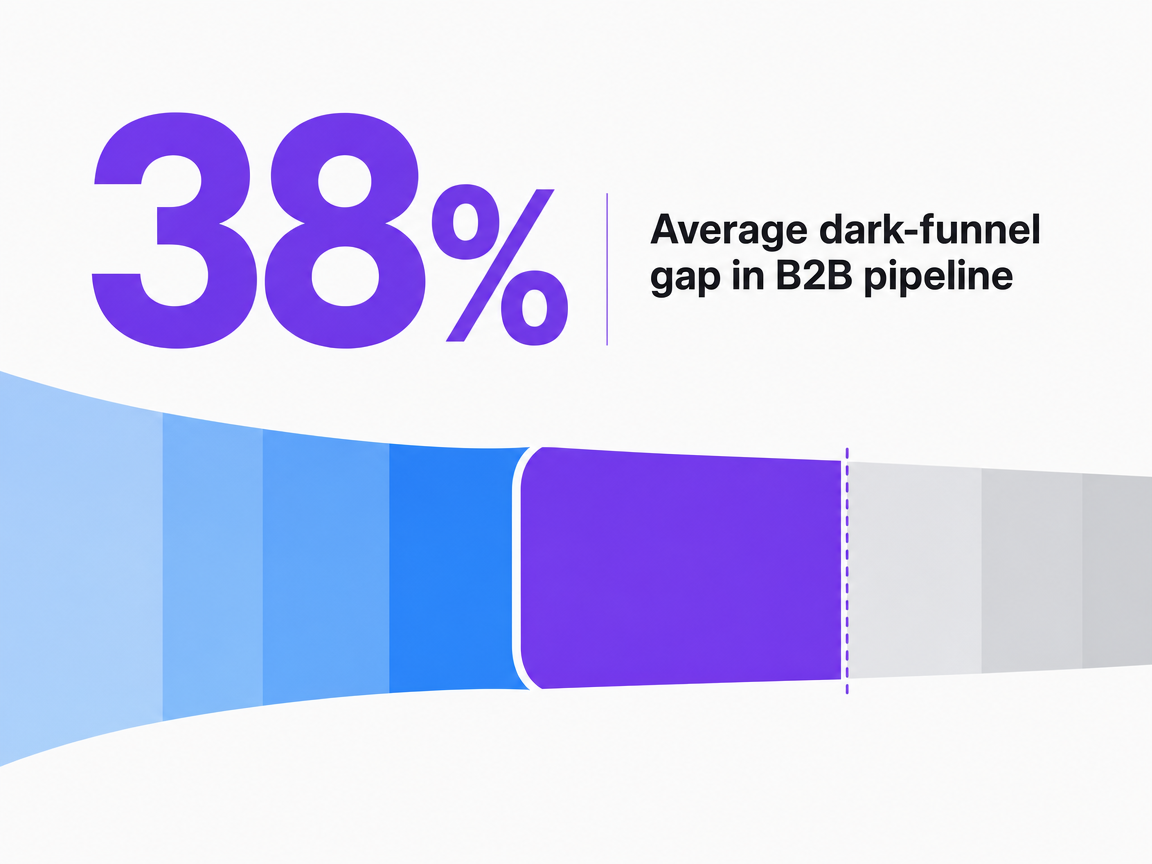 Average dark-funnel gap in B2B pipeline
Average dark-funnel gap in B2B pipeline
Frequently Asked Questions
References
- 1.Marketing Attribution Statistics 2026: 140 Data Points.
- 2.B2B Multi-Touch Attribution Benchmarks.
- 3.B2B Campaign ROI Benchmarks: 2024.
- 4.Content Marketing Reporting Guide: Measure ROI & Skip ....
- 5.How to Measure Content Marketing ROI | Winston Francois.
- 6.Proving Content ROI to Your CEO: Pipeline Attribution.
- 7.Content Marketing ROI 2026: Measurement Framework.
- 8.Multi-Touch Attribution Models In Digital Marketing.
- 9.B2B SEO: Traffic to Pipeline Engine - The Starr Conspiracy.
- 10.The Content ROI Playbook: How to Measure What Actually ....