
Key Takeaways
- Agencies conflate three distinct activities under 'buying links': followed paid placements, tagged sponsorships, and paid outreach that earns editorial links, each carrying different detection and disclosure exposure.
- Direct payment for followed links produces the exact graph signatures SpamRank, link spam alliance detection, and spam mass estimation are built to isolate, regardless of how editorial the placement appears 5, 6, 10.
- Graph-based detection reads structure, not prose — SpamRank flags inflated-authority pages 5, alliance detection isolates reciprocal networks 6, and spam mass quantifies purchased authority persisting after cleanup 10.
- FTC rules apply whenever a material connection exists, requiring clear and conspicuous disclosure that a rel attribute cannot satisfy, or the placement becomes a deceptively formatted advertisement 3, 4, 7.
- Encode three rules into the specialist's intake form: no paid followed links, above-the-fold disclosure plus rel='sponsored' on commercial placements, and paid outreach only when the publisher controls the linking decision.
- Portfolio-level exposure compounds because shared vendors create shared subgraphs across retainers, and spam mass recovery lags cleanup since the algorithm's inflated-authority estimate does not reset overnight 6, 10.
- AI-coordinated outreach separates execution work from judgment work, letting one lead supervise higher volume while placement decisions stay human and links remain editorial, keeping the graph signature clean 2, 7.
The three activities agencies conflate under 'buying links'
Agency SEO leads inherit a vocabulary problem. When a junior link builder, a paid media manager, and a compliance-conscious client all say "buying links," they are describing three operationally distinct activities with different detection profiles and different legal exposure. Treating them as one category is what produces manual actions on client portfolios.
The first activity is direct payment for a placement that passes PageRank — a guest post with a followed link, a homepage link rental, a niche edit inserted into an existing article without attribution. This is a policy violation and a detection target. Graph-based algorithms are built specifically to identify the inflated-authority signatures these placements create 5, 10.
The second is a tagged sponsorship: money changes hands for exposure, the link carries rel="sponsored" or rel="nofollow," and the placement is disclosed as advertising. No ranking signal is transferred by design. This is compliant advertising when the disclosure meets FTC standards for prominence and clarity 2.
The third is paid outreach and content production — retaining writers, digital PR specialists, or platforms that pitch editors, produce research, and earn placements that publishers choose to link editorially. Money is spent, but not in exchange for the link itself. This is the only category that scales without accumulating detection risk or disclosure liability.
The rest of this article maps each activity to the specific detection research and FTC enforcement standard that governs it, then translates those constraints into a policy junior teams can execute across a client portfolio without generating exposure.
A taxonomy of paid link activity by detection risk and disclosure obligation
Category one: paid placements that pass PageRank
A followed link acquired through direct payment is the highest-risk activity an agency can authorize on a client's behalf. The transaction is straightforward — money, a product, or reciprocal value moves in exchange for a link that transfers ranking signal — and the detection surface is exactly what graph-based spam research has been refining for two decades.
SpamRank operates on the premise that spam pages "inflate their perceived importance" through artificial link structures, and it flags hosts whose incoming authority is inconsistent with the rest of the graph 5. Spam mass extends that logic, quantifying how much of a page's PageRank is attributable to links from suspected spam sources 10. Neither method requires a human reviewer to spot the transaction. They measure the signature the transaction leaves behind.
The common patterns fall into this category regardless of how the vendor markets them:
- guest posts with followed links sold by placement brokers,
- homepage link rentals,
- niche edits inserted into aged articles, and
- PBN placements dressed up as editorial contributions.
All of them transfer PageRank by design. All of them accumulate spam mass on the target domain 10. For an agency running 15 to 80 accounts, one enforcement event does not stay contained — the vendor list is usually shared across clients, and the detection signal generalizes.
Category two: tagged sponsorships that trade money for exposure
Tagged sponsorships sit in a different regulatory box. Money changes hands, but the link carries rel="sponsored" or rel="nofollow", and the placement is labeled as advertising in the surrounding editorial context. No ranking signal is transferred by design, so the graph-based detection layer has nothing to flag — the transaction is declared, not disguised.
The compliance question shifts from Google policy to FTC enforcement. A tagged sponsorship is compliant advertising only when the disclosure meets the FTC standard for prominence and clarity. The Native Advertising guidance states that disclosures must be "clear and prominent" and that the ad's commercial nature cannot be obscured by editorial framing 2. A rel attribute in the HTML is not a disclosure to a reasonable consumer. A visible label above the byline, in the same font weight as the headline, is.
This category covers sponsored review sections, paid newsletter placements with disclosed sponsorship, and industry report co-marketing where the commercial relationship is stated on the page. The links do not build authority in Google's index. They build brand exposure, referral traffic, and — when placed on outlets the target audience already reads — pipeline. Agency teams should stop treating these as "link builds" and start reporting them as paid media.
Category three: paid outreach and content production that earns editorial links
The third category is where money is spent, but not in exchange for the link itself. An agency retains writers, digital PR specialists, or content platforms that pitch editors, produce original research, and earn placements the publisher chooses to link editorially. The publisher makes the linking decision. That distinction is what separates this category from the first one under both search engine policy and FTC framing.
Because no payment attaches to the link, the graph signature does not resemble the reciprocal or inflated-authority structures that SpamRank and link spam alliance detection target 5, 6. Editorial placements distribute across publishers based on story merit, not paid coordination, so they do not form the dense subgraphs that graph algorithms isolate. Because the publisher is not being paid to link, FTC disclosure obligations under the Native Advertising guidance and the Enforcement Policy Statement on Deceptively Formatted Advertisements do not attach to the placement 2, 7. The article is editorial content, not an advertisement mimicking editorial content.
This is the only category that scales. It is also the most operationally expensive per link, which is why undisciplined teams drift back to category one when quotas tighten.
The chart below consolidates the three categories against detection risk and disclosure obligation.
Paid link activity mapped against graph-based detection risk 5, 6and FTC disclosure obligation 2, 7.
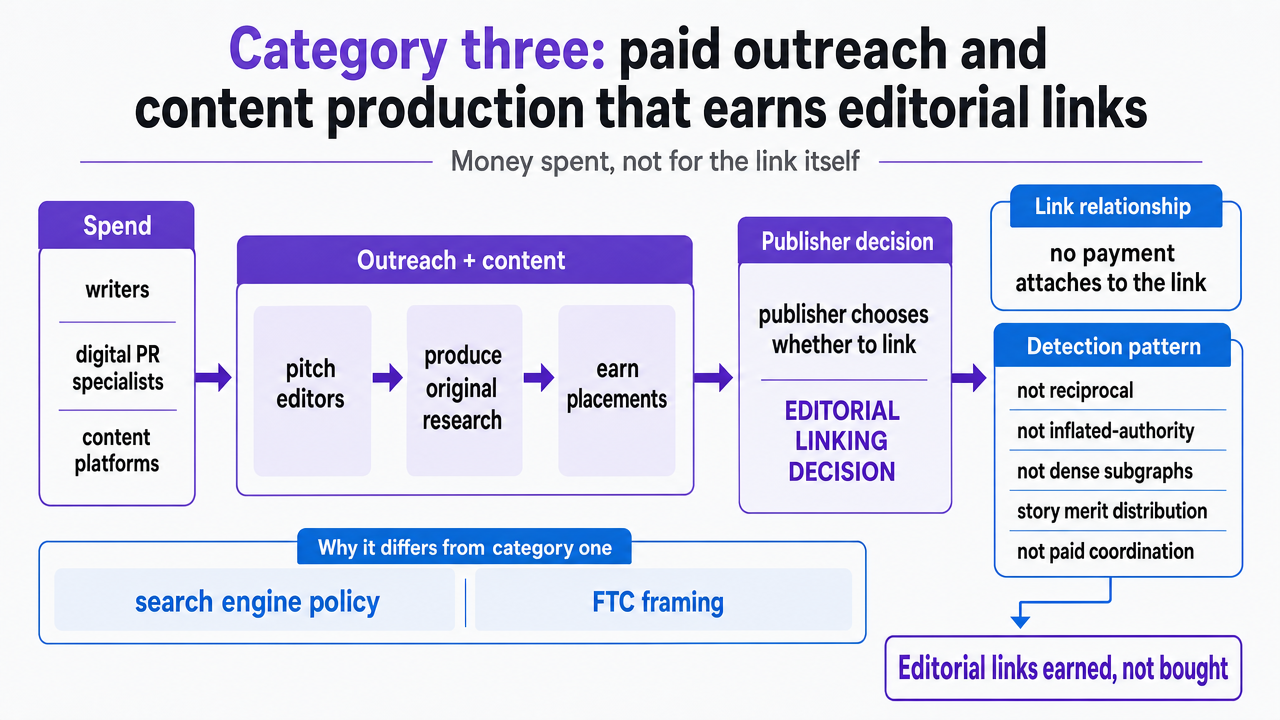 Consolidates the three link-buying categories against detection risk and disclosure obligation as introduced across section 2
How detection actually works: the graph-based research agency leads should cite internally
SpamRank and inflated-authority pages
SpamRank was designed to answer one question: which pages have accumulated PageRank that the rest of the graph does not justify? The algorithm compares a page's incoming authority against the distribution pattern of its supporters, then flags hosts whose inbound structure looks engineered rather than earned 5.
The practical implication for a paid-placement strategy is uncomfortable. A guest post network that sells followed links to fifty different buyers creates the exact signature SpamRank isolates — a set of supporter pages whose outbound linking behavior does not match the topical or authority profile of the pages they boost. The buyer does not have to know the seller's other clients for the pattern to emerge. The graph reveals it.
SpamRank's authors describe the target class directly: pages that "inflate their perceived importance" through artificial link structures 5. Agency leads reviewing a vendor pitch should read that phrase as a functional definition of the deliverable. If the seller's value proposition is that a link will lift a page's authority above what its content and organic mentions would produce, the seller is describing the SpamRank target set.
Link spam alliances and reciprocal networks
Link spam alliances are the structural version of the same problem. Gyöngyi and colleagues define them as
"groups of hosts that boost each other's rankings by placing many links among them,"
and demonstrate that link analysis can isolate these coalitions from the surrounding web graph 6. The detection does not depend on catching a transaction. It reads the shape of the linking pattern.
This matters for two paid-link archetypes agencies still encounter:
- The private blog network, where a vendor controls a set of properties and cross-links them to inflate the authority passed to paying clients.
- The reciprocal guest post arrangement, where two or more sites agree to publish and link to each other on a rolling basis.
Both create the dense, insular subgraph that alliance detection is built to find 6.
For an agency Head of SEO, the operational point is that a vendor's promise of "editorial diversity" across their network is not the same as graph diversity. If placements cluster in a subgraph that alliance detection can isolate, the client site inherits that cluster's risk regardless of how the individual articles read.
Spam mass and page farms: measuring the impact of purchased links
Spam mass reframes detection as a measurement problem. Rather than asking whether a specific link is paid, the method estimates how much of a target page's PageRank is attributable to links from suspected spam sources 10. The output is not a binary flag. It is a proportion — the share of a page's ranking signal that would disappear if the suspect supporters were discounted.
Page farms extend the analysis in the other direction. Zhou and colleagues define spamicity measures that examine the cluster of pages supporting a target and test whether that cluster looks like a natural distribution of editorial supporters or a farm assembled to boost one destination 9. The two methods together let a search engine score both ends of the transaction: the boosted page and the supporting structure.
Graph-based detection operates at web scale. One foundational study using maximal clique and min-cut methods identified roughly 0.6 million spam sites in strongly connected components around the web core 8. That figure comes from a specific academic analysis of the web graph at the time of the study, not a Google enforcement report, but it establishes that structural detection of link farms is a solved problem at scale, not an aspirational one.
Detection method to link-buying pattern: SpamRank isolates inflated-authority pages 5; link spam alliance detection isolates reciprocal networks 6; spam mass measures boosted target pages 10; page farm spamicity analyzes the supporting cluster 9. Graph-based methods have identified spam structures at web scale, including roughly 0.6 million spam sites in one large-scale study 8.
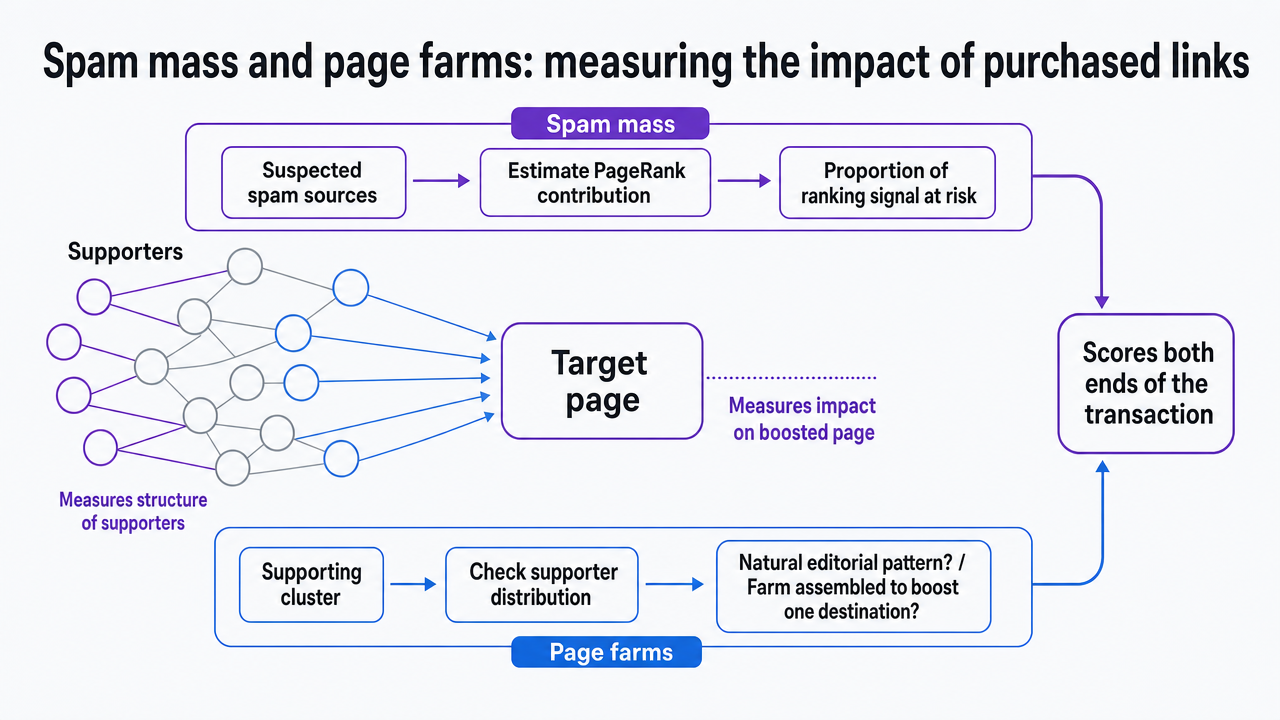 Maps each graph-based detection method to the specific link-buying pattern it targets, supporting the section's cited research walkthrough
Why 'clean-looking' paid links still register in the spam signature
The common defense from placement vendors is that their links look editorial — real sites, real writers, real traffic. That defense misreads what the detection layer measures. Spam mass does not evaluate whether an individual article reads naturally. It quantifies the proportion of a target page's PageRank drawn from sources that graph analysis has flagged, regardless of how well-written any single placement is 10.
Robust PageRank research adds another layer. The algorithm can be modified to reduce sensitivity to link-scheme exploitation through locally computable methods, meaning suspect nodes can be down-weighted without a full graph re-analysis 1. A placement can look editorial to a human reviewer and still contribute to a demoted authority score if its source cluster has been locally down-weighted.
The operational takeaway for agency policy is that vendor quality claims — "real editorial sites, no PBNs" — are not a compliance argument. They describe the surface of the placement. Detection reads the structure underneath.
Test compliant link building workflows risk-free now
Validate your link acquisition process and monitor impact with live content during your trial period.
FTC exposure: the compliance layer most SEO teams skip
Material connection and 'clear and conspicuous' disclosure
Search engine policy is one enforcement layer. FTC advertising law is another, and it applies whether or not Google ever registers the transaction. The trigger is a material connection — any payment, free product, employment relationship, or financial arrangement between the party endorsing something and the party benefiting from the endorsement. The FTC defines material connection to include personal, family, employment, and financial relationships such as payment or free products 4. If money or value changed hands to produce the placement, the material connection exists.
Once a material connection exists, disclosure becomes mandatory, and the standard is not a rel attribute buried in the HTML. The FTC requires disclosures to be clear and conspicuous — placed where a reasonable consumer will see them before engaging with the content, worded in plain language, and formatted so they are hard to miss 3. Bottom-of-page disclaimers and disclosures hidden behind expand links generally fail the standard 3.
For agency policy, the operative test is not whether the client's legal team signs off. It is whether a first-time reader would understand, before reading the article, that the piece was produced under a commercial arrangement. If the answer is no, the placement is exposed regardless of what the link attribute says.
When sponsored content becomes a deceptively formatted advertisement
The FTC's Enforcement Policy Statement on Deceptively Formatted Advertisements sets the outer boundary. An advertisement is deceptive when it misleads reasonable consumers about its nature or source, including when a party other than the sponsoring advertiser appears to be the source 7. A sponsored article written to look like independent editorial coverage, with the sponsoring brand's byline stripped and no disclosure above the fold, meets that definition even when every product claim inside the piece is factually accurate 7.
Native advertising guidance reinforces the same principle from a different angle. Native ads are deceptive if they mislead consumers about their commercial nature, and disclosures must be clear and prominent enough to correct that impression before the consumer engages 2. The framing test is net impression — what a reasonable reader takes away from the whole placement, not whether a disclosure exists somewhere on the page.
The practical consequence for an agency is that a poorly disclosed sponsored placement carries two independent liabilities: the search engine treats it as an undisclosed paid link if the rel attributes are missing, and the FTC treats it as a deceptively formatted advertisement if the labeling fails the reasonable-consumer test. Fixing one does not resolve the other.
Standardizing a link-acquisition policy for junior teams
The gap between an agency's stated link policy and what a junior link builder actually approves on a Tuesday afternoon is where manual actions get manufactured. A policy that lives in a Notion doc no one reads does not survive contact with a quota. A policy encoded as a decision the specialist has to make before authorizing spend does.
Three operational rules cover most of the exposure surface:
- No followed link may be acquired through direct payment, product exchange, or reciprocal placement — the transaction pattern that SpamRank, spam mass, and link alliance detection are built to isolate 5, 6, 10. Vendor claims about "editorial quality" or "real sites" do not override the rule, because detection reads the graph structure, not the prose 1.
- Any placement produced under a commercial arrangement carries a clear and conspicuous disclosure above the fold, in the same visual weight as the byline, plus rel="sponsored" on outbound links 3, 2.
- Paid outreach and digital PR spend is authorized only when the linking decision sits with the publisher — no guaranteed placements, no editorial control clauses.
Encoding those three rules into the intake form the specialist fills before authorizing a placement is what makes the policy operate. If a vendor cannot answer where the disclosure appears, who controls the linking decision, and whether followed links are guaranteed, the placement does not get approved.
Scale Link Acquisition Without Risking Google Penalties
Get an expert analysis of your link building approach, including risk assessment and compliance benchmarks tailored for agencies managing multiple client portfolios.
If you manage multiple client accounts: portfolio-level economics of a manual action
The audience shifts here. Single-site operators can absorb a link-scheme penalty as a bad quarter. Agency Heads of SEO running 15 to 80 accounts cannot, because the vendor list, the outreach playbook, and the placement inventory usually generalize across the portfolio. One manual action rarely arrives alone.
The exposure math has two sides that agency leadership should model in the same document. On the compliant side, authority-building has known cost inputs: outreach specialist hours, content production per asset, and digital PR retainer coverage. Those are budgetable and predictable. On the exposure side, the variables are less familiar to finance teams but sharper: retainer value at risk per affected client, the reconsideration request cycle when a manual action lands, and the algorithmic suppression tail from accumulated spam mass that persists after the offending links are removed 10.
The table below frames the two columns as variables rather than dollar figures, since retainer sizes, production rates, and PR scope vary by agency. What does not vary is which cells carry compounding risk across the portfolio.
Portfolio economics: compliant authority-building cost variables versus manual-action exposure variables. Detection mechanics from SpamRank 5, link spam alliance analysis 6, and spam mass estimation 10; disclosure exposure from FTC Native Advertising guidance 2and the Enforcement Policy Statement on Deceptively Formatted Advertisements 7.
Two compounding factors deserve separate attention. First, spam mass is a proportion, not a switch — disavowing the flagged supporters removes the links but the algorithm's estimate of the target page's inflated authority does not reset overnight 10. Recovery lags behind cleanup. Second, when a vendor is used across multiple clients, alliance detection can propagate the signal — the shared subgraph is the shared liability 6. An agency that placed the same guest post network across twelve retainers is not managing twelve independent risks. It is managing one correlated exposure with twelve billing relationships attached.
The FTC layer sits parallel to the graph layer and does not respect the same containment. A poorly disclosed sponsored placement on one client's behalf is a deceptively formatted advertisement under the same enforcement standard regardless of which retainer authorized it 2, 7. Portfolio-level policy has to price both liabilities into the same authorization workflow, not treat them as separate compliance tracks handled by different specialists.
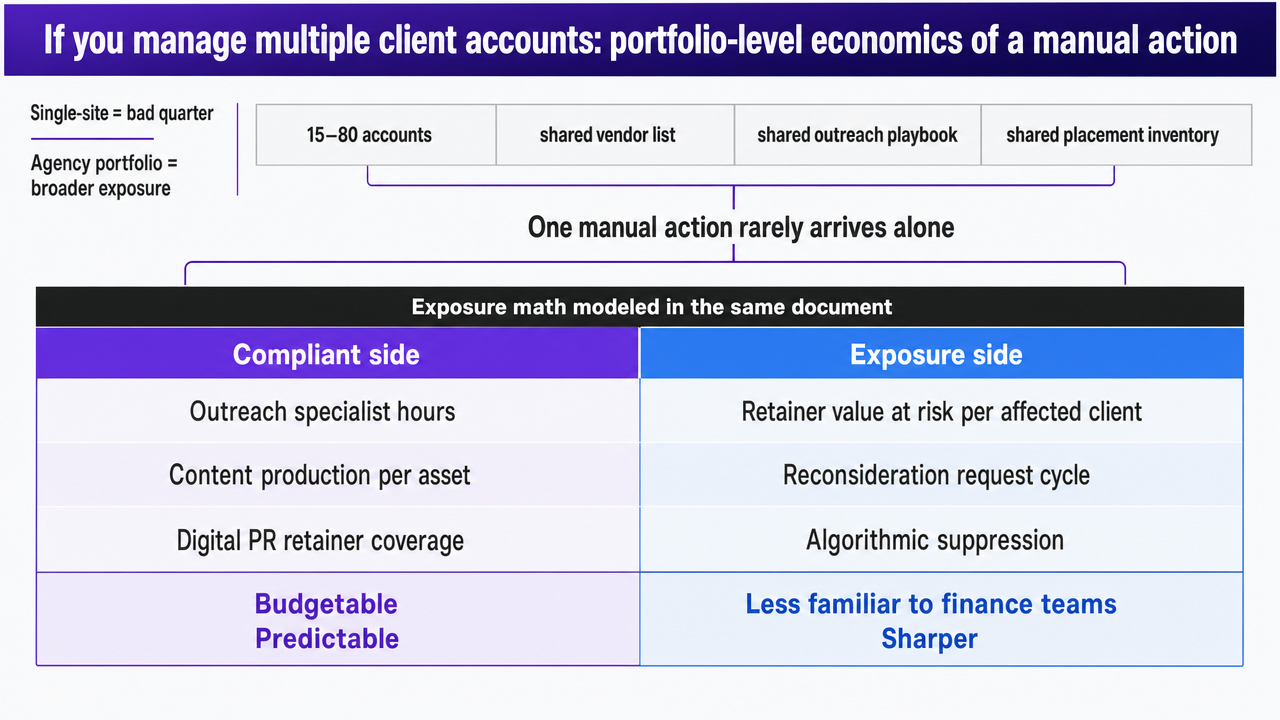 Visualizes the two-column exposure model (compliant cost variables vs manual-action exposure variables) that the section explicitly describes as a table
The scalable alternative: AI-coordinated outreach and editorial production
The third category — paid outreach and content production that earns editorial links — is operationally expensive per link because it depends on human judgment at three separate steps: which story to pitch, which publication to pitch it to, and which angle survives an editor's review. Traditional agencies solve that cost problem by hiring more specialists or by drifting back into category one when quotas tighten. Neither path scales without adding either headcount or exposure to the graph-based detection layer 5, 6.
AI-coordinated production changes the ratio between judgment work and execution work. Research synthesis, publication targeting, initial draft production, and outreach personalization are the execution layer. Story selection, editorial angle, and the final approval on what gets pitched under a client's name remain judgment work. When the execution layer is handled by coordinated AI strategists and the judgment layer stays with the specialist, one outreach lead can supervise the volume that previously required three or four. The link acquisition itself remains editorial — the publisher still decides — so the graph signature stays clean and no FTC disclosure obligation attaches 2, 7.
That is the operational premise behind platforms like Vectoron: keep every placement decision under human approval, and let the specialist strategists absorb the execution overhead that previously forced agencies to choose between hiring or cutting corners.
Frequently Asked Questions
References
- 1.Robust PageRank and Locally Computable Spam.
- 2.Native Advertising: A Guide for Businesses.
- 3.FTC’s Endorsement Guides: What People Are Asking.
- 4.Disclosures 101 for Social Media Influencers.
- 5.SpamRank – Fully Automatic Link Spam Detection.
- 6.Link Spam Alliances.
- 7.Enforcement Policy Statement on Deceptively Formatted Advertisements.
- 8.A Large-Scale Study of Link Spam Detection by Graph Algorithms.
- 9.Link spam target detection using page farms (ACM TKDD).
- 10.Link Spam Detection Based on Mass Estimation.